1. Introduction
At some point in their histories, the majority of the West Germanic languages and dialects underwent a change that has been labeled open syllable lengthening (OSL), because short vowels in stressed open syllables appear as phonetically long vowels after the change. This change was instrumental in the loss of phonetic quantity as a contrastive feature, which changed the phonological systems of these languages fundamentally (see, for example, Vennemann Reference Vennemann2000 for an overview). One curious fact about this change is that it applies with such apparent inconsistency that it has not been possible to reliably predict when a word is affected by it (see, for example, Page Reference Page, Salmons and Dubenion-Smith2007 and Becker Reference Becker2012:93). What is more, OSL has a different timing in different West Germanic languages. For example, English shows it earlier than German (in Middle English as opposed to Early Modern German), and different languages apply it more or less consistently. There is no language in which it is an exceptionless sound change; some languages do not display it at all, such as some Alemannic dialects (see, for example, Winteler Reference Winteler1876), and in some cases it applies to less than 50% of relevant cases, as, for example, in English (Fikkert et al. Reference Fikkert, Dresher, Lahiri, van Kemenade and Los2006).
The descriptive problem can be illustrated with English cradle and saddle, which go back to phonologically equivalent structures as far as the relevant criteria are concerned: Old English sadol and cradol both contain an open stressed syllable followed by a voiced alveolar stop which starts an identical second syllable. However, the words behave differently with respect to OSL, which they should both be subject to on the basis of their phonological structures. The first is affected, while the second is not. Across dialects, different treatments of the same word can be observed: For instance, water shows OSL in Standard English (/wɔː.tə/) but not in many dialects, for example, South Yorkshire English as spoken traditionally in Sheffield (/waṭə/).Footnote 1
This is sufficient to demonstrate that so-called Open Syllable Lengthening has remained descriptively elusive under the standard account, which tries to capture it as a sound change of the Neogrammarian type. No conditioning factors have been identified that would permit a reliable prediction of when it applies and when it does not. Perhaps even more importantly, it is presently unclear why there is so little uniformity across the West Germanic languages that undergo OSL with respect to the degree of its implementation, which, in some cases, is lower than 50%.
However, much points to the fact that OSL is precisely not a classical sound change, but an epiphenomenon of a prosodic change occurring in the transition from one phonological system to another (see especially Vennemann Reference Vennemann2000:268–272 for details). What is more, it has often been overlooked that there is in fact a complementary change that could be called open syllable closure (OSC). This change is such that in cases where OSL does not occur, the stressed syllable becomes closed by attracting the following consonant ambisyllabically, while maintaining a phonetically short vowel (see, for example, Becker Reference Becker2002:48).Footnote 2 There is good evidence for this closure in the languages concerned, as two examples demonstrate. First, through its meter, the 12th-century English text The Orrmulum shows unequivocally that nonetymological double consonant graphs add weight to the syllable, and in the case of formerly open syllables, such as <irrene> ‘of iron’ (Old English īrene-), this clearly demonstrates that the syllable is closed (see Murray Reference Murray2000, Mailhammer Reference Mailhammer, Cain and Russom2007:41–42, Reference Mailhammer2009:268–269 for further details). Second, as is well known, stressed syllables with short vowels must be closed in Modern German. For Modern German words that go back to a long, stressed vowel in an open syllable in Middle High German (last stage before OSL), like Jammer ‘sorrow’ (MHG jâmer), this suggests that the syllable was closed when the vowel was phonetically shortened, and in the case of Gatte ‘husband’ (MHG gate), the syllable was closed while the vowel remained phonetically short (see Reis Reference Reis1974:125–127 for the data and Vennemann Reference Vennemann2000:264, 269 for discussion).
One effect of OSL and its complementary counterpart, OSC, in West Germanic is that all stressed open syllables with phonetically short vowels were eliminated from the phonological system. As a result, after OSL/OSC, phonetically short stressed vowels can only occur in closed syllables. There is, in fact, a constraint disallowing stressed CV syllables in all West Germanic languages after OSL/OSC (see, for example, Murray Reference Murray2000 for English, Vennemann Reference Vennemann, Bertinetto, Kenstowicz and Loporcaro1991 for Modern German, and Becker 2002 for Middle Low German). OSL and OSC are thus different ways to implement this new constraint against stressed CV syllables, that is, two different paths to achieve the same goal, which is to eliminate stressed open syllables with short vowels. Which of the two applies cannot be fully predicted, although there are tendencies (see Mailhammer Reference Mailhammer2009:265–266). This may have to do with the fact that OSL/OSC are, in this case, changes triggered by a prosodic change, which itself is completely regular (new constraint: no stressed CV syllables; see, for example, Becker Reference Becker2002:48 and especially Page Reference B. Richard1999, Reference Page, Salmons and Dubenion-Smith2007), or it may be that the ultimate conditioning factor(s) have not yet been found.Footnote 3
The point of this discussion so far has been to show that OSL is one of two complementarily distributed changes in reaction to a new prosodic constraint banning stressed open syllables with short vowels. Trying to predict the occurrence of OSL and OSC on the level of the individual word has so far been a dead end, and it may well be impossible to go beyond probabilities (see Mailhammer Reference Mailhammer, Cain and Russom2013:8–9). However, the distribution of OSL and OSC is not random within any one West Germanic language: No language exhibits a 50:50 split. Neither is it random across languages: Significantly more languages apply OSL in more than 50% of the cases than in less than 50% (see section 2 below). This seems to have gone unnoticed or perhaps was deemed insignificant in much of previous work on OSL in West Germanic, although, in our view, it calls for an explanation. That languages can differ as to how they divvy up the application of OSL and OSC was actually noticed in the context of the syllable cut model (Restle Reference Restle2003:140), which also forms the theoretical background of this study, although the theory itself does not impact on the analysis presented in this paper (see section 2 for more details).
Working within a syllable cut model, Mailhammer (Reference Mailhammer2009) introduces a new factor to account for the typological classification of languages that underwent OSL and/or OSC triggered by a prosodic change as either OSL-prominent or OSC-prominent (terms adapted from Restle Reference Restle2003:140). He suggests that whether languages belong to one or the other type is influenced by the number of available open syllables with long vowels and syllables with short vowels that are closed by geminates, that is, prototypically smoothly- and abruptly-cut syllables in a syllable cut system. Although he does not explicitly say so, it appears that this hypothesis is motivated by cases like the ones discussed in Bybee Reference Bybee2001:93–95, which “show that it is possible for a phonological generalization to arise from frequency distributions in the lexicon” (Bybee Reference Bybee2001:94). Mailhammer (Reference Mailhammer2009) discusses some limited quantitative data from Old English showing that 15% (273) of the words in the corpus possess a stressed syllable with a short vowel and a closing geminate consonant. However, there are no quantitative data for open syllables with long vowels or for any of the languages compared, that is, Latin and German. Therefore, any conclusions are very tentative.
This paper aims at testing a more developed version of the hypothesis outlined in Mailhammer Reference Mailhammer2009 because frequency effects do occur in phonological change and could hence be a factor in the implementation of syllable cut. Type frequency is clearly a factor in the productivity of patterns in phonology as well (Bybee Reference Bybee2001:93–95), and especially in light of syllable cut theory (compare section 2). Thus, it can be argued that OSL and OSC are, in fact, patterns of adaptation to a new prosodic system.
We investigated whether the preference type (OSL versus OSC) of a language correlates with the numerical relationship of available target syllables (open syllables with long vowels or closed syllables with short vowels). Using corpora of four West Germanic languages at the stage before the loss of phonological quantity—Old English, Old Frisian, Old Saxon, and Middle High German—we calculated the ratio of closed syllables with short vowel to open syllables with long vowel. We then compared this ratio to the known preference for one or the other strategy (prominence type). The result is a robust and statistically significant correlation: The higher the ratio, the more likely a language is to close syllables maintaining a phonetically short vowel, that is, to prefer OSC. Old English exhibits the highest ratio and disprefers OSL. We take this result to indicate that analogical processes shaped how phonological quantity was lost in these West Germanic languages with implications for phonological change more generally.
The paper is organized as follows: Section 2 provides a more in-depth description of the topics of quantity breakdown and syllable cut phenomena to serve as groundwork for the quantitative study. Section 3 lays out our initial hypotheses and predictions, while section 4 introduces the quantitative study with some general remarks on the data sources and methodology used. Sections 5 through 8 present the data gathered from our analysis of comparable dictionaries of Old English, Old Frisian, Old Saxon, and Middle High German, with some remarks highlighting aspects of the results. Section 9 contains a detailed discussion of the results, while section 10 provides the conclusions made with respect to our hypotheses, along with suggestions for future research.
2. Quantity Breakdown and Syllable Cut
Section 1 established the following three points. First, OSL and OSC are complementarily distributed changes that are reactions to a fundamental change in the phonological system in which segmental quantity loses its status as an independently contrastive feature and becomes dependent on prosodic properties, especially an interrelation of segmental and structural properties. Second, under the new system, stressed open syllables with a short vowel are no longer permitted, and consequently, the relevant languages eliminate this type of syllable either by phonetically lengthening the vowel (OSL) or by closing the CV syllable with the onset consonant of the following syllable (OSC). Third, in this process, languages show a preference for one strategy over the other to the point of using only one of these methods. This preference permits their categorization into OSL- and OSC-prominent languages.
The main purpose of this section is to explain why OSL is the unmarked case in the establishment of the new prosodic contrast. The answer we argue for is that, in the implementation of a syllable cut prosody (the new phonological type), structural features outrank segmental features, that is, an open syllable preferably assumes smooth rather than abrupt cut. This sets the scene for the interpretation of the results further below and explains why OSL appears to be such a frequent change. Note, however, that as our explanation of the prominence types is based on frequency effects, it is not contingent on syllable cut theory. Syllable cut theory merely provides a theoretical context for the interpretation of our results, and it motivates the occurrence of OSL and OSC within a coherent framework.
In order to account for the apparent frequency of OSL, we must first explain what syllable cut is, because it provides the theoretical underpinning for this argument. Syllable cut describes a situation in which the phonetic properties of segments (vowels, consonants) correlate systematically with prosodic features, such as syllable structure.Footnote 4 Interactions between prosody/structure and segmental properties are common. For example, stressed vowels are generally phonetically longer than unstressed vowels, but in languages best describable with the syllable cut model, this interaction is used to form a phonological contrast that is prosodically determined. Thus, the relevant languages have contrasts that involve segmental as well as specific prosodic (suprasegmental) contrasts, especially syllable structure and stress. Languages that display such a configuration are called syllable cut languages.
An example is Modern Standard German (henceforth German). The contrast between, for instance, Miete [miːthə] ‘rent’ and Mitte [mɪthə] ‘middle’ exists on the level of the segment (long, tense vowel [iː] versus short, lax vowel [ɪ]), but also on the level of the syllable (open versus closed /mi.tə/ versus /mɪṭə/).Footnote 5 A description can, of course, focus only on the segmental contrast and maintain that German has an opposition of long/tense versus short/lax vowels and hence two groups of stressed syllables that are characterized in terms of this opposition. However, such an account neither captures nor explains the curious fact that the stressed vowel /ɪ/ in Mitte, and in fact all stressed short, lax vowels, can only ever occur in a closed syllable, and that replacing the vowel /i/ in Miete with the /ɪ/ in Mitte automatically induces syllable closure. In fact, the stressed syllables of German can be divided into two groups depending on whether they have a long, tense or a short, lax vowel, but this does not answer the question of why the short/lax set is restricted to closed syllables. What the syllable cut model does is to correlate the structural and the segmental features. The characteristic feature of syllable cut languages is that the syllables of a prosodically definable group of syllables (usually the stressed syllables) can be divided into two groups, which are characterized by different constellations of segmental and structural properties. These constellations are not random, but they form two different sets of segmental and structural features.
Using German as an example once more, the syllable cut model views the short/lax vowel in connection with the closed syllables as one set of features and contrasts it with the other group of syllables, whose features also form one set. Under this model, the stressed syllables of German are grouped into syllables with long, tense vowels, which may be open or closed, versus syllables with short, lax vowels, which may only be closed. Where syllable cut as a prosodic account goes beyond a segment-driven account is in its ability to motivate the properties of these assumed sets; that is, the syllable cut model can explain why lax/short stressed vowels are restricted to closed syllables, and it does not have to accept such restrictions without being able to motivate them (see in particular Vennemann Reference Vennemann, Bertinetto, Kenstowicz and Loporcaro1991 for further discussion on the syllable cut model versus segment-based accounts).
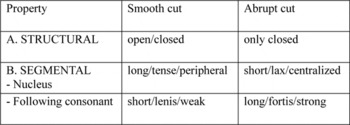
As mentioned above, in languages with a syllable cut prosody, the properties of segments and prosodic features are not independent but interdependent, which means that they systematically co-occur. Syllable cut languages align the segmental properties and the structural properties in two different sets, traditionally called smooth cut and abrupt cut (see Sievers Reference Sievers1901; Vennemann Reference Vennemann, Bertinetto, Kenstowicz and Loporcaro1991, Reference Vennemann2000).Footnote 6Table 1 summarizes the characteristics of these two sets (from Mailhammer Reference Mailhammer2009:263).
Structural and segmental properties of smoothly- and abruptly-cut syllables.

Table 1 reads as follows: If a syllable is smoothly cut, it may be open or closed; its vowel will be phonetically long and/or tense and/or peripheral, and coda consonant(s) will be short and/or lenis/weak. Conversely, if a syllable is abruptly cut, it will be closed, its vowel will be phonetically short and/or lax and/or nonperipheral, and the coda consonant(s) will be long and/or fortis/strong.
It is important to emphasize, however, that not all correlates need be present at once. It is enough if one correlate per cell is present. That is, it may be that some abruptly-cut syllables are closed by phonetically long consonants or by fortis consonants, or some open syllables are open and some are closed. The reason for this is that the correlates in each cell represent the same feature that is at the heart of a syllable cut prosody and which comes out best in alternative terms for syllable cut prosody, namely coupling prosody (Anschlussprosodie; see, for example, Trubetzkoy Reference Trubetzkoy1939) or coupling correlation (Restle Reference Restle2003). These terms capture whether vowels and successive consonants are more or less tightly coupled. Simplified, loose coupling—which equals smooth cut—means that a following consonant is less closely connected, and tight coupling—which equals abrupt cut—means that the following consonant is more tightly connected.
In syllable cut languages, these contrasts with respect to coupling manifest themselves in the way vowels and consonants can be manipulated phonetically. The vowels in smoothly-cut syllables are much more variable in their phonetic duration if manipulated than vowels in abruptly-cut syllables, and the converse is true for consonants (phonetic variability under abrupt cut but not under smooth cut; see especially Hoole et al. Reference Hoole, Mooshammer and Tillmann1994 and Kroos Reference Kroos1996; see also Restle Reference Restle2003:63–66 for discussion). Intuitively, this is obvious to a native speaker of German: While the stressed vowel in Koma /ko.ma/ ‘coma’ can be phonetically lengthened, the vowel in Komma /kɔṂa/ ‘comma’ cannot. Conversely, while the m in Koma cannot be lengthened, this is unproblematic for the m in Komma (Restle Reference Restle2003:66–67, Becker Reference Becker2012:95). The other corre-lates—tense/lax and peripheral/nonperipheral for vowels and fortis/ strong and lenis/weak for consonants—align naturally with this (Vennemann Reference Vennemann, Bertinetto, Kenstowicz and Loporcaro1991:233–234). In terms of markedness, smooth cut is the unmarked type, being less restrictive in terms of its permitted configurations (see Trubetzkoy Reference Trubetzkoy1939).
These contrasts can be seen, for example, in German Beet /bet/ ‘flower bed’ (smooth cut; long, peripheral V; fortis C) versus Bett /bɛt/ ‘bed’ (abrupt cut; short, central V; fortis C; Becker Reference Becker1998:79–81), where both smoothly- and abruptly-cut syllables are structurally closed and are distinguished on the basis of other segmental properties, such as length and peripherality/centrality of V (although the smoothly-cut syllable contains a fortis C). Even more clear-cut is a pair such as German beten ‘pray’ versus betten ‘lay down’, where the initial stressed syllable of beten has a long, peripheral nucleus, is open and followed by a fortis consonant (/'be.tən/, CVː.CVC). In contrast, the initial stressed syllable of betten has a short, more centralized nucleus and is structurally closed (/'bɛṭən/, CVC̣VC), although it is again followed by a fortis consonant.
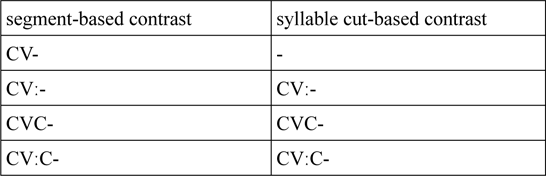
One consequence of the alignment patterns set out in table 1 is that languages with a fully-fledged syllable cut prosody generally do not have open syllables with short/lax/nonperipheral vowels as members of the prosodically defined class of syllables with a syllable cut contrast. This class usually comprises the stressed syllables rather than unstressed syllables. Therefore, we assume this as the default prosodically-defined class of syllables, and if nothing else is mentioned, we take syllable cut to operate in stressed syllables only, which is the case for West Germanic languages anyway, in order to avoid unwieldy formulations of generalizations (see Restle Reference Restle2003:138–140 for further details). This means that syllable cut languages generally have fewer syllable types in the domain of the syllable cut contrast than languages with a segment-based contrast.Footnote 7 This is illustrated in table 2 adapted from Mailhammer Reference Mailhammer2009:264.
Syllable types in systems with segment-based versus syllable cut-based contrast.
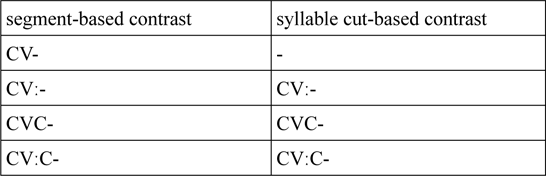
It is now evident why one consequence of a syllable cut prosody is that segmental properties are no longer independently distinctive but codependent on syllable structure: If a vowel is phonetically short, this automatically entails that it is in a closed syllable, and if it is long, then a coda consonant cannot be phonetically long. Syllable cut thus represents a special configuration in which the segmental properties of vowels and consonants are prosodically determined. Note that this is not the same as saying a language has no contrast in segmental properties at all: The segments and their properties are contrastive, but only as a concomitant of a prosodic opposition that also involves syllable structure (and stress). This explains the restrictions imposed on permissible syllable types. By contrast, in systems with a segment-based opposition, such prosodically-imposed restrictions are not necessary, although they may occur.
The development of a syllable cut contrast out of a segment-based system, such as quantity, is a fundamental, systemic change that goes beyond the loss of independence of segmental properties as contrastive features. This development also means that the definition of syllable weight is rewritten because phonetic length is no longer a factor in determining syllable weight, which is in turn connected to the stress system (see in particular Vennemann Reference Vennemann and Fix1995). However, the most visible change in the implementation of a syllable cut prosody is that the inventory of syllable types moves toward the alignment of segmental and structural properties shown in table 1.
Previous work has identified the general way a syllable cut prosody originates and how it is implemented (see especially Mailhammer Reference Mailhammer2009). What is relevant for the purposes of this paper is that one can predict not only the elimination of open (stressed) syllables with short vowels, but also the way it happens. That the process of establishing a syllable cut prosody entails the loss of CV syllables in the syllable cut domain follows from the ban on such syllables in syllable cut languages. The means by which CV syllables disappear is also evident: They are assigned either smooth or abrupt cut. It is furthermore apparent that the correlates of the different types of cut specified in table 1 give conflicting cues as to which type of cut is to be assigned. That the syllable is open is compatible only with smooth cut, and this seems indeed to be the preferred assignment, expressed in Vennemann's (Reference Vennemann2000:262) correlation default (see also Mailhammer Reference Mailhammer2009 for further details):
correlation default: Everything else being equal, the preferred correlation of syllable structure and syllable cut is: smooth cut in open syllables, abrupt cut in closed syllables.
(Vennemann Reference Vennemann2000:262)
The natural consequence is that the nucleus is lengthened phonetically (OSL). However, the short vowel is a cue for abrupt cut. If there are more such cues, for instance, a following strong consonant such as a voiceless stop (see, among others, Vennemann Reference Vennemann1988 on the concept of consonantal strength), then it is quite possible that a syllable assumes abrupt cut with resulting closure (OSC). Vennemann (Reference Vennemann2000:262) explains this as follows (similarly in Vennemann Reference Vennemann, Bertinetto, Kenstowicz and Loporcaro1991:234):
But everything else is rarely equal. Thus, there are deviations in both directions. They follow from the very way the syllable cuts are produced. In order to achieve abrupt cut, a consonant is needed […]. Such a consonant is the more suited to serve this purpose the more consonant-like it is—the stronger, in terms of hierarchies of consonantal strength. The more vowel-like—the weaker—the consonant is, the less suited it is for producing abrupt cut.
(Vennemann Reference Vennemann2000:262)
Thus, the syllable cut model provides a functional motivation for the ban against stressed open syllables with short vowels in West Germanic languages after OSL; it can predict the two ways these syllables are eliminated, and it can elucidate why the occurrence of those two changes or the allocation of the type of cut is not random and perhaps not one hundred percent predictable. It can also explain why the transition to smooth cut (OSL) is more frequent: Smooth cut is the unmarked member of the opposition because the structural cue is the strongest predictor in general (Mailhammer Reference Mailhammer2009:278). What remains to be explained—apart from the prediction of individual cases—is why languages lean toward one or the other way to eliminate CV syllables, particularly why languages would prefer the implementation of the marked member of the opposition, that is, abrupt cut, as a general solution.
3. Research Questions and Hypotheses
The research question this study investigates is whether the prominence type of a language in the implementation of a syllable cut prosody can be predicted from type frequency ratios of syllable types. This section explains the basis of the hypotheses tested in this study. We posit that type frequency could have influenced whether the languages in the sample eliminate stressed open syllables with a short vowel predominantly by OSL or by OSC, that is, if they are “smooth-cut prominent” (OSL-prominent) or “abrupt-cut prominent” (OSC-prominent). We hypothesize that a higher type frequency of open syllables with long vowels (smoothly-cut syllables) compared to that of closed syllables with short vowels (abruptly-cut syllables) correlates with smooth-cut prominence (hypothesis 1; H1). Conversely, if the type frequency of closed syllables with short vowels is higher than that of open syllables with long vowels, this correlates with abrupt-cut prominence (hypothesis 2; H2). The null hypothesis is that there is no correlation between frequency of syllable types and prominence type. There are two main reasons leading us to these hypotheses.
First, we find it unlikely that a traditional conditioning factor, such as the structure of the syllable or the properties of individual segments, or a combination of these factors, can reliably predict the cut assignment either for individual cases or in terms of the prominence type of a language. Previous work has identified factors that influence the assignment of cut-type in the transition from a segment-based contrast to a syllable cut prosody. Apart from the syllable type and the quantity of the vowel, the quality of the vowel (for example, Vennemann Reference Vennemann2000:270) and the properties of the following consonant (see, among others, Reis Reference Reis1974 for German and Hebda 2002 for English) also play a role. However, so far it has been impossible to connect any one factor or a combination of factors to whether a stressed CV syllable receives smooth or abrupt cut, that is, OSL or OSC (see Reis Reference Reis1974:125–127 for a list of exceptions to such generalizations in German). Reis (Reference Reis1974) conducted a comprehensive investigation on OSL and OSC in German showing that rules based on segmental properties alone cannot account for the data. Reis (Reference Reis1974:236) explicitly concludes that coupling relations, that is, syllable structure and segmental properties, especially following consonants, must be seen as the decisive factors. However, her solution is weakened by the unwarranted assumption of originally specific allophonic tense and lax realizations of vowels, which may decide the assignment of cut (for instance, in the case of German Titel ‘title’ < Middle High German titel, which fails to assume abrupt cut as otherwise predicted; see data in Reis Reference Reis1974:125–127 and in particular the discussion on pages 232–235). Therefore, it is unlikely that these factors will be helpful in identifying the general preference of cut assignment in any given language.
Second, as OSL and OSC are not sound changes in the classical sense, but rather two complementarily distributed patterns of change implementing a new prosodic constraint, it is possible that type-frequency can exert an influence on which pattern is more “productive”, that is, which pattern occurs more frequently. This is very similar to the cases of “phonotactic generalization” that Bybee (Reference Bybee2001:93–95) discusses, from which she concludes: “These examples show that it is possible for a phonological generalization to arise from frequency distributions in the lexicon rather than from pure coarticulation effects” (94–95).
This can be applied to the assignment of syllable cut (or the occurrence of OSL/OSC, in traditional terms) in the following way. The more frequent pattern—“smoothing” or “abrupting”—could correlate with a higher frequency of the target syllables before the implementation of syllable cut: open syllables with a long vowel in the case of smooth cut and closed syllables with a short vowel in the case of abrupt cut. The reason is that the phonological generalization, that is, the pattern employed to eliminate CV syllables—like a morphological pattern or rule—could be fueled by analogically extending type-frequent patterns in the sense of Bybee Reference Bybee2001:93–95 (see also Fertig Reference Fertig2012:113).
4. Data and Method: General Remarks
This section describes the methodology and data used to investigate the hypothesis presented in section 3 above. The first task is to select an appropriate data sample. There are theoretical and practical considerations driving the selection. First, our interest in West Germanic suggests examining corpora of West Germanic languages at the stage immediately preceding the establishment of a syllable cut prosody. Second, as mentioned in section 1 above, not all West Germanic languages and dialects develop a syllable cut contrast. Third, not all languages in question have either electronically processable data or sufficient and reliable information on the prominence type. In addition, one of the key points about this study is comparability. If our hypothesis that there is a correlation between prominence type and relative frequency of prototypically abruptly- or prototypically smoothly-cut syllables is to be verified, it is paramount that the data used are comparable. Given the vast differences in size and availability of text corpora for the languages under investigation, it seemed preferable to focus on type rather than token frequency to ensure comparability. Furthermore, type and token frequency have different frequency effects. This is especially relevant in this case, as we are investigating the productivity of a pattern, and this is precisely where type frequency plays a greater role (Bybee Reference Bybee2001:13 et passim).
Thus, we aimed to find reliable dictionaries that were comparable in their compositional principles. There are vast differences between the canonical dictionaries of the Germanic languages in terms of completeness, principles, size, and accuracy. Not all dictionaries have current updates and hence reflect different stages of scholarship. As a result, our search for suitable corpora was led by the property of comparability. For West Germanic, we chose a group of dictionaries authored by Gerhard Köbler (Reference Köbler2000, Reference Köbler2003a, Reference Köbler2003b, Reference Köbler2007). Even though they do not belong to the canonical dictionaries, these dictionaries have a sufficiently high linguistic and philological standard and are based on established and reliable dictionaries. This was confirmed with spot checks of a number of entries for each language against canonical dictionaries. The sample thus comprises electronic dictionaries for Middle High German, Old Saxon, Old Frisian and Old English, as these languages fit the requirements of the sample outlined above. For all four languages we have reliable information on the prominence type, and they all reflect the stage immediately prior to the establishment of a syllable cut prosody, and the data available are electronically processable.
Investigating our research question and testing our hypotheses involves two tasks. First, the prominence type of each language has to be established. This is done on the basis of existing work, as described in sections 5 through 8. Second, for each language the syllable types have to be quantified. For practical reasons we counted citation forms only. We are aware of the fact that the assignment of cut was probably initially potentially different for the citation form as opposed to other cells of the relevant paradigm, for example, Middle High German tac /tak/ ‘day(nom.sg.)’ versus ta.ges /ta.ɡəs/ ‘day(gen.sg.)’, and often the assignment went by the properties of the inflected forms, compare, for example, German Tag /tɑg/ ‘day’ with smooth cut. Thus, it could be argued that counting only the citation form may yield a systematic bias toward one syllable type. We do not think that this is a likely risk, as we applied the same method to all languages in the sample. As long as there is no reason to assume that in a subset of languages one type is systematically more frequent, this risk is perhaps negligible.
In addition, counting inflected forms only may not be seen as an accurate reflection of reality, since the inflected forms did exist and may presumably have been target forms. Consequently, our sample could be seen as skewed or as incomplete. Again, we believe that applying the same method to all languages ensures the same skewing in all languages. As for the issue of completeness, we are sure that we are missing data; our corpus is a sample, although, judging from the number of words it has, we think it is representative.
Our general method was to import the relevant dictionary as text into a spreadsheet so that each letter or letter-combination representing a phoneme was contained in a separate cell. Using logical functions, we were then able to label individual phonemes as C (consonant), V (short vowel), and Vː (long vowel), after which it was possible to calculate the syllable structure of each individual entry. Syllabification rules were generated reflecting accepted syllabification patterns for each language, and as a result, we were also able to label individual syllables as open or closed. The combination of these segmental (C/V/Vː) and structural (open/closed) properties of syllables were then automatically calculated and input into a table.
Sections 5 through 8 below are organized as follows. Each section begins with a brief discussion of previous research establishing the prominence type of the language under examination (Old English, Old Frisian, Old Saxon, Middle High German), along with our subsequent expectations with respect to the data. The following subsection presents the data source itself and our methodology of syllabification, together with a short description of the size and scope of each dictionary used, concluding with the results of the corpus-study, compiled in a table. A larger table combining the data from all of the languages examined can be found at the beginning of section 9, prefacing a full discussion of the results.
5. Syllable Cut in English: Abrupt-Cut Prominence
This section first establishes the prominence type of English in the implementation of syllable cut during the transition from Old to Middle English and then presents the results of the quantitative investigation of syllable types in Old English. Middle English is a full syllable cut language, exhibiting all key properties, including no stressed short vowels in open syllables (Murray Reference Murray2000:618). The transition starts in Old English and is still ongoing at the time of the Orrmulum, which nevertheless shows that a phonological contrast between abruptly- and smoothly-cut syllables had already been established (Murray Reference Murray2000, Mailhammer Reference Mailhammer, Cain and Russom2007, Reference Mailhammer2009). Other manuscript evidence corroborates this development (Murray Reference Murray2002). Chronologically, English starts implementing a syllable cut prosody by establishing a group of prototypical abruptly-cut syllables, by regularly shortening vowels before geminates and by then systematically moving the rest of the system in line, so that closed syllables, especially if they are multiply closed, exhibit a preference for short vowels, that is, abrupt cut (Mailhammer Reference Mailhammer2009).
The Orrmulum contains ample evidence for syllable closure and even shortening of long vowels that testify to this preference (Mailhammer Reference Mailhammer, Cain and Russom2007, Reference Mailhammer2009:268–269). Conversely, the other strategy to eliminate light syllables, namely, segmental adjustment, is consistent and early only for high vowels and seems to have occurred in less than 50% of the cases (Fikkert et al. Reference Fikkert, Dresher, Lahiri, van Kemenade and Los2006:143). Apart from segmental properties, such as the nature of the following consonant or the quality of the vowel (Vennemann Reference Vennemann, Bertinetto, Kenstowicz and Loporcaro1991, Reference Vennemann2000), Mailhammer (Reference Mailhammer2009:272–273) hypothesized that the number of available open and closed syllables could be a factor in the implementation of syllable cut. For Old English, the figures seemed suggestive, but they were not based on the entire lexicon, and the interpretation was not rigorously quantitative. Consequently, English is reinvestigated here in order to verify these preliminary results and in order to compare them with the results from other languages. Our hypothesis is that Old English will display a slight bias toward closed syllables with short vowels (and short syllables closed by geminates in particular) as opposed to open syllables with long vowels.
The current version of the Old English dictionary used is the second edition and dates from 2003 (Köbler Reference Köbler2003a). It incorporates all relevant lexicographic sources of Old English. The dictionary contains 25,068 entries. This includes prefixes as individual entries, but given the statistically insignificant number of these, they were not filtered out beforehand. Rules for syllabification follow the standard view on syllabification in Old English with combinations of obstruents and liquids typically tautosyllabified, especially if the second element is /r/ (Lutz Reference Lutz1986:200).
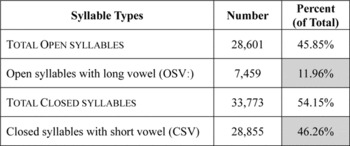
The total number of Old English syllables investigated is 62,374. Table 3 shows the distribution of long open syllables (OSVː) and short closed syllables (CSV) across the Old English lexicon.
Results from the dictionary of Old English.

The relevant figures have been shaded in the table: The overall percentages of OSVː and CSV syllables are 11.96% and 46.26%, respectively. This results in a ratio of 3.86 to 1 in favor of short closed syllables.
6. Syllable Cut in Old Frisian: Smooth-Cut Prominence
This section first establishes the prominence type of Frisian in the implementation of syllable cut during the transition from Old Frisian and then presents the results of the quantitative investigation of syllable types in Old Frisian. Current observations suggest that Old Frisian moved toward smooth-cut prominence throughout the progression of quantity breakdown. Hofmann (Reference Hofmann1989), for example, observes that OSL is predominant in later stages of Old Frisian. Additionally, consistent lengthening of high and back vowels is attested, while, in contrast, mid-front vowels generally remained short (Bremmer Reference Bremmer2009:116). Thus, in accordance with the pattern of syllable cut development, segmental length oppositions were ultimately lost once vowel and consonant length became predictable from syllable structure (Sjölin Reference Sjölin1969:29–30). These observations combined provide a basis for categorizing Old Frisian as being on track to becoming a smooth-cut prominent language. With regard to the data from Old Frisian, we therefore expect to observe a bias toward open syllables with long vowels.
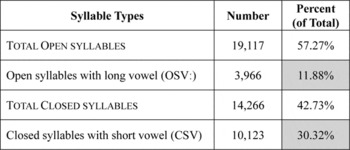
The dictionary of Old Frisian examined draws on established lexicographic sources for Old Frisian. It is the second edition, dating from 2003 (Köbler Reference Köbler2003b). The Old Frisian dictionary is comprised of 12,522 entries, including a statistically negligible number of prefixes. These entries break down into a total of 33,383 syllables. The syllabification of words in the spreadsheet accords with standard perspectives on syllable division and includes tautosyllabification of consonant clusters containing obstruents and liquids (as in Old English and Old Saxon). Table 4 shows the distribution of OSVː and CSV types across the Old Frisian lexicon.
Results from the dictionary of Old Frisian.

The relevant figures have been shaded in the table: The overall percentages of OSVː and CSV syllables are 11.88% and 30.32%, respectively. This results in a ratio of 2.55 to 1 in favor of short closed syllables, a ratio which is smaller than the ratio in Old English.
7. Syllable Cut in Low German: Smooth-Cut Prominence
This section first establishes the prominence type of Low German in the implementation of syllable cut during the transition from Old Saxon and then presents the results of the quantitative investigation of syllable types in Old Saxon. Similarly to Middle English, Middle Low German exhibits all the properties of a syllable cut language (Becker Reference Becker2002). In contrast to all other Germanic languages, however, Old Saxon already shows signs of a more progressive stage of implementation. Lengthening of /a/ and /o/ in open syllables appears to have occurred fairly regularly (Gallée Reference Gallé1993:16, 20). Middle Low German is fairly consistently smooth-cut prominent, but exceptions are not exactly rare (Becker Reference Becker2002:49). In addition, Lasch (Reference Lasch1914:35–38) primarily emphasizes processes of vowel lengthening, including OSL, but does not note processes of syllable closure (OSC). The hypothesis for Old Saxon is therefore that we should find a bias in favor of open syllables with long vowels, similar to Old Frisian.
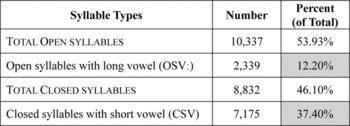
The dictionary used is the third edition, dating from 2000 (Köbler Reference Köbler2000). It comprises 7,925 entries, which break down into a total number of 19,169 syllables. Rules for syllabification follow the standard views. As in the data for Old English, clusters of obstruents and liquids have been tautosyllabified. Table 5 shows the distribution of OSVː and CSV types across the Old Saxon lexicon.
Results from the dictionary of Old Saxon.

The relevant figures have been shaded in the table: The overall percentages of OSVː and CSV syllables are 12.20% and 37.40%, respectively. This results in a ratio of 3.07 to 1 in favor of short closed syllables. This ratio is higher than in Old Frisian, but still lower than the ratio in Old English.
8. Syllable Cut in High German: Smooth-Cut Prominence
This section first establishes the prominence type of High German in the implementation of syllable cut during the transition from Middle High German and then presents the results of the quantitative investigation of syllable types in Middle High German. Modern Standard German exhibits all the pertinent features of syllable cut prosody as a result of the progression of quantity breakdown, which appears to have begun in earnest during the later stages of Middle High German. Von Reference Von KienleKienle (1969:37) observes the process of OSL as occurring around the 13th century, and OSL appears to be a prevalent option for the elimination of light syllables in general, although there are some significant exceptions.
Overall, however, the data point toward smooth cut prominence. Restle (Reference Restle2003:142) concludes that lengthening in short open syllables is more frequent than closure. In addition, von Kienle (Reference Restle1969) and Reis (Reference Reis1974) provide data demonstrating that the number of exceptions to OSL are less numerous than those for OSC, which suggests that OSL is the more preferred method for elimination.Footnote 8 Note also the fact that in German OSL applies to all vowels, regardless of quality, unlike comparable lengthening in English, which did not consistently affect high vowels (Mailhammer Reference Mailhammer2009:276). Many of these points are presented in greater detail by Mailhammer (Reference Mailhammer2009:276–277), who leaves possible explanations for the trend tentative, pending a quantitative investigation of the sort presented here. With this in mind, we expect to find a bias toward open syllables with long vowels in the data for Middle High German.
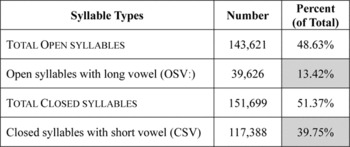
The dictionary of Middle High German used is Köbler (Reference Köbler2007). It is the largest of the dictionaries examined by far, consisting of 99,255 entries (including a small number of prefixes and suffixes). These entries yield a total of 295,320 separate syllables. Formulae for syllabification follow the same procedure as the other dictionaries examined, encoding tautosyllabification of consonant clusters of the form obstruent+liquid.Footnote 9
Results from the dictionary of Middle High German.

The relevant figures have been shaded in the table: The overall percentages of OSVː and CSV syllables are 13.42% and 39.75%, respectively. This results in a ratio of 2.96 to 1 in favor of short closed syllables—lower than in Old English and Old Saxon, but still slightly higher than the ratio in Old Frisian.
9. Results and Discussion
To begin the discussion of the results from the previous table, it is helpful to reiterate our basic hypotheses (H1 and H2): We hypothesized that the frequency of target syllable types influences whether the languages in the sample eliminate stressed CV syllables predominantly by OSL (in which case the language is OSL-prominent, or smooth-cut prominent) or by OSC (which makes the language OSC-prominent, or abrupt-cut prominent). We hypothesized that a higher type-frequency of open syllables with long vowels compared to closed syllables with short vowels will correlate with OSL/smooth-cut prominence (H1). Conversely, if the reverse is true (higher type-frequency of closed syllables with short vowels compared to open syllables with long vowels), this will correlate with OSC/abrupt-cut prominence (H2).
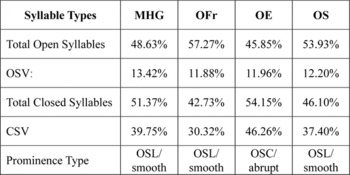
Table 7 compiles the relevant absolute percentages of OSVː and CSV for all the languages examined (taken from the tables in the previous sections), along with a specification of the expected prominence type for each language (OSL/smooth or OSC/abrupt).
Combined results for all languages.

As table 7 indicates, our hypotheses are not confirmed. The percentages for CSV syllable types exceed the frequency of OSVː syllable types by a significant margin in all four languages, and thus the comparative frequency of these types does not predict the prominence type of the languages in the sample.
However, our hypotheses did not acknowledge the general bias toward assigning smooth cut to stressed CV syllables, which is the unmarked case (that is, a general preference for OSL), as explained in section 2. As becomes clear from table 7, frequency rates are not distributed evenly across the four languages. That is, the percentages of closed syllables with short vowels can be ordered along a cline beginning with Old Frisian (the lowest), followed by Old Saxon, Middle High German, and ending with Old English. This is also possible for open syllables with long vowels, although with a slightly different order (Old Frisian, Old English, Old Saxon, Middle High German). Moreover, the distributions of syllable types for a given language are different for closed syllables with short vowels and for open syllables with long vowels.
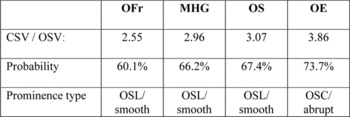
The difference between the two ends of the cline is about 16% (standard deviation 6.58%) for closed syllables with short vowels (46.25% in Old English versus 30.32% in Old Frisian), but only about 2.5% (standard deviation 0.72%) for open syllables with long vowels (13.42% in Middle High German versus 11.88% Old Frisian). Interestingly, Old English has the highest percentage of closed syllables with short vowels, but one of the lowest percentages of open syllables with long vowels. This suggests another way of conceptualizing the comparison between the two relevant syllable types, namely, as a ratio of closed syllables with short vowels to open syllables with long vowels. This captures the probability that a language will employ OSL or OSC predominately in the process of eliminating CV syllables based on the relative—rather than the absolute—frequency of target types. We derive this ratio by dividing the percentages of CSV syllables by the percentages of OSVː syllables. The result provides us with an indication of the likelihood by which smoothing (OSL) or abrupting (OSC) takes place. Table 8 illustrates the results for each language.
Correlation of syllable type ratios and prominence type.

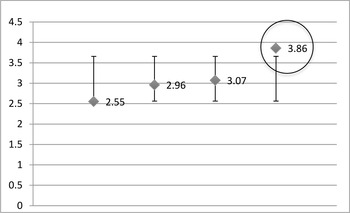
This ratio correlates clearly, robustly, and statistically significantly with the prominence type (p=0). It predicts the likelihood of a language being abrupt-cut prominent as a function of the differences in frequency. The more drastically closed syllables with short vowels outnumber open syllables with long vowels, the more likely it is that a language will be abrupt-cut prominent and implement OSC (abrupting) rather than OSL (smoothing) to eliminate open syllables with short vowels. This can also be captured more absolutely in terms of comparing the ratio of each language to the mean and standard deviation values across all four values. The average ratio is 3.11, and the standard deviation is 0.55 (see error bars in figure 1).
Ratios of CSV to OSVː and standard deviation.

As figure 1 illustrates, Old English is the only outlier among the four languages, showing a ratio that is higher than the standard deviation (circle in figure 1). As a result, we have one predictor for abrupt-cut prominence: Closed syllables with short vowels have to outnumber open syllables with long vowels by almost 4:1, or the number of closed syllables with short vowels has to be greater than the standard deviation in a sample of ratios of CSV to OSVː. This would have to be tested with more samples, but, together with the clear outlier position of Old English, the robust correlation clearly indicates that frequency effects influence the prominence type of a language in the implementation of a syllable cut prosody.
There remains the question of why the comparison of the absolute percentages does not predict the prominence type or why this drastic asymmetry is found. We think this reflects the fact that the assignment of smooth cut is the unmarked and hence default way to eliminate open syllables with a short vowel (see section 2 above). Up to a ratio of roughly 3:1, the unmarked path for eliminating CV syllables wins out, and all languages exhibiting this ratio are smooth-cut prominent. However, at a ratio of almost 4:1 (Old English) the balance tips in favor of abrupt cut. This can be captured with the calculated probability that one or the other development takes place, assuming that the numerical relationship of closed syllables with short vowels versus open syllables with long vowels is the only influencing factor. As table 8 shows, for Old English the calculated probability is 73.7% in favor of transitioning CV syllables to abrupt cut, while in the other languages it is around 66% or less (correlation is statistically significant, p=0). This strongly suggests that, in the implementation of syllable cut, speakers are sensitive to the relative type-frequency of available solutions in the vocabulary. It also confirms the hierarchy postulated in Mailhammer Reference Mailhammer2009, whereby structural requirements outrank segmental requirements, as well as the marked nature of abruptly-cut syllables.
The results also indicate that, in the implementation of syllable cut, stress is dissociated from the syllable template. That is, even though a syllable cut prosody exists only in stressed syllables, when stressed CV syllables are eliminated, the general strategy of how this is done is determined by the ratios of target syllables calculated across all syllables, stressed and unstressed, rather than just across the stressed syllables.Footnote 10 This suggests that the frequency effect on the pattern change is “blind” to the domain of the change, that is, the group of stressed syllables. We think the reason for this is that the changes are structural and segmental rather than accentual changes; that is, in the actual adjustment to the requirements of syllable cut, stress does not play a role, since it does not change. The presence of stress merely defines the set of syllables that are adjusted, but the way their structure changes is influenced by frequency ratios of the syllable types that represent possible outcomes of the change, and that is independent of the feature that specifies the domain across which the change is applied. Before the implementation of a syllable cut prosody, stress and segmental/structural properties are independent of each other; their interdependence is a feature of a contrastive syllable cut prosody. Thus, whether a stressed CV syllable changes to a CVː or a CVC syllable is influenced by the frequency ratio of all relevant targets in the language, independent of stress.
10. Conclusion
The overall goal of this study was to shed light on an insufficiently explained phonological change in the history of English and other West Germanic languages by exploring whether frequency effects might be able to provide some kind of answer. We showed that the change in question (OSL) is in fact one of two complementarily distributed changes (OSL and OSC) that affect stressed open syllables with short vowels. We also built on previous work in arguing that the underlying motivation is the transition from one phonological system to another. Predicting whether a particular word undergoes one or the other change, that is, whether it assumes smooth or abrupt cut in the resulting phonological system that can be described adequately with the syllable cut model, has proved an analytical challenge; it is unclear whether this will ever be possible, given that this is a change in pattern rather than a traditional sound change. This paper asked the question of how the specific preference for one or the other type of change that languages display is to be explained. Typically, OSL, or assignment of smooth cut, is more frequent, that is, unmarked, but there are languages that prefer OSC, such as English. We suspected that type frequency might be able to explain this, and we tested this hypothesis in a corpus study.
Our results confirm a developed version of our initial hypothesis: The relative frequency of the target syllable types of the two changes (OSL and OSC), that is, open syllables with long vowels and closed syllables with short vowels, is a robust predictor of the prominence types in terms of the likelihood of which path is chosen by a language. That is, the higher the ratio of closed syllables with short vowels to open syllables with long vowels, the more likely a language is to be abrupt-cut prominent. Empirically, we found that a ratio of about 3.8:1 tips the balance in favor of abrupt-cut prominence. We interpret this as a reflection of the markedness situation explained in section 2: Smooth cut is the unmarked member of the opposition, and the assignment of smooth cut is the default or unmarked operation to adjust the properties of CV syllables to this type of cut (structural adjustment; see Mailhammer Reference Mailhammer2009). The strength of this preference can be gathered from the fact that three out of four languages in the sample do exhibit it (see also Restle Reference Restle2003, chapter 3 for indicative data).
This result can be interpreted as a frequency effect. It is well known that type frequency influences the productivity of morphological and phonological patterns, and hence also sound changes (Bybee Reference Bybee2001:13 et passim). In this case, when stressed CV syllables are banned from the phonological system in the transition from a quantity-based system to a syllable cut-based system, the existing CV syllables are reinterpreted according to the requirements of syllable cut. Subsequently, their structural and segmental properties are taken as cues for the assignment of cut, smooth or abrupt. These properties of CV syllables contradict each other: The structural information (open syllable) points toward smooth cut and hence phonetic lengthening of the vowel, while the segmental information (short vowel) points toward ambisyllabic closure of the syllable. Typically, markedness will resolve the conflict, but at a certain point the balance can shift in favor of the marked case. That is, at some point, speakers may have significantly more exemplars in which a short vowel is followed by a tautosyllabic consonant than exemplars of open syllables with phonetically long vowels. This will give the speakers the impression that the now-illicit CV syllables are simply closed syllables, just like all the other closed syllables, which, in the vast majority of cases, have short vowels too. Thus, the process is similar to Bybee's (Reference Bybee2001:94) phonotactic generalization, and like the case she discusses, this one is about restricting the occurrence of segments within words.
The data in this study provide a threshold for a particular case, which suggests that a change in the marked direction requires a type frequency of exemplars outnumbering the unmarked exemplars by 3.8:1, equaling a calculated probability of 73.7%, as explained above. Future research will have to test this threshold in other samples, but for the languages in our sample it is clearly observable. Our results thus contribute to a more integrated and improved account of the change traditionally known as OSL—a major change in the history of West Germanic languages. Moreover, the results of our study answer a question neglected in previous work, namely, why languages differ with respect to how consistently they implement OSL, which is a considerable step in accounting for this change. Our results also further support the conceptualization of OSL/OSC as a pattern-influencing reaction to a fundamental change in the phonological system, and they demonstrate that type frequency may in fact be more relevant to the explanation of phonological changes than commonly assumed (see, for example, the overview in Fertig Reference Fertig2012).