Introduction
Huntington's disease (HD) is a progressive autosomal dominant neurodegenerative disorder caused by expanded cytosine-adenine-guanine (CAG) repeats on chromosome 4 of the huntingtin gene (Huntington's Disease Collaborative Research Group, 1993). HD is characterized by motor abnormalities, cognitive dysfunction, and psychiatric symptoms. Cognitive deficits in HD include impaired attention, executive functions, episodic memory, and visuospatial skills (Dumas, van den Bogaard, Middelkoop, & Roos, Reference Dumas, van den Bogaard, Middelkoop and Roos2013). Deficits in verbal and visual episodic memory occur early on in this disease (Montoya, Pelletier, et al., Reference Montoya, Pelletier, Menear, Duplessis, Richer and Lepage2006), and can be detected even in prodromal gene carriers for HD (Diamond et al., Reference Diamond, White, Myers, Mastromauro, Koroshetz, Butters and Vasterling1992; Pirogovsky et al., Reference Pirogovsky, Gilbert, Jacobson, Peavy, Wetter, Goldstein and Murphy2007; Soloman et al., Reference Soloman, Stout, Johnson, Langbehn, Aylward, Brandt and Paulsen2007). The profile of episodic memory impairment in HD is characterized by impaired encoding and retrieval, but relatively spared retention of information. This profile is thought to be due to frontostriatal dysfunction in HD that leads to impairments in higher-level strategy or organization of information during encoding and retrieval (Lemiere, Decruyenaere, Evers-Kiebooms, Vandenbussche, & Dom, Reference Lemiere, Decruyenaere, Evers-Kiebooms, Vandenbussche and Dom2004). Although prior studies have suggested that individuals with HD show impaired recall of information and relatively intact recognition memory, more recent studies suggest that recognition memory is impaired in HD, albeit to a lesser extent than recall (Montoya, Pelletier, et al., Reference Montoya, Pelletier, Menear, Duplessis, Richer and Lepage2006). Recognition memory impairment in HD has been linked to difficulty remembering the source of recently learned information (Fine et al., Reference Fine, Delis, Wetter, Jacobson, Hamilton, Peavy and Salmon2008), consistent with frontal system neuropathology.
The studies of episodic memory thus far have focused on retrospective memory, or memory for past events and experiences. Prospective memory (PM) is another aspect of episodic memory that involves the ability to perform an intended action at some designated point in the future (McDaniel & Einstein, Reference McDaniel and Einstein2000), or “remembering to remember.” PM is involved in many essential everyday tasks, such as remembering to attend doctor appointments or to take medication at the correct time (Kliegel & Martin, Reference Kliegel and Martin2003; Woods et al., Reference Woods, Dawson, Weber, Gibson, Grant and Atkinson2009). Therefore, PM impairment is a unique risk factor for significant declines in everyday functioning, including laboratory-based measures of functional skills (e.g., Pirogovsky, Woods, Filoteo, & Gilbert, Reference Pirogovsky, Woods, Filoteo and Gilbert2012), manifest declines in activities of daily living (e.g., Woods, Iudicello, et al., Reference Woods, Iudicello, Moran, Carey, Dawson and Grant2008), and lower health-related quality of life (e.g., Doyle et al., Reference Doyle, Weber, Atkinson, Grant and Woods2012). There is growing evidence suggesting that PM performance is dependent on the integrity of frontal systems and associated executive functions. Specifically, PM impairment has been observed in patients with frontal lobe lesions (Cheng, Wang, Xi, Niu, & Fu, Reference Cheng, Wang, Xi, Niu and Fu2008; Volle, Gonen-Yaacovi, de Lacy Costello, Gilbert, & Burgess, Reference Volle, Gonen-Yaacovi, de Lacy Costello, Gilbert and Burgess2011) as well as populations with disruption in frontostriatal circuits, including Parkinson's disease (PD; Foster, McDaniel, Repovs, & Hershey, Reference Foster, McDaniel, Repovs and Hershey2009; Pirogovsky et al., Reference Pirogovsky, Woods, Filoteo and Gilbert2012; Raskin et al., Reference Raskin, Woods, Poquette, McTaggart, Sethna, Williams and Troster2011), human immunodeficiency virus (HIV) infection (Carey et al., Reference Carey, Woods, Rippeth, Heaton and Grant2006; Zogg et al., Reference Zogg, Woods, Weber, Doyle and Grant2011), and healthy older adults (Harris & Wilkins, Reference Harris and Wilkins1982; McDaniel, Einstein, Stout, & Morgan, Reference McDaniel, Einstein, Stout and Morgan2003; McFarland & Glisky, Reference McFarland and Glisky2009). In addition, neuroimaging studies support the role of the prefrontal cortex in PM, particularly the rostral prefrontal cortex (Burgess, Scott, & Frith, Reference Burgess, Scott and Frith2003; Simons, Scholvinck, Gilbert, Frith, & Burgess, Reference Simons, Scholvinck, Gilbert, Frith and Burgess2006; Volle et al., Reference Volle, Gonen-Yaacovi, de Lacy Costello, Gilbert and Burgess2011). PM is also strongly correlated with measures of executive functions (e.g., cognitive flexibility) in populations with frontal systems dysregulation (e.g., Raskin et al., Reference Raskin, Woods, Poquette, McTaggart, Sethna, Williams and Troster2011; Gupta et al., Reference Gupta, Woods, Weber, Dawson and Grant2010).
The multi-process theory posits that the degree to which executive processes are required during a PM task will depend on specific characteristics of the target cue, which represents the designated moment to perform an intended action (McDaniel & Einstein, Reference McDaniel and Einstein2000). For example, in time-based PM tasks, the cue that represents the appropriate moment for action is a specified passage of time (e.g., remembering to take medication every 4 hr); while event-based PM involves performing an intended action when an external cue in the environment is presented (e.g., taking a medication with a meal). Time-based PM tasks have less salient cues that are hypothesized to require greater strategic attentional monitoring and self-initiated retrieval processes dependent on frontal systems compared to event-based PM tasks, which generally involve more distinctive external cues that signal the appropriate time to perform an intended action (McDaniel & Einstein, Reference McDaniel and Einstein2000). This pattern of disproportionate deficits in time- versus event-based PM has, for example, been demonstrated in patients with PD (e.g., Raskin et al., Reference Raskin, Woods, Poquette, McTaggart, Sethna, Williams and Troster2011), wherein time-based tasks also were more strongly correlated with measures of executive dysfunction.
Given the frontostriatal disruption and associated executive function deficits that occur in HD and the role of frontal systems in PM, individuals with HD would be expected to demonstrate impairments in PM tasks. However, no study to the authors’ knowledge has investigated PM performance in HD. Therefore, the aim of the current study was to examine PM in HD using a performance-based, standardized measure of PM that includes both time-based and event-based tasks (Memory for Intentions Screening Test, MIST; Woods, Moran, et al., Reference Woods, Moran, Dawson, Carey and Grant2008). Since time-based tasks are thought to involve more executive processes linked to frontal systems compared to event-based tasks, it was hypothesized that individuals with HD would perform worse in time-based PM relative to event-based PM (as defined by larger effect sizes for time-based PM group differences compared to event-based PM). The performance of the HD group was hypothesized to be marked by higher rates of omission errors (no response) and loss of time errors (correct response was performed at an incorrect time). It was also predicted that HD would be associated with higher failure rates on a semi-naturalistic PM task in which subjects are asked to telephone the examiner 24 hr after their study visit.
Finally, the current study also examined self-reported everyday PM complaints in HD and the relationships between performance-based PM and self-report measures of PM complaints. We hypothesized that there would be no differences in self-reported PM between groups and that the performance-based measure of PM would not significantly correlate with self-reported PM in HD. Research findings suggest that individuals with HD overestimate their cognitive abilities on self-report measures compared to their performance on objective cognitive tests (Deckel & Morrison, Reference Deckel and Morrison1996; Cleret de Langavant et al., Reference Cleret de Langavant, Fenelon, Benisty, Boisse, Jacquemot and Bachoud-Levi2013). In addition, individuals with HD have been shown to lack awareness of functional abilities across symptom domains including behavioral control, emotional control, and activities of daily living (Hoth et al., Reference Hoth, Paulsen, Moser, Tranel, Clark and Bechara2007). Associations were revealed between decreased self-awareness and global cognition, executive function and memory (Hoth et al., Reference Hoth, Paulsen, Moser, Tranel, Clark and Bechara2007).
Methods
Participants
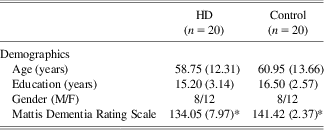
Demographic information for study participants is provided in Table 1. Symptomatic HD (n = 20) participants with mild–moderate severity as defined by the Unified Huntington's Disease Rating Scale (UHDRS; Huntington Study Group, 1996) were recruited from the HD Clinical Research Program at the University of California, San Diego. The UHDRS was administered by a senior staff neurologist. The mean (standard deviation, SD) UHDRS Total Functional Capacity Score was 9.40 (3.32). Scores on this measure can range from 0 to 13 with lower scores suggestive of increased disability. The mean total motor score for the HD participants was 28.2 (SD = 14.21). Scores on this measure can range from 0 to 124 with higher scores suggestive of more severe motor impairment. Based on the UHDRS motor exam, the neurologist assigned a diagnostic confidence rating representing the evaluator's confidence that the presence of motor abnormalities were a manifestation of HD and all patients received a score of 4 indicating a >99% confidence that the patients had manifest HD. In addition, all HD participants had a CAG repeat length of greater than 39, indicating that all participants carried the fully penetrant genetic mutation for HD. The mean (SD) number of CAG repeats for the HD group was 41.95 (3.46) and the mean age of diagnosis was 50.44 (11.11) years.
Mean (standard deviation) demographic characteristics and Mattis Dementia Rating Scale scores for individuals with Huntington's disease and control participants

*An analysis revealed a significant between-group difference on the MDRS F(1, 38) = 14.98, p < .01.
A demographically similar control group (n = 20) was recruited from San Diego County. The groups were matched in terms of age, gender, education, and ethnicity. Exclusion criteria for all participants in the study included a history of neurological disorders (with the exception of HD for the HD participants), a formal diagnosis of a psychiatric disorder such as major depressive disorder (with the exception of a diagnosis of anxiety disorder or depressive disorder for the HD participants), or a history of traumatic brain injury. Global cognition was assessed using the Mattis Dementia Rating Scale (MDRS; Mattis, Reference Mattis1976). As one would expect in a sample of mild to moderate HD participants, the MDRS scores ranged from normal to moderate cognitive impairment. The majority of participants fell into the normal or mild impairment range (n = 18), while two HD participants fell in the moderate range. See Table 1 for raw scores (SD) on the MDRS in HD and control participants. In the HD group, three participants endorsed symptoms of mild depression, two endorsed moderate symptoms, and one endorsed severe symptoms (Beck Depression Inventory-II, Beck, Steer, & Brown, Reference Beck, Steer and Brown1996; Geriatric Depression Scale, Sheikh & Yesavage, Reference Sheikh and Yesavage1986). Ratings of depression were not found to correlate (ps > .20) with performance on the MIST (event-based and time-based scores). Participants were compensated $10 per hr for participation in this study. All participants gave informed written consent for participation approved by the Institutional Review Boards of San Diego State University and University of California, San Diego.
Performance-Based Prospective Memory
The Memory for Intentions Screening Test (MIST) is a standardized performance-based measure of PM (Raskin, Reference Raskin2009). The MIST is a 30-min test consisting of eight PM tasks, with a total summary score ranging from 0 to 48. During the MIST, participants are engaged in word search puzzles that serve as ongoing distractor tasks. The participant was given one point per word found (circled) on the word search puzzle. Scores on the ongoing distractor task range from 0 to 40. The MIST consists of eight trials including four time-based trials and four event-based trials equally divided by delay interval (2-min or 15-min) and response manner (verbal or physical; Raskin, Reference Raskin2009). The test consists of verbal instructions, for example, “In 15 min, tell me it is time to take a break” (time-based trial) and “When I show you a red pen, sign your name on your paper” (event-based trial). Each of the eight PM trials is worth two points: one point for a correct response and one point for responding at the correct time (giving a response within 15% of the target time) or to the appropriate cue. One point was assigned for the trial if the participant gave a correct response to an incorrect cue or an incorrect response to a correct cue. Zero points were assigned for the trial if the participant failed to make a response or made an incorrect response to an incorrect cue.
The MIST includes scoring criteria for specific error types on the PM trials. Error types were recorded for all errors committed. A no response error (omission error) was committed if the participant did not recognize the cue or the appropriate time at which a response was due. A task substitution error was committed if a participant provided an incorrect response to a cue. A loss of content error occurred if the participant recognized the cue or the appropriate time the response was due, but did not recall the correct response. A loss of time error was committed when a correct response was performed at an incorrect time.
Immediately following the completion of the eight PM trials, participants completed a retrospective recognition memory task to assess recognition memory for the content of the trials. One question was allotted for each trial and each question was worth one point, for a total of eight points. In addition, a 24-hr naturalistic task is administered in which participants are instructed to call the test administrator in 24 hr and report the number of hours they slept the night of the testing session. This task serves as a semi-naturalistic assessment of everyday PM abilities (Raskin, Reference Raskin2009; Zogg et al., Reference Zogg, Woods, Weber, Iudicello, Dawson and Grant2010). The purpose of this trial is to provide a more naturalistic assessment of PM; therefore, participants were allowed to use any mnemonic strategy they choose (e.g., writing the phone number and assigned task in an organizer). However, participants were not explicitly instructed to use a mnemonic strategy on the 24-hr task.
Self-Report Prospective Memory
After administration of the performance-based prospective memory measure (MIST), participants completed a self-report measure of prospective and retrospective Memory. The Prospective and Retrospective Memory Questionnaire (PRMQ) is a self-report measure of prospective and retrospective memory abilities (Smith, Della Sala, Logie, & Maylor, Reference Smith, Della Sala, Logie and Maylor2000). The 16-item questionnaire consists of eight items pertaining to PM and eight items pertaining to retrospective memory (RM). The prospective and retrospective memory items are equally divided by cue type (self-cued or environmentally cued; Smith et al., Reference Smith, Della Sala, Logie and Maylor2000). An example of a PM self-cued item is “Do you decide to do something in a few minutes’ time and then forget to do it?” and an example of a RM environmentally cued item is “Do look at something without realizing you have seen it moments before?” Items are rated on a 5-point scale of the frequency of forgetting, from 1 (never) to 5 (very often). The scores for the self-cued and environmentally cued PM and retrospective memory scales each range from 4 to 20, with higher scores indicating increased self-reported memory problems. The self-report measure of PM was provided to participants as a take-home assessment. Two of the 20 HD participants did not complete the PRMQ as they did not return their completed questionnaires to the test administrator.
Statistical Analysis
Data were checked for normality using the Shapiro-Wilk test of normality. Since the performance-based and self-report measures of PM were non-normally distributed (p < .05), non-parametric Mann-Whitney U tests were used to examine group differences. Spearman rank correlational analyses were used to examine the relationships between variables of interest. Component process analyses were used to examine the types of errors committed on the MIST. The critical alpha level in the current study was set at .05.
Results
Performance-based Prospective Memory (MIST)
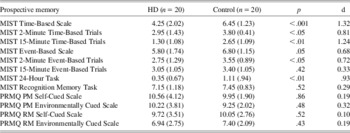
Descriptive data for the MIST in HD and control participants are displayed in Table 2 along with p-values and effect sizes for the main comparisons. The analyses indicated that the HD group performed significantly worse than controls on time-based trials (p < .001) and trend level lower scores were found in the HD group on the event-based trials (p = .05). Analyses of the delay interval showed that HD participants demonstrated significantly lower PM scores on the 2-min (p < .05) and 15-min (p < .01) time-based delay trials compared to controls. HD participants demonstrated significantly lower PM scores on the 2-min event-based delay trials (p < .05) compared to controls, but not the 15-min event-based delay trials (p > .05). HD participants were found to perform significantly worse than controls (p < .01) on the 24-hr semi-naturalistic PM trial. Specifically, 75% of HD participants and 35% of control participants failed to call the test administrator in accordance with the task instructions.
Mean (standard deviation) performance on prospective memory measures for individuals with Huntington's disease and control participants along with p-values (Mann-Whitney U tests) and effect sizes (Cohen's d) for group differences

Note. MIST = Memory for Intentions Screening Test; PRMQ = Prospective and Retrospective Memory Questionnaire; PM = Prospective Memory; RM = Retrospective Memory; d = Cohen's d effect size estimate.
Component process analyses revealed that HD participants committed significantly more no response errors than controls on time-based trials (HD M = 1.35; SD ± 1.31; Control M = .25; SD ± .55; p < .01) and event-based trials (HD M = .65; SD ± .81; Control M = .20; SD ± .41; p < .05) on the MIST. However, there were no significant differences between groups in the number of task substitution errors, loss of content errors, and loss of time errors committed (ps > .05).
HD participants performed significantly worse (p < .05) on the ongoing distractor task (M = 9.55; SD ± 5.59) compared to control participants (M = 13.30; SD ± 4.52). There were no significant differences (p > .05) on the retrospective recognition memory task between the HD group (M = 7.15; SD ± .26) and the control group (M = 7.45; SD ± .19).
Self-Reported Prospective Memory (PRMQ)
Analyses revealed no significant differences between HD and control participants on the PRMQ scales (all ps > .05; see Table 2). There were no significant correlations between any of the MIST variables and the PRMQ scales in either the HD group or the control group (all ps > .05).
Discussion
This is the first study to our knowledge to examine PM performance in individuals with HD. As predicted, HD participants demonstrated significantly worse PM as compared to control participants and the effect sizes for group differences were quite large. Based on the multi-process theory that time-based PM tasks place greater demand on frontal systems and associated executive processes compared to event-based PM tasks with more external cues in the environment, it was hypothesized that HD participants would show worse performance in time-based PM compared to event-based PM. The results of the present study provided preliminary support for this hypothesis, whereby the effect size for HD-associated deficits in time-based PM (Cohen's d = 1.39) was double that of event-based PM (d = .68). There is converging evidence for the critical role of the frontal cortex in PM (e.g., Burgess et al., Reference Burgess, Scott and Frith2003; Volle et al., Reference Volle, Gonen-Yaacovi, de Lacy Costello, Gilbert and Burgess2011), and studies have observed frontostriatal disruption and associated executive function and episodic memory impairments in HD (e.g., Montoya, Price, Menear, & Lepage, Reference Montoya, Price, Menear and Lepage2006). Thus, PM impairment in HD may be related to frontal systems dysfunction. More specifically, the lower scores in time-based PM in HD compared to controls supports the theory that time-based PM tasks with internal cues require increased levels of strategic monitoring and retrieval processes dependent on frontal systems relative to event-based PM tasks with more distinctive, external cues.
The current study found no significant between-group differences in scores on the post-test recognition memory task for the content of PM intentions, suggesting that HD participants’ performance on PM improved when demands on self-initiated retrieval were minimized. These results suggest that the lower performance of HD patients in PM is primarily related to the online detection and retrieval of PM, rather than encoding and retention of the contents of the intention. This profile of PM deficits in HD is consistent with the profile of retrospective memory retrieval impairments observed in HD (i.e., lower free recall in the setting of relatively better recognition performance). Nevertheless, the nature of the MIST does not allow us to completely rule out the influence of subtle, strategic encoding difficulties that may exacerbate difficulties with cue detection and retrieval (e.g., the so-called “mixed encoding-retrieval” profile; Delis et al., Reference Delis, Peavy, Heaton, Butters, Salmon, Taylor and White1994).
An examination of the errors on the MIST in HD revealed that deficits in both time-based and event-based PM were driven by an increased rate of no response errors in the HD group relative to the controls, but there were no significant differences in other error types (loss of content, loss of time, task substitution). This finding suggests that PM deficits in this group may have been related to difficulties with PM cue monitoring and detection and self-initiated retrieval of intentions dependent on frontal systems. One possible explanation for the notably higher impairment in time-based PM associated with an increased rate of no response errors is that time-based PM places greater demands on strategic time monitoring. In healthy adult samples, participants increase the rate of time monitoring (clock checking) as the target time to perform a designated action nears (see Mäntylä & Carelli, Reference Mäntylä and Carelli2006). This approach is considered strategic as it allows one to minimize interruptions to an ongoing task by allocating attention to time monitoring when the appropriate time to carry out an intention is nearing. Studies in various neurologic populations have shown a relationship between decreased strategic clock checking as the time to perform the intention is nearing and impaired time-based PM performance (Doyle et al., Reference Doyle, Loft, Morgan, Weber, Cushman and Johnson2013; Einstein et al., Reference Einstein, McDaniel, Richardson, Guynn and Cunfer1995; McFarland & Glisky, Reference McFarland and Glisky2009; Shum et al., Reference Shum, Ungvari, Tang and Leung2004). Thus, HD participants’ impaired performance on time-based PM tasks may be due to difficulty maintaining a balance between performance on the ongoing task (word search puzzle) and strategic time monitoring to perform the intended action on time. Indeed, we observed a slightly greater effect size for time-based PM deficits after a 15- versus 2-min delay, which prior studies have shown is a function of executive dyscontrol (e.g., Morgan et al., Reference Morgan, Weber, Rooney, Grant and Woods2012; Weinborn et al., Reference Weinborn, Woods, Nulsen and Park2011) and greatly increases risk of poorer real-world outcomes (e.g., Poquette et al., Reference Poquette, Moore, Gouaux, Morgan, Grant and Woods2013). Since the current study did not directly assess time monitoring, future studies examining the role of time monitoring in time-based PM in HD are needed to directly test this hypothesis.
Of note, the PM deficits observed in the laboratory performance of HD participants also appear to extend to real-world situations. Specifically, HD participants performed significantly worse on the 24-hr naturalistic test of PM compared to control participants. This finding demonstrates that the PM deficits observed in the laboratory-based test of PM also are observed in a more naturalistic PM measure, and provides evidence that individuals with HD may have difficulty with everyday PM tasks. In the present study, participants were allowed, but not explicitly instructed, to use any mnemonic strategy they chose (e.g., writing the phone number and assigned task in an organizer, reminder from caregiver). Thus, even though participants could use compensatory cognitive strategies for the 24-hr test of PM, the HD participants performed significantly worse than control participants. This finding suggests individuals with HD may not be using adequate compensatory strategies. Although the current study did not document participants’ use of compensatory strategies in completing the 24-hr task, future studies may wish to examine the relationship between use of compensatory strategies and naturalistic PM tasks in HD.
HD participants were expected to overestimate their PM abilities on self-report measures and it was hypothesized that the performance-based PM task (MIST) would correlate poorly with self-report measures of memory (PRMQ) in HD. As hypothesized, the results indicated that there were no differences between groups in self-reported PM or retrospective memory and the performance-based PM task did not significantly correlate with the self-report PM or retrospective memory scales in HD. Therefore, the HD participants exhibited significantly lower scores compared to controls on a performance-based test of PM; however, the HD participants did not endorse greater memory difficulty compared to control participants on self-report. The finding suggests that the HD participants may be overestimating their actual everyday PM ability and may lack insight into their PM impairment. Discrepancies between self-report and objective cognitive measures is a common finding in many neurocognitive disorders (Rankin, Baldwin, Pace-Savitsky, Kramer, & Miller, Reference Rankin, Baldwin, Pace-Savitsky, Kramer and Miller2005; Wadley, Harrell, & Marson, Reference Wadley, Harrell and Marson2003), including HD (Deckel & Morrison, Reference Deckel and Morrison1996; Cleret de Langavant et al., Reference Cleret de Langavant, Fenelon, Benisty, Boisse, Jacquemot and Bachoud-Levi2013). In addition, individuals with HD have been shown to lack awareness of functional abilities across various symptom domains, which may be associated with cognitive impairment (Hoth et al., Reference Hoth, Paulsen, Moser, Tranel, Clark and Bechara2007). The discrepancy between the HD participants’ performance-based and self-reported PM in the current study highlights the importance of using objective measures to assess PM in HD. However as noted above, discrepancies between self-report and objective cognitive measures have been reported in other neurocognitive disorders. In addition, in the present study we did not find a significant correlation between performance-based and self-reported PM in the control group. Taken together, these data suggest that individuals with neurocognitve disorders, including HD, and even healthy controls may not be particularly good at estimating their cognitive abilities.
The deficits observed in this study on a performance-based test of PM in HD participants could have implications for understanding functional independence in this patient population. However, one limitation is that the current sample was not large enough to examine the incremental value of PM in relation to other predictors of functional impairment in HD. Therefore, future studies with larger sample sizes should examine the incremental validity of PM relative to other standardized cognitive measures in predicting real-world problems in HD, including measures of functional capacity (e.g., medication management), manifest daily functioning (e.g., medication adherence), and health perceptions (e.g., quality of life). Although the clinical version of the MIST was recently published with demographically adjusted normative standards, the research version used in this study does not have any norms. Thus, whether these findings would generalize to the clinical version of the task remains to be determined. Nevertheless, the ecological relevance of the current results is likely strong, as most studies examining the MIST's association with everyday functioning outcomes (e.g., ADLs, adherence), have used the research version (e.g., Woods, Iudicello, et al., Reference Woods, Iudicello, Moran, Carey, Dawson and Grant2008). Although the effect sizes for the PM deficit in HD was in the medium to large range, it will not be known whether these differences on the MIST are clinically meaningful until HD patients’ scores can be compared to established norms and the level of impairment in PM can be assessed. Future studies also should investigate PM abilities in HD across all stages of the disease. For example, PM could be examined in prodromal gene carriers for HD and in later stages of HD to assess cognitive changes relating to PM throughout the spectrum of stages of the disease. Another limitation of this study is the use of a cross-sectional design. Future studies should use longitudinal designs to investigate changes in PM performance in individuals with HD over time. Since depression is common in HD and research has shown a relationship between cognition and depression during the prodromal stage of the disease (Smith et al., Reference Smith, Mills, Epping, Westervelt and Paulsen2012), it is possible that depression could impact prospective memory impairment in HD.
In summary, the results of the current study suggest that individuals with HD showed significantly lower scores in performance-based PM but may overestimated their PM abilities via self report. These results highlight the importance of using objective assessments of PM in individuals with HD. Since PM is thought to play a critical role in many everyday tasks, the current findings suggest that PM deficits may be associated with everyday functioning in HD. The results of the current study may lead to the development of interventions aimed at teaching compensatory cognitive strategies for PM dysfunction to improve everyday functioning and quality of life in individuals with HD.
Acknowledgments
We thank all of the participants for their contributions to this study. A portion of this research was supported by a National Institutes of Health Grants (AG034202) from the National Institute on Aging awarded to Paul E. Gilbert and (MH73419) from the National Institute of Mental Health. The information in this manuscript and the manuscript itself has never been published either electronically or in print. The authors disclose no conflicts of interest.