Introduction
The recent influx of refugees represents a formidable challenge for the welfare system in Germany. Between January 2015 and April 2017 about 1.2 million individuals applied for asylum in Germany (BAMF, 2017b). Although it is difficult to obtain accurate figures, recent estimates suggest that among the 722,000 asylum seekers in 2016, for instance, 36.7% (or 265,000) were between the ages of 11 and 25 years old (BAMF, 2017a). In addition there were at least 52,000 minors (BUMF, 2016) who arrived in Germany without a family unit or a legal guardian. Since German youth policy is concerned with the well-being of all children and youth between the ages of 12 and 27 years, regardless of their immigration status, these estimates illustrate the scale of this sudden increase in demand for child welfare services as a result of the recent refugee crisis.
Focusing on services for unaccompanied minors (UAMs), a core domain of youth services in Germany, this article explores the organizational responses to this crisis in Nuremberg. It is important to note that beyond a general acknowledgement that crises are a key condition for policy change, there is little agreement on the specific mechanisms that link certain events to particular shifts in policy. This article does not pretend to resolve these conceptual dilemmas. Instead, combining a policy implementation perspective with the insights from the crisis and policy change literature, the analysis presents a deeply contextualized account of how the child welfare system in Nuremberg responded to the sudden arrival of large numbers of UAMs. The findings illustrate how child welfare workers responded to the sudden increase in the arrival of UAMs with a flexible delegation of tasks, by disregarding some statutory requirements and by establishing new forms of organizational cooperation. We argue that these actions effectively changed the types and content of services provided to UAMs during the crisis, but also indicate potential for lasting changes in the implementation of child welfare policy.
The next section provides an overview over the extensive literature on crisis, policy change and institutional learning. While an exhaustive review is beyond the scope of this article, the overview seeks to highlight key processes and contradictions and point to several explanatory dimensions akin to sensitizing concepts (Glaser and Strauss, Reference Glaser and Strauss2017). The overview is followed by a description of the German youth welfare system, the data and methods used for the analysis and the presentation of findings.
Background
The enigmatic relationship between crisis and policy change
The term crisis is derived from the Ancient Greek word κρίσιζ (krisis) which is translated as ‘to separate’ or ‘sift’ in the sense of passing judgment or keeping only what is worthwhile. The meaning of its ancient root endures in contemporary notions that there is somehow opportunity in every crisis. In fact, much scholarship on public policy views crises or shocks as key conditions for policy change and institutional learning (Cortell and Peterson, Reference Cortell and Peterson1999; George, Reference George1980; Goldmann, Reference Goldmann1988; Keeler, Reference Keeler1993; Olsen, Reference Olsen1992). Despite the great variation of the nature, causes and magnitudes of such crises and their potential effects on policy, it is their tendency to challenge the existing state of affairs by scrutinizing the legitimacy of leadership and current institutional arrangements or by interrupting established institutional procedures, that make them seemingly critical conditions for policy change (Alink et al., Reference Alink, Boin and t’Hart2001; Boin et al., Reference Boin, Stern and Sundelius2005; Cortell and Peterson, Reference Cortell and Peterson1999; Nohrstedt and Weible, Reference Nohrstedt and Weible2010; Polsby, Reference Polsby1984; Sabatier and Jenkins-Smith, Reference Sabatier, Jenkins-Smith and Sabatier1999; Stern, Reference Stern1997). Such tests of the status quo provide opportunities for a re-evaluation of established perspectives on a particular issue and the advancement of alternative solutions (Baumgartner and Jones, Reference Baumgartner and Jones1993; Birkland, Reference Birkland1997; Kingdon, Reference Kingdon1995). Beyond these general propositions however, there is little agreement on how crises might affect policy. Some scholars, for instance, have questioned whether the volatility and unpredictability that often characterize moments of crises, provide the necessary conditions for facilitating lasting policy changes (Dekker and Hansen, Reference Dekker and Hansén2004) or may even generate a desire for stability and continuity that facilitate the return to a pre-crisis state of affairs (Boin and t’Hart, Reference Boin and t’Hart2003; Jenkins-Smith and Sabatier, Reference Jenkins-Smith, Sabatier, Sabatier and Jenkins-Smith1993; Nohrstedt and Weible, Reference Nohrstedt and Weible2010). Furthermore, the tendency to attribute the origins of crises to failures of leadership or policy leads frequently to post-crises contests over the framing of causes and implications which may prompt a defensive stance among political decision makers (Boin et al., Reference Boin, t’Hart and McConnell2009; Bovens et al., Reference Bovens, t’Hart and Gray1996; Dekker and Hansen, Reference Dekker and Hansén2004; Edelman, Reference Edelman2001; Goldmann, Reference Goldmann1988).
The conceptual dilemma is that crises might provide both the potential for change, but also the need for stability. This may, in part, be resolved by considering the magnitude of the event (Keeler, Reference Keeler1993; Cortell and Peterson, Reference Cortell and Peterson1999) and the policy domain or subsystem affected (Birkland, Reference Birkland2006; May et al., Reference May, Sapotichne and Workman2009). Research findings on the link between the magnitude of crises and their effect on policy, however, seem to be inconclusive. While some studies indicate that even minor events can lead to comprehensive changes (Pierson, Reference Pierson2000) others found that seemingly similar events may lead to different outcomes ranging from minor and incremental response to complete lack of policy change (Birkland, Reference Birkland2006; Boin et al., Reference Boin, t’Hart and McConnell2009; Nohrstedt, Reference Nohrstedt2008).
Whether and how crises result in change may depend on their proximity to a given policy subsystem (Rosenthal and Kouzmin, Reference Rosenthal and Kouzmin1997; Norstedt and Weible, Reference Nohrstedt and Weible2010). Proximity refers to geographical location of an event, such as a hurricane on the Gulf Coast of North America or the rising water levels in Venice, but also the issue propinquity to a particular policy domain or delivery system (Alink et al., Reference Alink, Boin and t’Hart2001; Boin et al., Reference Boin, t’Hart and McConnell2009; Rosenthal and Kouzmin, Reference Rosenthal and Kouzmin1997). This line of scholarship argues that the impacts of crises is greater on domains or subsystems in close geographical or policy proximity. The arrival of UAMs in Germany, for instance, is likely to have a more immediate effect on the child welfare system than on the labor market or national defense. In addition to proximity, the possibilities for change within a given domain or subsystem may also depend on the level of openness to new actors and ideas. In other words, crises may undermine the legitimacy of institutions or affect bureaucratic processes (Alink et al., Reference Alink, Boin and t’Hart2001) but they may also introduce new sets of actors or institutions to a particular policy subsystem (Bamgartner and Jones, Reference Baumgartner and Jones1993; Pralle, Reference Pralle2006).
The conceptual challenges of providing a clear definition of crisis that accommodates a wide range of phenomena and identifying the mechanisms that link these events to policy are mirrored in the difficulty of specifying the notion of change in policy. Models of policy change typically tend to consider magnitude or levels of variation or difference (Hall, Reference Hall1993). These models, however, are unable to resolve the problem that policy changes occur in a sweeping manner but also in more incremental steps, which over time can cumulate to system changes without being noticed (Hinrichs, Reference Hinrichs2000; van Kersbergen, Reference van Kersbergen, Kuhnle and van Deth2003). What is more, the focus on statutory indicators such as eligibility, funding, benefit levels and policy goals, risks failing to pay sufficient attention to shifts in the conditions under which front-line workers are implementing policy.
In fact, the emphasis on visible actors such as legislators and on variables that are susceptible to manipulation, in order to produce predictable outcomes, have long been at the core of critiques of top-down models of policy making (Brodkin, Reference Brodkin, Calista and Palumbo1990; Elmore, Reference Elmore1979; Matland, Reference Matland1995; Pressman and Wildavsky, Reference Pressman and Wildavsky1984). Thus, an important body of literature argues that implementation of policy is not simply a technocratic process of putting statutory laws into action, but a process through which policy mandates are specified and filled with meaning (Brodkin, Reference Brodkin, Calista and Palumbo1990). Scholars who adhere to such a bottom-up perspective on the policy making process posit that policy outcomes can only be understood by examining the interface between citizens (clients) and so-called street-level bureaucrats (SLBs). Particularly in policy domains such as human services or child welfare, where service delivery requires a high level of discretion, the decisions of front-line workers and the organizational contexts in which they are embedded become critical extensions of the policymaking process (Blaxland, Reference Blaxland2013; Breit et al., Reference Breit, Andreassen and Salomon2016; Høybye-Mortensen, Reference Høybye-Mortensen2013; Schram et al., Reference Schram, Soss, Fording and Houser2009). What SLBs do in these interactions emerges in response to the latent conditions of the job which are characterized by a complicated interaction between macro-level plans, policy goals, institutional incentives and a chronic mismatch between resources and demand (Brodkin, Reference Brodkin2012; Lipsky, Reference Lipsky1980; Maynard-Moody and Musheno, Reference Maynard-Moody and Musheno2000; Tummers et al., Reference Tummers, Bekkers, Vink and Musheno2015).
While this perspective has recently been applied to better understand how shifts in welfare governance in different countries altered the conditions for discretionary choices at the bureaucratic front lines (van Berkel et al., Reference van Berkel, Caswell, Kupka and Larsen2017; Brodkin and Marston, Reference Brodkin and Marston2013; Jessen and Tufte, Reference Jessen and Tufte2014; Mason et al., Reference Mason, Spinks, Hajkowicz and Hobman2014), we know much less about how the immediacy and unpredictability of a crisis may affect what front-line workers do. Drawing on administrative data and in-depth interviews with front-line workers, department heads and refugee youth, this article incorporates a street-level perspective into the analysis of the response of the child welfare system in Nuremberg to the recent refugee crisis.
In short, combining some core concepts of both literatures into a framework (to examine policy implementation in the context of crisis) balances some of their respective shortcomings. Specifically the emphasis in the crisis and policy change literature on unpredictability and disruption of established bureaucratic procedures offers a useful complement to the focus on front-line workers’ actions in the SLB literature.
The German federal system and the implementation of child welfare policy
Youth policy in Germany addresses the needs of all children and youth between the ages of 12 and 27 regardless of their citizenship or immigration status (Werdermann, Reference Werdermann, Hartwig, Mennen and Schrapper2017). Germany is a federal state with a parliamentary system of government. States (Länder) are charged with implementing most federal legislation but also participate in the federal legislative process through the Bundesrat (second chamber of parliament) (Hesse and Ellwein, Reference Hesse and Ellwein2012). The institutional system in Germany is based on the principle of ‘Rechtsstaat’ (Benz and Goetz, Reference Benz, Goetz, Benz and Goetz1996; Wollmann, Reference Wollmann2000) that requires a statutory basis for any administrative action which is embodied in an institutional system characterized by hierarchical coordination, input-orientation and rule-bound decision making (Bach, Reference Bach, Lægreid and Verhoest2010).
German youth policy is defined in volume 8 of the Social Code (Kinder- und Jugendhilfegesetz; KJHG). There are three broad domains within youth policy: general counseling and care (Beratung und Betreuung), youth centers and outreach (Jugendarbeit) and child welfare services (erzieherische Hilfen) that include family support programs, foster systems and the potential termination of parental guardianship.
On the federal level the Ministry of Family Affairs, Senior Citizens, Women and Youth (Bundesministerium für Familie, Senioren, Frauen und Jugend; BMFSFJ) is responsible for all matters regarding the welfare of children and youth in the country. The annual Children and Youth Services Plan (Kinder- und Jugendhilfeplan) lays out the goals and priorities of youth policy. While the BMFSFJ determines the overall direction for youth policy, the 16 states, local municipalities and nonprofit organizations are charged with the implementation and delivery of actual services.
The State Youth Ministries (Landesjugendämter) participate in funding and further refining the objectives of youth services: for instance, by establishing building codes or staff ratios for residential youth homes (see Bayerisches Landesjugendamt, 2009). The municipalities are ultimately responsible for providing the services mandated by the KJHG. Municipal youth departments consist of a youth council (Jugendhilfeausschuss; JHA) and an administrative branch, the actual youth department (Jugendamt). The JHA consists of members of the city council, representatives of interest groups (e.g. welfare associations) and individuals with youth service expertise. Within the bounds of the overall city budget, JHAs can make funding decisions, define guidelines for the distribution of funds and intervene in the administration of youth services through the municipal youth departments (Art. 70 I SGB VIII).
Despite the hierarchical and rule-bound nature of the German administrative system (Benz and Goetz, Reference Benz, Goetz, Benz and Goetz1996), there is significant front-line discretion, particularly in the delivery of youth services. While broad policy objectives are continuously refined as they move from the federal to the state and municipal level, assessments of what constitutes hazardous or neglectful circumstances for children and decisions of the appropriate intervention are difficult to standardize and require considerable professional discretion on the part of case workers (Høybye-Mortensen, Reference Høybye-Mortensen2013; Hutchison, Reference Hutchison1990; Parton, Reference Parton1998; Smith and Donovan, Reference Smith and Donovan2003). Child protective services encompass a specific subset of interventions within the domain of child welfare, aimed at ensuring the well-being and safety of at-risk children and youth (Art. 1 paragraph 3, number 3). In cases of serious risk for the safety of the child or where the parents or guardians are unwilling or unable to ameliorate these circumstances through e.g. participation in family support programs, the youth department is required to seek guardianship or the termination of parental rights and the establishment of a comprehensive service plan for the child (Art. 42). Article 42 specifically extends this obligation to children and youth who migrate to Germany without their parents or other legal guardians (paragraph 1, number 3). Thus the recent arrival of large numbers of UAMs represented a formidable challenge for municipal youth departments charged with providing child protective services according to the KJHG. The analysis in this article examines how a hierarchical administrative system, characterized by both the top-down principle of ‘Rechtsstaat’ as well as significant levels of professional discretion at the level of the front-line workers, responded to this challenge.
Methods and Data
The data for this article comes from a larger qualitative study of the experience of male Syrian refugee youth (14-21 years) in the U.S. and Germany. The analysis is based on 29 interviews with child welfare workers, teachers, translators and social workers and 26 interviews with refugee youth in Nuremberg, Germany. Nuremberg was chosen as a field site due to its accessibility to the researcher but its location in the southern part of the country also placed it at the forefront of the recent refugee crisis. The respondents were recruited through a snowball sample (Atkinson and Flint, Reference Atkinson and Flint2001). While the interviews with adult stakeholders focused on professional biographies, descriptions of positions and tasks and their experiences during the crisis in 2015 and beyond, questions for refugee youth explored their life in Syria, travel to Germany and their experiences since their arrival. All interviews were completed between 2016 and 2019. Stakeholder interviews were conducted in German and the youth interviews were conducted either in German or with the help of an Arabic translator. The recordings were transcribed and coded using Atlas.ti software. The analysis followed a combined inductive and deductive approach. Initial codes, derived from theory and literature, were complemented and continuously refined by emergent themes, such as the importance of institutional coping behaviors during the crisis. In order to safeguard against analytic bias, early findings and interpretations were presented at two academic conferences.
Although the larger research project was not designed as a study of the institutional responses to the refugee crisis in Germany, this issue quickly emerged as a critical part of how refugee youth experienced their initial arrival in GermanyFootnote 1. However. given the idiosyncrasies regarding location, type of crisis and the policy domain affected, the following results cannot provide predictions for other types of crises, nor will they be appropriate for understanding non-observed cases, such as responses of youth departments elsewhere in Germany. Despite these limitations that are endemic to much research on crises and policy change, the study illustrates an instance where the response of front-line workers to a sudden surge of demand altered the ways in which child protective services were provided and experienced by their clients. The findings raise important questions about the extent to which the experience during the crisis altered child welfare services after the crisis subsided.
Findings
This section begins with a description of the child protective service process under non-crisis conditions, before examining the effects of the refugee crisis on this process. The institutional crisis response broadly unfolded in the following order: (1) break-down of established bureaucratic procedures, and (2) coping, adjustment of resources and interagency cooperation.
Child protective services
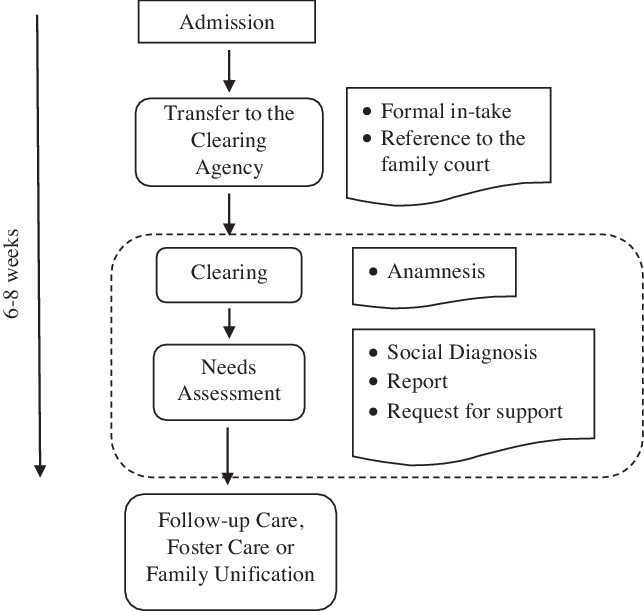
Figure 1 illustrates the process of intervention by child protective services. After the youth department is notified, a social worker meets with the child as soon as possible, typically on the same day, in order to conduct a formal in-take. During this meeting basic demographic information is recorded, including name, age, gender, country of origin. When the in-take is completed, the child is transferred to a ‘clearing agency’. These agencies are non-profit organizations that contract with the youth department to provide residential housing units. During the 2 to 3 months in these residential units, the clearing agency verifies the information gathered during in-take and collects additional information on general health, literacy and educational attainment. In addition, these agencies begin to provide German language training and support for the transition into the German school system. At the end of the clearing process the agency compiles a report that includes recommendations for follow-up care.
Clearing Process

The Bavarian Youth Welfare Department (Bayerisches Landesjugendamt; BLJA) requires these units and potential follow-up residential care units to provide between 12-15 slots and the continuous presence of a minimum of 2 social workers (BLJA, 2009). In 2013 the Nuremberg Department of Youth Welfare began contracting the operation and staffing of residential clearing units out to the “Rummelsberger Diakonie” a large, statewide non-profit agency. Mr. P.Footnote 2 the director of the department for immigrant and refugee services described the staffing and capacity of such residential units under normal circumstances: “We usually have groups of 12 [kids] for the initial reception and clearing with 6.4 staff [per unit] working in alternating shifts around the clock, 365 days a year.” In other words, the initial in-take and clearing process are highly structured, labor intensive and apply to refugee and non-refugee children alike.
Prior to the peak of the refugee crisis, the weekly average of new child protection cases was between 2 and 3 and the Child Protection Unit of the Municipal Youth Department had 3 full-time staff members. In addition, the “Rummelsberger Diakonie” operated and staffed 40 residential clearing slots in Nuremberg. The next section describes the surge in arrivals of UAMs in the wake of the crisis and the resulting pressures on established institutional processes and capacities.
The refugee crisis and break-down of bureaucratic processes
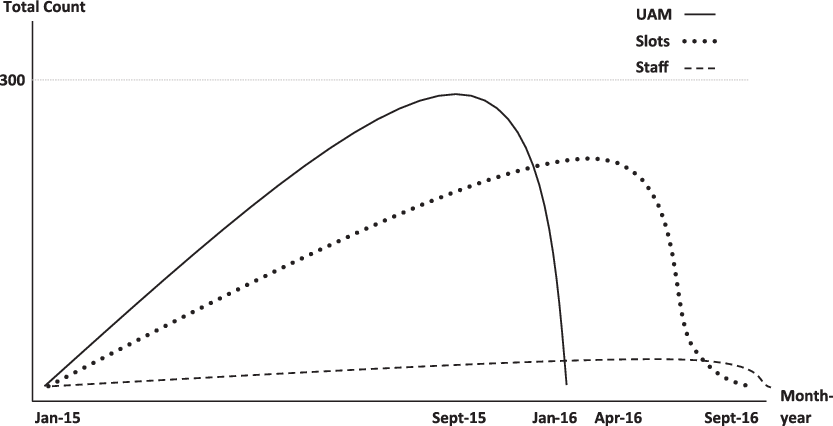
Figure 2 provides an illustration of the increase in child protection cases due to the influx of UAMs during the summer of 2015 as well as the available institutional resources such as staff and clearing agency slots.
Unaccompanied Refugee Minors, Residential Clearing Slots and Child Protection Staff in Nuremberg Source: This graph is based on figures provided by the Child Welfare Division of the Municipal Youth Department in Nuremberg

Although arrivals started to increase in early 2015, in June there were 90 children taken into custody. This number increased to 148 in July and peaked in September at about 250 children. Although the numbers of newly-arrived UAMs started to decrease in January 2016, the demand for follow-up services continued to increase. As a result, established routine processes for conducting comprehensive needs assessments and service planning during the clearing process were no longer possible. Ms. M., the supervisor at the Child Protection Unit of the Nuremberg Youth Department, remembered that especially during the latter half of 2015:
[…] in essence the whole process that used to be pretty structured collapsed because instead of 2 there were suddenly 30 [new arrivals/week]. We were not prepared for this and were not able to do it anymore. We had to focus on very basic things and coordinate the whole process from our desks and were not really able to have face-to-face contact with these youth which made it difficult to conduct assessments.
Similar to the initial in-take procedures, there was mounting pressure to establish additional residential clearing slots or some type of emergency housing. As Mr. P. remembers:
We really were in an emergency situation… ‘What do we do now, where do we find space?’ I can remember that during May, June, July, we looked at buildings almost weekly to see whether we would be able to use them as space for emergency shelters. At some point, we also said as institution that we are not able to handle it anymore, especially in terms of personnel. […] And as fast as they arrived, we couldn’t find accommodations.
The reflections of Ms. M. and Mr. P indicate that the highly structured clearing process and the requirements for residential clearing units set forth by the BLJA regarding physical space and staff-client ratios proved impossible to adhere to during the crisis. At times UAMs remained in the general refugee population for weeks until they were registered with the municipal youth department or could be transferred to a residential clearing unit, several of them housing up to 70 minors instead of the 15 under normal circumstances. But as Mr. P. notes, it “[…] simply was about having a bed and a roof over one’s head.”
Coping, resource adjustment and cooperation
Over the summer of 2015 and during the peak of the refugee crisis, three immediate institutional responses emerged that permitted the absorption of large numbers of UAMs: (1) The “Rummelsberger Diakonie” expanded the number of residential clearing units, (2) established a holding pattern that preceded the actual clearing process in order to quickly house UAMs, and (3), because of the staff shortage at the Child Protection Unit of the Municipal Youth Department, there was an informal transfer of in-take responsibilities to the agency.
The need to quickly find housing for the growing number of newly arriving UAMs in 2015 led to a loosening of requirements for such units in terms of occupancy, staff-client ratios and staff qualifications. The agency added 90 additional residential clearing slots over the summer of 2015 bringing the total number to 180. One of the main challenges, however, was finding qualified social workers to staff these new residential clearing units. This led to various strategies, such as splitting up experienced teams and supplementing them with inexperienced new hires, some of whom without a social work degree or students who had not yet completed all their coursework. As a contractor, however, the “Rummelsberger Diakonie” needed the approval of the Municipal Youth Department for the hiring of new staff and the opening of units that did not meet the BLJA guidelines. In some instances the approval to hire staff, adjust service concepts and rent spaces was granted orally. While this allowed for an ongoing provision of services, Mr. P. also acknowledges that in this situation “Things were approved that wouldn’t have been approved before, that wouldn’t be approved anymore today, [but] that was due to the emergency […].” In some instances the agency was forced to draw on security personnel to ensure some kind of adult supervision for 24 hours. Mr. P. remembered that the experienced workers were “[…] basically the knowledge keeper[s] and [we] hired new personnel.”
In order to maintain any consistency in professional standards, the agency attempted to provide supervision for new hires. The most common challenges experienced by staff during this period were exhaustion, conflict resolution, de-escalation and professional boundary maintenance. Particularly staff without any professional social work training were often driven by an altruistic motivation and lacked the ability to set and enforce rules. The difficulty to establish and maintain professional boundaries made new workers more susceptible to secondary trauma. The “Rummelsberger Diakonie” tried to respond to these challenges by offering an informal professional support group.
What we also did was that 2 experienced professionals of the “Rummelsberger” had an open group where people could go who needed to talk about things. That was no fixed supervision group, it was simply a group where employees knew it would take place a certain day where they could go to talk about things. (Mr. P.)
But because the agency was not able to hire staff and open new residential clearing units fast enough to keep up with the rising numbers of new arrivals during the summer of 2015, the agency also established a holding pattern that preceded the actual clearing process. This holding pattern consisted of emergency shelters that provided quick housing to UAMs and enabled the agency to separate them from the general adult population of refugee arrivals. These emergency shelters were opened in school gyms or the ballroom of a residential clearing facility.
While the agency tried to follow the sequence of housing UAM’s in emergency shelters before they were transferred to a residential clearing unit in order to maintain a somewhat orderly and impartial process, some youth had to wait for months until a residential slot opened up. This is reflected in the experiences of several Syrian youth who arrived in Nuremberg during the summer of 2015. Suhaib (17), for instance, remembered that after the police picked him up: “They [police] sent me to a camp for minors. I stayed there for 6 days. […] After that I went to another place where I stayed for 10 or 8 months and after that I went to a clearing unit.” Abdullah who was 15 when he arrived in Nuremberg in August 2015 had a similar experience:
They took us to the police station where they took our finger prints, weighed us and measured our height. […] we waited for a long time, like 8 hours or so. […] then they took us to [name of emergency shelter], that was a home for people under 18, a big home like for older ones. The first night we were 18 people and after 14 days we were 40. I stayed there for 15 days and then I was moved to another place where I stayed for 3.5 months, until mid-December 2015, after that I transferred to the clearing unit where I stayed from December until June 2016.
In some cases, where emergency shelters were in the same building as the residential clearing units, it proved to be challenging for youth to comprehend why those who were waiting in emergency shelters to be processed received very different supports and services compared to those who were already in the clearing process. Ms. T., a social worker at a residential clearing unit, remembered that: “The youth in our building received a language course, got pocket money, etc. [while] the kids in the emergency shelter sat around all day and got a lot less pocket money because the type of support from the youth department is very different [for those kids].”
These differences in services and supports created the impression of an arbitrary process among youth like Abdullah and Suhaib. Furthermore, the great numbers of new arrivals also backed up the transition from clearing units into follow-up programs. Once youth transfer out of the clearing process there are fewer restrictions and they are able to start school, join a sports team or get involved in other recreational activities. In addition to the crowding of clearing units during this time, the greater level of freedom increased the desire to move through the clearing process as quickly as possible. This created paradoxical situations for social workers where:
[…] we sometimes had youth in the clearing slot for about 6 months when we didn’t find a suitable follow-up situation. So there was pressure to open up slots as quickly as possible for the next ones who were waiting in emergency shelters under much worse conditions, but on the other hand I wasn’t going to send a 15 year old with high needs to a part-time care unit – that would not go well. And then it was really difficult to explain to the youth why youth A got to move out faster even though he was there for a shorter period. And then to explain that youth A is already 17 years old and can do everything on his own and can go to the doctor on his own and you need more support, was difficult at times. (Ms. T.)
The dramatic lack of capacity and resources led to a highly uneven process where older UMAs or those with fewer needs moved through the clearing process relatively fast while others remained in the residential clearing units for more than 6 months.
Furthermore, Ms. M.’s description of desk-management of cases during the peak of the crisis indicates a heavy reliance on assessments conducted by social workers in emergency shelters and residential clearing units – instead of the Municipal Youth Department. Similarly, under non-crisis conditions, it is the responsibility of the Municipal Youth Department to place unaccompanied minors into follow-up care. During the summer of 2015, many of these tasks were simply taken on by workers like Ms. T.:
And it was also interesting that normally the search for follow-up slots is the responsibility of the youth department. And what I mentioned earlier that the youth department during the peak of the work load transferred many of the responsibilities to us. This means that we looked for follow-up slots, we made appointments for interviews with follow-up agencies […]
In sum, the dramatic increase of newly arrived UAMs in Nuremberg during the summer and fall of 2015 led to a quick exhaustion of available resources and a break-down of established institutional routines. This break-down was characterized by the expansion of residential clearing units that were not always in compliance with the statutory staff-client ratios or occupancy requirements, the establishment of a holding pattern that preceded the clearing process in order to quickly house new arrivals and the informal delegation of critical clearing tasks from the municipal youth department to local agencies. In order to manage and coordinate the flexible and often pragmatic provision of services to the great numbers of UAMs during this time, several working groups were formed between different government and non-profit agencies. Some of these working groups included actors not typically involved in the provision of youth services, such as the police department, because of their strong involvement in picking up unaccompanied refugee minors throughout the city. While this continuous exchange of information between different institutions created trust and transparency, it also allowed for a pragmatic management of the high numbers of new arrivals during the peak of the crisis through a flexible handling of established responsibilities and tasks. These working groups provided a form of institutional scaffolding for the coping strategies of front-line workers such as ‘desk management’ of cases mentioned by Ms. M. or the transfer of tasks typically the responsibility of the Municipal Youth Department noted by Ms. T. This strategy is aptly described by Mr. F.: “On the pragmatic level, when we had to manage the high numbers, in the daily workflows, we had to give up on the regular work distribution. That means, the regular work distribution between the crisis institutions and the social services we didn’t say “this is my job, this is your job” but rather “who is free right now?”
Although the Youth Department received funding for an additional 10 positions for its Child Protection Unit at the end of 2015, it ran into problems trying to find enough qualified personnel. Thus, in light of the declining numbers of new arrivals in January 2016 the department ended up not filling all new positions. In the following quote, Mr. F., the Assistant Director of the Child Protection Unit describes the lag between the peak of the crisis and the expansion of resources, which resulted in an excess of capacity.
At the end of 2015 there was the peak [in new arrivals] and in January 2016 the numbers were already starting to decrease and it was only then that we started to catch up with additional staff and in terms of the initial in-take, which is the primary task of the youth department, we had the curious situation that in April, May we had capacity to house about 170 kids and about 12-14 full time staff but no kids because they were only with us for the initial in-take and then moved on. So for a time we operated under some sort of stand-by mode where we maintained the capacity but then no more kids were coming so that we had to respond to that. And then in September 2016 we completely decreased our staff capacity back to normal and moved the additional staff into other divisions.
In early 2016 the institutional resources and procedures began to readjust to their pre-crisis state and in 2018 Mrs. S. noted that: “Basically we are back to our regular operations. What’s new, although not at the same scale, is this holding pattern in the clearing process. There are new processes and co-operations. And a new professionalism developed.” This reflection also indicates that some of the informal delegation of tasks to the staff of the residential units were re-appropriated by the Child Protection Unit of the Municipal Youth Department which at times created some confusion as described by Ms. T.:
I think it was mostly during the transition period when they started to slowly take over their responsibilities again and started showing up at in-take interviews and wanted to see the youth perhaps for an age-determination that started to happen again, which for a time did not happen, and that was a re-adjustment. Or that staff from the clearing agency made interview appointments with follow-up agencies and the youth department said ‘Wait a minute, we are supposed to do this. What are you doing?’
In short, the response of the child welfare system in Nurnberg to the sudden arrival of large numbers of UAMs led to a break-down of established institutional procedures, an expansion of resources and the re-adjustment of these resources after the crisis subsided. But the time lag between the break-down of procedures and the expansion of resources during the peak of the crisis also created the need for adaptive responses on the front-lines of child welfare services. New forms of institutional cooperation included weekly working groups that provided coordination and guidance for service delivery but also allowed for a suspension of statutory requirements for staff qualifications or residential units. It also allowed for the flexible inter-agency handling of responsibilities and tasks within the clearing process and the establishment of an intermediary holding pattern that buffered the pressure on the inadequate number of residential units.
The extreme level of pressure and ambiguity became apparent during the interviews as the respondents reflected on – and often seemed to relive – their experiences during the crisis. While their actions and decisions may have created the impression of an arbitrary process among refugee youth who arrived during this time, they also allowed the child welfare system to serve a much larger group of vulnerable youth than anticipated. Although the clearing process seems to have largely returned to a pre-crisis mode, the experiences and responses during the crisis introduced new actors such as the police department and professionals to the work of child welfare. And finally, the un-bureaucratic cooperation between different institutional actors continues in the form of monthly meetings, but it also arrayed the possibilities of different modes of coordinating the implementation of child welfare policy in the future.
Conclusion
Since child protective services in Germany do not distinguish between immigrant and non-immigrant children, the recent refugee crisis constituted a sudden and massive increase in service demand. This resulted in young people having to wait extended periods of time until they saw a social worker to conduct a formal in-take and needs assessment. In many cases UAMs were housed in the general adult refugee population or in emergency shelters that provided little else other than a place to sleep. Once they were registered and transferred to a residential unit they spent different amounts of time in the clearing process depending on their assessed level of need for follow-up care. While this may also occur in non-crisis circumstances, the level of discrepancy in duration of the clearing process was exacerbated by the intense pressure on front-line workers to make residential slots available as quickly as possible. It is important to note that these changes were experienced by all minors during that time, which effectively changed the content of child welfare services.
On the other hand, the decisions and actions of agencies and staff allowed the child welfare system in Nuremberg to serve a much greater number of at-risk children than ever anticipated. While the responses to the crisis changed services without statutory changes, they also altered the processes of service provision and the dynamic between different institutions. New forms for cooperation allowed for coordination and management of caseloads that enabled flexible and un-bureaucratic responses to need. Furthermore, the crisis introduced new institutional actors, such as the police department, as well as new professional staff to the domain of child welfare, and, thus, developed a new level of professional capacity in the city.
The on-the-ground perspective of this study complements recent research on child welfare responses to the refugee crisis in Germany and Sweden (Aflaki and Freise, Reference Aflaki and Freise2019; Seidel and James, Reference Seidel and James2019). Beyond the implications for Nuremberg, the findings may also be relevant to other child welfare systems in Germany or elsewhere that include an equal protection mandate for refugee and non-refugee youth (see Çelikaksoy and Wadensjö, Reference Çelikaksoy and Wadensjö2017; Frechon and Marquet, Reference Frechon and Marquet2017; Gimeno-Monterde and Gutiérrez-Sánchez, Reference Gimeno-Monterde and Gutiérrez-Sánchez2019; Horgan and Ní Raghallaigh, Reference Horgan and Ní Raghallaigh2019; Ní Raghallaigh and Thornton, Reference Ní Raghallaigh and Thornton2017). The crisis highlighted that actions of front-line workers were not merely guided by policy mandates and regulations but also responded to the situational and organizational conditions of their work. While the SLB perspective emphasizes a chronic mismatch between resources and demand, the crisis led to an expansion of critical resources such as staff capacity and alternative forms of coordination and collaboration. These findings serve as a reminder that the latent shortage of resources in human services is politically conditioned. Furthermore, the policy effects of shifting professional attitudes and modes of service delivery are much more difficult to trace than changes in statutory policies. But the extent to which the experiences during the recent crisis lead to differences in front-line practices poses an important empirical question for future research on the relationship between crisis and policy change.
For the child welfare system in Nuremberg, future research would therefore need to explore the types of expertise gained during the crisis and highlight aspects of the crisis response that may alter the clearing process moving forward. And finally, the experience of un-bureaucratic cooperation and the temporary suspension of established rules and procedures may help better prepare the child welfare system for the next crisis.
Acknowledgements
This paper benefitted greatly from the comments of the participants of the 2nd Conference on Street-level Research in the Employment and Social Policy Area at Aalborg University Copenhagen in 2017 and the Complicators. I am also grateful to the participants in the Syrian Refugee Youth Study who taught me much about human and institutional resilience.