Population ageing is a global challenge and will be associated with increasing mental health demands on health and social care systems worldwide. The big questions are how to meet these needs and how to finance the services required to meet them (Suh and Han, Reference Suh and Han2008; Horgan et al., Reference Horgan, LeClair, Donnelly, Hinton, MacCourt and Krieger-Frost2009; Draper et al., Reference Draper, Reutens and Subau2010). In 2010 the total number of people with dementia across the world was estimated at 35.6 million and a doubling every 20 years has been projected, giving an anticipated total of 115.4 million in 2050 (World Health Organization, 2012). Similarly the global cost of dementia was estimated at US$ 604 billion in 2010 (World Health Organization, 2012): this total will rise as population demography changes. Alongside this, the profile of the workforce is changing too, as there are fewer younger people to support a rising number of elders (de Mendonça Lima et al., Reference de Mendonça Lima, Draper and Benbow2012). Thus, dementia, and the associated health and social care needs of those living with the condition, is an issue of political concern for policy-makers across the world, and coupled with this there is an increasing focus on implications for the dementia workforce.
In the United Kingdom old age psychiatry became a specialty in 1989 and numbers of consultants and other professionals specializing in the subject grew as services expanded in the late 20th century (Pitt et al., Reference Pitt, Arie, Benbow and Garner2006; Macdonald et al., Reference Macdonald2007; Hilton et al., Reference Hilton, Arie and Nicolson2010). The 21st century finds the specialty under pressure, and services in the United Kingdom have been paradoxically criticized as ageist (Royal College of Psychiatrists, 2009; 2011; 2013) in providing specialist mental health care for older adults. If the global challenge of dementia is to be addressed, we need to attend to service design and workforce issues. Workforce models employed currently in high-income countries (which are not applicable in low- and middle-income countries) will need to evolve and change.
It is therefore important that we understand the work patterns of staff working in old age psychiatry, what supports them in their work, and what they find stressful in order to plan to meet the future needs of the increasing older adult population. We describe here a preliminary investigation of how work patterns have changed in consultant old age psychiatrists in one country (the United Kingdom) over the last 20 years, together with an analysis of their views on stressors and supports in their practice.
The aims of this exploratory project were to obtain information regarding the current work patterns of consultant old age psychiatrists; compare these with work patterns in the past; and obtain initial indications of what factors old age psychiatrists identify as supportive and stressful in their working lives.
Method
As a first step we sought to replicate our 1993 survey (Benbow et al., Reference Benbow, Jolley and Leonard1993) by obtaining a profile of work undertaken on a defined Wednesday. A link to an online questionnaire (designed using Qualtrics) was circulated to all consultant old age psychiatrists on the list of the Faculty of Old Age Psychiatry with a request for those who agreed to be included in the survey to complete the questionnaire with details of their work pattern on their last working Wednesday. The questionnaire incorporated information and consent procedures and the project was scrutinized and approved by Staffordshire University under their fast-track ethical approval procedure.
The following basic demographic information was requested: age; gender; years in current post; whether the consultant was in their first consultant post; information about their work on a specified working Wednesday; the three things which they were finding most stressful in their current job; and the three things that they were finding most supportive in their current job.
Responses were stored electronically. The researchers did not at any stage have access to the identities of the people mailed or of those who responded, since the mailing went out through the Royal College of Psychiatrists. A second reminder email was sent through the College approximately six weeks after the first email.
Free text answers were analyzed thematically using NVivo (Bazeley, Reference Bazeley2007; QSR International, 2011): one author coded the text thematically by reading and re-reading the source material to identify themes. Themes and text segments coded to themes were reviewed, discussed, modified, and developed by both authors.
Results
Quantitative data
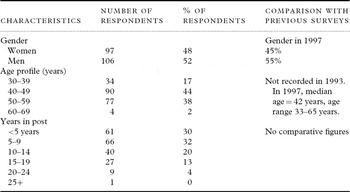
In total there were 210 usable responses that contributed to analysis. Not all respondents completed every question. In all 203 respondents specified their gender: just under 50% were women. Of 205 respondents who gave their age, most were under the age of 50 years (Table 1); in the United Kingdom consultant psychiatrists appointed before 6th March 1995 had mental health officer status which entitled them to retire early, about the age of 55 years (NHS Business Services Authority, 2009), and the General Medical Council (GMC) has suggested that number of older doctors left practice after the introduction of licensing in 2009 (General Medical Council, 2012). The Workforce Review Team found that in 2007 just over one-third of psychiatrists were aged over 50 years (NHS Workforce Review Team, 2008). Of 204 respondents, 153 (75%) reported that they were in their first consultant post. Most (75%) were working full-time; 3% (6) worked for fewer than five sessions and 23% worked for five or more sessions.
Respondents’ gender profile, age profile, and breakdown of time in years in current post

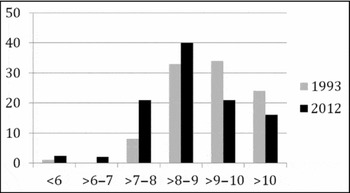
Figure 1 compares the hours at work of respondents in 2012 with those reported by the 1993 cohort (Benbow et al., Reference Benbow, Jolley and Leonard1993). In 1993 50% of old age psychiatrists reported arriving at work before 9 am; in 2012 this had increased to 71%. In 1993 50% of old age psychiatrists remained at work beyond 6 pm; in 2012 the corresponding figure was 40% and in 1993 33% reported going on to work for another hour or more at home, 35% doing that in 2012.
Consultant old age psychiatrists’ hours at work in 1993 compared with 2012.

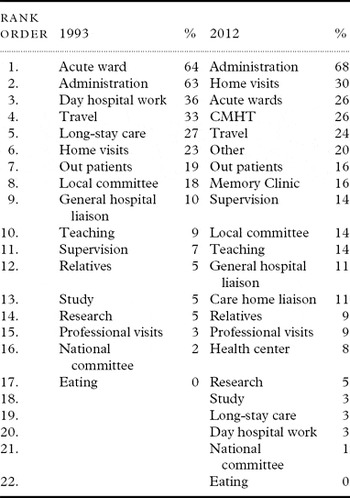
Table 2 lists individual activities contributing to the working day in rank order for 2012 and 1993. The range of activities reported in 2012 is broader than that reported in 1993. Both administration and acute ward work were undertaken by over 60% of consultants on the Wednesday in 1993; only administration rated so highly in 2012, and acute ward work had fallen to 26%. Other hospital-based clinical activity was also less prominent: time in long-stay care fell from 27% to 3%, and day hospitals from 36% to 3%. Outpatient activity, however, remained steady in the high teens and was supplemented in 2012 by Memory Clinics (16%) and Health Center Clinics (8%). Planned visits to patients at home increased from 23% in 1993 to 30% in 2012. More time was given to teaching and supervision of junior staff, but personal study and research by consultants received even less time allocation in 2012 than in 1997 (Jolley and Benbow, Reference Jolley and Benbow1997).
Proportions of respondents spending time in particular activities on one Wednesday in 1993 and 2012, listed in rank order

Qualitative data
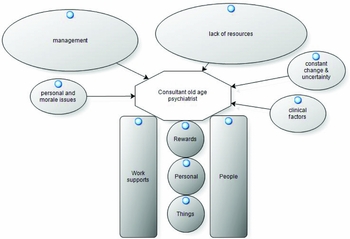
The qualitative data consisted of respondents’ free text answers to the following two questions: What are the three things that are stressing you most in your job; and what are the three things that support you most in your job? Figure 2 sets out a model showing the stresses and supports identified in the analysis. Although we include below reference to the numbers of text segments coded under major themes, these numbers depend on coding practice: they should be regarded only as indicative, in general terms, of the overall pattern of coding and one text segment might be coded to more than one theme.
Model showing old age psychiatrists’ stresses and supports, as identified in the qualitative analysis.

Stresses
The two main themes identified were lack of resources (242 coded text segments (CTS)) and management (201 CTS). Three minor themes were constant change and uncertainty (61 CTS); personal and morale issues (46 CTS); and clinical factors (31 CTS).
1. Lack of resources: Increasing demand was an issue here.
Increasing clinical workload and expectations with no more time.
Too much of it (work); impossible to cope with demands in contracted hours.
Lack of time was another issue, as one respondent simply wrote:
My hours are too long.
Yet another noted the following:
General workload is excessive for hours employed.
This theme also covered lack of resources in specific areas:
1. Administrative/secretarial support – as illustrated in two comments below:
Appalling secretarial support – 5 to 6 weeks to get a letter out.
Extremely limited secretarial support so that outpatient letters take at least 4 weeks to be typed.
2. Medical support included both quantity and quality of medical staff.
Being the sole dedicated medic for my sector, no dedicated junior support for long stay ward (both of which came about when staff grade post was CIPed when the incumbent moved elsewhere). [CIP means Cost Improvement Programme and is a term used as a synonym for cuts.]
Low quality of core trainees that cannot work independently and cannot pass any exams.
3. Management involvement and availability were identified stressors.
Increasing demand for involvement in meetings/committees at the expense of clinical work.
Medical staffing – the medical staffing department has been shut so no one is responsible for organising the rota, therefore when I've been on call recently, every time the junior doctor has failed to appear for their shift.
4. Other staff shortages were another source of stress.
No replacement of staff following retiral [retirement] or on long term sick (numbers very depleted) but increased pressures on me to run an effective and bulletproof service.
Cuts to service provisions, including frontline clinical staff.
5. Facilities were also highlighted here, largely lack of beds with resulting pressure to find a bed when someone needed admission, plus a lack of office space.
2. Management: This included bureaucracy, form filling, computer systems, or, in the words of one respondent,
Increasing amount of paperwork and form-filling which adds little or nothing to patient care.
One person gave their three stresses simply as follows:
NHS red tape; NHS red tape; NHS red tape,
and a number of people commented on how computer systems had slowed things down and hindered access to information. Similarly, targets figured here:
A “target driven” culture. I feel I am constantly failing to meet unrealistic targets. Success in this organisation is calculated by dashboards rather than what is delivered at the coal face. While I accept there may be some benefit from this approach, the pendulum has swing too far towards achieving targets.
Achieving any target is minimalised and the next round of what you are failing to meet hits the agenda and off we go again.
Financially driven cuts also figured:
The iterative annual erosion of services (from CRES savings). [CRES is the acronym for Cost Releasing Efficiency Saving, another synonym for cuts.]
Some people commented on their lack of control or influence, as illustrated here:
Feeling helpless to influence things in my team.
Other people making decisions about my working practice without even consulting me.
3. Constant change and uncertainty (minor theme) included concern about the National Health Service (NHS) generally and the future of old age psychiatry in particular:
Changes (unnecessary I might add) to local service provision (replacing “old age psychiatry” with organic/functional split).
Rapid changes in service provision without adequate consideration of impact on patients and staff – all to do with efficiency, but not actually efficient.
4. Personal and morale issues (minor theme) included working with unhappy demoralized or difficult colleagues, traveling and parking, worry, isolation and tiredness, and a few more personal comments such as the following:
Having to constantly apologise for the absence of things – from Social Services support to admission beds and most other things you can mention.
5. Clinical factors (minor theme) included complaints, challenging patients and families, but also inappropriate referrals and a feeling of personal responsibility for lack of continuity of care and poor standards of care.
Supports
The two major themes here were work supports (449 CTS) and other people (86 CTS), but work supports often captured relationships with people the old age psychiatrist worked with.
1. Work supports.
i. Administrative support was a major sub-theme here, usually a good, excellent, supportive, or efficient secretary or personal assistant (PA) (101 CTS).
ii. Colleagues was a word that featured repeatedly (99 CTS) (often prefaced by an adjective such as good, great, excellent, supportive, or empathic), but, when qualified, it referred to a wide range of professions operating in various different settings. It was closely followed by the following:
iii. Team (81 CTS), often the community mental health team, but also various other teams, and again adjectives were applied by some; including excellent, good, experienced, supportive, conscientious, strong, and cohesive.
iv. Medical support (72 CTS) was also a large subcategory, usually consultant colleagues, but also trainees and specialty doctors/staff grades.
v. Trust managers of various types were less prominent (42 CTS), but included:
A sensible Chief Executive who I've meaningful dialogue with.
vi. Some people commented on aspects of their work pattern as being supportive, e.g. time to think; or a particular activity (research or teaching) as sustaining them, but each of these was a minor sub-theme.
2. Other people (86 CTS) was a theme capturing people other than working colleagues, namely friends, family, patients, and patients’ relatives. It appears that patients and their families are more often regarded as supports than stressors. One person described as follows:
Pleasures and privilege of clinical encounters with both patients and carers.
3. Personal supports (minor theme) (41 CTS) captured a range of enjoyment, interest, and job satisfaction as well as personal characteristics (including one person with a “sense of black humour”).
4. Rewards was a minor theme (23 CTS), including pay, respect, and early retirement.
5. Similarly, things/objects was a minor theme (only 13 CTS), including laptops, phones, and offices.
If the people within the working environment who were seen as supportive were combined with people outside work, then relationships were overwhelmingly the major support of responding old age psychiatrists.
Discussion
In the 20 years since our original work, the NHS and mental health services have undergone serial reorganizations in the United Kingdom, and these have changed the shape and probably the dynamics of old age psychiatry. “New Ways of Working” was an initiative intended to reduce the workload and stress perceived by consultant general psychiatrists (Department of Health, 2005; CSIP/NIMHE, 2007). It was subsequently generalized across mental health services and, in association with reduced finances and remodeled facilities, resulted in unanticipated service changes, including the introduction of a split between functional and organic services, loss of continuity of care, and changes to consultant responsibility (St John-Smith et al., Reference St John-Smith2009). “New Ways of Working” has attracted considerable controversy as enthusiasts have been countered by outrage from traditional clinicians who feel cheated of their role and the satisfaction of delivering continuity of care, which is valued by patients and families (Dale and Milner, Reference Dale and Milner2009; Singhal et al., Reference Singhal, Garg, Rana and Naheed2010; Rathod et al., Reference Rathod, Mistry, Ibbotson and Kingdon2011; Royal College of Psychiatrists, 2011).
Services for older people and services specifically for people with dementia in the United Kingdom have experienced different pressures. Anti-dementia drugs have entered mainstream old age psychiatry practice (National Institute for Health and Clinical Excellence, 2011). An ambitious National Dementia Strategy in England (Department of Health, 2009) has been followed by similar initiatives in Scotland, Wales, and Northern Ireland (The Scottish Government, 2010; Department of Health Social Services and Public Safety Northern Ireland, 2011; Welsh Assemby Government, 2011) in keeping with a world movement to respond to the dementia epidemic (World Health Organization, 2012). Indeed, many countries have national dementia plans at various stages of development (see the Alzheimer Europe website: http://www.alzheimer-europe.org/EN/Policy-in-Practice2/National-Dementia-Plans and Alzheimer's Disease International http://www.alz.co.uk/alzheimer-plans).
The UK dementia lobby has become powerful and effective and has required, via the National Dementia Strategy, that every locality provides a Memory Clinic, a phenomenon imported from the United States and adopted in many other countries as a way of reaching people earlier in their difficulties, with good quality assessments and minimal stigma (Jolley et al., Reference Jolley, Benbow and Grizzell2006). There is additional pressure to identify and respond to the special needs of people with dementia when they enter a general hospital (Alzheimer's Society, UK, 2009) and to improve care and continuity within care homes and the community (Alzheimer's Society, UK, 2007; Banerjee, Reference Banerjee2009). But what about the larger number of older people who experience problems of mood or other short- or long-term disorders other than dementia? There is continuing controversy as blinkered interpretations of the need for age equality (Royal College of Psychiatrists, 2009) and age integration of services (Hill, Reference Hill2008) threaten to dismiss the gains of specialized services for older people in the United Kingdom, while no one questions the desirability of designated services for children and adolescents (Department of Health, 2004). Thus, the needs of people with dementia are receiving attention in the United Kingdom, but there is concern that this is occurring at the expense of older people with other mental disorders (Age Concern, 2007), and the marked variation in how services function identified by Challis and colleagues (Reference Challis, Reilly, Hughes, Burns, Gilchrist and Wilson2002) has probably become more not less marked over recent years.
It seems likely that all these changes have influenced the work patterns of old age psychiatrists. We first gathered information about work patterns in old age psychiatry in the United Kingdom in the early 1990s starting with a simple audit of activities on one day among colleagues attending a section (now a faculty) meeting (Benbow et al., Reference Benbow, Jolley and Leonard1993). This suggested that old age psychiatrists had long working days, leaving little opportunity for family life, recreation, personal study, or research. This pattern was confirmed by more detailed studies using questionnaires covering every day of the week and including measures of stress and burnout (Benbow and Jolley, Reference Benbow and Jolley1997; Reference Benbow and Jolley1999; Reference Benbow and Jolley2002). People were at work on average nearly nine hours per day during the working week (except on Fridays); in addition more than 40% did work at home on every weekday except Friday and more than 30% worked at home on Saturdays and Sundays (Jolley and Benbow, Reference Jolley and Benbow1997). Many identified symptoms of stress and burnout which they related to work overload and organizational structure and climate (Benbow and Jolley, Reference Benbow and Jolley1997; Reference Benbow and Jolley2002). Our new study shows that, despite attention to consultant psychiatrists’ workload and changes in how services are provided, the working hours of consultant old age psychiatrists in 2012 are very similar to those in 1993 and 1997. Many start work early and finish late, and spend at least as long on administration as they did in the 1990s.
What has changed is the activity profile of the UK old age psychiatrists. Work in long-stay care has decreased considerably, but perhaps care home liaison should be regarded as a replacement for it, since care homes provide the vast majority of long-term care. Memory Clinics have been given a boost since the introduction of the National Dementia Strategy, and there is growing interest in primary care memory clinic models (Jolley et al., Reference Jolley, Greaves, Greaves and Greening2010; Greaves and Greaves, Reference Greaves and Greaves2011). Day hospitals have become unfashionable: The Royal College of Psychiatrists survey of day hospitals described day hospitals as “becoming ‘silted-up’ with patients who would be better provided for by social care” (Day Hospital Network (Faculty of Old Age Psychiatry), 2008; Holmes et al., Reference Holmes2010) and acute bed numbers have fallen (Keown et al., Reference Keown, Weich, Bhui and Scott2011). Overall there has been a shift away from time devoted to the clinical care and treatment of patients in the in-patient wards, toward work with patients and families via clinics at the hospital, in health centers, in their own homes, and/or in other care settings such as general hospitals and care homes. More time is given to support and teaching of doctors and others in training, but the benefit of personal study and involvement in research to consultants (as identified in previous work) is neglected. Greater outreach activity has to be a good thing, but loss of specialist inpatient and day hospital facilities may have adverse effects, especially for patients with the most severe symptoms. This loss may result in personal suffering and additional pressures in other care settings. Loss of continuity of care is certainly felt by patients and families. The apparent disregard of the need for consultants to have time for personal study and involvement in research or audit is worrying, for these activities can refresh them and provide the opportunity for valuable reflection to measure where services are achieving good or floundering. Such feedback from the clinical interface would give ownership to clinicians and ensure honest responsiveness and the best use of resources.
The move to reorganize into so-called functional teams in the UK psychiatry was not investigated directly here. Where applied to services, it has divided psychiatrists into community and hospital-based consultants (a change imported from general psychiatry) (Goldberg, Reference Goldberg2008; Faculty of the Psychiatry of Old Age of the Royal College of Psychiatrists, 2011), and this change (perhaps alongside a decrease in bed numbers; Keown et al., Reference Keown, Weich, Bhui and Scott2011) may partly explain why fewer respondents in 2012 report time on acute wards. Similarly, the introduction of consultants in liaison old age psychiatry (Royal College of Psychiatrists, 2005; Holmes et al., Reference Holmes2010) may explain why general hospital liaison has failed to become a more prominent activity among old age psychiatrists as a group, despite growing acknowledgment of its importance. Another driver for change has been misinformed interpretations of the need for age equality (Royal College of Psychiatrists, 2009) and age integration of services (Hill, Reference Hill2008). The Royal College of Psychiatrists’ (2009) position statement on age discrimination points out that
comprehensive specialist mental health services for older people are essential to meet need across the life cycle. This is consistent with the principle of recognising people's different needs, addressing those needs in an equal way and not treating all people the same when their needs are different.
Banerjee's (Reference Bazeley2009) work on anti-psychotic drug prescribing emphasizes the need for specialist services, as does the Dementia Guideline (NICE/SCIE, 2007, p. 20), which refers to Everybody's Business (Department of Health/Care Services Improvement Partnership, 2005) and
specialist mental health services, including community mental health teams, memory assessment services, psychological therapies and inpatient care.
There is no doubt that meeting the challenge of increasing number of older people living with dementia and other mental disorders is an issue that clinicians, managers, governments, and societies across the world need to address at a time when there are financial constraints and concern that demographic changes will limit the available workforce (Draper and Anderson, Reference Draper and Anderson2010; de Mendonça Lima et al., Reference de Mendonça Lima, Draper and Benbow2012; Jeon, Reference Jeon2012). Old age psychiatry will need to respond to this challenge by evolving ways of working which make specialist expertise available to those who need it, while supporting other professionals in continuing to care for people with dementia and their families, in both primary and secondary care. This pilot project suggests that work patterns in old age psychiatry are indeed changing in response to these demands within the constraints placed upon the specialty. In other countries old age psychiatry has achieved specialty status (e.g. Canada; Andrew and Shea, Reference Andrew and Shea2010) or aspires to develop its specialty/subspecialty knowledge, training, and practice across the whole range of mental disorders in later life (Colenda et al., Reference Colenda, Wilk and West2005; Stek et al., Reference Stek, Eikelenboom and Beekman2008; Ribeiro et al., Reference Ribeiro, Fernandes, Firmino, Simões and Paúl2010) and across different professions involved (Pachana et al., Reference Pachana, Emery, Konnert, Woodhead and Edelstein2010 write about the same issue in relation to psychology).
The method employed in the study involved the Faculty of Old Age Psychiatry in sending out a link to an electronic questionnaire to their members so that they could respond anonymously. A majority of old age psychiatrists in the United Kingdom will belong to the Faculty of Old Age Psychiatry, but the Faculty circulation list includes many members who are not old age psychiatrists but choose to be on the list because of an interest in older adults. In addition, at any time there will be a number of email addresses listed, which are no longer functioning. Thus, it is not possible to know how many Faculty members were asked to take part in the survey. The Workforce Review Team (2008) quote a figure of 510 consultant old age psychiatrists in 2007: It would be reasonable to estimate that about 40% of old age psychiatrists have responded to the survey. Those consultants who are most stressed and over-worked may be less likely to respond, so the details of hours worked and stresses perceived may represent underestimates. The results are a snapshot of work patterns, stresses, and supports in one country and do not necessarily generalize to other areas of the world. They do, however, offer a description of what is happening in the United Kingdom, and a base that people in other countries can use for comparisons.
It will be important to explore these changes further in the United Kingdom through a survey of a representative whole week and its work. In addition, we should attempt to monitor the impact of these work patterns and hours on the health, well-being, and morale of consultants and on the appropriateness and effectiveness of services. It will, perhaps, be even more important to look at different service models around the world and how specialist expertise is made available to those who need it in different economic and social contexts. Our concern is that financial pressure has become the main factor in reshaping services, often in response to short-term considerations. While economic considerations are undoubtedly very important, they must not obscure the need for care and humanity.
Conflict of interest
None of the authors received any fees or grants from, employment by, consultancy for, shared ownership in, or close relationship with any organization or individual whose interests, financial or otherwise, may be affected by the publication of this paper.
Description of authors’ roles
Both authors were involved in all the stages of the study.
Acknowledgments
The authors wish to thank all those consultant old age psychiatrists who responded to the survey and the Faculty of Old Age Psychiatry for circulating the invitations to take part.