


Introduction
Borderline Personality Disorder (BPD), as a review article describes (Lieb et al., Reference Lieb, Zanharini, Schmahl, Linehan and Bohus2004), is characterized by severe functional impairments, death by suicide at a rate of 50 times that of the general population, a negative effect on the course of depression, extensive use of treatment and high costs to society (Leichsenring et al., Reference Leichsenring, Leibing, Kruse, New and Leweke2011). Yet, it remains a condition with a treatment evidence base still in its infancy (NICE, 2009) and a client group who report extremely low quality of life (QoL) (IsHak et al., Reference IsHak, Elbau, Ismail, Delaloye, Ha, Bolotaulo, Nashawati, Cassmassi and Wang2013). One of the major obstacles to the development and evaluation of evidence-based interventions for those with BPD is the diverse range of outcome measures used across published studies (NICE, 2009). The measures used cover a heterogeneous range of outcomes: from BPD-specific symptoms (such as emotional instability or interpersonal difficulties) to more general symptoms such as depression and anxiety, as well as use of services and self-harming behaviour. Indeed, there is little agreement regarding whether these measures are even specific to the needs, difficulties and priorities of people with a BPD diagnosis (NICE, 2009). Despite numerous calls for research into an outcome measure for BPD which is both meaningful to service users and universal across treatments (e.g. Juett et al., Reference Juett, McKay and Hill2012; NICE, 2009), there has yet to be such a measure developed and agreed upon. Such recommendations form the basis of this investigation.
Published research into effective treatments for BPD has historically been limited (NICE, 2009). Three meta-analyses (two published and one unpublished) exploring the effectiveness of interventions for BPD are reported. These focus on DBT-based interventions (Kliem et al., Reference Kliem, Kroger and Kosfelder2010), the effectiveness of ‘psychotherapies’ for BPD (Cristea et al., Reference Cristea, Gentili, Cotet, Palomba, Barbui and Cuijpers2017) and group interventions for BPD (Droscher, Startup, Petfield, Horsman and Cartwright-Hatton, unpublished observations).
The meta-analysis of Kliem et al. (Reference Kliem, Kroger and Kosfelder2010) on dialectical behaviour therapy (DBT) included 16 studies and found a moderate effect size for suicidal and self-injurious behaviours. However, a total of 34 different measures were used to evaluate effectiveness across the included studies. This suggests that even amongst trials of DBT, which claims to tap a fairly discrete set of overt symptoms (such as self-harm behaviours and suicidality), there remains considerable heterogeneity in how change is measured. Kliem et al. (Reference Kliem, Kroger and Kosfelder2010) suggested that a core battery of assessment measures agreed upon within the field is critical. More recently, Cristea et al. (Reference Cristea, Gentili, Cotet, Palomba, Barbui and Cuijpers2017) completed a systematic review and meta-analysis of randomized control trials assessing the effectiveness of psychotherapies for BPD (including DBT, cognitive behavioural therapy and psychodynamic psychotherapies). Outcomes reported were varied across research trials and analysis required the authors to group together diverse outcome measures in order to make comparisons across published research. For example, outcomes pertaining to general psychopathology, anxiety and depression were grouped as ‘general psychopathology’ and BPD symptom measures, self-harm, parasuicide and suicidal behaviours were grouped as ‘borderline relevant’ (Cristea et al., Reference Cristea, Gentili, Cotet, Palomba, Barbui and Cuijpers2017). The authors concluded that this led to a high level of heterogeneity across all outcome categories and overall small effect sizes for treatments for BPD (Cristea et al., Reference Cristea, Gentili, Cotet, Palomba, Barbui and Cuijpers2017).
Droscher et al. (unpublished) completed a systematic review and meta-analysis of published group treatment trials for BPD. Of the 20 studies included in the meta-analysis, over 19 different symptoms were reported, including depression, anxiety, suicidality and impulsivity. Not only did this reflect great diversity in defining what constitutes a clinical outcome but most trials also included a number of different ways of assessing the same outcomes. For example, self-harm was assessed by 16 different measures, impulsivity by five different measures and anxiety by four different measures. Therefore, even when looking at a specific symptomatic behaviour such as self-harm, there is considerable variation in the way in which different researchers evaluate change. Overall, Droscher et al. (unpublished) concluded that group treatments for people with BPD were moderately effective but systematic evaluation across research studies is challenging and marred by the heterogeneity of outcome measures employed and high drop-out from interventions.
A further issue is whether the measures used capture what is meaningful for those with BPD. Katsakou et al. (Reference Katsakou, Marougka, Barnicot, Savill, White, Lockwood and Priebe2012) argued that whilst decreases in self-harming behaviours (perhaps the hallmark of BPD outcome studies) or use of acute services may be important outcomes for services, it is unclear whether these outcomes reflect the priorities of service users. IsHak et al. (Reference IsHak, Elbau, Ismail, Delaloye, Ha, Bolotaulo, Nashawati, Cassmassi and Wang2013) conducted a review of the literature on QoL in BPD. The review concluded that despite change across the overt symptoms of BPD (e.g. self-harm, emotion dysregulation, interpersonal functioning), QoL remains consistently low for BPD sufferers. Such findings highlight the critical importance of the service user voice in defining outcomes. Furthermore, as Ajayi et al. (Reference Ajayi, Bowyer, Hicks, Larsen, Mailey, Sayers and Smith2009) suggest, it is possible to experience personal recovery while still having recurring psychiatric symptoms. Thus, meaningful improvement for sufferers of BPD might capture factors such as social relationships or the fostering of identity as indicators of recovery (May, Reference May2000). Many outcome measures neglect QoL indicators in favour of an exclusive focus on overt symptom reduction (Thornicroft and Tansella, Reference Thornicroft and Tansella2005) or reduction in the use of costly services (Slotema et al., Reference Slotema, Niemantsverdriet, Blom, van der Gaag, Hoek and Sommer2017).
Consequently, the notion of recovery is complex for individuals with BPD (Castillo et al., Reference Castillo, Ramon and Morant2013) requiring a careful exploration of personal meanings of change (Slade et al., Reference Slade, Amering and Oades2008). However, to date and to our knowledge, no published research into effective treatments for BPD have utilized service user-defined ways of conceptualizing recovery, nor have service user views of recovery been operationalized into a way of measuring change.
Research into effective treatments for BPD is limited (Cristea et al., Reference Cristea, Gentili, Cotet, Palomba, Barbui and Cuijpers2017) and arguably will remain limited until change can be captured and measured in a manner that is meaningful and relevant to those diagnosed with BPD whilst also being user-friendly for professionals and researchers. NICE (2009) recommends asking service users to define meaningful change as a starting point for the development of an outcome measure that can be used universally across treatments. This investigation begins to address these issues by exploring service users’ perspectives on commonly used outcome measures and by asking them to define meaningful change in recovery from BPD.
Method
Sample
Participants were recruited using an opportunity sample. All participants were service users accessing specialist Personality Disorder services within the Sussex Partnership NHS Foundation Trust. In total, 15 service users took part in the study, 12 females and three males. There were a total of 73 service users accessing the specialist services at the time of recruitment and thus the sample comprised 21% of the total population. All service users who expressed an interest in participating went on to participate in the focus groups. The average age group of participants was 39–45 years. Ethnicity of participants was 93.3% White British, 6.7% English/East Indian. All service users are screened routinely upon entry to the services using the ZAN-BPD (Zanarini, Reference Zanarini2003; Yeomans et al., Reference Yeomans, Gutfreund, Selzer, Clarkin, Hull and Smith1994) and MCMI-IV (Millon et al., Reference Millon, Grossman and Millon2015) and meet criteria for a BPD diagnosis. All participants were in the skills development and consolidation phase of their treatment within the services. This is defined as a period of up to 2 years which occurs after a 6-month initial attachment phase within the service and in which service users have opportunities to learn and consolidate skills to understand and regulate emotions and manage interpersonal difficulties.
Procedure
The project was first presented to the trust audit team and permission to complete the research as part of routine service evaluation and audit was granted. The project was then presented by the first author to service users in the monthly community meetings at the two specialist services. The first author explained the purpose of the study and asked for service user volunteers to take part in focus groups. Flyers and posters were distributed across both services.
Service user volunteers were asked to attend one of three focus groups across two specialist services. Given the nature of the services and attendance being contingent on service users being in receipt of a formal Personality Disorder diagnosis, all service users who expressed an interest in the research were invited to take part. Focus groups lasted for approximately 1 hour with a ten-minute break in the middle. There were seven participants in the first focus group and four in groups two and three; no participants dropped out or withdrew during or after the focus groups. The focus groups were facilitated by a clinical psychologist and an assistant psychologist. A semi-structured interview was used during each focus group and audio-recorded for later analysis. All participants signed consent forms for the focus groups to be recorded.
Interview schedule
The starting point for the creation of the interview schedule came from the NICE (2009) recommendations calling for the development of agreed outcome measures that better reflect patient experience and allow for a more adequate comparison of interventions. NICE (2009) suggest a three-stage process involving the identification of aspects of QoL, function and symptoms important to both service users and carers, which can then be matched to existing outcome measures in order to highlight where measures are lacking and thus guide the development of appropriate outcomes and in turn evidence-based treatment guidelines. This paper addresses the first component of these recommendations.
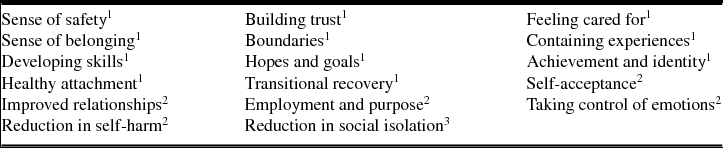
In order to access patient perspectives and experience of recovery in BPD, a semi-structured exploratory interview was conducted. Semi-structured interviews are frequently used within healthcare as their flexibility provides participants with some guidance whilst allowing for the discovery and elaboration of information (Gill et al., Reference Gill, Stewart, Treasure and Chadwick2008). Guidelines for developing interview schedules suggest that questions should move from general to more specific and should be ordered relative to the importance of issues in the research agenda (Stewart and Shamdasani, Reference Stewart and Shamdasani1990). This allows for confidence and rapport to be built upon, thus yielding as much information from respondents as possible (Britten, Reference Britten, Pope and Mays1999). Previous research highlights that service users feel that recovery is an ongoing, open-ended journey and that the focus of treatment within therapy clashed with or did not incorporate areas deemed important to them (Katsakou et al., Reference Katsakou, Marougka, Barnicot, Savill, White, Lockwood and Priebe2012). A number of areas have been identified as important when exploring recovery within BPD (see Table 1). The themes were identified from a literature review exploring important aspects of recovery and informed the creation of the interview schedule.
Key themes deemed to be important when measuring recovery, identified through literature review exploring aspects of recovery

1 Castillo et al. (Reference Castillo, Ramon and Morant2013); 2Slade et al. (Reference Slade, Amering and Oades2008) and Katsakou et al. (Reference Katsakou, Marougka, Barnicot, Savill, White, Lockwood and Priebe2012); 3Ajayi et al. (Reference Ajayi, Bowyer, Hicks, Larsen, Mailey, Sayers and Smith2009).
The initial development of the interview schedule was guided by the authors’ understanding and experience of utilizing outcome measures [including single symptom measures such as depression or anxiety, global scales measuring BPD dysfunction such as the ZAN-BPD (Millon et al., Reference Millon, Grossman and Millon2015), and more symptom-specific BPD scales such as the distress tolerance scale (Simons and Gaher, Reference Simons and Gaher2005)], as well as from the incorporation of themes highlighted as important by previous research. A topic guide was developed by two members of the research team and a number of initial themes and prompts were developed, including: definition of recovery; future hopes; symptoms as listed by the DSM-V criteria; increases in behaviours, good and bad; past experience of outcome measures; timeframe for measuring change; social inclusion (hobbies, engagement in community or support networks, volunteering/employment); coping with challenges/coping strategies (applying strategies, changes in patterns of coping, reduction in impulsive behaviour); negotiating relationships (managing conflicts, personal boundaries, awareness and development of healthy relationships); and managing change (trust, self-value, self-confidence and self-worth, hope, aspirations and goals for the future).
Two service user volunteers were asked for their views and recommended changes to the draft questions. This process resulted in changes to the order and wording of the schedule of questions and it was suggested that the research was better contextualized for the service users taking part. The interview schedule utilized open-ended questions designed to facilitate spontaneous reflection regarding participants’ understanding of recovery and of their experiences using service outcome measures. Questions and probes were designed to achieve further exploration of known themes.
Data analysis
Interviews were analysed using thematic analysis (Braun and Clarke, Reference Braun and Clarke2006). Thematic analysis was selected as it allows relative epistemological freedom and is considered a flexible approach to data analysis (Braun and Clarke, Reference Braun and Clarke2006). The ability to integrate existing theory with novel data fitted with the broad aims of this research which was driven by a theoretical interest as well as a desire to explore service user experiences in a rich and detailed way. The data were approached from a critical realist perspective, therefore both individual meaning as well as the broader social context were taken into consideration as part of the analytic process (Willig, Reference Willig, Nightingale and Cromby1999). In line with critical realist assumptions that data analysis will never be free of context or a neutral process, as well as due to the researchers’ prior knowledge and interest in the area, the data were analysed using a theoretical approach (Braun and Clarke, Reference Braun and Clarke2006).
The focus groups were transcribed verbatim and anonymized during the transcription process. Braun and Clarke's (Reference Braun and Clarke2006) six phases of thematic analysis were rigorously followed. Thus, initially transcripts were read several times to ensure familiarity and understanding. The first three authors (the research team) independently read through the transcripts and produced a list of initial codes on the basis of something that appeared interesting or prominent within the data (Braun and Clarke, Reference Braun and Clarke2006). The research team then independently started the process of theme development by grouping codes together into potential themes and searching for relationships between themes (Braun and Clarke, Reference Braun and Clarke2006). Next the research team met and the initial codes and themes were rigorously discussed and compared. From this, codes and themes were either differentiated further or grouped according to their commonalities. The differentiation and merging of initial codes allowed for the honing of a set of prominent themes and subthemes. During final analysis these themes were further grouped into over-arching superordinate themes consisting of more detailed subordinate themes. In order to ensure that the structure of themes remained grounded in the transcripts, analysis involved a recursive movement back and forth between source, extract and theme, and data were extracted inclusively with surrounding text to ensure that the meaning was not lost (Braun and Clarke, Reference Braun and Clarke2006). Final validation and supervision of the development of the super- and subordinate themes was provided by the fourth author in line with best practice recommendations for qualitative research (Elliott et al., Reference Elliott, Fischer and Rennie1999). The fourth author also provided the research team with support to explore disagreements or discrepancies in the data analysis.
Analysis
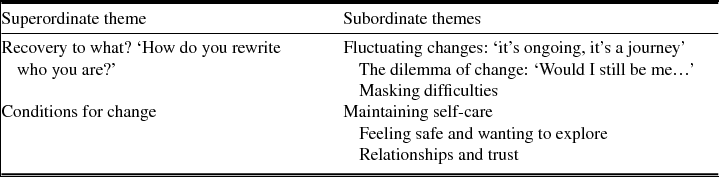
Two superordinate themes were synthesized from the data: (1) Recovery to what? ‘How do you rewrite who you are?’ and (2) ‘Conditions for change’. Each superordinate theme consists of three subordinate themes that are defined and illustrated using the data below. Where possible, direct extracts from the transcripts are used in the titles and description of the theme in an attempt to remain as grounded within the data as possible. A summary of the themes is presented in Table 2.
Summary of themes

(1) Recovery to what? ‘How do you rewrite who you are?’ (PamFootnote 1 3:9Footnote 2)
This theme concerns the way in which people with a BPD diagnosis describe recovery as unobtainable, unrealistic and unrecognizable. It is constructed as a superordinate theme as it encompasses a notion of change being multifaceted, dynamic and having far-reaching implications for individuals’ sense of self. Participants described recovery as implying a return to a past ‘well self’ which they had never experienced. Participants constructed their problems as being the result of life-long experiences and difficulties. Therefore, as life had never been ‘normal’, the notion of returning to normality was unrecognizable and ultimately unacceptable or irrelevant:
Lucy: I've never felt normal, normal was always something different when I was a kid (1:10)
Stacey: there was not a time where I felt that things were OK (1:2)
Paul: recovery seems like, to recover to some sort of normal life and I don't know what normal is and I don't think I've ever had it (1:3)
Fluctuating changes: ‘It's ongoing, it's a journey’ (Pam 2:1)
Despite the difficulties with the notion of ‘recovery’, participants did not describe their mental health experience as static but rather could identify with it as a fluctuating process. This subtheme concerns the idea that there is a lack of linearity in the process of change:
Norman: . . . you might get better with one thing then something else will start up (2:1)
Stacey: they are definitely transient the symptoms . . . it always feels like things move in and out of remission in a way (1:10)
Pam: Yeah, there are times when you're on an even keel and then there's times when you hit the bottom again and then there's times when it just changes a bit (3:3)
Also important was the sense that measuring changes in all-or-nothing terms may lead people to feel as though they have ‘failed’ and thus contribute to hopelessness:
Kate: . . . it's not a line, you're kind of going up and down I think, so if you try to measure recovery, I think you'll just end up feeling . . . a bit of a failure really (1:9)
Taken together, this subtheme suggests that the measurement of change may need to take this fluctuating process into account. In addition, it may be important to consider the way in which change is constructed and communicated in order to ensure that measures do not inadvertently lead to a sense of hopelessness or failure.
The dilemma of change: ‘Would I still be me without them?’ (Lucy 1:10)
This subtheme concerns a sense of uncertainty expressed by participants regarding who they would be without their symptoms. Within this theme, participants described change as being ‘scary’ and difficult to imagine coupled with a loss of identity if they did change:
Pam: . . . I just know there's something quite different (about me) but I'd like to be the same as everybody else but I know I'm not (3:5)
Lucy: . . . the way I feel about it. . . I just feel (the symptoms) are quite inherent to my personality, would I still be me without them? (1:10)
Perhaps linked with the difficult dilemma regarding how and whether to change, participants expressed a sense that they simply managed their difficulties (‘damage control’) rather than attempting to move forward or change:
Stacey: my main objective is to stay alive and like kind of damage control (1:2)
Pam: I can't ever imagine doing anything different. . . I think it's (self-harm) partly habit, partly a comfort thing . . . so I don't believe it'll ever stop (3:14)
Masking difficulties
This theme concerns some of the challenges participants identified with measuring change. Participants suggested that change measured in simplistic ways may mask the complexities of the difficulties they manage:
Paul: I'm incredibly needy. . . I cling to that person and do anything I can to stop them from leaving me. . . but I'll do everything I possibly can to not put myself in that situation (1:9)
Lucy: I go so far out of my way to avoid even situations where I can be abandoned (1:8)
Participants described how superficially others may regard them as well but they are managing through the use of destructive behaviours or avoidance:
Lucy: (impulsivity) might look like it's come down . . . someone will look healthy again but actually no, it's only come down because I didn't get on a motorbike (1:13)
Norman: there's the thing of like, destructive habits but just because you've got rid of those doesn't mean you've got a normal life (2:3)
Sam: . . . having quite a high-level job through the day and then in your insomnia setting up (a project) through the night and then going back to work again. People see that as being well. . . I don't think that's the right way to go (1:4)
One participant suggested that overcoming this difficulty would require questioning at multiple levels including exploring whether respondents were avoiding situations altogether:
Linda: measuring it (relationships) would first be about . . . are you avoiding it altogether . . . or are you managing things better . . . managing positive and healthy, happy relationships (1:20)
(2) Conditions for change
The second over-arching theme concerns the conditions or baseline for change. Participants described a number of aspects of change including basic conditions being met (e.g. financial security) before other changes should be measured. This superordinate theme is made up of a number of subordinate themes which include participants’ views of measurable aspects of change and what baseline conditions need to be met before higher order change might be measured.
Maintaining self-care
Participants described some aspects of their living conditions or lifestyle that they perceived as central to their wellbeing. These were summarized by one participant as self-care and encompassed living in a tidy environment, sleeping and eating in a healthy way, maintaining physical care and being organized. Again, these factors appear to be linked with the broad superordinate theme of conditions for change as participants suggested that change would not be possible without their self-care being maintained.
Sam: for me it's simple things like getting up, making sure I'm keeping the place tidy and things, washing. . . (1:14)
Stacey: it's sort of self-care, isn't it? It's sleeping right, eating right, washing, showering, keeping your surroundings tidy, having some sort of organisation in your life
‘Feeling safe and wanting to explore’ (Stacey 1:2)
In addition to basic living conditions, many participants described how important it was to feel safe as a baseline for making changes from. Without a sense of safety or security, many participants described changes as being impossible:
Stacey: for me recovery (is about) . . . not operating from a place of anxiety where I'm trying to do damage control, it would be more about feeling safe and wanting to explore and being more outgoing and positive (1:2)
Once safety is established, participants described a number of important factors as marking changes in their recovery. These included doing things outside of mental health services, making and fulfilling commitments, and having goals for the future.
Relationships and trust
The ability to trust was a theme that could be identified in each focus group. Participants described a range of difficulties associated with relationships, although trust appeared to be a central focus for most. An increase in stable and trusting relationships was suggested to be a marker for change and sign that things were getting better.
Norman: not taking every single tiny thing and turning it into a negative and then seeing it as rejection and then acting out to test them (2:21)
Kate: Things are beginning to change. . . I'm trusting . . . I can see why I don't trust, my past experiences (2:10)
Discussion
There remains limited consensus regarding best treatments for people with BPD (NICE, 2009) and available treatments show small effect sizes (Cristea et al., Reference Cristea, Gentili, Cotet, Palomba, Barbui and Cuijpers2017) and are continually marred by high drop-out (Cristea et al., Reference Cristea, Gentili, Cotet, Palomba, Barbui and Cuijpers2017). Furthermore, there is limited agreement regarding what and how to measure change for people with BPD. The implications for people with BPD are huge: we know little about how to help them (Cristea et al., Reference Cristea, Gentili, Cotet, Palomba, Barbui and Cuijpers2017) and whether available treatments match the priorities and needs of this population. NICE (2009) calls for research into an outcome measure for BPD which is both meaningful to service users and universal across treatments. The aim of the current study was to speak directly to individuals with BPD in order to understand their perspectives and experiences of recovery as a first step in the process of working towards the design of a suitable outcome measure.
Using semi-structured interview techniques, this investigation identified two superordinate themes each consisting of three subordinate themes. The first superordinate theme concerned the complexity of measuring change in a group who do not identify recovery as a return to a former functioning self. The theme further concerned the fluctuating nature of change and how superficial measures of change (e.g. whether someone is working) can mask dysfunctional coping behaviours that associated with apparent functioning (e.g. the person is overwhelmed by work, demonstrating apparent rather than genuine competence and only coping by engaging in self-destructive behaviours). The second superordinate theme focused on how change is contingent on basic living conditions (e.g. self-care), sense of safety and security and trust in others.
The first superordinate theme suggests that the concept of recovery may require further exploration and definition before it can be deemed helpful or relevant. This is echoed in previous research (Biskin, Reference Biskin2015). Furthermore, this investigation suggests that change and wellness are extremely complex for people with BPD and measures of change need to allow for this complexity. According to our participants, superficial measures of functioning or symptoms may not capture the dysfunctional coping behaviours that they have developed or the fluctuating nature of change and wellness that they experience. Droscher et al. (unpublished) support this notion, positing that measures used in BPD research may be more appropriate for axis 1, rather than axis 2 conditions, given that they measure overt symptom reduction.
A further issue described by participants was the way in which simplistic symptom measures may contribute to individuals feeling misunderstood and may lead to greater hopelessness within a group already high in hopelessness (Soloff et al., Reference Soloff, Lynch, Kelley, Malone and Mann2000). Alongside this, participants expressed a sense that they would not know who they were without identifying with psychiatric symptoms. This underlines the importance of developing measures that are meaningful and relevant to this population; participants describe both a sense of failure if they have not improved on symptom measures and an identity so fragile that without symptoms they would not know who they are. Indeed, the language we use to describe and explore change within this group is paramount given that identity disturbance is one of the core features both identified in this investigation and in the diagnostic nosology.
The second superordinate theme appears to link with Maslow's Hierarchy of Needs (Maslow, Reference Maslow1943). Participants’ descriptions of self-care (housing, financial security, getting adequate food and sleep) resonates with Maslow's ‘physiological needs’ forming the most fundamental level of need. Participants also described the importance of feeling safe and secure and having stable and trusting relationships which seems again to reflect aspects of the ‘safety needs’ and ‘belongingness and love needs’ described by Maslow. According to Maslow, if basic conditions and needs are not met, a person cannot achieve higher order needs (such as esteem needs including a sense of achievement, value and contribution). Castillo et al. (Reference Castillo, Ramon and Morant2013) explored recovery as defined by people with a Personality Disorder diagnosis and similarly developed a pyramidal model that reflected Maslow's (Reference Maslow1943) work. Whilst further research is required to explore and validate these notions, it seems possible that measures of change should consider basic QoL factors as well as motivation to engage in certain types of therapy or treatment.
Taken together, the themes suggest that a greater emphasis on QoL (or the qualities of a ‘good enough’ life) may be appropriate and important in measuring change for people with BPD. Furthermore, change is a dynamic process for individuals with BPD and helping individuals put voice to this process is critical in instilling hope. We believe that by listening more closely to the needs and wishes of those with BPD we can better tailor our outcome measures and set as a priority the robust and meaningful evaluation of psychological interventions for this group of individuals.
There are some limitations to the present investigation, many of which are due to the naturalistic nature of this work, which was conducted across two busy specialist Personality Disorder services. Although participants met the criteria for a BPD diagnosis on entry to the service [ZAN-BPD (Zanarini et al., Reference Zanarini2003) and MCMI-IV (Millon et al., Reference Millon, Grossman and Millon2015)], they were not formally diagnosed as part of this project and instead self-identified as having received a BPD diagnosis. Therefore, participants may not be deemed to have BPD if diagnosed via structured interview (Zimmerman and Mattia, Reference Zimmerman and Mattia1999). However, the notion of BPD itself is extremely problematic and arguably has limited reliability regardless of method of diagnosis (Akiskal, Reference Akiskal2004). Exploring the problematic nature of the diagnosis is beyond the scope of the current review. Additional limitations include all participants being recruited from specialist services, which may limit the extent to which the findings can be generalized to other settings. However, our impression is that many individuals with BPD are not embedded within other settings, they are simply not receiving treatment. Whilst qualitative methodology allows for rich data, the small sample size is a further limitation and may have an impact on the generalizability of this investigation. Finally, participants were all currently engaged in specialist mental health services and this may have an impact on the extent to which they are able to consider change within their lives. Detailed information regarding participants’ length of time within the service was not available and some participants had been known to other services prior to their engagement in the services used in this study. This may have caused variation in responses. Future research might benefit from the inclusion of people at various stages of their recovery to explore whether change indicators are different at different stages of recovery.
Conclusion and recommendations
The present investigation highlights the complexity of capturing clinical outcome and change for people with BPD. Whilst further research is needed, it seems that measures of change may need to account for the complexities individuals with BPD experience with their core sense of self and that a single symptom focus is likely to be unsatisfactory for this population. We believe that this investigation forms the start of a wider piece of research defining and validating how change might be measured for people with BPD. Our next step will be to follow the recommendations from NICE (2009) and in collaboration with service users and staff to identify whether there are any current measures that may be deemed appropriate for this population. Our current expectation is that this is unlikely and therefore further research will be required to develop a meaningful tool. We welcome collaboration from interested individuals and services.
Acknowledgements
We thank the service users who participated in the focus groups. We also thank Amit Jagdev and Sarah Jones who supported the development of this paper, and Pia and Janette for their support developing the interview schedule.
Conflicts of interest: Louise McCusker, Georgina Pike, Marie-Louise Turner and Helen Startup have no conflicts of interest with respect to this publication.
Ethical statement: The authors have abided by the Ethical Principles of Psychologists and Code of Conduct as set out by the APA. Ethical approval was not needed as the project fell within the remit of routine service evaluation. It was registered locally with the Trust Audit Team.
Financial support: This research received no specific grant from any funding agency, commercial or not-for-profit sectors.



Comments
No Comments have been published for this article.