Implications
We analyzed the impact of protected designation of origin specifications and of a mountain environment on breeding values of cows and on the husbandry effects at the herd level in the northern French Alps. The presence of a milk yield limit in the specifications and a ‘high mountain’ environment were associated with (i) a higher average lactation rank (Abondance breed), (ii) calving grouped in winter (Abondance and Tarentaise breeds) and (iii) lower estimated breeding values or herd–year effects for milk yield and protein content (Abondance and Montbéliarde breeds) in the majority of cases but with certain exceptions. The different breeds showed specificities and we discuss the leeway farmers have to adapt their farming system subject to the constraints they face.
Introduction
Agriculture in mountainous areas has to face specific environmental constraints. In the mountainous areas of Europe with a humid climate, dairy cattle production is a major agricultural activity and the milk is often processed into cheese under quality and/or origin certification. Protected designation of origin (PDO) certification identifies and promotes the typical characteristics of a product together with local know-how. In the northern French Alps, several cheeses have a PDO label and these represent the majority of cheeses produced in that area (approximately 60% to 70%, according to Agreste and data from INAO, the French institute for geographical indications and quality). Thanks to the combined effects of the PDO reputation and the use of evocative names, how the cheese industry is structured with small factories (mainly managed by the farmers themselves), and strong consumer demand means that the price premium concerns not only cheese but also milk. The price that farmers receive for their milk is from 35% to 60% higher than the national mean (Ricard, Reference Ricard1994; Verrier et al., Reference Verrier, Tixier-Boichard, Bernigaud and Naves2005). PDO cheese specifications imply that certain rules have to be respected and that these may have an impact on local production activities (Hauwuy et al., Reference Hauwuy, Delattre, Roybin and Coulon2006). In particular, the area of production is restricted, the milk has to be produced by cows from two or three specified cattle breeds and silage cannot be used as feedstuff. In some cases, there is a milk yield limit (averaged at the herd level). During interviews conducted in a previous in-depth field study (Lambert-Derkimba, Reference Lambert-Derkimba2007), farmers and other actors of the cheese market chain said that the aims of the milk yield limit are to avoid over-intensification, promote pastoral farming systems, maintain the high quality of the cheeses and preserve a good public image of these products. Such a collective choice may also be linked to the sustainability of the livestock systems at the regional level (Gibon et al., Reference Gibon, Sibbald, Flamant, Lhoste, Revilla, Rubino and Sørensen1999).
PDOs have different rules and the area of production of a given PDO generally includes a variety of environments. Within a PDO area, farmers are free to produce milk for another kind of product. Hence, farmers who choose to produce under PDO certification agree with the specifications and are supposed to accept the corresponding constraints. On the other hand, farmers have no choice in the environmental constraints they face. The abovementioned interviews enabled us to conclude that the PDO specifications and the mountain environment were two key factors taken into consideration by the farmers in the genetic management and husbandry of their herds (Lambert-Derkimba, Reference Lambert-Derkimba2007). In this context, the choice of artificial insemination (AI) bulls and the choice of a feeding system appeared to be of particular importance. Based on this qualitative information, we asked ourselves two questions. First, to what extent do PDO specifications and/or the constraints due to the mountain environment impact the spatial distribution of cows’ breeding values and of environmental effects at the scale of the herds? Second, what is the proportion of individual (the farmer makes the decision) and collective (breed management) choices concerning herd dynamics in the face of existing constraints? The purpose of this study conducted in the northern French Alps was to analyze the consequences of the cheese production specifications and of the mountain environment for (i) the estimated breeding values (EBVs) of cows and the herd × year effects (HYEs), as revealed by the results of the national genetic evaluation procedure based on performances recorded on the farm and (ii) some simple husbandry indicators such as the distribution of lactation ranks and calving months.
Material and methods
Area, PDO cheeses and breeds under study
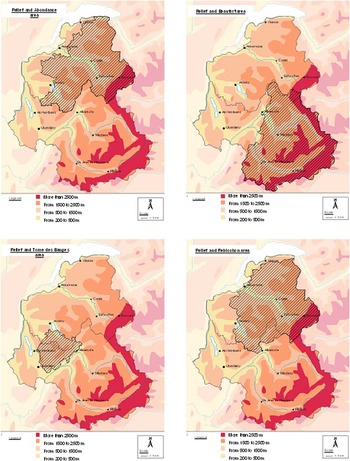
The study was conducted in the departmental administrative districts of Savoie and Haute-Savoie in the northern French Alps, near the border with Switzerland and Italy, where there is a west–east altitude gradient from 350 to 4810 m (Figure 1). The two districts were chosen because they cover the whole production area of four PDO cheeses produced in the French Alps (Figure 1) and most of the area where the two French alpine cattle breeds, Abondance and Tarentaise, are raised. According to the most recent national census in 2000, the total number of reproducing cows of these two breeds was about 55 000 and 13 000, respectively. The two districts accounted for 56% and 75% of these cows, respectively.
(Color online) Map of the Savoie and Haute-Savoie departmental districts showing the production area of the four PDO cheeses (hatched areas) (www.sabaudia.orgv2carterelief.php.gif and INAO)

All Abondance cheeses and most Reblochon cheese are produced in the Haute-Savoie district, and the two production areas overlap (Figure 1). Most Tome des Bauges cheese is produced in the Savoie district but one part, which is located within the Haute-Savoie district, overlaps with the two previous areas. Beaufort cheese is mainly produced in the Savoie district and this area overlaps slightly with the Abondance and Reblochon cheese production areas. Table 1 lists some characteristics of the four PDO cheeses. On the basis of quantity, Reblochon is the main cheese produced in the study area and ranks 4th among the 43 French PDO cheeses produced nationally. According to PDO specifications, the milk processed into cheese must be produced by cows belonging to only three breeds: Abondance and Tarentaise, which originate from the northern French Alps, and (except for the production of Beaufort cheese) Montbéliarde, which originates from the Franche-Comté region and which, according to the 2000 census, is the second French dairy cattle breed based on population size. Abondance is the only breed that contributes substantially to all four cheeses. Montbéliarde contributes to a large part of the production of the three cheeses for which it is allowed, and the Tarentaise breed is mainly used for the production of Beaufort cheese. The specifications of the two PDOs that concern the most widely produced cheeses in the Savoie district (Beaufort and Tome des Bauges) include a milk yield limit, whereas the specifications of the other two PDOs do not.
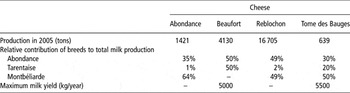
Production of PDO cheeses: relative contribution of dairy cattle breeds to milk produced for processing, and maximum cows’ milk yield (averaged at the herd level) allowed in the product specifications

PDO = protected designation of origin.
Source: INAO and Lambert-Derkimba et al. (Reference Lambert-Derkimba, Casabianca and Verrier2006).
Data, traits and variables analyzed, factors of variation
In France, the commune is the smallest territorial administrative district and PDO areas are usually defined at the level of the commune, as are European subsidies for mountainous areas. Four data sources were used for this study: (i) the official list of communes in the Savoie and Haute-Savoie districts, (ii) the list of communes in each PDO area (available from the French National Institute for Origin and Quality, INAO), (iii) the list of communes concerned by subsidies for mountainous areas defined by the European Union and the French Government and (iv) the national database for dairy records and genetic evaluation (Système d’Information Génétique, SIG), in which each animal is identified by a unique 12 digit number that includes the number of the commune where the farm to which it belongs is located. It should be noted that in our study area, some herds spend the four summer months in high altitude pastures (called ‘Alpages’), which may be located in a different commune than the farm (see, e.g. Verrier et al., Reference Verrier, Tixier-Boichard, Bernigaud and Naves2005); however, in the database, no information about this practice was available.
Lactations recorded in the two districts from September 2005 to August 2006 were analyzed. Depending on the breed, the proportion of cows having calved twice during this period ranged from 0.5% to 3.3%. In this case, the second lactation was excluded, so that only lactations from different cows were analyzed. For statistical reasons, for a given breed, herds with less than five recorded lactations were excluded. A total of 37 023 lactations were analyzed, with the following distribution: 10 346 lactations by Abondance cows in 407 herds; 5161 lactations by Tarentaise cows in 164 herds; 21 516 lactations by Montbéliarde cows in 582 herds.
Two characteristics of the lactations known to influence dairy performances were analyzed as discrete variables. First, lactation rank with five categories, with the fifth category including rank five and above, and second, the month of calving with 12 categories.
Three dairy traits were taken into consideration: milk yield (in kg/lactation), and protein and fat contents (in g/kg of milk). The individual performances (P) available in the database were obtained by multiplicative pre-adjustment of the recorded values for both lactation rank and length, and the pre-adjustment was applied according to the national procedure for genetic evaluation of dairy cattle (http://www-interbull.slu.se/national_ges_info2/framesida-ges.htm). Table 2 shows the mean and the standard deviation of the pre-adjusted performances for the three traits in the three breeds. For each trait, two quantitative variables were analyzed: the EBV of each cow and the HYE of each herd, which were the results of the official French genetic evaluation procedure, performed with a single-trait animal model BLUP accounting for within-herd heterogeneous genetic and residual variances (Robert-Granié et al., Reference Robert-Granié, Bonaïti, Boichard and Barbat1999).
Overall mean ± s.d. of the three traits studied in the three main breeds raised in the Savoie and Haute-Savoie departmental administrative districts, recorded during the period from September 2005 to August 2006

Performances are expressed in 305-day mature equivalent.
The two factors of variation considered were the status of the commune with respect to (i) the cheese production specifications and (ii) the mountain environment. Owing to the rather large overlap of the PDO areas (see Figure 1), it was not possible to distinguish between the four cheeses produced in the area. However, areas with a milk yield limit in their PDO specification (Beaufort and Tome des Bauges) overlap only slightly with areas having no limit (see Figure 1). Consequently, three categories of communes were defined with an increasing level of constraints for milk production: (i) No PDO, (ii) PDO with no milk yield limit and (iii) PDO with a milk yield limit. When one commune was located in an area with a PDO with no milk yield limit and simultaneously in a PDO with a milk yield limit, the commune was included in the ‘PDO with no milk yield limit’ category: 46 communes out of a total of 577 fell into this category. Concerning the mountain environment, we simply adopted the classification used by the European Union and included in the French legislation (Law Nr 85-30, 9 January 1985) according to criteria of altitude, slope or both and according to the massif. In the Alps, four categories are defined with an increasing level of natural constraints: (i) plain (no natural constraint due to altitude or slope), (ii) piedmont (communes on the border with mountainous areas), (iii) mountain (minimal altitude of 800 m for 80% of the area of the commune) and (iv) high mountain (average altitude of the commune above 1200 m).
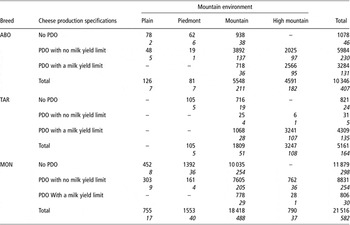
Table 3 shows the distribution of available lactations and herds according to the two factors considered for each breed. All communes in the high mountain category were included in at least one PDO area, and in the plain or piedmont communes there is no PDO with a milk yield limit, which explains why some cells in Table 3 are empty. Moreover, the data may appear to be rather unbalanced, because the majority of the communes (514 out of 577) are classified in the mountain or high mountain categories. The prevalence of the three breeds varied with the area. The Abondance and Tarentaise breeds were most present in the mountain or high mountain categories (98% of the lactations of each of the two breeds), whereas the Montbéliarde breed was rare in the high mountain environment. Data on the Abondance breed came from all cheese production specification categories, with substantial numbers and relatively balanced proportions (10.4%, 58.2% and 31.3%, respectively). Conversely, data from the Tarentaise breed mainly came from the category ‘PDO with a milk yield limit’ (83.3% of the lactations), while data from the Montbéliarde breed were scarce in this category (3.7% of the lactations).
Distribution of lactations (normal font) and herds (in italics) across the categories of communes defined for cheese production specifications and for the mountain environment

ABO = Abondance; TAR = Tarentaise; MON = Montbéliarde; PDO = protected designation of origin.
Statistical analysis
Owing to the differences across breeds concerning the data design (see above), and because genetic evaluation is performed within a given breed, each breed and each variable were analyzed separately.
The independence of the discrete variables (lactation rank and calving month) with respect to the factors under study (cheese production specifications and mountain environment) was checked with a χ 2 test. The mean and the standard deviation of the lactation rank were computed for each combination of categories for the two factors under study. The distribution of calving months was assessed by simple counting. Attention was paid to the proportion of calving from June to September, because this 4-month period roughly corresponds to the period when the cows graze on high-altitude pastures and farmers who practice transhumance with their herd try to avoid calving during this period (e.g. Verrier et al., Reference Verrier, Tixier-Boichard, Bernigaud and Naves2005).
By construction, both EBVs and HYEs are corrected for the effects of all environmental factors identified within the framework for the genetic evaluation of dairy cattle. Therefore, for each trait and for each variable (EBV or HYE), a two-factor ANOVA was performed using the following simple model:

In this equation, the subscripts refer to the category of cheese production specifications (i), the mountain environment category (j) and the cow or the herd considered (k). Y is the observed value, μ the overall mean, c the fixed effect of the category for cheese production specifications, m the fixed effect of the category for mountain environment and E is a random error. The data design (see Table 3) did not allow us to check for interaction between the two factors. Whatever the variable analyzed, a Bonferroni correction was applied for multiple comparison tests for a given breed and a given factor.
For the Abondance and Montbéliarde breeds, all data were analyzed enabling comparison of all categories for each factor. For the Tarentaise breed, due to an unbalanced design (see Table 3), data from the ‘PDO with no milk yield limit’ category and data from the ‘piedmont’ category were excluded from the analysis, which limited the comparison to only two cheese production specification categories and two mountain environment categories.
Results
Distribution of lactation ranks and calving months
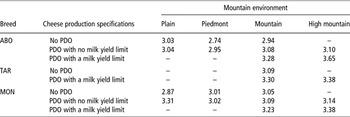
Table 4 shows the average lactation rank according to the combination of categories for the two factors of variation considered. In the Abondance breed, the lactation rank was found to be associated with cheese production specifications and mountain environment (P < 0.001 in both cases). The lactation rank increased with an increase in production constraints (Table 4), the difference between the two extreme values being 0.91. A similar trend was observed in the Montbéliarde breed, with a difference between extreme values of 0.49, but no significant association was found with cheese production specifications (P = 0.057) or with mountain environment (P = 0.572). In the Tarentaise breed, no significant association was found with the two factors (P = 0.153 and 0.131, respectively).
Average lactation rank according to cheese production specifications and mountain environment. Depending on the breed and the categories considered, the s.d. ranged from 1.71 to 2.37

ABO = Abondance; TAR = Tarentaise; MON = Montbéliarde; PDO = protected designation of origin.
No data is given for the Tarentaise breed in the ‘PDO with no milk yield limit’ and ‘piedmont’ categories.
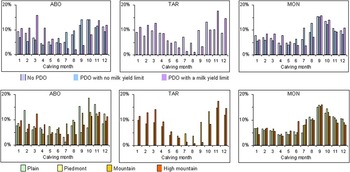
Figure 2 shows the distribution of calving during the year. In all breeds, the calving month was found to be associated with the two factors considered (P < 0.001 in all cases). In the Abondance and Tarentaise breeds, calving was most grouped in the ‘PDO with a milk yield limit’ and ‘high mountain’ categories: in these two categories, the proportion of calving between June and September was rather low in the Abondance breed (12.3% and 20.9%, respectively) and very low in the Tarentaise breed (8.7% and 6.3%, respectively). In the Montbéliarde breed, differences between categories were less marked than in the other breeds, and this was all the more true in the ‘mountain environment’ factor. In the ‘PDO with a milk yield limit’ category, the proportion of calving between June and September was 18.6%, which was substantially less than in the other two categories of ‘cheese production specifications’. For the ‘mountain environment’ factor, the proportion ranged from 36.5% (plain) to 45.5% (high mountain).
(Color online) Distribution of calving month (1 = January, etc.) according to the cheese production specifications (top graphs) and the mountain environment (bottom graphs). Breeds: ABO = Abondance, TAR = Tarentaise, MON = Montbéliarde.

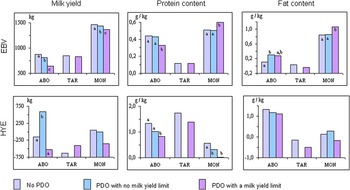
Effect of cheese production specifications on dairy traits (Figure 3)
In the Tarentaise breed, no significant effect of the cheese production specifications was found for any trait or any variable (P-values ranged from 0.238 to 0.822). However, significant effects were found in the other two breeds.
(Color online) Least square means of cows’ estimated breeding values (EBV), herd × year effects (HYE) according to the cheese production specifications. Values with different letters are significantly different. No letter means that there is no significant difference between the values. Owing to differences in reference bases among the breeds, the comparison of absolute values from one breed to the other is not meaningful. The scale for the y axis differs from one graph to another. No data are given for the Tarentaise breed in the ‘protected designation of origin (PDO) with no milk yield limit’ category. Breeds: ABO = Abondance, TAR = Tarentaise, MON = Montbéliarde.

The effect of the cheese production specifications on EBVs for milk yield was highly significant (P < 0.001) in both the Abondance and Montbéliarde breeds. In these two breeds, the average cows’ EBV decreased with an increase in cheese production constraints (Figure 3), the difference between extreme values being 226 and 93 kg in the Abondance and Montbéliarde breeds, respectively. The effects on HYE were significant in the Abondance breed only (P < 0.001). Mean values were highest in the ‘PDO with no milk yield limit’ category (Figure 3), the difference between this category and the other two categories being 740 and 1110 kg, respectively.
Concerning the protein content, in the Abondance breed the effect of the cheese production specifications on EBV was highly significant (P < 0.001) but not significant on HYE (P = 0.054). The trend was the same for the two variables, the mean being lower in the ‘PDO with a milk yield limit’ category (Figure 3) by about 0.1 g/kg for EBV and 0.5 g/kg for HYE. In the Montbéliarde breed, both EBVs and HYEs were significantly affected (P = 0.019 and < 0.001, respectively) but the trends were opposite (Figure 3). The difference between the extreme mean values of each variable was of the same magnitude as in the Abondance breed. Concerning the fat content, there was a significant effect on EBV in the Abondance and Montbéliarde breeds (P = 0.023 and 0.001, respectively). In the Montbéliarde breed, there was a similar trend in EBV for the fat and protein contents, and the mean value increased with an increase in the level of constraints, whereas in the Abondance breed the reverse trends were observed (Figure 3). No significant effect was found on HYE for fat content, whatever the breed.
Effect of the mountain environment on dairy traits (Figure 4)
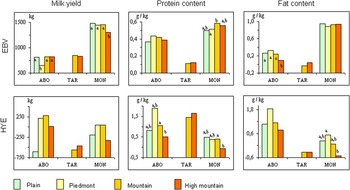
Just as for ‘cheese production specifications,’ no significant effect of the mountain environment was found in the Tarentaise breed for any trait or any variable (P-values ranged from 0.105 to 0.930).
(Color online) Least square means of cows’ estimated breeding values (EBV), herd × year effects (HYE) according to the mountain environment. Values with different letters are significantly different. No letter means that there is no significant difference between the values. Owing to the differences in reference bases among breeds, the comparison of absolute values from one breed to the other is not meaningful. The scale for the y axis differs from one graph to another. No data are given for the Tarentaise breed in the ‘plain’ and ‘piedmont’ categories. Breeds: ABO = Abondance, TAR = Tarentaise, MON = Montbéliarde.

The effect of the mountain environment on EBVs for milk yield was significant in the Abondance (P = 0.002) and Montbéliarde (P < 0.001) breeds. In both breeds, one category had a lower value than the others, by about 150 kg, namely, the ‘piedmont’ category in the Abondance breed and the ‘high mountain’ category in the Montbéliarde breed (Figure 4). Unlike for EBV, no significant effect was found for HYE.
Concerning milk composition, EBVs for protein content were only significantly affected in the Montbéliarde breed (P = 0.005) and for fat content in the Abondance breed (P = 0.015). The effect on HYE for protein content was highly significant in the Abondance breed (P < 0.001) and slightly significant in the Montbéliarde breed (P = 0.051). HYEs for fat content were only significantly affected in the Montbéliarde breed (P = 0.018). When significant, differences between average values were about 0.1 to 0.2 for EBVs, 0.5 for HYE for protein content and 1.0 for HYE for fat content (Figure 4).
Discussion
Relevance and limits of our working scale
We chose to include a large number of herds (a total of 1153 herds, see Table 3) for which information was available on a few variables rather than a small sample of herds in which more variables could have been used. This practice, which is very common in animal genetics studies, generally allows significant trends to be detected (if there are any) but does not allow the researcher to go into detail when interpreting the results. This study would benefit from further complementary analyses, based on large surveys with detailed questionnaires (e.g. Keown, Reference Keown1988; Leroy et al., Reference Leroy, Verrier, Wisner-Bourgeois and Rognon2007) or on a fine description of performances and farmers’ practices in a small sample of herds (e.g. Agabriel et al., Reference Agabriel, Coulon and Marty1991, Reference Agabriel, Coulon, Marty and Bonaïti1993 and Reference Agabriel, Coulon, Journal and de Rancourt2001; Dubeuf, Reference Dubeuf1995; Coulon et al., Reference Coulon, Hauwuy, Martin and Chamba1997).
With the kind of data available, the finest scale for our spatial analysis was communal, and we only considered the location of the farm. That meant that it was not possible to account for either within-commune variability with respect to the use of milk (PDO v. no PDO) and the mountain environment or the practice of transhumance of some herds. However, concerning the PDO classification, field studies (e.g. Lambert-Derkimba, Reference Lambert-Derkimba2007) revealed that the majority of the farms located within a PDO area are concerned because of the attractiveness of the supply chain and the high milk price farmers can obtain thanks to PDO certification. As the classification of the mountain environment is based on very simple and aggregate criteria, the real mountain conditions of each farm were only approximated. Such an approximation may partly explain why the effect of the ‘mountain’ factor appeared to be significant in fewer cases than the effect of the ‘PDO’ factor. However, there was a clear gradient – at least in altitude – between a plain and a high mountain, with consequences concerning climatic conditions and the availability of feed resources. We assumed that the gradient was clear enough to enable us to interpret it. Even if we cannot be extremely precise, the aggregation of data in this study enabled us to reach a good understanding of the territorial dynamics of the breeds concerned.
Another limit of our work was the fact that the study period was limited to one year: to what extent are our results temporary or due to exceptional weather in the study period or a particular group of bulls being available to give birth to the recorded cows? The analysis of the average recorded dairy performances in the two departmental districts concerned in the period 2000 to 2009 revealed a slow and very regular trend, whatever the trait, the breed, the lactation rank and the calving month: for example, the between-year coefficient of variation of milk yield ranged only from 2% to 3% (Hélène Leclerc, personal communication). Based on meteorological data recorded in the French Alps from the middle of the 20th century to the middle of the 2000s, 2006 can be considered as an ‘average’ year (ONERC, 2008). Moreover, when comparing HYEs in a given year, as in this study, a change in average values, due, for instance, to differences in climatic conditions from one year to the next, would have no consequences for comparisons among herds. Only a change that affected different sub-areas differently would have consequences for such comparisons, and our study area is not large enough for this to be plausible. On the other hand, changes in the characteristics of the bulls used for breeding over time reflect demographic fluctuations and the genetic progress in the population. With overlapping generations and a generation length for the sire-sire path of about 9.0, 10.0 and 7.5 years in the Abondance, Tarentaise and Montbéliarde breeds, respectively (Mattalia et al., Reference Mattalia, Barbat, Danchin-Burge, Brochard, Le Mézec, Minéry, Jansen, Van Doormaal and Verrier2006; Danchin-Burge, Reference Danchin-Burge2009), the turnover in bulls is low (about 13% of new bulls each year, or less). Over the period 1995 to 2005, variations in the average EBV of AI bulls weighted by their annual number of services showed a relatively constant trend in each breed and for each dairy trait (Institut de l’Elevage and INRA, 2007). Under such conditions, it is doubtful that the group of bulls having procreated the cows for which data were recorded would have displayed unique features. We can thus reasonably consider that our results are not specific to the year under study.
Production constraints and farmers’ breeding and husbandry practices
In this study, both factors considered corresponded to a gradient of constraints due to PDO specifications and to the mountain environment. We analyzed the impact of an increase in breeding and husbandry constraints at the herd level as revealed by the genetic evaluation process. The clarity of the results varied with the variable, the trait and the breed considered. In particular, the effect of the factors of variation was found to be lower (i) on the distribution of lactation ranks than on the distribution of calving months, (ii) on fat content than on the other two dairy traits, (iii) on HYE rather than on EBVs and (iv) on the Tarentaise breed rather than on the other two breeds. In the last two cases, this may be at least partly due to smaller sample sizes for HYE (herds v. animals) and the Tarentaise breed (see Table 3). In the same way, the magnitude of the differences between average values (when significant) was higher (i) for fat content than for protein content, which is consistent with wider genetic and environmental variance in fat content and (ii) in HYE than in EBV, which is consistent with results of studies at the farm level (e.g. Agabriel et al., Reference Agabriel, Coulon, Marty and Bonaïti1993).
Concerning cheese production conditions, the clearest results came from the comparison between the two categories of communes with a PDO (with a milk yield limit v. without; owing to the structure of the data, this comparison was not possible in the Tarentaise breed). In both the Abondance and Montbéliarde breeds, a milk yield limit was associated with a higher average lactation rank and calving grouped in autumn and winter. In the Abondance breed, the differences in milk yield were in the same categories for both EBV and HYE, meaning that farmers use both genetic choices and husbandry practices to meet the criterion to produce milk for a PDO with a yield limit. It should be noted that the presence of a milk yield limit had a negative impact on HYE for both milk yield and protein content. As both traits to some extent depend on the energy available in the feed, this observation probably reveals that certain feeding practices are designed to respect the limit, such as reducing the amount of concentrates in the diet. In comparison with the Abondance breed, the picture in the Montbéliarde breed was similar for milk yield but opposite for protein or fat content. In particular, in the Montbéliarde breed, the situation for EBVs was consistent with the negative genetic correlation between milk yield and protein or fat content (at the level of the whole population), which was not the case in the Abondance breed. This could be due to more emphasis placed by Montbéliarde farmers on the restriction of the EBV for milk yield of the AI bulls used in their herd. Finally, the rank of the category ‘No PDO’ largely depended on the situation analyzed and it is difficult to distinguish a general trend. This may be due to the smaller sample size in this category (see Table 3) and to the rather marginal status of this area within two districts where the dairy industry is dominated by PDOs (Figure 1; Ricard, Reference Ricard1994; Lambert-Derkimba, Reference Lambert-Derkimba2007).
Concerning the impact of natural constraints through the classification of communes for the European mountain policy, the clearest results came from the comparison of the ‘mountain’ and ‘high mountain’ categories. In the Abondance breed, a high mountain location was linked with a higher average lactation rank, meaning that under these conditions the longevity of cows is a trait of more value than under other conditions. In both the Abondance and Tarentaise breeds, the proportion of calving in summer was much lower in the high mountain category, which was not the case in the Montbéliarde breed. The difference may be linked to the practice of the summer transhumance, which is common for the Abondance and Tarentaise herds but not so common for the Montéliarde herds (Verrier et al., Reference Verrier, Tixier-Boichard, Bernigaud and Naves2005; Lambert-Derkimba, Reference Lambert-Derkimba2007). Concerning the three dairy traits, when differences were significant, the mean values were systematically lower in the high mountain than in the mountain category, whatever the variable (EBV or HYE) or the breed. Indeed, the high mountain environment represents harsh conditions for milk production, including long winters, a short period for harvesting hay, varying climatic conditions and pastures on deep terrain. Moreover, farmers place less emphasis on milk traits in their breeding choices, according to interviews with the farmers (Lambert-Derkimba, Reference Lambert-Derkimba2007). The results observed in the other two categories (plain and piedmont) were less clear, partly due to smaller sample sizes (see Table 3). It should be noted that in communes located in the plain, which are assumed to be less or not at allsubject to natural constraints, the average values were rarely higher than in the mountain and even high mountain categories.
Specificities and management of the breeds under study
The Abondance and Tarentaise breeds originate from mountainous areas and, as already mentioned (see Material and Methods), are mainly raised in this area. By combining data on annual cheese production, the ratio of the quantity of cheese produced to the quantity of milk processed, and cows’ performances recorded on the farm, it was estimated that the equivalent of about 40% and 55% of the national Abondance and Tarentaise stock, respectively, were used to produce milk for the four PDO cheeses in this study (Lambert-Derkimba et al., Reference Lambert-Derkimba, Casabianca and Verrier2006). In particular, we estimated that 50% of Tarentaise cows were used to produce milk under specifications with a milk yield limit, whereas for Abondance cows the proportion was only 11%.
When defining the breeding goals of the Tarentaise breed through an aggregate genotype (called ‘ISU’ for dairy cattle in France), the breeders agreed almost unanimously not to focus on milk productivity, but on raising animals under stringent conditions and using high-altitude pastures (Lambert-Derkimba, Reference Lambert-Derkimba2007). Accordingly, among French dairy cattle breeds, the Tarentaise breed is the only one for which the relative weight of dairy traits in the aggregate genotype is lower than half (Colleau and Regaldo, Reference Colleau and Regaldo2001). The agreement between breeders concerning breeding goals, including breeders who are not concerned by a milk yield limit, could explain why no difference was found in EBV between the different categories considered (in addition to the statistical reasons mentioned above). Conversely, the definition of the aggregate genotype for the Abondance breed was the subject of controversy among breeders (Lambert-Derkimba, Reference Lambert-Derkimba2007). On the one hand, Abondance breeders in the same situation as Tarentaise breeders wished to emphasize functional traits and fat and protein contents. On the other hand, breeders located in communes without a PDO or with a PDO with no milk yield limit wished to focus on milk yield. This divergence in breeding goals among Abondance breeders could be the source of significant differences in EBV for milk yield, which varied with the conditions governing cheese production (see Figure 3).
From 1980 to 2000, the annual genetic gain in milk yield was estimated at +38.4 and +39.6 kg/lactation in the Abondance and Tarentaise breeds, respectively, that is, both breeds showed similar trends (Lambert-Derkimba et al., Reference Lambert-Derkimba, Astruc, Barbat, Boulanger, Casabianca and Verrier2007). The same authors showed that, conversely, the annual gain in herd-year effect was +19.2 kg in the Abondance breed and −12.6 kg in the Tarentaise breed. This analysis of the evolution of these two local breeds over time revealed their differences with respect to the milk yield limit specified in two PDOs. The ability of the Tarentaise breed to face its conditions may be seen as a crucial adaptive trait (Cardellino and Boyazoglu, Reference Cardellino and Boyazoglu2009), collective management being sufficient to ensure the ‘right’ animals for all the farmers. This phenomenon was not observed in the Abondance breed due to the low proportion of herds concerned by a milk yield limit, as well as more heterogeneous production conditions.
The case of the Montbéliarde breed is quite different from that of the two local breeds, because its population is very large: it is currently raised in almost all French departments and only a small percentage of cows are concerned by the districts and the PDO cheeses in this study. A large choice of AI bulls allows farmers to adapt their breeding strategy to their own farming system.
What is the leeway for farmers’ decisions?
The question of the leeway individual farmers have in the situation they face has been addressed frequently (McCown, Reference McCown2002), especially in the case of crop and fruit production (e.g. Doré et al., Reference Doré, Sebillotte and Meynard1997; Aubry et al., Reference Aubry, Capillon and Papy1998; Navarrete et al., Reference Navarrete, Le Bail, Papy, Bressoud and Tordjman2006). Some authors have suggested that this approach is also appropriate for animal production (Béranger and Vissac, Reference Béranger and Vissac1994), and several studies have addressed the question in terms of flexibility in work organization or allocation of grazing at the farm level (Coléno and Duru, Reference Coléno and Duru1999; Rapey et al., Reference Rapey, Lifran and Valadier2001; Girard et al., Reference Girard, Duru, Hazard and Magda2008; Madelrieux et al., Reference Madelrieux, Dedieu, Dobremez and Girard2009). Our results tackled this question in connection with breeding management at both the herd and population levels, and husbandry at the herd level.
Obviously, our data did not concern the way the farmers make their decisions. At our working scale, we can observe the combined effects of what the farmer is dealing with and the choice he/she makes among a set of possible choices, as described by Keown (Reference Keown1988). In particular, the choice of an AI bull can be considered as the concrete expression of the trade-off between (i) what is reasonably possible at a given time and in the prevailing situation, possibly including PDO requirements and/or environmental constraints and (ii) what the farmer expects in terms of improvement of the genetic potential of his herd. The leeway farmers have in decision-making is thus expressed by such concrete data. Incidentally, collective and individual decisions are not strictly independent. For instance, the choice of AI bulls used on the farm first involves a collective decision, that is, the selection of bulls to be used for breeding among a series of progeny-tested bulls and, second, an individual decision, that is, the farmer’s choice of bull among the AI bulls available to mate with a particular cow.
From our results, the real leeway farmers have in making a decision depends to a large extent on their particular situation. When collective management of the breed accounts for the PDO specification and for natural constraints (this was the case for the Tarentaise breed), our results did not provide evidence of diversified strategies in farmers’ choices. Conversely, where PDO specifications and natural constraints had less influence on the collective management of the breed (as observed in both the Abondance and Montbéliarde breeds), our results showed significant differences among categories that may at least partly result from different strategies in farmers’ choices and incidentally in more leeway for farmers in making their decisions.
The leeway farmers have may also depend on the size of the population and on the genetic variability of the breed. The Montbéliarde breed offers a large set of choices with about 700 000 cows and 600 AI bulls, whereas the Abondance breed is much smaller, with about 55 000 cows and 80 AI bulls and whose genetic variability has suffered from severe bottlenecks (Mattalia et al., Reference Mattalia, Barbat, Danchin-Burge, Brochard, Le Mézec, Minéry, Jansen, Van Doormaal and Verrier2006; Danchin-Burge, Reference Danchin-Burge2009). Such a contrast is consistent with what the farmers said in their interviews (Lambert-Derkimba, Reference Lambert-Derkimba2007) as those with a Montbéliarde herd appeared to use both genetic and husbandry strategies while those with an Abondance herd mainly use husbandry strategies.
Finally, in herds located simultaneously in the ‘PDO with a milk yield limit’ category and in the ‘high mountain’ category, we observed a conjunction of maximum of chosen PDO constraints and a maximum of not chosen environmental constraints. In this case, there was the least leeway for flexible decision-making. A reasonable explanation is that in order to better adjust the genetic potential of the herd to the high level of constraints, specialization toward adaptation to these constraints is the best possible solution. This trend toward specialization includes a risk of a too high dependence of the breeds on a particular environment, a particular market or both. Managers of local breeds should pay attention to different possible ways to develop diversified production systems, in order to avoid problems that could arise if, for instance, consumer demand for a particular PDO cheese disappears. Indeed, the reduction in real leeway that we evidenced in our data analysis corresponds to a dramatic narrowing in trade-off possibilities in extreme conditions. Inversely, when farmers face fewer constraints, chosen constraints (PDO specifications) as well as not chosen constraints (mountain conditions), they have a larger trade-off capacity.
Conclusion
Our work showed that in the case of the dairy farmers in the northern French Alps, PDO specifications including a milk yield limit (or not) have a real influence on the breeding and husbandry practices of farmers, whereas natural constraints only have an influence in the ‘high mountain’ category. Thus, adding a milk yield limit to the severe constraints already faced by cows in high mountains could be considered as a rather logical choice. This combination of maximum constraints led to extreme specialization and was linked to the minimum leeway for decision-making at the farm level. It would be useful to conduct similar investigations in other regions with harsh environments to check if our results can be generalized. From a methodological point of view, the fact that this study was based on database processing provides evidence that interviewing farmers and managers at a local level helps identify relevant questions upstream.
Acknowledgments
Financial support was provided by the French National Agency for Research (ANR) as part of the project ‘ANR-05-PADD-012, Promotion du développement durable par les indications géographiques’, and by the French Genetic Resources Bureau (BRG, now known as FRB) as part of the project ‘Signes officiels de qualité et races locales’. The authors thank Emilie Lebarbier and Didier Boichard for valuable advice and useful discussion. Two anonymous referees and the associate editor of the journal are also acknowledged for their helpful comments and suggestions.