Commenting in 1973 on yet another failure to achieve a settlement between Israel and its Arab rivals, Israeli Ambassador to the UN Abba Eban expressed his deep dismay by lamenting that ‘the Arabs never miss an opportunity to miss an opportunity’, and warned that ‘tragedy is not what men suffer but what they miss’. That the fault of the deadlock rested chiefly with the Arab states is highly debatable; nevertheless, Eban’s comments aptly elucidate the haunting specter of the road not taken and the high price of option rejection in international relations.
The consequences of actions taken are easy to observe and judge; the consequences of missed opportunities are more elusive, hence difficult to detect and analyze. Although naturally the number of options forgone far exceeds the number of those acted upon, the focus in conflict resolution research has clearly been on analyses of actions taken. For every article scrutinizing a significant missed opportunity for conflict settlement, there is a wealth of research addressing the consequences of agreements reached. This relative neglect should not be taken to imply that inaction does not have significant consequences or costs. In fact, it has been demonstrated that looking back on their lives, people tend to more poignantly regret omissions than commissions.Footnote 1
An outside observer of the conflicts in which protagonists vacillate between hostilities and attempts to reach a resolution through negotiations may very well wonder why the adversaries pass up, sometimes repeatedly, reasonable offers that could end the conflict. To account for such puzzling decisions, some scholars stress domestic political considerations, while others emphasize organizational, institutional and other structural factors. Although the importance of these factors is undisputed, there is a sense that they do not tell the entire story. To bridge this gap, in recent years numerous researchers have focused on the impact of psychological factors on decision making. This approach is aptly expressed in Levy’s observation that ‘… variations in the beliefs, psychological processes, and personalities of the individual decisions makers explain a significant amount of the variation in foreign policy behavior of states in the international system ….’Footnote 2 The considerable impact of the thriving subfield of political psychology could be seen as a tribute to the merits of this approach.
One psychological effect that has been successfully integrated into the international relations literature is the sunk cost effect: the tendency of individuals to continue committing resources (money, time or effort) to an endeavor even when the initial investment fails to produce the expected outcomes.Footnote 3 This article presents yet another psychological phenomenon that is likely to affect international relations, specifically within the realm of negotiations. We introduce the concept of inaction inertia, which was developed and extensively researched in the field of social psychology.Footnote 4 Briefly put, inaction inertia entails the tendency to continue to reject seemingly good action opportunities once a superior action opportunity has already been missed. A history of a missed opportunity renders decision makers susceptible to regret, which they can circumvent, at least temporarily, by turning down subsequent action opportunities. Thus, whereas sunk costs might motivate states to continue pursuing sub-optimal action policies, inaction inertia prevents them from adopting optimal action policies.
To demonstrate how inaction inertia may operate in international negotiations, we examine two types of situations: hostage negotiations and territorial disputes. We assess the potential contribution of the inaction inertia effect to the understanding and analysis of international negotiations using two laboratory experiments and an illustrative descriptive analysis. We conclude with a discussion of the theoretical and policy implications of our findings.
The Inaction Inertia Effect
The term ‘inaction inertia’ was first introduced by Tykocinski, Pittman and Tuttle to describe the reluctance of individuals who had missed an attractive action opportunity to take a subsequent action opportunity in the same domain. Inaction inertia occurs when the current opportunity is substantially inferior to the one forgone, although objectively it still has positive value in an absolute sense.Footnote 5 As Tykocinski and Pittman point out, ‘having passed up one opportunity to gain, the person becomes more likely to pass up another opportunity to gain, but gain less’.Footnote 6
In a classic demonstration of the effect, three groups of participants were asked how likely they were to purchase a ski pass for their favorite ski resort for $90 instead of the regular price of $100. Some of the participants were also told that had they acted sooner they could have taken advantage of a more attractive discount offer. Participants’ willingness to purchase the pass at the current price of $90 was influenced by the attractiveness of the opportunity they had already missed. Those who had missed an opportunity to purchase the pass for $40 were relatively reluctant to purchase it now, compared to those who had missed an opportunity to purchase it for $80, or compared to the control group, which had no history of a missed opportunity for the ski pass.Footnote 7 One could argue that the fact that an attractive deal existed in the past encourages people to wait for a recurrence of a similar golden opportunity. However, in another experiment the authors showed that inaction inertia occurs even when it is absolutely clear that the initial loss could not be recouped (Experiment 2).
Although the majority of inaction inertia research has inspected gain situations, the phenomenon has also been demonstrated in the domain of losses. Tykocinski, Israel and Pittman (Reference Tykocinski, Israel and Pittman2004) used a stock market simulation to demonstrate that investors who had missed an opportunity to leave a bear market were less likely to sell their stock at a later opportunity when facing a grave loss. This result is particularly important to our current perspective, as it suggests that inaction inertia processes are applicable to international negotiations, which often occur against the background of accumulated losses.
During the past decade, inaction inertia has been investigated in a variety of studies, employing both scenario and behavioral methodologies. Several explanations have been suggested to account for the effect. A key element in these explanations is the anticipation of regret. The psychological juxtaposition of the superior – forgone – opportunity and the inferior current opportunity triggers an unpleasant counterfactual thinking process (‘if only I had acted sooner …’) and provides fertile ground for a sense of loss and the experience of regret.Footnote 8 By quickly dismissing the current action opportunity, the decision maker is able to terminate this unpleasant thinking process and avoid the pangs of regret, albeit at the cost of missing yet another opportunity.
Any dynamic situation in which action opportunities with distinctive values are sequentially presented, and then either expire or are withdrawn, opens the door to inaction inertia. Thus the effect applies to a large variety of situations, and indeed has been employed to explain human behavior in varied domains such as consumer decision making,Footnote 9 investment decisionsFootnote 10 and academic procrastination.Footnote 11
One line of inaction inertia research has focused specifically on the conditions that moderate or terminate the psychological state of inaction inertia. Of the factors identified, two are particularly relevant for international negotiations analysis. First, inaction inertia might be moderated given high avoidance costs due to the existence of external constraints that force action. For example, in one experiment participants who had missed out on an attractive discount for an item were more likely to settle for a lesser offer if they were under time pressure to complete the transaction.Footnote 12 Secondly, actors are able to shake off inaction inertia if, using framing, their temporal orientation successfully shifts from focusing on past missed opportunities to focusing on potential future gains.Footnote 13
Inaction Inertia in International Negotiations
In international negotiations, settlement offers are sequentially presented and then either ignored, rejected or accepted by the protagonists. A large portion of the negotiation and bargaining literature focuses on causes for negotiation deadlocks, ‘the still points of all negotiation’Footnote 14 from which parties cannot move forward. Inaction inertia, we suggest, may play a significant role in the creation of negotiation deadlocks.
Traditionally, negotiation research was dominated by the rational approach that, focusing on parties’ preferences and cost-benefit analysis as the driving force behind negotiation decisions, identified strategic barriers as the main causes of deadlocks.Footnote 15 Fearon, for example, listed four barriers to negotiated settlement: (1) poor information or incentives to misrepresent information; (2) commitment problems; (3) issue indivisibility and (4) audience costs.Footnote 16
In time, research expanded to include wider perspectives on negotiation deadlocks, allowing for the consideration of institutional/structural factors such as limiting bureaucratic structures, political agents that serve as spoilers, the number of negotiating parties and issues in contention, and the competing parties’ relative power.Footnote 17 More recently, the literature on negotiation and deadlocks has been enriched by the inclusion of psychological perspectives, which provide a lens for viewing cognitive and affective processes to which negotiators are subject that may constrain rationality and players’ ability to reach an agreement.Footnote 18 Researchers who adopt the psychological perspective posit that in order to fully understand states’ negotiation behavior it is necessary to focus on the individuals who make key decisions, as these decisions reflect the aggregation of their preferences, beliefs, attitudes and judgments.Footnote 19 While acknowledging the importance of objectively anchored national interests, the psychological approach allows one to consider motivations of players that reach beyond cost-benefit analyses, such as commitment, conviction, potential loss of face, regret and elevated emotional responses. These motives may serve to bolster conflict and prevent settlement. For example, Kelman suggested that long-term involvement in deep-rooted conflict encourages a worldview built around the conflict.Footnote 20 Since the image of the enemy is often central to people’s worldview, and has implications for national identity, perception of their society and history, these images are typically highly resistant to change and contribute to the perpetuation of the conflict.
In addition to the more general psychological perspectives, the extant literature refers to a host of specific psychological phenomena that may directly affect negotiations and deadlock creation, such as framing, anchoring and adjustment, sunk costs, reactive devaluation and optimistic overconfidence.Footnote 21 It is within this vein of research that we position negotiation inaction inertia. The exchange of offers and counteroffers that is typical of international negotiations provides a fertile backdrop to inaction inertia dynamics. Upon recognizing the superior merits of an offer that was (but is no longer) available, a party becomes susceptible to regret that would be actualized by accepting the current, relatively inferior, offer. An attempt to avoid regret by repeatedly rejecting offers is likely to lead to deadlocks. Constructive negotiations may thus grind to a halt simply due to the existence of a history of missed opportunities. It is also important to note that in international negotiations, acceptance of an inferior settlement might expose decision makers not only to actualized private regret, but also to public criticism. Once the details of an accepted settlement become known, domestic audiences and political opponents are quick to point out superior offers that were missed, and the unnecessary accumulation of conflict costs that could have been avoided. Such recrimination could prove politically devastating for leaders and governments. Thus it is perhaps not surprising that decision makers would be highly motivated to avoid actualizing current (inferior) action opportunities. However, we must keep in mind that even though a subsequent opportunity may not be as favorable as the one forgone, it may still represent an optimal opportunity vis-à-vis the current status quo if accepting this opportunity resolves the conflict. In this sense, by avoiding subsequent inferior offers that could terminate the conflict, the decision maker is choosing a sub-optimal option.
By studying inaction inertia in the context of international negotiations, we will be better equipped to detect inaction inertia patterns and better positioned to introduce interventions to rekindle effective negotiations. As with other psychological effects and motivations, decision makers themselves may not be fully cognizant of inaction inertia and its ability to drive players into a state of non-cooperation. In this sense, awareness of the existence and impact of inaction inertia may serve as a first step toward putting negotiations back on track.
To examine the relevance of inaction inertia to the context of conflict resolution, we first report the results of two laboratory experiments that used international negotiation scenarios. We then define the conditions that signal the possible presence of an inaction inertia pattern in real-life situations. We illustrate these conditions using the negotiations that took place over the release of the captured Israeli soldier Gilad Shalit during 2006–11.
Experimental Research
Overview
To test the explanatory potential of inaction inertia in international negotiations research, we designed two laboratory experiments. For each topic (territorial dispute and hostage negotiations), we constructed a scenario depicting a negotiation situation and asked participants to indicate their willingness to accept the opponent’s current settlement offer. In keeping with past inaction inertia experiments, each scenario had three versions. In two versions, a previous opportunity had already been missed. In the large-difference condition, the missed opportunity was far superior to the current offer. In the small-difference condition, the forgone opportunity was only slightly better than the current offer. In the control condition, no previous opportunity was mentioned. If the inaction inertia effect operates in international negotiation situations, we expect participants who had already missed a far superior action opportunity to be least likely to support acceptance of the current offer, compared to participants in both the control and the small-difference conditions.
Experiment 1. Hostage Negotiations
Method
Undergraduate government students (n=121, seventy-nine male and forty-two female) volunteered to participate in the study. Participants were randomly assigned to one of the three scenario conditions (large-difference, small-difference and control) and were instructed to read the scenario and indicate their response. The scenario concerned an event in which a wounded Israeli soldier had been kidnapped by the ‘Islamic Liberation Army’. The participants were asked to assume the role of an Israeli government minister and decide whether or not they support the acceptance of the terrorists’ demands: in return for the release of the soldier, Israel would free 700 Palestinian prisoners held in Israel, of which twenty-five are serving time for taking the lives of Israeli citizens in terrorist attacks and are therefore considered serious offenders, with ‘blood on their hands’. In two versions of the scenario (small-difference and large-difference conditions), this demand followed a previous demand that had already been passed up by the Israeli government. In the large difference-condition, the previous demand was far superior (from the Israeli perspective) to the one currently on the table (the release of 400 prisoners, five of whom had ‘blood on their hands’). In the small-difference condition, the rejected deal was moderately superior to the current one (660 prisoners, twenty of whom had ‘blood on their hands’). In the control version of the scenario no previous offer was mentioned (see Online Appendix A for the full text).
At the end of the scenario participants were asked: ‘as a member of the Israeli government you are summoned to an emergency meeting and asked to express your opinion about the proposed deal’. Participants rated their support on an eleven-point scale from 0 (‘I object to accepting the offered deal’) to 10 (‘I support the acceptance of the offered deal’).
Results
A one-way ANOVA on the support ratings was found significant, F(2, 118)=4.27, p<0.016 (see Table 1). As predicted, participants who had missed a far more attractive deal were least likely to support the current offer. Simple comparisons showed that whereas the control and small-difference groups were not significantly different from one another, F(1,118)=1.11, n.s., the ratings of participants in the large-difference condition were significantly lower than the small-difference and control conditions combined, F(1,118)=7.44, p<0.007.
Hostage Negotiations: Mean Support Ratings and Standard Deviations in the Three Groups

Note: higher numbers indicate greater support for accepting the current offer.
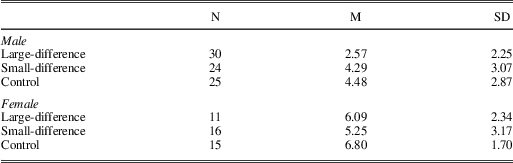
Examining the data, it became clear that overall, female participants tended to support accepting the current offer far more than male participants (Ms, 6.02 vs. 3.70, respectively). This difference was highly significant, F(1,119)=19.87, p<0.00002. Although we had no hypothesis regarding gender differences, we found this result highly intriguing and decided to explore it further. In a two-way ANOVA we found an interaction between offer condition and gender that was marginally significant, F(2,115)=2.06, p<0.13. Next, the results were again analyzed separately for male and female participants (see Table 2). A one-way ANOVA on the ratings of male participants was found to be significant, F(2,76)=1.20, p<0.02, and consistent with the predicted inaction inertia pattern. Male participants in the large-difference condition showed less interest in accepting the current deal than males in the small-difference and control groups combined F(1,76)=8.32, p<0.005, whereas the control and small-difference conditions were not significantly different F<1. However, the existence and nature of a previous offer had no significant effect on the support ratings of the female participants F(2,39)=1.48, n.s. Although this gender-related finding is interesting, it should be interpreted with caution, given its exploratory nature and the relatively low number of female participants.
Hostage Negotiations: Mean Support Ratings as a Function of Respondent’s Gender

Experiment 2: Territorial Dispute
Method
Undergraduate students (n=186, eighty-two male and 104 female) volunteered to participate in the study. The experimental session was conducted online using the Qualtrics interface. Participants accessing the experiment site were randomly assigned to one of the three scenario conditions (large-difference, small-difference and control), read the scenario and responded to the dependent measure question. The scenario concerned a territorial dispute between two fictitious African states ‘Kibagho’ and ‘Naphurah’. The participants were asked to assume the role of a minister in the Kibagho government and to decide whether or not they support the acceptance of a settlement brokered by the French government. According to the agreement, Naphurah would terminate the hostilities and sign a peace treaty with Kibagho if Kibagho agrees to return 85 per cent of the disputed territory to the sovereignty of Naphura. In two versions of the scenario (small- and large-difference conditions), this offer follows a previous one that had already been forgone. In the large difference-condition, the previous offer was far superior (from Kibagho’s perspective) to the one currently on the table (the return of only 40 per cent of the disputed territory). In the small-difference condition, the rejected proposal was moderately superior to the current one (the return of 80 per cent of the territory under dispute). In the control condition no previous offer is mentioned (see Online Appendix B for the full text).
After reading the scenario, participants expressed their opinion about the proposed deal on an eleven-point scale from 0 (‘I object to accepting the offered deal’) to 10 (‘I support the acceptance of the offered deal’).
Results
A one-way ANOVA on the support ratings was found to be significant, F(2, 183)=5.29, p=0.005 (see Table 3). As predicted, participants who had missed a far more attractive deal were least likely to support the acceptance of the current offer. Simple comparisons showed that whereas the control and small-difference groups were not significantly different from one another, F<1, n.s., the support ratings of participants in the large-difference condition were significantly lower than those of participants in the small-difference and control conditions combined, F(1,183)=9.99, p<0.002.
Territorial Dispute: Mean Support Ratings and Standard Deviations in the Three Groups

Note: higher numbers indicate greater support for accepting the current offer.
Consistent with the gender differences found in Experiment 1, overall, female participants tended to support accepting the current offer far more than male participants (Ms, 6.58 vs. 5.33, respectively). This difference in support rates was significant, F(1,184)=11.13, p<0.001. In this experiment, however, gender did not interact significantly with the nature of the previous offer (F<1, n.s).
Experimental research discussion
Within the field of psychology, inaction inertia has been demonstrated mostly in the context of personal decisions regarding the purchase of goods or services. The current experiments demonstrated that the inaction inertia effect can be reliably applied to policy decisions. Evidently, missing out on a golden opportunity to settle a territorial dispute or secure the return of a captured soldier has the power to trigger the inaction inertia mind-set and consequently the reluctance to accept subsequent, relatively inferior, offers. Unlike the personal decisions studied in psychological inaction inertia research, in political settings, forgoing an attractive action opportunity exposes the decision maker not only to self-recrimination and anticipated regret, but also to public scrutiny and criticism. This difference may constitute an important contributing factor that helps account for the gender differences observed in both experiments. To the best of our knowledge, no gender differences have been detected in prior inaction inertia studies. Although this question is beyond the scope of this article, one may wonder whether the observed gender differences could be linked to the public nature of the international relations context, as some research suggests that men are more status conscious and therefore may be more sensitive to public criticism than women.Footnote 22 In addition, these gender effects are consistent with the Women and Peace hypothesis, which portrays women as having a higher propensity for compromise and a lower propensity to use violence, compared to men.Footnote 23 It is interesting to note that in the first experiment women did not show the inaction inertia pattern at all, but this was not the case in the second experiment. It may be that when dealing with lives rather than territory, gender differences are particularly relevant. Further research may help clarify the significance of these initial findings.Footnote 24
Although the above experiments successfully demonstrated inaction inertia in international negotiations settings, there are some limitations to making inferences from experimental findings to real-world settings. One may not overlook the fact that the laboratory experiments used a pool of students who were not experienced political decision makers, nor were they necessarily the kinds of individuals selected into political leadership. Moreover, scenarios cannot capture the complexity or the high stakes involved in real-world negotiations. Finally, due to methodological constraints, the experiments did not fully capture the dynamic nature of negotiations that progress over time with multiple offers: it is impossible to present participants with opportunities and then only use those who rejected the initial opportunity without running into a ‘selection’ threat to internal validity. With this in mind, to substantiate our claims that inaction inertia may contribute to our understanding of decisions in actual international negotiation settings, we attempt an historical analysis.
Case Illustration
Overview
To illustrate the notion of inaction inertia in international negotiations, we portray negotiations as a ‘bargaining in the shadow of conflict’ game in which rivals present offers and counteroffers for the settlement of a conflict. When an actor considers an initial offer to resolve a dispute, its value is judged against the value of the status quo (SQ) of continued conflict. If that the offer is rejected, however, subsequent offers (SO) are judged not only vis-à-vis the status quo, but also in light of the forgone opportunit(ies) (FO). Thus it is possible that at this point, an actor would painfully realize that the opportunity that was already missed had been superior to the SO currently on the table. If the value of the SO is nominally identical to the value of the FO, it would in fact also constitute an inferior offer due to the passage of time; in the absence of an agreed upon settlement, the conflict would persist and the disputing actors would continue to incur costs, such as reduced power, economy costs, decline in domestic and international support, and the painful price of deaths and casualties.Footnote 25 According to the inaction inertia effect, a retroactive realization that one would have been better off by taking a previous action opportunity increases the tendency to continue rejecting offers. Accepting a less favorable SO would actualize the loss and is likely to trigger regret and – in the case of international negotiations – public recriminations as well. By quickly rejecting the current offer, the actor would be able to terminate this unpleasant psychological situation and avoid the anticipated regret, albeit at the cost of missing yet another opportunity that objectively may be advantageous to the status quo of continued conflict. It is important to note that, given an offer (SO) that is better than the SQ, the two comparisons (SO to FO vs. SO to SQ) are fundamentally different because they create different reference points. In the first case the actor considers the question ‘what have I lost by not accepting the forgone offer’, whereas in the second, the actor contemplates the question ‘what may I gain by accepting this offer’. Thus the first comparison is more likely to elicit a ‘loss frame’ that would encourage a sense of regret and open the way to inaction inertia, whereas the second is more likely to create a ‘gain frame’ that may in fact terminate a state of inaction inertia.
Unlike experimental research on inaction inertia, which focuses on a single forgone opportunity juxtaposed with one viable option, real-world negotiation analysis allows one to examine inaction inertia as a process that proceeds over several negotiation decisions. Yet actual historical situations pose other challenges. First, the researcher typically has limited access to reliable information regarding the precise terms of offers made. Secondly, known opportunities may be hard to compare as they may vary in their degree of detail. Thirdly, new issues may arise over time and past concerns may die away, causing settlement proposals to shift in their scope. Most importantly, when an offer is rejected, the researcher may find it difficult to determine unequivocally whether the rejection reflects a state of inaction inertia or is the result of the opportunity being perceived as inferior to the status quo. In dealing with this last concern, the existence of an eventually accepted settlement (AS) in the case illustration is a crucial component, as it allows for assessment of the relative value of forgone offers. If the offer accepted (AS) met the actor’s policy goals, the act of finally accepting this offer signals its superiority to the SQ. Given this fact, the accepted offer may serve as a reference against which previous offers could be judged.Footnote 26 When a comparison of the AS to the FO reveals that the AS is in fact inferior in value, it suggests that a state of inaction inertia existed. Conversely, if the AS is superior to the FO, inaction inertia was absent. Instead, it is likely that only the last offer passed the threshold of achieving the policy goals. In sum, a state of inaction inertia can be inferred once the settlement agreement has no greater value than opportunities that were previously missed, as this creates a pattern that cannot be accounted for using a pure traditional rationalist approach.
We use the above conceptualization to guide our discussion of the decisions taken by Israel in the negotiations for the release of the captured soldier Gilad Shalit during 2006–11.
The Gilad Shalit Negotiations, 2006–11
The Shalit ordeal began on 25 June 2006 when Hamas, together with the Palestinian Popular Resistance Committees and the Jish al-Islam, carried out an assault on the Kerem Shalom border crossing in Israel, taking IDF Corporal Gilad Shalit hostage.Footnote 27 According to Israel’s policy concerning hostage situations, force should be used to free hostages if the circumstances allow. If not, Israel should negotiate their release.Footnote 28 Israel’s failure to discover Shalit’s place of holding left it with no military option, and consequently, no alternative but to enter into negotiations with Hamas, the organization it held responsible for the attack.
Throughout the negotiations, which ran over the course of five years and four months, Israel remained in the dark regarding the soldier’s whereabouts, and very little was known about his physical and mental wellbeing. Negotiations that began shortly after the Israeli soldier was captured led to his eventual release in October 2011. As set out in the agreement reached between the sides, Israel freed 1,027 security prisoners held in Israeli jails in return for the release of Gilad Shalit. Since this number was on top of twenty female prisoners who were let go by Israel in October 2009 in return for a sign of life of Shalit, the total price Israel paid for his release was 1,047 prisoners.
Israel’s policy objective in the negotiations was, first and foremost, to bring the soldier home unharmed. Yet there were also other objectives. One was to secure terms that would ensure that the convicted terrorists, once released, would not resume terrorist activity against Israel. This was the main motivation underlying Israel’s insistence that many of the released prisoners not be allowed to return to their homes in the West Bank. Finally, Israel sought to minimize the damage an exchange deal might cause to its deterrence power.
Although details regarding the talks between the sides are at times sketchy, reports published in open sources and verbal accounts of people involved in the negotiations on the Israeli side reveal the following picture. From the outset, the general terms of a deal for Shalit’s release were relatively clear to Israeli decision makers, as these had been set in previous negotiations over Israelis held by terrorist organizations: the release of security prisoners from Israeli jails in exchange for freeing a significantly smaller number of Israeli soldiers and civilians in captivity. The Shalit negotiations centered on several basic disagreements. The first concerned the number of security prisoners to be released. The second concerned the release of ‘heavy offenders’ (terrorists with ‘blood on their hands’). A third point of contention concerned the expulsion of released prisoners from the West Bank. Whereas Hamas demanded that the prisoners be allowed to return to their homes in the West Bank including East Jerusalem, Israel insisted that many of them be deported to third countries or Gaza. Finally, Israel opposed Hamas’ demand to include Israeli Arabs in the list of freed prisoners, fearing that it would grant Hamas popularity as an organization capable of bringing about the release of criminal murderers as well.
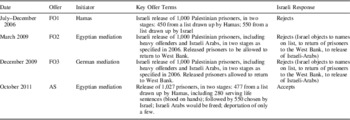
Four main negotiation junctures are identified in the Shalit negotiations: (1) the initial demands put forth by Hamas in 2006; (2) a deal proposed by Egyptian mediators in March 2009; (3) a 2009 offer put forth by the German mediator and (4) the 2011 deal mediated by Egypt, which Israel accepted and that led to Shalit’s release. Below, we present the negotiating decisions taken by the Israeli government.
Shortly after the kidnaping, in July 2006, the basic demands of the terrorists were made public, with a more detailed outline presented in December 2006: in return for the release of Gilad Shalit, the terrorists demanded that Israel free 1,000 security prisoners in two stages. In the first stage, Israel would free 450 security prisoners from a list drawn up by Hamas. In a second phase, after Shalit was repatriated, Israel would release another 550 prisoners, whom it would select itself. Since the list of 450 drawn up by Hamas included names the Israeli government had vowed never to release, Israel rejected the proposal. Subsequently, the negotiations derailed for two years.Footnote 29
Following this first forgone opportunity (FO), negotiations resumed for a second round of talks in Cairo in March 2009, with Egypt mediating between the Israeli and Hamas delegations. The basic offer put forth by the Egyptians was not different from the previous proposal. The sides remained in disagreement over the list of names, in particular the names of 125 heavy offenders, and regarding the questions of expulsion and release of Israeli Arabs.Footnote 30
By this time, two and a half years had passed since Shalit had been captured, and Israel was accumulating considerable costs for failing to bring him home. The country was flooded with posters demanding action by the government, and massive demonstrations were held ‘Asking for Gilad’s Forgiveness’. Failure to secure the return of the soldier caused demoralization among many of Israel’s troops. Each day that went by without a solution resulted in additional criticism of the government and widened the rift within Israeli society between those who favored and those who opposed conceding to the terrorists’ demands. The Israeli government, however, rejected the Egyptian offer and talks broke off for another nine months.
In the summer of 2009 a third round of negotiations produced yet another offer. Benjamin Netanyahu, who had replaced Ehud Olmert as Israel’s prime minister, enlisted the German intelligence agency to mediate the negotiations instead of the Egyptians. By late 2009 the senior German agent, Gerhard Conrad, produced a compromise deal. Similar to earlier rounds of negotiations, this offer entailed the release of 1,000 Palestinian prisoners to be freed in two stages. Yet Israel was adamant to keep in jail heavy offenders that Hamas insisted on releasing. Likewise, the issues of deportation of freed prisoners from the West Bank and the release of Israeli Arabs remained unresolved.Footnote 31 Israel rejected the offer and negotiations broke off.
A fourth round of negotiations took place in Cairo during August–October 2011 with the new Egyptian government mediating talks. The proposal produced constituted the fourth substantive offer made since the kidnaping in 2006. In contrast to previous rounds, however, the Israeli government accepted this offer, thus opting for action over inaction after five and a half years and three forgone settlement opportunities (FO) that could have resolved the dispute. According to the accepted settlement (AS), in return for Shalit, 1,027 – not the original 1,000 – security prisoners would be freed from Israeli prisons in two stages.Footnote 32 By accepting the offer, Israel overturned its refusal regarding the release of Israeli Arabs and agreed to free additional prisoners from the heavy offender list. Although the agreement was not without achievement for Israel (that is, some heavy offenders would not be released, a number of prisoners would be expelled from the West Bank and released prisoners re-arrested for terrorist activities would have their previous sentences reapplied), ultimately it was Israel that made the supreme compromise in agreeing to release terrorists it had vowed never to set free.Footnote 33 On its most important dimension, the Israelis conceded in the final deal.
Additionally, a benefit that Israel had expected to gain in the deal’s second stage had become irrelevant due to the passage of time. For this stage, which involved releasing prisoners selected by Israel, Israel had planned to consult with Palestinian Authority President Mahmoud Abbas, thus creating the impression of an independent political achievement for the more moderate Abbas in having secured the release of a larger number of prisoners than was freed by Hamas. However, by the time the second stage came about, Israel’s perception of the Palestinian Authority and Abbas was tainted by the unilateral steps taken by the Palestinian Authority in the UN, causing Netanyahu to refrain from any gesture toward Abbas.Footnote 34 Had a settlement been reached earlier, Israel could have capitalized on this issue.
Finally, by accepting the deal in 2011, Israel compromised on its concern regarding the ramifications of an exchange deal for its deterrence power. Throughout the negotiations, Israel had been concerned that an exchange agreement with terrorists would signal that abduction was an effective strategy, thus encouraging additional abductions. Yet accepting the deal after the passage of time sent perhaps an even less favorable message from Israel’s perspective. In 2011, not only did the deal that was reached signal that kidnapping was effective, but the delay sent the message that Israeli would eventually concede even if it did not initially. A summary of the negotiation rounds appears in Table 4.
The Shalit Negotiations, 2006–2011

Why did Israel forgo in 2011 positions that it had held for over five years? We suggest that two external factors converged to affect a change in Israel’s perspective. The first was the Arab Spring, the revolutionary wave that swept over the Arab world in 2011. The growing instability in the Arab world, and tightened relations between the new Egyptian government and Hamas, signaled that circumstances were rapidly changing and that any window of opportunity for a resolution may soon vanish for good. The second factor concerned domestic issues in Israel. Social protests that had begun in the summer of 2011, during which hundreds of thousands of Israelis took to the streets to protest the rising costs of living, put extreme pressure on the Israeli government. Bringing home the captured soldier would go a long way toward diverting attention from the domestic crisis and bolstering public support.
Case Discussion
An unequivocal identification of inaction inertia in any real negotiation situation would require insight into the psyche of decision makers, which is beyond the reach of the scholar (and, in most cases, of the decision makers themselves). However, by setting well-defined criteria, we suggest a method that allows for the identification of situations of negotiation deadlocks in which inaction inertia is a prime suspect.
These specified conditions were met in the Shalit negotiations: (a) the settlement that was eventually reached was successful in achieving Israel’s policy objectives and (b) the settlement reached was not superior to previous offers that Israel had rejected. Also consistent with inaction inertia findings in the psychological research, the settlement acceptance was first and foremost due to external pressures that entered into consideration.
By accepting the 2011 deal, Israel succeeded in achieving its most important objective: bringing Gilad Shalit home alive. In addition, the exchange deal that included the release of heavy offenders did not seem to result in a resurgence of terrorist attacks (though we recognize that this may be due to preventive actions taken by Israeli security forces). Thus it seems that from Israel’s perspective, the 2011 deal was satisfactory. Secondly, judging by the AS, it is reasonable to suggest that Israel would have benefited from accepting one of the earlier offers. By accepting a previous offer, Israel could have released fewer prisoners; it may have compromised on the heavy offender list and expulsions, but it did so anyway in 2011. Furthermore, it would have avoided the high costs incurred due to the passage of time for the soldier who spent five and a half years in solitary confinement; for his family who made endless efforts to bring about his release; in terms of the morale of Israeli soldiers who had been brought up on the ethos that Israel would do absolutely everything to bring home captured soldiers; and in terms of the rift caused within Israeli society. Thus the balance seems to point to the conclusion that an earlier settlement would have been advantageous for Israel.
Finally, the shift out of the state of inaction inertia can be clearly attributed to external forces; that is, the evolving situation in Egypt and domestic unrest in Israel. Thus we find that the course of events in the Shalit negotiations is consistent with an inaction inertia pattern on the part of Israel.
Conclusion
The outcomes of negotiations are not monocausal events, but rather the product of a multitude of strategic, political and, as this study highlights, psychological factors. The current research represents a first attempt at applying inaction inertia to international negotiations analysis, and the results are very encouraging. We believe that the findings of both the experiments and the case illustration clearly demonstrate the potential value of the concept of inaction inertia to international negotiations analysis.
The contribution of the current work is fourfold. First, the research brings together two rich bodies of literature: the negotiation literature in international relations and the body of judgment decision-making research in psychology. Secondly, for students of international relations, the concept of inaction inertia can contribute to the understanding of negotiation deadlocks. Thirdly, the application of inaction inertia to the dynamic environment of international negotiations, as opposed to the static one-opportunity settings studied to date, opens the door to a more multi-dimensional and dynamic theory on inaction inertia than that presented in the field of psychology. Finally, we see great potential in the concept of inaction inertia for practitioners as well. Understanding inaction inertia processes may help individual or state actors to (1) identify inaction inertia-induced deadlocks and (2) use this insight to break the deadlock. External interventions might also prove efficient in terminating inaction inertia. Possible interventions may include redirecting attention to future benefits rather than past missed opportunities, and redefining the situation in a way that decouples the past from the present.
The findings presented in the current article point to several avenues for further research that we intend to pursue, and that we hope will incite interest among other scholars as well. First, there is a need to expand on the theory to allow for the incorporation of a more dynamic conceptualization of inaction inertia that includes both parties involved in the negotiations. Secondly, exploring the impact of variables taken from the fields of political science and international relations on inaction inertia behavior would contribute greatly to a more comprehensive understanding of the conditions for inaction inertia in political and international contexts. The relevant variables should also include gender effects, as the current experiments suggested that gender may play an important role. Further research may also aim to obtain more direct process measures of the inaction inertia effect, particularly the role of regret, by exploring in-depth interviews and biographical accounts of decision makers. Perhaps most important is research that explores possible interventions that may help pull players out of negotiation inaction inertia. Although we have leads to this end from psychology, these should be tested in the context of international negotiation scenarios and contexts.