Introduction
Thomas Willis (1621–1675), physician and anatomist, was a remarkable man in many ways. He invented the word ‘neurologia’ and is credited with being the founder of clinical neuroscience (Williams, Reference Williams2003). The validity of Willis’s accounts of pathophysiology and treatment was limited by the highly speculative contemporary notions such as the ancient humoral theory of disease and ‘iatrochemistry’ (the theory that disease is the result of chemical reactions involving, for example, ‘explosions’, ‘explosive particles’ or ‘spirits’). However, he anticipated modern views about the aetiology of many disorders including aspects of psychiatry and sleep disorders.
For example, Willis distinguished between inherited, congenital and acquired causes of intellectual disability which he called ‘stupidity’, differentiating this from ‘folly’ by which he seems to have meant psychiatric disorder, perhaps of a psychotic type. He also wrote at length about disorders causing sleepiness and insomnia, as well as discussing dreams and nightmares and even what is now known as restless legs syndrome (Thorpy, Reference Thorpy2000).
Awareness of the importance of sleep for satisfactory daytime functioning is ages old. In the first paediatric textbook in English, Thomas Phaire (1510–1560) equated the growing child’s need for sleep to that for food, the effect of inadequate sleep being that ‘the hole body falleth in distemper, cruditie and weakenes’ (Phaire, [1545] Reference Phaire1995). Nearer ourselves in time, and more prosaically, in 1923 Eaton described how ‘persistent, long-continued sleeplessness … interferes markedly with its possessor’s health and happiness’ (Eaton, Reference Eaton1923).
However, it was not until many years later that, based on systematic clinical observation and research, this point began to be made more widely and forcefully. In the forefront was the Stanford University Sleep Disorders Center with such publications as the 1993 article by Dement and Mitler ‘It’s Time to Wake Up to the Importance of Sleep Disorders’ (Dement & Mitler, Reference Dement and Mitler1993). In this and further publications around that time evidence was marshalled to illustrate the adverse effects of sleep deprivation and poor quality sleep on mood and behaviour, cognitive function and performance at work or at school, interpersonal relationships, physical health and overall quality of life.
Since then, much further information to the same effect has accrued as described in comprehensive recent accounts (Colten & Altevogt, Reference Colten and Altevogt2006; Cappuccio et al. Reference Cappuccio, Miller and Lockley2010) in which emphasis has continued to be placed on disordered sleep as a serious and widespread public health problem, and on the need for considerable improvement in its recognition and treatment. The economic cost to the nation of sleep disorders is considered to be vast. In-depth books specifically concerned with the relationships between sleep and mental illness have been published recently (Pandi-Perumal & Kramer, Reference Pandi-Perumal and Kramer2010; Winkelman & Plante, 2010). In addition, there are major publications relevant to psychiatry, including neuropsychiatry and neurodevelopmental disorders (Overeem & Reading, Reference Overeem and Reading2010; Kothare & Kotagal, Reference Kothare and Kotagal2011; Stores, Reference Stores2014a). These sources demonstrate the many clinical implications of sleep and its disorders for psychiatric practice.
Necessarily, this article is concerned with just some of these aspects with the emphasis on some issues of importance in clinical practice, together with a brief account of possible medical consequences of disordered sleep, which are increasingly being recognised, and which are likely to have their own psychiatric implications.
First, however, as background to the rest of the article, some basic points about sleep and its disorders are made with the intention of reflecting present-day approaches to the subject. Further and more detailed information on these general aspects is available elsewhere (Mindell & Owens, Reference Mindell and Owens2010; Kryger et al. Reference Kryger, Roth and Dement2011). The references cited in the present article are selected from what is now an extensive relevant literature.
Some general points about sleep and its disorders
The functions of sleep
Sleep can be seen as particularly important in view of the fact that adult human beings spend about one-third of their life asleep and children much more than that. By early school age the average child has spent more time asleep than eating, playing, exploring his environment and interacting with others.
Sleep is an essential part of existence in that without it survival is not possible. If kept awake continuously long-term, experimental animals undergo profound deterioration in their basic bodily processes and they die. Sleep serves many different functions, the balance between them changing during the course of development and possibly varying from one species to another.
Different theories have emphasised mental and bodily restoration and recovery during sleep, or the laying down of memories so that learning from experience is possible. Others have speculated that dreaming is essential for the working out of possibly deep-seated emotional problems and conflicts. More convincingly, basic physiological functions for which adequate good quality sleep is required include growth, resistance to infection, the process of tissue repair following damage to bodily tissues and various other metabolic processes (see below).
The nature of sleep
Sleep does not simply consist of the shutdown of daytime activities. The onset of sleep, waking up and the two distinct types of sleep all involve complex brain mechanisms the modern view of which has been described (Brown et al. Reference Brown, Basheer, McKenna, Strecker and McCarley2012).
The two distinct physiological types of sleep are non-rapid eye movement (NREM) sleep and rapid eye movement (REM) sleep. It seems that a balance between these two types is required to function well. They usually alternate several times during nighttime sleep. Deep NREM sleep (mainly seen in the first part of overnight sleep) is the most restorative type of sleep. REM sleep (also called ‘dreaming sleep’ as most dreaming occurs during it) is seen mainly later in the night and is thought to be involved, for example, in memorising functions. Both types of sleep can be disturbed in, for example, severe depression including the early occurrence of the first episode of REM sleep (short REM latency) indicating basic physiological changes in this form of mental disorder.
Biorhythms
The timing of sleep is regulated by a circadian body clock located in the suprachiasmatic nucleus (SCN) in the hypothalamus. From an early age, the sleep–wake cycle becomes synchronised or ‘entrained’ with the 24-hour night–day (dark–light) cycle by the influence of external cues (zeitgebers) the main one being daylight. Other cues include mealtimes and social activities. The body clock usually ensures that the sleep–wake cycle is synchronised with the circadian fluctuations in body temperature and the output of cortisol.
The SCN is acted upon by the hormone melatonin mainly produced in the pineal gland during darkness and suppressed by bright light. Melatonin, therefore, promotes sleep during the night and its suppression encourages wakefulness. It has circadian sleep–wake phase shifting properties as well as its sleep-promoting action. Synthetic melatonin has been used to treat some sleep disorders in adults and also children including those with a neurodevelopmental disorder.
Problems (usually a combination of insomnia and excessive daytime sleepiness) arise when the various circadian rhythms become uncoupled (as in jet lag or shift work sleep disorder) resulting in disruption of sleep with adverse effects on daytime function and well-being. People with circadian rhythm sleep disorders are unable to sleep and wake at the times required for normal work, school and social activities.
‘Irregular sleep–wake rhythm disorder’, consisting of a chronic or recurrent pattern of irregular sleep and wake episodes throughout the 24-hour period is seen in neurodegenerative disorders and some childhood neurodevelopmental disorders. Unawareness of the usual zeitgebers (as in dementing disorders), or not being exposed to them regularly (especially regarding exposure to daylight) as may happen in institutional care, for example, is likely to cause significant disruption of circadian sleep–wake rhythms. Disordered circadian sleep–wake rhythms have been implicated in the genesis of major psychiatric illness, notably depression.
Alertness and degree of sleepiness fluctuate within each 24 hours (an ‘ultradian rhythm’). Generally, people are most alert in the evening before the onset of sleepiness. Going to bed too early during this alert period causes difficulty getting to sleep. The tendency to sleep is greatest in the early hours of the morning at the time of deep NREM sleep. However, the timing of the different levels of alertness and sleepiness can vary from one person to another. Some individuals wake up about 2 hours earlier than most others and are very alert in the morning, but then tire early in the evening (‘morning types’ or ‘larks’). Others tend to wake relatively late and have difficulty getting going in the morning but become alert and active in the evening, perhaps until quite late (‘evening types’ or ‘owls’). Larks can have special difficulty coping with night shift work because they are required to be active when their body clock is forcefully telling them to sleep.
Sleep requirements
The amount of sleep required for satisfactory function during the day varies with age and (for genetic reasons) from one person to another. Knowing this can help to prevent unnecessary anxiety about a person’s own sleep or that of other family members, especially children.
Significant developmental changes in sleep occur during early life. Full-term babies sleep something like 17 out of each 24 hours with prominent REM-type sleep. By about 6 months, their nighttime sleep should be fairly continuous without the need for repeated feeds at night. Daytime naps should start to reduce significantly until about 3–4 years of age they have stopped in most children. Through the toddler stage and later, sleep requirements gradually lessen until in later childhood (before puberty) most children need about 10 hours sleep each night.
About the time of puberty the need for sleep plateaus and might actually increase. A pubertal delay in the timing of the sleep phase also occurs at this time, making it difficult to get to sleep until later than before. This change, combined with late-night study or social activities, is likely to lead to insufficient sleep. Most teenagers need at least 9 hours sleep (many obtain much less) without which they are at risk of various psychological and social problems. By early adulthood the usual amount of sound sleep required to function satisfactorily during the day is 7–8 hours and this remains the case from then on, although in later life getting to sleep and staying asleep may be less easy with the quality of sleep reduced because of brief awakenings and less deep NREM sleep.
At any age, good quality (sound) sleep is important. Impaired sleep quality is physiologically characterised by repeated brief arousals and relatively superficial rather than deep restorative sleep. Whatever its cause, of which there are various possibilities, it is likely to have adverse effects equivalent to those caused by actual sleep loss. These can consist of tiredness on waking, not feeling refreshed and alert during the day, excessive daytime sleepiness and changes in mood and behaviour, as well as overall under-functioning.
Disturbed sleep, its assessment and treatment
Persistent and upsetting sleep disturbance is commonplace, affecting about a third of the general population at any one time. Sleep problems are more common than this in certain subgroups including the elderly and particularly people with a psychiatric illness, neurological disorder and those with other chronic medical conditions. Despite the size and seriousness of this problem, sleep and its disorders is a neglected topic in both public health education and professional training including medical training at undergraduate and postgraduate levels (Peile, Reference Peile2010). Consequently, clinical services for those with significantly disturbed sleep and its consequences are inadequate, with many opportunities lost for effective treatment and relief of distress on the part of both patients and their carers.
The notion of sleep disturbance raises a key issue for clinical practice, that is, the distinction between sleep problems and sleep disorders. At any age, there are just three basic types of sleep problems:
∙ difficulty initiating or maintaining sleep;
∙ excessive daytime sleepiness (hypersomnia);
∙ behaving in unusual ways, having strange experiences or exhibiting unusual movements in relation to sleep. The collective technical term for this type of sleep problem is ‘parasomnias and abnormal sleep-related movements’.
These sleep problems are not diagnoses or conditions in their own right any more than is ‘breathlessness’ or ‘pain’. For the correct advice or treatment to be chosen, it is necessary to identify the underlying cause of a sleep problem, that is, the sleep disorder. Attempts to treat the sleep problem without accurate diagnosis of the underlying cause are likely to be unsuccessful.
The 2014 edition of the International Classification of Sleep Disorders or ICSD-3 (American Academy of Sleep Medicine, 2014) is the foremost source of information about sleep disorders of which over 80 are now officially recognised. This classification system is considered to be more diagnostically specific and up-to-date than the DSM and ICD classifications of sleep disturbance.
History taking should routinely include screening questions for sleep problems such as:
∙ Difficulty getting off to sleep?
∙ Waking during the night?
∙ Breathing problems while asleep?
∙ Unusual behaviours, experiences or movements at night?
∙ Difficulty waking up in the morning?
∙ Being unusually sleepy during the day?
Positive responses should then be followed by assessment for the underlying sleep disorder, by means of detailed clinical enquiry and possibly special investigations (Doghramji & Choufani, Reference Doghramji and Choufani2010) in order to decide on appropriate advice or treatment. Diagnostically difficult cases may indicate referral to a sleep disorders clinic.
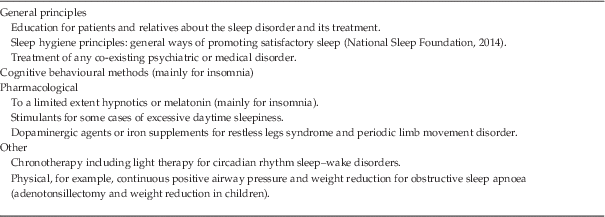
There are now many possible ways of treating disturbed sleep. Table 1 illustrates in general terms main possibilities from which the choice can be made depending essentially on the nature of the individual’s sleep disorder.
Main examples of possible treatments for sleep disorders

Sleep disorders in psychiatric practice
There are many connections between disordered sleep and psychiatry (including subspecialties such as child and adolescent psychiatry, learning disability, neuropsychiatry, forensic psychiatry and liaison psychiatry). Awareness that sleep disorders can predispose to medical illness is also important for the comprehensive assessment of any patient.
∙ Significantly disturbed sleep is a very common feature of many psychiatric disorders in children, adolescents and adults (Abad & Guilleminault, Reference Abad and Guilleminault2005) and also many neurological and other medical illnesses (Stores, Reference Stores2009). The relation between disordered sleep and disturbed behaviour can be bi-directional. For example, sleep loss can cause depression but depression brings with it the likelihood that sleep will be disturbed.
∙ Sleep disturbance can be a presenting symptom or early warning sign of psychiatric illness such as depression (or threat of relapse) which, if recognised, might have important preventive value (Baglioni et al. Reference Baglioni, Battaggliese, Feige, Spiegelhalder, Nissen, Voderholzer, Lombardo and Riemann2011). Insomnia may also foreshadow bipolar disorder or substance abuse (Putnins et al. Reference Putnins, Griffin, Fitzmaurice, Dodd and Weiss2012), and REM sleep behaviour disorder (RBD) may herald the eventual development of neurodegenerative disease (Postuma et al. Reference Postuma, Gagnon, Vendette and Montplaisir2009).
∙ If severe, sleep disturbance can affect mood and behaviour to the extent of causing psychiatric disorder. At least a contributory effect of this type has been suggested for some forms of adult depression, and also for cases of childhood attention deficit hyperactivity disorder (ADHD) which are a consequence (rather than a cause) of a primary sleep disorder (Gregory & Sadeh, Reference Gregory and Sadeh2012). Possibly there are counterparts to this in adult ADHD. As discussed later, serious sleep disturbance can also predispose to medical illness.
∙ Hypersomnia is associated with major depressive disorder, bipolar disorder, dysthymic disorder and seasonal affective disorder with the possibility that it might contribute to the maintenance of mood disorder symptoms (Kaplan & Harvey, Reference Kaplan and Harvey2009).
∙ Some parasomnias, such as sleep-related panic attacks or dissociative states, are psychiatric in origin with clinical manifestations that essentially consist of disturbed behaviour (Stores, Reference Stores2014b).
∙ Disruption of circadian sleep–wake rhythms has been associated with abnormal cognition and mood states as well as neuropsychiatric illness (Quera Salva et al. Reference Quera Salva, Hartley, Barbot, Alvarez, Lofaso and Guilleminault2011; Foster & Kreitzman, Reference Foster and Kreitzman2014).
∙ Various medications used in psychiatry and general medicine are associated with disordered sleep (Turjanski & Lloyd, Reference Turjanski and Lloyd2005; Schweitzer, Reference Schweitzer2011). The effects of antidepressants in particular on sleep were discussed in detail by Wilson & Argyropoulos (Reference Wilson and Argyropoulos2005). Successful treatment of the clinical condition in question is likely to lead to improvement in sleep.
∙ Some sleep disorders may well be mistaken for primary psychiatric conditions (and therefore treated inappropriately) because of similarities in clinical presentation. This aspect deserves special consideration because of the potentially serious consequences of misdiagnosis (Stores, Reference Stores2010a).
Misdiagnosis of sleep disorders
It has been suggested that the rate of ‘non-trivial’ diagnostic error in developed countries could be as high as 15% (Graber & Berner, Reference Graber and Berner2008). As this overall error rate is thought to apply in conventional medical specialties in which teaching and training is well provided, it seems likely that such errors are likely to be higher in the sleep disorders field where, as already mentioned, professional education is often wanting. This section provides some examples of possible diagnostic errors concerning various sleep disorders. Up-to-date general accounts of these sleep disorders, including appropriate references, are available in the corresponding sections of ICSD-3 (American Academy of Sleep Medicine, 2014) and the overall sleep medicine texts mentioned earlier (Mindell & Owens, Reference Mindell and Owens2010; Kryger et al. Reference Kryger, Roth and Dement2011).
Sleepwalking
It seems generally not well appreciated that complicated behaviour is possible while a person remains asleep. Sleepwalking is a prime example. It may take the form of relatively simple behaviour or highly agitated actions as if fleeing from some sort of threat. Other sleepwalking behaviours include following complicated routes outside the home, climbing through bedroom windows after undertaking complex manoevres in order to do so or making and consuming meals (‘sleep-related eating disorder’; Winkelman et al. Reference Winkelman, Johnson and Richards2011). The term ‘sexomnia’ has been coined for sexual behaviour while asleep (Schenck et al. Reference Schenck, Arnulf and Mahowald2007).
Sleepwalking with behaviours such as these may be misinterpreted as other parasomnias, especially those of a dramatic nature including sleep-related epilepsy, sleep-related dissociative disorders or ‘pseudoparasomnias’ with conscious intent (Stores, Reference Stores2010b).
Diagnostic uncertainty concerning sleepwalking (and other sleep disorders) is highlighted in connection with the forensic issues surrounding sleep disorders associated with violence (Morrison et al. Reference Morrison, Rumbold and Riha2014). In addition to sleepwalking and other ‘arousal disorders’ (i.e. confusional arousals and sleep terrors) violent behaviour can occur in RBD and nocturnal dissociative states. Sexomnia, including violent acts, has been linked mainly with arousal disorders. Parasomnia-like behaviours can occur in ‘factitious disorders’ in which illness is simulated on purpose. Guidelines for medico-legal use have been formulated to help a distinction to be made between cases in which violence or other anti-social acts have occurred as a result of a genuine sleep disorder and those in which evidence of that is less convincing (Morrison et al. Reference Morrison, Rumbold and Riha2014).
Obstructive sleep apnoea (OSA)
This common condition is mainly associated with obesity in adults or adenotonsillar hypertrophy in children. Repeated upper airway obstruction during sleep produces poor quality, unrestorative sleep that causes psychological and medical problems during the day. A series of patients with OSA were studied to see what they had been treated for before this diagnosis had eventually been made (Smith et al. Reference Smith, Ronald, Delaive, Walld, Manfreda and Kryger2002). This included depression and hypertension without it being recognised that these conditions were caused by OSA. Elsewhere in the literature there are additional accounts of the underactivity and excessive sleepiness of OSA patients being misinterpreted as laziness, disinterest and even dementia, and also ADHD because of the paradoxical overactivity in sleepy children.
Delayed sleep phase disorder (DSPD) in adolescents
At puberty the timing of the sleep phase at night is shifted by the biological clock to a later time than earlier in development. Often this shift is accentuated by changes in lifestyle, especially indulging in social activities until very late. This causes persistent difficulty getting to sleep until very late even when sleep deprived. Consequently, because of the limited time asleep, it is very difficult to wake up in the morning and parents’ attempts to waken their teenager may meet with strong resistance. School attendance will often suffer and, because of sleep deprivation and accumulating ‘sleep debt’, daytime sleepiness, under-functioning and changed behaviour become problematic. Sleeping late at weekends or during holidays simply perpetuates this unsatisfactory sleep pattern.
Unawareness of this sleep disorder readily leads parents and others to misinterpret DSPD as ‘typical difficult adolescent waywardness’ and family tensions are likely. Alternatively, the condition is misinterpreted as depression, the more usual form of school refusal, or substance abuse. DSPD requires re-setting of the biological clock by various means (chronotherapy).
Advanced sleep phase disorder (ASPD) in the elderly
In contrast to the sleep phase change in adolescents, in later life the internal clock advances the timing of the major sleep episode and older people often feel the need to sleep earlier than formerly. Being alone or needing to keep warm may also lead to going to bed early. As a result, adequate time asleep might have been reached by the early hours making it difficult to return to sleep. This ‘early morning waking’ should not be misconstrued as a symptom of depression or other abnormality. ASPD is not exclusive to the elderly, also occurring in some children put to bed too early or others with a neurodevelopmental disorder.
Recurrent isolated sleep paralysis
This benign and relatively common condition (as distinct from sleep paralysis associated with narcolepsy) consists of recurrent brief episodes of inability to move or speak when going to sleep or on waking up usually from a dream. Consciousness is preserved and eye movements are possible but, although respiratory movements are spared, there is often a sensation of not being able to breathe. Episodes end spontaneously or on being touched or moved. Sleep paralysis can be particularly alarming if combined with complex hallucinatory phenomena (also in themselves benign in the sense of not being associated with psychiatric or medical illness). The overall experience can be so bizarre (including interacting with imaginary people or creatures, as well as feelings of threat, dread or alien presence) that a psychotic illness may be mistakenly suspected (Stores, Reference Stores1998). Otherwise, the behaviour may be misdiagnosed as attention seeking behaviour.
Narcolepsy
Once thought to be a psychological disorder in which, for example, conflict situations were avoided is now known to be a neurological disorder caused by a deficiency of the neuropeptide hypocretin. Its main feature is excessive sleepiness, including sleep attacks, associated mainly with cataplexy (loss of muscle tone in reaction to strong emotion), but also with sleep paralysis, hypnagogic (sleep onset) hallucinations and automatic behaviour with impaired awareness. All of these features are prone to misinterpretations such as daydreaming, attention seeking or other psychological disorders, syncope or epilepsy. The correct diagnosis and treatment may be delayed for many years and some cases may not be correctly diagnosed at all.
A series of patients with narcolepsy were reviewed by a sleep specialist to see what diagnoses had been made in the year before the correct diagnosis (Kryger et al. Reference Kryger, Walld and Manfreda2002). The correct diagnosis had been made in 38% of cases with a series of psychiatric diagnoses made instead, that is, neurotic disorder, depression, adjustment reaction and personality disorder. Neurologists had correctly recognised narcolepsy 55% of the time, other internists 23.5% of the time, general practitioners 21.9% of the time and psychiatrists 11.1% of the time. Paediatricians had failed to recognise narcolepsy in all of the cases perhaps partly because the presentation of childhood narcolepsy in children can be more complicated than in adults.
Kleine–Levin syndrome
This rare condition usually begins in the teenage years and consists of prolonged episodes of marked hypersomnia (up to 20 hours a day), which alternate with periods of normality. When awake during episodes, patients are usually confused and in a dream-like state with anterograde amnesia. Other features can be overeating or anorexia, hypersexuality, mood change, hallucinations and delusions and other disturbed behaviours that are often bizarre and out of character. The condition is frequently mistaken for a psychological disorder or another medical condition such as cerebral tumour, encephalitis, epilepsy or substance abuse (Pike & Stores, Reference Pike and Stores1994). Usually, gradual remission occurs spontaneously. Both aetiology and response to treatment remain uncertain.
RBD
In this sleep disorder the normal paralysis of the skeletal musculature in REM sleep is lost, allowing dreams to be enacted. If the content of the dreams is violent, the patient may punch, kick, leap out of bed, or run about, and possibly shout, cry out or swear, with the risk of self-injury or injury of others nearby. RBD occurs mostly in elderly males but people of both sexes and all ages (rarely including children) have been reported.
Some cases of RBD seem to be idiopathic although, increasingly, the term ‘cryptogenic’ is preferred because an underlying condition might well eventually come to light. RBD is strongly associated with neurodegenerative disorders and also narcolepsy. Some cases have been associated with antidepressant medication or substance withdrawal states. It may precede the development of Parkinson’s disease perhaps by many years, otherwise it can develop after its onset. A prodromal period, possibly over months or more, has also been described consisting of persistent sleep talking, loud vocalisations and limb twitching or body jerking. Correctly diagnosed, RBD is usually responsive to treatment with clonazepam.
The complex disruptive behaviours in RBD may well be confused with other dramatic parasomnias. The distinction can be helped by the correspondence between the behaviours and the content of the patient’s accompanying dreams, plus polysomnographic evidence of muscle activity during REM sleep.
Nocturnal frontal lobe epilepsy (NFLE)
NFLE is one of a number of types of epilepsy in which seizures occur predominantly or exclusively during sleep. Although described mainly in adults, it can (rarely) occur in children. Seizures often include dramatic motor automatisms such as kicking, hitting, rocking, thrashing and cycling or scissor movements of the legs. There may be accompanying grunting, coughing, muttering, moaning, shouting, screaming or roaring. Such episodes can be associated with impairment of consciousness or not, and may be frequent, of sudden onset and termination and short duration. As these features are collectively different from those of other seizure types, misdiagnosis of NFLE as pseudoseizures or other dramatic parasomnias is likely. The chance of this is increased by the fact that, even during the seizures, scalp electroencephalograph findings may be unremarkable. Other forms of NFLE include nocturnal wandering that can be misconstrued as non-epileptic confusional states as in dementia.
Potential medical consequences of disordered sleep
There is growing evidence that not only does inadequate or poor quality sleep predispose to psychiatric problems but also that various physical illnesses are associated with disordered sleep probably because of its interference with basic physiological processes. Such physical illnesses themselves are likely to add to the initial sleep disturbance, either directly and/or because of their effects on mental state (notably anxiety or depression) to which they give rise. Various forms of disordered sleep have been implicated in this way (Depner et al. 2014).
Short sleep duration
Grandner et al. (Reference Grandner, Jackson, Pak and Gehrman2012) have reviewed recent epidemiological studies concerning associations between disordered sleep and serious physical illness, as well as presenting their own findings on the topic. Short sleep duration has been reported to be associated with cardiometabolic risk (i.e. the chances of having type 2 diabetes, heart disease or stroke) and all causes of death. The risk results from the cardiometabolic syndrome, a disorder of energy utilisation and storage characterised by a combination of some of the following: abdominal obesity, hypertension, elevated fasting plasma glucose, high serum triglycerides and low high-density cholesterol. This risk is said to be increased if short duration sleep is combined with subjective sleep disturbance including a complaint of insomnia and also snoring. Some of these associations are not confined to adults. Short sleep duration among children and adolescents is reported to increase the risk for obesity and early onset cardiometabolic disease (Grandner, Reference Grandner, Jackson, Pak and Gehrman2012).
General sleep disturbance
Assessing a large, American representative sample by means of self-reported measures, Grandner et al. (Reference Grandner, Jackson, Pak and Gehrman2012) found that general sleep disturbance (expressed simply as difficulty falling asleep, staying asleep or sleeping too much without specifying possible underlying causes) was associated with an increased risk of myocardial infarction, stroke, coronary heart disease, diabetes and obesity. Other relevant reports are mentioned by these authors. As both depression and disordered sleep are reported to be associated with a similar range of medical disorders, the question has arisen whether they are independent or overlapping factors for cardiometabolic disease. As yet, the answer is unclear (Mezick et al. Reference Mezick, Hall and Matthews2011).
OSA
OSA has been linked with physical disease. Increasingly, it is being recognised as a risk factor for various clinical conditions such as systemic hypertension, cardiovascular disease, stroke and diabetes (Punjabi, Reference Punjabi2008). In addition, there is a possible link with cancer (Kim & Kapur, Reference Kim and Kapur2014). Alongside other possible causes, early onset of OSA should be considered when young children fail to thrive as it can reduce deep NREM sleep with which growth hormone production is linked (Bonuck et al. Reference Bonuck, Parikh and Bassila2006).
Circadian disruption
The public health consequences of disordered sleep include the potential adverse effects of abnormal and extreme work schedules on occupational safety (Sigurdson & Ayas, Reference Sigurdson and Ayas2007). Despite the European Working Time Directive, the combination of shift work, irregular and extended hours worked by junior doctors continues to be a concern regarding potential risk to the mental and physical health of both doctor and patients (Mansukhani et al. Reference Mansukhani, Kolla, Surani, Varon and Ramar2012).
‘Shift work sleep disorder’, a common condition in those who work night shifts, predisposes them to such illnesses as peptic ulcers, coronary artery disease, menstrual and pregnancy problems and possibly cancer (Knutsson, Reference Knutsson2003). Haus & Smolensky (Reference Haus and Smolensky2013) discuss evidence of an increased risk of breast cancer in particular in female night and rotating shift workers, while Sigurdardottir et al. (Reference Sigurdardottir, Valdimarsdottir, Fall, Rider, Lockley, Schernhammer and Mucci2012) consider the possibility that circadian disruption increases the risk of prostate cancer. The suggested pathophysiological processes underlying such potential associations include pineal melatonin suppression from exposure to light, impairment of the immune system caused by sleep deprivation and metabolic changes favouring obesity, as well as proinflammatory reactive oxygen species. Injuries may be incurred from motor vehicle accidents caused by falling asleep while driving, for example, because of being sleep deprived for whatever reason including night shift work (Horne & Reyner, Reference Horne and Reyner1999).
Other sleep-related physical effects
Additional reported physical effects of disordered sleep include reduced immunity, which can have widespread clinical effects (Bollinger et al. Reference Bollinger, Bollinger, Oster and Solbach2010), and impaired tissue repair (Krachman et al. Reference Krachman, Criner and D’Alonzo1995). Sleep loss is linked with increased pain, some specific causes of which have been described as being associated with insomnia (Sivertsen et al. Reference Sivertsen, Lallukka, Salo, Pallesen, Hysing, Krokstad and Øverland2014).
Conclusions
∙ Sleep and its disorders is a topic of central relevance to practice in psychiatry and other forms of clinical practice.
∙ A working knowledge of modern approaches to the field of sleep disorders medicine is appropriate for all physicians.
∙ Screening for sleep problems should be a routine part of clinical assessment of psychiatric patients of all ages.
∙ Depending on the results of screening, the sleep disorders underlying any sleep problems should be diagnosed as this will dictate the advice and treatment required.
∙ To ensure adequate overall clinical assessment, it is important to be aware of the many possible reciprocal relationships that can exist between sleep, psychiatric disorder and medical conditions.
∙ To achieve maximum improvement in the patient’s disordered sleep and its adverse effects, it is appropriate to treat both the sleep disorder itself and also any comorbid psychiatric or medical illness.
Conflict of Interest
None.