Introduction
Despite the aetiological and diagnostic barrier that has been implicated between emotional conditions and psychosis (Kraepelin, Reference Kraepelin1919; Foulds & Bedford, Reference Foulds and Bedford1976), there is increasing focus on links between the two (Freeman & Garety, Reference Freeman and Garety2003). In particular, anxiety and depression may affect the development, maintenance and consequences of psychotic experiences (Soppitt & Birchwood, Reference Soppitt and Birchwood1997; Smith et al. Reference Smith, Fowler, Freeman, Bebbington, Bashworth, Garety, Dunn and Kuipers2006; Startup et al. Reference Startup, Freeman and Garety2007; Hartley et al. Reference Hartley, Haddock and Barrowclough2012). Elucidating which specific aspects of anxious and depressive processes influence the experience of psychosis may enable effective intervention strategies to be developed, which target the problematic information processing style rather than trying to reduce overall levels of negative affect. Two likely targets are the key anxious and depressive thought processes, worry and rumination, which are influential in the experience of anxiety (Gana et al. Reference Gana, Martin and Canouet2001) and depression (Nolen-hoeksema & Morrow, Reference Nolen-hoeksema and Morrow1993) respectively. Moreover, they are associated with a range of negative consequences, such as enhanced threat appraisals (Belzer et al. Reference Belzer, D'Zurilla and Maydeu-Olivares2002; Stapinski et al. Reference Stapinski, Abbott and Rapee2010), difficulties engaging away from threat or negative material (Donaldson et al. Reference Donaldson, Lam and Mathews2007; Verkuil et al. Reference Verkuil, Brosschot, Putman and Thayer2009), misinterpretation of social interactions (Mellings & Alden, Reference Mellings and Alden2000; Donaldson & Lam, Reference Donaldson and Lam2004), attempts at avoidance (Cribb et al. Reference Cribb, Moulds and Carter2006; Moulds et al. Reference Moulds, Kandris, Starr and Wong2007) and increased cognitive intrusions (Wells & Papageorgiou, Reference Wells and Papageorgiou1995; Becker et al. Reference Becker, Rinck, Roth and Margraf1998; Lyubomirsky et al. Reference Lyubomirsky, Kasri and Zehm2003; Watkins, Reference Watkins2004). Thus, worry and rumination may increase the experience and negative impact of delusions and hallucinations through these mechanisms. In addition, models that highlight the role of negative beliefs about thought processes (meta-cognitions) have led to findings that negative beliefs about worry and rumination are key in the development and maintenance of anxiety and depression, and also augment their negative impact (Papageorgiou & Wells, Reference Papageorgiou and Wells2003; Wells, Reference Wells2005).
Evidence suggesting that worry and rumination may have a role in the experience of psychosis has already begun to accumulate. Findings indicate that worry is related to persecutory delusion distress and the inception and persistence of paranoia and delusional ideation more generally (Morrison & Wells, Reference Morrison and Wells2007; Startup et al. Reference Startup, Freeman and Garety2007; Freeman et al. Reference Freeman, Pugh, Antley, Slater, Bebbington, Gittins, Dunn, Kuipers, Fowler and Garety2008, Reference Freeman, Stahl, McManus, Meltzer, Brugha, Wiles and Bebbington2012), that negative beliefs about worry are associated with persecutory delusional distress (Freeman & Garety, Reference Freeman and Garety1999) and that interventions targeting worry may help to alleviate delusional and hallucinatory experiences (Foster et al. Reference Foster, Startup, Potts and Freeman2010; Hepworth et al. Reference Hepworth, Startup and Freeman2011). More generally, there is evidence that various types of meta-cognitive beliefs may be associated with the experience of psychosis (Lobban et al. Reference Lobban, Haddock, Kinderman and Wells2002; Larøi & Van der Linden, Reference Larøi and Van der Linden2005). In addition, ruminative thought may be associated with hallucination proneness in non-clinical samples (Jones & Fernyhough, Reference Jones and Fernyhough2009).
However, there is as yet no comprehensive investigation of the role of worry and rumination in triggering or maintaining delusions and hallucinations. Experience sampling methodology (ESM; Myin-Germeys et al. Reference Myin-Germeys, Oorschot, Collip, Lataster, Delespaul and van Os2009) involves assessing constructs of interest using questions delivered by paper or electronic means at unpredictable intervals during participants' daily life. This provides a rich, ecologically valid dataset within which to examine the relationships between variables as they fluctuate over time. ESM has already been used with samples of people experiencing psychosis (Myin-Germeys et al. Reference Myin-Germeys, Delespaul and van Os2003a ) and studies have revealed that delusional and auditory hallucination intensity is associated in the moment with negative affect (Peters et al. Reference Peters, Williams, Cooke and Kuipers2012), auditory hallucinations are preceded by elevations in anxiety (Delespaul et al. Reference Delespaul, deVries and van Os2002) and paranoid ideation is preceded by elevations in anxiety and low mood (Ben-Zeev et al. Reference Ben-Zeev, Ellington, Swendsen and Granholm2011), although there is a great deal of individual variation (Oorschot et al. Reference Oorschot, Lataster, Viviane, Wichers and Myin-Germeys2012).
Aims
Using ESM to capture momentary assessments as part of participants' daily life, this study aimed to investigate whether rumination and worry are associated with persecutory delusions, auditory hallucinations and the distress associated with these experiences. We hypothesized that antecedent worry and rumination (both in the proximal period and time-lagged) would predict higher levels of psychotic symptoms. Furthermore, we predicted that these relationships would be moderated by negative beliefs about worry and rumination, such that the effect of worry and rumination on psychotic experiences would be augmented in people who hold high levels of negative meta-cognitive beliefs about these processes. We specifically focused on persecutory delusions and auditory hallucinations because of their prominence in the evidence that has accumulated so far, and because they are prevalent experiences in psychosis.
Method
Design
The study combined within-subject measures (momentary assessments) with between-subject measures (questionnaire and semi-structured interview). This was based on the understanding that meta-cognitions are stable belief structures (Flavell, Reference Flavell1979) that may vary over time but may not produce sufficient variability over the time course of the study to provide usable data, and thus are more appropriately assessed using traditional measures. Retrospective assessments of experiences associated with psychosis were included to act as a screening tool to confirm the presence of key symptoms in an attempt to ensure endorsement of these items within the momentary assessment period (6 days).
Participants
Following approval by the North West 12 National Health Trust (NHS) Research Ethics Committee and local research and development offices, participants were recruited from five mental health trusts. Recruitment was facilitated by community mental health teams and early intervention services and the study was also promoted within independent service user and carer groups.
Participants met criteria for a diagnosis of schizophrenia, schizophreniform disorder, schizo-affective disorder, delusional disorder or psychotic disorder not otherwise specified (NOS). They were currently receiving mental health services in North West NHS Trusts, and able to provide informed consent. Screening assessments also confirmed that participants were experiencing persecutory delusions and/or auditory hallucinations as evidenced by the Positive and Negative Syndrome Scale [PANSS; Kay et al. Reference Kay, Opler and Fiszbein1987: a score of ⩾3 on the delusions subscale (P1) with content of a persecutory nature; a score of ⩾3 on the hallucinations (P3) subscale, with auditory hallucinations].
In line with the inclusion criteria of an adjoined study, participants also had at least 10 hours a week contact with a key relative (such as a parent), although they did not necessarily share residence with them.
Potential participants were excluded if they had a primary organic disorder or their comprehension or production of the English language was insufficient to support questionnaire and ESM assessments.
ESM measures
Item development
The ESM items used in the current study (listed in the Appendix) were produced following a rigorous process involving several stages. Items were generated based on previous studies (deVries & Delespaul, Reference deVries and Delespaul1989; Myin-Germeys et al. Reference Myin-Germeys, Peeters, Havermans, Nicolson, deVries, Delespaul and van Os2003b ; Moberly & Watkins, Reference Moberly and Watkins2008) and literature exploring key elements of the constructs under investigation. These items were then revised to produce phrases that were clear, concise, and of the correct format to facilitate endorsement ‘in the moment’ or over short time periods (Palmier-Claus et al. Reference Palmier-Claus, Myin-Germeys, Barkus, Bentley, Udachina, Delespaul, Lewis and Dunn2010). Following this, the items were informally piloted using paper diaries to assess acceptability and ease of understanding and then revised based on feedback. These items were piloted using Palm-top devices to ensure that the questions and answering formats translated well to this mode of presentation. Finally, the items were reviewed by two consultants, one male identifying himself as having experienced psychosis and one female identifying herself as a carer of someone experiencing psychosis, recruited through personal contacts, and then revised based on this feedback.
To capture both momentary experiences and more protracted processes, the final items were preceded by one of two phrases: ‘Just before the beep’ or ‘Since the last beep’ (a full list of relevant items is given in the Appendix). Items relating to distress concerning delusional beliefs and auditory hallucinations were used (as opposed to general distress) to delineate the distress felt towards each of these two specific types of experience.
ESM hardware, software and sampling scheme
The ESM items were delivered and completed using a Palm computer (Hewlett Packard; model Tungsten E2) and ESP software (Barrett & Feldman Barrett, Reference Barrett and Feldman Barrett2000). Participants were prompted to fill out the diary questions on the Palm in response to an electronic beep of a programmed watch (Timex Iron Man).
The ESM prompts were delivered 10 times a day over a period of 6 days. The timing of the prompts was based on a pseudo-random stratified scheme; there was a range of 90 min within which at least one beep would occur, and a maximum of 3 h and a minimum of 15 min between each beep, with limits of 0900 and 2400 h. These parameters follow previous guidelines (Myin-Germeys et al. Reference Myin-Germeys, Peeters, Havermans, Nicolson, deVries, Delespaul and van Os2003b ) and are intended to strike a balance between generation of sufficient, valid, variable data with participant burden. This information was known by the investigator but not by the participants, who were informed of the limits of the scheme and that the timing of each beep would be unpredictable. To reduce interference with participants' daily life, participants were explicitly instructed not to change their normal habits (including waking and sleeping times) to fit in with the schedule. Participants were advised that, after each beep, they should stop their activity and fill out the ESM items in the Palm device. ESM reports were considered valid if completed within a 15-min window of the beep, although participants were not explicitly informed of this.
Non-ESM measures
Pre-ESM phase
Assessments conducted prior to the ESM phase (usually during the previous week) included those necessary to describe the sample and examine symptom levels to confirm adherence to the symptomatology inclusion criteria described earlier. Sociodemographic information was collected using a brief interview assessment including questions on ethnicity, marital and employment status, living arrangements and education.
The severity of psychotic experiences was assessed using the PANSS (Kay et al. Reference Kay, Opler and Fiszbein1987), which was included as part of the pre-ESM phase to act as a screening tool according to the inclusion criteria outlined earlier. The PANSS covers positive, negative and general symptoms in schizophrenia. More detailed information about the experiences of interest (delusions and auditory hallucinations) was collected using the Psychotic Symptoms Rating Scales (PSYRATS; Haddock et al. Reference Haddock, McCarron, Tarrier and Faragher1999). These consist of two scales designed to rate auditory hallucinations and delusions and they have good inter-rater reliability and correlations with PANSS scores. Inter-rater reliability within the current study was assessed using a random sample of three of the 36 cases. Intraclass correlations coefficients (ICCs) showed that reliability was good for both the PANSS (ICC = 0.985) and the PSYRATS (ICC = 0.863).
Post-ESM phase
Measures of other key constructs were taken in the week following the ESM period. These were not conducted before the ESM period so as to reduce participant burden (especially for those who were subsequently deemed ineligible for the ESM phase). Meta-cognitions relating to rumination were assessed using the Negative Beliefs about Rumination Scale (NBRS; Papageorgiou & Wells, Reference Papageorgiou and Wells2001), which consists of 13 items assessing beliefs about uncontrollability, harmfulness and interpersonal consequences of rumination, such as ‘Rumination means I'm out of control’. Items are rated on a scale from 1 (do not agree) to 4 (agree very much).
Meta-cognitions relating to worry were assessed using the belief items of the Meta-Worry Questionnaire (MWQ; Wells, Reference Wells2005), which is a seven-item tool designed to measure specifically the frequency of meta-worry and belief in it, such as ‘My worrying will escalate and I'll cease to function’. The scale measures frequency on a four-point scale (from ‘never’ to ‘almost always’) and belief on a 100-point scale (from ‘I do not believe this thought at all’ to ‘I completely believe this thought’).
Procedure
Pre-ESM phase
Once informed consent was given, the pre-ESM screening assessments (the PANSS and PSYRATS) were completed. Data arising from these measures were screened for eligibility prior to the next phase of the project. Participants who did not meet eligibility criteria were informed of the reasons for this and debriefed. Eligible participants then met with the researcher to be briefed about the experience sampling procedure and their involvement. This involved explanation of the ESM diary format, practice questions using the equipment, an opportunity to explore any concerns and provision of the research team contact details.
ESM phase
On the first day of the experience sampling scheme, each participant was contacted to ensure that the equipment was functional, that they still wanted to continue and that the items were being completed properly. In some cases, a collaborative decision was made (for instance, due to issues with compliance or concern) for additional contacts in the remaining days.
Post-ESM phase
After the ESM period, participants were visited again and the non-ESM measures were completed, along with a feedback questionnaire about their involvement.
Statistical analyses
Participant-level data were inspected for normality and transformed where skewness and/or kurtosis exceeded accepted levels (z scores of ⩾1.96) (Field, Reference Field2009).
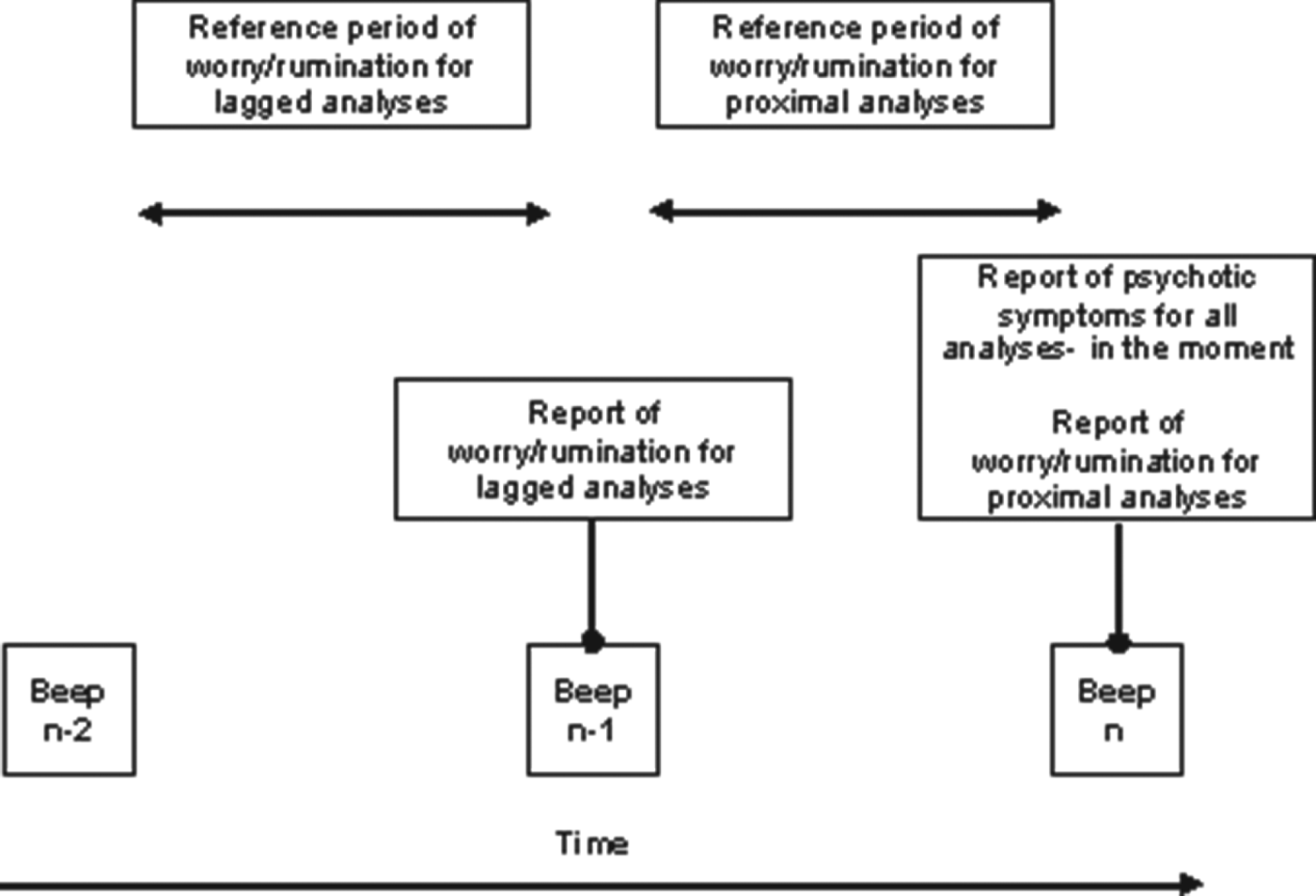
Given that ESM data are clustered within individuals and around multiple time points, analysis of the momentary data requires the use of multi-levelling modelling procedures, which take account of this clustering and also are able to handle substantial amounts of missing data without excluding whole cases. Clustering also affects the validity of sample size calculations. As outlined previously (Kimhy et al. 2012), where the momentary data point is the unit of interest, the number of data points can be used as a basis for power considerations. In the current study, the maximum number of possible data points was 60 for each participant (10 per day over 6 days). ESM data were analysed using Stata Statistical Software release 12 (Stata Corporation, USA) and participant-level data were analysed using SPSS version 16 (SPSS Inc., USA). The analysis strategy involved both main effects analyses and interaction terms. The main effects analyses were twofold for each hypothesis. In the proximal analyses, the predictor variable (worry and rumination) scores were taken from the time period directly preceding the current report, whereas in the lagged analyses this was the period preceding the current report minus one (see Fig. 1). This was intended to provide an estimation of how long the predictor effect lasts, and to reduce the potential of concurrent reports of delusions/hallucinations and worry/rumination contaminating one another. The outcome measure at the previous beep was not included as a covariate in these lagged analyses because the random intercept is highly correlated to this lagged outcome and so its inclusion might result in spurious findings; this is known as the ‘initial conditions’ problem. Significant interactions were plotted using values from the regression model and depict the relationships at low and high levels of the predictor and moderator variables, where low is 1 standard deviation (s.d.) below the mean and high is 1 s.d. above the mean. Multilevel models can also accommodate covariates within the model, providing an opportunity to control for potentially confounding variables. However, the interpretation of effects in these circumstances might be more complex and may lead to significant main effects being missed.
Depiction of proximal and time-lagged analyses.

Results
Sample
Thirty-six people consented to take part in the study; of these, 32 met eligibility criteria following the screening assessment. The sample of eligible participants had a mean age of 33 years (s.d. = 10.7), were predominantly male (n = 22) and all but one classed themselves as white. Most of the sample (n = 22) were unemployed and not studying, although more than half had completed some form of post-16 education (n = 20). Participants predominantly classed themselves as single (n = 20) and 15 lived with their parent/s, which may be a result of the large proportion of recruits from early intervention services (n = 14). The most prevalent diagnosis was schizophrenia (n = 15) but participants also met criteria for psychotic disorder NOS (n = 14; eight of whom were noted as first episode), schizo-affective disorder (n = 2) and acute psychotic disorder (n = 1). In terms of specific experiences, 26 participants were experiencing persecutory delusions, 26 were experiencing auditory hallucinations and 20 were experiencing both types of symptoms, as defined by a score of at least ‘mild’ on the relevant PANSS items.
Retention and adherence
Of the 32 participants who entered the ESM data collection phase, 27 completed the schedule, providing data on average at more than half of the 60 assessment points (mean = 35.4, s.d. = 13.9), with 24 participants meeting the traditional cut-off of at least one-third of the assessment points (Palmier-Claus et al. Reference Palmier-Claus, Myin-Germeys, Barkus, Bentley, Udachina, Delespaul, Lewis and Dunn2010).
Following square-root transformations of the PANSS Negative subscale and item P3 (auditory hallucinations) to remedy high levels of skewness, independent-samples t tests were used to assess differences between those who completed the ESM phase and those who did not. These tests revealed that there were no differences in age, positive, negative or general symptoms or the severity of delusions or hallucinations between the two groups.
After converting the participant education (to beyond secondary level or not) and employment status (to employed/studying versus unemployed) variables to remedy low subgroup numbers, χ 2 tests were undertaken, which indicated no differences in these aspects between those who did complete the ESM phase and those who did not. Gender also did not differ between groups.
Effects of antecedent worry on current psychotic experiences
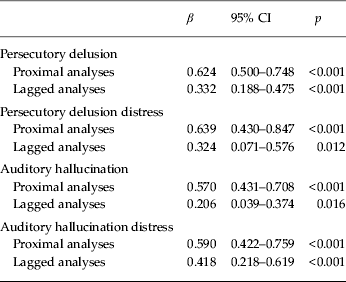
To assess whether proximal antecedent worry predicted current persecutory delusional ideation and distress, and auditory hallucination experiences and distress, four separate regression analyses were conducted, using the xtmixed command in Stata and adjusting for participant- and day-level random effects (intercepts). The results of these analyses, shown in Table 1, revealed significant links with both delusions and hallucinations, and both severity and distress. The worry variable was then lagged such that it reflected worry since the previous beep minus 1. The analyses were repeated using this variable and all effects remained significant, although the coefficients were smaller, indicating a less pronounced effect (see Table 1).
Effect of worry on current psychotic experiences

CI, Confidence interval.
The moderating effect of meta-cognitive beliefs on the relationship between worry and psychotic experiences
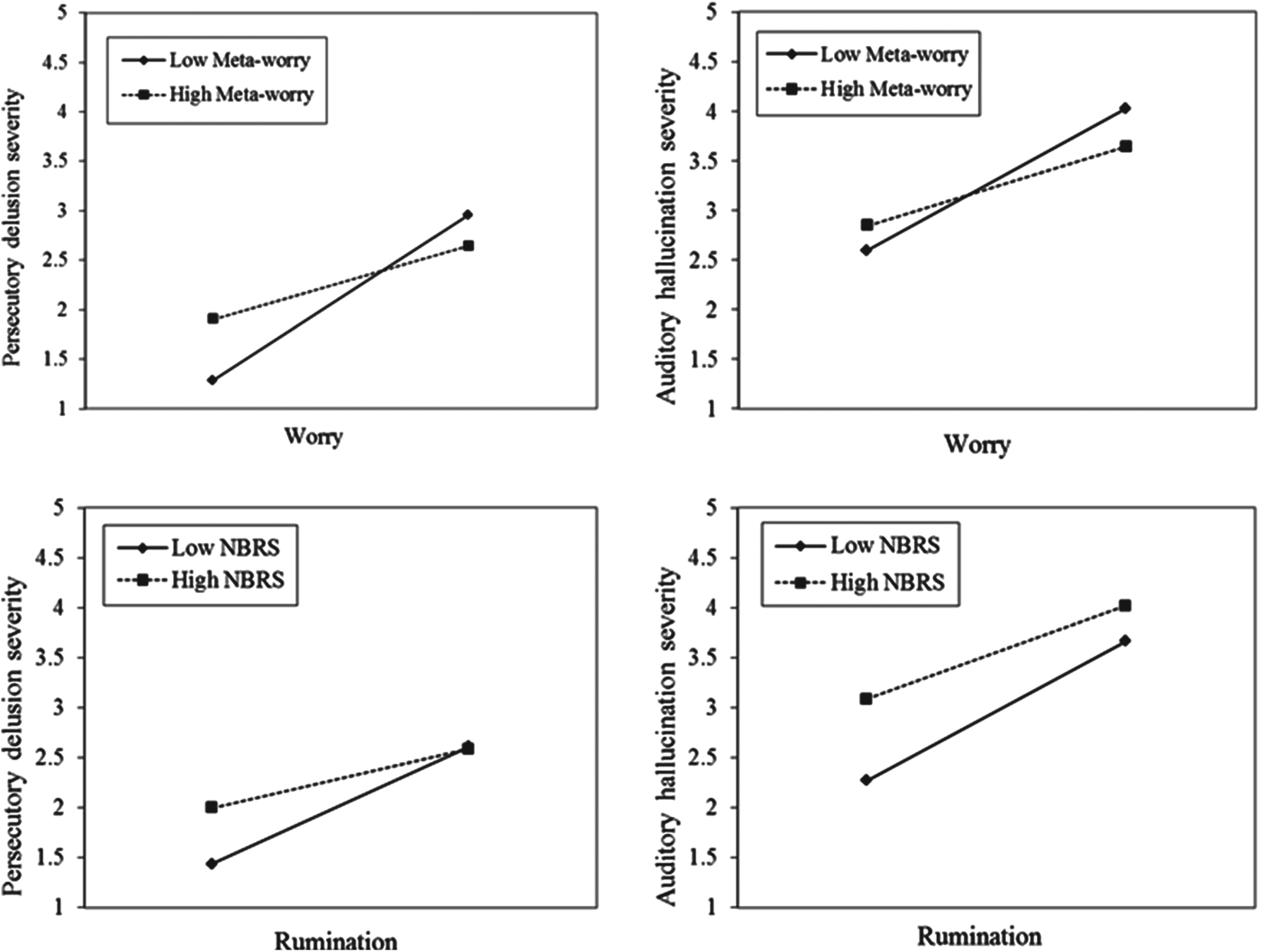
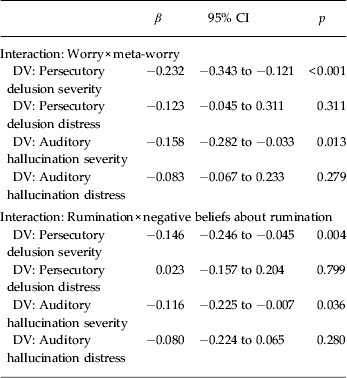
The multilevel regression analyses were rerun with the insertion of the potential moderator variable (meta-worry belief score) and the interaction term between meta-worry belief score and proximal worry. The results of these analyses revealed significant interaction effects between worry and meta-worry on momentary delusion severity and momentary auditory hallucination severity. Plotting the results (Fig. 2) shows that, for people scoring high on meta-worry, there is a weaker association between worry and psychotic experiences.
Interaction effects between predictor variables (worry and rumination) and moderator variables (meta-worry and negative beliefs about rumination). NBRS, Negative Beliefs about Rumination Scale.

Effects of antecedent rumination on current psychotic experiences
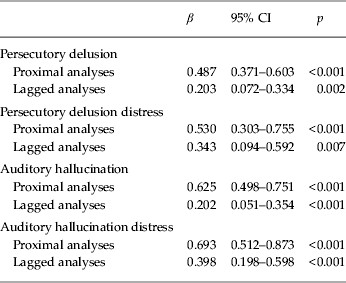
As with the worry analyses, to assess whether proximal antecedent rumination predicts current persecutory delusional ideation and distress, and auditory hallucination experiences and distress, four separate regression analyses were conducted, using the xtmixed command in Stata and adjusting for participant- and day-level random effects. The results of these analyses revealed significant links with both delusions and hallucinations, and both severity and distress (Table 2). The rumination variable was then lagged such that it reflected rumination since the previous beep minus 1. The analyses were repeated using this variable and all effects remained significant, although the coefficients were smaller, indicating a less pronounced effect (see Table 2).
Effect of rumination since the previous beep on current psychotic experiences

CI, Confidence interval.
The moderating effect of meta-cognitive beliefs on the relationship between rumination and psychotic experiences
The multilevel regression analyses were rerun with the insertion of the potential moderator variable (negative beliefs about rumination score) and the interaction term between rumination and negative beliefs about rumination. The results of these analyses revealed significant interaction effects between rumination and negative beliefs about rumination on momentary delusion severity and momentary auditory hallucination severity (Table 3). Plotting the results (Fig. 2) indicates a similar pattern to the worry results; that is, for people scoring high on negative beliefs about rumination, there is a weaker association between rumination and psychotic experiences.
Moderation effects

CI, Confidence interval; DV, dependent variable.
The main effects and interaction term analyses were rerun to include only data from those participants who completed at least 20 of the possible 60 ESM reports (as has been the traditional cut-off; Palmier-Claus et al. Reference Palmier-Claus, Myin-Germeys, Barkus, Bentley, Udachina, Delespaul, Lewis and Dunn2010). None of the results changed (in terms of the significance of findings and their interpretation) and therefore the findings from the larger sample were retained.
Discussion
As hypothesized, in the context of daily life, worry and rumination predicted greater levels of persecutory delusional ideation and auditory hallucinations and the distress experienced as a result of these events. In both the proximal period and the time-lagged analyses, antecedent worry and rumination predicted current levels of psychotic experiences, adding weight to the proposal that these processes may influence psychotic experiences. The effects were significant but slightly diminished for the time-lagged analyses, indicating that the links may be most pertinent over shorter time periods.
In addition, negative beliefs about worry and rumination were shown to moderate the relationships between these thought processes and the severity (although not the distress) of persecutory delusions and auditory hallucinations. The nature of the interactions was not entirely as expected; negative beliefs about worry and rumination weakened the effect of these processes on momentary levels of delusions and hallucinations rather than enhanced them, as had been hypothesized. One possible, although speculative, explanation is that, in situations where worries and the consequent negative somatic and emotional sensations ensue, if someone has a stable belief that worry is bad then they may be less likely to seek meaning elsewhere (they feel bad and they know worry to be bad, so the experience fits with their beliefs) and thus less likely to misinterpret or misattribute the experience and augment the severity of the psychotic experience. The lack of significant moderation with regard to symptom distress may be because the distress related to the psychotic experience (which may be augmented by worry processes) is moderated mainly by meta-cognitions about the symptom rather than about the thought process that may have triggered it. Similar explanations may apply for rumination and negative beliefs thereof.
The novel findings produced by the current study show that worry and rumination are important in the day-to-day experience of persecutory delusions and auditory hallucinations, in a sample of people who are currently experiencing psychosis. Moreover, we have demonstrated that the moderating effects of negative meta-cognitions in this context are not as expected, warranting further investigation. These findings build on previous work, using traditional retrospective measures, that has shown that worry is important in the experience of delusions (Freeman & Garety, Reference Freeman and Garety1999; Startup et al. Reference Startup, Freeman and Garety2007) and rumination is linked with subsyndromal auditory hallucinations (Jones & Fernyhough, Reference Jones and Fernyhough2009). A divergence has previously been noted between anxious and depressive processes such that the former is more readily associated with delusions and the latter with auditory hallucinations (Hartley et al. Reference Hartley, Haddock and Barrowclough2012). The current study has not mirrored this finding (all links were statistically significant), although the effects for the worry–delusions links are greater than the worry–auditory hallucinations links (and vice versa for rumination).
There are many ways that worry and rumination could lead to increases in, or trigger, delusions and auditory hallucinations. Possible mechanisms that have been demonstrated to be related to worry and rumination include thought suppression or avoidance (Cribb et al. Reference Cribb, Moulds and Carter2006; Moulds et al. Reference Moulds, Kandris, Starr and Wong2007), increases in cognitive intrusions (Wells & Papageorgiou, Reference Wells and Papageorgiou1995; Becker et al. Reference Becker, Rinck, Roth and Margraf1998; Lyubomirsky et al. Reference Lyubomirsky, Kasri and Zehm2003; Watkins, Reference Watkins2004) and attention to and appraisal of threat (Belzer et al. Reference Belzer, D'Zurilla and Maydeu-Olivares2002; Donaldson & Lam, Reference Donaldson and Lam2004; Donaldson et al. Reference Donaldson, Lam and Mathews2007; Verkuil et al. Reference Verkuil, Brosschot, Putman and Thayer2009; Stapinski et al. Reference Stapinski, Abbott and Rapee2010). Future work might explore whether these processes mediate between increases in worry and rumination and subsequent rises in psychotic experiences.
Limitations
Despite the strengths of the methodology described here, there are some limitations or points of consideration that should be outlined prior to firm conclusions being drawn.
First, the sample did not reflect the diversity of North West England, with all but one participant classing themselves as white in ethnic origin; therefore the results may not be generalizable to other groups.
Second, the possibility remains that ESM items do not capture exactly the same phenomena as retrospective measures, although arguably this is a key feature of ESM studies rather than a limitation. In addition, the items used in the current study represent fairly simplistic conceptualizations of delusional and hallucinatory experience (severity and distress); therefore future replications might attempt to encompass the multifaceted nature of these experiences and appraisals thereof (Peters et al. Reference Peters, Williams, Cooke and Kuipers2012). Similarly, future work focusing on rumination might acknowledge the delineation between different types of repetitive introspective thought, such as reflection and brooding (Treynor et al. Reference Treynor, Gonzalez and Nolen-Hoeksema2003).
Third, the ESM items remain self-report in nature and consequently suffer similar limitations as more traditional measures, requiring an awareness of one's experiences. Concurrent objective measures, such as heart rate monitoring (Csikszentmihalyi & Larson, Reference Csikszentmihalyi and Larson1987), could provide momentary level validation of the items, although the prospects for this when relating to complex psychological experiences such as delusions and hallucinations seem limited at present.
Fourth, despite the dynamic moment-to-moment data that the analyses encompass, the link between worry and rumination and subsequent psychotic experiences cannot be assumed to be unidirectional and causal in nature. It may be that complex bidirectional models are at work (Oorschot et al. Reference Oorschot, Lataster, Viviane, Wichers and Myin-Germeys2012), which future work could explore.
Implications for clinical practice
The current study has provided a novel insight into the impact of worry and rumination on the experience of persecutory delusions and auditory hallucinations in daily life. The key findings indicate that worry and rumination may be useful targets in facilitating the reduction of the severity of psychotic experiences and the distress they elicit. This focus might be incorporated into current psychological interventions, such as the use of mindfulness or worry reduction techniques, which have already begun to be piloted with people experiencing psychosis (Chadwick et al. Reference Chadwick, Taylor and Abba2005; Foster et al. Reference Foster, Startup, Potts and Freeman2010). Furthermore, ESM could be harnessed to deliver momentary interventions (Granholm et al. Reference Granholm, Ben-Zeev, Link, Bradshaw and Holden2012; Kelly et al. Reference Kelly, Gooding, Pratt, Ainsworth, Welford and Tarrier2012), which, when triggered by heightened levels of worry and/or rumination, instigate a short individualized intervention strategy to reduce the impact on distressing experiences.
Appendix. ESM items

Acknowledgements
This work was supported by the National Institute for Health Research (NIHR)-funded RECOVERY programme under its Programme Grants for Applied Research scheme (RP-PG-0606-1086), which provided payment for the Ph.D. fees of the first author. The views expressed in this publication are those of the authors and not necessarily those of the NHS, the NIHR or the Department of Health. We thank two anonymous consultants and the Mental Health Research Network (MHRN) FACTOR group, who reviewed the study materials. We also thank G. Byrne for help with the Palm devices and data extraction, the clinical studies officers and clinical teams for facilitating recruitment, and the participants for taking part in this study.
Declaration of Interest
None.