Social anxiety disorder (SAD) is characterised by persistent fear of social or performance situations (American Psychiatric Association, 2013). SAD is common with a 12-month prevalence rate of approximately 7% and a lifetime prevalence rate of 13% (Kessler, Petukhova, Sampson, Zaslavsky, & Wittchen, Reference Kessler, Petukhova, Sampson, Zaslavsky and Wittchen2012). SAD is associated with high levels of impairment and comorbidity (Ruscio et al., Reference Ruscio, Brown, Chiu, Sareen, Stein and Kessler2008), as well as increased levels of suicidal ideation (Olfson et al., Reference Olfson, Guardino, Struening, Schneier, Hellman and Klein2000). While SAD is a common and impairing condition generally, the lifetime prevalence of SAD is significantly higher in women (14.2%) compared to men (11.8%) (Kessler et al., Reference Kessler, Petukhova, Sampson, Zaslavsky and Wittchen2012), and women demonstrate higher levels of symptom severity when they present for treatment (Asher, Asnaani, & Aderka, Reference Asher, Asnaani and Aderka2017). For this reason, it is important to examine SAD specifically in women.
Despite the prevalence of SAD, as well as the pervasive negative consequences of the condition, individuals with SAD often do not seek help for their SAD symptoms (Ormel et al., Reference Ormel, Petukhova, Chatterji, Aguilar-Gaxiola, Alonso, Angermeyer and Kessler2008; Ruscio et al., Reference Ruscio, Brown, Chiu, Sareen, Stein and Kessler2008) or delay seeking treatment for many years after symptom onset (Grant et al., Reference Grant, Hasin, Blanco, Stinson, Chou, Goldstein and Huang2005; Thompson, Issakidis, & Hunt, Reference Thompson, Issakidis and Hunt2008). Barriers identified for individuals with SAD include treatment costs, not knowing where to get help, and therapy wait times (Chartier-Otis, Perreault, & Bélanger, Reference Chartier-Otis, Perreault and Bélanger2010). Additionally, there is some literature to suggest that those living in rural or remote areas have increased difficulty accessing mental health treatment or can have different barriers to accessing care compared with those in urban settings (Logan, Stevenson, Evans, & Leukefeld, Reference Logan, Stevenson, Evans and Leukefeld2004; Smith, Paparo, & Wootton, Reference Smith, Paparo and Wootton2021). For example, Logan et al. (Reference Logan, Stevenson, Evans and Leukefeld2004) found that women in rural areas had more difficulty obtaining an appointment for mental health services than women in urban areas and had more concerns about confidentiality. There is also some research to suggest that barriers to treatment can differ across age groups, genders, and based on previous psychological treatment (McCausland, Paparo, & Wootton, Reference McCausland, Paparo and Wootton2021; Pepin, Segal, & Coolidge, Reference Pepin, Segal and Coolidge2009; Smith et al., Reference Smith, Paparo and Wootton2021). For example, Smith et al. (Reference Smith, Paparo and Wootton2021) found that young adults (18–25) with depressive symptoms endorsed barriers such as ‘I don't think that a therapist would be able to understand my problems’ and ‘I worry about the therapist keeping my problems confidential’ significantly more than adults aged 25 and over. Similarly, McCausland et al. (Reference McCausland, Paparo and Wootton2021) found that those who previously engaged with psychological treatment were significantly more likely to report no barriers to accessing treatment than individuals who had sought treatment in the past. Although mental health treatment barriers have been studied in the literature, to date no research has investigated the unique barriers that women with SAD may face.
There is now considerable evidence that SAD can be effectively treated with cognitive behavioral therapy (CBT) (Carpenter et al., Reference Carpenter, Andrews, Witcraft, Powers, Smits and Hofmann2018; Mayo-Wilson et al., Reference Mayo-Wilson, Dias, Mavranezouli, Kew, Clark, Ades and Pilling2014). Best-practice CBT for SAD generally involves weekly sessions, cognitive restructuring, graded exposure, and between-session homework tasks (Jørstad-Stein & Heimberg, Reference Jørstad-Stein and Heimberg2009). Despite the research demonstrating the efficacy of CBT, less than 10% of individuals seeking help for their SAD symptoms receive notionally effective treatment, compared to approximately 60% for affective disorders (Andrews, Issakidis, Sanderson, Corry, & Lapsley, Reference Andrews, Issakidis, Sanderson, Corry and Lapsley2004). However, more recently, the focus on evidence-based practice has increased, and as such, the proportion of patients receiving evidence-based treatment may also have increased. Thus, it is important to investigate the treatment provided to individuals with SAD in a contemporary context. Such research may inform future policy and practice, for example, by ensuring that clinicians-in-training receive adequate education on the assessment, diagnosis, and delivery of evidence-based treatment for SAD.
Over the last decade, the use of technology to deliver CBT for mental health conditions has increased, and patients now have multiple options when accessing care. Treatments for SAD can be divided into those that are high intensity and those that are low intensity. High-intensity CBT treatments often require significant clinician time and patient resources. Common high-intensity treatments include traditional individual face-to-face treatment, group-based treatment, accelerated treatments, and internet videoconferencing. Each of these treatment modalities has been demonstrated to be efficacious for SAD in clinical trials (Mayo-Wilson et al., Reference Mayo-Wilson, Dias, Mavranezouli, Kew, Clark, Ades and Pilling2014; Wootton et al., Reference Wootton, Hunn, Moody, Lusk, Ranson and Felmingham2018; Yuen et al., Reference Yuen, Herbert, Forman, Goetter, Juarascio, Rabin and Bouchard2013). Low-intensity treatments require much less clinician time and are a more efficient way of delivering treatment. Common low-intensity treatments include internet-delivered CBT (ICBT) and bibliotherapy-delivered CBT (BCBT). Low-intensity interventions have also been demonstrated to be efficacious in clinical trials for SAD (Andersson, Cuijpers, Carlbring, Riper, & Hedman, Reference Andersson, Cuijpers, Carlbring, Riper and Hedman2014; Furmark et al., Reference Furmark, Carlbring, Hedman, Sonnenstein, Clevberger, Bohman and Andersson2009).
Despite the availability of a variety of treatment approaches for SAD, there has been limited research examining the acceptability of these various approaches. In internet-treatment samples, the acceptability of ICBT is high (Titov et al., Reference Titov, Andrews, Schwencke, Robinson, Peters and Spence2010, Reference Titov, Andrews, Schwencke, Solley, Johnston and Robinson2009). However, in samples who are seeking treatment in a face-to-face clinic, patients prefer face-to-face treatment (Berle et al., Reference Berle, Starcevic, Milicevic, Hannan, Dale, Brakoulias and Viswasam2015). Several other studies have also found that low-intensity mental health treatment services were perceived as less acceptable than traditional face-to-face interventions (McCausland et al., Reference McCausland, Paparo and Wootton2021; Robertson, Paparo, & Wootton, Reference Robertson, Paparo and Wootton2020; Smith et al., Reference Smith, Paparo and Wootton2021). Some researchers have also found differences in CBT treatment preferences based on age and geographical location (McCausland et al., Reference McCausland, Paparo and Wootton2021; Smith et al., Reference Smith, Paparo and Wootton2021). For example, Smith et al. (Reference Smith, Paparo and Wootton2021) found that younger adults are significantly less likely to access internet videoconferencing-based CBT (VCBT) compared with adults aged 25 and above, and McCausland et al. (Reference McCausland, Paparo and Wootton2021) found that individuals in rural locations were more likely to access internet videoconferencing-based CBT than individuals in urban locations. However, to date, the CBT treatment delivery preferences of those with SAD specifically have not been examined. It is possible that those with SAD may prefer non-face-to-face interventions, given the inherent avoidance associated with the condition (American Psychiatric Association, 2013). An improved understanding of treatment delivery preferences in this population would enable the development and promotion of interventions that are most likely to attract and retain individuals with SAD symptoms in treatment.
Overall, the literature has identified clear barriers to evidence-based treatment for individuals with SAD, yet to date no studies have investigated the unique barriers that women face. Previous studies have demonstrated that less than one in 10 individuals with SAD receive best-practice treatment; however, these data are now outdated and may underestimate the proportion of individuals receiving evidence-based care. Furthermore, while evidence supports the efficacy of a variety of CBT approaches for SAD, little research has investigated treatment preferences for women with SAD. Given these limitations of the existing literature, the current study aims to examine: (1) reported barriers to treatment; (2) treatment histories; and (3) treatment preferences in a sample of women with clinically relevant SAD symptoms. The study was designed as exploratory with no a priori hypotheses. Given the literature highlighting potential differences in barriers based on age and geographical location (Logan et al., Reference Logan, Stevenson, Evans and Leukefeld2004; McCausland et al., Reference McCausland, Paparo and Wootton2021; Pepin et al., Reference Pepin, Segal and Coolidge2009; Smith et al., Reference Smith, Paparo and Wootton2021), we examined group differences based on age, geographical location, and previous treatment experiences. Similarly, given the literature highlighting different levels of acceptability for the various CBT delivery methodologies (McCausland et al., Reference McCausland, Paparo and Wootton2021; Robertson et al., Reference Robertson, Paparo and Wootton2020; Smith et al., Reference Smith, Paparo and Wootton2021), we wished to further examine whether there are any differences in acceptability based on age and geographical location.
Method
Participants
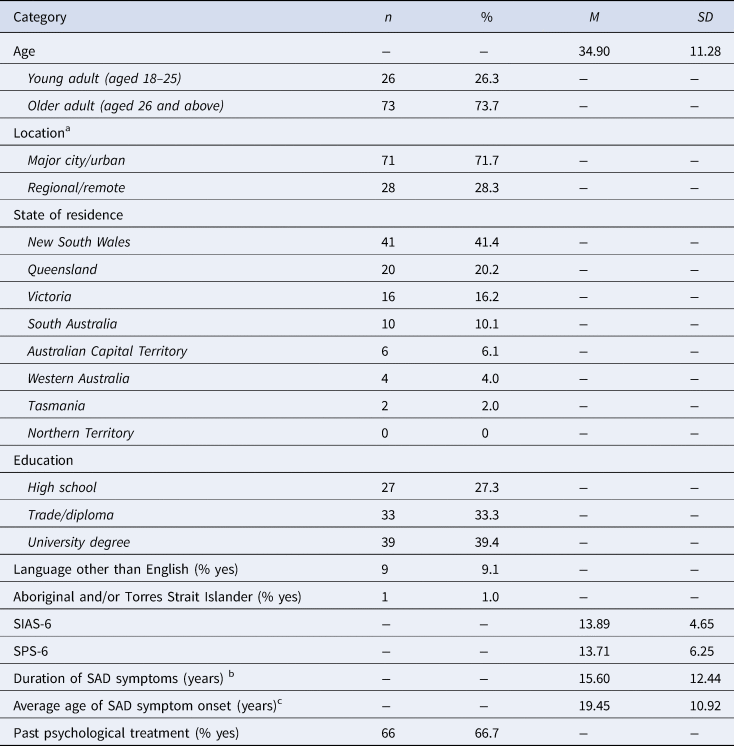
Ninety-nine women (M age = 34.90, SD = 11.28) were included in the study. Participant characteristics are outlined in Table 1. To be included in the study, participants were required to (1) identify as female and be at least 18 years of age; (2) be located in Australia; (3) be able to read English; (4) score equal to or greater than seven on the short form of the Social Interaction Anxiety Scale (SIAS-6) (Peters, Sunderland, Andrews, Rapee, & Mattick, Reference Peters, Sunderland, Andrews, Rapee and Mattick2012) and equal to or greater than two on the short form of the Social Phobia Scale (SPS-6) (Peters et al., Reference Peters, Sunderland, Andrews, Rapee and Mattick2012); and (5) complete at least one of the study questionnaires in addition to the demographic information sheet. There were no other exclusion criteria and comorbidity data are not available.
Demographic Characteristics and Outcome Measures (N = 99)

Note. aRegional/remote status was calculated by postcode using The Accessibility/ Remoteness Index of Australia (ARIA).
b n = 87.
c n = 96.
Measures
Social Interaction Anxiety Scale and Social Phobia Scale — Short Form (SIAS-6 and SPS-6)
The SIAS and SPS are a companion set of measures designed to assess two similar yet distinct aspects of SAD: scrutiny fears and more generalised social interaction anxieties (Mattick & Clarke, Reference Mattick and Clarke1998; Peters et al., Reference Peters, Sunderland, Andrews, Rapee and Mattick2012). The short forms are self-report measures, each comprised of six items. The items are rated on a 5-point Likert scale ranging from 0 (not at all characteristic or true of me) to 4 (completely characteristic or true of me). The optimum cut-off scores for discriminating between those with and without a diagnosis of SAD are 7 or higher on the SIAS-6 and 2 or higher on the SPS-6 (Peters et al., Reference Peters, Sunderland, Andrews, Rapee and Mattick2012). The short forms have demonstrated sound psychometric properties displaying adequate to good internal consistency (α = .75–.85), convergent and discriminant validity, diagnostic discrimination, and treatment sensitivity in previous studies (Le Blanc et al., Reference Le Blanc, Bruce, Heimberg, Hope, Blanco, Schneier and Liebowitz2014; Peters et al., Reference Peters, Sunderland, Andrews, Rapee and Mattick2012).
Treatment Barriers Questionnaire
The Treatment Barriers Questionnaire (TBQ) was used to assess barriers to treatment. The measure was developed for this study and was based on similar measures used in the literature (Langley, Wootton, & Grieve, Reference Langley, Wootton and Grieve2018; McCausland et al., Reference McCausland, Paparo and Wootton2021; Robertson et al., Reference Robertson, Paparo and Wootton2020). Participants were asked to indicate factors likely to impede future psychological help-seeking by selecting applicable factors from a list of 22 response options, e.g., ‘I think I can/should work out my own problems rather than talking to a psychologist’ and ‘I would not be able to afford treatment’.
Treatment History Questionnaire
The Treatment History Questionnaire (THQ) is a 9-item scale developed specifically for this study to ascertain the past experience with various SAD treatments and was based on the previously published literature (McCausland et al., Reference McCausland, Paparo and Wootton2021; Robertson et al., Reference Robertson, Paparo and Wootton2020; Stobie, Taylor, Quigley, Ewing, & Salkovskis, Reference Stobie, Taylor, Quigley, Ewing and Salkovskis2007). Example items include ‘Who did you first approach for professional help for your social anxiety symptoms?’ and ‘Which of the following types of professional help have you ever received for your social anxiety symptoms?’ Only those who indicated previously engaging in psychological treatment for SAD completed the THQ.
Treatment Preferences Questionnaire
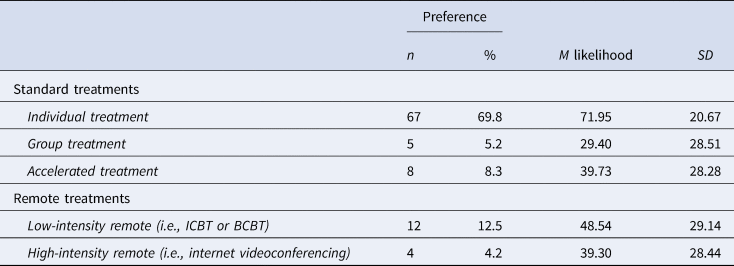
The Treatment Preferences Questionnaire (TPQ) assessed CBT treatment delivery preferences. The TPQ has been used in previous similar research (McCausland et al., Reference McCausland, Paparo and Wootton2021; Robertson et al., Reference Robertson, Paparo and Wootton2020; Smith et al., Reference Smith, Paparo and Wootton2021). The 8-item questionnaire asked participants to firstly indicate their preference between various types of CBT treatment approaches for SAD including high-intensity (i.e., individual face-to-face, group-based treatment, accelerated treatment, and internet videoconferencing) and low-intensity options (i.e., ICBT and BCBT). Participants were also asked to indicate how likely they would be to use each of the treatment approaches on a scale of 0 (not at all likely) to 100 (extremely likely).
Procedure
Ethical approval was provided by the University of Technology Sydney Human Research Ethics Committee. The measures were administered online using REDCap electronic data capture tools hosted at the University of Technology Sydney (Harris et al., Reference Harris, Taylor, Minor, Elliott, Fernandez, O'Neal and Duda2019, Reference Harris, Taylor, Thielke, Payne, Gonzalez and Conde2009) and were accessible via a link provided in the hardcopy/online advertisements. Participants were recruited from advertisements on community noticeboards and posts on social media between March and August 2019.
Data Analysis
Treatment barriers, histories, and preferences were analysed using descriptive statistics. Group differences were examined using Pearson's chi-square test of contingencies and independent samples t-tests. When examining group differences based on age, young adult participants were categorised as those aged 18–25 and adult participants were those aged 26 and above. For chi-square analyses, effect-size estimates were calculated using φ where values of .1, .3, and .5 were interpreted as small, medium, and large, respectively (Cohen, Reference Cohen1992). When expected frequencies were below five, Fisher's exact test was interpreted. Effect sizes for independent samples t-tests were estimated using Cohen's d and values of .20, .50, and .80 were interpreted as small, medium, and large, respectively (Cohen, Reference Cohen1992). All data were analysed with IBM SPSS Statistics for Windows, Version 27.0.
Results
Preliminary Analyses
Table 1 outlines the demographic information and outcomes of each of the measures. Participants were, on average, aged in their mid-30s (M = 34.90; SD = 11.28) and resided in a major city (71.7%). Participants were located across most of the Australian States/Territories and 1% of the sample identified as an Aboriginal and/or Torres Strait Islander. Participants had experienced social anxiety symptoms for an average of 15.60 years (SD = 12.44). The average age of symptom onset was 19.45 years (SD = 10.92).
Treatment Barriers
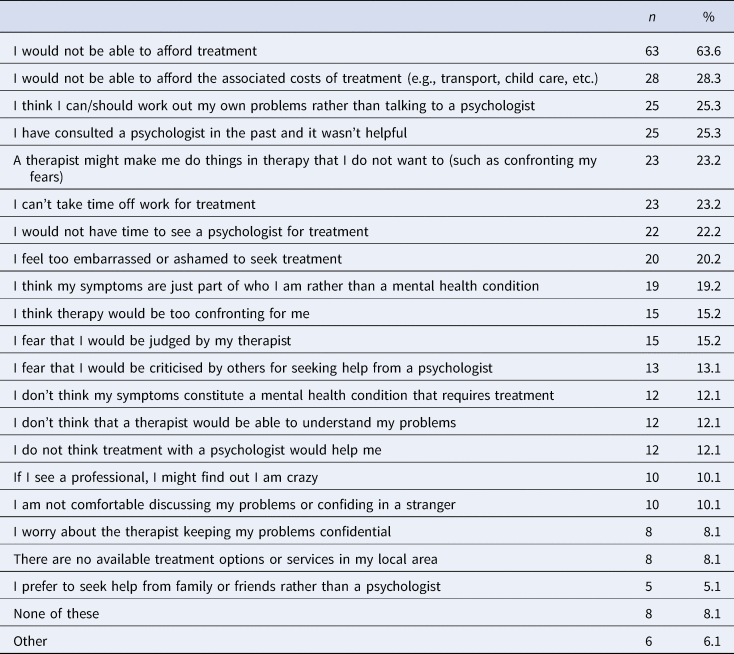
The mean number of barriers was 3.78 (SD = 2.84) and endorsed barriers are outlined in Table 2. Chi-square tests indicated that younger women were more likely (9/26; 34.6%) than older women (4/73; 5.5%) to endorse a fear of criticism [χ2 (1, N = 99) = 14.27, p < .001; φ = .38, medium effect]. Younger women were also more likely (9/26; 34.6%) than older women (10/73; 13.7%) to think that their symptoms were just part of who they were [χ2 (1, N = 99) = 5.41, p = .02; φ = .23, small effect].
Treatment Barriers (N = 99)

Women living in regional/remote areas were more likely (7/28; 25%) than women in urban areas (5/71; 7.0%) to think that a therapist would not be able to understand their problems [χ2 (1, N = 99) = 6.08, p = .01; φ = .25, small effect]. Women living in regional/remote areas were also more likely (5/28; 17.9%) than women in urban areas (3/71; 4.2%) to report not having treatment options in their area [χ2 (1, N = 99) = 5.02, p = .03; φ = .23, small effect].
Women who had previously received psychological treatment were less likely (3/66; 4.4%) than women who were treatment-naive (9/33; 27.3%) to endorse that their symptoms did not constitute a mental health condition requiring treatment [χ2 (1, N = 99) = 10.67, p = .001; φ = .33, medium effect]. Women who had previously received psychological treatment (21/66; 31.8%) were also more likely than women who were treatment-naive (4/33; 12.1%) to endorse that past treatment had not been helpful [χ2 (1, N = 99) = 4.52, p = .03; φ = .21, small effect].
Treatment History
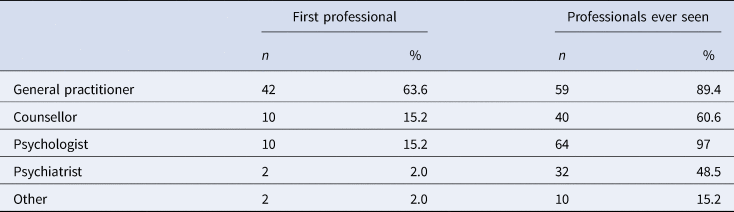
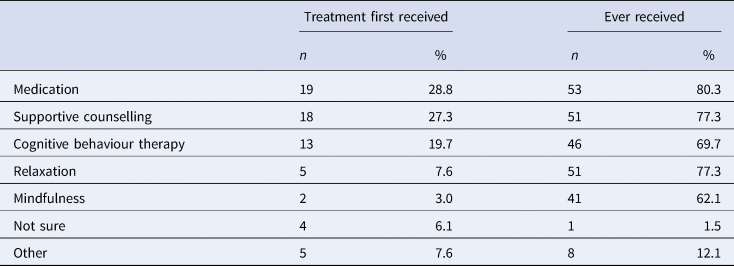
Sixty-six participants (66/99; 66.7%) indicated that they had previously sought help from a health professional regarding their SAD symptoms and provided details. The professionals consulted are outlined in Table 3, and the types of treatments received are outlined in Table 4. Most participants (42/66; 63.6%) initially sought help from a general practitioner, followed by a counsellor (10/66; 15.2%) and a psychologist (10/66; 15.2%). Participants reported that on average, they had previously consulted 6.34 (SD = 6.47) health professionals for their SAD symptoms. Medication was the most commonly reported type of help received when treatment was first sought (19/66; 28.8%), followed by supportive counselling (18/66; 27.3%) and CBT (13/66; 19.7%). Of those who stated they had ever received CBT (n = 46), 28 (60.9%) reported focusing on the SAD symptoms for the majority of the session, 19 (41.3%) reported completing exposure tasks, 14 (30.4%) reported having at least weekly sessions, and 35 (76.1%) reported being given tasks to complete between sessions. Two of the 46 participants (4.3%) received all the above and thus likely received best-practice CBT.
Professionals Accessed for Treatment (N = 66)

Note. For professionals ever seen, respondents could select more than one option; therefore, percentages do not equal 100.
Type of Treatment Received (N = 66)

Treatment Delivery Preference
Treatment delivery preferences are outlined in Table 5. The most preferred treatment delivery method overall was individual face-to-face treatment (67/96; 69.8%). The most commonly endorsed remote treatment was low-intensity treatment options, such as ICBT or BCBT (12/96; 12.5%), rather than high-intensity remote treatment, such as VCBT (4/99; 4.2%). Those who had previously received psychological treatment from a mental health professional reported a preference for individual face-to-face treatment (M = 76.69, SD = 19.05) more often than those who had not (M = 62.47, SD = 22.79) [t (94) = −3.25, p < .01, d = .72, medium effect]. There were no significant differences in treatment delivery preferences according to age or geographical location.
Treatment Preferences (N = 96)

Discussion
The aim of the current study was to examine barriers to treatment, treatment histories, and treatment preferences in a sample of women with clinically relevant SAD symptoms. Consistent with existing research on SAD (Chartier-Otis et al., Reference Chartier-Otis, Perreault and Bélanger2010), as well as other mental health conditions (Langley et al., Reference Langley, Wootton and Grieve2018; McCausland et al., Reference McCausland, Paparo and Wootton2021; Smith et al., Reference Smith, Paparo and Wootton2021; Spence et al., Reference Spence, Titov, Solley, Dear, Johnston, Wootton and Choi2011), the most frequently endorsed barrier to treatment was cost: ‘I would not be able to afford treatment’, with more than half the sample endorsing this barrier. Thus, despite the widespread availability of effective treatments, many women with SAD symptoms are not able to afford treatment.
We identified some group differences in treatment barriers which were of moderate size. Firstly, the results indicated that younger adults (aged 18–25) were more likely than older adults (aged over 25) to endorse fear of criticism as a barrier to accessing treatment. This finding is consistent with the existing literature (Mackenzie, Gekoski, & Knox, Reference Mackenzie, Gekoski and Knox2006; Mackenzie, Heath, Vogel, & Chekay, Reference Mackenzie, Heath, Vogel and Chekay2019), and highlights the importance of intervention services specifically for adolescents and young adults, which may assist in helping young women to access treatment, as such speciality services may make young women feel more at ease when access treatment. Secondly, we found that women who had previously received psychological treatment were less likely to endorse that their symptoms did not constitute a mental health condition requiring treatment. This finding may indicate that the treatment that participants received helped to normalise symptoms and improve mental health literacy. While other group differences emerged, the effects were small in size and require replication.
Despite CBT being an effective treatment for SAD (Carpenter et al., Reference Carpenter, Andrews, Witcraft, Powers, Smits and Hofmann2018; Mayo-Wilson et al., Reference Mayo-Wilson, Dias, Mavranezouli, Kew, Clark, Ades and Pilling2014), that is recommended as a first-line intervention (National Institute for Health and Care Excellence, 2013), our results found that only 4% of our sample received a likely best-practice intervention when they sought help from a health practitioner. This finding is consistent with the findings of earlier research (Andrews et al., Reference Andrews, Issakidis, Sanderson, Corry and Lapsley2004; Chapdelaine, Carrier, Fournier, Duhoux, & Roberge, Reference Chapdelaine, Carrier, Fournier, Duhoux and Roberge2018) that demonstrates many patients with SAD do not receive adequate treatment and highlights the potential of therapist drift (Waller, Reference Waller2009; Waller & Turner, Reference Waller and Turner2016) as being a major issue in the community. Much research demonstrates that exposure-based interventions are generally under-utilized in the treatment of anxiety disorders (Hipol & Deacon, Reference Hipol and Deacon2013), and it is important that clinical psychologists are adequately trained and supervised in the delivery of evidence-based interventions for SAD in the future.
Despite the efficacy (Andersson et al., Reference Andersson, Cuijpers, Carlbring, Riper and Hedman2014; Furmark et al., Reference Furmark, Carlbring, Hedman, Sonnenstein, Clevberger, Bohman and Andersson2009) and widespread availability of remote treatment for SAD (Titov et al., Reference Titov, Dear, Staples, Bennett-Levy, Klein, Rapee and Nielssen2015, Reference Titov, Dear, Staples, Bennett-Levy, Klein, Rapee and Nielssen2017), the majority of women in the current sample indicated that traditional face-to-face treatment was their preferred method of treatment delivery. This finding is consistent with previous studies that have highlighted that patients prefer face-to-face treatment over remotely delivered treatments (Berle et al., Reference Berle, Starcevic, Milicevic, Hannan, Dale, Brakoulias and Viswasam2015; McCausland et al., Reference McCausland, Paparo and Wootton2021; Robertson et al., Reference Robertson, Paparo and Wootton2020; Smith et al., Reference Smith, Paparo and Wootton2021). Furthermore, our analysis of group differences in treatment preferences indicated that those participants who had previously received psychological treatment from a mental health professional preferred individual face-to-face treatment more often than those who had not. While this is not surprising, given the participant was familiar with that treatment methodology, it is possible that consumers lack awareness of the availability and efficacy of remote treatments. Thus, enhancing knowledge of these low-intensity treatment options, possibly as part of stepped-care approaches, is an important area for future research.
While the current study provides a preliminary understanding of treatment barriers, treatment preferences, and treatment histories of women with SAD symptoms, it is important to highlight some limitations of the present study. Firstly, the use of a cross-sectional design only offered information at a single time point. Future studies may wish to utilise a longitudinal, prospective design in order to allow inferences to be generated. Secondly, the study comprised self-report measures only, which can be susceptible to bias. Future research may wish to replicate the findings using a sample of individuals who have been assigned a diagnosis of SAD based on a diagnostic interview and may also wish to interview participants about their treatment histories and preferences in order to ensure that participants fully considered the questions being asked of them and were able to ask clarification questions as needed. Thirdly, while all participants demonstrated clinically relevant symptoms of SAD, it is unknown if SAD was the primary mental health disorder for each participant and future research may wish to replicate the study in a sample of participants with SAD as their primary mental health condition. Fourthly, it is unknown if participants were currently in treatment or wanting treatment for their SAD symptoms. Future research may examine and control for concurrent treatment. Finally, limited demographic information was elicited from participants, and other demographic details such as employment status, ethnicity, and relationship status may influence the results of this study if they were controlled for.
Implications for Practice and/or Policy
The results of the present study have a number of important considerations for practice and policy. Firstly, the results of the study demonstrate that many women with SAD symptoms are unable to access effective treatment because of cost. Thus, it is important for governments to provide low-cost treatment options for women suffering from anxiety disorders, including SAD. Such options may include low-intensity services such as ICBT or BCBT, especially for women who are treatment-naive. Secondly, many women are not being provided with evidence-based treatment when they do access care. As such it may be important for regulatory bodies to routinely assess their members’ understanding of, and commitment to, evidence-based practice when working with common mental health conditions.
Conclusions
The current study demonstrates that women experience a number of barriers to accessing treatment for SAD symptoms. Additionally, the study demonstrates that when women do seek treatment, they are often provided with pharmacological interventions or non-evidenced-based psychological treatments. Participants in this study highlighted a preference for face-to-face treatment, although indicated they would likely try a low-intensity intervention such as ICBT. Given SAD is a common and disabling mental health condition, it is important that (1) future government policy addresses barriers to care; (2) measures are put in place to ensure that clinicians-in-training are trained in best-practice assessment and treatment of SAD symptoms; and (3) that a number of efficient and effective treatment options are available to women with SAD symptoms.
Availability of Data and Material
De-identified data will be made available to other researchers upon reasonable request pending ethical approval.
Authors’ Contributions
B.W. developed the research idea. Material preparation and data collection and analysis were performed by B.W., J.B., and J.P. The first draft of the manuscript was written by J.B. and B.W., and J.P. commented on previous versions of the manuscript. All authors read and approved the final manuscript.
Funding
This research did not receive any specific grant from funding agencies in the public, commercial, or not-for-profit sectors.
Declaration of Interest
The authors have no conflicts of interest to declare that are relevant to the content of this article.
Ethics Approval
The methodology for this study was approved by the University of Technology Sydney Human Research Ethics Committee (Ethics approval number: ETH18-2759).
Code Availability
Code will be made available to other researchers upon reasonable request.