Introduction
In spite of extensive efforts over several decades, a complete understanding of the charge-transport mechanism in organic molecular semiconductors still has to be reached.Reference Coropceanu, Cornil, da Silva Filho, Olivier, Silbey and Brédas1–Reference Troisi5 Theoretical and experimental studies of highly ordered crystalline structures are critical for the determination of the intrinsic charge-transport properties and of the upper limits that carrier mobilities could reach. As described in other contributions in this issue of MRS Bulletin, significant progress has been made recently in synthesizing high-quality single crystals of organic molecular semiconductors and characterizing their electronic and electrical properties by means of various techniques such as electron spin resonance, Hall effect measurements, or angle-resolved ultraviolet photoelectron spectroscopy (ARUPS). Both p-channel and n-channel organic crystals with charge-carrier mobilities above 1 cm2 V−1 s−1 are now available. In particular, much attention has been given to pentacene and rubrene due to their remarkably high hole mobilities around 20–40 cm2 V−1 s−1 measured in single-crystal OFET (organic field-effect transistor) configurations.Reference Anthony6–Reference Jurchescu, Baas and Palstra10 While interest to date has largely focused on organic crystals based on a single molecular building block, it has been shown that bimolecular crystals, where one component acts as an electron donor (D) and the other as an acceptor (A), could open new opportunities for organic electronics.Reference Horiuchi, Hasegawa and Tokura11–Reference Hasegawa, Mattenberger, Takeya and Batlogg15 For instance, ambipolar OFETs using DA bimolecular crystals as active components have been recently reported.Reference Zhang, Geng, Virk, Zhao, Tan, Di, Xu, Singh, Hu, Shuai, Liu and Zhu14, Reference Hasegawa, Mattenberger, Takeya and Batlogg15
On the theoretical side, significant efforts have been made toward evaluation of the microscopic parameters that govern charge transport using quantum-chemical calculations.Reference Valeev, Coropceanu, da Silva Filho, Salman and Brédas16–Reference Sánchez-Carrera, Paramonov, Day, Coropceanu and Brédas20 In many systems, the microscopic interactions that determine, on the one hand, electronic couplings and, on the other hand, electron-phonon (electron-vibration) couplings, are found to be of comparable magnitude. Since none of these interactions can be treated as a perturbation, several attempts have been made recently to develop charge-transport models that are able to treat all relevant interactions on the same footing.Reference Zhu, Yi, Li, Kim, Coropceanu and Brédas13, Reference Li, Yi, Coropceanu and Brédas21–Reference Troisi and Orlandi26 Here, we review some recent progress made along these lines and illustrate the results in the case of pentacene and DMQtT–F4TCNQ (DMQtT = dimethylquaterthiophene; F4TCNQ = 7,7,8,8-tetracyano-2,3,5,6-tetrafluoroquinodimethane), as representative examples of single-component and bimolecular DA crystals, respectively.
Microscopic model
Since we are interested in the intrinsic charge-transport properties of organic semiconductor crystals, we assume single crystals of high purity, free of structural disorder and chemical defects. In this case, a tight-binding Hamiltonian is often considered, as it provides a simple but illustrative model for the description of the electronic properties of molecular solids:Reference Coropceanu, Cornil, da Silva Filho, Olivier, Silbey and Brédas1, Reference Pope and Swenberg27, Reference Silinsh and Cápek28
 $$H_{\rm{e}} = \sum\limits_m {{\rm{\varepsilon }}_m a_m^ + a_m } + \sum\limits_{m \ne n} {t_{mn} a_m^ + a_n } .$$
Here,  $a_m^ + $ and am denote the creation and annihilation operators, respectively, for an electron at site m; εm represents the energy of an electron/hole located on molecule m, and tmn is the electronic coupling (also often referred to as transfer integral) between molecules m and n.
The site energy εm corresponds to the ionization potential in the case of holes and the electron affinity in the case of electrons. It can be roughly divided into an intramolecular component and an intermolecular component. The inter-molecular component, referred to as the electronic polarization energy, arises from the interaction of the electron or hole localized on a given molecule with the induced and permanent multipole moments of the surrounding molecules.Reference Martinelli, Idé, Sánchez-Carrera, Coropceanu, Brédas, Ducasse, Castet, Cornil and Beljonne19, Reference Pope and Swenberg27, Reference Norton and Brédas29 The transfer integral, tmn, describes the ability of the charge carrier to move between molecules m and n and is determined by the overlap of the wave functions corresponding to the electrons (holes) localized on sites m and n. In general, tmn decays exponentially with increasing monomer-monomer distance.Reference Coropceanu, Cornil, da Silva Filho, Olivier, Silbey and Brédas1
In the framework of the tight-binding description given in Equation 1, two major electron-phonon coupling mechanisms can be distinguished. The first comes from the modulation by vibrations of the site energy (local or Holstein-typeReference Holstein30, Reference Holstein31 electron-phonon coupling). The second mechanism is due to the dependence of the transfer integral on the distances between adjacent molecules and their relative orientations (nonlocal or Peierls-typeReference Peierls32 electron-phonon coupling). These two contributions are also referred to as diagonal and nondiagonal (or off-diagonal) dynamic disorder mechanisms, respectively.Reference Bässler and Köhler2 In the electron-transfer literature for both conventional donor-acceptor systemsReference Berlin, Grozema, Siebbeles and Ratner33 and complex biological systems,Reference Balabin and Onuchic34 the nonlocal electron-phonon interaction is also expressed as the non-Condon effect, since it explicitly considers the variations in electronic coupling as a function of vibrational coordinates (in the Condon approximation, the dependence of a matrix element such as a transfer integral on vibration coordinates is neglectedReference May and Kühn35).
In the harmonic approximation, the Hamiltonian of the phonon subsystem (lattice vibrations) H ph and the dependence of the site energies and transfer integrals on vibration coordinates when considering only the linear electron-phonon interactions are given by:
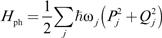 $$H_{ph} = {1 \over 2}\sum\limits_j {\hbar {\rm{\omega }}_j \left({P_j^2 + Q_j^2 } \right)} AU1$$
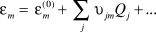 $${\rm{\varepsilon }}_m = {\rm{\varepsilon }}_m^{(0)} + \sum\limits_j {{\rm{\upsilon }}_{jm} Q_j } + \cdots $$
 $$t_{mn} = t_{mn}^{(0)} + \sum\limits_j {{\rm{\upsilon }}_{jmn} Q_j } + \cdots $$
Here, ωj, Qj, and Pj denote the frequency and the dimensionless coordinate and momentum of vibration mode j, respectively;  ${\rm{\varepsilon }}_m^{(0)} $ and
 $t_{mn}^{(0)} $ stand for the site energies and transfer integrals obtained at the equilibrium geometry; υjmn (υjm) represents the nonlocal (local) linear electron-phonon coupling constants; and ħ is the reduced Planck constant.
Electronic coupling
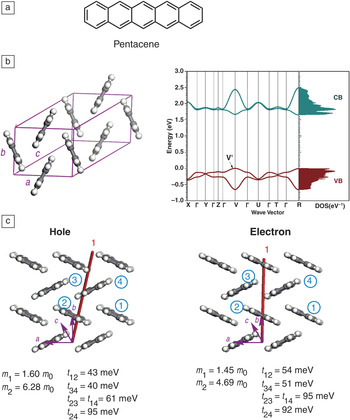
The electronic coupling is a key factor that determines the extent of charge delocalization in the crystal. In organic systems, it is also the main source of anisotropy in the charge-carrier mobility. A number of approaches exist to evaluate the electronic couplings (transfer integrals), which have been reviewed extensively in the literature.Reference Newton36–Reference Kaduk, Kowalczyk and Van Voorhis39 In the mean-field approximation (where electron-electron interactions are treated in an average fashion), a simple approach to evaluate the transfer integrals in a single-component system is to make use of Koopman’s theorem (according to which the ionization energy of a system can be approximated as the energy of the frontier orbital)Reference Koopmans40 and to estimate tmn for holes (electrons) as half the energy splitting of the highest two occupied molecular orbitals εH and εH−1 (lowest two unoccupied molecular orbitals, εL+1 and εL) of the molecular dimers based on molecules m and n: 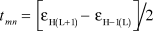 $t_{mn} = {{\left[ {{\rm{\varepsilon }}_{{\rm{H}}\left({{\rm{L}} + 1} \right)} - {\rm{\varepsilon }}_{{\rm{H}} - 1\left({\rm{L}} \right)} } \right]} \mathord{\left/$.Reference Coropceanu, Cornil, da Silva Filho, Olivier, Silbey and Brédas1, Reference Valeev, Coropceanu, da Silva Filho, Salman and Brédas16 However, this approach works properly only in the case of symmetric dimers.Reference Valeev, Coropceanu, da Silva Filho, Salman and Brédas16 In a general case, the transfer integral for any given dimer can be evaluated by using a method that defines the dimer orbitals in terms of molecular (fragment) orbitals.Reference Valeev, Coropceanu, da Silva Filho, Salman and Brédas16, Reference Senthilkumar, Grozema, Bickelhaupt and Siebbeles41 Alternatively, band-structure calculations, in particular those based on contemporary density functional theory (DFT) methods (see Figures 1 and 2),Reference Coropceanu, Cornil, da Silva Filho, Olivier, Silbey and Brédas1, Reference Zhu, Yi, Li, Kim, Coropceanu and Brédas13, Reference Coropceanu, Sánchez-Carrera, Paramonov, Day and Brédas17, Reference Sánchez-Carrera, Paramonov, Day, Coropceanu and Brédas20, Reference Li, Coropceanu and Brédas42 can be performed on the crystals to evaluate the electronic couplings.
Calculated band structure, density of states (DOS), effective masses, and electronic couplings in the pentacene crystal.Reference Sánchez-Carrera, Paramonov, Day, Coropceanu and Brédas20, Reference Li, Coropceanu and Brédas42 (a) Chemical structure of pentacene. (b) Band structure (the conduction band and valence band are labeled as CB and VB, respectively) of the pentacene crystal determined at the density functional theory (DFT) level using the B3LYP functional and the 6-31G basis set. The points of high symmetry in the first Brillouin zone used for the calculations of the band dispersion are labeled as follows: Γ = (0, 0, 0), X = (0.5, 0, 0), Y = (0, 0.5, 0), Z = (0, 0, 0.5), U = (0, 0.5, 0.5), V = (0.5, 0, 0.5), T = (0.5, 0.5, 0), and R = (0.5, 0.5, 0.5), all in crystallographic coordinates. The zero of energy corresponds to the top of the VB. C and H atoms are given in gray and white, respectively. (c) Illustration of the most important charge-transport pathways for holes and electrons in pentacene. The band edges for holes and electrons located at V′ = (0.375, 0.5, 0.075) and R = (0.5, 0.5, 0.5), respectively. The approximate position of the V′ point is shown with the arrow. The numbers in blue circles label the molecules used for electronic couplings (tmn) calculations; the red solid line shows the direction of the smallest effective mass component m 1. m 0 is the mass of a free electron in vacuum.

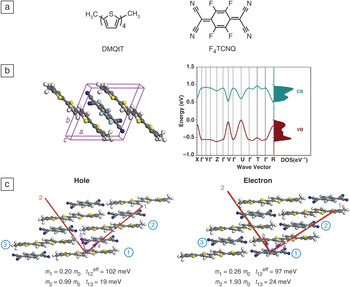
The results obtained for pentaceneReference Sánchez-Carrera, Paramonov, Day, Coropceanu and Brédas20, Reference Li, Coropceanu and Brédas42 and DMQtT–F4TCNQReference Zhu, Yi, Li, Kim, Coropceanu and Brédas13 using both approaches (i.e., the evaluations of the transfer integrals between dimers and the calculations of the crystal electronic bands) are shown in Figures 1 and 2. In the case of pentacene (Figure 1), the largest electronic couplings for both electrons and holes (about 90 meV) are obtained along the diagonal directions (along which the molecules pack in a herringbone fashion) within the ab-plane. In addition, significant couplings are found as well along the a-direction. The band-structure calculations indicate that the smallest effective masses are about 1.6 m 0 and 1.5 m 0 for holes and electrons, respectively. The effective mass for holes estimated by means of ARUPS measurements is about 1.3m 0.Reference Kakuta, Hirahara, Matsuda, Nagao, Hasegawa, Ueno and Sakamoto43
Calculated band structure, density of states (DOS), effective masses, and electronic couplings in the dimethylquaterthiophene-7,7,8,8-tetracyano-2,3,5,6-tetrafluoroquinodimethane (DMQtT-F4TCNQ) crystal.Reference Zhu, Yi, Li, Kim, Coropceanu and Brédas13 (a) Chemical structures of DMQtT and F4TCNQ; C, H, S, N, and F atoms are given in gray, white, yellow, dark blue, and light blue colors, respectively. (b) Band structure of the DMQtT-F4TCNQ crystal determined at the density functional theory level using the B3LYP functional and the 6-31G basis set (DFT-B3LYP/6–31G). The points of high symmetry in the first Brillouin zone used for the calculations of the band dispersion are labeled as follows: Γ = (0, 0, 0), X = (0.5, 0, 0), Y = (0, 0.5, 0), Z = (0, 0, 0.5), U = (0, 0.5, 0.5), V = (0.5, 0, 0.5), T = (0.5, 0.5, 0), and R = (0.5, 0.5, 0.5), all in crystallographic coordinates. The zero of energy corresponds to the top of the valence band (VB). Note: CB, conduction band. (c) Illustration of the most important charge-transport pathways for holes and electrons in DMQtT-F4TCNQ. The effective transfer integrals (t eff) along the stacking direction have a super-exchange nature. The numbers in blue circles label the molecules used for electronic couplings (tmn) calculations; the red solid lines show the direction of two smallest effective mass components m 1 and m 2. This compound is characterized by very small effective masses and large electronic couplings for both holes and electrons.

Large electronic couplings of about 100 meV are found for both holes and electrons along the stacking direction in DMQtT–F4TCNQ (Figure 2).Reference Zhu, Yi, Li, Kim, Coropceanu and Brédas13 This result might be surprising at first sight. In fact, in contrast to pentacene, the electronic couplings between D molecules or between A molecules have a super-exchange nature (these transfer integrals are denoted as t eff in Figure 2) (i.e., the electronic coupling for holes [electrons] results from the mixing of the frontier orbitals of two closest donor [acceptor] molecules with the orbitals of the “bridging” acceptor [donor] molecule). The effective mass along the stacking direction of DMQtT–F4TCNQ (this component is labeled m 1 in Figure 2) is calculated to be remarkably small for both holes (0.2 m 0) and electrons (0.26 m 0). This result can be explained by the fact that the effective mass also depends on the effective hopping distance ( $m = \hbar ^2 /2ta^2 $, a— distance); this distance along the stacking direction in the DMQtT–F4TCNQ is much larger than (essentially twice as large as) the characteristic distances between adjacent, strongly interacting molecules in pentacene.
Local electron-phonon coupling
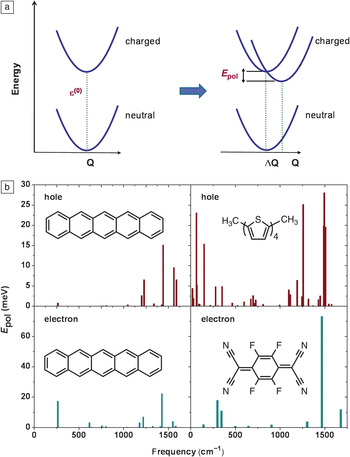
The local electron-phonon coupling represents a key interaction in Holstein-type polaron models.Reference Holstein31 The overall strength is given by the polaron binding energy E pol (or relaxation energy) at a given site m ( $E_{m,{\rm{pol}}} = \sum\nolimits_j {{{{\rm{\upsilon }}_{jm}^2 } \mathord{\left/$). It consists of both intramolecular (internal) and intermolecular (external) contributions. The internal component reflects the changes, upon going from the neutral state to the charged state or vice versa, in the geometry of an individual molecule (see Figure 3a); the external component reflects the variations in the polarization and positions of the surrounding molecules. We note that the reorganization energy (that enters the electron-transfer rate equation in Marcus’ electron transfer theoryReference Marcus44, Reference Barbara, Meyer and Ratner45) roughly corresponds to twice the polaron binding energy as it considers the relaxations of both the molecule to which the electron is transferred and the molecule from which the electron originates.
Intramolecular contribution to the polaron binding energy.Reference Coropceanu, Cornil, da Silva Filho, Olivier, Silbey and Brédas1, Reference Zhu, Yi, Li, Kim, Coropceanu and Brédas13, Reference Coropceanu, Malagoli, da Silva Filho, Gruhn, Bill and Brédas46 (a) Illustration of the site energy (ε(0)) and polaron binding energy (E pol). Q is the coordinate of a molecular vibrational mode. (b) Intramolecular component of the polaron binding energy for holes and electrons in the pentacene, DMQtT (dimethylquaterthiophene), and F4TCNQ (7,7,8,8-tetracyano-2,3,5,6-tetrafluoroquinodimethane) molecules, calculated at the density functional theory level using the B3LYP functional and the 6-31G(d,p) basis set.

The extensive studies we have performed on this issue indicate that quantum-chemical methods, in particular those based on DFT, provide a reliable description of the intramolecular contributions to the local electron-phonon coupling constants and associated reorganization energies.Reference Coropceanu, Cornil, da Silva Filho, Olivier, Silbey and Brédas1 The calculated E pol values for holes and electrons in pentacene are about 49 meV and 66 meV, respectively.Reference Coropceanu, Malagoli, da Silva Filho, Gruhn, Bill and Brédas46E pol for electrons in F4TCNQ and for holes in DMQtT is estimated to be 128 meV and 146 meV, respectively. An interesting aspect is that the contributions to the polaron binding energies coming from each vibrational mode can be deduced, as shown in Figure 3b. We see from the figure that both holes and electrons mainly interact with high-frequency intramolecular vibrational modes.
The external contribution to the local electron-phonon coupling has in general been much less studied than the intramolecular contribution. Several approaches, based on molecular mechanicsReference Brovchenko47, Reference McMahon and Troisi48 or hybrid quantum-mechanics/molecular mechanicsReference Norton and Brédas29 methodologies and, more recently, a valence-bond/Hartree–Fock technique,Reference Martinelli, Idé, Sánchez-Carrera, Coropceanu, Brédas, Ducasse, Castet, Cornil and Beljonne19 have been used to evaluate the external reorganization energies in oligoacenes. These calculations indicate that the external contribution to the polaron binding energy is much smaller (a few percent) than the internal contribution.
Interestingly, the polaron binding energies calculated for both pentacene and DMQtT-F4TCNQ are smaller than the half-widths of the conduction and valence bands (given by 2t along the direction corresponding to the herringbone packing in the case of pentacene and to the D-A stacks in DMQtT-F4TCNQ). These results imply that the formation of small molecular polarons in these systems is not favorable.
Nonlocal electron-phonon coupling
The nonlocal electron-phonon coupling constitutes the major interaction considered in so-called Peierls-type models, such as the Su-Schrieffer-Heeger (SSH) HamiltonianReference Peierls32, Reference Su, Schrieffer and Heeger49 that has been largely applied to conjugated polymers. The overall strength of the nonlocal electron-phonon coupling can be quantified by means of the relaxation energies  $L_{mn} $ (
 $L_{mn} = \sum\nolimits_j {{{{\rm{\upsilon }}_{jmn}^2 } \mathord{\left/$) that we introduced in Reference Reference Coropceanu, Sánchez-Carrera, Paramonov, Day and Brédas17. These relaxation energies can be considered to play a role in the nonlocal electron-phonon mechanism similar to E pol in the case of local coupling.Reference Coropceanu, Sánchez-Carrera, Paramonov, Day and Brédas17
The nonlocal electron-phonon coupling constants have been evaluated for several organic crystalline semiconductors but, in nearly all instances, on the basis of the normal vibrational modes estimated at the Γ-point (center of the Brillouin zone).Reference Coropceanu, Sánchez-Carrera, Paramonov, Day and Brédas17, Reference Girlando, Grisanti, Masino, Bilotti, Brillante, Della Valle and Venuti18, Reference Sánchez-Carrera, Paramonov, Day, Coropceanu and Brédas20, Reference Hannewald, Stojanović, Schellekens, Bobbert, Kresse and Hafner50–Reference Girlando, Masino, Bilotti, Brillante, Della Valle and Venuti52 While these investigations have provided good insight, more recent studies based on a supercell approachReference Yi, Coropceanu and Brédas53 have allowed us to take into account the dispersion of the phonon modes.Reference Li, Yi, Coropceanu and Brédas21, Reference Yi, Coropceanu and Brédas53 Our results indicate that the nonlocal electron-phonon couplings are significantly underestimated when they are evaluated just from Γ-point normal-mode calculations. For instance, in comparison with Γ-point estimates, when considering phonon dispersion, the converged values (obtained by systematically increasing the supercell size) of L in pentacene are larger by about 30–100% and 220–280% for the herringbone dimers and parallel dimers, respectively.Reference Li, Yi, Coropceanu and Brédas21, Reference Yi, Coropceanu and Brédas53
We note that in pentacene, the values of Lmn remain smaller than  ${{L_{mn} } \mathord{\left/$, with the ratios
 $t_{mn}^{(0)} $ about 0.1–0.2.Reference Yi, Coropceanu and Brédas53 However, it is useful to recall that Lmn is directly related to the variance of the thermal fluctuations of the corresponding transfer integral.Reference Coropceanu, Sánchez-Carrera, Paramonov, Day and Brédas17 The value of L = 20 meV, estimated for the herringbone dimer in pentacene, results at room temperature in a standard deviation of the transfer integral of about 30 meV (i.e., about 30% of the value of the transfer integral). This result underlines that at elevated temperatures, the nonlocal coupling leads to a substantial dynamical disorder. A small value for L along the stacking direction has been estimated for DMQtT-F4TCNQ.Reference Zhu, Yi, Li, Kim, Coropceanu and Brédas13 However, the description of the nonlocal interactions in DA bimolecular crystals, due to the super-exchange nature of the electronic coupling, represents a very complex problem, and a more comprehensive study of this mechanism is still needed.
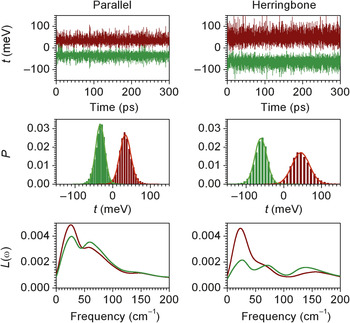
The nonlocal electron-phonon couplings can also be obtained through molecular dynamics simulations.Reference Yi, Coropceanu and Brédas53, Reference Troisi and Orlandi54Figure 4 shows the evolution of the transfer integrals with sampling time and the derived probability distribution of the transfer integrals at 300 K for the parallel and herringbone dimers (t 34 and t 23 in Figure 1) in the pentacene crystal. L can be computed from the width of the probability distribution, while the Fourier transform of the autocorrelation function  $F_{mn} (t) = \left\langle {{\rm{\delta }}t_{mn} \left(0 \right){\rm{\delta }}t_{mn} \left(t \right)} \right\rangle $, where
 ${\rm{\delta }}t_{mn} \left(t \right) = t_{mn} \left(t \right) - \left\langle {t_{mn} \left(t \right)} \right\rangle $, yields the frequency dependence of L. As seen from Figure 4, only low-frequency modes contribute to L, with significant couplings for phonons with energies smaller than 20 cm−1.Reference Yi, Coropceanu and Brédas53, Reference Troisi and Orlandi54 Interestingly, the energy of the lowest optical phonon in pentacene is estimated to be about 20 cm−1;Reference Sánchez-Carrera, Paramonov, Day, Coropceanu and Brédas20 thus, these results underline the importance of the role that acoustic phonons play in the charge-carrier mobilities in the crystal.
Investigation of non-local electron-phonon coupling by means of molecular dynamics simulations:Reference Yi, Coropceanu and Brédas53, Reference Troisi and Orlandi54 (upper panels) the time modulation of the transfer integrals (t) due to thermal motion, (middle panels) the distribution of the transfer integrals (P), and (lower panels) frequency dependence of the relaxation energy (L(ω)) obtained by a Fourier transform of the autocorrelation function (F) of the transfer integrals for holes (dark red) and electrons (dark green) at 300 K for the parallel (pair 34, left panels) and herringbone (pair 23, right panels) dimers (see Figure 1) in the pentacene crystal.

Charge-transport models
Until recently, interpretation of charge transport in organic semiconductors was made most often in the framework of the Holstein small-polaron theory.Reference Holstein30, Reference Holstein31 According to this model, (1) at low temperatures, charge transport can exhibit a conventional band-like behavior with the mobility decreasing in a power-law fashion ( ${\rm{\mu }} \propto T^{ - n} $,
 $n > 0$) with increasing temperature (T); and (2) at high temperatures, as a result of strong polaron localization effects (band narrowing), the motion of the carriers could be described as a sequence of uncorrelated hops, with the mobility showing an Arrhenius-like (activated) temperature dependence.Reference Coropceanu, Cornil, da Silva Filho, Olivier, Silbey and Brédas1, Reference Bässler and Köhler2 However, experimental data obtained on high-quality single crystals indicate that the appearance of activated transport is in many instances more likely due to the presence of structural disorder and chemical defects rather than the intrinsic signature of polaron formation.Reference Anthony6–Reference Jurchescu, Baas and Palstra10
As pointed out previously and in more detail elsewhere,Reference Coropceanu, Cornil, da Silva Filho, Olivier, Silbey and Brédas1 in most organic systems of current interest such as pentacene and rubrene, the polaron binding energy due to local electron-phonon coupling is of the same magnitude as, or even (much) smaller than, the width of the conduction or valence band. In addition, the largest part of the polaron binding energy arises from high-frequency intramolecular vibrations whose excited levels are thermally inaccessible even at room temperature. Therefore, a local-type Holstein mechanism taken alone cannot provide a comprehensive description of the charge-transport properties of organic semiconductors.
An attempt to extend the microscopic transport theory for the case where both local and nonlocal electron-phonon couplings are operative was made initially by Munn and SilbeyReference Munn and Silbey55, Reference Munn and Silbey56 and later by Hannewald and co-workers.Reference Hannewald, Stojanović, Schellekens, Bobbert, Kresse and Hafner50, Reference Ortmann, Bechstedt and Hannewald57 However, these contributions, as well as more recent work by Zhao and co-workers,Reference Chen, Ye, Zhang and Zhao58 make use of a canonical (unitary) transformationReference Mahan59 in the spirit of small polaron theory and omit specific terms. In the case of the Holstein model, such a methodology works only in the case of very weak electronic couplings.Reference Coropceanu, Cornil, da Silva Filho, Olivier, Silbey and Brédas1, Reference Holstein30, Reference Holstein31 The range of application of this approach in the case of combined Holstein-Peierls models remains an open question.
In order to study the impact of large nonlocal electron-phonon couplings on charge transport, Troisi and OrlandiReference Troisi and Orlandi26 used an approach in which the vibrations were treated classically. This work as well as other studies based on similar approachesReference Wang, Chen, Zheng, Wang and Shi60–Reference Zhong and Zhao62 underscored the importance of the dynamical disorder arising from these effects. Recently, Fratini and CiuchiReference Ciuchi and Fratini22, Reference Fratini and Ciuchi25 investigated the charge transport in high-mobility organic crystals by treating the nonlocal coupling in the framework of a quasi-static approximation (justified when the electronic processes are much faster than the lattice vibrations). The authors concluded that coherent band-like states and incoherent localized states induced by the thermal disorder coexist in the electronic spectrum, and both contribute to the charge-transport processes.
The methodologies used by Troisi and OrlandiReference Troisi and Orlandi26 and Fratini and CiuchiReference Fratini and Ciuchi25 are based on the conventional one-dimensional SSH model. In this approximation, the dependence of the transfer integrals on vibration coordinates (Equation 4) is given by  $t_{m,m + 1} = t_{m,m + 1}^{(0)} + {\rm{\upsilon }}\left({Q_m - Q_{m + 1} } \right)$. However, Lindenberg and co-workersReference Zhao, Brown and Lindenberg63 have shown that in the framework of the one-dimensional SSH model, a second mechanism exists given by
 $t_{m,m + 1} = t_{m,m + 1}^{(0)} + {\rm{\upsilon }}_{\rm{s}} \left({Q_m + Q_{m + 1} } \right)$. These two mechanisms are referred to as antisymmetric and symmetric nonlocal electron-phonon couplings, respectively. Our calculations of the nonlocal coupling constants indicate that the strengths of these mechanisms are comparable in oligoacene crystals.Reference Coropceanu, Sánchez-Carrera, Paramonov, Day and Brédas17, Reference Sánchez-Carrera, Paramonov, Day, Coropceanu and Brédas20, Reference Li, Yi, Coropceanu and Brédas21 In fact, the two coupling mechanisms lead to rather different interaction patterns. For instance, for an electronic band
 $E_k = - 2t^{(0)} \cos \left({ka} \right)$, where k is the wave vector of the electron, in the case of antisymmetric coupling, the strongest electron-phonon coupling in reciprocal space occurs between electrons at the band center (
 $k = \pm {\textstyle{{\rm{\pi }} \over {2a}}}$) and short-wavelength phonons; in the case of symmetric coupling, it takes place between electrons at the band edges (
 $k = 0$ and
 $ \pm {\textstyle{{\rm{\pi }} \over a}}$) and long-wavelength phonons, as shown in Figure 5. As a result, the corresponding electronic spectra are impacted in very different ways by the two coupling mechanisms. This effect can also be explicitly reflected in the charge-transport properties (see Figure 5e), since the two coupling mechanisms manifest themselves most strongly in different temperature ranges.Reference Li, Yi, Coropceanu and Brédas21 When both mechanisms contribute to the scattering processes, a power-law-like behavior is generally observed; however, the exponent strongly depends on the relative contributions of each mechanism and the range of temperatures under consideration.Reference Li, Yi, Coropceanu and Brédas21
Illustration of the impact of symmetric and antisymmetric nonlocal electron-phonon couplings, using parameters relevant for the pentacene crystal: ħω = 50 cm–1, t (0)/ħω = 10, L/ħω = 1,  $T = 300{\rm{ K}}$. Considering the equation
 $c = {{L_{\rm{s}} } \mathord{\left/$, the case
 $c = 1$ corresponds to exclusively symmetric coupling (see (a) and (b)); the case
 $c = 0$, to exclusively antisymmetric coupling (see (c) and (d)); and the case
 $c = 0.5$, to equivalent contributions from the two coupling mechanisms. (a) and (c) Strength of the electron-phonon coupling constants in reciprocal space as a function of electron and phonon momentum. (b) and (d) Corresponding electronic spectra and densities of electronic states (DOS). (e) Charge mobility calculated by the Kubo formula.Reference Mahan59 (f) Band dispersion extracted from the maximum of the spectral function; the inset gives an enlarged view with the black dashed line providing the band dispersion in an ideal lattice without electron-phonon coupling. Here, ω represents the lattice vibration energy,
 $t^{(0)} $ the average transfer integral, L = L s + L a the total nonlocal relaxation energy with L s(a) being the contribution from the symmetric (antisymmetric) coupling,
 $k_{\rm{B}} $ the Boltzmann’s constant, μ0 = ea 2/ħ a mobility unit, k the electron wave vector, q the phonon wave vector, and
 $e$the elementary charge.Reference Li, Yi, Coropceanu and Brédas21

Conclusions
We have underlined that quantum chemistry represents a powerful tool for the investigations of the electronic and electrical properties of organic semiconductors. Calculations of the transfer integrals and of the intramolecular contributions to the Holstein polaron binding energy can now be routinely performed. However, the development of efficient methodologies is still needed to calculate the external contributions to the local electron-phonon interactions and to account for the phonon dispersion in the calculations of the nonlocal electron-phonon couplings.
The charge-transport models developed recently highlight the important role of dynamical disorder due to nonlocal electron-phonon couplings. Most current charge-transport models applied to organic semiconductors consider the coupling of charge carriers to only optical phonons. However, as was underlined previously, the electrons and holes are coupled equally to both acoustic and optical phonons. Thus, to reach an adequate description of the charge-transport properties in these systems, the interactions of charge carriers with acoustic modes need to be taken into account as well. In addition, extensions of the current models are highly desirable to account for nonlinear electron-phonon coupling interactions, anharmonicity of the phonons, and electron-electron interactions. Finally, models that go beyond static approximations and classical descriptions of phonons need to be developed and applied to rationalize recent experimental findings described in other contributions in this issue of MRS Bulletin, such as the impact of high carrier density; data related to the Hall effect, angle-resolved ultraviolet photoelectron spectroscopy, or electron spin resonance measurements; and optical properties.
Acknowledgments
This work has been funded in part by Solvay and by the National Science Foundation under Award No. DMR-0819885 of the MRSEC Program (JLB) and Award No. DMR-1105147 (VC). The computational resources have been made available in part by the National Science Foundation under Award No. CHE-0946869 of the CRIF Program.