Introduction
Knowledge is an elusive explanatory variable both in history and in the social sciences. On the one hand, history provides many examples of cases in which societies “learn” something from their experience and from the experience of other societies. On the other hand, sociological and political-science methods are, on the average, still skeptical regarding the capacity of ideas to affect institutional processes. Between these two alternatives, a third one is that ideas and the epistemic communities that carry them, do not determine history but affect the “paths” through which history progresses (Fourcade-Gourinchas and Babb Reference Fourcade-Gourinchas and Babb2002). In this article I employ this third approach to examine the role of economic ideas and economists in the formative years of the Israeli state.
The rise of economists in Israel was part of an international trend. In the mid-twentieth century, economics expanded from a small speculative field of study to a fully developed academic discipline that had direct implications on policy issues. This period saw the emergence of macroeconomics and econometrics, which resulted in the “fiscal revolution” (Hall Reference Hall1989; Barber Reference Barber, Furner and Supple1990; Collins Reference Collins, Mary and Supple1990). These processes took place both in industrial states and in the dozens of new peripheral states that were established after World War II (Coats Reference Coats1996a). During this period, American economic ideas and practices, as well as economists, were transferred from the United States to the new post-colonial countries.
In the broadest sense, the explanation of transfer of policies and ideas can be divided into two types: functional explanations and institutional (or sociological) explanations. Functional explanations are those that assume that knowledge is a cognitive entity that is necessary to the formulation and implementation of effective policies. This approach conceives transfer of knowledge as a process of “social learning” (Hall Reference Hall1993; Bennett and Howlett Reference Bennett and Howlett1992; Rose Reference Rose1991; Rose Reference Rose1993; Sabatier Reference Sabatier1998; Levy Reference Levy1994). The institutional explanations neglect the cognitive aspects of knowledge, and emphasize the cultural, symbolic, political, and structural aspects of transfer. According to these approaches knowledge is adopted due to direct pressure such as conditionality (Drazen Reference Drazen2002; Goldstein Reference Morris2001; Khan and Sharma Reference Khan and Sharma2003), “soft” pressure such as persuasion (Barnett and Finnemore Reference Barnett and Finnemore2004), or symbolic merit (DiMaggio and Powell Reference DiMaggio and Powell1983; Meyer et al. Reference Meyer, John, Thomas and Ramirez1997).
Efraim Kleiman has explained the rise of economists in Israel on the basis of the functional approach. As the economic problems of the state became “more intricate,” a demand arose for more “sophisticated economic analysis which only trained economists could provide” (Kleiman Reference Kleiman1981, 563–564). Anat Leibler, on the contrary, explains adoption of standardized practices on the basis of the institutional approach. As she writes, “the U.S. government was demanding commensurability in categories and in the structure of tables for higher legibility as a tool but also as a condition to get help in reducing the [risk of] economic crisis” (Leibler Reference Leibler2008, 133).
The functional and the institutional explanations are not necessarily mutually exclusive. In practice, policy makers may adopt ideas both because they believe they can be functional and because they are pressured to do so. In such cases policy makers may translate an imported model in order to solve some local problem (Djelic and Sahlin-Andersson Reference Djelic, Kerstin, Djelic and Sahlin-Andersson2008; Rose Reference Rose1991). Distinguishing between the functional and sociological approaches is a useful way to explain long-term global tendencies. However, if we seek to capture the differences among countries and to explain timing, pace, extension, and intensities of policy changes we have to account for locally contingent factors (Fourcade-Gourinchas and Babb Reference Fourcade-Gourinchas and Babb2002).
The rise of professional economists in Israel raises several types of questions that I seek to address in this article. First, I am interested in characterizing the content of ideas carried by the economists. I assume that economics is not a homogenous field of knowledge and, therefore, it is necessary to discuss which type of economic ideas the economists advocated. Moreover, it is important to be attentive to the process by which these ideas were translated and localized. Second, I discuss the institutional aspect of the rise of the economists. Here, I study the economists as an epistemic community and I trace how it secured autonomy and how it constituted its capacity to produce and disseminate ideas. Third, I address questions regarding of the relationship between the rise of the professional economists and the process of state formation. Specifically, I will attempt to show that the linkages between the epistemic community and state actors contributed to the consolidation of the autonomy of the state and its capacity to confront societal actors.
The key figure in this article is Prof. Don Patinkin, the founder and director of the Economic Department at the Hebrew University in Jerusalem from 1949. In 1956 he was nominated research director of the Falk Project, the first economic research institution. This article will trace the historical background of Don Patinkin's role in shaping economic discourse in Israel. Sections I and II describe two early attempts to import and localize economic practices in Israel. Section III deals with the early stages of the foundation of the Falk Project, specifically, with the creation of the System of National Accounts in Israel. Section IV addresses the debate between Simon Kuznets and Don Patinkin regarding the research vision of the Falk Project. Finally, section V describes and analyzes the institutional strategies by which Patinkin managed to secure the autonomy of the epistemic community of professional economists and promote its capacity to disseminate economic ideas.
I. Ga'athon and the Input-Output Tables
Arieh Ga'athonFootnote 1 (1898?-1986) received his doctorate from the University of Berlin in 1933. In 1935, after immigrating to Palestine, he joined the Economic Research Institute of the Jewish Agency, and worked under the directorship of Arthur Ruppin. After the establishment of the State he served as an economist in the office of the Prime Minister. In 1950 Ga'athon submitted a Four-Year Development Plan for Israel (Gruenbaum Reference Gruenbaum1950), which consisted of a set of annual input-output tables for each of the years in the period 1950–1953.
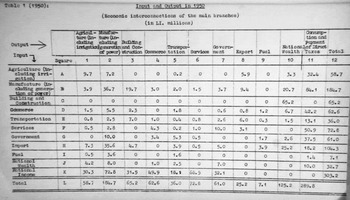
The input-output tables classified economic units according to the type of goods produced: agricultural goods, industrial goods, housing, etc. Economic units of production, therefore, were aggregated to form “branches”: the agriculture branch, the manufacturing branch, the construction branch, etc. (see fig. 1). Moreover, the tables represented the flow of resources among the branches. Each cell specified the quantity of goods (measured in money) that were to flow from the producer branch as output to the user branch as input. This method of representation enabled the potential planner to “see” at a glance the “structure” of the economy and the relationship among the branches. It enabled the potential planner to think about the branches as objects of knowledge, management, and intervention. The branches could be managed by adding or substracting the resources channeled to them.
“Input and output in 1950.” A. Ludwig Gruenbaum, Four Year Development Plan of Israel, p. 30.

The “social accounts” – as the input-output tables were also called – were not the only econometric convention available in the 1950s. Another convention was the “national accounts.” In the 1950s there was no consensus among experts as to whether developing countries should use the social or the national accounting system and many countries used both (Seers Reference Seers1952; Hollinger Reference Hollinger1954; Peacock and Dosser Reference Peacock and Dosser1957; Eleish Reference Eleish and Khan1963; Stone and Corbit Reference Stone and Corbit1997). Social accounts enabled the calculation of not only “how much national income” the economy produced, but also “what sort of income,” that is, which type of product was produced (Seers Reference Seers1952). The social accounts could answer questions such as how many new jobs would be created if the demand for a specific type of good increased (Leontief Reference Leontief1944, 290). Ga'athon believed that this type of analysis would be able to provide answers to essential questions that were pertinent for the absorption of immigrants: “in which industries will the . . . immigrants be employed? What products will they produce? . . . What will be the share of imports in each of the additional consumer items? How many new employees would be needed by different industries?” (Ga'athon Reference Ga'athon, Naphtali, Horowitz and Forder1962, 186).
An inherent assumption that accompanied the social accounts was that some branches were more essential to the national economy than others. The distinction between “productive” and “unproductive” branches was inspired by the Marxian material production system, and it assumed that agricultural and industrial branches contributed more to the national economy than other branches (Stone and Corbit Reference Stone and Corbit1997, 20). This distinction, it should be pointed out, had deep cultural roots in Jewish and Zionist discourse (Hart Reference Hart2000; Penslar Reference Penslar2001).
However, the use of social accounts to employ selective policies was not unique to communist countries or to fully planned economies. In the post-World War II period the econometric convention of social accounts was common amongst peripheral and semi-peripheral mixed economics. Japan, for example, employed mathematical economists and econometricians who used “inter-industry tables” and “long-term economic forecasts” for that purpose (Ikeo Reference Ikeo and Coats1996; see also, Shishido Reference Shishido, Dietzenbacher and Lahr2004). France also employed input-output tables in the late 1950s in order to “analyze the whole technological and economic situation in France” and to carry out a national development plan (Aujac Reference Aujac, Dietzenbacher and Lahr2004, 65). Also, countries such as Sri Lanka and Egypt used a similar method (Pyatt and Roe Reference Pyatt and Roe1977; Eleish Reference Eleish and Khan1963). Therefore, Ga'athon's plan cannot be dismissed as old-fashioned or impractical.
Moreover, in ensuing years, state-led allocation of credit was central to Israel's development strategy. David Horowitz, the governor of the Bank of Israel declared in 1960 that “qualitative control of credit is imperative in order to achieve selectivity in investment and a proper order of priorities with a view to improving as rapidly as possible the balance of payment of the country” (Horowitz Reference Horowitz1960). However, the qualitative – or selective – credit control was carried out without a planning center. Therefore, it justified the claim that Ga'athon's scheme of development had functional merit.
Why, then, was Ga'athon's plan not implemented? There is more than one reason. Ga'athon's plan was prepared during the heyday of mass immigration when Prime Minister Ben-Gurion defined the absorption of immigrants as the most urgent national goal. Ga'athon offered a plan whose main objectives were the expansion of production of basic goods and the creation of jobs. These objectives necessitated large-scale foreign aid. Therefore the goal of economic independence was not a priority (Gruenbaum Reference Gruenbaum1950). Ga'athon's hierarchy of national goals was rejected by the Ministry of Finance. The director-general of the Ministry of Finance, David Horowitz, and his economic advisor, Yitzak Galfat, criticized the plan on the ground that even after four years of development Israel would still require “huge amounts of foreign currency.”Footnote 2
Indeed, Israel's reliance on foreign support was an emerging problem. In the early 1950s, the government relied on financial aid from the United States – either directly from the government or from the Jewish Diaspora. In 1950 the import of capital, including grants and loans, reached 49 per cent of the GDP. During the first decade of the State's existence, one-quarter of the import of capital came from the United States government and another quarter was financed by Jewish donors, most of them Americans (Michaely Reference Michaely1963, 23, table 10; 58, table 25). Israel's financial dependency on the U.S. gave Americans leverage over the economic policy of the Israeli government. Oscar Gass (1923–1990), an American-Jewish economist, who represented the Israeli government in negotiations with the American Bank for export and import, warned the Israeli government not to embrace Ga'athon's plan. He claimed that the American administration expected an economic plan aimed at achieving economic independence.Footnote 3 In response, the Minister of Finance requested Ga'athon to prepare a plan that would be “reasonable” from “technical and economic perspectives,” as well as “deemed reasonable by the American government and the Congress.”Footnote 4
Another factor that led to the abandonment of Ga'athon's plan was its timing. After Ga'athon's plan was distributed among policy makers, the consensus around the mass immigration policy dissipated. The population of Israel had almost doubled and new urgent economic problems emerged, the most pressing of which were inflation and the deteriorating foreign currency reserves (Haim Barkai Reference Barkai1990; Gross Reference Gross, Troen and Lucas1995). In 1951 the Ministry of Finance invited Michael Kalecki, a Jewish Keynesian economist who was working for the United Nations, to prepare a report on the Israeli economy (Kalecki Reference Kalecki1951). The report laid the foundation for the austerity measures of the New Economic Policy (NEP). By declaring the NEP, the government abandoned the objectives of rapid development and full employment for a period of about two years (Barkai Reference Barkai1990). The new national priority made Ga'athon's plan less compelling and so the prospect of carrying out Ga'athon's project diminished.
In response, Ga'athon made attempts to mobilize support for his plan from world-famous foreign economic experts. He sent copies of his plan to scholars such as Jan Tinbergen, the Director of the Central Planning Bureau in the Netherlands (Den Bakker Reference Den Bakker and Kenessey1994), Colin Clark from Australia, and Wassily Leontief. Some responded politely, but none of his attempts developed into the kind of long-term collaboration that could have provided Ga'athon more leverage in the local arena.Footnote 5 In the following years American economists armed with up-to-date economic ideas and practices and with international prestige entered the local scene. Ga'athon and his notion of economic planning were marginalized and crowded out.
II. Gass and the EAS
The second attempt to rationalize economic policy making was made in 1953 when the government established the Economic Advisory Staff (EAS) under the directorship of Oscar Gass, an American Jewish economist who had collaborated with the Jewish Agency in the early 1940s (Troen Reference Troen and Gal1996). Following the establishment of the State, Gass served the Israeli government as economic advisor and handled its foreign exchange transactions. As the director-general of the Ministry of Finance put it, Gass assisted the Ministry of Finance in the establishment of “sound basic reporting practices with regard to Foreign Exchange” and “serious budgeting.” When Eliezer Kaplan, the first Minister of Finance died, Gass resigned.Footnote 6 Gass's resignation was considered a great loss as it was assumed that “adequate development plans” were “an essential tool for the continuation of streaming capital to Israel and for receiving financial aid.”Footnote 7
Gass was then invited to establish a formal body for economic consultancy, the EAS. He gathered the following American economists who had played various roles in the American administration: Bernard Bell, a specialist in international finance and balance of payments who had been a chief economist in the Export-Import Bank; Bertrand Gross, an expert in the fields of construction, housing, education, and health, who was an Executive Secretary of the Council of Economic Advisers and the chairman of the Regional Planning Council of the District of Columbia; and Marion Clawsonn, an expert in agriculture.Footnote 8 The most senior economist in the EAS was Abba P. Lerner, an established American Keynesian economist (Scitovsky Reference Scitovsky1984). In addition to the American economists, Ga'athon also joined the staff. The cost of establishing and maintaining the EAS –1.6 million dollars – was divided equally between the government and the Technical Cooperation Program of the United Nations.Footnote 9
The tension between Gass and the Israeli government had begun even prior to the establishment of the EAS. Initially, Gass was reluctant to accept the position for the same reason that he had left the previous one. He conceded only after David Ben-Gurion intervened and sent him a long letter urging him to accept the offer.Footnote 10 Gass envisaged the EAS as a center for economic planning; that is, he wished to be involved not only in the planning process itself but also in implementing it. The Ministry of Finance dismissed Gass's intentions and rebuffed his attempts at collaboration.Footnote 11 Gass accused the government of using him and his staff as a “rubber stamp.” Planning, in the eyes of an Israeli policy maker, he commented cynically, was something that was always “needed in the sphere of others but not in his own.”Footnote 12
Despite all efforts, the EAS did not manage to establish any productive relationship with the Ministry of Finance (Leibler Reference Leibler2008). Its main contribution was in assessing investment projects for the Ministry of Trade and Industry (Ga'athon Reference Ga'athon, Naphtali, Horowitz and Forder1962, 184; Kleiman Reference Kleiman1981, 552). In 1955, when the contract of the EAS terminated, its renewal was not considered. Therefore, the EAS was dismantled without leaving any legacy of planning in Israeli economic policy discourse. Moreover, by that time the Falk Project had been established and fulfilled the need for economic advice.
The failure of the EAS poses a puzzle. The organization possessed all the ingredients that could have made it an influential planning body. It enjoyed the financial support of a foreign institution and its members were well-respected, skilled economists with hands-on experience in policy-oriented research. Moreover, there is evidence to suggest that the government, including the Ministry of Finance, acknowledged the substantial need for economic expertise, not only as a rubber stamp but also for the purpose of economic advice and planning. Despite these favorable conditions, the EAS had only marginal influence on Israeli policy discourse.
Three factors can explain this failure. First, the team that made up the EAS lacked a unified agenda. As comparative studies have shown, “coherent economic teams” are a necessary prerequisite for the implementation of policy reforms (Coats Reference Coats1996b, 343). This condition was not fulfilled in the case of the EAS. Each of its members followed a different path. Ga'athon persisted in promoting his style of state-led allocation of resources through input-output analysis.Footnote 13 Bell focused on managerial skills at the level of the firm, and pointed out that Israeli firms lacked management skills.Footnote 14 Gass supported his employees, but did not provide a clear, positive agenda. Lerner had his own unique conception of economic planning, which deviated not only from existing planning models in Israel but also from models that were common in the U.S. (Colander Reference Colander1984). The lack of unity and coherence within the EAS was a significant factor that led to its weakness in Israeli economic policy discourse.
Another factor was the inability of Gass to build alliances with other local actors; he failed to persuade governmental bodies or societal actors other than the Ministry of Industry and Trade that their knowledge and skills could contribute to the national interest. The EAS therefore operated as an independent but isolated institution. The incapacity to establish links with local actors might be explained by the existence of a “cultural divide” between American economists and Israel politicians. The EAS consisted of American experts, who came for a short-term mission to a newly established state that lacked formal procedures of governance. The situation was very different from the formal bureaucratic structure that they were accustomed to in the United States. In Israel, the political system consisted of a community of politicians who had been working together for 30 years. In this environment, informal ties were considerably more important than formal bureaucratic procedures. Therefore, what seemed legitimate action for the local political leadership in Israel was seen by EAS members as “discriminatory and tyrannical” handling of State affairs.Footnote 15
The cases of Ga'athon and Gass provide a conceptual grid through which we can frame the case of Patinkin. Ga'athon's program failed because of bad timing, because he lacked international professional prestige, and because his plan was inconsistent with the expectations of the U.S. administration. Gass failed because he lacked a coherent agenda and because he failed to build ties with local actors. Patinkin, as I will show below, enjoyed outstanding professional prestige, his policies were in harmony with foreign sources of financial aid, he had a coherent agenda, and he constructed alliances with local actors.
III. The Falk Project: The Vision
Despite the undeniable importance of the Economics Department at Hebrew University,Footnote 16 it was the Falk Project that enabled Patinkin to distribute his economic vision among policy-makers. The initiative to establish an autonomous economic research institution did not come from local circles; according to the historian of the Falk Foundation, it was the initiative of an American Zionist. Once the Foundation accepted the idea, they approached Simon Kuznets, by then a world-renown economist whose key contribution was the construction of national accounting methods. Kuznets and the directors of the Falk Foundation shared the view that the new economic research institute in Israel should focus on economic policy issues rather than academic issues and that its aim should be to contribute to the “general economic well-being” of societies (Starrett Reference Starrett1966, 23). It should aim, according to Kuznets, “to furnish independent competent analysis of economic facts, upon which more rational decisions affecting national policy may be based.” In addition, the Falk Project was supposed to “develop trained economic analysts for careers in government, teaching and industry.”Footnote 17
At the time, the key policy issue in Israel was absorption of immigrants. Kuznets, therefore, wished to organize the research around this problem, including its social and institutional aspects. First, he suggested that researchers should collect economic, social, and occupational statistics on the population. Second, they should research the unique types of settlements in Israel such as “the Ma'abara (transition camp), the Kfar Avoda (labor village) and in-between forms.” Finally, and most importantly, the researchers should trace “the degree of economic adjustment of the various types of workers as reflected in their personal attitudes towards their jobs, coworkers, management, and social environment.”Footnote 18 Kuznets’ vision demonstrates that he conceived the economy as a holistic whole and economic policy-making as a process that had to take into account a wide array of economic, institutional, and social factors.
The SNA: Reclassifying the Economy
When the Falk Project was eventually inaugurated in 1954, Kuznets’ vision had to be postponed. It was decided that the first goal of the Falk Project would be to lay the foundation for Israel's System of National Accounts (SNA). The task was coordinated by Daniel Creamer, the first research director of the Falk Project (Leibler Reference Leibler2008). By that stage, the SNA was recommended by the U.N. as a standardized econometric convention (Creamer et al. Reference Creamer, Weisbrod, Kahane, Kotowitz, Katz, Barkai, Noam, Kurzweil and Duvshani1957; Leibler Reference Leibler2008). Therefore, its adoption was conceived as a technical issue and it did not raise any debates or disagreements. Nevertheless, the adoption of the SNA was a milestone in the evolution of the economic policy discourse in Israel. Specifically, the adoption of the SNA marked a shift from the “branch” system.
The SNA classified economic units according to ownership. Economic units of production that were owned by private entrepreneurs were aggregated to form the “private sector.” Units that were owned by the government or by other public organizations were aggregated to form the “public sector.”Footnote 19 Therefore, the SNA shifted from branches as objects of knowledge and intervention to sectors (private and public). The language of the SNA led to the proliferation of study and debate about the best way to govern the private (market) and the public (government) sectors.
The SNA also abandoned the distinction between “productive” and “unproductive” economic activities. Instead, it introduced the quantitative indexes of efficiency and productivity of labor as measuring rods for the evaluation of the contribution of economic units, branches, and sectors to the national economy. Both indexes were defined as a ratio between surplus value and factors of production (capital and labor) measured by money (Creamer et al. Reference Creamer, Weisbrod, Kahane, Kotowitz, Katz, Barkai, Noam, Kurzweil and Duvshani1957, 40). Efficiency and productivity became the measuring rods of economic progress and the quality of the labor force.
These new measuring rods created a new value system by which policy-makers evaluated what was good for the nation. The branch system implied that large agricultural and manufacturing branches were essential for the national interests as they provided goods and employment for immigrants. The language of the SNA implied that expansion of production and employment as such were not a measure of national interest if they were not accompanied by greater efficiency and productivity, that is, by the creation of new value with a minimal quantity of factors of production. The new value system changed the way the economic reality was viewed and evaluated. By using new measuring rods, the first report of national accounts could claim that the agricultural branch was least efficient and that the private sector contributed more than half the national income (Creamer et al. Reference Creamer, Weisbrod, Kahane, Kotowitz, Katz, Barkai, Noam, Kurzweil and Duvshani1957, 45). These evaluations, of course, had practical implications regarding economic policy.
IV. Kuznets vs. Patinkin: Competing Methods of Research
After the Falk Project laid the foundation for national accounts, the Central Bureau of Statistics took over preparing the national accounts report. At this stage, the question regarding the type of research that should be conducted in the Falk Project was raised once again. Moreover, after Creamer retired from his post, a permanent research director had to be nominated.
The Advisory Committee, which was located in the U.S., decided that the next research director of the Project would have to be an Israeli resident.Footnote 20 Given this preference, the obvious, if not the only, candidate was Don Patinkin. Patinkin was both an Israeli resident and a world-renowned economist. He had graduated from the Economics Department at the University of Chicago, a leading university in the field, where he was supervised by senior economists who had revolutionized the economics of the time (Patinkin Reference Patinkin1995; Mehrling Reference Mehrling2002). In 1949 he immigrated to Israel after the Hebrew University offered him a position as the founding director of the Economics Department (Gross Reference Gross2004a and Reference Gross2004b). In the 1950s, there was no other candidate in Israel who could match Patinkin's credentials. This status endowed Patinkin with considerable negotiating power, which he used firmly and wisely.
The downside of Patinkin's candidacy was his lack of experience in empirical economic research. Patinkin had gained his reputation as a mathematical economist. However, he expressed his wish to take up the challenge. “Doing serious empirical work in economics,” he wrote to Kuznets, was an “old desire” of his.Footnote 21 In the autumn of 1956, Patinkin filled the position of research director in the Falk Project, after having spent a sabbatical year at the Johns Hopkins University in 1955–6, where Simon Kuznets resided. Kuznets, during this period, took upon himself the role of mentor in order to prepare Patinkin for his new position. He advised Patinkin regarding his career decisions, guided him in the new field, and encouraged Patinkin when he felt that he was not prepared for the job. Despite the personal affection and trust between the two economists, it soon became apparent that they had diametrically opposed views regarding economic research and policy making.
When Patinkin embarked on his new position, the Advisory Committee informed him that he was expected to change the research direction of the Falk Project from “data projects” to “problem projects.”Footnote 22 We can get a clearer idea regarding the distinction between “data” and “problem” projects from the exchange between Kuznets and Patinkin regarding the quality of the studies produced in the Falk Project.
When Patinkin submitted to the Advisory Committee the first drafts of the studies that had been pursued by his students, Kuznets responded with disapproval. He wrote to Patinkin: “Not a single one of them compels keeping the whole economy in focus.”Footnote 23 Moreover, “the authors have been too close to the data.” What the researchers had to do, Kuznets suggested, was to “stop, think, and do some analysis and conjecturing.” Kuznets was particularly referring to the report by Harold Lubell, which was one of the Project's principal works, on which Kuznets lamented, “We have enough bricks and timber for the time being. Let us see what this all adds up to.”Footnote 24
Patinkin resisted the pressure of the Committee. Initially, he claimed incompetence. The type of research the Committee expected him to conduct, he insisted, required skills with which neither he nor his staff was equipped. “I am now [sic] [not] too happy with how things are progressing here,” he wrote to Kuznets in February 1957. “More seriously, I am worried about my inability to provide breadth of vision and understanding.”Footnote 25 Particularly, Patinkin emphasized the difficulty of conducting empirical research that included both political and social aspects of the economy. In this type of research “you have to see the political and social implications of the problem, and not only the pure economics proper.” It required a “mature and more comprehensive background” to see “what the relevant relations for study are.”Footnote 26 Such a background, Patinkin claimed, was lacking in the Falk Project. However, incompetence was not the only reason for Patinkin's resistance to following the instructions of Kuznets.
The “Measurement without Theory” Debate
The question regarding the kind of research that the Falk Project should pursue had already been raised by Creamer in the Project's first annual report. To make his point Creamer referred to the style of research of two American economic research institutions: the Brookings Institution and the National Bureau of Economic Research (NBER). The Brookings Institution, explained Creamer, was “organized for the purpose of aiding constructively in the development of sound national policy.” Accordingly, such a research program would “embrace problems of a controversial character,” and “involve interpretation and the reaching of conclusions as well as the assembling of relevant information.” In the case of the NBER, research was organized “in such a way as to avoid controversial issues of public policy and to confine its activities chiefly to the assembling and analyzing of factual information.” The rhetoric of the NBER refrained from saying “what ought to be done.” It focused its efforts on “collecting and analyzing of economic data.”Footnote 27 Creamer himself believed that this latter strategy, which was described as a “self-denying ordinance” by Wesley Mitchell,Footnote 28 should be adopted by the Falk Project on his departure.
Can the disagreements between Kuznets and Patinkin be understood as a choice between the Brookings Institution and the NBER styles of research? Not quite. As we shall see below, Patinkin wished to pursue a research style that differed from both the NBER and the Brookings Institution. Unlike the Brookings Institution, Patinkin directed his students to pursue data-oriented projects. However, unlike the NBER, each of these studies focused on a specific economic aspect and they were not as broad as those of the NBER.
In order to understand the core issue around which the debate between Patinkin and Kuznets was organized, we have to trace it back to their respective training trajectories. This leads us to two American research institutions, the Cowels Commission and the NBER, which were responsible for the professional upbringing of Patinkin and Kuznets respectively, and which, ten years prior to the events I discuss in this article, were engaged in a tough debate that was a milestone in the history of modern economics (Yonay Reference Yonay1998, 188; Morgan and Rutherford Reference Morgan and Rutherford1998; Weintraub Reference Weintraub2002, 158).
The debate erupted after a member of the Cowles Commission wrote a review on a book by Arthur Burns and Wesley Mitchell, the director of the NBER, in which they analyzed the business cycles, the most urgent issue in the period that followed the Great Recession. Burns and Mitchell's method, according to Koopmans, was “empirical” in the sense that they did “not reveal at all in this book what explanations of cyclical fluctuations, if any, they believe to constitute plausible models or hypothesis.” Koopmans compared this approach to Kepler's, the seventeenth century astronomer. Kepler, according to Koopmans, contributed to the scientific revolution by providing a mathematical description of the “empirical regularities” of the planets’ trajectories. He “was able to find simple empirical ‘laws’ which were in accord with past observations.” The “Kepler stage” in the scientific revolution, as Koopmans called it, was distinguished from the “Newton stage” in which the “fundamental laws” of motion were discovered (Koopmans Reference Koopmans1947, 161). Koopmans accused Burns and Mitchell of doing Kepler's method rather than Newton's. “The decision not to use theories of man's economic behavior, even hypothetically, limits the value to economic science and to the maker of policies” (Koopmans Reference Koopmans1947, 172). Koopmans framed the debate as if it had taken place between those who made observations in the light of theory and those who made observations without theory.
However, this framing of the debate was misleading. In actuality, it was a debate between two competing conceptions regarding the notion of economic theory itself. The Cowles Commission assumed that economic theory should be based on individualistic behavioral principles. In contrast, the NBER assumed that “the aggregate has an existence apart from its constituent particles and behavior characteristics of its own not deducible from the behavior characteristics of the particles.” Therefore, according to this approach, the task of empirical research was not to project economic laws on observation but rather to describe and understand the “structure and functioning” of this complex entity. Economics, according to this approach, is a “science of variation” rather than “an argument in political philosophy” (Vining Reference Vining1949, 79). The behavioral individualistic assumptions of the Cowles Commission produced a universal and standardized conception of economic theory. The holistic and aggregative assumptions of the NBER produced an economic view that is more susceptible to institutional variations. These two conceptions reverberated in the debate between Kuznets and Patinkin in the Israeli case.
Kuznets presented his views regarding the role of economic empirical research to Israeli readers in two papers he published in the Israeli Economics Quarterly during the 1950s. His conception regarding economic research and policy-making consisted of four tenets. First, regarding econometric research, Kuznets held the view that econometric measurements could justifiably lead to a rejection of economic theories and to a reformulation of econometric classification systems. Therefore, the purpose of empirical research was not only to “bring together empirical data” but also to “reformulate elementary economic assumptions” (Kuznets Reference Kuznets1954, 291). The superiority of observation over theory was based on the view that no universal scientific principles or “natural laws” exist in economics as they do in the natural sciences (Kuznets Reference Kuznets1954, 294).
Secondly, if economics was not a universal science, then neither was economic policy-making. Institutional, political, and social differences among countries do not allow economists to justifiably prescribe similar policies for different countries. For example, small countries, he claimed, should take advantage of their greater capacity for mass mobilization and induce the adjustment of the population and the economy to changing technological conditions (Kuznets Reference Kuznets1957). This approach to policy making had a bearing on the purpose of economic research, which was, according to Kuznets, to identify and study the unique social and political aspects of a nation, in order to facilitate policy makers to formulate policies that take advantage these unique features of the nation.Footnote 29
Finally, Kuznets argued that economic theory cannot justifiably dictate national goals nor can it reject them. The role of the economist is to provide policy makers with the necessary economic information and knowledge in order to realize the national goals as the government conceived them. Often, Kuznets writes, “public economic policy has to take into consideration non-economic considerations.” However, when such a case arises, it is important “not to do it out of ignorance but on the basis of knowledge of the measurable economic variables” (Kuznets Reference Kuznets1954, 294).
Patinkin's vision was very different. First, for Patinkin economics was a universal science, and economic theory, formulated in mathematical form and on the basis of individualistic behavioral principles, was the foundation of any empirical research or policy. As he formulated it, “a necessary condition for planning is the knowledge of the value of the economic parameters of the system; a necessary condition for measuring these parameters is econometric studies; a necessary condition for econometrics is mathematical economics” (quoted in Mehrling Reference Mehrling2002, 164). This view implied that the role of empirical economic research was to provide empirical flesh to the mathematical abstract and universal principles by projecting those principles unto an econometric universe. This method enabled the economist to formulate generalizations about the economy and therefore to devise effective economic policies.
Patinkin also held a robust ideology regarding the relationship between the state and the market. In his recollections, he referred to a paper published by his teacher, Henry Simons, “Positive Program for Laissez Faire,” in response to the Great Depression (Simons [Reference Simons1934] 1948). In this paper Simons advocated what can be termed state-led liberalism. According to this approach, the market and the price mechanism – the core of the liberal economy – had to be defended by the state. The state was necessary to guarantee market competition by “opposing with equal rigor all forms of monopoly, business as well as labor unions.” For Patinkin, as Mehrling observes, the real issue in the planning debate “was not social control versus laissez-faire, but rather how practically to use social control to implement and sustain liberalism” (Mehrling Reference Mehrling2002, 164).
The economic progress of Israel
In 1960 Patinkin published his book The Israel Economy: The First Decade.Footnote 30 The book synthesized the reports that had been produced by the Falk Project with the addition of a final chapter, entitled “Progress towards Economic Independence,” which consisted of fierce criticism against the economic policy of the Israeli government during the first decade. Patinkin's key argument was that the economy of Israel “has not moved significantly closer to economic independence. . . . This represents the major failure of Israel economic policy in its first decade” (Patinkin Reference Patinkin1967, 132). To improve economic performance, Patinkin recommended a set of measures that could be described as a policy of austerity: reducing public investment, increasing domestic savings which implied lowering the standard of living, putting more emphasis on monetary stability, and relying more heavily on the “market mechanism,” which “could probably be used here to greater advantage than it has been heretofore” (Patinkin Reference Patinkin1967, 132–140).
There was nothing in Patinkin's arguments that had not been voiced before. Criticism of the interventionist attitude of Zionist/Israeli policy makers had been expressed as early as the 1920s by American Zionist institutions and by local representative of the private sector (Troen Reference Troen and Gal1996; Metzer Reference Metzer1979). After the establishment of the State, during the peak of mass immigration the right-wing parties who represented the private sector and the growing middle class voiced such criticism and advocated similar policies (Molcho Reference Molcho, Bareli, Gutwein and Friling2005; Frenkel Reference Frenkel2008; Rozin Reference Rozin2008). However, in the late 1950s there was sufficient empirical foundation, due to the SNA and the studies conducted by the Falk Project, to substantiate Patinkin's criticism empirically.
Specifically, the indexes of efficiency and the productivity of labor were essential for the empirical substantiation of Patinkin's criticism and recommendations. During the first decade, the Gross National Product (GDP) of Israel grew at an annual average of 12 per cent, which is often described as an economic “miracle” (Halevi and Klinov-Malul 1968, table 28, p. 72). Nevertheless, Patinkin argued that the growth of the GDP was not the correct index for the evaluation of Israel's economic progress. Growth, he claimed, was simply the product of the massive import of capital. Patinkin calculated that only 30 to 42 per cent of the growth could be explained by improved efficiency (Patinkin Reference Patinkin1960, 23). The “progress” of the Israeli economy had to be evaluated on the basis of its efficiency, that is, the “increase [of product] per each unit of input.” According to this criterion, the performance of the Israeli economy was poor. This point is essential as it demonstrates why the shift from the branch system to the SNA was so important from the point of view of the capacity of policy makers to justify certain economic policies. The branch system prioritized growth, expansion of production, and creation of jobs. The SNA prioritized efficiency, high productivity of labor, and economic independence.
Patinkin argued that in order to achieve real economic progress, the government must reduce its intervention in the economy and rely more heavily on the market and price mechanisms. “From a theoretical perspective one may expect that this [the price] mechanism would be able solve the problem of allocation of resources. . . . It is likely that the increase of export and the production of import substitutes would be achieved . . . by letting the various units in the market act freely” (Patinkin Reference Patinkin1960, 27). Therefore, we may claim that the capacity to justify specific economic policies is not independent from the prevalent specific econometric conventions. The adoption of a new econometric convention – the SNA – therefore, was likely to enhance the reception of market-oriented policies.
V. Institutions
So far I have discussed the epistemic aspects of the process by which Patinkin localized pro-market economic ideas. In the following sections I discuss the institutional factors that enabled him to consolidate his vision without external local interferences and to distribute it within the circle of policy makers.
Autonomy – the University
Prior to Patinkin's directorship, the Falk Project was a very small institution consisting of two people: Creamer, the director, and Harold Lubell, the deputy. The researchers were the employees of the Unit for the Measurement of the National Economy in the Central Bureau of Statistics. When Patinkin took over as director, the issue of the future affiliation of the Falk Project was reopened and became a matter of contention between him and the Advisory Committee.
The Committee wanted the Falk Project to be independent not only from politicians but also from all existing academic institutions. Its aim, as Kuznets conceived it, was to serve as a hub for researchers from all the academic institutions as well as the state institutions. “There is need,” Kuznets wrote, “for a research program that offers opportunities to people in government service and in other institutions in Israel, particularly the Technion and maybe the Tel Aviv [University] people.”Footnote 31
Patinkin rejected this institutional arrangement and insisted that the Falk Project be part of the Economics Department at the Hebrew University in Jerusalem. “Ever since its inception in 1949,” he wrote to Kuznets, “the Department has been continuously criticized for not dealing adequately with those problems of applied economies.”Footnote 32 He hoped that the Falk Project would give the Department the opportunity to strengthen its empirical side.
Patinkin also saw in the Falk Project an opportunity to provide employment and training for his students. The Project, he wrote to Kuznets, “can provide the financial help that will enable them [faculty and graduate students] to concentrate on research instead of being forced into all sorts of unproductive jobs to supplement their inadequate university salaries.”Footnote 33 Finally, when all the other arguments did not convince the Advisory Committee, Patinkin conditioned his acceptance of directorship on affiliation to the University. “The university,” he wrote to Kuznets, “took a chance on me five and a half years ago [sic].” He referred to the fact that the Hebrew University appointed him to direct the Economics Department as a very young economist. Therefore, he wrote, “my primary loyalties are to it.”Footnote 34
The Committee had no choice but to accept Patinkin's demand. Irrespective of Patinkin's reasons for insisting on the affiliation of the Project to the University, his success in compelling the Committee to give up the idea of an independent research institution was another crucial milestone in the ascendancy of Patinkin and his students. Not only did it provide Patinkin an environment protected from political pressures, it provided him with an environment where he did not have to compete with other economists who held different economic views.
Indeed, during the 1950s there were other types of economists in Israel who criticized Patinkin's economic agenda. After Patinkin published his book describing the Israeli policy during the first decade as a failure, a series of articles were published in the Economics Quarterly, harshly attacking his negative evaluation of the government's policy. Most the economists who criticized Patinkin – an economist in the Planning Authority of the Prime Minister office (Pinnes Reference Pinnes1961), an employee in a research institute of Histadrut (Golomb Reference Golomb1961), a former economic advisor in the Ministry of Finance (Galfat Reference Galfat1960), and one of the editors of Economics Quarterly (Ronnen Reference Ronnen1960) – were affiliated with the government or the Histadrut. Unlike Patinkin, however, these economists did not have the administrative and financial resources necessary to empirically substantiate their alternative evaluations and recommendations.
To sum up, the affiliation of the Falk Project with the Economics Department created a stronghold where Patinkin was free to nurture his community of professional economists without interference from politicians or competing economists. The Department provided international prestige and the Project applied the economic vision to the local conditions and formulated concrete evaluations and recommendations. Both the Department and the Project were highly autonomous, as they did not depend directly on approval or financial support from local actors.
Alliances – governing institutions and the economists
The Falk Project would have remained isolated if it had not succeeded in building alliances with other actors. Indeed, Patinkin managed to build an intricate network of links with state institutions. Among these institutions were the Bank of Israel, the Ministry of Finance, the Ministry of Trade and Industry, and finally, the Ministry of Foreign Affairs. These institutions exchanged knowledge, personnel, and financial resources.
These state institutions collaborated extensively with professional economists. A study of consumption and savings patterns conducted by the Falk Project (Liviatan), the Central Bureau of Statistics (Sicron), and the Guttman Institute for Practical Social Research (Sandbeerg) demonstrated the extent of their exchange of knowledge. The survey on which the study was based was financed by the Finance Ministry and the Bank of Israel and was conducted by the Field Survey Unit of the Central Bureau.Footnote 35 In another case, Patinkin directly requested financial support from the Bank of Israel to conduct research that he believed would also benefit the Bank.Footnote 36
As for exchange of personnel, Patinkin pursued Avraham Kessler of the Ministry of Finance and he was transferred to the Falk Project.Footnote 37 He conducted a study in collaboration with Zwi Citron from the Central Bureau (Citron and Kessler Reference Citron and Kessler1958). Uri Baharal, who was employed in the Ministry of Trade and Industry, moved to the Falk Project and conducted research on the effect of mass immigration on wages (Baharal Reference Baharal1965). Nadav Halevi, a student of Patinkin's, was employed by the Research Department of the Bank of Israel (1955–59), and conducted studies for the Falk Project. He was also involved in a government committee to examine the implications of joining the European Common Market. Ruth Klinov, also a researcher in the Falk Project, was appointed mediator in labor disputes both in the civil service and in the private sector. A group of economists from the Hebrew University, including graduate students, met with government members and senior civil servants (e.g., the Director-General of the Minister of Finance) several times a year.Footnote 38
The intricate linkages between the community of economists and State institutions defined the relationship between the state and the experts. The community of experts became, for practical purposes, part of the State apparatus, no less than, for example, the Central Bureau of Statistics or the Research Department of the Bank of Israel. In all three cases, objective knowledge was produced by professional skilled personnel for the State. Hence, the autonomy of the community of economists did not oppose the logic of the State but rather served it. The community of economists could become part of the state apparatus because it was autonomous. The autonomy of the economists was a resource that the State could use in order to enhance its own autonomy vis-à-vis societal actors in the economic policy domain. It is impossible to explain the emergence of the Bank of Israel, the Ministry of Finance, and the Ministry of Trade and Industry as strong, autonomous and capable state actors without accounting for the role of the community of economists in this process. More broadly, the rise of the economists and the consolidation of the state autonomy in the economic domain were mutually dependent processes.
Articulation and foreign leverage
The story I have presented up till now might create the impression that the ascendance of the economists was dependent only on Patinkin. I have chosen to tell the story from the point of view of the professional community of economists; however, a different, similarly convincing story could have been told that shows how other agents acted upon Patinkin and his students. In other words, while Patinkin mobilized local actors to achieve his goals, local actors mobilized Patinkin to achieve their goals. The overlapping of interests explains the long-term effect of the linkages between the economists and state actors.
In 1957, Patinkin was invited by the Economics Department of the Ministry of Foreign Affairs to participate in a meeting of a committee to discuss the economic implications of establishing a European Economic Community (EEC), or as it was also called, the Common European Market. David Kochav, the director of the research department of the Bank of Israel, and Nadav Halevi participated in the meeting.
Israel, as one of the participants in the committee described it, had a choice: either “to stay an isolated economic island or to assimilate into the ‘market’ and the ‘region’.” If it chose to assimilate it had “to examine what such assimilation obliged us to do.”Footnote 39 The participants in the meeting expressed the need for knowledge of the consequences of shifting from the “protectionist policy, which we currently employ” to “a more liberalized policy.”Footnote 40 In other words, the participants in the meeting shared the view that if Israel wished to gain anything from the new European order it would have to adjust its economy and adopt market-oriented policies. This would entail both domestic adjustment in terms of curtailing state intervention and international adjustment in terms of “liberalization” of trade and reducing the protection on domestic production. As Nadav Halevi put it, “joining the Common Market would oblige the economy to go through a process of recovery and would bring us closer to economic independence.”Footnote 41 The rapprochement between the Ministry of Foreign Affairs and the community of economists was a milestone in the process of the propagation of the ideas advocated by the community of economists.
The prospects of joining the EEC and the national benefits that local policy makers were expected to gain from it, enabled the mobilization of a foreign actors – the EEC – for the campaign over Israel's economic strategy and the definition of its national interests. Both the Ministry of Foreign Affairs and the community of economists could have presented the need to adjust as a necessary shift forced on Israel from outside.
The mobilization of the foreign actor was necessary, or at least important, because in order to realize such adjustment, policy makers had to overcome the resistance of the most powerful societal actor in Israel – the Histadrut. In other words, the linkages between the community of economists, the State institutions, and the EEC, were part of the process of the consolidation of the State autonomy vis-à-vis the Histadrut. These linkages enabled State institutions to intervene in the economy in a way they could not have done before.
Baruch Kimmerling describes this process in a very similar way. He wrote that during the late 1950s and the 1960s
technocrats, who were filling more and more power positions in the Israeli economic-political structure, viewed the creation of ties with the European Common Market as a means for creating exogenous pressure for change and modernization in the Israeli economic structure. It seemed to them that only by means of external pressure of this type would it be possible to overcome the vested interests and ideological foundation on which the structure of the Israeli economy was based. (Kimmerling Reference Kimmerling1983, 129)
Kimmerling's references to the “vested interests” and the “ideological foundation” on which the economy was based, are references first and foremost to the Histadrut. Indeed, the linkage between the professional economists and the State institutions contributed to the consolidation of the autonomy of these institutions, and it increased their capacity to confront powerful societal actors such as the Histadrut.
In the same period, the Ministry of Finance and the Bank of Israel initiated a program for “economic planning” (Susman Reference Susman1960, 337). In this case, the term “economic planning” had a different meaning from the meaning Ga'athon had ascribed to it ten years earlier. The earlier meaning of “planning” was to achieve rapid development and full employment by State-led allocation of resources and protectionist policies. The new meaning of “planning” was to reduce the trade deficit, which could be achieved by refraining from intervention in the price mechanism, increasing efficiency and productivity, and exposing the Israeli economy to international markets (Aharoni Reference Aharoni1962). According to the director of the Research Department of the Bank of Israel, economic planning would eradicate “distortions in the economic system,” such as “legal restrictions of the interest rate, multiple exchange rates, indexing of wages to price levels and continuous inflationary pressures” (Kochav Reference Kochav1959, 45). This type of economic planning did not “ignore the price system” and did not “try to act against it. Rather, it acts through the price system” (Kochav Reference Kochav1959, 46). In general, “the main principle of [economic] planning is to create the conditions and the framework for the economic private and public enterprises, rather than initiating and executing detailed plans” (Kochav Reference Kochav1959, 47). In other words, the new meaning of planning was planning of the free market.
Hence, what was at stake was not the question of whether the State should or should not intervene in the economy but rather what type of intervention it should use. The new type of planning advocated such intervention that would provide favored conditions for an export-oriented market economy. Just like the view advocated by Henry Simons, Patinkin's teacher, that the market economy has to be defended by the State.
VI. Epilogue: The Recession Policy
In this article I argued that during the 1950s, economic discourse in Israel went through a radical change. While in the early 1950s the common view was that the State should allocate resources in order to expand production and employment, by the end of the decade the opinion of economic experts and policy makers was that the State should rely more heavily on the market for allocation of resources, and create more favorable conditions for employers. Three questions arise from this argument. The first is whether the change was the consequence of Patinkin's initiative or rather a consequence of a diffusion of a global trend. The second question is whether this view was translated into actual policies or merely stayed at the level of ideas and discourse. And, finally, what was the implication of these processes on the formation of the State?
During the 1950s and the 1960s, economics went through a process of homogenization, internationalization, and Americanization (Morgan and Rutherford Reference Morgan and Rutherford1998; Weintraub Reference Weintraub2002; Coats Reference Coats1981). Teaching macroeconomics in universities was standardized internationally. However, outside universities, the international distribution of economic ideas was quite heterogeneous. The international regime that was consolidated under American hegemony was flexible and recognized the legitimacy of states to employ unique policy instruments to handle their domestic problems (Ruggie Reference Ruggie1982). Many American experts acknowledged the fact that structural differences between industrial and developing countries required different types of policies (Krampf Reference Krampf2009a). Countries, both developing and developed, employed policies that deviated from the Anglo-American free-market convention (Johnson Reference Johnson1982; Loriaux Reference Loriaux and Woo-Cumings1999; for cases of developing countries see Woo-Cumings Reference Woo-Cumings1999; Haggard and Lee Reference Haggard, Chung, Haggard, Lee and Maxfield1993; Sikkink Reference Sikkink1991). Therefore, the fact that pro-market ideas and prescriptions dominated economic discourse in Israel during the late 1950s cannot be explained solely as part of an international trend.
The heterogeneity of international discourse on economic policy suggests that the homogeneity of the discourse on local policy in Israel and the dominance of pro-market views among professional economists were not the product of diffusion and global standardization but rather the product of local factors. Patinkin used his prestige and influence in the international and local arenas in order to resist Kuznets’ pressure to conduct economic research along the principle of the institutional school. Instead, the research of the Falk Project was carried out according to the principle of standardized mathematical economics that Patinkin had been exposed to during his formative years. Contrary to the vision of Kuznets and the Advisory Committee of the Falk Project, the Falk Project was affiliated with the Hebrew University in Jerusalem. Therefore, instead of a heterogeneous group of researchers from a variety of organizations, the Project was dominated by Patinkin's students, most of whom adhered to his research vision. The links between the Economics Department, the Falk Project, and the affiliation with the Hebrew University increased the capacity of the epistemic community of professional economists to propagate economic ideas among policy-makers. Due to the dominance of the epistemic community, its prestige, its financial resources, and its connection with state institutions, economic experts who were not part of this group were marginalized. Patinkin's epistemic community of economists acquired the status of gatekeepers of economic rationality, in the sense that any actor in the Israeli political system who wished to present himself as economically rational, had to be accepted by Patinkin and his students. This argument explains the linkage between the Ministry of Foreign Affairs and the epistemic community.
Academic policy discourse, it should be pointed out, did not reflect the policy of the government. However, they shape the worldview of policy makers in a long, cumulative, and gradual process. The ideas that Patinkin and his students developed and disseminated in the 1950s were translated into policy only in the mid-1960s.
The shift from administrative planning to market planning culminated in a recession policy executed in the mid-1960s. This policy, indeed, had two precipitating triggers: a sudden expansion of the absolute size of the trade deficit to more than 40 per cent in 1964 relative to the previous year (calculated from Halevi and Klinov-Malul Reference Halevi and Klinov-Malul1988) and a wave of “wild” strikes. Political economists have described this combination as a crisis of the full employment policy that led to the collapse of cooperation between the government and the trade union, the Histadrut (Shalev Reference Shalev1992; Grinberg Reference Grinberg1991).
However, the analysis presented in this paper suggests that the economic ideas on the basis of which the recession policy was formulated and justified had already prevailed in economic discourse of the late 1950s. When State actors – the Ministry of Finance, the Ministry of Trade and Industry, the Bank of Israel, and the Ministry of Foreign Affairs – started to contemplate the need for a change in policy, they used the available economic model offered by professional economists.
The policy instruments that were implemented in 1965 were not essentially different from the recommendations Patinkin described in his book published in 1960 (Greenwald Reference Greenwald1972, 25). Patinkin's analysis for policy-makers and his economic explanation that minimized the social cost of unemployment was a consequence of the recession policy. “Workers who lose their jobs by (say) the curtailment of building activity,” Patinkin wrote in 1960, “will be reemployed in those industries (import-substitutes and exports) that will expand as a result of the foregoing policies” (Patinkin Reference Patinkin1967, 139).
Moreover, when the recession policy was carried out, Patinkin's students took an active role in its implementation. In the winter of 1966 the government organized public events to “explain” the necessity of the policy to the public. Two students of Patinkin, Haim Barkai and Efraim Kleiman, were invited to speak at an event that took place in Tzavta theatre in Tel Aviv. Barkai and Kleiman supported the austerity policy and advocated the use of harsher policy measures. Specifically, they claimed that the currency should be devalued. (Krampf Reference Krampf2009b, 25–27). Eventually, the government devalued the currency in November 1967 (Greenwald Reference Greenwald1972, 57). Of course, no causal link can be empirically established between the ideas advocated by the economists and the policies carried out by the government. The policies of the government could have been influenced by other intellectual sources. However the congruity between the respective contents of the policies and the ideas and the direct involvement of the professional economists in the execution of the recession policy suggests that the ideas advocated by the economists were a contributing factor to the recession policy and its intensity.
This article demonstrates the deep linkages that were constructed between State actors and the epistemic community of economists. This consolidation contributed to the process of State formation, specifically, the consolidation of State autonomy vis-à-vis societal actors. The economic ideas advocated by the economists, and the reformulation of national interests, legitimized the attempt of State actors to dissociate themselves from the traditional ally of the government, the Histadrut. During the 1950s the Ministry of Finance, the Ministry of Trade and Industry, and the Bank of Israel became significant players in the Israeli political economy (Levi-Faur Reference Levi-Faur2001; Krampf Reference Krampf2009c). The capacity of these institutions to confront vested interests was based, to some degree, on their capacity to present an alternative formulation of the national interest. Instead of absorption of immigrants, employment, and a higher standard of living, these institutions articulated the national interests of efficiency, integration with trade markets, and economic independence. The new formulation of the national interest played a crucial role in enabling the State to legitimize the recession policy.