Introduction
The concept of ‘ageing in place’ has received a great deal of attention in the last decade and it is usually referred to as the policy ideal of enabling people to remain in their ordinary home while ageing (Cutchin Reference Cutchin2003; Golant Reference Golant2011; Löfqvist et al. Reference Löfqvist, Granbom, Himmelsbach, Iwarsson, Oswald and Haak2013). Furthermore, extensive academic literature on the preferences of older people themselves has shown their desire to age in place (Means Reference Means2007; Weeks et al. Reference Weeks, Shiner, Stadnyk and MacDonald2013) and this seems to be the preferred residential strategy even when care is needed, economic difficulties are experienced or when older people live in inadequate houses or deprived areas (Gilleard, Hyde and Higgs Reference Gilleard, Hyde and Higgs2007).
Notwithstanding the popularity of this concept among policy makers and older people, recent studies stress the need for a broader approach (Byrnes Reference Byrnes2011a , 2011b), in the course of which ‘ageing in place’ is seen as a possible option rather than a ‘“one-stop” solution to later-life aspirations and needs' (Hillcoat-Nallétamby and Ogg Reference Hillcoat-Nallétamby and Ogg2013: 1790). Ageing in place should not be considered as the prevailing standard for ageing well (Means Reference Means2007; Sixsmith and Sixsmith Reference Sixsmith and Sixsmith2008). Several studies have demonstrated possible hazards and negative outcomes for the wellbeing, health and independence of older people when living in inadequate housing (Golant Reference Golant2011; Lord, Menz and Sherrington Reference Lord, Menz and Sherrington2006; Oswald et al. Reference Oswald, Wahl, Schilling, Nygren, Fänge, Sixsmith, Sixsmith, Széman, Tomsone and Iwarsson2007; Sixsmith and Sixsmith Reference Sixsmith and Sixsmith2008; Wagner, Shubair and Michalos Reference Wagner, Shubair and Michalos2010). Ageing in place might not signify that all older people should stay put (Means Reference Means2007) or want to stay put (Byrnes Reference Byrnes2011b ; Strohschein Reference Strohschein2012), but rather illustrates the importance of older adults' residential comfort and a sense of residential mastery over their lives (Golant Reference Golant2011). As Hillcoat-Nallétamby and Ogg (Reference Hillcoat-Nallétamby and Ogg2014: 1788) note, ‘“ageing in place” is not a continuous, uniform experience or solution, but will vary in its “do-ability” depending upon evolving lifecourse needs‘. Several active strategies can be developed by which older persons can maintain this residential comfort and sense of residential mastery, such as adjusting their residential environment or moving into a new dwelling (Golant Reference Golant2011). Despite the potential positive effects on their quality of life (Nygren and Iwarsson Reference Nygren and Iwarsson2009), studies have pointed out that relocation decreases when people get older (Boldy et al. Reference Boldy, Grenade, Lewin, Karol and Burton2011) and also the consideration of a possible move reduces with age (Hansen and Gottschalk Reference Hansen and Gottschalk2006; Hillcoat-Nallétamby and Ogg Reference Hillcoat-Nallétamby and Ogg2013; Weeks, Keefe and Macdonald Reference Weeks, Keefe and Macdonald2012).
Many of the key mechanisms influencing why younger people decide to relocate cannot be applied to older people (Sommers and Rowell Reference Sommers and Rowell1992). The wish to improve one's residential situation is less strong for older people and some reasons for moving, for example due to career opportunities or family growth, occur less frequently in comparison with younger adults (Hansen and Gottschalk Reference Hansen and Gottschalk2006). In addition, older people can experience a strong emotional attachment to their living environment (Oswald and Wahl Reference Oswald, Wahl, Rowles and Chaudhury2005; Peace, Holland and Kellaher Reference Peace, Holland and Kellaher2011). Considering the fact that most older people have lived in the same dwelling for many decades, many retain personal reminiscences of their homes (Oswald and Wahl Reference Oswald, Wahl, Rowles and Chaudhury2005) and ‘attachments appeared to have intensified over time, as neighbourhoods changed around them, their social spaces fluctuated and their demands on houses changed’ (Wiles et al. Reference Wiles, Allen, Palmer, Hayman, Keeling and Kerse2009: 670). Peace, Holland and Kellaher (Reference Peace, Holland and Kellaher2011) point towards the concept of ‘option recognition’ with ageing, whereby older people recognise the influence of personal biographies on attitudes and the decision-making process of staying put or relocating. This concept refers to the on-going process of assessing and reinterpreting the living environment and leads to a range of strategies, such as deciding whether or not to renovate the current home or making an appeal to formal or informal services or considering a move. According to Peace, Holland and Kellaher (Reference Peace, Holland and Kellaher2011), these strategic responses differ according to an older individual's health, activity and social involvement.
Studies concerning relocation have highlighted many different reasons why older people decide to move. In previous research on residential behaviour among older adults, causes for moving have repeatedly been classified into push and pull factors, as described in the early conceptual frameworks of Lee (Reference Lee1966) and Wiseman (Reference Wiseman1980) (see also Bäumker et al. Reference Bäumker, Callaghan, Darton, Holder, Netten and Towers2012; Bekhet, Zauszniewski and Nakhla Reference Bekhet, Zauszniewski and Nakhla2009; Boldy et al. Reference Boldy, Grenade, Lewin, Karol and Burton2011; Hillcoat-Nallétamby and Ogg Reference Hillcoat-Nallétamby and Ogg2013; Marx et al. Reference Marx, Burke, Gaines, Resnick and Parrish2011; Robison and Moen Reference Robison and Moen2000; Stimson and McCrea Reference Stimson and McCrea2004; Stoeckel and Porell Reference Stoeckel and Porell2010; Tyvimaa and Kemp Reference Tyvimaa and Kemp2011; Weeks, Keefe and Macdonald Reference Weeks, Keefe and Macdonald2012). Although these studies explored different factors which influence a consideration or decision to relocate, no research has been conducted to identify the personal characteristics associated with the push and pull factors of moving. As stated in the migration theory of Lee (Reference Lee1966), push and pull factors are defined differently for each individual and therefore this study explores the influences of socio-demographic and socio-economic characteristics, kinship and health factors on different push and pull reasons for why older people decide to move. By examining the profiles of older people who move for different reasons, we draw upon and extend the conceptualisation of the push and pull framework, and we provide new insights into the residential decision-making process. Taking into account the heterogeneity of the ageing population, as suggested by Peace, Holland and Kellaher (Reference Peace, Holland and Kellaher2011), we attempt to explore the more vulnerable groups among older people.
Reasons for relocation: push and pull mechanisms
Older people consider a move at a certain time when there is a discrepancy between the actual and desired living conditions (Hansen and Gottschalk Reference Hansen and Gottschalk2006; Weeks et al. Reference Weeks, Shiner, Stadnyk and MacDonald2013). Previous research has shown several reasons for this consideration of relocation. According to the migration theory of Lee (Reference Lee1966), each environment has factors that attract people to stay or move and factors that drive people out. Also, the elderly migration model of Wiseman (Reference Wiseman1980) argues that older people are triggered by various factors, whereby they evaluate their residential satisfaction and consider a possible move. These theories were later referred to as the push and pull framework and they have repeatedly been applied in research on residential behaviour among older adults. Push factors can relate to reasons ‘pushing’ people out of their residence, including changing life circumstances (e.g. deteriorating health status) (Stimson and McCrea Reference Stimson and McCrea2004) and inadequate residences (Weeks, Keefe and Macdonald Reference Weeks, Keefe and Macdonald2012). On the other hand, pull factors represent attractive influences relating to why older people remain in their home or move to a new one (Lee Reference Lee1966). For instance, ‘attachment to place’ will pull people to their current house (Hillcoat-Nallétamby and Ogg Reference Hillcoat-Nallétamby and Ogg2013) but when the ‘destination’ neighbourhood is more age-friendly and pleasant than the current neighbourhood, people could instead be ‘pulled’ to move. Researchers suggest that it is likely for some push and pull factors to have a symbiotic relationship (Bekhet, Zauszniewski and Nakhla Reference Bekhet, Zauszniewski and Nakhla2009; Boldy et al. Reference Boldy, Grenade, Lewin, Karol and Burton2011; Stimson and McCrea Reference Stimson and McCrea2004). When people are not able to maintain their home, this can be seen as a push factor, but it can also emerge as a pull factor when, for example, older people move to a newly built smaller house (Boldy et al. Reference Boldy, Grenade, Lewin, Karol and Burton2011).
Studies have mapped several push and pull reasons relating to why older people decide to move. Many of these reasons can be ascribed to environmental triggers (Pope and Kang Reference Pope and Kang2010). For instance, aspects of the dwelling can generate triggers for moving. An Australian study showed that older people consider moving due to a desire to downsize their housing (Stimson and McCrea Reference Stimson and McCrea2004). Barriers within the dwelling, such as living in a large house (Stimson and McCrea Reference Stimson and McCrea2004) or stairs and steps inside and outside the dwelling (Hansen and Gottschalk Reference Hansen and Gottschalk2006) can make housekeeping difficult (e.g. cleaning) (Tyvimaa and Kemp Reference Tyvimaa and Kemp2011; Weeks, Keefe and Macdonald Reference Weeks, Keefe and Macdonald2012), and increasing health problems (Boldy et al. Reference Boldy, Grenade, Lewin, Karol and Burton2011) is also a reason why older people can be pushed out of their homes. Likewise, a recent study concerning the influence of the home environment on moving behaviour has pointed out that dislikes concerning the home, such as concerns about structural design features, location and maintenance, lead to a higher probability of older people contemplating relocation (Hillcoat-Nallétamby and Ogg Reference Hillcoat-Nallétamby and Ogg2013).
Besides the dwelling, neighbourhood features are also factors for relocation. Byrnes (Reference Byrnes2011b ) investigated the living conditions among older people in an urban, poor, age-segregated environment. The results from this study show that a move to age-segregated housing can be an escape from harsh living conditions that do not match the needs of older residents. Exchanging ‘bad people, whiskey, robbery and drug dealers' for ‘a nice, new and clean place’ seemed of great importance in older people's consideration of moving (Byrnes Reference Byrnes2011b ). Additionally, a lack of services available in the neighbourhood counts for a relocation trigger among older people (Tyvimaa and Kemp Reference Tyvimaa and Kemp2011).
Finally, reasons regarding social support appear to be important for moving in later life (Bekhet, Zauszniewski and Nakhla Reference Bekhet, Zauszniewski and Nakhla2009; Pope and Kang Reference Pope and Kang2010). Sommers and Rowell (Reference Sommers and Rowell1992: 259) pointed out that ‘most elders would not relocate if the move lessened the amount of support they received from family members’. The study of Stoeckel and Porell (Reference Stoeckel and Porell2010) concluded that social support appears to be significant in how older people consider relocation. These results suggest that social networks, such as relatives living in close proximity or having good friends as neighbours (Hansen and Gottschalk Reference Hansen and Gottschalk2006), are important and older people are less willing to consider moving if it requires them to leave the support of family and friends. But the opposite can also be the case, the desire to ‘attach’ to people (Hillcoat-Nallétamby and Ogg Reference Hillcoat-Nallétamby and Ogg2013) and to move closer to children (van Diepen and Mulder Reference van Diepen and Mulder2009), both of which shape the decision of moving.
In the current social and economic climate, the push and pull framework remains relevant and it can be further refined in research concerning later-life relocation (Bekhet, Zauszniewski and Nakhla Reference Bekhet, Zauszniewski and Nakhla2009; Perry, Andersen and Kaplan Reference Perry, Andersen and Kaplan2013). Although several studies have been undertaken concerning motives for moving in later life, little attention has been drawn to providing a more nuanced and diverse perspective on identifying individual differences among older people in terms of the push and pull reasons for moving. Because of the complexity of relocation at old age, this topic needs to be further elaborated by taking into account the different needs and experiences of older people (Löfqvist et al. Reference Löfqvist, Granbom, Himmelsbach, Iwarsson, Oswald and Haak2013; Nygren and Iwarsson Reference Nygren and Iwarsson2009). Relocation studies should account for the social diversity of older adults (Bekhet, Zauszniewski and Wykle Reference Bekhet, Zauszniewski and Wykle2008; Perry, Andersen and Kaplan 2013) and be aware of the heterogeneity among older adults (Nygren and Iwarsson Reference Nygren and Iwarsson2009; Peace, Holland and Kellaher Reference Peace, Holland and Kellaher2011). Thus, in the context of these recommendations, the objective of this study was to examine which push and pull reasons are of more or less importance for older people and whether individual characteristics (in terms of socio-demographic, socio-economic, kinship and health features) can be predictive for moving. Based on the literature review, we include the most mentioned push and pull reasons for moving (concerning housing, health, neighbourhood and social contact). Developing a knowledge base of the key factors underlying older people's push and pull factors for moving can contribute to the development of housing policies and can support home services to meet the specific wishes and needs of this heterogeneous group.
Design and method
Survey: the Belgian Ageing Studies
This study used data from the Belgian Ageing Studies, a research project of home-dwelling older people. Between 2008 and 2013, a total of 35,402 people aged 60 and over living in 79 municipalities and cities in Flanders and Brussels participated in the study through a self-completion questionnaire. The project gathered information from home-dwelling older residents about their perceptions on housing conditions, housing tenure, relocation motives, neighbourhood features, feelings of unsafety, social networks, etc.
The data collection method of the Belgian Ageing Studies was designed to maximise the response of older people. Older people can be especially interested in research if it involves becoming politically active and aware, and if the findings change services or policies to their advantage (Fudge, Wolfe and McKevitt Reference Fudge, Wolfe and McKevitt2007). From the beginning of the project older people were involved in the different stages not only as a research target group, but also as experts and actors by playing a role as volunteers in the research process (e.g. older people were involved in the steering committee and in the development of the questionnaire, they were coached as research supervisors and they were involved as evaluators). They were trained as researchers, encouraging respondents to participate in the study and complete the questionnaire. Although the questionnaire was self-administered, respondents could ask for clarification and/or help if necessary. Respondents were also assured of the voluntary nature of their contribution. The method of peer research has the advantage of face-to-face contact, while minimising social desirability effects and leading to a higher first response rate, with an average rate of between 65 and 85 per cent depending on the municipality. Due to an intensive recruitment campaign, which was identical in every municipality, on average between 30 and 50 older volunteers participated in the project. The ethical committee of the Vrije Universiteit Brussel approved the study protocol (B.U.N. 143201111521). For a more complete description about the research design, see De Donder et al. (Reference De Donder, De Witte, Verté, Dury, Buffel, Smetcoren, Brosens and Verté2014).
Participants and recruitment
The scope of the survey was home-dwelling residents aged 60 years and above. Older people living in institutional services were excluded. The municipalities were not randomly selected, that is, they could freely decide whether they wanted to participate or not. In each participating municipality, a random sample from the population register of the municipal inhabitants was drawn. Gender and age were applied as stratified quota so as to ensure that proportions were identical to the underlying population of the municipality. The sampling fraction depended on the size of the municipality, fluctuating between 109 and 984 respondents. Therefore, these numbers were not representative at a national level, but every sample was representative for the specific municipality. To reduce the potential bias of non-response, two additional samples were provided with replacement addresses in the same quota category for respondents who refused or had difficulties filling in the questionnaire. In this way, the target sample for the specific municipality was met.
Because the aim of the study was to determine whether individual characteristics can be predictive for certain motives of moving, only respondents who moved in the last ten years were included. Of the entire data-set of 35,402 respondents, 13.9 per cent indicated having moved in the last ten years (N = 4,823). This group of movers formed the data to answer the research questions.
Measures
Eight possible multiple choice push and pull reasons were included in the questionnaire. The reasons why older people were pushed out of their previous house included: (a) need for more social contact, (b) housing problems, (c) health problems, (d) problems concerning financial situation and (e) due to feeling unsafe. The reasons why older people were pulled to a new home environment included: (f) not wanting to be dependent on children, (g) presence/availability of more services around the new dwelling and (h) a more attractive environment. For every reason respondents could answer whether this was important for them to move with ‘yes’ (1) or ‘no’ (0).
Seven independent variables were included. A first set of independent variables were socio-demographic characteristics: age (measured in years) and gender (0 = woman, 1 = man). Secondly, marital status (1 = married, 2 = never married, 3 = divorced, 4 = co-habiting, 5 = widowed) was considered as an indicator of kinship. Socio-economic characteristics included monthly household income (1 = ≤€999, 2 = between €1,000 and €1,499, 3 = between €1,500 and €1,999, 4 = ≥€2,000) and housing tenure (1 = owner, 2 = private renter, 3 = social renter). Finally, variables concerning general health status were included as predictors. Information on current mental health status was obtained by using six items of the General Health Questionnaire (GHQ-12). These six factors formed a scale for measuring better mental health (e.g. less feelings of anxiety and depression) (Cronbach's α = 0.88). A higher score indicates a better level of mental health. Information concerning physical health was obtained by using the Medical Outcome Scale short-form General Health Survey (Kempen et al. Reference Kempen, Brilman, Heyink and Ormel1995). This is a continuous scale (Cronbach's α = 0.89), with a higher score indicating good physical health.
Data analysis
Descriptive statistics were used to describe the sample. Chi-square tests and t-tests were used to evaluate the associations between the eight reasons for moving and the independent set of variables. Regression analyses for movers were undertaken, with the variables that were significant in the bivariate analyses. Finally, after testing for multicollinearity, eight logistic regressions were performed for each of the eight dependent variables with the statistical software program SPSS (version 22.0). The statistical significance for all analyses was set at p < 0.05.
Results
Sample demographics
Movers (N = 4,823) were aged between 60 and 102 years, with an average age of 71.2 years (standard deviation (SD) = 8.13); 55.9 per cent were women. Considering monthly income, the results indicated that one out of five respondents had to manage with less than €1,000 a month and a quarter of the movers had an income of more than €2,000. More than half of the recent movers owned (after the move) their dwelling, 33.6 per cent rented a property on the private market and 12.8 per cent rented on the social housing market. Six out of ten were married, almost a quarter were widowed, 9.9 per cent were divorced, 4.5 per cent never married and 4.1 per cent lived together with a partner. Finally, a last group of variables was related to the current health status (physical and mental health). On average, older movers scored 1.65 (SD = 0.36) on the physical health scale and 3.49 (SD = 0.62) on the mental health scale.
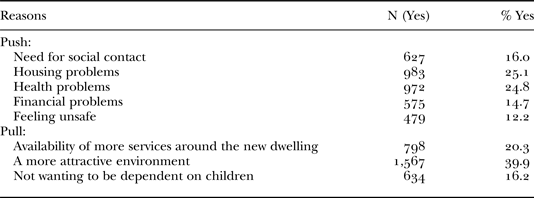
Table 1 shows the prevalence rates for every reason concerning a move in the last ten years. Moving to a more attractive environment was the most widespread reason (39.9 per cent), followed by relocation because of housing problems (25.1 per cent) and moving due to health issues (24.8 per cent). One in five respondents indicated that the availability of more services near the new dwelling had an important influence on their residential relocation decision. Not wanting to become dependent on their children and the need for more social contact were ranked fifth and sixth. Financial reasons and feelings of unsafety were the least prevalent reasons.
Frequencies of push and pull factors

Bivariate analyses push and pull reasons
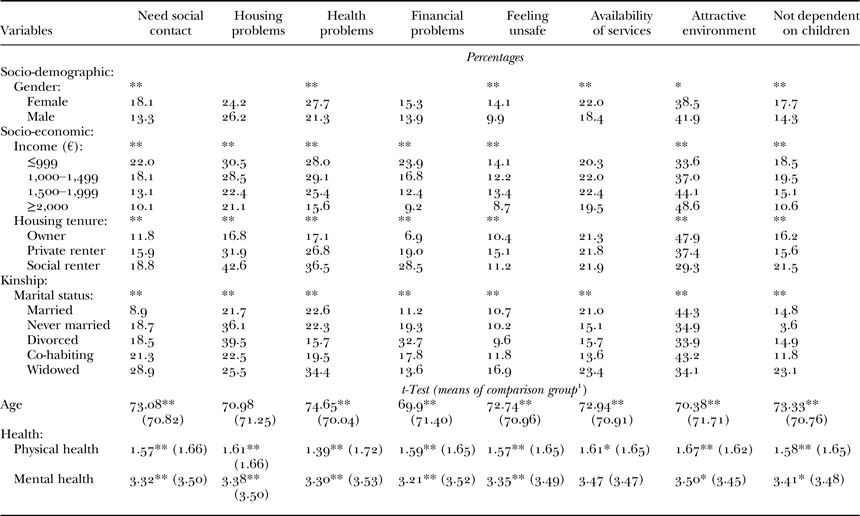
Table 2 presents the bivariate analyses (chi-square and independent t-tests). A higher proportion of women (χ2 = 16.605, degrees of freedom (df) = 1, p < 0.01), older people with a monthly income lower than €1,499 (χ2 = 46.992, df = 3, p < 0.01), with poor physical (mean = 1.57, p < 0.01) and mental health (mean = 3.32, p < 0.01), who rent (χ2 = 18.950, df = 2, p < 0.01), widowed older people (χ2 = 207.794, df = 4, p < 0.01) and social tenants (χ2 = 18.950, df = 3, p < 0.01) had moved out of a need for more social contact. Respondents who answered ‘yes’ were on average older than respondents who did not indicate this as a reason for moving (73.08 versus 70.82 years).
Bivariate analyses: push and pull factors for being moved

Note: 1. Respondents who indicated ‘no’.
Significance levels: * p < 0.05, ** p < 0.01.
Relocation due to housing problems was the second reason that pushed respondents out of their previous dwelling. A higher proportion of older people with income lower than €1,500 (χ2 = 25.529, df = 3, p < 0.01), social renters and to a lesser extent renters in the private market (χ2 = 166.821, df = 2, p < 0.01), divorced older people (χ2 = 68.347, df = 4, p < 0.01), with poorer physical (mean = 1.61, p < 0.01) and mental health (mean = 3.38, p < 0.01) moved because of this reason.
Subsequently, health reasons appeared to be a significant trigger for moving among women (χ2 = 21.121, df = 1, p < 0.01), people with an income lower than €2,000 (χ2 = 53.173, df = 3, p < 0.01), widowed respondents (χ2 = 73.819, df = 4, p < 0.01) and tenants in the social market (χ2 = 91.140, df = 2, p < 0.01). The mean age among older people who had moved due to health problems was higher (74.65 years versus 70.04 years) and they reported poorer physical (mean = 1.39, p < 0.01) and mental health (mean = 3.30, p < 0.01).
A higher proportion of older people from the lowest income category (χ2 = 68.184, df = 3, p < 0.01) who had rented social accommodation (χ2 = 178.045, df = 2, p < 0.01) and were divorced (χ2 = 127.398, df = 4, p < 0.01) had moved due to their financial situation. Respondents who moved for this fourth reason were on average younger (mean = 69.90, p < 0.01) and they reported poorer physical (mean = 1.59, p < 0.01) and mental health (mean = 3.21, p < 0.01)
Finally, feeling unsafe was taken into account as a push reason for moving. A lower proportion of men (χ2 = 15.289, df = 1, p < 0.01), the highest income group (χ2 = 12.678, df = 3, p < 0.01) and home-owners (χ2 = 15.338, df = 2, p < 0.01) moved because of feeling insecure and a higher proportion of widowed respondents moved because of this reason (χ2 = 27.646, df = 4, p < 0.01). Respondents who had replied ‘yes’ for this reason were on average older (mean = 72.74, p < 0.01) and reported poorer physical (mean = 1.57, p < 0.01) and mental health (mean = 3.35, p < 0.01).
Table 2 also shows the results of the bivariate analyses for the pull reasons. A higher proportion of women (χ2 = 7.575, df = 1, p < 0.01) and widowed respondents (χ2 = 18.991, df = 4, p < 0.01) indicated the availability of services in the neighbourhood as an important reason why they had moved in the past. Furthermore, respondents were on average older (mean = 72.94, p < 0.01) and had a tendency towards poorer physical health (mean = 1.61, p < 0.01).
Secondly, moving to a more appealing environment appeared to be a significant reason for respondents with a monthly income higher than €1,499 (χ2 = 45.144, df = 3, p < 0.01), for home-owners (χ2 = 66.706, df = 2, p < 0.01), and married and co-habitant older people (χ2 = 39.216, df = 4, p < 0.01). Respondents were on average younger (mean = 70.38, p < 0.01) and indicated better physical (mean = 1.67, p < 0.01) and mental health (mean = 3.50, p < 0.01). Additionally, men showed a tendency to have moved because of this reason (χ2 = 4.661, df = 1, p < 0.05).
A last pull reason for moving was not to become dependent on children. A higher proportion of women (χ2 = 8.278, df = 1, p < 0.01), respondents with income lower than €1,500 (χ2 = 31.564, df = 3, p < 0.01), social tenants (χ2 = 9.340, df = 2, p < 0.01) and widowers (χ2 = 59.101, df = 4, p < 0.01) moved because they did not want to become dependent on their children. Respondents who answered ‘yes’ were on average older (mean = 73.33, p < 0.01) and reported poorer physical (mean = 1.58, p < 0.01) and mental health (mean = 3.41, p < 0.01).
Logistic regression results
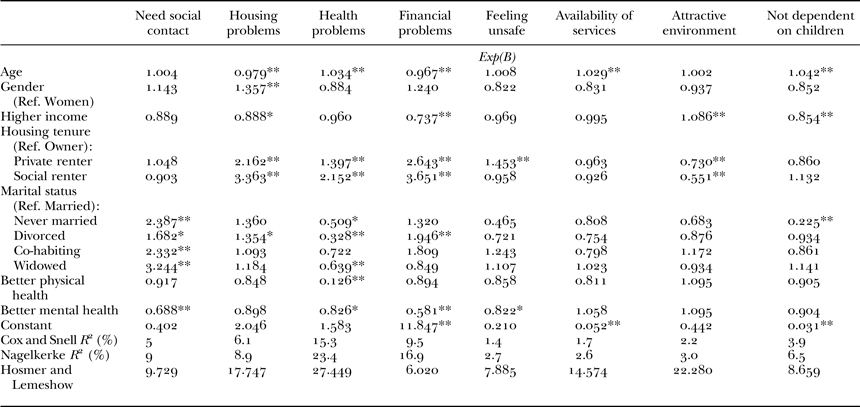
As all independent variables were significantly related to at least one reason for moving and no problems concerning multicollinearity were detected, all the variables were included in a multivariate model, which makes it possible to draw comparisons between the different regression models. Binary logistic regression analyses were assessed for each of the reasons for moving to measure the relative importance of each independent variable. Table 3 shows the regression models of the push and pull reasons.
Logistic regression models: predictors of push and pull factors for moving

Note: Ref.: reference category.
Significance levels: * p < 0.05, ** p < 0.01.
A first regression model which included the need for more social contact as the push reason for moving detected two significant predictors. Marital status was an important indicator; divorced (odds ratio (OR) = 1.682), never married (OR = 2.387) and co-habiting respondents (OR = 2.332) were two times more likely to have moved because they wanted more social contact, and widowers (OR = 3.244) were three times more likely than married respondents who moved. Finally, a poorer mental health status increased the probability that older people had moved due to a need for more social contact (OR = 0.688).
A second model relates to the experience of housing problems as a motive for moving in the past ten years. Younger age (OR = 0.979), men (OR = 1.357), lower income (OR = 0.888) and being divorced (OR = 1.354) increased the possibility of having moved due to housing problems. Subsequently, being a current renter on the private housing market (OR = 2.162) doubled the odds of having moved because of previous housing problems and being a current social tenant (OR = 3.363) tripled this probability in comparison with home-owners.
A higher age (OR = 1.034) increased the probability of having moved because of health issues. Current social renters were two times more likely to have moved for health problems than home-owners (OR = 2.152). Also renting a private dwelling increased the probability of having moved due to health problems (OR = 1.397). Never married (OR = 0.509), divorced (OR = 0.328) and widowed (OR = 0.639) older people showed a lower probability of having moved because of health reasons than married older people. The poorer the mental health (OR = 0.126) and physical health (OR = 0.826), the higher health issues played an important role in the decision to move.
For the fourth reason, younger seniors (OR = 0.967), lower income (OR = 0.737) and divorced older people (OR = 1.946) were more likely to have moved in the past as a result of their financial situation. Present social tenants were 3.5 times more likely (OR = 3.651) to have moved because of financial difficulties compared to home-owners. Being a current private renter doubled the odds (OR = 2.643) that older people had moved because of financial problems as opposed to home-owners. The better the mental health status, the lower the probability of indicating money problems as a motive for moving (OR = 0.581).
Two variables added significantly to the last regression model concerning push reasons: housing tenure and mental health status. Current private renters had a higher probability than home-owners of having moved due to feeling unsafe (OR = 1.453). Secondly, poorer mental health increased the chance of moving as a result of feeling unsafe in the previous environment (OR = 0.822).
Subsequently, Table 3 presents the results for the logistic regression models of the pull reasons for moving. Only age appeared to be a significant indicator for moving as a consequence of the availability of services in the new neighbourhood. The older the respondents, the higher the probability they had moved in the past for this reason (OR = 1.029).
Income was a significant factor in moving to a more attractive environment. A higher income increased the chance of moving for this reason (OR = 1.086). Also, current home-ownership heightened the probability of moving as a result of the attractiveness of the new environment. Being a current private renter (OR = 0.730) and a social tenant (OR = 0.551) lowered the probability that respondents had moved for this reason in comparison with home-owners.
Finally, the probability that respondents relocated because they did not want to become dependent on children increased with age (OR = 1.042). Income shows a negative correlation; the lower the monthly income, the higher the probability older people had moved because they did not want to become dependent on their children (OR = 0.854). Older people who had never been married were less likely than married older people (OR = 0.225) to have moved because they wanted to be independent.
Discussion
Ageing in place is mostly held to be the residential strategy older people prefer. But despite this strong wish to age in place, some long-cherished home environments can create hazards preventing older people from ageing well (Golant Reference Golant2011; Lord, Menz and Sherrington Reference Lord, Menz and Sherrington2006; Oswald et al. Reference Oswald, Wahl, Schilling, Nygren, Fänge, Sixsmith, Sixsmith, Széman, Tomsone and Iwarsson2007; Sixsmith and Sixsmith Reference Sixsmith and Sixsmith2008; Wagner, Shubair and Michalos Reference Wagner, Shubair and Michalos2010). Several active strategies can be applied in order to cope with this incongruence and to maintain residential normalcy (Golant Reference Golant2011, 2014; Peace, Holland and Kellaher Reference Peace, Holland and Kellaher2011). One of these coping mechanisms is moving to a new environment. The research presented in this paper builds on the classic push and pull framework as described in the earlier work of Lee (Reference Lee1966) and Wiseman (Reference Wiseman1980) and subsequently by other researchers (e.g. Bekhet, Zauszniewski and Nakhla Reference Bekhet, Zauszniewski and Nakhla2009; Boldy et al. Reference Boldy, Grenade, Lewin, Karol and Burton2011; Hillcoat-Nallétamby and Ogg Reference Hillcoat-Nallétamby and Ogg2013; Stimson and McCrea Reference Stimson and McCrea2004; Weeks, Keefe and Macdonald Reference Weeks, Keefe and Macdonald2012), by identifying individual differences among older people in terms of push and pull reasons for moving.
First, the results demonstrate that both push and pull reasons are important to take into account in the process of relocation – 39.9 per cent of the respondents indicated that they had moved because of the attractiveness of the new neighbourhood, underlining the importance of an enjoyable neighbourhood in old age. This is in line with previous research where moving to a pleasant and new neighbourhood emerged as a primary reason when deciding to move (Byrnes Reference Byrnes2011b ). Next, housing problems appeared to be the second most important trigger for moving. This might be explained by the fact that the Belgian housing stock ‘is rather old, with many elderly households concentrated in badly equipped and badly isolated houses, which are often too large for their needs' (De Decker and Dewilde Reference De Decker and Dewilde2010: 258). Health problems emerged as a third important trigger for moving. Because older people do not plan proactive moves in advance, bearing in mind future age-related stressors, it is mainly stressful events such as acute illness or hospitalisation that serve as a trigger for older people to move (Pope and Kang Reference Pope and Kang2010).
Taking into account the predictors of push and pull reasons, we can argue that certain vulnerabilities have been brought to the surface. First, a higher proportion of the oldest of those surveyed moved because of health issues, availability of services in the new neighbourhood and the desire not to become dependent on children, as opposed to their younger counterparts who move more frequently because of problems with their previous dwelling and financial reasons. According to the migration theory of Litwak and Longino (Reference Litwak and Longino1987), people tend to make three types of possible moves after retirement. At a younger stage in later life, older people move primarily because they want to change their residential amenities. This is in line with our finding that younger seniors have a higher possibility of having moved because of previous residential problems. A second reason for a move occurs when people are facing health and mobility disabilities and they need to adjust their environment, so they move because they need more physical or social support. Finally, a third type of relocation is a final move towards an institutional setting (Litwak and Longino Reference Litwak and Longino1987). Also, our results demonstrate that a higher age indicates a higher probability of moving because of health and support reasons. Löfqvist et al. (Reference Löfqvist, Granbom, Himmelsbach, Iwarsson, Oswald and Haak2013) conducted a large cross-national study on how very old people contemplate relocation and ageing in place. Their results showed that when thinking about a possible move, the oldest old seem to struggle with mixed feelings (Löfqvist et al. Reference Löfqvist, Granbom, Himmelsbach, Iwarsson, Oswald and Haak2013). On the one hand, they are aware of the process of ageing and therefore reasons for ageing reflect the need to stay in control and to avoid loneliness. On the other hand, a strong attachment to the home and neighbourhood, practical aspects and fear of losing routines are reasons why they do not want to move (Löfqvist et al. Reference Löfqvist, Granbom, Himmelsbach, Iwarsson, Oswald and Haak2013; Peace, Holland and Kellaher Reference Peace, Holland and Kellaher2011).
Socio-economic variables appeared to play an important role. People with lower income have moved more because of push factors such as housing and financial problems, and a higher proportion of those with higher income have moved because of a pull reason, that is, to a more attractive environment. The second variable measuring socio-economic status is housing tenure. A higher proportion of older tenants on both the private and social rental market mentioned problems concerning previous dwellings, health issues and financial concerns as motives for moving than older people who were current home-owners. In Belgium, both social and private renters face a high poverty risk compared to home-owners (De Decker and Dewilde Reference De Decker and Dewilde2010). Furthermore, older public-sector renters have a poorer self-reported health and higher mortality rates (Connolly, O'Reilly and Rosato Reference Connolly, O'Reilly and Rosato2010) and have a higher probability of experiencing affordability stress (Temple Reference Temple2008) in comparison to older home-owners. A higher proportion of current home-owners moved due to the attractiveness of the new environment.
Likewise, the results report significant social disparities by marital status. In particular, we can conclude that divorced older people move because of stressors such as a lack of social contact, dwelling problems and financial problems pushing them out of their home environment. As indicated by Brown and Lin (Reference Brown and Lin2012), little is known about the consequences of being divorced in later life. Traditional gerontological research has focused on widowhood, largely ignoring the rise of divorcees in later life. New forms of marital status should be taken into account for further research (Brown and Lin Reference Brown and Lin2012). Also, widowed and never-married older people move because of a need for more social contact. Besides widowhood, ‘unmarried baby boomers are vulnerable to the vagaries of aging, including economic disadvantage, poor health and loneliness’ (Lin and Brown Reference Lin and Brown2012: 164).
A last important indicator is the health status of older people. Manifest health stressors such as deteriorating functional status (Stoeckel and Porell Reference Stoeckel and Porell2010) and a long-term illness or disability (Hillcoat-Nallétamby and Ogg Reference Hillcoat-Nallétamby and Ogg2013) affect residential decision-making processes (Baümker et al. Reference Bäumker, Callaghan, Darton, Holder, Netten and Towers2012; Pope and Kang Reference Pope and Kang2010). Our results demonstrate that mental health seemed to be a predictor for four out of five push reasons for moving but had no influence on the pull reasons.
Conclusion
This paper has attempted to draw a more nuanced and diverse perspective on the relocation process in later life by identifying the facilitating and inhibiting individual factors in motives for moving. Our results show several social, income and health inequalities among different push and pull reasons for moving in later life. The question emerges whether relocation is voluntary, ‘being able to move’, or involuntary, ‘being forced to move’ (Bekhet, Zauszniewski and Nakhla Reference Bekhet, Zauszniewski and Nakhla2009; Wiseman Reference Wiseman1980). For example, older people with lower household incomes were significantly more likely to have moved because of housing problems (= being pushed), whereas older people with higher household incomes had moved mainly because of a more attractive and pleasant environment (= being pulled). It is reasonable to conclude that some of the movers could be categorised as involuntary movers due to personal and environmental stressors (= being pushed). Pope and Kang (Reference Pope and Kang2010) have shown that although older people in general are more likely to relocate because of reactive reasons (e.g. deteriorating health) than proactive reasons (e.g. moving to a better community), personal resources also influence this reactive and proactive behaviour and this should be taken into account. Their results indicated that the proactive group had higher incomes and that having fewer financial resources generates a higher risk for moving because of a crisis (Pope and Kang Reference Pope and Kang2010).
It is important for further research to focus on inequalities in later-life relocation, in general, and the different reasons for moving, in particular. Maintaining a sense of control over the relocation process has a positive influence on the environmental satisfaction after the relocation (Bekhet, Zauszniewski and Wykle Reference Bekhet, Zauszniewski and Wykle2008; Rutman and Freedman Reference Rutman and Freedman1988) and older people have a strong desire to maintain this control over their lives in order to achieve residential normalcy (Golant Reference Golant2011, 2014; Löfqvist et al. Reference Löfqvist, Granbom, Himmelsbach, Iwarsson, Oswald and Haak2013). Furthermore, involuntary moving has a negative influence on life satisfaction and is associated with a decline in health status (Bekhet, Zauszniewski and Wykle Reference Bekhet, Zauszniewski and Wykle2008; Ferraro Reference Ferraro1983). Oswald and Rowles stress the need for anticipatory conversations with older people so they can think about and plan future relocation: ‘reducing the potential for relocation trauma in old age is one outcome of the anticipation of different relocation possibilities earlier in life’ (Reference Oswald, Rowles, Wahk, Tesch-Römer and Hoff2006: 145). For the more vulnerable groups, such as low-income older people, it is important to provide support as our study shows they relocate mainly due to stressors. Confidence, knowledge and adaptive skills would help less-resilient older people in dealing with problems in order to achieve residential mastery (Golant Reference Golant2014).
Our study should be considered in the light of the following limitations, which could be addressed in further research. A first limitation is the potential bias that may exist due to non-random selection of the municipalities. Every municipality could choose autonomously whether or not they wanted to participate in the project. In each of the participating municipalities a random sampling strategy (stratified for age and gender) was used to recruit persons aged 60 years and older and living self-independently. Consequently, the total sample (N = 35,402) was not representative on a national level, but each sample was representative for the specific municipality. The participating municipalities used in this study differed only slightly in average yearly income per inhabitant (€17,796) from the average of all Flemish municipalities (€17,416) but they were more densely populated (614 versus 539 inhabitants per square kilometre). Notwithstanding this limitation, taking into account the large sample size this study clearly provides valuable information.
Secondly, the data only provided information about the respondent's current situation. Data on the respondent's situation before the actual move could generate new insights. For example, as indicated by previous research, a large number of older home-owners want to save their house as a kind of ‘piggy bank’ for their children or for when problems occur and they need to receive care or move to other accommodation (De Decker Reference De Decker2013; Peace, Holland and Kellaher Reference Peace, Holland and Kellaher2011). Our results have demonstrated that older renters (both private and social) had mainly moved because of problems such as financial difficulties, housing problems, etc. It would be of significant value to know if current tenants were home-owners before the actual move and if they needed to sell their home as a result of these problems. Furthermore, all the respondents in the sample made a move from one dwelling to another and people who had moved towards a residential setting were excluded; including this group in further research could offer different perspectives on push and pull reasons (Bekhet, Zauszniewski and Nakhla Reference Bekhet, Zauszniewski and Nakhla2009). Subsequently, as stated by Peace, Holland and Kellaher (2011: 752), thinking about future housing is an ‘ongoing process of assessment, calibration and adjustment’. Future research could involve ensuing residential reasoning, as a large extent of the decision-making process depends on the resilience of the older individual and their environment (Granbom et al. Reference Granbom, Himmelsbach, Haak, Löfqvist, Oswald and Iwarsson2014).
This paper has sought to broaden the classical push and pull framework by introducing several inequalities in the relocation decision-making process among older people. Ensuing from the results, a number of issues for both practice and policy can be formulated. First, the basic result of our research adds knowledge for improving intervention strategies for community aged-care services. Certain life events can hamper or stimulate people to change their residential situation (De Groot et al. Reference De Groot, Mulder, Das and Manting2011). Our results have demonstrated that vulnerable older people relocate more out of negative experiences such as health and housing problems. Therefore, professionals who are involved in home care could be trained to assist less-resilient older people throughout this process. Supporting and training home-care professionals could prevent seniors from having a traumatic experience and increase their autonomy and feelings of control in everyday lives. Additionally, relocation should not be considered an isolated event (Löfqvist et al. Reference Löfqvist, Granbom, Himmelsbach, Iwarsson, Oswald and Haak2013) and it is important to involve older people not ‘as passive victims but rather active agents in their own housing situations’ (Means Reference Means2007: 82). Subsequently, the quality of the neighbourhood appeared to play an important role in attracting people to move. Even though moving because of this reason is rather reserved for well-off seniors, co-operation between architects, urban developers, environmental planners and policy makers could gather more information about the different aspects of environmental design that contribute to the independence and wellbeing of older people. There could also be a special focus on less-resilient older people. For example, more attention should be given to developing alternatives of living solutions for older people (e.g. co-housing, house-sharing) (Löfqvist et al. Reference Löfqvist, Granbom, Himmelsbach, Iwarsson, Oswald and Haak2013; Smetcoren et al. Reference Smetcoren, Dury, De Donder, De Witte, Van Regenmortel, Kardol and Verté2014; Weeks et al. Reference Weeks, Shiner, Stadnyk and MacDonald2013). In Belgium, there is a lack of attractive alternatives in the neighbourhood and too often the residential possibilities of older people are limited to staying put in the current dwelling or moving towards a care facility (Smetcoren et al. Reference Smetcoren, Dury, De Donder, De Witte, Van Regenmortel, Kardol and Verté2014). As Mallers, Claver and Lares point out, ‘Innovations in aging, such as cohousing and intentional neighbourhoods, have expanded aging-in-place to community-in-place, whereby residents have voice and environmental control over the design and sustainability of communities in which they live’ (Reference Mallers, Claver and Lares2014: 73).
Our results also support the findings of Löfqvist et al. (Reference Löfqvist, Granbom, Himmelsbach, Iwarsson, Oswald and Haak2013), in which very old people are more likely to move for reactive reasons such as health problems and housing problems instead of proactive reasons. Subsequently, we support the idea of stimulating advanced care planning. Policy should make younger age groups aware of the importance of their residence in later life. Frequently, policy makers incorporate housing as an aspect of care, but in fact this should be the other way around; ageing in place starts with a good and adapted residential environment in which proper care can be provided. As already stated, the Belgian housing stock is rather old and badly equipped (De Decker and Dewilde Reference De Decker and Dewilde2010), with a large majority of older people living in suburban houses often too large and underused (Vanneste, Thomas and Goossens Reference Vanneste, Thomas and Goossens2007), out-dated on modern comfort (with high renovation costs) and labour-intensive gardens (Bervoets and Heynen Reference Bervoets and Heynen2013). Additionally, home-ownership has been promoted by the Belgian government for decades (De Decker Reference De Decker2011) and it is especially embedded in the minds of older people and, even more so, in their hearts (Palmans and De Decker Reference Palmans and De Decker2010). The research of Palmans and De Decker (Reference Palmans and De Decker2010: 973) indicated that some older home-owners believe that if they ended their life without their house, all the effort involved in achieving this was pointless. Therefore, many older adults are only willing to sell their house in a worst-case scenario. Unfortunately, many older home-owners lack the financial means to adapt their dwelling to their needs and therefore they are more likely to be long-time occupants of poor and inadequate housing. Policy makers could promote the idea of ‘moving-in-time’ by stimulating residential-reasoning among younger age groups (e.g. by means of public awareness campaigns).