Introduction
During the European late Upper and Final Palaeolithic (c. 15–9.6 kyr cal BC) and the Mesolithic (9.6–5.5/3.7 kyr cal BC), an increasing number of very different implements made from organic materials were used to catch marine and freshwater fish. In the Upper Magdalenian, harpoons (a detachable, barbed point—normally of antler—mounted on a wooden shaft) were mainly employed, although bipointed gorges were also used for line fishing (Cleyet-Merle Reference Cleyet-Merle1990; Cziesla Reference Cziesla2001; Pétillon Reference Pétillon2009). Northern European Mesolithic sites in particular have produced numerous examples of leisters (composed of bone or antler barbed points fixed to a wooden shaft) used to spear fish, along with fish hooks and remains of basket traps and nets (Verhart Reference Verhart, Vermeersch and Van Peer1990; Gramsch Reference Gramsch, Bellier, Cattelain and Otte2000, Reference Gramsch2002; Cziesla Reference Cziesla2001, Reference Cziesla, Terberger and Eriksen2004; Hall Reference Hall, Foulds, Drinkall, Perri, Clinnick and Walker2014; Clemente Conte et al. Reference Clemente Conte, Lozovski, Gassiot Ballbè, Mazurkevich, Lozovskaya, Hardy and Kubiak-Martens2015).
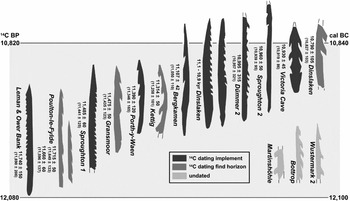
Both harpoons and leisters were used during the Final Palaeolithic (12.3–9.6 kyr cal BC) of north-west Europe. The barbed points from Poulton-le-Fylde (Barnes et al. Reference Barnes, Edwards, Hallam and Stuart1971) have often been used to argue that barbed-pointed spears were also used to hunt land mammals, as such points are generally regarded as components of fishing gear. This is, however, a single find. The barbed points known to date demonstrate the great variability of fishing methods during the final stages of the Pleistocene (Figure 1). Almost every new find exhibits its own specific morphological features. They would originally have been mounted on a wooden shaft and been either detachable (in the case of a harpoon), or not (fish spear). The earliest European fish hooks also date to this period, but the use of fish traps is not (yet) demonstrated (Cziesla Reference Cziesla2001, Reference Cziesla, Terberger and Eriksen2004; Pasda Reference Pasda, Gehlen, Heinen and Tillmann2001; Gramsch et al. Reference Gramsch, Beran, Hanik and Sommer2013).
Variability of north-west European barbed points dated to the late Meiendorf and Allerød (Greenland Interstadial (GI) 1). For original references, see Baales (Reference Baales2002) and Jacobi et al. (Reference Jacobi, Higham, Lord, Street, Barton and Terberger2009).

Several north-west European finds demonstrate the manufacture of Mesolithic leisters by mounting a barbed point on a wooden fishing spear. For all those periods, barbed points exhibiting hafting residues are also known. Such adhesive remains are usually identified as birch tar, sometimes supplemented by a binding made of bast or sinew (Weiner Reference Weiner1999; Gramsch Reference Gramsch, Bellier, Cattelain and Otte2000, Reference Gramsch2002).
There is no evidence to date for European Final Palaeolithic hafting residues on bone points. The use of birch tar, or a comparable substance produced by the dry distillation of birch bark, as an adhesive, is, however, evidenced in Europe as early as the late Middle Pleistocene, although the processes for its production remain unknown (Koller et al. Reference Koller, Baumer and Mania2001; Mazza et al. Reference Mazza, Martini, Sala, Magi, Colombini, Giachi, Landucci, Lemorini, Modugno and Ribechini2006). Further reports of birch tar come from the Upper and Final Palaeolithic, when it was mainly used to mount lithic projectile points (Bokelmann Reference Bokelmann, Cziesla, Kersting and Pratsch1999; Weiner Reference Weiner1999; Baales Reference Baales2002, Reference Baales2006; Dinnis et al. Reference Dinnis, Pawlik and Gaillard2009).
Experimental studies have successfully used birch tar in replicating Upper Palaeolithic atlatls and spears, and also Final Palaeolithic (and later) arrows (cf. Pétillon et al. Reference Pétillon, Bignon, Bodu, Cattelain, Debout, Langlais, Laroulandie, Plisson and Valentin2011). Other experimental adhesives have also been widely tested (cf. Gaillard et al. Reference Gaillard, Chesnaux, Girard, Burr, Darque-Ceretti, Felder, Mazuy and Regert2016). These include pine resin, mixtures of pine resin and beeswax (cf. the Late Mesolithic archaeological evidence for this at Zamostje 2: Lozovski Reference Lozovksi1996: 54) or powdered charcoal, bone or haematite added to the resin (Pirnay Reference Pirnay1981; Albarello Reference Albarello1986; Allain & Rigaud Reference Allain and Rigaud1986; Stodiek Reference Stodiek1993: 151–52; De Bie & Caspar Reference De Bie and Caspar2000: 128). The addition of powdered haematite to plant resin is archaeologically demonstrated in the Serbian Late Mesolithic and the much older South African late Middle Stone Age, in the latter case possibly also by adding beeswax to the resin (Wadley et al. Reference Wadley, Hodgskiss and Grant2009; Wadley Reference Wadley2010; Charrié-Duhaut et al. Reference Charrié-Duhaut, Porraz, Cartwright, Igreja, Connan, Poggenpoel and Texier2013; Cristiani et al. Reference Cristiani, Živaljević and Borić2014; Kozowyk et al. Reference Kozowyk, Langejans and Poulis2016; but see also Zipkin et al. Reference Zipkin, Wagner, McGrath, Brooks and Lucas2014).
Experiments have shown that pure pine resin (which was generally available during the European Upper and Final Palaeolithic and early Mesolithic, on the evidence of numerous pollen analyses) can be tempered by ingredients to increase its malleability, thereby improving the adhesive stability. Pure pine resin was too brittle without this pretreatment, and splintered away from the wooden shaft during use. Gaillard et al. (Reference Gaillard, Chesnaux, Girard, Burr, Darque-Ceretti, Felder, Mazuy and Regert2016: 5) show that a mixture of 30 per cent pine resin and 70 per cent beeswax achieved the best results for recreating Mesolithic arrows (especially with regard to the stability of the lithic arrow tip during flight).
Archaeological evidence for the use of beeswax as a main component of adhesive is rare in European contexts pre-dating the Neolithic (cf. Vahur et al. Reference Vahur, Kriiska and Leito2011: 4; Roffet-Salque et al. Reference Roffet-Salque, Regert, Evershed, Outram, Cramp, Decavallas, Dunne, Gerbault, Mileto, Mirabaud, Pääkkönen, Smyth, Šoberl, Whelton, Alday-Ruiz, Asplund, Bartkowiak, Bayer-Niemeier, Belhouchet, Bernardini, Budja, Cooney, Cubas, Danaher, Diniz, Domboróczki, Fabbri, González-Urquijo, Guilaine, Hachi, Hartwell, Hofmann, Hohle, Ibáñez, Karul, Kherbouche, Kiely, Kotsakis, Lueth, Mallory, Manen, Marciniak, Maurice-Chabard, McGonigle, Mulazzani, Özdoğan, Perić, Perić, Petrasch, Pétrequin, Pétrequin, Poensgen, Pollard, Poplin, Radi, Stadler, Stäuble, Tasić, Urem-Kotsou, Vuković, Walsh, Whittle, Wolfram, Zapata-Peña and Zoughlami2015). The use of beeswax to fix coloured drawings onto limestone slabs is reported from the Late Epigravettian site of Riparo Dalmeri in northern Italy (Dalmeri et al. Reference Dalmeri, Cusinato, Kompatscher, Hrozny Kompatscher, Bassetti and Neri2009: 101). In the same region during the Late Mesolithic and Early Neolithic periods, lithic arrow tips were hafted onto wooden shafts using a mixture of beeswax, bitumen and haematite powder (Cristiani et al. Reference Cristiani, Pedrotti and Gialanella2009).
Otherwise, the use of beeswax as an adhesive clearly has a long tradition in southern Africa. Here, already some 40000 years ago, a mixture of beeswax and other ingredients was used to fix lithic implements into a haft (d'Errico et al. Reference d'Errico, Backwell, Villa, Degano, Lucejko, Bamford, Higham, Colombini and Beaumont2012).
The use of beeswax as an adhesive in the Upper and Final Palaeolithic has so far not been reported north of the Alps. Our analysis of a barbed bone point from Westphalia (western Germany) is now the first evidence for the use of beeswax in this way, and provides rare direct evidence for the presence of the honeybee (Apis mellifera) in Northern Europe during the Final Pleistocene.
The Final Palaeolithic barbed point from Bergkamen, Westphalia
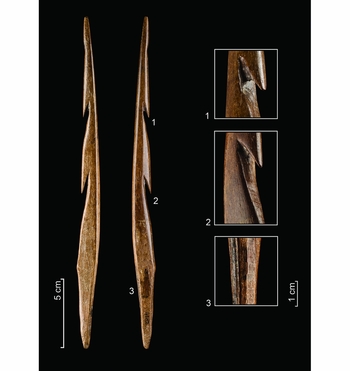
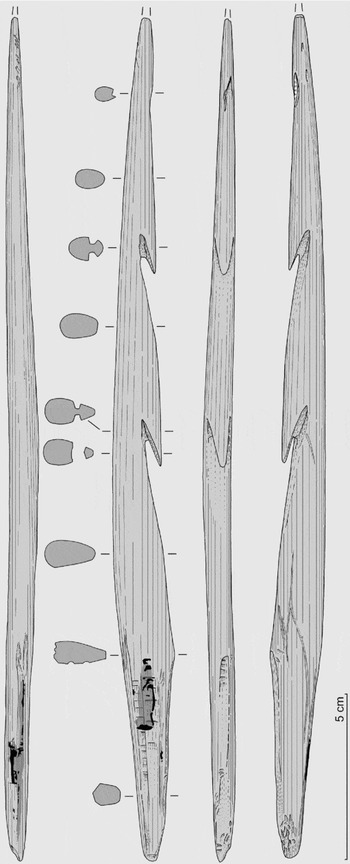
A nearly complete, large, slender barbed point (Figures 2 & 3) made of bone, and exhibiting two large barbs, was uncovered in the 1930s during straightening work (Regulierung) within oxbow sediments of the Seseke River near Bergkamen-Oberaden (Unna district in the Westphalian Embayment in the North Rhine-Westphalia district of western Germany) (Table 1).
The Bergkamen-Oberaden barbed point, dated to the late Federmessergruppen. (H. Menne & A. Müller/LWL-AfW Olpe; Westphalian Archaeological Heritage Service identification number AKZ 4411,158.)

Illustration of the Bergkamen-Oberaden barbed point. Grey to black shading at its base denotes the analysed black hafting residues. (A. Müller/LWL-AfW Olpe.)

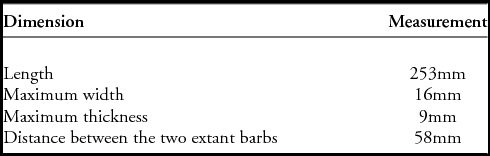
Measurements of the Bergkamen barbed point.

The object displays excellent preservation. The barbed point was cut from a long bone shaft, perhaps from the prominent bone ridge located on the plantar side of an elk's (Alcesalces) metatarsal (although further confirmatory analysis is required). It was definitely not cut from an antler.
In 1936 the barbed point was transferred to the Gustav-Lübcke Museum at Hamm (Westphalia). In 2011/2012, AMS dating of Westphalian Upper Palaeolithic and Mesolithic organic artefacts helped to resolve the dating of the barbed point (Baales et al. Reference Baales, Birker, Stapel, Baales, Pollmann and Stapel2013a, forthcoming).
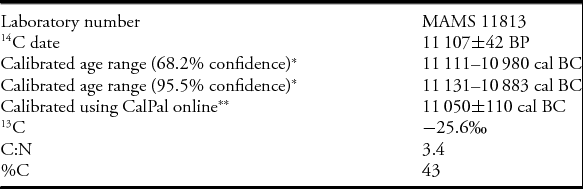
A sample for AMS dating was cut off the base of the point and dated at the MICADAS AMS-facility of the Curt-Engelhorn Centre Archaeometry gGmbH (Klaus-Tschira laboratory for physical age determination). Collagen from the sample was pretreated by ultrafiltration to produce the >30 kD fraction required for dating. The fraction was subsequently freeze-dried and incinerated, and the resulting CO2 reduced to graphite. Dating produced a surprisingly old result (Table 2).
AMS dating result of the Bergkamen barbed point.

* calibrated using IntCal13 in OxCal v4.2 online calibration (Bronk Ramsey Reference Bronk Ramsey2009; Reimer et al. Reference Reimer, Bard, Bayliss, Beck, Blackwell, Bronk Ramsey, Buck, Cheng, Edwards, Friedrich, Grootes, Guilderson, Haflidason, Hajdas, Hatté, Heaton, Hoffmann, Hogg, Hughen, Kaiser, Kromer, Manning, Niu, Reimer, Richards, Scott, Southon, Staff, Turney and van der Plicht2013).
** calibrated using CalPal2007_HULU by CalPal Online Radiocarbon Calibration on http://www.calpal-online.de/ (accessed 14 June 2017).
The AMS analysis dates the Bergkamen barbed point to the final Allerød interstadial—a period when Alces alces was common (Street & Baales Reference Street, Baales and Benecke1999). It adds to the growing number of comparable contemporaneous Final Palaeolithic finds in north-western Europe. The morphology of the bone point is unique, but the large barbs resemble those from Gransmoor (East Yorkshire, England), which is some 350 years older (Sheldrick et al. Reference Sheldrick, Lowe and Reynier1997; Figure 1).
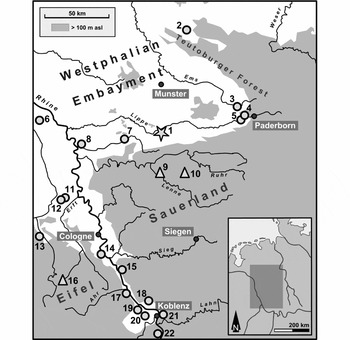
The age of the Bergkamen point assigns it to the Final Palaeolithic Federmessergruppen in Westphalia and adjacent regions, although this attribution is hampered by an under-representation of Final Palaeolithic sites and single finds (e.g. at Kettig) that have produced radiocarbon ages (Figure 4; Baales Reference Baales2002, Reference Baales2006; Richter Reference Richter2012; Holzkämper et al. Reference Holzkämper, Maier and Richter2013; Baales et al. forthcoming). Among them is the early Federmessergruppen site of Rietberg to the east of Bergkamen (Richter Reference Richter2012; Holzkämper et al. Reference Holzkämper, Maier and Richter2013), which delivered no organic implements, and the late Federmessergruppen site cluster of the Neuwied Basin to the south, where at least at Kettig one slender barbed point of red deer antler was excavated (Baales Reference Baales2002, Reference Baales2006).
Location of the Bergkamen-Oberaden barbed-point site situated within the southern Westphalian Embayment, and further important early Final Palaeolithic (curved backed point) sites in Rhineland and Westphalia. Dots indicate open-air sites; triangles are cave/abri sites. (M. Baales/LWL-AfW Olpe.) Early curved backed point site (Meiendorf Interstadial): 15) Bonn-Oberkassel (burial site). Late curved backed point/Federmessergruppen sites (Allerød Interstadial): 1) Bergkamen-Oberaden (barbed point, radiocarbon-dated); 2) Westerkappeln (lithic assemblage, excavated); 3) Rietberg (lithic assemblage, excavated); 4) Paderborn-Sande (Megaloceros antler artefact); 5) Salzkotten-Thüle (lithic assemblage, excavated); 6) Goch (lithic surface assemblage); 7) Herne (Megaloceros antler artefact); 8) Dinslaken (barbed points, radiocarbon-dated); 9) Martinshöhle (lithic assemblage and barbed point); 10) Feldhofhöhle (lithic assemblage); 11) Mönchengladbach-Geneicken (lithic and faunal assemblage, excavated); 12) Wegberg-Berg (lithic surface assemblage); 13) Barmen (lithic surface assemblage); 14) Wesseling (lithic assemblage, excavated); 16) Katzensteine (lithic assemblage, excavated); 17) Bad Breisig (lithic and faunal assemblage, excavated). Central Rhineland sites: 18) Niederbieber (lithic and faunal assemblage, excavated); 19) Andernach-Martinsberg (lithic and faunal assemblage, excavated); 20) Kettig (lithic and faunal assemblage, excavated); 21) Urbar (lithic and faunal assemblage, excavated); 22) Boppard (lithic and faunal assemblage, excavated).

The local Federmessergruppen assemblages are generally dated to the late Meiendorf (Greenland Interstadial 1e) and Allerød (Greenland Interstadial 1c–a) periods of the Final Pleistocene (Baales Reference Baales2002, Reference Baales2006; Street et al. Reference Street, Baales, Cziesla, Hartz, Heinen, Jöris, Koch, Pasda, Terberger, Vollbrecht and Weninger2002); there is no definite proof for further Final Palaeolithic techno-complexes within this area. The Federmessergruppen techno-complex is, however, common in all parts of Westphalia. Sites are predominately clustered within the Westphalian Embayment (where the Bergkamen barbed point originated), but there are also finds from the surrounding uplands. Approximately 60 sites are known, represented mainly by lithic surface scatters containing at least one typical backed point, or Federmesser (Baales et al. Reference Baales, Pollmann, Stapel, Baales, Pollmann and Stapel2013b).
The dating of the Bergkamen barbed point denotes a late (or classical) Federmessergruppen context, judging from comparable radiocarbon dates available for typical Federmessergruppen assemblages in the Neuwied Basin, approximately 150km to the south (Baales Reference Baales2002, Reference Baales2006).
Analysis of the black residues
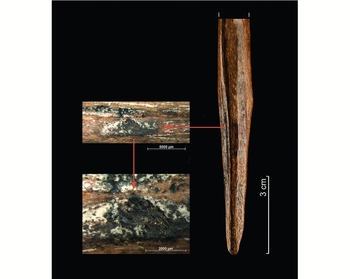
Towards the base of the Bergkamen barbed point are at least two large spots of black mastic (Figures 3 & 5). One spot is attached to one of the sides, while further residue fills grooves on the reverse of the implement. Microscopic inspection of the black mastic confirms that the residues were directly attached to the surface of the implement, and they were immediately interpreted as representing remains of adhesive material used to fix it to a wooden shaft. This interpretation is supported by the following:
-
• The state of preservation of the implement is excellent—all surfaces are untreated and not weathered.
-
• The museum records revealed no use of preservative to consolidate the implement.
-
• Organic implements discovered around the same time and stored in the museum archive exhibit a highly visible artificial surface coating, which was splintered and flaking from the implement. No such coating was found on the Bergkamen barbed point.
-
• No residues of any kind were found in any other surface depressions apart from those at the base.
-
• The black mastic is only visible on the base of the implement.
Microscopic views of residue spots located on the base of the Bergkamen-Oberaden barbed point. (F. Mucha, Erfurt, and H. Menne & A. Müller/LWL-AfW Olpe.)

That this black mastic was associated with hafting is further supported by the fact that the base of the barbed point was left rough for better attachment to a wooden shaft. The presence of the black mastic on the base immediately suggests that the barbed point was the non-detachable tip of a leister or fishing spear, and not part of a harpoon with a detachable point.
The black colour of the residues suggested that birch tar was used to fix the barbed point. Chemical analysis was performed to verify this assumption. Small fragments of residue were removed and divided, microscopically, into suitable subsamples to be analysed by infrared spectroscopy (Fourier-transform infrared or FTIR spectroscopy). This material was then crushed in a diamond anvil cell (DAC) to obtain a very thin, homogeneous layer. The sample was analysed in transmission mode using a Perkin Elmer Spectrum Spotlight 200 FT-IR microscope attached to a Spectrum 100 FTIR spectrometer housed at the Natural Sciences Laboratory, Discipline of Conservation and Restoration, University of Applied Sciences, Erfurt. The pretreated sample was analysed in the 3260cm−1 to 600cm−1 spectral range, with a resolution of 4cm−1 and 128 accumulations per spectrum.
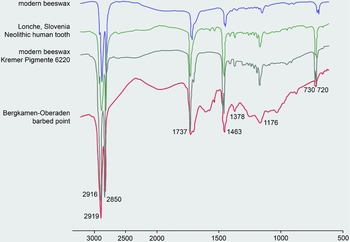
FTIR analysis yielded intense vC-H stretching bands at 2956, 2919 and 2850cm−1 (due to CH3) and δC-H bending vibrations in the 1473–1377cm−1 domain (indicating CH2), which can be attributed to the presence of an aliphatic, non-aromatic compound. Surprisingly, the spectrum suggested that natural wax, rather than birch tar, matched best as the main component of the sample (Figure 6). To confirm this result, the Bergkamen spectrum was compared to a sample of modern beeswax (Kremer pigments 6220) and to an archaeological beeswax spectrum obtained for a sample of Neolithic (c. 4.5 kyr cal BC) dental filling from Lonche 1, northern Istria (Slovenia; Bernardini et al. Reference Bernardini, Tuniz, Coppa, Mancini, Dreossi, Eichert, Turco, Biasotto, Terrasi, De Cesare, Hua and Levchenko2012). Both FTIR beeswax spectra are fully concordant with the Bergkamen spectrum (Figure 6).
Comparing the IR spectra of the Bergkamen-Oberaden barbed-point residues, the Lonche (Slovenia) Neolithic tooth filling and modern samples of natural beeswax. (For ‘modern beeswax’ and ‘Lonche, Slovenia, Neolithic human tooth’, see Bernardini et al. Reference Bernardini, Tuniz, Coppa, Mancini, Dreossi, Eichert, Turco, Biasotto, Terrasi, De Cesare, Hua and Levchenko2012: fig. 4; for ‘modern beeswax Kremer Pigmente 6220’ and ‘Bergkamen-Oberaden barbed point’, see this study.) (M. Baales & A. Müller/LWL.AfW.)

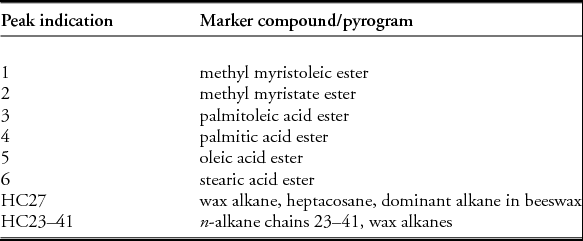
To strengthen our conclusion, a further subsample of the Bergkamen material was analysed by pyrolysis-gas chromatography/mass spectrometry (employing a PerkinElmer Clarus SQ 8 GC/MS System) using tetramethylammonium hydroxide for thermally assisted hydrolysis and methylation (THM-Py-GC/MS). During sample pyrolysis (20 seconds by 700°C in a quartz tube with CDS Pyroprobe 5000), we obtained volatile, less reactive and therefore easier to identify methyl derivates of the pyrozylate via in situ hydrolysis/methylation, by adding 1µl TMAH (25% tetramethylammonium hydroxide in water) (cf. Roffet-Salque et al. Reference Roffet-Salque, Regert, Evershed, Outram, Cramp, Decavallas, Dunne, Gerbault, Mileto, Mirabaud, Pääkkönen, Smyth, Šoberl, Whelton, Alday-Ruiz, Asplund, Bartkowiak, Bayer-Niemeier, Belhouchet, Bernardini, Budja, Cooney, Cubas, Danaher, Diniz, Domboróczki, Fabbri, González-Urquijo, Guilaine, Hachi, Hartwell, Hofmann, Hohle, Ibáñez, Karul, Kherbouche, Kiely, Kotsakis, Lueth, Mallory, Manen, Marciniak, Maurice-Chabard, McGonigle, Mulazzani, Özdoğan, Perić, Perić, Petrasch, Pétrequin, Pétrequin, Poensgen, Pollard, Poplin, Radi, Stadler, Stäuble, Tasić, Urem-Kotsou, Vuković, Walsh, Whittle, Wolfram, Zapata-Peña and Zoughlami2015).
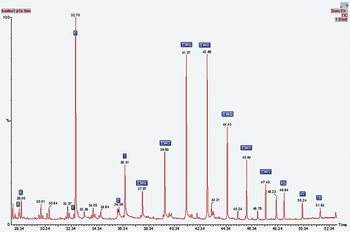
Identification of diagnostic marker compounds was enabled by comparing the received retention times and mass spectra with our reference measurement data, the NIST02 spectra database and results found in Asperger et al. (Reference Asperger, Engewald and Fabian1999, Reference Asperger, Engewald and Fabian2001). The obtained diagnostic marker compounds are detailed in Table 3 and displayed in the Figure 7 pyrogram.
Identified marker compounds in the Bergkamen wax sample (using pyrolysis-gas chromatography/mass spectrometry).

Pyrogram of the Bergkamen-Oberaden barbed-point residues. (F. Mucha, Erfurt.)

The pyrogram identified beeswax as the main component of the Bergkamen sample. Here, the quantity of alkanes compared to aliphatic acids is much higher than in non-matured, fresh beeswax. This is due to microbial degradation of aliphatic acids over the last 13 kyr—a process that affects alkanes to a much lesser extent. Both analytical methods applied to the Bergkamen residue sample show that (matured) beeswax is the main component of the adhesive.
Microscopic analysis of the residue samples attributed the black colour to small carbon-rich particles intermingled with the more translucent beeswax. Although these particles could confidently be identified as (crushed) charcoal, they could not be further analysed. It is also interesting to note that honeycomb wax darkens over time to a dark-brownish colour (Eckhard Czarnowski pers. comm.), a process that, in this case, may have increased colouration during degradation in sediment. Both aspects may have contributed to the dark colour of the residue.
Discussion
Our results provide the first clear evidence for the use of a beeswax adhesive in the fabrication of a European Palaeolithic composite tool—in this case, attaching a Final Palaeolithic barbed bone point to a wooden shaft. The identification of charcoal in our sample validates experimental approaches that claim that the addition of temper prevents the adhesive from crumbling. The use of plant fibre or animal tissue (such as bast or sinew) to improve the hafting connection cannot, however, be discounted.
The key question is whether groups were already able to obtain beeswax in Westphalia/Central Europe during the early stages of the Final Palaeolithic, or whether the beeswax must have been extracted farther to the south. Networking was important for Upper and Final Palaeolithic and Mesolithic hunter-gatherer groups in the spread of innovations and knowledge, and was fundamental for their social life (cf. Hussain & Floss Reference Hussain and Floss2016). Furthermore, regular exchanges with relatives and neighbours ensured that small (family) groups had support in cases of emergency and during special ventures conducted throughout the process of socialisation of young individuals (initiation) to become a fully approved member of their group. This networking is seen in the presence of lithic raw materials, special objects or jewellery, such as small Mediterranean shell beads, several hundred kilometres from their source (cf. Langley & Street Reference Langley and Street2013). It cannot, therefore, be excluded that the beeswax found on the Bergkamen implement was transported north by regular inter-group contacts or by some type of individual or residential macro-moves.
If the birch tar detected on Final Palaeolithic implements from Central Europe is the result of ‘on-site’ production processes, the Bergkamen evidence might similarly suggest the presence of a wild honeybee of the genus Apis sp. in Central Europe during the Allerød interstadial. Today, there are several species of Apis, which are mostly restricted to Asia. In Europe, Africa and the Near and Middle East, only the wild honeybee Apis mellifera (the western or European honeybee) is known, and has been present for approximately one million years (Han et al. Reference Han, Wallberg and Webster2012; Wallberg et al. Reference Wallberg, Han, Wellhagen, Dahle, Kawata, Haddad, Simões, Allsopp, Kandemir, De la Rúa, Pirk and Webster2014). Population sizes would have varied during the Pleistocene climatic changes. During the glacial maxima, the species survived in Europe in southerly refuges and in northern Africa (Kotthoff et al. Reference Kotthoff, Wappler and Engel2013: 1836; Husemann et al. Reference Husemann, Schmitt, Zachos, Ulrich and Habel2014: 86). From there it recolonised northern Eurasia during several of the interglacials and after the Weichselian Last Glacial Maximum. Our results suggest that this had already occurred during the Final Pleistocene climatic amelioration, rather than during the following Early Holocene (Kotthoff et al. Reference Kotthoff, Wappler and Engel2013: 1836; Roffet-Salque et al. Reference Roffet-Salque, Regert, Evershed, Outram, Cramp, Decavallas, Dunne, Gerbault, Mileto, Mirabaud, Pääkkönen, Smyth, Šoberl, Whelton, Alday-Ruiz, Asplund, Bartkowiak, Bayer-Niemeier, Belhouchet, Bernardini, Budja, Cooney, Cubas, Danaher, Diniz, Domboróczki, Fabbri, González-Urquijo, Guilaine, Hachi, Hartwell, Hofmann, Hohle, Ibáñez, Karul, Kherbouche, Kiely, Kotsakis, Lueth, Mallory, Manen, Marciniak, Maurice-Chabard, McGonigle, Mulazzani, Özdoğan, Perić, Perić, Petrasch, Pétrequin, Pétrequin, Poensgen, Pollard, Poplin, Radi, Stadler, Stäuble, Tasić, Urem-Kotsou, Vuković, Walsh, Whittle, Wolfram, Zapata-Peña and Zoughlami2015: 227).
The later prehistoric exploitation of honeycombs to gather honey (and obviously also beeswax) is attested in the famous drawing from Cuevas de la Araña, Spain, of a woman climbing up to a beehive and surrounded by bees (Dams & Dams Reference Dams and Dams1977; cf. Crane Reference Crane2001: 19–22). Beeswax was simple to process, as it melts around 60°C (Fröhlich Reference Fröhlich2000: 53), an easily obtainable temperature.
Conclusion
Analysis of residues attached to the base of a Final Palaeolithic (Federmessergruppen) barbed point has, for the first time, demonstrated the use of beeswax as a major component in a European Palaeolithic adhesive. An initial interpretation of birch tar based on the residue colour was refuted with the use of chemical analysis. Crushed charcoal was added to the beeswax to prevent the adhesive from fracturing during use. Together with the natural discolouration of the wax, this caused the blackish colouring.
Our study also provided evidence that the honeybee Apis mellifera had already expanded from its Mediterranean glacial refuges to northern Central Europe during the Final Pleistocene—at least 2000 years earlier than the Early Holocene date previously suggested.
Acknowledgements
We wish to acknowledge financial support from the government of North Rhine-Westphalia (Thomas Otten) for AMS dating at Mannheim and laboratory costs in Erfurt. We thank Bernd Kromer, former head of the Curt-Engelhorn-Centre Archaeometry gGmbH (Klaus-Tschira laboratory for physical age determination), and Wilfried Rosendahl from the Reiss-Engelhorn Museums Mannheim for their support. For technical support and for preparing the figures, Hermann Menne, Andreas Müller and Andreas Weisgerber of the LWL-Archäologie für Westfalen are also thanked. Furthermore, we thank Birgit Gehlen (University of Cologne) for the opportunity to add the two recently obtained dates for the two Dinslaken barbed points to our Figure 1 (pers. comm. to M. Baales). Finally, we are grateful to the two anonymous reviewers for their valuable comments and suggestions, which helped to improve the text.