Introduction
Graviera Agraphon cheese is a protected designation of origin (PDO) Greek hard cheese, produced in the mountain of Agrapha, central Greece. The cheese is made out of ewe's milk or mixtures of ewe's and goat's milk, the latter not exceeding a percentage of 30%. Graviera type hard cheeses are also produced in other regions of Greece with different types of milk or different milk mixtures. According to Greek legislation (Greek Codex Alimentarius, 2003), Graviera Agraphon cheese can be sold after three months of ripening. The cheese has been traditionally sold in its initial cylindrical shape (wheel) form. In recent years for commercialization or retail purposes, Graviera Agraphon cheese blocks are also frequently stored under modified atmosphere packaging (MAP) conditions (Fletouris et al., Reference Fletouris, Govari and Botsoglou2015).
E. coli O157:H7, L. monocytogenes, S. Typhimurium and S. aureus are important food-borne pathogens. The occurrence of these pathogens in sheep and goat cheese products has been verified by several workers (Sara et al., Reference Sara, Cody, Sharon, Abbott, Anthony, Marfin, Beth Schulz, Wagner, Robbins, Janet, Mohle-Boetani, Duc and Vugia1999; EFSA, 2008; Farrokh et al., Reference Farrokh, Jordan, Auvray, Cerf, Glass, Oppegaard, Raynaud, Thevenot, Condron, De Reu, Govaris, Heggum, Heyndrickx, Hummerjohann, Lindsay, Miszczycha, Moussiegt and Verstraete2013; Pexara et al., Reference Pexara, Solomakos and Govaris2013). E. coli O157:H7, L. monocytogenes, S. Typhimurium and S. aureus outbreaks associated with consumption of cheese products have been reported in many countries (Espie et al., Reference Espie, Vaillant, Mariani-Kurkdjian, Grimont, Martin Schaller, De Valk and Vernozy-Rozand2006; Jelastopulu et al., Reference Jelastopulu, Venieri, Komninou, Kolokotronis, Constantinidis and Bantias2006; Pintado et al., Reference Pintado, Grant, Halford-Maw, Hampton, Ferreira and McLauchlin2009; Van Duynhoven et al., Reference Van Duynhoven, Isken, Borgen, Besselse, Soethoudt, Haitsma, Mulder, Notermans, Jonge, Kock, Van Pelt, Stenvers and Van Steenbergen2009).
The microbial stability of cheeses is determined by the combined application of different microbial hurdle factors (low pH, aw values, NaCl, LAB) during the manufacturing process, ripening and storage (Leistner and Gorris, Reference Leistner and Gorris1995). However, the fate of several pathogens in cheese products has not been extensively studied during post ripening storage. Modified atmosphere packaging (MAP) is an attractive preservation method for foods and has been extensively used for the refrigerated storage of various foods including cheese (Dermiki et al., Reference Dermiki, Ntzimani, Badeka, Savvaidis and Kontominas2008). MAP involves the use of O2 concentrations below atmospheric levels, CO2 concentrations at relatively high concentrations, usually higher than 20%, and N2 as an inert filler gas. CO2 is active against several bacteria including food-borne pathogens.
The aim of this study was to investigate the physicochemical and microbiological properties of Graviera Agraphon cheese under MAP conditions during refrigerated storage, as well as the fate of the food-borne pathogens E. coli O157:H7, L. monocytogenes, S. Typhimurium and S. aureus.
Materials and methods
Graviera Agraphon cheese
Graviera Agraphon cheese was taken from a cheese manufacturing plant (Kissas Bros, Mouzaki, Greece), 3 months after its production. The loaves of Graviera Agraphon cheese (ca 13 Kg), obtained from the same production batch, were cut in blocks sized 11 × 9 × 1.7 cm with a weight of ca 200 g and used for the MAP tests.
Modified atmosphere packaging (MAP) and experimental design
The cheese blocks were packaged in plastic trays of 16 × 20.5 × 4.8 cm (Cryovac UBRT®, Cryovac, Sealed Air S.r.l., Passirana di Rho, Italy), and sealed by a sealing machine (model TSM105 Foodtech, Minipack-torreS. p.A., Dalmine, Italy) with a film (OPET, Cryovac) of 39 µm thickness, under MAP conditions (50% N2 – 50% CO2), or control (atmospheric air). The gas mixtures were obtained from Air Liquid SA, Athens, Greece.
Control and MAP cheese samples were stored at 4 and 10 °C, simulating proper or improper refrigerated storage, respectively. Control cheese samples were stored at 4 °C or 10 °C for 35 and 16 d, respectively. MAP cheese samples were stored at 4 °C or 10 °C for 85 and 28 d, respectively. The above storage times of control and MAP cheese samples at refrigerated temperatures were selected since preliminary tests showed visual spoilage by yeasts or molds by those days.
Headspace gas determination
Prior to opening, CO2 and O2 of the headspace of all packages were determined by using a gas analyser Checkmate O2/CO2 (PBI-Dansensor A/S, Ringsted, Denmark) equipped with a needle for penetrating through the package. A rubber septum (Syntech Ltd, Glasgow, UK) was glued on the upper surface of the package and pierce with a 23gauge needle connected to the gas analyzer.
Bacterial strains and inoculation procedure of the cheese blocks
The L. monocytogenes Scott A and Lmk strains, and S. aureus LHA and LHB strains S. Typhimurium ST1 and ST2 strains from our Laboratory stock were used. E. coli O157:H7 toxigenic strains EDL-932 and EDL-933 were obtained from Prof. Genigeorgis University of California, California, USA. Pathogen inocula were made as previously described (Govaris et al., Reference Govaris, Botsoglou, Sergelidis and Chatzopoulou2011). In brief, each strain of the pathogens was grown separately in 50 ml brain heart infusion broth (Oxoid, Basingstoke, UK) for 24 h at 37 °C, with two consecutive transfers. The bacterial cells were pelleted by centrifugation at 5000 g for 15 min at 5 °C and washed twice with 10 ml of 0.1 mol/ml phosphate buffer saline (PBS, Oxoid), pH 7.0, and diluted to 1.0 × 10⁸ cfu/ml in PBS. The two strains of each pathogen were combined at equal concentrations for the inoculum of cocktail strains. Cell densities of the final suspension of the inoculum were determined by serial dilution and subsequent enumeration on tryptone soy agar TSA (Oxoid).
Prior to packaging, four groups of the cheese blocks were inoculated with a single pathogen inoculum of L. monocytogenes, S. Typhimurium, E. coli O157:H7 or S. aureus, while one group of cheese blocks served as control (no inoculation). Inoculation was carried out, by spreading on the upper and lower surface of these blocks the pathogen inocula using a sterile bent glass rod to an initial population of ca 104 log cfu/g, according to the procedure described by Govaris et al. (Reference Govaris, Botsoglou, Sergelidis and Chatzopoulou2011). Prior to inoculation, the cheese has been examined for contamination by the examined pathogens as described in the microbiological analysis section.
Microbiological analysis
Samples for microbiological analysis of Graviera Agraphon cheese packaged under MAP condition or control were taken at 0 d, 2-d intervals up to 10th day and 5-d intervals up to the end of 4 °C storage, while 2-d intervals up to 4th day and 4-d intervals up to the end of 10 °C storage. At each sampling time, duplicate cheese samples (25 g) were placed in the stomacher bags and aseptically filled with 225 ml of peptone water 0.1%. The content was macerated in the stomacher for 2 min at room temperature. Resulting slurries were serially diluted (1 : 10) in 0.1% sterile peptone water and plated (0.1 ml) on appropriate growth media. Populations of L. monocytogenes were determined on Palcam Listeria Selective Agar (Merck, Darmstadt, Germany) supplemented with Palcam Listeria Selective Supplement (No.1.1175, Merck) at 30 °C for 48 h. S. aureus populations were counted on Baird-Parker agar (Merck, Darmstadt, Germany) supplemented with egg yolk tellurite emulsion (Merck) (BPA + EYT) according to ISO 6888-1 (ISO, 1999), at 37 °C for 24 h. S. Typhimurium populations were estimated on selective XLD agar (Merck) at 37 °C for 24 h. E. coli O157:H7 counts were estimated on sorbitol MacConkey agar (Oxoid) at 37 °C for 48 h.
Before the inoculation trials, the absence of the pathogen in the cheese was verified by an initial enrichment. Duplicate cheese samples (25 g) were placed in sterile stomacher bags, diluted in 225 ml of modified E. coli broth (CM 990, Oxoid) supplemented with novobiocin (SR 181, Oxoid), Listeria enrichment broth (Merck), Rappaport–Vassiliadis broth (Merck), Baird broth (Merck) and incubated (24 h) at 37, 30, 42, 37 °C for E. coli O157:H7, L. monocytogenes, S. Typhimurium, and S. aureus, respectively. Enriched samples were plated (0.1 ml) in duplicate on appropriate agar media for each pathogen, as described above.
LAB were estimated on de Man Rogosa Sharpe agar (Oxoid), as described by Govaris et al. (Reference Govaris, Koidis and Papatheodorou2002) at 28 °C. Psychrotrophs were enumerated on Plate Count Agar (Oxoid), after incubation at 7 °C for 10 d. Yeasts and molds were enumerated on the Yeast-extract-glucose chloramphenicol agar (YGC) (Merck) according to ISO 6611/IDF (2004). Microbiological analyses were performed in triplicate.
Physicochemical analysis
Standard methods were used for the determination of protein, fat, moisture, and sodium chloride in Graviera Agraphon cheese samples (APHA, Reference Wehr and Frank2004). The samples for physicochemical analysis were taken at the same time of microbiological analysis. At each sampling time, pH values of cheese samples were also determined with a pH meter (WTW, type 525, Wissennchaftlich – TechnischeWerkstatten, GmbH, D 82362 Weilheim, Germany). Physicochemical analyses were performed in triplicate.
Statistical analysis
Data were subjected to analysis of variance in the general linear model using the SPSS 10.05 statistical program (SPSS Ltd. Woking, UK). When significant treatment effects were disclosed, Duncan's multiple range tests with examination for significant differences at each storage interval for individual treatment were employed. A probability level of P ≤ 0.05 was used in testing the statistical significance of all experimental data.
Results and discussion
Physicochemical analysis
Chemical analysis of cheese samples showed mean values of 27.1 ± 0.1% for protein, 32.50 ± 0.2% for fat, 34.2 ± 0.4% for moisture, and 2.54 ± 0.1% for sodium chloride. Results showed that protein, fat, moisture and salt contents did not change significantly (P > 0.05) among control or MAP cheese samples throughout storage at 4 °C or 10 °C. The cheese used in this study was in compliance with the Greek Codex Alimentarius (2003), which requires that Graviera Agraphon cheese should contain not less than 40% fat in dry matter but no more than 38% moisture.
The initial mean pH value (5.52 ± 0.2) of the MAP cheese samples was not significantly different (P > 0.05) than that of the control cheese samples and remained unchanged (P > 0.05) throughout the storage at 4 °C. However, the pH values of control and MAP cheese samples were significantly (P < 0.05) reduced to 5.10 ± 0.3 and 4.95 ± 0.3 by the end of 16 and 24 d storage at 10 °C, respectively. The decrease in pH of control or MAP cheese samples during storage at 10 °C may be due to further activity and growth of LAB as compared to lower growth at 4 °C. Similar pH values for other Graviera cheese types after repining in Greece were also observed by other workers (Moatsou et al., Reference Moatsou, Moschopoulou and Anifantakis2004; Samelis et al., Reference Samelis, Kakouri, Pappa, Matijasić, Georgalaki, Tsakalidou and Rogelj2010). In agreement to present findings, no important changes of pH values (ca 5.90) of a grated Graviera cheese type of Northern Greece packaged under aerobic or 100% nitrogen atmosphere during storage at 4 °C for 70 d (Mexis et al., Reference Mexis, Chouliara and Kontominas2011). Other workers also observed a similar stability in pH value of other cheese types such as Stracciatella cheese (Gammariello et al., Reference Gammariello, Conte, Di Giulio, Attanasio and Nobile2009) or white cheese (Kirkin et al., Reference Kirkin, Gunes and Kilic-Akyilmaz2013) packaged under various MAP conditions during refrigerated storage.
Determination of headspace gases
The O2 content of the headspace of MAP packages was estimated at 0.5% on 0 d and remained almost the same throughout the refrigerated storage at 4 °C or 10 °C. The initial CO2 content of MAP packages was found to be 49.85% at 0 d and declined (P < 0.05) to 41.3 and 40% at 10th and 12th day of storage at 4 °C or 10 °C, respectively. No important changes of the CO2 content were observed during subsequent storage time. The O2 content of the headspace of control packages was found to be 20.5% on 0 d and decreased to 20.1 and 20.3% by the end of storage at 4 °C or 10 °C, respectively. Trobetas et al. (Reference Trobetas, Badeka and Kontominas2008) found that the CO2 content remained rather stable for grated Graviera cheese packaged under various MAP conditions (100% CO2, 50% CO2– 50% N2, 100 N2) during storage at 4 °C. Consistent with the present findings, a similar pattern of CO2 changes for grated Graviera Agraphon cheese was observed by Fletouris et al. (Reference Fletouris, Govari and Botsoglou2015) or other types of cheese products stored under MAP conditions, such as feta cheese (Govaris et al., Reference Govaris, Botsoglou, Sergelidis and Chatzopoulou2011) or white cheese (Kirkin et al., Reference Kirkin, Gunes and Kilic-Akyilmaz2013).
Microbiological analysis
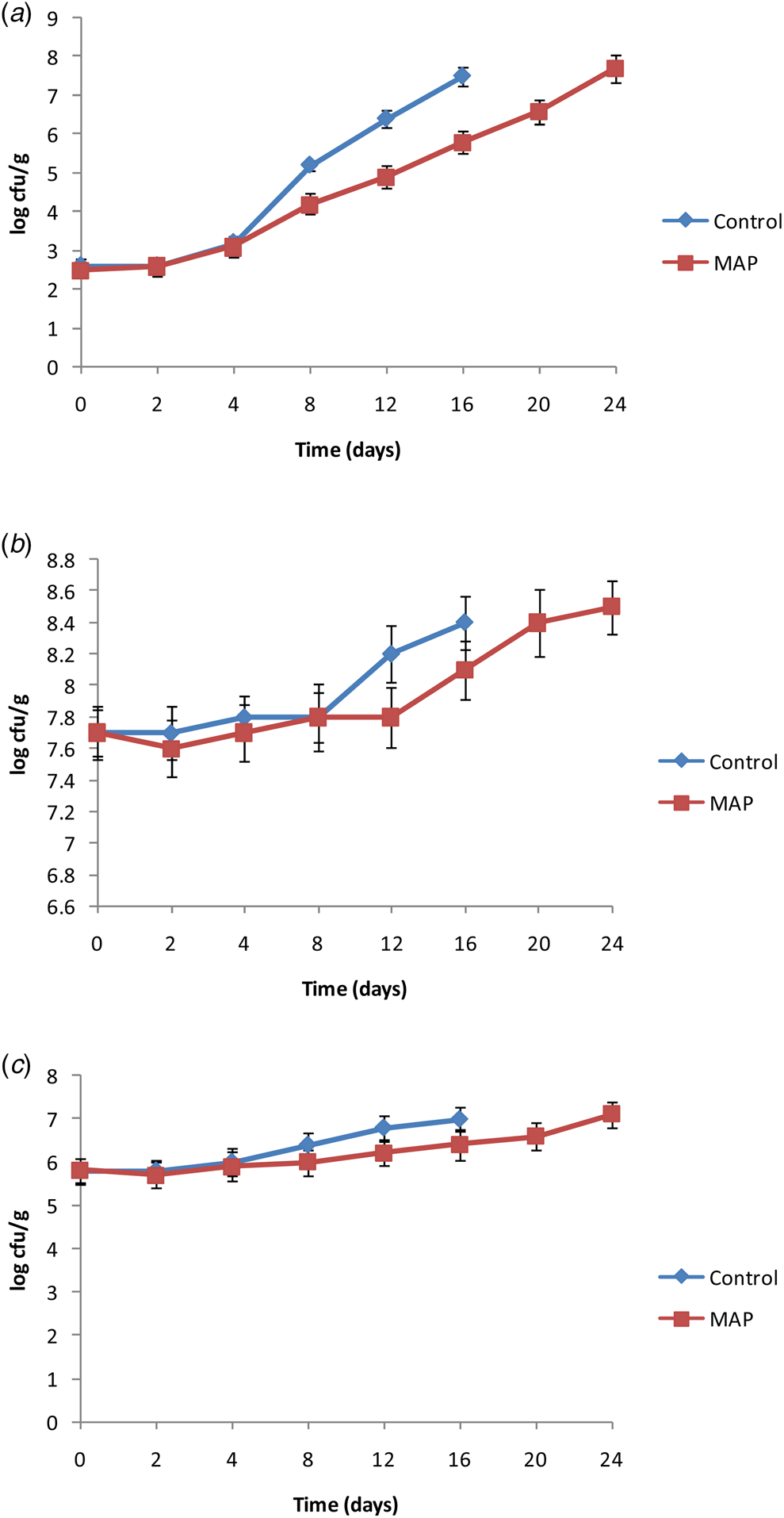
Changes in yeasts and molds, psychrotrophs and LAB of control or MAP Graviera Agraphon cheese samples during storage at 4 °C or 10 °C are shown in Figs 1 and 2, respectively. The initial counts of yeasts and molds, psychrotrophs and LAB were 2.5, 5.8 and 7.7 log cfu/g, respectively. Similar populations for yeasts and molds or LAB were also observed for a type of Graviera cheese produced in Northern Greece after the ripening time in a previous work (Mexis et al., Reference Mexis, Chouliara and Kontominas2011). Υeasts and molds, psychrotrophs and LAB of control or MAP cheese samples were significantly increased (P < 0.05) during storage at 4 °C or 10 °C. The yeasts and molds, psychrotrophs and LAB were significantly higher (P < 0.05) for control than MAP cheese samples after the 4th, 8th, and 4th days, respectively, at 10 °C storage. During storage at 4 °C, the comparison of control samples to MAP cheese samples showed that LAB were not significantly different (P > 0.05) throughout storage, but yeasts and molds or psychrotrophs were significant higher (P < 0.05) after 6th and 15th days, respectively.
Changes in yeasts and molds, LAB and psychrotrophs of control or MAP Graviera Agraphon cheese samples during storage at 4 °C (yeasts and molds = a; LAB = b; psychrotrophs = c).

Changes in yeasts and molds, LAB and psychrotrophs of control or MAP Graviera Agraphon cheese samples during storage at 10 °C (yeasts and molds = a; LAB = b; psychrotrophs = c).

LAB can grow under aerobic or anaerobic conditions in various food products. No important differences in growth of LAB were found in grated Graviera cheese (Mexis et al., Reference Mexis, Chouliara and Kontominas2011) or shredded Mozarella cheese (Eliot et al., Reference Eliot, Vuillemard and Emond1998) packed under aerobic and nitrogen atmosphere conditions during storage at 4 °C. Whitley et al. (Reference Whitley, Muir and Waites2000) reported lower counts in LAB packed under various MAP conditions as compared to control samples packed under aerobic conditions. However, Kirkin et al. (Reference Kirkin, Gunes and Kilic-Akyilmaz2013) observed a higher decrease in LAB in white cheese packed under various MAP conditions as compared to packs under aerobic conditions during storage at 4 °C for 13 weeks. In agreement to present findings, the growth of psychrotrophs was retarded in cheese products stored under high CO2 concentrations MAP conditions, such as Stracciatella cheese (Gammariello et al., Reference Gammariello, Conte, Di Giulio, Attanasio and Nobile2009), Cameros cheese (Gonzalez-Fandos et al., Reference Gonzalez-Fandos, Sanz and Olarte2000) or Mozzarella cheese (Alves et al., Reference Alves, De Luca Sarantopoulos, Van Dender and Faria1996; Eliot et al., Reference Eliot, Vuillemard and Emond1998; Alam and Goyal, Reference Alam and Goyal2011). However, other workers did not observe any inhibitory effect of CO2 against psychrotrophs in cottage cheese (Chen and Hotchkiss, Reference Chen and Hotchkiss1991). The different behaviour of growth of the psychrotrophs in the presence of CO2 may be due to the different nature of psychrotrophic microflora in the cheese products.
It is important to note that visible spots of spoilage were observed when populations of yeasts and molds reached ca 7 log cfu/g. The growth of yeasts and molds requires the presence of O2, while an atmosphere with high levels of CO2 acts against this growth (Singh et al., Reference Singh, Wani, Karim and Langowski2012). The inhibitory action of CO2 against yeasts and molds was demonstrated in previous studies for other cheese products stored under MAP conditions, such as Mozzarella cheese (Alves et al., Reference Alves, De Luca Sarantopoulos, Van Dender and Faria1996; Eliot et al., Reference Eliot, Vuillemard and Emond1998), white cheese (Kirkin et al., Reference Kirkin, Gunes and Kilic-Akyilmaz2013), or Stracciatella cheese (Gammariello et al., Reference Gammariello, Conte, Di Giulio, Attanasio and Nobile2009).
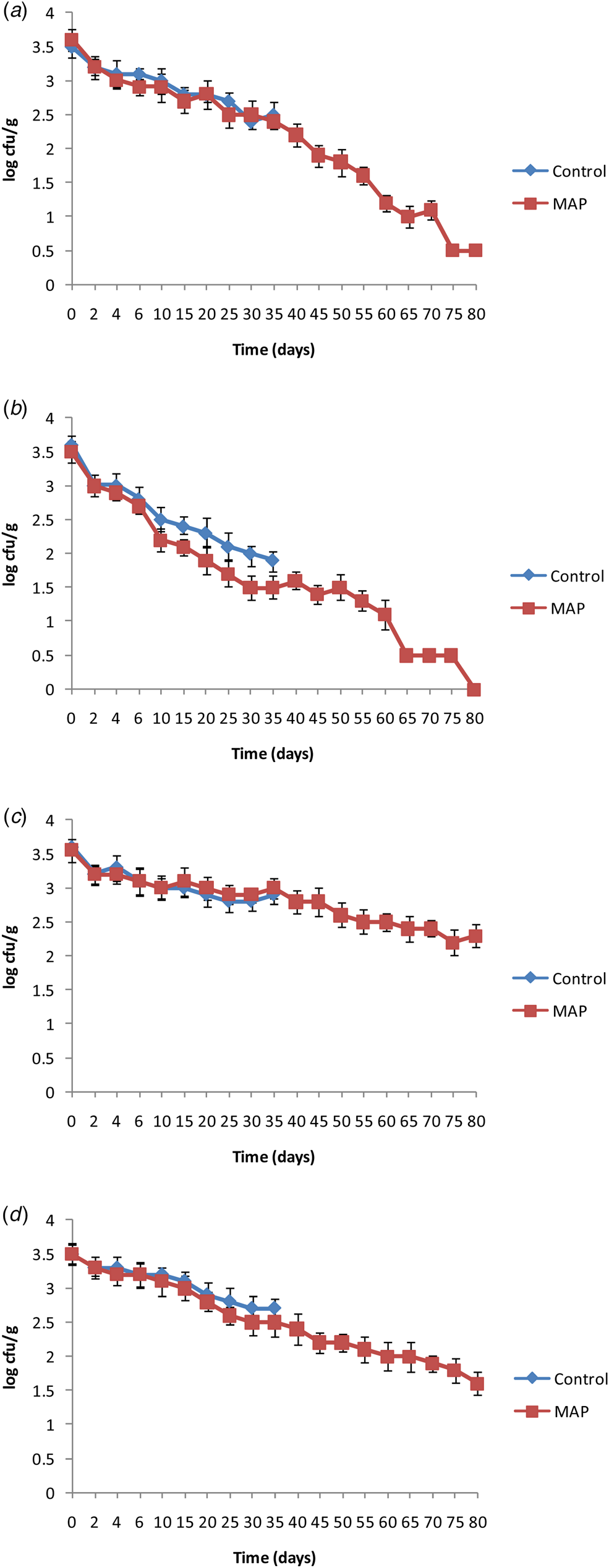
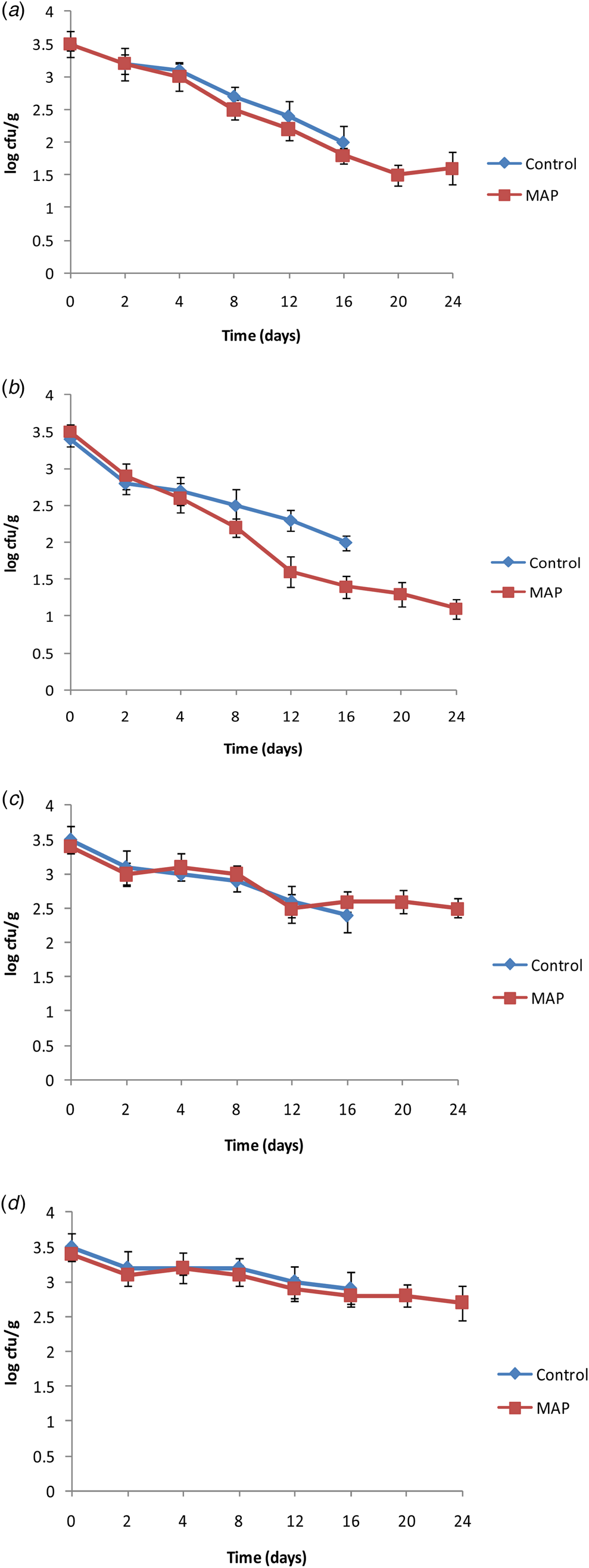
E. coli O157:H7, L. monocytogenes, S. Typhimurium and S. aureus pathogens were significantly decreased (P < 0.05) during refrigerated storage under control or MAP at 4 °C (Fig. 3) or 10 °C (Fig. 4). It is also important to note that no significant differences (P > 0.05) were observed between populations of L. monocytogenes, E. coli O157:H7 and S. Typhimurium for samples of Graviera Agraphon cheese stored under control or MAP throughout the storage at both refrigerated temperatures. In contrast, S. aureus showed populations significantly different (P < 0.05) between control and MAP after 10 and 8 d of storage at 4 and 10 °C, respectively.
Changes in E. coli O157:H7, L. monocytogenes, S. Typhimurium and S. aureus of control or MAP Graviera Agraphon cheese samples during storage at 4 °C (L. monocytogenes = a; S. aureus = b; S. Typhimurium = c; E. coli O157:H7 = d).

Changes in E. coli O157:H7, L. monocytogenes, S. Typhimurium and S. aureus of control or MAP Graviera Agraphon cheese samples during storage at 10 °C (L. monocytogenes = a; S. aureus = b; S. Typhimurium = c; E. coli O157:H7 = d).

To the best of our knowledge, there are no studies available on the fate of E. coli O157:H7, S. Typhimurium and S. aureus in cheeses stored under MAP conditions at refrigerated storage. In Cameros cheese, a fresh goat cheese with a pH of 6–6.7 and no starter culture, packed under 80%N2 – 20% CO2, 60% N2- 40% CO2, and 100% CO2, L. monocytogenes populations increased by 3.4, 3.0 and 2.5 log cfu·g−1 by the end of 28 d storage at 4 °C, respectively (Gonzalez-Fandos et al., Reference Gonzalez-Fandos, Sanz and Olarte2000). In Stilton cheese, a mold ripened cheese with a pH of 6.2–6.6, packed under 80%N2 – 10% CO2 – 10% O2, L. monocytogenes showed an initial lag of 2 weeks and a subsequent growth by 1.5 log cfu/g by the end of 6 weeks storage at 2 °C (Whitley et al., Reference Whitley, Muir and Waites2000). Giannou et al. (Reference Giannou, Kakouri, Matijasic, Rogelj and Samelis2009) studied the fate of L. monocytogenes in ripened Graviera cheese, produced in the northwest of Greece, packed under air or vacuum and stored at 4, 12 and 25 °C for 90 d. The pathogen declined faster under air packaging than vacuum packaging for all temperature treatments. By the end of storage, the initial populations of L. monocytogenes (ca 3 log cfu/g) in Graviera cheese samples reached, 1.48 and 2.43 log cfu/g under air or vacuum packaging at 4 °C, respectively, but to undetectable level regardless of packaging (air or vacuum) at 12 °C or 25 °C.
In the present study, populations of all examined foodborne pathogens showed a higher decrease (P < 0.05) at 10 °C than 4 °C storage. Enhanced inactivation of certain foodborne pathogens at higher temperatures than at refrigerated temperatures was also reported in previous studies in post-aging cheese products. A higher inactivation was reported for Salmonella spp. (Shrestha et al., Reference Shrestha, Grieder, McMahon and Nummer2011a) or L. monocytogenes (Shrestha et al., Reference Shrestha, Grieder, McMahon and Nummer2011b) in cheddar cheese at 21 °C compared to 4 °C storage, and E. coli O157:H7 in feta cheese at 12 °C compared to 4 °C storage (Govaris et al., Reference Govaris, Koidis and Papatheodorou2002). Giannou et al. (Reference Giannou, Kakouri, Matijasic, Rogelj and Samelis2009) observed a higher survival of L. monocytogenes in Graviera cheese samples at 4 °C than 12 °C and 25 °C storage, as previously noted. This phenomenon of higher inactivation of foodborne pathogens may be due to a high antagonistic activity of LAB or lower pH values in cheese products at higher temperatures (Farrokh et al., Reference Farrokh, Jordan, Auvray, Cerf, Glass, Oppegaard, Raynaud, Thevenot, Condron, De Reu, Govaris, Heggum, Heyndrickx, Hummerjohann, Lindsay, Miszczycha, Moussiegt and Verstraete2013).
According to our results, S. aureus proved more sensitive in inactivation in the MAP conditions than the atmospheric conditions in Graviera Agraphon cheese samples. The mechanism of the antimicrobial effect of CO2 may be due to the displacement of oxygen, decrease in pH, and by cellular penetration (Eklund and Jarmund, Reference Eklund and Jarmund1983). In agreement with our results, previous in-vitro studies showed that S. aureus had a higher decrease than that of other Enterobacteriaceae food borne pathogens (e.g. E. coli) in atmospheres with high CO2 content as compared to atmospheric air (Kimura et al., Reference Kimura, Yoshiyama and Fujii1999).
The Gram positive pathogens L. monocytogenes and S. aureus presented a higher decrease than that of Gram negative pathogens E. coli O157:H7 and S. Typhimurium. Sims et al. (Reference Sims, Glenister, Brocklehurst and Lund1989) found a decrease in populations of S. aureus, but an increase in populations of S. Typhimurium in cottage cheese during storage at 10 °C. The lower decrease in populations of certain Gram-negative bacteria, as compared to Gram positive bacteria may be due to the protective role of the outer membrane of Gram negative bacteria against antimicrobial compounds such as lactic acid produced by LAB in fermented milk or cheese products (Sims et al., Reference Sims, Glenister, Brocklehurst and Lund1989; Millette et al., Reference Millette, Luquet and Lacroix2007).
In conclusion, MAP (50% N2 – 50% CO2) proved efficient in retarding the growth of yeasts, molds and psychrotrophs in Graviera Agraphon cheese during refrigerated storage 4 and 10 °C as compared to atmospheric packaging conditions. E. coli O157:H7, L. monocytogenes, S. Typhimurium and S. aureus populations were decreased either in MAP or atmospheric conditions, but S. aureus decreased faster in the MAP conditions than the atmospheric conditions.
Acknowledgment
The present work was supported by Ministry of Education of Greece, General Secretariat for Research and Technology within the ‘Kouponi’ research program.