The attainment and maintenance of long-term satisfactory relationships is regarded as a significant and important life goal for overall mental and physical health (Davila & Bradbury, Reference Davila, Bradbury and L'Abate1998; Mikulincer & Shaver, Reference Mikulincer, Shaver, Mikulincer and Shaver2007). Notwithstanding, the incessantly growing divorce rate attests to the difficulty of achieving such a desired goal, with an abundance of research demonstrating the devastating impact of relationship dissolution and divorce on general wellbeing (Amato & Sobolewski, Reference Amato and Sobolewski2001; Kurdek, Reference Kurdek1991). In light of these findings, research has focused on ascertaining the causes of relationship dissolution. A particular focus has been deployed on identifying possible determinants of relationship maintenance (i.e., commitment) and couple satisfaction (Feeney, Reference Feeney2002). Attachment theory has proven to be one of the most comprehensive theories for understanding relationship formation, stability, and quality (Mikulincer & Shaver, Reference Mikulincer, Shaver, Mikulincer and Shaver2007). Nonetheless, a specified model linking romantic attachment, romantic commitment, and relationship satisfaction remains wanting prior to an enhanced understanding of these important relational processes and their interrelations. Accordingly, the present study aimed to examine a novel and systematic model investigating the mediating role of romantic commitment goals on the association between romantic attachment and couple satisfaction.
Romantic Commitment
Given its significant and diverse roles, varied definitions of romantic commitment have been developed in order to better comprehend the maintenance of love relationships. Nevertheless, romantic commitment is principally and largely conceptualised as a cognitive construct (Sternberg, Reference Sternberg1986; Beach & Tesser, Reference Beach, Tesser, Sternberg and Barnes1988). More explicitly, this is conceptualised as the intention to maintain a couple relationship in the future (Rusbult, Reference Rusbult1983; Levinger, Reference Levinger, Sternberg and Barnes1988; Stanley & Markman, Reference Stanley and Markman1992), despite its costs or benefits and possible fluctuations in positive feelings (Sternberg, Reference Sternberg1986; Rusbult & Buunk, Reference Rusbult and Buunk1993). As a result of the assorted and disparate formulisations of commitment, Strachman and Gable (Reference Strachman and Gable2006) proposed a more parsimonious definition based on Gray's motivational theory. According to Gray (Reference Gray1987, Reference Gray1990), two motivational systems underlie emotions and behaviours to regulate aversive and appetitive motives (Carver & White, Reference Carver and White1994). The aversive motivational system, referred to as the Behavioural Inhibition System (BIS), inhibits behaviours in response to a threat or to avoid unfavourable outcomes, and is associated with negative emotions such as anxiety, fear, and frustration (Gray, Reference Gray1987, Reference Gray1990). The appetitive motivational system, called the Behavioural Activation System (BAS), initiates or increases behaviours in response to signals of a reward and is linked with positive feelings, such as hope and happiness (e.g., Gray, Reference Gray1987, Reference Gray1990).
Drawing upon this theory, Strachman and Gable (Reference Strachman and Gable2006) posited two facets of commitment that are similarly oriented with two distinct motivational goals, termed ‘approach commitment’ and ‘avoidance commitment’. Approach commitment is conceptualised as the desire to continue a relationship in order to maintain the benefits inherent within this (e.g., companionship, shared activities). Alternately, avoidance commitment refers to a desire to continue a relationship in order to avoid potential losses that could occur from the relationship terminating (e.g., loneliness, financial hardships). In this way, approach commitment is regarded as a goal towards relationship stability and rewards, whereas avoidance commitment is viewed as a goal away from relationship instability and dissolution costs (Strachman & Gable, Reference Gable2006). This formulisation is contended to provide a broader understanding of romantic commitment as both incentives to persist in the relationship and restraints to leave are addressed simultaneously (Strachman & Gable, Reference Gable2006). Building on the prolific literature of motives and goals, it was believed that the incorporation of this innovative and inclusive definition of romantic commitment could help further clarify the role of commitment goals in romantic relationships. More specifically, these goals were anticipated to better inform the well-established association between couple satisfaction and romantic attachment.
Romantic Attachment
Attachment theory, originally developed by Bowlby (Reference Bowlby1969/1982, 1988), was first used to describe the enduring emotional bond uniting an infant and its primary caregiver. Based on one's idiosyncratic caregiver experiences, insecure or secure attachment strategies may develop. These strategies not only guide appraisals and expectations of others, but also continue to exert a central role in the development, maintenance, and quality of subsequent attachment relationships, including adult relationships (Bowlby, Reference Bowlby1969/1982; Hazan & Shaver, Reference Hazan and Shaver1987; Shaver, Hazan, & Bradshaw, Reference Shaver, Hazan, Bradshaw, Sternberg and Barnes1988). In adulthood, romantic partners are demonstrated to be the most significant attachment relationship formed (Bartholomew, Reference Bartholomew and Duck1993), with insecure romantic attachment most notably conceptualised in terms of anxiety over abandonment (defined as fears of abandonment and anger about separation in romantic relationships) and avoidance of intimacy (defined as a desire for limited closeness and the suppression of emotions in romantic relationships; Brennan, Clark, & Shaver, Reference Brennan, Clark, Shaver, Simpson and Rholes1998).
Insecure attachment patterns are believed to result from experiences with emotionally unavailable attachment figures in early life (Brennan, Clark, & Shaver, Reference Brennan, Clark, Shaver, Simpson and Rholes1998). Explicitly, due to sporadically available caregivers, anxiously attached individuals are more likely to develop incessant worries regarding abandonment and rejection. In an attempt to cope, hyperactivating attachment strategies prototypically develop (i.e., exaggerated and intensified proximity seeking behaviours; Mikulincer & Shaver, Reference Mikulincer, Shaver, Mikulincer and Shaver2007). In romantic relationships, hyperactivation is most often displayed by ceaselessly seeking reassurance regarding their partner's love and commitment at the expense of developing healthy autonomy and self-reliance (Mikulincer, Reference Mikulincer, Mikulincer and Goodman2006). Conversely, avoidantly attached individuals’ early experiences with non-responsive caregivers is characteristically shown to result in the view of others as unavailable. To adapt to caregiver unavailability, deactivating attachment strategies typically ensue (i.e., the minimisation of proximity seeking behaviours) (Bartholomew & Horowitz, Reference Bartholomew and Horowitz1991; Fraley & Shaver, Reference Fraley and Shaver2000). In romantic relationships, deactivation is typically displayed by high levels of self-sufficiency and autonomy, the dismissal of attachment threats and desires, and the demonstration of cold and detached behaviours in an attempt to restrain high levels of closeness (see Mikulincer, Reference Mikulincer, Mikulincer and Goodman2006).
Attachment and Couple Satisfaction
Overall, the term ‘satisfaction’ implies that a need or a desire has been fulfilled. Within attachment theory, these needs entail having a romantic partner who is available to provide a sense of security, closeness, and dependability, while simultaneously supporting autonomous activities when appropriate (Mikulincer & Shaver, Reference Mikulincer, Shaver, Mikulincer and Shaver2007). Given anxiously and avoidantly attached individuals’ idiosyncratic difficulties establishing a healthy balance between autonomy and closeness (Mikulincer, Reference Mikulincer, Mikulincer and Goodman2006), they are more likely to experience lower levels of relationship satisfaction (Mikulincer & Shaver, Reference Mikulincer, Shaver, Mikulincer and Shaver2007). Such findings correspond with a large body of research consistently yielding significant inverse associations between attachment insecurity and couple satisfaction (e.g., DiFilippo & Overholser, Reference DiFilippo and Overholser2002; Elizur & Mintzer, Reference Elizur and Mintzer2001; Rholes, Simpson, & Friedman, Reference Rholes, Simpson and Friedman2006; Ridge & Feeney, Reference Ridge and Feeney1998; Roberts & Noller, Reference Roberts, Noller, Simpson and Rholes1997; Treboux, Crowell, & Waters, Reference Treboux, Crowell and Waters2004).
As a result of this highly established link, a plethora of researchers have aimed to identify possible mediators (e.g., negative affectivity, maladaptive patterns of coping, low sensitivity to partner needs; see Mikulincer & Shaver, Reference Mikulincer, Shaver, Mikulincer and Shaver2007, for a review) that may further elucidate this understanding. Notwithstanding, there remain noteworthy and uncharted research avenues to be investigated for an improved comprehension of the mechanisms underlying the important association between romantic attachment and couple satisfaction. The present study sought to accomplish this task by exploring the novel mediational effect of commitment goals on this well-established relation.
Commitment Goals and Attachment
A large body of research has illustrated the significant and central relation between commitment and romantic attachment (Mikulincer & Shaver, Reference Mikulincer, Shaver, Mikulincer and Shaver2007). As previously alluded to, attachment security depends on one's confidence in their attachment figure's continued care and availability in times of need. In the context of couple relationships, which significantly differ from parent–child dyads in that one partner may chose to terminate the relationship at any given time, security is all the more challenging to achieve (Duemmler & Kobak, Reference Duemmler and Kobak2001). Given insecurely attached individuals’ tendency to question their partner's availability, they are more likely to encounter difficulties related to romantic commitment (Mikulincer & Shaver, Reference Mikulincer, Shaver, Mikulincer and Shaver2007). Specifically, aligned with the mechanisms of hyperactivation, anxiously attached individuals are more likely to persistently and intrusively seek out higher levels of commitment in their relationship (Mikulincer & Erev, Reference Mikulincer and Erev1991). They are correspondingly more prone to experience feelings of frustration instigated from their perception of their partner as incapable of committing as fully as they do (Hazan & Shaver, Reference Hazan and Shaver1987). Inversely, avoidantly attached individuals’ deactivating strategies are shown to result in the minimisation of the importance of their relationship (Mikulincer & Shaver, Reference Mikulincer, Shaver, Mikulincer and Shaver2007), and consequently, reports of lower desires for (and experiences of) romantic commitment (Pistole, Clark, & Tubbs, Reference Pistole, Clarke and Tubbs1995).
Studies to date have yet to examine the relation between romantic attachment and approach and avoidance commitment goals, despite both constructs ultimately aimed at understanding relationship motives. Based on previous literature, it may be postulated that due to fears of abandonment, anxiously attached individuals will tend to place a higher level of focus on prospective relationship threats and their costs, and consequently, demonstrate higher avoidance commitment goals. Contrarily, current research does not appear to support the articulation of a specified relation between attachment anxiety and approach commitment goals. That is, whereas it is conceivable that their fears of abandonment (Brennan et al., Reference Brennan, Clark, Shaver, Simpson and Rholes1998) and concurrent desires for interdependence (Mikulincer & Erev, Reference Mikulincer and Erev1991) may bias them towards perceiving more positive aspects of their relationship, it is similarly feasible that their vigilance to signs of abandonment may minimise their ability to accurately assess or even experience positive aspects, particularly those implying security. Hence, their particular experience (or recognition) of the positive features of their relationship may influence whether approach commitment goals may be present. As such, no a priori hypotheses were put forth for the abovementioned association.
Contrarily, considering avoidantly attached individuals’ tendency to use deactivating strategies, their discomfort with closeness, and minimisation of the importance of their relationship (Mikulincer & Shaver, Reference Mikulincer, Shaver, Mikulincer and Shaver2007), it is tenable that they may be more prone to minimise the positive aspects of their relationship, and consequently, demonstrate lower approach commitment goals. However, it is unclear whether this attachment orientation may influence relationship stability in the face of relationship dissolution costs (i.e., avoidance commitment). For instance, whereas avoidantly attached individuals may be unlikely to report persisting in their relationship to minimise interpersonal losses (e.g., loneliness), they may readily admit to those factors not characterised as such (e.g., financial costs). Hence, a specified relation between avoidant attachment and avoidance commitment goals similarly does not appear to be theoretically substantiated.
Commitment Goals and Couple Satisfaction
Lastly, in support of our proposed models, a plethora of research has demonstrated the well-established link between general romantic commitment and higher couple satisfaction (see Cate, Levin, & Richmond, Reference Cate, Levin and Richmond2002, for a review; Johnson, Caughlin, & Huston, Reference Johnson, Caughlin and Huston1999; Rusbult, Reference Rusbult1980). Nonetheless, despite couple satisfaction being an important factor of romantic commitment, it is not a necessary feature (Strachman, Reference Strachman2008). In this way, an individual can be satisfied and committed to their relationship, whereas another may be equally committed but dissatisfied. Strachman and Gables’ (Reference Strachman and Gable2006) motivational perspective offers an explanation for the seemingly paradoxical relation between romantic commitment and relationship satisfaction. Specifically, they showed that approach commitment goals were positively, and avoidance commitment goals negatively, associated with couple satisfaction (Frank & Brandstatter, Reference Frank and Brandstatter2002; Strachman, Reference Strachman2008). This was explained by the tendency of individuals with higher approach commitment goals to endorse positive cognitive processing, focus on positive relationship characteristics, and attribute negative events to factors external to their partner (Gable, Reference Gable2006; Strachman & Gable, Reference Gable2006). Contrarily, those with higher avoidance commitment goals are more likely to endorse negative cognitive processing, recall threatening events, and display stronger reactivity to such events (Gable, Reference Gable2006). Therefore, while both individuals with higher avoidance or approach commitment goals were more likely to persist in their relationship, lower couple satisfaction was reported by those with avoidance (relative to approach) commitment goals (Strachman, Reference Strachman2008).
Objectives and Hypotheses
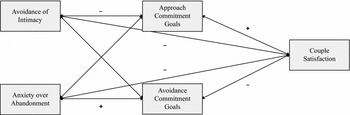
The present study aimed to fill gaps of previous research related to three important relationship domains: attachment, commitment, and couple satisfaction. Specifically, we aimed to gain an improved understanding of the interrelation between these constructs by the novel examination of approach and avoidance commitment goals as mediators of the link between insecure romantic attachment and couple satisfaction, respectively. First, as it pertains to main effects, we expected attachment anxiety and avoidance to be significantly and negatively associated with couple satisfaction. Second, we expected a significant and negative association between attachment avoidance and approach commitment goals. No a priori link was speculated between attachment avoidance and avoidance commitment goals. As it pertains to attachment anxiety, a positive association was expected with avoidance commitment goals. No a priori link was speculated between attachment anxiety and approach commitment goals. Third, we expected approach commitment goals to be significantly and positively associated with couple satisfaction, whereas a negative association was anticipated between avoidance commitment and couple satisfaction. Lastly, as it pertains to indirect effects, (1) no a priori hypotheses were stipulated for the mediation effect of avoidance commitment goals on the relation between attachment avoidance and couple satisfaction, (2) approach commitment goals were expected to partially mediate the association between attachment avoidance and couple satisfaction, (3) avoidance commitment goals were expected to partially mediate the association between attachment anxiety and couple satisfaction, and finally (4) no a priori hypotheses were stipulated for the mediation effect of approach commitment goals on the relation between attachment anxiety and couple satisfaction (see Figure 1). As previously alluded to, the aforesaid mediation models that were not explicitly outlined are due to a lack of theoretical and empirical research to support specified hypotheses or models. However, given their novelty and potential to demonstrate mediation effects, all mediation models were examined.
Hypothesised main and indirect effects between romantic attachment, commitment goals, and couple satisfaction

Method
Participants
A total sample of 301 individuals (249 women, 52 men) participated in this study. Eligibility criteria included current involvement in a romantic relationship of at least 12 months and being 17 years of age or older. The mean age of participants was 21.67 years (SD = 6.02, range 17-57), with a mean relationship length of 3.51 years (SD = 4.9). Within the sample, 32.52% were cohabitating with their romantic partner (M = 3.84 years, SD = 6.3), 8% were married (M = 10.08 years, SD = 9.99), and 7.69% had children (M = 2.57, SD = 1.43). The sample constituted primarily of Caucasians (76.51%, African = 7.23%, Asian = 7.82%, Native American = 3.01%, Other = 5.43%). The mean annual revenue of participants was $12,420 Canadian dollars (SD = 20 230).
Procedure
Participants were recruited through introductory psychology courses that allowed students to voluntarily participate in research for one course credit. Interested participants received a secure and encrypted Internet link (through Survey Monkey), which provided access to the online questionnaire package. The package comprised of an information letter outlining the voluntary nature of the study and the participants’ right to withdraw at any given time, consequence-free, as well as a resource list of available psychological services in the area. The total time required to complete the entire package was 60 minutes; with the explicit questionnaires used in the present study requiring 20 minutes.
Measures
Sociodemographic Questionnaire
This measure was used to gather information on personal (e.g., age, gender, annual income) and relationship demographics (e.g., relationship status, relationship duration).
Experiences in Close Relationships (ECR; Brennan et al., Reference Brennan, Clark, Shaver, Simpson and Rholes1998)
The ECR is a 36-item measure of romantic attachment, which is comprised of two dimensions: anxiety over abandonment (e.g., ‘I need a lot of reassurance that I am loved by my partner’) and avoidance of intimacy (e.g., ‘I try to avoid getting too close to my partner’). Each scale contains 18 items rated on a Likert scale, from 1 = strongly disagree, to 7 = strongly agree, with higher scores representing increased attachment anxiety or attachment avoidance. Alpha coefficients within the present sample were .92 and .90 for anxiety over abandonment and avoidance of intimacy, respectively, as compared to scores of .91 and .94 reported by Brennan and colleagues (Reference Brennan, Clark, Shaver, Simpson and Rholes1998). The quality of the ECR's two-factor structure has been demonstrated over the years by its excellent reliability coefficients, as well as its high construct and predictive validity among diverse populations (Alonso-Arbiol, Shaver, & Yarnoz, Reference Alonso-Arbiol, Shaver and Yarnoz2002; Lafontaine & Lussier, Reference Lafontaine and Lussier2003; Shaver & Mikulincer, Reference Shaver and Mikulincer2002).
Approach and Avoidance Commitment (AAC; Strachman, Reference Strachman2008)
The AAC is a 12-item measure of approach commitment (‘I want to continue having fun with my partner’) and avoidance commitment (‘I don't want to be single’. Each subscale contains six items rated on a 7-point Likert scale, ranging from 1 = not at all, to 7 = very much, with higher scores representing increased approach and avoidance commitment. A confirmatory factor analysis showed that both subscales were only moderately correlated and offered an adequate fit to a two-factor model. Within the current study, alpha coefficients were .91 and .92 for approach and avoidance commitment, respectively, compared to Strachman's (Reference Strachman2008) scores of .80 and .89.
Dyadic Adjustment Scale — 4 items (DAS-4; Sabourin, Valois, & Lussier, Reference Sabourin, Valois and Lussier2005)
The DAS-4 is a briefer version of the original 32-item DAS (Spanier, Reference Spanier1976), a widely used and psychometrically validated self-report measure of dyadic adjustment for individuals involved in a marital or cohabitating relationship (Bouchard, Reference Bouchard2006). The DAS-4 items include questions such as: ‘How often do you discuss or have you considered divorce, separation, or terminating your relationship?’ Varying Likert-type scales are used and items are summed to obtain a global score, with higher scores reflecting higher couple satisfaction. Sabourin and colleagues (Reference Sabourin, Valois and Lussier2005) found the DAS-4 to have adequate reliability (α = .84), good discriminant validity between distressed and non-distressed couples (.82 and .94, respectively), as well as better predictive validity of relationship dissolution over a 2-year period than the DAS-32 (Sabourin et al., Reference Sabourin, Valois and Lussier2005). The Cronbach's alpha among the current sample was adequate with a value of .71.
Results
Preliminary Analyses and Inferential Statistics
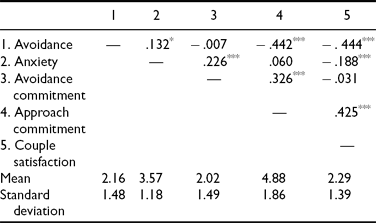
Although a total of 301 participants were recruited for the current study, three did not meet the eligibility criteria and 12 failed to complete the questionnaire package beyond a few questions. These participants were therefore excluded and analyses were conducted among the remaining 286 participants. Single imputations (using the expectation-maximisation algorithm) were used to replace missing data (less than 1% of the dataset, missing at random). Logarithmic transformations were implemented to correct for violations of normality. Bivariate correlations were computed in order to verify preliminary relations amongst variables (see Table 1).
Intercorrelations of Primary Study Variables
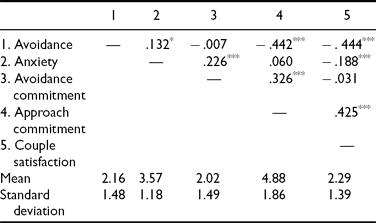
Note: * p < .05, **p < .01, ***p < .001
Main Analyses
Recent literature has suggested that bootstrapping, a non-parametric procedure for deriving an empirical sampling distribution (Efron, Reference Efron1988), is one of the most powerful methods for evaluating the indirect effect of a mediator (M) on the relation between an independent variable (IV) and a dependent variable (DV) (MacKinnon, Fairchild, & Fritz, Reference MacKinnon, Fairchild and Fritz2007; Preacher & Hayes, Reference Preacher and Hayes2004; Hayes & Preacher, Reference Hayes and Preacher2013). Furthermore, bootstrapping is now recommended over the causal step procedure proposed by Baron and Kenny (Reference Baron and Kenny1986) as it provides more accurate estimates (minimising type I error rates) and has greater power in detecting indirect effects (Preacher & Hayes, Reference Preacher and Hayes2008). Bootstrap analyses with bias corrected and accelerated (BCa) confidence intervals (CI) were conducted within SPSS (version 19.0) to evaluate the significance of the proposed mediational models (MacKinnon et al., Reference MacKinnon, Fairchild and Fritz2007). Andrew Hayes’ MEDIATE syntax for probing mediational models was used to conduct the aforementioned analyses (Hayes & Preacher, Reference Hayes and Preacher2013). Five thousand bootstrap samples were utilised, as recommended by Preacher and Hayes (Reference Preacher and Hayes2008), to create a pseudo population of direct and indirect effects. All four mediation effects of interest were examined within one mediational model by the incorporation of attachment anxiety and avoidance as independent variables, (IV1 and IV2, respectively), avoidance and approach commitment as mediators (M1 and M2, respectively), and lastly, couple satisfaction as the dependent variable (DV). All associations required for mediation, as dictated by Baron & Kenny, were explored within each of our models.
Mediation Model
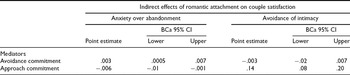
First, findings revealed that attachment anxiety and avoidance were both significantly related with couple satisfaction, t = −2.86, p < .01; t = −4.73, p < .001. Second, findings showed that higher attachment anxiety was related to higher avoidance and approach commitment goals, t = 3.99, p < .001; t = 2.26, p < .05, respectively. Conversely, while attachment avoidance was not shown to be significantly related with avoidance commitment goals, t = −.63, ns, this was demonstrated to be negatively related with approach commitment goals, t = −8.58, p < .001. Third, both avoidance and approach commitment goals were shown to be significantly and positively correlated with couple satisfaction, t = 2.10, p < .05; t = 5.90, p < .001, respectively. As it pertains to indirect effects (see Table 2), results revealed that (1) there was no significant indirect effect of avoidance commitment goals on the relation between attachment avoidance and couple satisfaction, (2) there was a significant indirect effect of approach commitment goals on the relation between attachment avoidance and couple satisfaction, (3) there was a significant indirect effect of avoidance commitment goals on the relation between attachment anxiety and couple satisfaction, and finally, (4) there was a significant indirect effect of approach commitment goals on the relation between attachment anxiety and couple satisfaction.
Indirect Effects of Anxiety over Abandonment and Avoidance of Intimacy on Couple Satisfaction Through Approach and Avoidance Commitment

Note: BCa = bias corrected and accelerated. Couple Satisfaction and Approach Commitment are reflected values.
Discussion
The present study comprised of the examination of two mediation models whereby it was proposed that (1) low approach commitment goals would mediate the negative relation between attachment avoidance and couple satisfaction, and (2) that high avoidance commitment goals would mediate the negative relation between attachment anxiety and couple satisfaction. Both mediation models were empirically supported. In general terms, our findings helped clarify the relation between insecure romantic attachment and couple satisfaction by means of underlying commitment goals. Mainly, five conclusions can be drawn from our results.
Attachment and Satisfaction
First, consistent with our hypotheses and the existing literature focused on close relationships (see Mikulincer & Shaver, Reference Mikulincer, Shaver, Mikulincer and Shaver2007), attachment anxiety and avoidance were revealed to be associated with couple satisfaction. Explicitly, our research supported the widespread and acknowledged view of higher attachment insecurity as contributing to lower reports and experiences of couple satisfaction.
Attachment and Commitment Goals
The second conclusion pertains to the novel exploration of insecure romantic attachment and its relation with commitment goals. As hypothesised, results revealed that individuals reporting higher levels of attachment anxiety (i.e., fears of abandonment) were more likely to have commitment goals focused on avoiding the negative consequences of relationship dissolution. Results may be further elucidated by Alonso-Arbiol and colleagues’ (Reference Alonso-Arbiol, Shaver and Yarnoz2002) findings, which demonstrated that higher attachment anxiety was associated with higher levels of dependency in both emotional and instrumental contexts. Thus, higher dependence in combination with fears of abandonment may partially explain anxiously attached individuals’ higher propensity to focus on the costs of terminating a romantic relationship (i.e., avoidance commitment goals). Moreover, avoidance commitment goals coupled with higher dependency may correspondingly explicate anxiously attached individuals’ incessant demands for higher commitment (Hazan & Shaver, Reference Hazan and Shaver1987; Mikulincer & Shaver, Reference Mikulincer, Shaver, Mikulincer and Shaver2007) and greater proneness to remain in unsatisfactory relationships (Davila & Bradbury, Reference Davila and Bradbury2001). Additionally, results showed that high anxiety over abandonment was related to higher approach commitment goals. It can thus be inferred that, although anxiously attached individuals tend to focus on the losses associated with their relationship potentially coming to an end, they are also cognisant of its current rewards and positive attributes. In fact, some researchers have shown that those who demonstrate elevated anxiety over abandonment tend to rate higher on idealisation measures when asked to describe their romantic partner (Feeney & Noller, Reference Feeney and Noller1990) or their couple relationship (Feeney & Noller, Reference Feeney and Noller1991). This is also consistent with the original conceptualisation of anxious attachment as a negative view of self (i.e., as unlovable and profoundly flawed) combined with a positive evaluation of others (i.e., as worthy and needed for self to function; Bartholomew & Horowitz, Reference Bartholomew and Horowitz1991).
With regard to attachment avoidance, consistent with our hypothesis, results showed a negative relation with approach commitment goals; such that the more one demonstrated attachment avoidance the less likely they were to report maintaining their relationship as a result of its inherent benefits. These results may be enlightened by research findings of Mikulincer, Shaver, and Slav (Reference Mikulincer, Shaver, Slav, Mikulincer and Goodman2006), who found that avoidant individuals not only perceive less positive behaviours from their relationship partner than do anxiously or securely attached individuals, but moreover, they report lessened levels of gratitude for these behaviours even when acknowledged. In this way, avoidantly attached individuals’ minimisation (or reduced recognition) of the positive features of their relationship may elucidate their preponderantly demonstrated thwarted desires for increased commitment. Furthermore, results showed that attachment avoidance was unrelated to avoidance commitment goals. Thus, the potential losses derived from a relationship ending do not appear to necessarily engender commitment levels among those exhibiting a discomfort with intimacy. Therefore, when compared to anxiously attached individuals, they may be less motivated to commit so as to prevent relationship dissolution costs. Overall, it can be concluded that avoidantly attached individuals are less likely to report persisting in their relationship due to its benefits, and are correspondingly less likely to be influenced by the costs of a relationship terminating when contrasted with anxiously attached individuals.
Commitment Goals and Couple Satisfaction
The third conclusion that can be derived from the present study relates to the complexity of the established relation between commitment goals and couple satisfaction. Consistent with our proposed hypothesis, our results indicated that the more one focuses on the positive aspects central to their relationship (e.g., approach commitment goals), the more likely they are to report higher couple satisfaction. Also consistent with our stipulation, results revealed that avoidance commitment goals were negatively associated with couple satisfaction. Thus, the more one chooses to commit to a romantic partner in order to avoid negative outcomes stemming from the relationship terminating (e.g., lack of partner alternatives, fears of being alone, financial dependency), the less likely they are to be content with their relationship overall. These findings replicate those obtained by Strachman (Reference Strachman2008), thus confirming the pertinence of differentiating between approach and avoidance commitment goals in predicting relationship satisfaction.
Mediating Role of Commitment Goals
The fourth conclusion that emerged from the current findings pertains to the mediating effect of commitment goals on the relation between romantic attachment and couple satisfaction. First, results did not yield any significant indirect effect to support avoidance commitment goals as a mediator of the negative relation between avoidance of intimacy and couple satisfaction. The previously mentioned lack of association between attachment avoidance and avoidance commitment goals appears to explain this non-significant mediation effect. Specifically, considering that the costs of relationship dissolution do not appear to impact, either positively or negatively, avoidantly attached individuals’ commitment goals, such goals did not elucidate lower levels couple satisfaction amongst these individuals. Second, consistent with our hypothesis, approach commitment goals were found to mediate the relation between attachment avoidance and relationship satisfaction. Explicitly, higher attachment avoidance, which was shown to be related with a decreased ability to either appreciate or acknowledge the positive aspects of one's romantic relationship, was in turn linked with lower couple satisfaction. According to Birnie, McClure, Lydon, and Holmberg (Reference Birnie, McClure, Lydon and Holmberg2009), avoidantly attached individuals often enter romantic relationships with negative partner and relational expectations that undermine their level of commitment. Given their expectation of negative events and anticipation of few positive events, avoidantly attached individuals often foresee their relationship as being prone to inevitably fail (Birnie et al., Reference Birnie, McClure, Lydon and Holmberg2009). Perhaps these scripts, combined with a limited ability to acknowledge the positive aspects of their relationship (i.e., approach commitment goals), might not only explain why avoidant individuals are more likely to be discontent with their relationship (e.g., Feeney, Reference Feeney1999), but correspondingly, their tendency to demonstrate lower levels of general romantic commitment (Pistole et al., Reference Pistole, Clarke and Tubbs1995).
Third, with regard to anxiety over abandonment, results indicated that high avoidance commitment goals mediated the negative relation with couple satisfaction. However, this significant mediation effect appears to be a spurious finding given that the positive link between the mediator variable (approach commitment) and both the independent and dependent variable (attachment anxiety and couple satisfaction, respectively) cannot logically explain, theoretically or statistically, the negative association between the independent and outcome variable. Given that main effects demonstrated within this study appear to be consistent with past research findings, it can be inferred that indiscernible results likely pertain to the indirect effect in question. Of note, the aforesaid mediation effect was not shown to be significant when models were examined separately for attachment anxiety and avoidance. Thus, the inclusion of multiple variables within one model, explicitly, the inclusion of both attachment dimensions, may lead to unexplained variance resulting in a type I error as it pertains to this statistically significant indirect effect. Further research is needed to further clarify this obscure finding. Nevertheless, results not only illustrate the complexity of the link between attachment, commitment goals, and couple satisfaction, but moreover, the need to examine models in diverse ways in order to clearly ascertain direct and indirect links.
As a final point of interest, given Rusbult's (Reference Rusbult1983) theory of commitment suggesting that satisfaction can predict commitment levels, mediational models examining satisfaction as a mediator of the link between attachment and commitment goals were similarly examined. Results demonstrated that avoidant attachment and its negative link with approach commitment goals was explained via higher couple satisfaction. No additional mediation effects were supported. Thus, results highlighted that, when involved in an unsatisfactory relationship, avoidantly attached individuals may be less likely to report persisting in their relationship due to the positive aspects inherent within this. Contrasting this model with the current study's primary model of interest highlights the reciprocity of the relation between commitment and satisfaction among avoidantly attached individuals whereby approach motives to maintain one's relationship may influence and be impacted by one's couple satisfaction. Accordingly, both models may prove to be useful in informing the link between attachment avoidance, commitment goals, and couple satisfaction depending on one's particular area of interest.
Limitations and Future Research
Although the current study provides important and innovative findings, a number of methodological limitations must be addressed. First, our correlational data limit causal inferences that can be drawn the data. Although commitment goals were postulated to lead to greater couple satisfaction, the reverse may also hold true. This was highlighted by the support of two distinct mediation effects whereby both satisfaction and commitment goals functioned as significant mediators. Prospective data incorporating longitudinal data are needed to explore the directionality of our models. A second limitation of the study pertains to the use of a relatively homogeneous sample primarily comprised of a younger university population. Future research may seek to replicate our models among heterogeneous samples (i.e., same-sex couples, older couples, a higher percentage of married couples, and individuals from varying economic and educational backgrounds) in order to increase the generalisability of results. Accordingly, the current findings can only be interpreted within the context of the particular sample used. Finally, the examination of dyadic processes (e.g., actor and partner effects) of attachment, commitment goals, couple satisfaction, and their interrelations could similarly be advantageous in furthering our understanding. For instance, a query of interest may be whether one's partner's commitment goals mediate the relation between one's romantic attachment and one's couple satisfaction. Despite some limitations, several methodological strengths that characterise our study must also be noted, including: (1) the use of individuals in a relationship of at least 12 months duration, (2) a comprehensive examination of two facets of commitment, (3) the novel examination of approach and avoidance commitment goals within an attachment perspective, and finally, (4) the exploration of innovative mediation models that permitted a more comprehensive understanding of the strongly established relation between insecure attachment and couple satisfaction by means of commitment goals.
Implications and Conclusions
In summary, a number of important empirical implications can be drawn from our results. First, the proposed mediation models offer both a parsimonious and original explanation of the relation between romantic attachment and couple satisfaction by means of Strachman's (Reference Strachman2008) commitment goals. Previous research in romantic attachment had thus far overlooked the importance of motivational commitment goals. By including the approach and avoidance commitment constructs to our models, the present study fills a considerable gap in research regarding commitment and romantic attachment and its link with couple functioning. Furthermore, the study's mediation models similarly contribute to the integration of two prolific areas of social psychology (attachment theory and motivational psychology) for further comprehending couple satisfaction.
In addition, given the ongoing motivation towards attaining both relationship stability and satisfaction, but an increasing trend towards divorce, this study may also have a myriad of important clinical implications. As an illustration, the results of the present study may serve as reinforcement to therapeutic approaches, such as Emotionally Focused Therapy (EFT; Johnson, & Greenberg, Reference Johnson and Greenberg1985), one of the most strongly validated couples’ therapy approaches (Johnson, Hunsley, Greenberg, Schindler, Reference Johnson, Hunsley, Greenberg and Schindler1999), which aims to improve couple satisfaction by means of attachment related processes. Our findings suggest that introducing changes to insecurely attached individuals’ commitment goals may be a valuable way to reduce the likelihood of dysfunctional and dissatisfying relationships. Many couple counsellors employ diverse techniques, which encourage distressed couples to positively re-evaluate their commitment to one another (Strachman, Reference Strachman2008). Our results indicate that a particular emphasis on approach commitment goals, wherein individuals are taught not only to recognise positive relationship experiences when they occur, but also to internalise such experiences and their meaning, could be beneficial in increasing couple satisfaction (Birnie et al., Reference Birnie, McClure, Lydon and Holmberg2009). This emphasis appears to be particularly pertinent for individuals exhibiting higher attachment avoidance. Moreover, our findings highlighted that although commitment is an important aspect of relationship functioning, the motives underlying commitment goals may play a more important role. Within clinical contexts, a greater focus on these commitment goals, in contrast to general commitment levels, may therefore be advised.
In conclusion, maintaining a stable and satisfying couple relationship is a challenging feat, which involves many factors. The present study was conducted with the aim of contributing to the understanding of these varying components as there remains much to be gained from determining the features of successful relationships, particularly their effective maintenance. The approach-avoidance commitment goals perspective provides a relevant and innovative angle to such issues.
Acknowledgments
This study was funded by two Social Sciences and Humanities Research Council grants (0100-410-2004, 767-2009-1783). Preliminary results were presented at the annual meeting of the Canadian Psychological Association, Canada, in June 2011. The authors would like to thank the entire Couple Research Lab team for their support in the data collection for this project, as well as Christine Levesque for her statistical knowledge and guidance.