Social stigma has been identified as one of the most important problems for people with mental illness (PWMI; World Health Organization, 2005). Social stigma towards PWMI causes them to be excluded and discriminated in areas such as housing, employment, interpersonal relationships, healthcare, and media, adding to the impairments that some of the mental illnesses themselves can cause in these areas (Corrigan & Watson, Reference Corrigan and Watson2002). In addition, stigmatizing experiences are also related to a lower life satisfaction, reduced psychological well-being, and a lower probability to seek mental healthcare (Corrigan, Reference Corrigan2004; Link, Struening, Neese-Todd, Asmussen, & Phelan, Reference Link, Struening, Neese-Todd, Asmussen and Phelan2001; Markowitz, Reference Markowitz1998). According to Ritsher, Otilingam, and Grajales (Reference Ritsher, Otilingam and Grajales2003), the subjective perception of devaluation and marginalization directly affects self-esteem and level of distress of a stigmatized individual. This subjective perception has been called internalized stigma (Bos, Pryor, Reeder, & Stutterheim, Reference Bos, Pryor, Reeder and Stutterheim2013; Livingston & Boyd, Reference Livingston and Boyd2010; Ritsher et al., Reference Ritsher, Otilingam and Grajales2003). In a recent review, Bos et al. (Reference Bos, Pryor, Reeder and Stutterheim2013) state that being aware of the existence of stigma in the community can result in self-stigma.
Perceived discrimination
Perceived discrimination has been defined as the awareness of public stereotypes and discrimination. It is not a unitary construct. Within it, we can differentiate between perceived group and individual discrimination, on one hand, and perceived subtle and blatant discrimination, on the other hand (Molero, Recio, García-Ael, Fuster, & Sanjuán, Reference Molero, Recio, García-Ael, Fuster and Sanjuán2013).
Perceived group discrimination is defined as the extent to which an individual believes his or her group is discriminated, while perceived individual discrimination is the extent to which a person believes he or she has been personally discriminated. Group discrimination shows significantly higher scores (but lower relations to well-being) than individual discrimination in groups such as ethnic and sexual minorities, and people with HIV (Molero et al., Reference Molero, Recio, García-Ael, Fuster and Sanjuán2013). The relationship between perceived group discrimination and perceived individual discrimination, on the one hand, and mental health outcomes on the other hand has not been examined before among PWMI.
Perceived subtle discrimination refers to the perception of distrust and subtle rejection, while blatant discrimination refers to open discrimination and rejection. Blatant discrimination can be identified with traditional prejudice; subtle discrimination relates to the “modern” forms of prejudice (Anderson, Reference Anderson2010). Most of the research comparing the effects of both types of discrimination has been conducted on women and racial minorities. A meta-analysis by Jones, Peddie, Gilrane, King, and Gray (Reference Jones, Peddie, Gilrane, King and Gray2013) supported the notion that subtle discrimination is at least as damaging for both psychological and physical health as blatant discrimination. Subtle discrimination has only been measured once before in PWMI, and it showed a bigger impact on well-being than blatant discrimination (Magallares et al., Reference Magallares, Perez-Garin and Molero2013).
The combination of these two dimensions gives us four different types of discrimination: blatant group discrimination, subtle group discrimination, blatant individual discrimination, and subtle individual discrimination. The effects of these four types of discrimination have never been compared before in PWMI. However, among the different forms of perceived discrimination, subtle discrimination can be expected to be more harmful for three reasons (Jones et al., Reference Jones, Peddie, Gilrane, King and Gray2013). First, because it is more difficult to identify and assess than blatant discrimination, people who face subtle discrimination are less likely to attribute negative feedback to prejudice, which protects well-being (Cihangir, Reference Cihangir2008; Operario & Fiske, Reference Operario and Fiske2001). Second, because subtle discrimination is more difficult to detect, targets may not have as many options for reporting or remedying this kind of discrimination. Third, because it is more pervasive than blatant discrimination (which is widely considered as socially unacceptable or even illegal nowadays), it might have chronic effects. Furthermore, it seems legitimate to assume that personally experienced discrimination will have a greater impact in an individual than discrimination towards his or her group (Molero et al., Reference Molero, Recio, García-Ael, Fuster and Sanjuán2013), and a recent meta-analysis (Schmitt, Branscombe, Postmes, & Garcia, Reference Schmitt, Branscombe, Postmes and Garcia2014) points that indeed individual discrimination has a stronger negative relation with well-being than group discrimination. Consistently with these findings, individual subtle discrimination has displayed the highest negative association with psychological well-being in members of different immigrant collectives and sexual minorities (Molero et al., Reference Molero, Recio, García-Ael, Fuster and Sanjuán2013). However, its relationship with well-being in PWMI has not been tested yet.
Internalized stigma
Internalized stigma refers to the endorsement of negative stereotypes about PWMI, their application to oneself, and the resulting reduction of self-worth, psychological distress, withdrawal, and secrecy (Bos et al., Reference Bos, Pryor, Reeder and Stutterheim2013; Livingston & Boyd, Reference Livingston and Boyd2010; Ritsher et al., Reference Ritsher, Otilingam and Grajales2003). Its negative effects on the well-being of PWMI are well documented. Higher scores in internalized stigma are associated with lower self-esteem and self-efficacy (Corrigan, Watson, & Barr, Reference Corrigan, Watson and Barr2006; Ritsher et al., Reference Ritsher, Otilingam and Grajales2003; Ritsher & Phelan, Reference Ritsher and Phelan2004; Yanos, Roe, Markus, & Lysaker, Reference Yanos, Roe, Markus and Lysaker2008); higher depressive and negative symptoms (Ritsher & Phelan, Reference Ritsher and Phelan2004; Yanos et al., Reference Yanos, Roe, Markus and Lysaker2008); lower hope, and more avoidant coping (Yanos et al., Reference Yanos, Roe, Markus and Lysaker2008); and lower empowerment and recovery orientation (Ritsher et al., Reference Ritsher, Otilingam and Grajales2003).
Well-being in people with mental illness
Life satisfaction
Subjective well-being is defined as ‘a person’s cognitive and affective evaluations of his or her life’ (Diener, Oishi, & Lucas, Reference Diener, Oishi, Lucas, Snyder and Lopez2002). This cognitive evaluation of one’s life is what we call life satisfaction, and it can be measured as a global judgment or as the satisfaction with specific life domains (Baker & Intagliata, Reference Baker and Intagliata1982). Furthermore, a meta-analysis by Livingston and Boyd (Reference Livingston and Boyd2010) shows that life satisfaction in PWMI is negatively associated with different measures of stigma.
Affect balance
The affective evaluation of one’s life can be measured through the levels of positive and negative moods, emotions and feelings (Diener et al., Reference Diener, Oishi, Lucas, Snyder and Lopez2002). Although positive and negative affect are two relatively independent dimensions, their scores can be summarized by affect balance, which indicates the predominance of positive moods, emotions and feelings, or vice versa (Bradburn, Reference Bradburn1969). A previous study by Magallares et al. (Reference Magallares, Perez-Garin and Molero2013) showed that affect balance was negatively associated with stigma in PWMI.
Psychological well-being
Ryff argued that asking people about their life satisfaction or affects is not enough to assess their wellness. Well-being is more than just happiness, and most people, regardless of their actual life conditions, report themselves to be happy. Therefore, she proposed a model of psychological well-being comprised by a set of features of positive psychological functioning. (Ryff & Keyes, Reference Ryff and Keyes1995).
Traditionally, the well-being measures used in stigma in PWMI have been self-esteem, self-efficacy, life satisfaction, and symptoms of anxiety and depression, all of which have been found to be significantly related to stigma (Link et al., Reference Link, Struening, Neese-Todd, Asmussen and Phelan2001; Markowitz, Reference Markowitz1998). To our knowledge, only one study about stigma in PWMI (Magallares et al., Reference Magallares, Perez-Garin and Molero2013) has used affect balance and one of the well-being subscales (self-acceptance) of Ryff’s measure. It found self-acceptance to be negatively related to stigma consciousness, and affect balance to be negatively related to both stigma consciousness and perceived discrimination (Magallares et al., Reference Magallares, Perez-Garin and Molero2013).
The present research
According to Corrigan (Corrigan & Rao, Reference Corrigan and Rao2012; Watson, Corrigan, Larson, & Sells, Reference Watson, Corrigan, Larson and Sells2007), stigma awareness does not directly harm well-being: it is the internalization of stigma that harms self-esteem and self-efficacy. In a previous study in Spanish PWMI, Muñoz, Sanz, Pérez-Santos, and Quiroga (Reference Muñoz, Sanz, Pérez-Santos and Quiroga2011) found support for a structural equation model in which internalized stigma acted as a mediator between stigma and discrimination experiences, and psychosocial functioning. Thus, their results indicate that it is not only stereotype awareness that leads to internalized stigma, but also personal discrimination experiences. Therefore, we would like to explore the relationship between all four perceived discrimination scales and internalized stigma, as group discrimination refers to beliefs about general discrimination (stigma awareness), and individual discrimination refers to personal discrimination experiences. The relationship of these four types of perceived discrimination with internalized stigma has never been tested before in PWMI.
The present study examines perceived discrimination, internalized stigma and well-being in PWMI. In particular, we investigate to what extent internalized stigma mediates the relationship between perceived discrimination and various measures of psychological and subjective well-being. In order to explore which type of discrimination is more strongly related to the internalization of stigma, we will assess the effects of the different types of perceived discrimination separately. As for the hypotheses, first, we expect perceived discrimination (especially subtle individual discrimination) to be positively related to internalized stigma.
Second, for the reasons discussed above, we expect both perceived discrimination (again, we expect subtle individual discrimination to have the highest association) and internalized stigma to be negatively associated with the psychological well-being scales, life satisfaction and affect balance.
Third, we expect internalized stigma to mediate the relationship between perceived discrimination and well-being among PWMI.
Method
Participants
The sample consisted of 213 clients from 19 different centers from the public network of social care for people with mental illness of the communities of Madrid (N = 170), Catalonia (N = 35) and the Balearic Islands (N = 8), of whom 126 were men and 85 were women (the remaining two respondents did not indicate their gender).All of our respondents were over 18 years old, their mean age being 43.04 years old (SD = 10.65). All of them were Spaniards of Spanish ethnicity, which compose the vast majority of the clients of these centers. Main diagnosis was registered by the professionals in the centers, taken from the participant’s medical history. 64.8 % were said to have “schizophrenia, schizotypal disorders or delusional disorders”, 11.7% were reported to have “mood disorders”, another 11.7% had “personality disorders”, 2.8% had “neurotic disorders”, and 1.4% were marked as having “other” disorders. There is no data about the diagnosis of the remaining 7.5% participants (both socio-demographical and clinical variables were filled out by the professionals from the different centers, based on information from the patients’ files, all of whom had been diagnosed in the public health care system).
Measures
Multidimensional Perceived Discrimination Scale (Molero et al., Reference Molero, Recio, García-Ael, Fuster and Sanjuán2013)
This scale consists of 12 items that measure, in a five-point Likert scale, the respondent’s perception of four different types of discrimination: Blatant Group Discrimination (e.g., “In Spanish society there is a strong rejection towards people with mental illness”), Subtle Group Discrimination (e.g., “People seem to accept people with mental illness, but I think sometimes there is a hidden rejection”), Blatant Individual Discrimination (e.g.,“I have felt rejected for being a person with mental illness”), and Subtle Individual Discrimination (e.g., “I feel people do not trust me for being a person with mental illness”). The original scale, which was designed to be used in a wide variety of stigmatized groups (Molero et al., Reference Molero, Recio, García-Ael, Fuster and Sanjuán2013), was comprised of 20 items. However, in order to make the scale shorter, the last five items in each of the two Blatant Discrimination subscales, concerning discrimination in employment, health, legal, social relationships and private institution areas, were replaced for a more general item about discrimination “in various social and work settings”. All the subscales showed a good consistency in the present study (Blatant Group Discrimination had an alpha of .86; Subtle Group Discrimination had an alpha of .73; Blatant Individual Discrimination had an alpha of .92, and Subtle Individual Discrimination had an alpha of .84).
Internalized Stigma of Mental Illness Scale (Ritsher et al., Reference Ritsher, Otilingam and Grajales2003)
Is a 29-item questionnaire which consists of five subscales, each assessing a different aspect of internalized stigma: Alienation, Stereotype Endorsement, Discrimination Experience, Social Withdrawal and Stigma Resistance. However, we decided to drop the Stigma Resistance subscale, as the original authors of the scale suggest, because of its low reliability coefficients and the fact that some of its items also weighted in other factors. We used Muñoz et al’s (Reference Muñoz, Sanz, Pérez-Santos and Quiroga2011) Spanish translation of the questionnaire. Respondents had to answer how much they agreed with each statement in a five-point likert scale. The scale as a whole showed a high internal consistency (α = .93).
Satisfaction with Life Domains Scale (SLDS; Baker & Intagliata, Reference Baker and Intagliata1982)
Is a 15-item questionnaire in which participants are asked about their satisfaction with 15 different areas related to their life quality: housing, neighborhood, food, clothing, health, cohabitants, friends, family relationships, relationships with others, occupation/work, free time, leisure environment, neighborhood services, economic situation, and hospital/community. In this study, we used the Spanish translation validated by Carlson et al. (Reference Carlson, Ochoa, Haro, Escartín, Ahuir, Gutierrez-Zotes and Gallo2009). Responses were given in a five-point scale. This scale had a high internal consistency in our study (α = .92).
Positive and Negative Affect Schedule (PANAS; Watson, Clark, & Tellegen, Reference Watson, Clark and Tellegen1988)
It was used to measure Affect Balance. It consists of two 10-item subscales which asses positive and negative affect in a five-point scale. To calculate affect balance we simply subtracted the negative affect score from the positive affect score. A positive score indicates the predominance of positive over negative affect. This instrument measures two internally consistent and largely uncorrelated factors: Positive Affect and Negative Affect, both of which showed a high alpha in our sample (.90 and .89, respectively). We used Sandín et al.’s Spanish translation (1999).
Ryff’s Psychological Well-Being Scales (Ryff & Keyes, Reference Ryff and Keyes1995)
Is an instrument that measures six aspects of psychological well-being (Díaz et al., Reference Díaz, Rodríguez-Carvajal, Blanco, Moreno-Jiménez, Gallardo, Valle and Van Dierendonck2006): self-acceptance (positive attitudes towards oneself), positive relations with others (ability to love and maintain stable and positive personal relationships), autonomy (ability to maintain independence and personal authority in different social contexts), environmental mastery (the ability to choose or create enabling environments to meet one’s own needs and desires), purpose in life (personal goals and objectives that give life a meaning), and personal growth (efforts to develop one’s own potential and grow as a person). In the present study we used the general scale, which other researchers have also used in the past. We used Díaz's (Reference Díaz, Rodríguez-Carvajal, Blanco, Moreno-Jiménez, Gallardo, Valle and Van Dierendonck2006) 29-item Spanish adaptation. Responses were given in a five-point likert scale. The general scale showed a high internal consistency (α = .91).
Procedure
To distribute the questionnaires, we had the collaboration of the workers from the different Intress Rehabilitation Centers. These professionals explained the purpose of the study to their clients and requested their voluntary cooperation. After volunteers had read and signed an informed consent form, professionals handed out the questionnaires, solving doubts that arose in some items. The research’s goals, instruments and procedure had been previously approved by Intress’ ethics committee.
Results
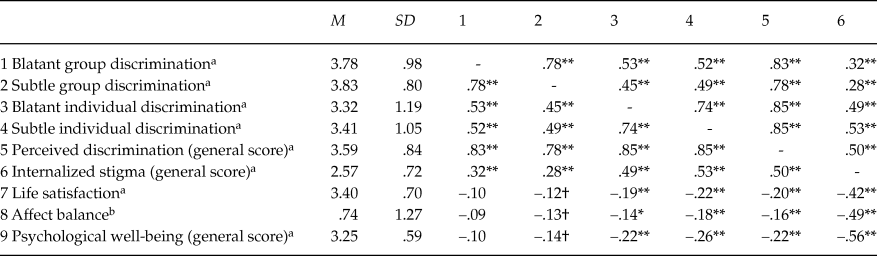
Table 1 shows the descriptive statistics and partial correlations (controlling for the effect of diagnosis and gender) for the variables we used in our analyses. It should be noted that both blatant and subtle group discrimination scores are significantly higher (p < .001) than the individual discrimination scores. The two group discrimination scores are not significantly different from each other, and neither are both individual discrimination scores. As for these variables’ correlations, as we can see, the four perceived discrimination scales are highly correlated with internalized stigma, and both forms of subtle discrimination show the highest correlations with internalized stigma (especially subtle individual discrimination). We can also see that both perceived discrimination and internalized stigma are negatively and significantly correlated with psychological well-being, life satisfaction, and affect balance, and that those correlations are higher for internalized stigma. Both individual discrimination scores have significant correlations with all three well-being variables, while the correlations are lower for group discrimination (and only significant for subtle group discrimination and psychological well-being).
Means, standard deviations and partial correlations of the main variables in this study

Note: N = 208. arated on scale of 1 to 5 with higher scores indicating greater agreement; brated on a scale of -4 to 4 with higher scores indicating predominance of positive affect over negative affect. Partial correlations controlling for the effect of gender and diagnosis.
† p < .10; *p < .05; **p < .01.
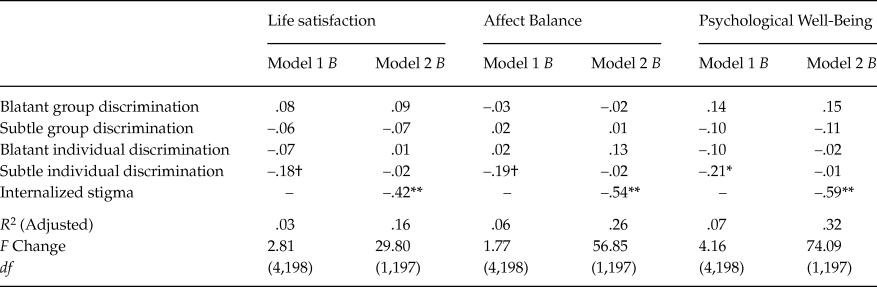
To test for the possible mediation of internalized stigma between perceived discrimination and well-being, we ran a multiple regression analysis Footnote 1 for each of our three well-being measures (psychological well-being, affect balance and life satisfaction). We used the four types of perceived discrimination as predictors in the first step, and added internalized stigma in the second. Subtle individual discrimination appears as the only form of discrimination that significantly predicts psychological well-being (see Table 2). For affect balance and life satisfaction, however, its effects are only marginally significant when controlled for the other forms of perceived discrimination. When internalized stigma is included in the model, the direct effect of subtle discrimination is reduced to non-significance for all three outcome variables.
Predictors of Subjective and Psychological Well-Being

Note: Table reports standardized regression coefficients for each variable, controlling for the effect of diagnosis. df = degrees of freedom.
† p < .10 ; *p < .05; **p < .001.
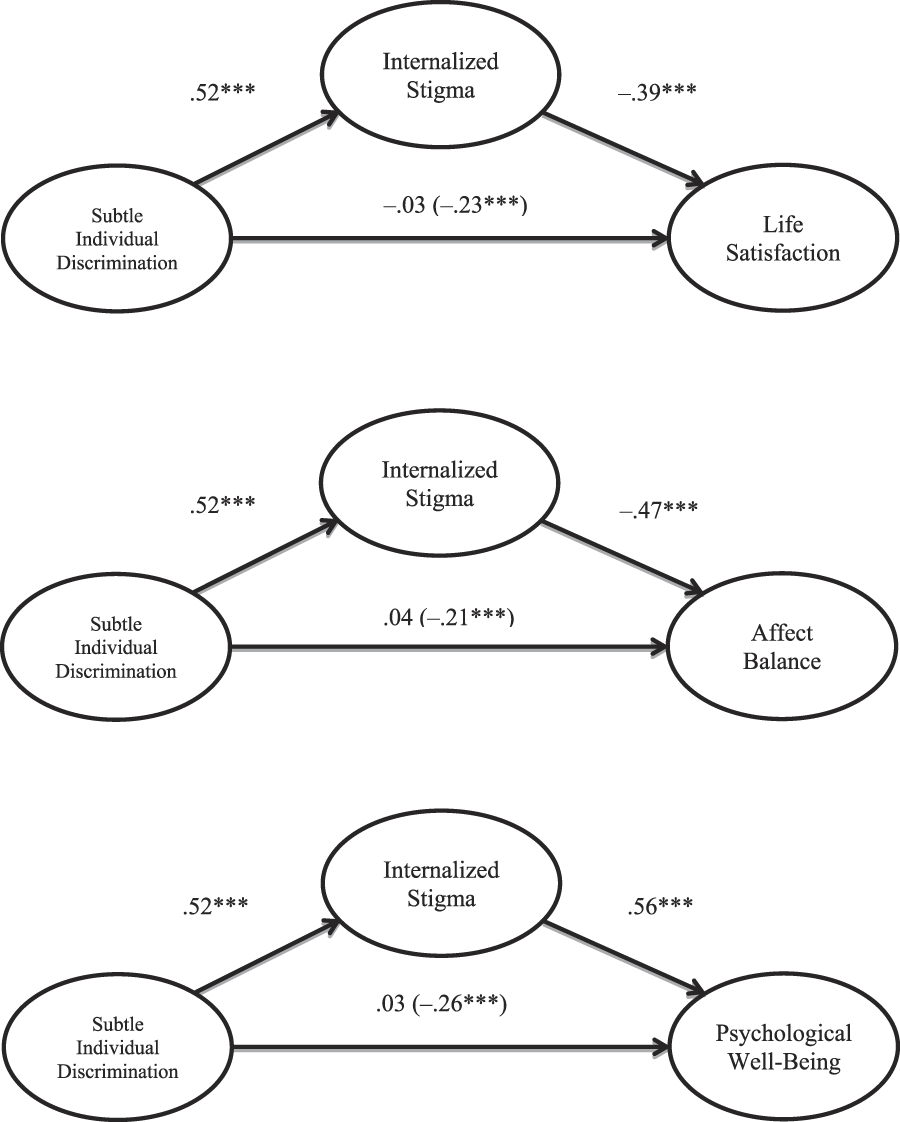
In order to confirm that internalized stigma behaved as a mediator between individual discrimination and the three measures of well-being, we ran mediation analyses. Subtle individual discrimination was the only type of discrimination which was a significant predictor in our regression analyses. Therefore, we only report mediation analyses with subtle individual discrimination as a predictor variable Footnote 2 . As we can see in Figure 1, the results of the analyses are consistent with full mediation for all three variables, as the total effect (c path) is significant for all of them and the direct effect (c’) is not significant for any of them.
Mediation models for Psychological Well-Being, Affect Balance and Life Satisfaction (tested on the basis of Preacher and Hayes, Reference Preacher and Hayes2008). Standardized regression coefficients. Total effect (c path) in parentheses.
**p < .01 ; ***p < .001.

Discussion
The present study examined the relations between perceived discrimination, internalized stigma, psychological well-being, affect balance, and life satisfaction. Based on previous research and theory (Corrigan & Rao, Reference Corrigan and Rao2012; Livingston & Boyd, Reference Livingston and Boyd2010; Magallares et al., Reference Magallares, Perez-Garin and Molero2013; Muñoz et al., Reference Muñoz, Sanz, Pérez-Santos and Quiroga2011; Ritsher et al., Reference Ritsher, Otilingam and Grajales2003), we expected perceived discrimination and internalized stigma to be signicantly related to each other and our three well-being measures, and internalized stigma to explain the associations between perceived discrimination and well-being.
Our first hypothesis was that perceived discrimination would be positively related to internalized stigma, and that the individual subtle discrimination score would have the strongest relation. In line with our hypothesis, perceived discrimination and internalized stigma were indeed positively and significantly correlated. In fact, even though all types of perceived discrimination are significantly correlated with internalized stigma, individual discrimination shows the strongest correlations, especially subtle individual discrimination, as we predicted. This suggests that subtle individual discrimination might play the most important role in the internalization of stigma. This is consistent with Cihangir’s (Reference Cihangir2008) finding that, in an experimental setting, women in the subtle discrimination condition experienced more self-directed negative emotions and less other-directed negative emotions than their peers in the blatant discrimination condition. As Operario and Fiske (Reference Operario and Fiske2001) stated, when faced with ambiguous rejection experiences, attributing negative interactions to prejudice can help members of minorities avoid the debilitating effect of internalizing rejection and discrimination. Together with these previous findings, our results suggest that when discrimination is subtle it is harder for people who suffer it to attribute negative interaction or outcomes to social stigma, and thus they are more likely to internalize stigma.
Our second hypothesis was that perceived discrimination and internalized stigma would be significantly associated with psychological well-being, life satisfaction, and affect balance. We also expected subtle individual discrimination to be the type of discrimination with the strongest relation to well-being. Our second hypothesis was partially supported by the data, as only both forms of individual discrimination were significantly associated with all three well-being measures. As we predicted, subtle individual discrimination had the strongest relation with all of them. Although this finding is consistent with previous literature (Molero et al, Reference Molero, Recio, García-Ael, Fuster and Sanjuán2013; Schmitt et al., Reference Schmitt, Branscombe, Postmes and Garcia2014), it had never been tested before in PWMI. Internalized stigma is also significantly associated with all the well-being variables. In fact, it has a stronger association with well-being than any of the perceived discrimination scales or the general score for perceived discrimination, which is consistent with the idea that internalized stigma might have a more direct effect on well-being than perceived discrimination (Corrigan & Rao, Reference Corrigan and Rao2012; Rithser et al., Reference Ritsher, Otilingam and Grajales2003).
Based on Corrigan and Ritsher’s idea (Corrigan & Rao, Reference Corrigan and Rao2012; Rithser et al., Reference Ritsher, Otilingam and Grajales2003) that discrimination does not harm well-being directly, but through internalization, our third hypothesis predicted that the magnitude of the associations between perceived discrimination and the three measures of well-being would be reduced to non-significance when the scores for the internalized stigma were included in the regression model. We found support for this hypothesis, even though when we performed our regression analyses including all the types of perceived discrimination, the only one which significantly predicted psychological well-being was subtle individual discrimination, and it only had a marginally significant effect on life satisfaction and affect balance. Internalized stigma, however, did significantly predict all three, and its inclusion in the model made the effects of subtle individual discrimination become non-significant. Moreover, while the regression models with all four perceived discrimination measures significantly predict well-being Footnote 3 , they only explain a very small fraction of the variance. The inclusion of internalized stigma makes the proportion of explained variance increase substantially. Mediation analyses confirm that our results are consistent with full mediation for the three outcome variables, as subtle individual discrimination has a significantly negative total effect on all of them, but a non-significant direct effect.
Together, these findings suggest that subtle discrimination plays an important role in the internalization of stigma, and that internalized stigma has an important negative effect on well-being (especially on psychological well-being). This is consistent with previous literature about stigma in PWMI. Muñoz et al. (Reference Muñoz, Sanz, Pérez-Santos and Quiroga2011) found support for a structural equation model in which internalized stigma acted as a mediator between stigma and discrimination experiences, as predictor variables, and psychosocial functioning, as an outcome, while Watson et al. (Reference Watson, Corrigan, Larson and Sells2007) found support for the mediating effect of self-concurrence between group identification and perceived legitimacy of discrimination, as predictors, and self-efficacy, as an outcome. However, this is the first time that internalized stigma is tested as a mediator between perceived discrimination and well-being. Furthermore, the finding that subtle individual discrimination seems to have the greatest effect on the internalization of stigma is completely new.
The present study has several strengths: In the first place, this study explores for the first time the possible mediating role of internalized stigma between perceived discrimination and well-being outcomes. Second, it assesses how the perception of different kinds of discrimination (blatant group discrimination, subtle group discrimination, blatant individual discrimination and subtle individual discrimination) relates to the internalization of stigma. The relation of these four different types of perceived discrimination with internalized stigma had never been studied before in PWMI. Finally, this study addresses the effects of social stigma from a positive psychology perspective, focusing not on the impact of perceived discrimination and internalized stigma on negative mental health outcomes such as depression or anxiety symptoms (Lysaker, Yanos, Outcalt, & Roe, Reference Lysaker, Yanos, Outcalt and Roe2010), or behavioral outcomes such as psychosocial functioning or treatment adherence (Livingston & Boyd, Reference Livingston and Boyd2010), but on life satisfaction, affect balance, and psychological well-being.
Limitations of our study also need to be considered. First, because our data are cross-sectional, causality cannot be determined. There are theoretical reasons in previous literature to think that it is perceived discrimination that causes internalized stigma, and not the other way around (Corrigan & Rao, Reference Corrigan and Rao2012). Furthermore, a recent study showed that perceptions of public stigma predicted self-stigma over a three-month span in a sample of college students, although both measures only assessed stigma related to seeking and receiving psychological help (Vogel, Bitman, Hammer, & Wade, Reference Vogel, Bitman, Hammer and Wade2013). The role of internalized stigma as a predictor of well-being variables is also supported by previous research (Ritsher & Phelan, Reference Ritsher and Phelan2004). Therefore, the pathway we propose in the present paper is supported by previous research. However, to be able to establish causal relationships with certainty, longitudinal studies with PWMI should be conducted. The relationship between discrimination and internalized stigma could also be tested experimentally, manipulating the type of discrimination participants are exposed to, in a similar fashion to what Cihangir did (2008), and measuring internalized stigma.
Second, we only use self-report measures of internalized stigma. Rüsch found that implicit internalized stigma is a measurable construct which independently predicts quality of life (Rüsch, Corrigan, Todd, & Bodenhausen, Reference Rüsch, Corrigan, Todd and Bodenhausen2010). It would be relevant to test the relationship of implicit internalized stigma with perceived discrimination, and its effect on other well-being outcomes.
Third, previous research on PWMI suggests that disclosure can be a protective factor against the negative effects of internalized stigma on quality of life and well-being (Corrigan, Kosyluk, & Rüsch, Reference Corrigan, Kosyluk and Rüsch2013). Future research should assess the role of disclosure in the mediation we propose in this paper.
The finding that subtle individual discrimination seems to have the greatest impact on internalized stigma and well-being, points at the need to make subtle discrimination and its deleterious effects visible. Intervention programs to make this kind of discrimination visible for PWMI, professionals and members of the general population, are needed in order to be able to fight it. In a recent review, Corrigan et al. (Reference Corrigan, Kosyluk and Rüsch2013) distinguished three different strategies to reduce public stigma: protest strategies, which point at the injustice of stigma; educational approaches, which try to change stereotypical thoughts by providing factual information about mental illness, and contact strategies, which use interpersonal contact with PWMI as a way to change targets’ attitudes. These three approaches can be used in media-based interventions or in vivo interventions. The latter type of intervention has proved to be more effective for all three strategies (Corrigan & Kosyluk, Reference Corrigan and Kosyluk2013). Moreover, research shows that the most effective in vivo interventions are those targeted at a specific population (e.g. landlords and employers), developed to meet local needs, and in which the contact is credible and continuous (Corrigan & Kosyluk, Reference Corrigan and Kosyluk2013). As it is public stigma that causes self-stigma (that is, both perceived discrimination and internalized stigma), reducing the former will also have the effect of reducing the latter. Therefore, we think that developing intervention programs aimed at reducing subtle discrimination that adhere to these principles is in PWMI’s best interest.
Finally, our results suggest that perceived discrimination affects well-being through internalized stigma. Needless to say, the roots of the problem of stigma towards PWMI are external to them. However, we think that interventions aimed at reducing internalized stigma will undoubtedly also have a positive effect on PWMI’s well-being. A recent review identified two approaches for reducing internalized stigma: interventions aimed at changing stigmatizing beliefs and attitudes about mental illness, and interventions that do not challenge stereotypes but rather improve stigma-coping skills by enhancing self-esteem, empowerment, and help-seeking behavior (Mittal, Sullivan, Chekuri, Allee, & Corrigan, Reference Mittal, Sullivan, Chekuri, Allee and Corrigan2012). Even though tackling stigmatizing beliefs might seem a more direct and logical way to reduce internalized stigma, an important number of stigma experts seem to favor the coping training approach (Mittal et al., Reference Mittal, Sullivan, Chekuri, Allee and Corrigan2012). Future research should explore if such reduction has, in turn, a positive effect on well-being, as our results suggest.