Introduction
It is a well-replicated finding that individuals affected by eating disorders (EDs) have low self-esteem and negative self-evaluation (SE) (e.g. Bruch, Reference Bruch1962; Jacobi, Reference Jacobi2000). Whereas most people base their SE on their perceived achievements in several life domains, such as the quality of their relationships, work, parenting and physical ability (e.g. Shavelson et al. Reference Shavelson, Hubner and Stanton1976), clinical observations suggest that ED individuals judge their SE more vigorously in terms of their body shape/weight and eating and their ability to control these. This dysfunctional system for evaluating self-worth plays a central role in several theories of EDs (Vitousek & Hollon, Reference Vitousek and Hollon1990; Pike et al. Reference Pike, Loeb, Vitousek and Thompson1996; Fairburn et al. Reference Fairburn, Cooper and Shafran2003). The importance of a link between shape/weight and SE for the core psychopathology of ED has been recognized in DSM-IV (APA, 2000), where the presence of an ‘undue influence of shape and weight on self-evaluation’ is required for a diagnosis of anorexia nervosa (AN) and bulimia nervosa (BN).
Given the central role of the link between shape/weight/eating concepts (termed shape/weight in the following) on the one hand, and SE on the other, for current ED theory and nosology, it is surprising that only a few studies have investigated their link directly. One set of studies assessed these constructs by means of self-report questionnaires and semi-structured interviews and demonstrated positive correlations between shape/weight concerns and SE (e.g. Garfinkel et al. Reference Garfinkel, Goldbloom, Davis, Olmsted, Garner and Halmi1992; Geller et al. Reference Geller, Johnston, Madson, Goldner, Remick and Birmingham1998; Goldfein et al. Reference Goldfein, Walsh and Midlarsky2000; Wilksch & Wade, Reference Wilksch and Wade2004). Also based on self-report, but possibly more experimentally controlled, Cooper et al. (Reference Cooper, Clark and Fairburn1993) elicited thoughts about eating, weight and shape in BN patients and found that this increased the frequency of negative self-statements.
However, research relying solely on self-report has several well-known general limitations such as susceptibility to response biases, which include self-presentation and social desirability (e.g. Paulhus, Reference Paulhus1984). More specifically, SE and its constituents might not be represented verbally in all respects and might therefore be subject to introspective limits (Nisbett & Wilson, Reference Nisbett and Wilson1977; Meijboom et al. Reference Meijboom, Jansen, Kampman and Schouten1999). To circumvent the limitations of self-report and to tap into more implicit aspects of the association between shape/weight and SE, research has turned to experimental measuresFootnote 1Footnote †. Meijboom et al. (Reference Meijboom, Jansen, Kampman and Schouten1999) studied individuals at high or low risk for ED (restrained and unrestrained eaters) in an affective priming (AP)/lexical decision task. In this task, participants had to identify letter strings or shape/weight words as either words or non-words in a subliminal and a supraliminal condition (30-ms and 3-s word duration respectively) after half of each group had been primed with low SE sentences (e.g. ‘I am a complete failure’). Only in the subliminal condition did primed high restrained eaters recognize more shape/weight words than their unprimed high restrained counterparts. Primes did not affect word recognition of unrestrained eaters. Thus, in restrained eaters, shape/weight was linked to SE on an implicit level. Along similar lines, we have recently tested whether a manipulation of body dissatisfaction (by means of mirror exposure) differentially affected explicit self-esteem (measured by self-report questionnaires) and implicit self-esteem (measured with the implicit association test) in restrained versus unrestrained eaters (Hoffmeister et al. Reference Hoffmeister, Teige-Mocigemba, Blechert, Klauer and Tuschen-Caffier2010). Although explicit self-esteem showed no changes from pre- to post-manipulation, implicit self-esteem decreased in the restrained group but increased in the unrestrained group. Other research has found remarkable discrepancies between implicit and explicit self-esteem in BN patients, the former being higher and the latter lower compared to healthy controls (Cockerham et al. Reference Cockerham, Stopa, Bell and Gregg2009; Hoffmeister et al. Reference Hoffmeister, Teige-Mocigemba, Blechert, Klauer and Tuschen-Caffier2010).
Taken together, these studies suggest that associative links between SE and shape/weight do exist, and that implicit aspects of this association might differ from the more explicit relationships that have been established with questionnaires and interviews. However, a study of both implicit and explicit aspects of shape/weight–SE associations in ED patients is currently missing. In addition, most previous studies implemented SE or self-esteem at a global level and did not distinguish between the several subcomponents that exist for self-esteem (see Marsh & O'Mara, Reference Marsh and O'Mara2008, for review). Several models of self-esteem distinguish at least an academic/professional/school ability domain (termed ‘performance’ domain in the following) from a social/interpersonal domain (termed ‘interpersonal’ domain in the following), and a physical attractiveness/appearance domain (e.g. Shavelson et al. Reference Shavelson, Hubner and Stanton1976; Fleming & Courtney, Reference Fleming and Courtney1984; Heatherton & Polivy, Reference Heatherton and Polivy1991). Assuming that SE comprises similar components, the question is, which of these might be associated with shape/weight in ED patients?
Most previous studies on the undue influence of shape/weight on general SE probably implicitly tapped the appearance domain of SE and did not probe other specific SE domains. However, performance-related and interpersonal life domains, two areas less directly linked to shape/weight, could also be affected by ED patients' shape/weight-based self-evaluations. One study by McFarlane et al. (Reference McFarlane, McCabe, Jarry, Olmsted and Polivy2001) suggests that this is the case. ED patients reported that not only their appearance-based SE but also their social- and performance-based SE depended on body weight. Clinical observations indeed suggest that some ED patients regulate any threat to their SE (i.e. interpersonal or work-related stressors) by enhancing investment in shape/weight without always being fully aware that their problem (interpersonal, work) and their problem-solving strategy (e.g. fasting) are in fact unrelated.
The present investigation asked the following questions. Are the non-appearance-related SE domains performance and interpersonal SE related to shape/weight? If yes, how do different groups on the ED spectrum (Study 1: AN, BN patients; Study 2: restrained eaters) differ from controls in the strength of these associations? Do those associations lie on an implicit or an explicit level? To investigate these questions we developed an AP paradigm in which shape/weight-related prime sentences preceded SE-related target adjectives. Targets tapped into the SE domains performance or interpersonal. For example, a weight-related prime sentence such as ‘When I lose weight, I feel…’, typically appraised positively by ED individuals, could be completed with either a positive (affectively congruent) or a negative (affectively incongruent) target word, with targets drawn from either the performance (e.g. ‘competent’, ‘incompetent’) or the interpersonal (‘popular’, ‘unpopular’) domain. Participants had to classify targets as being either positive or negative as quickly and accurately as possible. Affective processing was expected to increase reaction times (RTs) in affectively incongruent compared to affectively congruent prime–target pairs. In addition, in line with a multi-method approach, we measured the N400, a negative-going event-related potential (ERP) that is increased if a sentence (prime) is completed by a semantically unexpected or affectively incongruent target word (Schirmer et al. Reference Schirmer, Kotz and Friederici2002; Bostanov & Kotchoubey, Reference Bostanov and Kotchoubey2004; Zhang et al. Reference Zhang, Lawson, Guo and Jiang2006). The N400, typically preceding any overt RTs, provides an ongoing measure of sentence processing and, thus, an insight into early stages of sentence comprehension. To complement these implicit measures, explicit ratings of disagreement with the prime–target sentences and psychometric measures of self-esteem and shape/weight were assessed.
Based on the evidence reviewed above, we expected stronger AP effects (meaning stronger associations of shape/weight and SE) for both SE domains in ED patients (Study 1) and restrained eaters (Study 2) compared to their respective control groups on all dependent measures (RTs, N400, ratings).
Study 1: Method
Participants
The study sample consisted of 20 women diagnosed with AN, 20 with BN and 28 healthy controls (HCs)Footnote 2. Participants took part in the study in exchange for a remuneration of €50 and were recruited from the community through newspaper announcements, the department's website, and from collaborating clinics. All participants were native German speakers. Exclusion criteria for all participants were schizophrenia spectrum disorders, bipolar disorder, substance abuse or dependence, or neurological disorders. Exclusion criteria for HC participants included a lifetime diagnosis of any mental disorder according to DSM-IV. ED participants fulfilled DSM-IV diagnostic criteria of either AN or BN as assessed by the Eating Disorder Examination (EDE; Cooper & Fairburn, Reference Cooper and Fairburn1987; German version: Hilbert et al. Reference Hilbert, Tuschen-Caffier and Ohms2004). SCID-I was used for all other psychiatric diagnoses (First et al. Reference First, Spitzer, Gibbon and Williams1995; Wittchen et al. Reference Wittchen, Zaudig and Fydrich1997). Borderline personality disorder was assessed with SCID-II. The following co-morbid disorders were found in the AN/BN groups: major depression (8/3), dysthymia (2/1), borderline personality disorder (5/2), post-traumatic stress disorder (4/1), specific phobia (2/0), and social phobia (2/0). Four AN patients and one BN patient were taking selective serotonin reuptake inhibitors. Eight BN patients reported a history of AN.
Psychometric measures
ED psychopathology and depressive symptoms were assessed with the EDE Questionnaire (EDE-Q; Fairburn & Beglin, Reference Fairburn and Beglin1994; Hilbert et al. Reference Hilbert, Tuschen-Caffier, Karwautz, Niederhofer and Munsch2007) and the Beck Depression Inventory (BDI; Beck & Beamesderfer, Reference Beck and Beamesderfer1974; Hautzinger et al. Reference Hautzinger, Bailer, Worall and Keller1994). The Rosenberg Self-Esteem Scale (RSE; Rosenberg, Reference Rosenberg1979; Ferring & Filipp, Reference Ferring and Filipp1996) was administered to assess general self-esteem. In addition, participants completed the 32 items of the Multidimensional Self-Esteem Scale (MSES; Fleming & Courtney, Reference Fleming and Courtney1984; Schütz & Sellin, Reference Schütz and Sellin2006) containing the subscales self-regard, social confidence (split up into two scales in the German version: social contact and dealing with criticism), school abilities, physical appearance, and physical abilities. Both SE instruments have good psychometric properties (Blaskovich & Tomaka, Reference Blaskovich, Tomaka, Robinson, Shaver and Wrightsman1991; Schütz & Sellin, Reference Schütz and Sellin2006).
Materials and procedure
After a telephone screening, eligible participants were invited for diagnostic interviews. After this session, participants attended two experimental sessions, approximately 1 week apart. After welcoming participants to session 2, the experimenter familiarized participants with the electroencephalography (EEG) laboratory and the upcoming procedures, fitted the electrode cap, and guided participants to the dimly lit, electrically shielded, sound-proof 2.5 m×3 m cabin where participants sat quietly for a 4-min adaptation time.
Prime sentences were constructed to elicit body shape and weight concerns in addition to typical eating concerns of ED patientsFootnote 3. The following sentences were used as positive primes: ‘When I lose weight I feel…’, ‘When I eat nothing, I feel…’, ‘When I weigh less, I feel…’, ‘When I continue to diet, I feel…’. By analogy, negative primes conveyed the reverse meaning: ‘When I gain weight, I feel…’, etc. Targets were drawn from interpersonal and performance-related areas in both positive and negative valence. Negative performance items were ‘incompetent’, ‘incapable’ and ‘weak’; positive performance items were ‘competent’, ‘capable’ and ‘strong’. Positive interpersonal items were ‘popular’, ‘liked’ and ‘accepted’; negative interpersonal items were ‘unpopular’, ‘disliked’ and ‘rejected’. A program written in Presentation (Neurobehavioral Systems, Inc., USA) fully crossed the eight primes [four positive (+), four negative (−)] with the six interpersonal (3+, 3−) and the six performance targets (3+, 3−) to form 96 (8 primes×12 targets) individual sentences. Thus, half of these sentences were affectively congruent (++, −−) and half were affectively incongruent (+−, −+). For example, a congruent sentence would read ‘When I eat nothing, I feel…competent’; an incongruent sentence would read ‘When I gain weight, I feel…accepted’. Each sentence was shown twice, resulting in 192 trials that were presented in individually randomized order, with an intertrial interval varying between 600 and 900 ms. Each prime sentence was presented centrally on the screen for 2 s before the target adjective appeared below it. The whole sentence remained on the screen until a response was indicated or for a maximum of 4 s. Participants were instructed to judge the valence of the target by pressing one button on the keyboard for positive targets and another button for negative targets (valence-to-response assignments were counterbalanced across participants). The experimenter highlighted that the target was to be evaluated in the context of the prime sentence but that the response should only refer to target valence and not to affective (in)congruence of the whole sentence.
After completion of the 192 experimental trials (approximately 12 min), participants completed a ‘disagreement questionnaire’ by rating their disagreement with each prime–target sentence used in the AP procedure on a seven-point scale (1 ‘correct for me’; 7 ‘not correct for me’).
EEG recording
EEGs were digitally recorded with SynAmps amplifiers, Scan 4.0 software (NeuroScan, Inc., USA) and Ag/AgCl electrodes, using an extended 10–20-System electrode cap (EasyCap, Falk Minow Services, Germany) from Fz, Cz and F3/F4, F7/F8, FC5/FC6, FT7/FT8, T7/T8, C3/C4, CP1/CP2, CP5/CP6, TP9/TP10, P3/P4, P7/P8, O1/O2. The ground electrode was positioned on the midline at AFz; Pz was used as an online reference. The vertical electro-oculogram (VEOG) was recorded from above and below the right and left eyes, and the horizontal electro-oculogram (HEOG) was recorded from the outer canthi of each eye. The sampling rate was 500 Hz. Data were online band-pass filtered (0.1 to 100 Hz). Electrode impedance was kept below 5 kΩ (10 kΩ for VEOG and HEOG).
Offline analyses were performed for correct trials (correct classification of target valence) using AVG-QFootnote 4 (Feige, Reference Feige1999). Each trial was corrected for vertical EOG artifacts using the algorithm of Gratton et al. (1983), re-referenced to a common average (Deveney & Pizzagalli, Reference Deveney and Pizzagalli2008), and low-pass filtered at 20 Hz. Trials were rejected if excessive physiological artifact remained (i.e. base-to-peak amplitude exceeded 150 μV on any channel). The number of valid trials was high (96.5%) and did not differ between conditions or groups (F's <1.00). ERPs were constructed by separately averaging baseline-subtracted (200 ms) epochs for each prime–target combination (++, +−, −+, −−), SE domain (interpersonal, performance), electrode and participant.
Statistical analysis
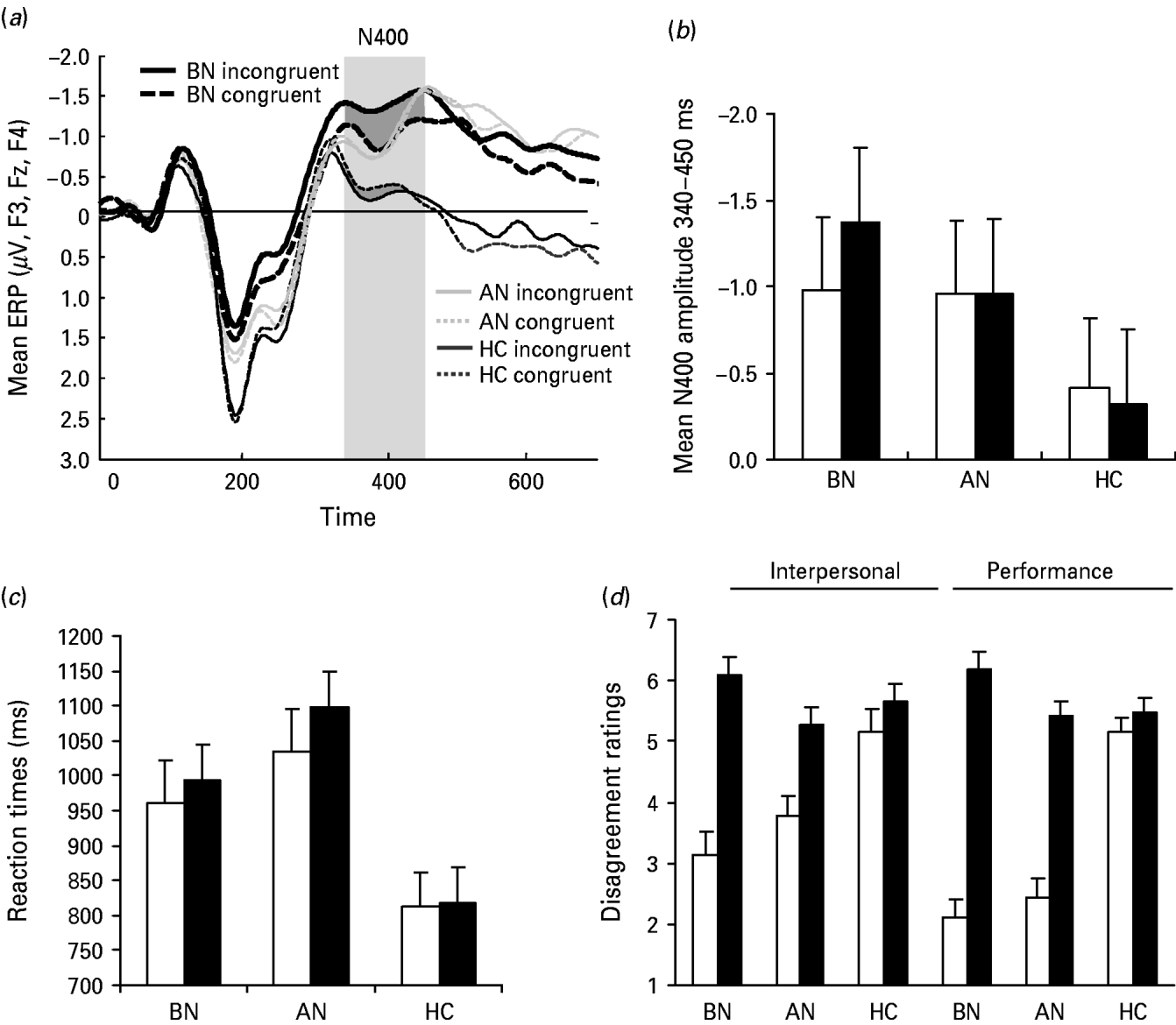
Initial ERP analyses were conducted by visual inspection and repeated-measures ANOVAs. The grand average N400 was maximal over frontal sites (F3, Fz, F4)Footnote 5, which is in line with research describing a fronto-central location of the N400 (e.g. Deveney & Pizzagalli, Reference Deveney and Pizzagalli2008; Rhodes & Donaldson, Reference Rhodes and Donaldson2008). For subsequent statistical analysis, congruence–incongruenceFootnote 6 differences were based on averaged activity in a time window from 340 to 450 ms, centered on the peak of the N400 (see Fig. 1 a).
Study 1. (a) Event-related potential (ERP) waveforms to interpersonal and performance targets in congruent and incongruent sentences at frontal electrodes (activity pooled over F3, Fz, F4) for the bulimia nervosa (BN), anorexia nervosa (AN) and healthy controls (HC) groups. (b) Means (standard errors) of N400 amplitude averaged between 340 and 450 ms (shaded area in a). (c) Reaction times. (d) Disagreement ratings. □, Congruent; ▪, incongruent.

The hypothesis of higher congruence–incongruence differences on N400, RTs and disagreement ratings in the ED and restrained groups was tested by congruence (congruent, incongruent)×SE domain (performance, interpersonal)×group [Study 1: BN, AN, HC; Study 2: restrained (RES) versus unrestrained (UNRES)] ANOVAs and should be evident in significant group×congruence interactions or in group×congruence×SE domain interactions. Effects not involving group and congruence are not presented for reasons of brevity (i.e. SE domain and group main effects, SE domain×group interaction, SE domain×congruence interaction).
All analyses were carried out with the general linear model module of SPSS version 17 (SPSS Inc., USA) after ensuring normal distribution of all dependent variables. The α level was set to 0.05. When the sphericity assumption was violated, the Greenhouse–Geisser correction for repeated measures was applied to the degrees of freedom (df). Nominal df values and effect sizes are reported (partial η2, in %).
Results
Psychometric measures and sample characteristics
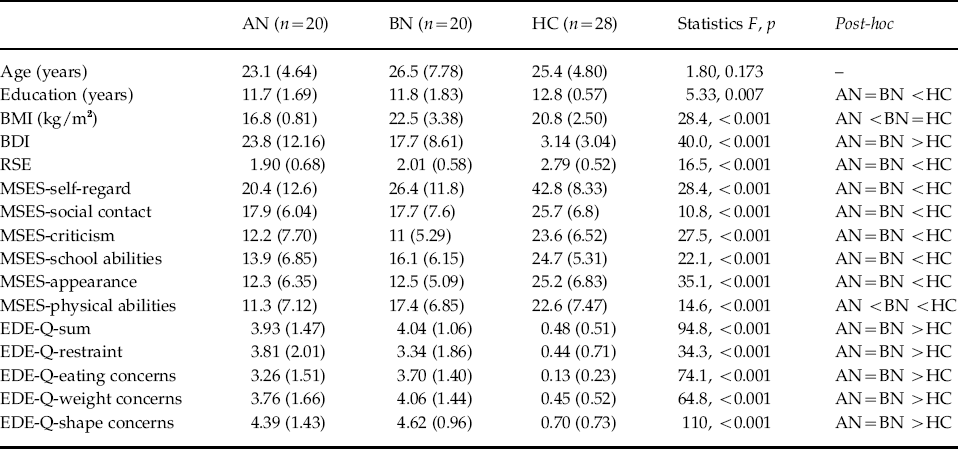
As indicated in Table 1, groups did not differ in age, but HC participants had higher education and AN patients had lower body mass index (BMI) than the other groups. Both ED groups had higher scores on the BDI and all scales of the EDE-Q than HCs. AN and BN patients scored lower than controls on the RSE and on all subscales of the MSES. Only the MSES scale ‘physical abilities’ differentiated between the two ED groups: AN patients endorsed the lowest scores, followed by BN and HC individuals.
Study 1: means (standard deviation) of sample characteristics, eating disorder (ED) pathology and self-esteem measures

AN, Anorexia nervosa; BN, bulimia nervosa; HC, healthy controls; BMI, body mass index; BDI, Beck Depression Inventory; RSE, Rosenberg Self-Esteem Scale; MSES, Multidimensional Self-Esteem Scale; EDE-Q, Eating Disorder Examination Questionnaire.
N400
The congruence×SE domain×group ANOVA for the N400 amplitude yielded a group×congruence interaction [F(2, 65)=3.78, p=0.028, η2=10.4]. To follow up on this interaction, N400 amplitudes were pooled across SE domains and t tests compared incongruent with congruent conditions separately within each group. N400 amplitudes were higher (more negative) for incongruent conditions than for congruent conditions in the BN group [t(19)=4.07, p<0.001, d=0.27] but not in the other two groups (t's<1.00). Figure 1 a illustrates the ERP waveforms in congruent and incongruent conditions and Fig. 1 b displays mean amplitudes averaged across the time interval 340–450 ms (both pooled across SE domains).
RTs
Analogue to the N400 data, correct RTs were analyzed by an ANOVA with the factors congruence, SE domain and group. Again, a significant group×congruence interaction testified that group modulated the congruence effect [F(2, 65)=3.30, p=0.043, η2=9.20]. Similar to the N400 analysis, we pooled RTs across SE domains to follow up on the group×congruence interaction (Fig. 1 c). Post-hoc t tests comparing congruent and incongruent conditions separately for each group yielded significant congruence effects in the AN group [t(19)=2.65, p=0.016, d=0.19], and a trend toward a significant congruence effect in the BN group [t(19)=1.87, p=0.077, d=0.10], but no congruence effect in the HC group (t<1.0).
Error rates were altogether low, and groups did not differ in their error rates, as indicated by a univariate ANOVA [F(1, 67)=1.23, p=0.298, η2=3.70; BN, AN, HC=5.2, 4.3, 1.9% respectively].
Disagreement ratings of prime–target sentences
The congruence×SE domain×group ANOVAFootnote 7 for disagreement ratings yielded a significant three-way interaction [F(2, 65)=5.69, p=0.005, η2=14.9] and a significant group×congruence interaction [F(2, 65)=15.1, p<0.001, η2=31.8], in addition to several other effects that are not discussed here. As Fig. 1 d suggests, and post-hoc tests confirmed, strong congruence effects (higher disagreement ratings for incongruent relative to congruent conditions) were present in both ED groups (t's>2.33, p's<0.031) but not in the HC group (t's<1.89, p's>0.069), representing the group×congruence interaction. The three-way interaction (and the SE domain×congruence interaction) indicated stronger congruence effects in ED groups for performance targets compared to interpersonal targets. This was mainly due to lower disagreement ratings in the congruent conditions in the ED groups. t tests confirmed that both ED groups gave lower disagreement ratings for congruent performance targets, compared to congruent interpersonal targets (t's>3.87, p's<0.001), whereas ratings for congruent targets did not differ between interpersonal and performance targets (all t's<1.00; in the HC group no differences were significant on any factor).
To determine whether co-morbid depression, which affected a substantial percentage of the patient groups, accounted for the results, a set of ANCOVAs was run for N400, RTs and disagreement ratings. The inclusion of BDI depression as a covariate did not substantially alter the pattern of results.
Study 2
Introduction
Study 2 explored whether the link between the SE subdomains performance and interpersonal and shape/weight is specific to AN and BN patients or if it is also present in healthy individuals with a habitual tendency to restrain their eating. In adolescence, dietary restraint and chronic concerns about shape and weight as defined by the restraint scale (Herman & Polivy, Reference Herman, Polivy and Stunkard1980) are considered risk factors for EDs (cf. Jacobi et al. Reference Jacobi, Hayward, de Zwaan, Kraemer and Agras2004). However, many restrained eaters do not develop clinical symptoms but maintain normative concerns about shape, weight and eating during adulthood. Therefore, restrained eaters represent an interesting non-clinical control group.
Participants and procedure
Participants were female students selected from a screening sample of 128 students on the basis of their score on the restraint scale (Herman & Polivy, Reference Herman, Polivy and Stunkard1980; Dinkel et al. Reference Dinkel, Berth, Exner, Rief and Balck2005). The RES group (n=19) scored in the range 1623 (mean=19.1, s.d.=2.22) on the scale, whereas the UNRES group (n=21) scored 110 (mean=6.95, s.d.=2.55), which is concordant with established cut-offs for restrained eating (Dinkel et al. Reference Dinkel, Berth, Exner, Rief and Balck2005). The SCID sections for AN and BN were administered to exclude participants who fulfilled the diagnostic criteria for an ED. As in the second part of an unrelated study (Hoffmeister et al. Reference Hoffmeister, Teige-Mocigemba, Blechert, Klauer and Tuschen-Caffier2010), participants completed the same disagreement questionnaire as used in Study 1.
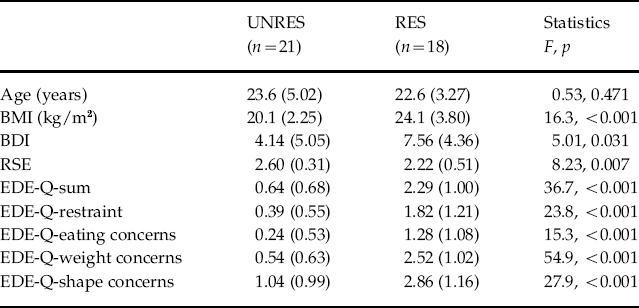
As indicated in Table 2, groups did not differ in age and education (all were university students), but the RES group scored higher on BMI, BDI depression and ED psychopathology (EDE-Q) and had lower SE on the RSE.
Study 2: means (standard deviation) of sample characteristics, eating disorder pathology and self-esteem measures

UNRES, Unrestrained eaters; RES, restrained eaters; BMI, body mass index; BDI, Beck Depression Inventory; RSE, Rosenberg Self-Esteem Scale; EDE-Q, Eating Disorder Examination Questionnaire.
Results
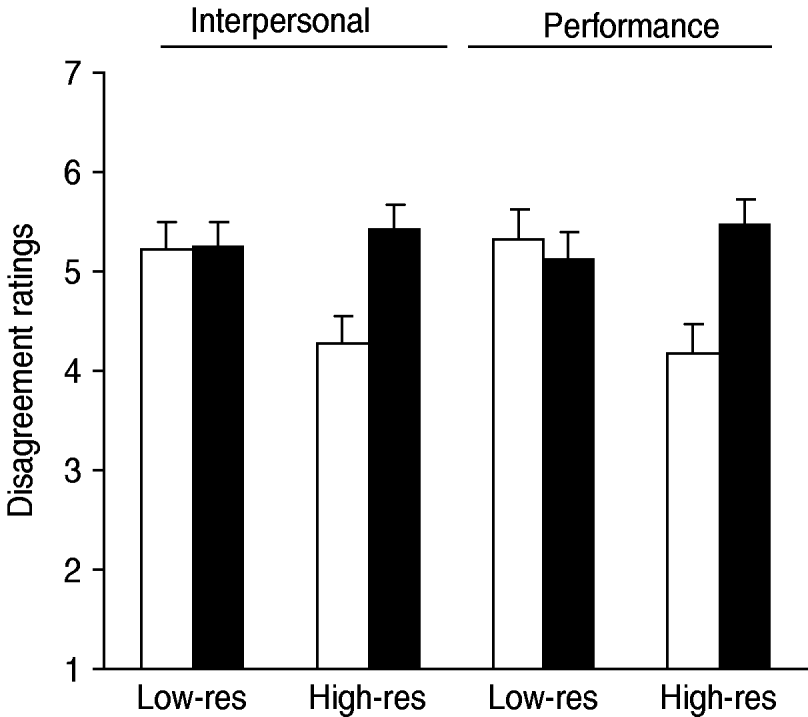
Disagreement ratings were averaged in the same way as in Study 1 and submitted to a congruence×SE domain×group (RES, UNRES) ANOVA. As in Study 1, a significant group×congruence interaction emerged [F(1, 37)=10.4, p=0.003, η2=21.9] but no three-way interaction was evident (all other F's <1.00) (Fig. 2). The significant two-way interaction was due to higher disagreement ratings for affectively incongruent sentences relative to affectively congruent sentences in the RES group [t(17)=4.31, p<0.001, d=1.12] but not in the UNRES group (t<1.00). Thus, in line with our hypotheses, restrained eaters also showed an explicit link between shape/weight and SE, with slightly lower congruence–incongruence differences in the high-RES group (group×congruence interaction η2=21.9 in Study 2) compared to ED patients in Study 1 (group×congruence interaction η2=31.7 in Study 1). Of interest, and in contrast to Study 1, no three-way interaction was found, which means that similar congruence effects were found for interpersonal and performance domains.
Study 2. Disagreement ratings: congruent (□) and incongruent (▪) sentences separately for interpersonal and performance-related self-esteem domains. RES, restrained eaters.

Discussion
To our knowledge this is the first multi-method study of the link between different domains of SE and shape/weight concerns in ED patients (Study 1) and restrained eaters (Study 2). The results of Study 1 can be summarized as follows.
Replicating previous results, both ED groups had lower explicit self-esteem than controls, which suggests that they evaluate themselves in a negative way in one or several life domains. In our AP task, we investigated how closely the non-appearance-related SE domains performance and interpersonal relationships were linked with shape/weight, and on what response levels (implicit, explicit) such associations might operate. In fact, all dependent measures showed differential AP effects (congruence/incongruence differences) for the different groups, consistent with the general idea that shape/weight and SE are linked in ED but not in controls. However, each measure also revealed a specific picture, which validates our multi-method approach. On N400 amplitudes, only the BN group showed congruence–incongruence differences whereas the AN and HC groups did not display these AP effects. On RTs and disagreement ratings, however, both ED groups but not controls showed AP effects. Of note, on disagreement ratings AP effects in ED patients were more pronounced for performance targets than for interpersonal targets.
The results of Study 2 partially replicated the rating findings of Study 1. On disagreement ratings, restrained but not unrestrained eaters showed an association of shape/weight with both SE domains. However, in contrast to Study 1, congruence effects did not differ between SE domains, suggesting that both domains were equally affected by shape/weight. Using self-report data, McFarlane et al. (Reference McFarlane, McCabe, Jarry, Olmsted and Polivy2001) found differential shape/weight–SE links in ED patients and restrained eaters. As in our study, the interpersonal domain was linked with shape/weight in both groups (ED patients and restrained eaters). In their study, however, the performance domain was linked with shape/weight only in ED patients but not in restraint eaters, which is inconsistent with our findings. It should be noted, however, that our restrained and unrestrained eaters had more extreme scores on the restraint scale than theirs, and thus might have been closer to a clinical ED. Nevertheless, explicit global self-esteem in restrained eaters was not as low and their AP effects not as strong as in ED patients (i.e. AP effect sizes of 21.9% v. 31.8% in Study 1 and 2 respectively) suggesting a broad but weaker associations linking performance and interpersonal domains to SE in restrained eaters.
The stepwise increase of the strength of shape/weight–SE associations from healthy/unrestrained to restrained and ED individuals together with a stepwise decrease of explicit self-esteem (i.e. 2.8, 2.6, 2.2, 2.0 and 1.9 on the RSE in the HC, unrestrained, restrained, BN and AN groups respectively) suggests an underlying continuum: stronger linkage between shape/weight concerns and SE (and the performance domain in particular) might give rise to stronger ED symptoms and lower explicit self-esteem. Of course, the reverse could also be true: increasing ED symptoms might strengthen shape/weight–SE associations and lower self-esteem. It would be important to understand the directionality of this correlation, for example by studying whether these associations predate the development of restrained eating or ED or whether they are a consequence of these conditions. Further light on the directionality of these associations could be gained in designs that manipulate one of these constructs experimentally. For example shape/weight–SE associations could be measured before and after activating shape/weight concerns by means of mirror exposure (Hoffmeister et al. Reference Hoffmeister, Teige-Mocigemba, Blechert, Klauer and Tuschen-Caffier2010). In addition, even though we measured shape/weight–SE associations on explicit and implicit levels, we did not include an implicit measure of self-esteem. This would be an interesting extension because dual process models hold that implicit evaluations predict different behaviors (i.e. more impulsive behaviors) than explicit evaluations (Strack & Deutsch, Reference Strack and Deutsch2004) and implicit and explicit self-esteem might be discrepant (Kernis et al. Reference Kernis, Abend, Goldman, Shrira, Paradise and Hampton2005; Cockerham et al. Reference Cockerham, Stopa, Bell and Gregg2009). Furthermore, an extension of the present task to other SE domains would be feasible. In addition to including physical appearance, the domain of physical abilities might be interesting because this was the only domain that distinguished between AN and BN.
Regarding the ED-specific findings, a central result was that ED patients associated both SE domains with shape/weight to a stronger degree than healthy individuals. These findings clearly support existing theories and current nosology with respect to the ‘undue influence of shape and weight on self-evaluation’ (e.g. APA, 1994; Fairburn et al. Reference Fairburn, Cooper and Shafran2003). Conditional on replications of these results, future revisions of the DSM criteria for AN and BN might become more specific about the ‘undue influence of shape/weight on self-evaluation’ by indicating that not only appearance but also performance and interpersonal SE domains might be affected in AN and BN patients.
Does AN resemble BN with respect to the undue influence of shape/weight on SE as suggested by the DSM-IV criteria? Although most findings of Study 1 pertained to both AN and BN patients, there seemed to be some differences, too. In BN individuals, the shape/weight–performance association was also reflected in the N400 and thus in judgment-preceding brain processes reflecting comprehension of the sentences. Thus, in BN patients neural affective processing indicated an even tighter link between SE domains and shape/weight concerns as compared to the other groups. Future research could follow up on these potential differences, for example by separately studying purging versus non-purging AN patients in relation to BN patients or by separating BN patients from BN patients with a history of AN. In addition, the duration of the disorders and the history of weight fluctuation (i.e. the past success in regulating shape/weight) might be related to weight/shape–SE associations as those might be formed during initial success with dieting and the resulting social reinforcement (cf. McFarlane et al. Reference McFarlane, McCabe, Jarry, Olmsted and Polivy2001).
What are the clinical implications of strong weight/shape–SE associations? To name just a few, these associations mean that body dissatisfaction could translate into dissatisfaction with work and relationships. This route could also work in the opposite direction. A break-up or job loss could result in increased weight/shape concerns and stronger efforts to control them. If efforts to restore positive SE in work or relationships are directed toward shape/weight control, a vicious cycle might ensue. Failure to control body shape/weight again impacts on the associated SE domains. Shape/weight–SE associations could also affect general self-esteem and mood. When failing to control body shape or weight, patients might be prone to general feelings of ineffectiveness and social rejection (cf. Bruch, Reference Bruch1962, p. 191) in ambiguous social or work-related situations. Possible consequences include social withdrawal, development of negative self-concepts (cf. Jacobi, Reference Jacobi2000), and co-morbid depression. Finally, self-views of being ineffective and a low general self-esteem decrease the probability of profiting from psychotherapy (cf. Fairburn et al. Reference Fairburn, Cooper and Shafran2003). Therefore, ED-specific treatments might benefit from interventions that break up inadequate associations of shape/weight concerns with unrelated SE domains such as performance/achievement and interpersonal relationships.
Acknowledgments
This research was supported by Grants TU78/6-1 and AN393/2-1 from the German Research Foundation.
Declaration of Interest
None.