INTRODUCTION
Cognitive impairment is among the most common and profound consequences of MS, occurring in approximately 40–65% of persons with the disorder (Peyser et al., Reference Peyser, Edwards, Poser and Filskov1980; Rao et al., Reference Rao, Leo, Bernardin and Unverzagt1991a). Cognitive impairment is a leading cause of disability in MS (Rao et al., Reference Rao, Leo, Ellington, Nauertz, Bernardin and Unverzagt1991b). It disrupts multiple aspects of daily life, including employment and social activities (Beatty, Reference Beatty1993; Beatty et al., Reference Beatty, Blanco, Wilbanks, Paul and Hames1995; Rao et al., Reference Rao, Leo, Ellington, Nauertz, Bernardin and Unverzagt1991b; Wild et al., Reference Wild, Lezak, Whitman and Bourdette1991), as well as driving (Schultheis et al., Reference Schultheis, Garay and DeLuca2001, Reference Schultheis, Garay, Millis and Deluca2002; Shawaryn et al., Reference Shawaryn, Schultheis, Garay and DeLuca2002). These types of effects may remain even after controlling for severity of neurological impairment, disease course, depressive symptoms, and use of medications (Rao et al., Reference Rao, Leo, Ellington, Nauertz, Bernardin and Unverzagt1991b).
Cognitive impairment in MS is associated with neuroradiological findings (e.g., lesions and atrophy) (Benedict et al., Reference Benedict, Bruce, Dwyer, Abdelrahman, Hussein, Weinstock-Guttman, Garg, Munschauer and Zivadinov2006; Christodoulou et al., Reference Christodoulou, Krupp, Liang, Huang, Melville, Roque, Scherl, Morgan, MacAllister, Li, Tudorica, Li, Roche and Peyster2003). The impairment can take a variety of forms, but the most frequently affected domain involves learning and memory, especially episodic memory for newly learned verbal and visuospatial information (Beatty et al., Reference Beatty, Wilbanks, Blanco, Hames, Tivis and Paul1996; DeLuca et al., Reference DeLuca, Gaudino, Diamond, Christodoulou and Engel1998; Rao et al., Reference Rao, Leo, Bernardin and Unverzagt1991a; Thornton & Raz, Reference Thornton and Raz1997). Also quite common are deficits on tasks requiring complex attention and rapid information processing (DEsposito et al., Reference DEsposito, Onishi, Thompson, Robinson, Armstrong and Grossman1996; Diamond et al., Reference Diamond, DeLuca, Kim and Kelley1997; Rao et al., Reference Rao, Leo, Bernardin and Unverzagt1991a), executive functions (planning, problem solving, sequencing, flexible set shifting, and self-monitoring) (Arnett et al., Reference Arnett, Rao, Grafman, Bernardin, Luchetta, Binder and Lobeck1997; Beatty et al., Reference Beatty, Goodkin, Beatty and Monson1989a; Rao et al., Reference Rao, Leo, Bernardin and Unverzagt1991a), and visuoperceptual processing (Rao et al., Reference Rao, Leo, Bernardin and Unverzagt1991a; van den Burg et al., Reference van den Burg, van Zomeren, Minderhoud, Prange and Meijer1987). Language ability is relatively spared, with the exception of verbal fluency (Foong et al., Reference Foong, Rozewicz, Quaghebeur, Davie, Kartsounis, Thompson, Miller and Ron1997; Rao et al., Reference Rao, Leo, Bernardin and Unverzagt1991a). The degree of cognitive dysfunction in MS varies across individuals, and cognitive abilities decline at varying rates (Amato et al., Reference Amato, Ponziani and Amaducci1999; Jennekens-Schinkel et al., Reference Jennekens-Schinkel, Laboyrie, Lanser and van der Velde1990; Kujala et al., Reference Kujala, Portin and Ruutiainen1997).
Patients and their families face challenges in planning for the future because of difficulty predicting who will decline cognitively as their disease progresses (Beatty et al., Reference Beatty, Goodkin, Monson and Beatty1989b; Bergendal et al., Reference Bergendal, Fredrikson and Almkvist2007; Kujala et al., Reference Kujala, Portin and Ruutiainen1997; Piras et al., Reference Piras, Magnano, Canu, Paulus, Satta, Soddu, Conti, Achene, Solinas and Aiello2003; Savettieri et al., Reference Savettieri, Messina, Andreoli, Bonavita, Caltagirone, Cittadella, Farina, Fazio, Girlanda, Le Pira, Liguori, Lugaresi, Nocentini, Reggio, Salemi, Tedeschi, Trojano, Valentino and Quattrone2004). Few longitudinal studies have examined cognitive decline in MS (Bergendal et al., Reference Bergendal, Fredrikson and Almkvist2007; Kujala et al., Reference Kujala, Portin and Ruutiainen1997; Sperling et al., Reference Sperling, Guttmann, Hohol, Warfield, Jakab, Parente, Diamond, Daffner, Olek, Orav, Kikinis, Jolesz and Weiner2001). Little is known about possible predictors of cognitive change (Wallin et al., Reference Wallin, Wilken and Kane2006), though there is some indication that clinical variables such as Expanded Disability Status Scale (EDSS) (Amato et al., Reference Amato, Ponziani, Siracusa and Sorbi2001) and secondary progressive (SP) disease course (Amato et al., Reference Amato, Zipoli and Portaccio2006; Bergendal et al., Reference Bergendal, Fredrikson and Almkvist2007; Feinstein et al., Reference Feinstein, Kartsounis, Miller, Youl and Ron1992) may be risk factors, especially over a long period of time such as 10 years (Amato et al., Reference Amato, Ponziani, Siracusa and Sorbi2001, Reference Amato, Zipoli and Portaccio2006). Among demographic variables, age has been shown to predict cognitive decline in MS over the long term (Amato et al., Reference Amato, Ponziani, Siracusa and Sorbi2001, Reference Amato, Zipoli and Portaccio2006). In addition, education has been posited to play a protective role in disorders such as Alzheimer’s disease (by contributing to “cognitive reserve”), but any effects in MS are unknown (Stern, Reference Stern2006). The impact of psychological factors on future decline in MS is unknown, though stress has been found to precede the appearance of new brain lesions (Mohr et al., Reference Mohr, Goodkin, Bacchetti, Boudewyn, Huang, Marrietta, Cheuk and Dee2000), with possible implications for cognitive decline. In addition, cross-sectional studies have found that depressive symptoms such as depressed mood and depressive evaluations correlate with cognitive dysfunction in MS (Arnett, Reference Arnett2005; Arnett et al., Reference Arnett, Higginson, Voss, Bender, Wurst and Tippin1999a, Reference Arnett, Higginson, Voss, Wright, Bender, Wurst and Tippin1999b).
The current exploratory study examined a variety of potential baseline predictors of later cognitive change in an available sample of MS subjects who were participating in an ongoing longitudinal study of cognition. Predictors included demographic features (e.g., education, age, gender), baseline clinical characteristics (e.g., MS type, EDSS), and psychological profile (e.g., anxiety, depression, mood, apathy, fatigue).
METHOD
Participants
Participants were recruited from Long Island, New York, as part of an ongoing longitudinal study of cognition in MS. The study was approved by an institutional review board, and all subjects provided written informed consent. Inclusion required MS diagnosis (McDonald et al., Reference McDonald, Compston, Edan, Goodkin, Hartung, Lublin, McFarland, Paty, Polman, Reingold, Sandberg-Wollheim, Sibley, Thompson, van den Noort, Weinshenker and Wolinsky2001), EDSS ≤7.0 (Kurtzke, Reference Kurtzke1983), and education ≥10 years. MS disease–modifying medications (e.g., interferon beta, glatiramer acetate) were allowed. Participants had to be neurologically stable for at least 30 days prior to study entry and annual assessment. They also had to be willing to maintain their current medication use (or nonuse) during the study period to the extent possible. The focus of the overall longitudinal study was to identify the characteristics of subjects that decline cognitively over the course of the study. Because depression might lower initial cognitive performance and mask cognitive decline over time, persons meeting Diagnostic and Statistical Manual, 4th edition (DSM-IV) criteria for a current major depressive episode were excluded at screening, using the Structured Clinical Interview for DSM-IV Axis I Disorders (SCID) (First et al., Reference First, Spitzer, Gibbon and Williams1997), administered by an individual trained and experienced in its use (over 100 prior SCID administrations; the SCID was not administered at follow-up). Concurrent antidepressants and antispasticity agents were permitted. Exclusion criteria included current use of benzodiazepines, due to their potential adverse effect on cognition, current alcohol or substance abuse, history of head injury, or other medical conditions known to affect cognition (e.g., various forms of non–MS-related dementia, history of learning disability).
Procedures
Subjects were tested at baseline and at approximately 1 year. Participants completed a set of neuropsychological tests from standard MS cognitive batteries comprising tests known to be commonly impaired in persons with MS: the Brief Repeatable Battery (BRB) (Rao & the Cognitive Function Study Group of the National Multiple Sclerosis Society, Reference Rao1990) and the Minimal Assessment of Cognitive Function in MS (MACFIMS) (Benedict et al., Reference Benedict, Fischer, Archibald, Arnett, Beatty, Bobholz, Chelune, Fisk, Langdon, Caruso, Foley, LaRocca, Vowels, Weinstein, DeLuca, Rao and Munschauer2002). Tests taken from the BRB included two measures of episodic learning and recall, the Selective Reminding Test (SRT) six-trial version (Buschke & Fuld, Reference Buschke and Fuld1974; Rao & the Cognitive Function Study Group of the National Multiple Sclerosis Society, Reference Rao1990; Scherl et al., Reference Scherl, Krupp, Christodoulou, Morgan, Hyman, Chandler, Coyle and MacAllister2004), which measures verbal memory, and the 10/36 Spatial Recall Test (10/36) (Rao & the Cognitive Function Study Group of the National Multiple Sclerosis Society, Reference Rao1990), which measures visuospatial memory. Tests taken from the MACFIMS were the Judgment of Line Orientation (JOLO) (Benton et al., Reference Benton, Hannay and Varney1975), a test of basic visual perceptual skills, and Delis–Kaplan Executive Function System (D-KEFS) Card Sorting Test (Benedict et al., Reference Benedict, Fischer, Archibald, Arnett, Beatty, Bobholz, Chelune, Fisk, Langdon, Caruso, Foley, LaRocca, Vowels, Weinstein, DeLuca, Rao and Munschauer2002; Delis et al., Reference Delis, Kaplan and Kramer2001), which measures reasoning and problem-solving skills. The remaining tasks are common to both the BRB and MACFIMS; they included a version of the Symbol Digit Modalities Test (SDMT) of sustained concentration, and speeded visual information processing modified to require a verbal response (Benedict et al., Reference Benedict, Fischer, Archibald, Arnett, Beatty, Bobholz, Chelune, Fisk, Langdon, Caruso, Foley, LaRocca, Vowels, Weinstein, DeLuca, Rao and Munschauer2002; Rao & the Cognitive Function Study Group of the National Multiple Sclerosis Society, Reference Rao1990; Smith, Reference Smith1973); the Paced Auditory Serial Addition Test (PASAT) (Benedict et al., Reference Benedict, Fischer, Archibald, Arnett, Beatty, Bobholz, Chelune, Fisk, Langdon, Caruso, Foley, LaRocca, Vowels, Weinstein, DeLuca, Rao and Munschauer2002; Gronwall, Reference Gronwall1977; Rao & the Cognitive Function Study Group of the National Multiple Sclerosis Society, Reference Rao1990), a task assessing working memory, sustained concentration, and information processing speed; and Controlled Oral Word Association (COWA) (Benton & Hamsher, Reference Benton and Hamsher1989; Rao & the Cognitive Function Study Group of the National Multiple Sclerosis Society, Reference Rao1990; Spreen & Strauss, Reference Spreen and Strauss1998), which measures speeded verbal output to a target letter. Most tasks (SRT, 10/36, SDMT, PASAT, and COWA) were also administered prior to baseline in a prebaseline session designed to control for practice effects. The exceptions were the D-KEFS Card Sorting Test and the JOLO, both of which have only two versions.
Neuropsychological performance in the MS sample was compared to that of healthy persons. A group of 38 healthy controls completed the same tasks at prebaseline and baseline. A Z score was calculated for each test score based on the performance of the controls at baseline [i.e., for each test score, mean healthy performance = 0, standard deviation (SD) = 1]. Seven Z scores (one from each cognitive task) were combined into a mean to measure overall cognitive performance. The seven scores contributing to the cognitive Z score mean were as follows: SRT total recall, 10/36 total recall, SDMT total correct, PASAT 2- and 3-s trials combined total, COWA total words, JOLO total correct, and D-KEFS confirmed correct sorts. The primary outcome of the present study was change in cognitive Z score mean, calculated by taking the follow-up testing Z score mean and subtracting the baseline Z score mean.
Participants also completed a series of well-validated psychological questionnaires at baseline and approximately 1 year assessing depressive symptoms, anxiety, positive and negative affect, fatigue, and apathy. The Center for Epidemiological Studies Depression Scale (CESD) (Radloff, Reference Radloff1977) was one of two questionnaires assessing depressive symptoms. The other depression measure was the Chicago Multiscale Depression Inventory (CMDI) (Nyenhuis et al., Reference Nyenhuis, Luchetta, Yamamoto, Terrien, Bernardin, Rao and Garron1998), a questionnaire designed specifically for use in MS and other medical patient groups. It has vegetative, mood, and evaluative scales consisting of 14 items each. The CMDI makes it possible to separate out neurovegetative symptoms of depression which are a potential confound in medical populations such as MS (Nyenhuis et al., Reference Nyenhuis, Rao, Zajecka, Luchetta, Bernardin and Garron1995). Additional measures included the state version of the State Trait Anxiety Inventory (STAI) (Spielberger, Reference Spielberger1983), the Positive and Negative Affect Scale (PANAS) (Watson et al., Reference Watson, Clark and Tellegen1988), a well-validated measure of state-related positive and negative affect, and the Apathy Evaluation Scale (AES) (Marin et al., Reference Marin, Biedrzycki and Firinciogullari1991), a measure of apathy, defined as a lack of motivation not attributable to diminished level of consciousness, cognitive impairment, or emotional distress. The Fatigue Severity Scale (FSS) (Krupp et al., Reference Krupp, LaRocca, Muir-Nash and Steinberg1989), a common MS measure, was used to assess fatigue. As with the neuropsychological tests, Z scores for MS subjects on the psychological questionnaires were normed on the responses of healthy controls tested in our laboratory.
Statistical Analyses
In this exploratory study, we chose to examine baseline variables measured within four general classes (demographic variables, clinical aspects of MS, affect-related self-report measures, and non–affect-related self-report measures) to determine whether the class as a whole helped predict cognitive change. Each class was initially examined with a multiple regression analysis using simultaneous entry of predictors. If (and only if) the overall multiple regression effect was significant, a more detailed exploration of the component variables was undertaken, primarily using Pearson correlations. An alpha less than .01 was used for all analyses to reduce the likelihood of chance results. Analyses were performed using SPSS 15.0 unless stated otherwise.
RESULTS
Sample Characteristics
The 38 persons in the MS sample were predominantly female (58%) and Caucasian (97%), with a mean age of 45.5 years (SD = 8.4) and a mean of 14.9 years of education (SD = 2.2). The 38 persons in the healthy control group used in the calculation of Z scores did not differ from the MS group in terms of gender (71% female), race (92% Caucasian), age (M = 44.9, SD = 9.7), or education (M = 15.3, SD = 2.0). The MS sample was diagnosed with either relapsing remitting (n = 28) or SP (n = 10) MS (McDonald et al., Reference McDonald, Compston, Edan, Goodkin, Hartung, Lublin, McFarland, Paty, Polman, Reingold, Sandberg-Wollheim, Sibley, Thompson, van den Noort, Weinshenker and Wolinsky2001) with a median EDSS (Kurtzke, Reference Kurtzke1983) score of 3.5 (range 1.0–6.5). Most were receiving MS disease–modifying therapies (interferon beta = 20, glatiramer acetate = 10, none = 8). Mean time between their prebaseline and baseline testing was approximately 1.5 months (M = 44.97 days, SD = 37.578) and between baseline and follow-up testing was approximately 13.5 months (M = 407.63 days, SD = 72.83).
Baseline Cognitive and Affective Features
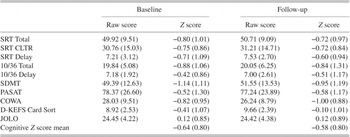
The sample showed mild difficulties on the neuropsychological test battery. Compared to a local sample of 38 healthy persons of similar demographic background, the MS persons averaged approximately 1.5 SD below the mean of the healthy sample (Table 1), performing most poorly on the SDMT (Z score mean = −1.14) and best on the JOLO (Z score mean = 0.12). For the sample as a whole, there was no significant cognitive change over the study period, though there was a good deal of inter-subject variability. The primary outcome measure, change in cognitive Z score mean, appeared to be normally distributed.
Mean (SD) performance on neuropsychological tests at baseline and follow-up

Note.
SRT Total = Selective Reminding Test total words recalled over six trials; SRT CLTR = Selective Reminding Test consistent long-term retrieval; SRT Delay = Selective Reminding Test delayed recall; 10/36 Total = 10/36 spatial recall total recall over three trials; 10/36 Delay = 10/36 spatial recall delayed recall; SDMT = Symbol Digit Modalities Test total score; PASAT = Paced Auditory Serial Addition Test total for 2- and 3-s trials; COWA = Controlled Oral Word Association total score for three letters; D-KEFS Card Sort = Delis–Kaplan Executive Function System Card Sorting Test confirmed correct sorts; JOLO = Judgment of Line Orientation total correct; Cognitive Z score mean = Z score mean for SRT Total, 10/36 Total, SDMT, PASAT, COWA, Card Sorting, and JOLO.
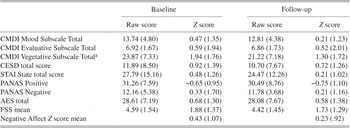
While participants were not clinically depressed at baseline as defined by DSM-IV criteria, they displayed some mild elevation on self-report measures of psychological state as compared to the local sample of healthy persons, though there was a good deal of variability between subjects (Table 2). The highest elevations were on measures of vegetative symptoms of depression (Z score mean = 1.94) and fatigue (Z score mean = 1.88). There was no significant change on any of the psychological self-report measures, with the exception of a decrease in the CMDI vegetative subscale at follow-up.
Mean (SD) scores on psychological questionnaires at baseline and follow-up

Note.
CMDI = Chicago Multiscale Depression Inventory; CESD = Center for Epidemiological Studies Depression Scale; STAI = State Trait Anxiety Inventory; PANAS = Positive and Negative Affect Scale; AES = Apathy Evaluation Scale; FSS = Fatigue Severity Scale; Negative Affect Z-Score Mean = Z-Score Mean for CMDI Mood, STAI State, PANAS Negative.
a Change from baseline to follow-up, p < .05.
Predicting Changes in Cognitive Function
The prediction of cognitive change was examined with four multiple regression analyses, each assessing a different class of baseline predictors. The analysis examining demographic variables (age, education, and gender) was found to be nonsignificant (R = .207, p = .681), as was the analysis of MS-related clinical variables (MS type, EDSS, use of disease-modifying therapy) (R = .152, p = .865). An analysis of non–affect-related self-report measures (AES and FSS) was also not significant (R = .216, p = .435). The analysis of affect-related self-report measures (CESD, CMDI subscales combined, PANAS Negative, PANAS Positive, and STAI) was statistically significant (R = .677, R 2 = .458, p = .001) (Table 3). To estimate cross-validation shrinkage for the significant affect result, an adjusted R 2 was calculated using the Stein formula, finding that the affect measures predicted approximately 25% of the variability in cognitive change (adjusted R 2 = .254, adjusted R = .504) (Stevens, Reference Stevens2002).
Summary of simultaneous multiple regression analysis for affect variables predicting change in cognitive function (R 2 = .458)

Note.
CMDI Combined = Chicago Multiscale Depression Inventory Z score mean combination of subscales; CESD = Center for Epidemiological Studies Depression Scale; STAI = State Trait Anxiety Inventory; PANAS = Positive and Negative Affect Scale.
** p ≤ .01 (two-tailed).
Exploring Specifics of the Relation Between Baseline Affect and Cognitive Change
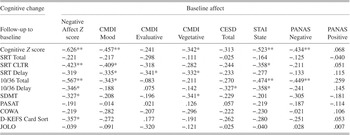
As evident in correlations presented in Table 4, the strongest relations between baseline affect measures with overall cognitive performance were found for three measures of negative affect (CMDI Mood subscale, STAI State, and PANAS Negative), which we combined to create a negative affect Z score mean (Table 4).
Correlation of baseline negative affect and change in cognitive function during the study

Note.
CMDI = Chicago Multiscale Depression Inventory; STAI = State Trait Anxiety Inventory; PANAS = Positive and Negative Affect Scale; CESD = Center for Epidemiological Studies Depression Scale; Negative Affect Z score = mean of CMDI Mood, STAI State, PANAS Negative Affect; SRT Total = Selective Reminding Test total words recalled over six trials; SRT CLTR = Selective Reminding Test consistent long-term retrieval; SRT Delay = Selective Reminding Test delayed recall; 10/36 Total = 10/36 spatial recall total recall over three trials; 10/36 Delay = 10/36 spatial recall delayed recall; SDMT = Symbol Digit Modalities Test total score; PASAT = Paced Auditory Serial Addition Test total for 2- and 3-s trials; COWA = Controlled Oral Word Association total score for three letters; D-KEFS Card Sort = Delis–Kaplan Executive Function System Card Sorting Test confirmed correct sorts; JOLO = Judgment of Line Orientation total correct; Cognitive Z score = Z score mean for SRT Word Total, SRT CLTR, SDMT, PASAT, COWA, Card Sorting, and JOLO.
** p ≤ .01 (two-tailed).
* p ≤ .05 (two-tailed).
The effect of baseline negative affect on cognitive change occurred in the absence of a cross-sectional relation between Negative Affect Z score and Cognitive Z score at either baseline (r = .064, p = .702) or follow-up (r = −.065, p = .716). Nor was the relationship between negative affect and cognition reciprocal, since baseline Cognitive Z score did not predict change in Negative Affect Z score (r = .096, p = .589). In addition, controlling for baseline Cognitive Z score did not alter the relation between baseline negative affect and change on the cognitive Z score (pr = −.630, p < .001). Baseline measures of negative affect tended to most strongly predict changes in cognitive measures of verbal (SRT) and visuospatial (10/36) episodic memory (Table 4).
DISCUSSION
Baseline measures of negative affect (e.g., depressed mood, state anxiety, and momentary negative affect) consistently predicted cognitive change over approximately 1 year in persons with MS. The finding is striking because persons meeting criteria for major depression were excluded from the study. It raises the possibility that even among persons without clinical depression, negative affect symptoms in MS may have adverse consequences, though this cannot be firmly established from the present exploratory correlational investigation. The longitudinal relation occurred in the absence of a cross-sectional relation between negative affect and overall cognition. High baseline negative affect particularly predicted a relative decline in episodic memory for newly learned verbal and visuospatial information. The negative affect measures were unique in their predictive value among the baseline measures assessed, a group that included demographic, clinical, cognitive, and psychological variables.
Affective disturbance is clearly an important issue in MS regardless of its relation to cognition. The prevalence of affective disturbance in MS is among the highest of any medical disorder (Joffe et al., Reference Joffe, Lippert, Gray, Sawa and Horvath1987; Minden et al., Reference Minden, Orav and Reich1987; Minden & Schiffer, Reference Minden and Schiffer1990; Patten et al., Reference Patten, Metz and Reimer2000; Sadovnick et al., Reference Sadovnick, Remick, Allen, Swartz, Yee, Eisen, Farquhar, Hashimoto, Hooge, Kastrukoff, Morrison, Nelson, Oger and Paty1996), higher than in otherwise healthy persons (Patten et al., Reference Patten, Beck, Williams, Barbui and Metz2003), higher than in those with other chronic medical illnesses (Patten et al., Reference Patten, Beck, Williams, Barbui and Metz2003), and even higher than in other neurological disorders, including temporal lobe epilepsy and amyotrophic lateral sclerosis (Schiffer & Babigian, Reference Schiffer and Babigian1984). Major depression has received the most research attention among affective disorders in MS. Lifetime prevalence of major depression in MS has been estimated at 25–50% (Chwastiak et al., Reference Chwastiak, Ehde, Gibbons, Sullivan, Bowen and Kraft2002; Joffe et al., Reference Joffe, Lippert, Gray, Sawa and Horvath1987; Minden et al., Reference Minden, Orav and Reich1987; Patten et al., Reference Patten, Metz and Reimer2000; Sadovnick et al., Reference Sadovnick, Remick, Allen, Swartz, Yee, Eisen, Farquhar, Hashimoto, Hooge, Kastrukoff, Morrison, Nelson, Oger and Paty1996; Siegert & Abernethy, Reference Siegert and Abernethy2005). Anxiety disorders in MS have received less research attention, but they are often comorbid with depression, and have an estimated prevalence of 36% in MS (Korostil & Feinstein, Reference Korostil and Feinstein2007).
We know of no other studies that have assessed the influence of baseline negative affect on cognitive change in MS, though there are cross-sectional studies that have examined the relation between these two general domains. The relation of anxiety to cognition in MS has not been extensively studied. One cross-sectional study found a relation between anxiety scores and performance on the Trail Making Test (Stenager et al., Reference Stenager, Knudsen and Jensen1994). Another MS investigation did not find a relation between the presence of an anxiety disorder and the presence of cognitive impairment, though a trend was reported (Korostil & Feinstein, Reference Korostil and Feinstein2007). In the general population, anxiety has been linked to altered and slowed information processing (Andrews & Anderson, Reference Andrews and Anderson1998) and to selective processing of threatening and negative information (Beck & Clark, Reference Beck and Clark1997).
Initial cross-sectional studies of depressive symptoms in MS reported no relation with cognition (Clark et al., Reference Clark, James, Li, Oger, Paty and Klonoff1992; Millefiorini et al., Reference Millefiorini, Padovani, Pozzilli, Loriedo, Bastianello, Buttinelli, Di Piero and Fieschi1992; Rao et al., Reference Rao, Leo, Bernardin and Unverzagt1991a), though Rao et al. (Reference Rao, Leo, Bernardin and Unverzagt1991a) noted a trend. More recent investigations have uncovered a relation between depression and cognition by employing more sophisticated and appropriate measures of depression that separate out vegetative symptoms and focus on the core attributes of negative mood (e.g., sadness) and negative evaluations (e.g., ruminative thoughts of self-criticism) (Arnett, Reference Arnett2005; Arnett et al., Reference Arnett, Higginson, Voss, Bender, Wurst and Tippin1999a, Reference Arnett, Higginson, Voss, Wright, Bender, Wurst and Tippin1999b). Persons with high levels of negative mood and/or negative evaluations have been found to have specific difficulty on tests with high working memory demands and involving complex speeded attention and executive functions (Arnett, Reference Arnett2005; Arnett et al., Reference Arnett, Higginson, Voss, Bender, Wurst and Tippin1999a, Reference Arnett, Higginson, Voss, Wright, Bender, Wurst and Tippin1999b, Reference Arnett, Higginson and Randolph2001; Thornton & Raz, Reference Thornton and Raz1997).
The results for depression in cross-sectional studies of the general population are generally similar to those in the MS literature (Thornton & Raz, Reference Thornton and Raz1997). One difference is that depression’s impact on episodic learning and memory has been more clearly demonstrated in the otherwise healthy population (Thornton & Raz, Reference Thornton and Raz1997; Zakzanis et al., Reference Zakzanis, Leach and Kaplan1998), though recent MS research using more sophisticated measures of depression has reported some relations to episodic memory (Arnett, Reference Arnett2005). No such relation was found in the current study, possibly because of a restriction of range on depressive symptomology brought on by the exclusion of persons experiencing a current major depressive episode. As in MS, cross-sectional studies in Alzheimer’s disease have also had more difficulty identifying a relation between depression and episodic memory abilities (Backman et al., Reference Backman, Hassing, Forsell and Viitanen1996; Fahlander et al., Reference Fahlander, Berger, Backman and Wahlin1999). It has been hypothesized that the neurodegenerative effects of Alzheimer’s disease on memory overshadow the effects of depression on memory in cross-sectional Alzheimer’s patient comparisons (Fahlander et al., Reference Fahlander, Berger, Backman and Wahlin1999). Likewise in MS, it is possible that the high prevalence of episodic memory disturbance (Rao et al., Reference Rao, Leo, Bernardin and Unverzagt1991a) introduces enough variability between subjects to make it difficult to uncover a cross-sectional relation.
In any case, the longitudinal impact of depression on episodic memory appears more pronounced in neurological as well as otherwise healthy persons, and our initial results are consistent with this pattern, even with the limited range of depressive symptoms in the current sample. For example, otherwise healthy depressed elderly persons have an increased risk of cognitive decline (Paterniti et al., Reference Paterniti, Verdier-Taillefer, Dufouil and Alperovitch2002). Furthermore, depressed persons are more likely to develop Alzheimer’s disease (diagnosis of which requires memory impairment) and a recent National Institutes of Health consensus report strongly recommends further research to examine the link between depression and Alzheimer’s disease (Geerlings et al., Reference Geerlings, Schoevers, Beekman, Jonker, Deeg, Schmand, Ader, Bouter and Van Tilburg2000; Green et al., Reference Green, Cupples, Kurz, Auerbach, Go, Sadovnick, Duara, Kukull, Chui, Edeki, Griffith, Friedland, Bachman and Farrer2003; Kessing & Andersen, Reference Kessing and Andersen2004; Modrego & Ferrandez, Reference Modrego and Ferrandez2004; Speck et al., Reference Speck, Kukull, Brenner, Bowen, McCormick, Teri, Pfanschmidt, Thompson and Larson1995). Detrimental longitudinal effects of depression have been noted for a variety of other neurological disorders (epilepsy, stroke, Parkinson’s disease, and Alzheimer’s disease), and some have hypothesized that depression-induced hippocampal atrophy is a key mechanism (Kanner, Reference Kanner2005). From this perspective, stress and depression damage the hippocampus by causing hippocampal atrophy (Campbell et al., Reference Campbell, Marriott, Nahmias and MacQueen2004; Videbech & Ravnkilde, Reference Videbech and Ravnkilde2004), reducing hippocampal neurogenesis (Campbell & Macqueen, Reference Campbell and Macqueen2004; Warner-Schmidt & Duman, Reference Warner-Schmidt and Duman2006), and presumably impairing cognitive functions reliant on the hippocampus (Cabeza & Nyberg, Reference Cabeza and Nyberg2000; Squire et al., Reference Squire, Stark and Clark2004; Squire & Zola-Morgan, Reference Squire and Zola-Morgan1991).
Stress also may have a negative impact on the MS disease process. A meta-analytic review in 2004 (Mohr et al., Reference Mohr, Hart, Julian, Cox and Pelletier2004) determined that there is a consistent association between stressful life events and subsequent exacerbation in MS, though some have questioned this relation (Galea et al., Reference Galea, Newman and Gidron2004; Hintzen et al., Reference Hintzen, Buljevac, Hop and Janssens2004). In a prospective study, negative everyday stress not specifically related to MS (e.g., a disruption of routine or a conflict at work or with family) was found to predict gadolinium-enhanced lesions 8 weeks later (Mohr et al., Reference Mohr, Goodkin, Bacchetti, Boudewyn, Huang, Marrietta, Cheuk and Dee2000). Interestingly, stress is also known to play an important role in causing or precipitating depressive episodes (Duman & Kehne, Reference Duman and Kehne2007). The size of the effect of stress on MS exacerbation is modest, but it is clinically meaningful, equaling the strength of MS disease–modifying medications in reducing exacerbations (Filippini et al., Reference Filippini, Munari, Incorvaia, Ebers, Polman, D’Amico and Rice2003). While the studies reviewed have not focused on cognition, the implication is that cognitive decline would occur over time as a consequence of inflammation and disease exacerbation.
While the current results dovetail with prior findings, it must be noted that this study was exploratory in nature and had a number of limitations. It was based on a relatively small sample and excluded persons with a current major depressive episode, so its generalizability to such persons is unclear. Also, no history of depression measure was administered, so it is possible that prior episodes of depression might have influenced baseline negative affect or rate of cognitive decline in some way. In addition, the current sample limited some predictors such as education (≥10 years) and EDSS (≤ 7.0), which may have reduced the likelihood they would influence cognition.
The current results clearly need replication in a prospective longitudinal study with a broader sample that includes persons with major depression. It will also be important to clarify the nature of any replicable effects of negative affect on cognitive decline in MS. For example, are any such effects specific to episodic memory or are they more general? Are they generated by damage to the hippocampus or by a more general effect on the MS disease process? Efforts to treat cognitive and affective disturbances in MS will likely benefit from a better understanding of the nature of their relation.
ACKNOWLEDGMENTS
Supported by the National Multiple Sclerosis Society (grant # RG3315A4/1), the National Institutes of Health (grant # 1 R03 HD42263-01), and the National Center for Research Resources (grant # 5-MO1-RR-10710). Some of the data from this investigation were presented at the 2007 annual conference of the International Neuropsychological Society. The authors have no financial or other relationships that could be regarded as a conflict of interest affecting this manuscript.