Introduction
Attention deficit hyperactivity disorder (ADHD) is a common condition involving inattention, hyperactivity and impulsivity. The prevalence of DSM-IV ADHD among US adolescents has been estimated as 5.9–7.1% (Willcutt, Reference Willcutt2012). Although a rich literature describes associations of ADHD with academic underachievement (Frazier et al. Reference Frazier, Youngstrom, Glutting and Watkins2007; Pingault et al. Reference Pingault, Tremblay, Vitaro, Carbonneau, Genolini, Falissard and Cote2011; Klein et al. Reference Klein, Mannuzza, Olazagasti, Roizen, Hutchison, Lashua and Castellanos2012), suicidality (James et al. Reference James, Lai and Dahl2004; Sourander et al. Reference Sourander, Klomek, Niemela, Haavisto, Gyllenberg, Helenius, Sillanmaki, Ristkari, Kumpulainen, Tamminen, Moilanen, Piha, Almqvist and Gould2009; Chronis-Tuscano et al. Reference Chronis-Tuscano, Molina, Pelham, Applegate, Dahlke, Overmyer and Lahey2010; Impey & Heun, Reference Impey and Heun2012) and psychosocial role impairment (Kadesjo & Gillberg, Reference Kadesjo and Gillberg2001; Strine et al. Reference Strine, Lesesne, Okoro, McGuire, Chapman, Balluz and Mokdad2006; Larson et al. Reference Larson, Russ, Kahn and Halfon2011), much ambiguity surrounds the risk pathways involved in these adverse effects owing to the very high co-morbidities of ADHD with other psychiatric disorders (Pliszka, Reference Pliszka2000; Kadesjo & Gillberg, Reference Kadesjo and Gillberg2001; Gillberg et al. Reference Gillberg, Gillberg, Rasmussen, Kadesjo, Soderstrom, Rastam, Johnson, Rothenberger and Niklasson2004; Steinhausen et al. Reference Steinhausen, Novik, Baldursson, Curatolo, Lorenzo, Rodrigues Pereira, Ralston and Rothenberger2006), most of which post-date ADHD in onset (Taurines et al. Reference Taurines, Schmitt, Renner, Conner, Warnke and Romanos2010; Kessler et al. Reference Kessler, Avenevoli, McLaughlin, Green, Lakoma, Petukhova, Pine, Sampson, Zaslavsky and Merikangas2012b ).
Despite some concern that high ADHD co-morbidity might represent an artifact of shared diagnostic criteria or informant bias, expert consensus holds that co-morbidity is a real and distinctive clinical feature of ADHD (Angold et al. Reference Angold, Costello and Erkanli1999; Daviss, Reference Daviss2008). However, as many of the disorders co-morbid with ADHD have been independently linked to the same adverse outcomes as ADHD (Szatmari et al. Reference Szatmari, Boyle and Offord1989; Lollar et al. Reference Lollar, Hartzell and Evans2012), it is plausible to think that they might mediate the observed associations of ADHD with those outcomes. Although clinic-based research has begun exploring this possibility to optimize ADHD treatment and refine secondary prevention strategies (Lahey et al. Reference Lahey, Loeber, Burke, Rathouz and McBurnett2002; Biederman et al. Reference Biederman, Petty, Dolan, Hughes, Mick, Monuteaux and Faraone2008; Molina et al. Reference Molina, Pelham, Cheong, Marshal, Gnagy and Curran2012), comparatively little is known about the mediating effects of co-morbidities in the general population. One large US epidemiological survey of youth (aged 6–17 years) with parent-reported ADHD documented that numerous indicators of functioning declined as the number of co-morbid disorders increased (Larson et al. Reference Larson, Russ, Kahn and Halfon2011), but failed to investigate the mediating effects of specific co-morbidities. Two smaller prospective studies examined this attenuation but their estimates were biased by controls including only childhood-onset (i.e. not adolescent-onset) co-morbid disorders (Hinshaw et al. Reference Hinshaw, Owens, Zalecki, Huggins, Montenegro-Nevado, Schrodek and Swanson2012), leading to an underestimation of the extent to which co-morbid disorders mediate the effects of ADHD. One of these two studies also included controls for intercurrent ADHD symptom profiles (Latimer et al. Reference Latimer, August, Newcomb, Realmuto, Hektner and Mathy2003), leading to an overestimation of the mediating effects of co-morbid disorders.
Elaborating the complex interconnections between ADHD and co-morbid conditions in leading to adverse outcomes of ADHD might help to identify promising areas for targeted preventive and treatment interventions. The current report presents data of this sort based on the US National Comorbidity Survey Replication Adolescent Supplement (NCS-A), a national survey of common adolescent DSM-IV disorders. We first examined the prevalence and associations of DSM-IV ADHD with temporally secondary co-morbid disorders and diverse measures of adverse outcomes. Statistical decomposition methods were then used to trace out the extent to which the gross (uncontrolled) associations of ADHD with the outcomes are due to direct effects of ADHD versus indirect effects of ADHD through temporally secondary anxiety, mood, disruptive behavior and substance disorders.
Method
Sample
The NCS-A is a well-characterized community epidemiological study of the presence and correlates of adolescent DSM-IV disorders. Previous reports have described study design, field procedures and overall disorder prevalence (Kessler et al. Reference Kessler, Avenevoli, Costello, Green, Gruber, Heeringa, Merikangas, Pennell, Sampson and Zaslavsky2009a , Reference Kessler, Avenevoli, Costello, Green, Gruber, Heeringa, Merikangas, Pennell, Sampson and Zaslavsky b , Reference Kessler, Avenevoli, Costello, Georgiades, Green, Gruber, He, Koretz, McLaughlin, Petukhova, Sampson, Zaslavsky and Merikangas2012a ; Merikangas et al. Reference Merikangas, Avenevoli, Costello, Koretz and Kessler2009). In brief, adolescents (aged 13–17 years) selected from a dual-frame household–school sample were interviewed at home between February 2001 and January 2004 in separate household and school samples. Adolescents were administered face-to-face interviews and one parent or surrogate (hereafter referred to as the parent) for each participating adolescent completed a self-administered questionnaire. The conditional adolescent response rate was 86.8% and 82.6% for household and school samples respectively. Parent data were only available for a subset of adolescent respondents; this was taken into consideration by weighting data in complete pairs to adjust for differences with incomplete pairs (Kessler et al. Reference Kessler, Avenevoli, Costello, Green, Gruber, Heeringa, Merikangas, Pennell, Sampson and Zaslavsky2009a , Reference Kessler, Avenevoli, Costello, Green, Gruber, Heeringa, Merikangas, Pennell, Sampson and Zaslavsky b ). This report focuses on the 6483 adolescent–parent pairs having complete data. Each participant was paid US$50 for participation. Recruitment and consent procedures were approved by the Human Subjects Committees of Harvard Medical School and the University of Michigan. Data were weighted to adjust for discrepancies between the sample and the US Census population distributions of a wide range of sociodemographic and geographic variables (Kessler et al. Reference Kessler, Avenevoli, Costello, Green, Gruber, Heeringa, Merikangas, Pennell, Sampson and Zaslavsky2009a , Reference Kessler, Avenevoli, Costello, Green, Gruber, Heeringa, Merikangas, Pennell, Sampson and Zaslavsky b ).
Measures
DSM-IV disorders
All adolescents completed the World Health Organization (WHO) Composite International Diagnostic Interview (CIDI), a fully structured diagnostic interview (Kessler & Üstün, Reference Kessler and Üstün2004), to assess lifetime and recent prevalence of common DSM-IV disorders. Diagnoses included two mood, six anxiety, five disruptive behavior and two substance disorders. Age of onset (AOO) of each lifetime disorder was assessed retrospectively using probes shown experimentally to maximize recall accuracy (Knäuper et al. Reference Knäuper, Cannell, Schwarz, Bruce and Kessler1999). Adolescent self-reports were obtained for all 15 disorders. Parent informant reports were obtained for four disorders shown in prior research to benefit most from inclusion of informant reports (Grills & Ollendick, Reference Grills and Ollendick2002; De Los Reyes & Kazdin, Reference De Los Reyes and Kazdin2005). ADHD was one of those disorders along with major depression/dysthymia, conduct disorder and oppositional defiant disorder. A clinical reappraisal study documented good concordance of all diagnoses with independent clinical assessments based on the Schedule for Affective Disorders and Schizophrenia for School Age Children, Present and Lifetime Version (K-SADS-PL; Kaufman et al. Reference Kaufman, Birmaher, Brent, Rao and Ryan1997), with adolescent and parent reports combined using an ‘or’ rule. In the case of ADHD, however, maximum concordance with K-SADS diagnoses was obtained by using only parent reports of Criteria A (at least six of nine symptoms of inattention and/or hyperactivity-impulsivity), B (some impairing symptoms before age 7), C (clinically significant impairment in at least two settings) and D (clinically significant impairment in social, academic or occupational functioning) (Frazier et al. Reference Frazier, Youngstrom, Glutting and Watkins2007), yielding area under the receiver operating characteristic curve (AUC) of 0.78, sensitivity (SN) of 0.58 and specificity (SP) of 0.96. The positive likelihood ratio [LR+; (SN)/(1 – SP)] was 18.7, a value well above the minimum LR+ value of 10.0 generally considered definitive for ruling in diagnoses (Haynes et al. Reference Haynes, Sackett, Guyatt and Tugwell2006). As a result, parent-only reports are used here to define ADHD. Concordance (AUC) of diagnoses based on the CIDI with diagnoses based on the K-SADS for other disorders was in the range 0.79–0.94 for anxiety and mood disorders, 0.85–0.98 for disruptive behavior disorders other than ADHD and 0.92–0.98 for substance abuse.
Adverse outcomes
Three domains of adverse adolescent outcomes are considered here: educational performance, suicidal behaviors and parent perceptions of adolescent health and functioning.
Educational performance
Parents were asked about lifetime occurrence and AOO of their adolescent being suspended from school and having to repeat a grade in school. Adolescents rated their grades over the most recent school year on a seven-point scale from ‘below average’ to ‘above average’. As only a small proportion of adolescents rated their grades below average, responses were collapsed into a single yes–no measure of below-average grades.
Suicidal behaviors
Adolescents were asked about their lifetime history of suicidal behaviors with a modified version of the Suicidal Behavior Module of the CIDI (Nock et al. Reference Nock, Hwang, Sampson, Kessler, Angermeyer, Beautrais, Borges, Bromet, Bruffaerts, de Girolamo, de Graaf, Florescu, Gureje, Haro, Hu, Huang, Karam, Kawakami, Kovess, Levinson, Posada-Villa, Sagar, Tomov, Viana and Williams2009). These questions assessed lifetime occurrence and AOO of suicide ideation, plans and attempts.
Parent perceptions of adolescent health and functioning
Parents were asked to rate their adolescent's overall physical and mental health on a 0 to 10 scale, where 0 represents ‘the worst possible health’ and 10 represents ‘the best possible health.’ Responses were standardized to a mean of 0 and a variance of 1 to facilitate interpretation. Parents also completed the Strengths and Difficulties Questionnaire (SDQ; Goodman, Reference Goodman1997), a 25-item screening instrument that includes parent ratings of the extent to which adolescent difficulties with ‘emotions, concentration, behavior, or being able to get along with other people’ interfere with the adolescent's everyday life in the areas of ‘home life, friendships, learning and leisure activities’ and cause ‘upset or distress’. Response categories for interference and distress were ‘a great deal’, ‘quite a lot’, ‘only a little’ or ‘not at all’ (coded 3–0 respectively) (Goodman, Reference Goodman2001; Becker et al. Reference Becker, Steinhausen, Baldursson, Dalsgaard, Lorenzo, Ralston, Dopfner and Rothenberger2006). Again, responses were standardized to a mean of 0 and a variance of 1 to facilitate interpretation.
Sociodemographics
Sociodemographics considered here include sex, race/ethnicity (Non-Hispanic White, Non-Hispanic Black, Hispanic, Other), parental education [less than high school graduation, high school or General Educational Development (GED), some post-secondary education, college degree], number of biological parents residing with the adolescent (0, 1, 2), and urbanicity of residence (major metropolitan area, other urbanized area, rural area). Survey information was collected to date transitions in the number of biological parents residing with the adolescent, allowing us to define that variable as a time-varying predictor of disorder onset and role impairments. Urbanicity was assessed only for time of interview.
Analysis methods
Logistic regression analysis (Hosmer & Lemeshow, Reference Hosmer and Lemeshow2001) examined sociodemographic correlates of ADHD. Discrete-time survival analysis (Willett & Singer, Reference Willett and Singer1993) with person-year the unit of analysis and a logistic link function estimated associations of temporally primary ADHD with subsequent first onset of other DSM-IV/CIDI disorders controlling sociodemographics. Survival coefficients and their standard errors were exponentiated and are reported as odds ratios (ORs) with 95% confidence intervals (CIs).
The gross (i.e. without controls for co-morbidities) associations of lifetime ADHD with the adverse outcomes were estimated using either discrete-time survival analysis to predict dated lifetime outcomes (suspension, grade retention, suicidality), logistic regression to predict below-average school performance, or ordinary least-squares regression analysis (Draper & Smith, Reference Draper and Smith1998) to predict continuous outcomes (parent perceptions of adolescent health, functioning and distress), all controlling sociodemographics. We then examined parallel models for net (i.e. controlling co-morbidities) associations between lifetime ADHD and the same outcomes. Given that ADHD pre-dates the overwhelming majority of co-morbid disorders (Taurines et al. Reference Taurines, Schmitt, Renner, Conner, Warnke and Romanos2010), differences between gross and net associations are largely due to indirect effects of ADHD through secondary disorders: that is, the product of the associations of ADHD with secondary disorders and of secondary disorders with the outcomes. It is important to note that these indirect effects indicate the existence of temporal mediation of the gross associations of ADHD with later outcomes, but that temporal mediation does not necessarily represent causal mediation because of the possible existence of unmeasured common causes. Formal statistical decomposition methods exist to trace out these temporally indirect effects by comparing coefficients for ADHD in models with and without controls for mediators (Karlson & Holm, Reference Karlson and Holm2011). We used these methods to calculate the extent to which the associations of ADHD with the outcomes were mediated through intervening mood, anxiety, disruptive behavior and substance disorders. Estimates of direct effects (i.e. coefficients for ADHD in models controlling co-morbid disorders) and indirect effects (i.e. effects of ADHD mediated through each of the four sets of secondary disorders) were then divided by estimates of gross associations of ADHD with the outcomes to describe the proportions of gross associations due to each component.
Standard errors of prevalence estimates and regression coefficients were estimated using the Taylor series method (Wolter, Reference Wolter1985) implemented in SAS (SAS Institute, 2008) to account for NCS-A sample weights and clustering. Simulation was used to estimate standard errors of proportional direct and indirect effect estimates using the jackknife repeated replications pseudo-replication method (Wolter, Reference Wolter1985) implemented in a SAS macro. Significance of predictor sets was evaluated using Wald χ 2 tests based on Taylor series coefficient variance–covariance matrices. Statistical significance was consistently evaluated using 0.05-level two-sided tests.
Results
Prevalence
Lifetime and 12-month prevalence of DSM-IV/CIDI ADHD (standard errors in parentheses) is 8.1% (0.6) and 6.3% (0.5) respectively. Prevalence is significantly higher among boys than girls [12.1% (0.9) v. 3.9% (0.5) lifetime, χ 1 2 = 66.2, p < 0.001; 9.6% (0.9) v. 2.8% (0.5) 12-month, χ 2 1 = 45.8, p < 0.001].
Sociodemographic correlates
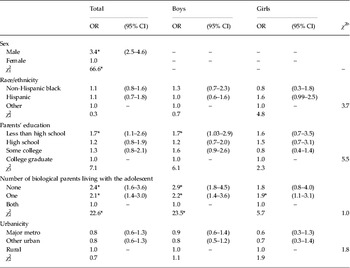
Lifetime DSM-IV/CIDI ADHD is significantly more common among adolescents living with neither or only one biological parent than with both biological parents (OR 2.4–2.1; χ 2 2 = 22.6, p < 0.001) (Table 1), This association is found among both boys (OR 2.9–2.2) and girls (OR 1.8–1.9). However, ADHD is unrelated to race/ethnicity (χ 2 2 = 0.3, p = 0.86), parent education (χ 2 3 = 7.1, p = 0.07) or urbanicity (χ 2 2 = 0.7, p = 0.69).
Sociodemographic correlates of lifetime DSM-IV/CIDI ADHD (n = 6483) a

CIDI, Composite International Diagnostic Interview; ADHD, attention deficit hyperactivity disorder; OR, odds ratio; CI, confidence interval.
a Based on a series of bivariate logistic regression equations, one for each of the sociodemographic predictors. The equations in the first column predicted lifetime ADHD in the total sample (n = 6483), those in the second and third columns predicted lifetime ADHD separately among boys and girls.
b The χ 2 tests evaluate the significance of sex differences in ORs.
* Significant at the 0.05 level, two-sided test.
Associations of ADHD with temporally secondary DSM-IV/CIDI disorders
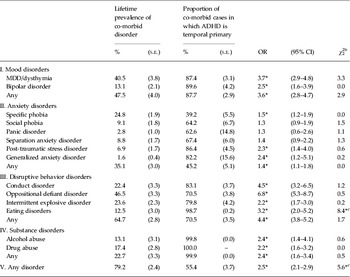
Lifetime DSM-IV/CIDI ADHD is associated with elevated odds of all 14 temporally secondary DSM-IV/CIDI disorders considered here (Table 2). The range of ORs is 1.3–6.8. Eleven ORs are significant: both mood disorders (2.5–3.7), three anxiety disorders (1.5–2.4), all four disruptive behavior disorders (2.2–6.8) and both substance disorders (2.2–2.4). By far the highest ORs are with conduct disorder (4.5) and oppositional defiant disorder (6.8). ORs differ significantly by sex of respondent only for one disorder: eating disorders (OR 4.9 for boys, 1.2 for girls, χ 2 1 = 8.4, p = 0.004).
Associations between lifetime DSM-IV/CIDI ADHD and the subsequent lifetime onset of other lifetime DSM-IV/CIDI disorders (n = 6483) a

CIDI, Composite International Diagnostic Interview; MDD, major depressive disorder; s.e., standard error; OR, odds ratio; CI, confidence interval.
a Discrete-time survival models with person-year as the unit of analysis were used to predict first onset of each outcome disorder. ADHD was treated as time varying (i.e. turned on only at age of onset) and controls were used for the sociodemographic variables in Table 1. Person-year was coded as a series of year-specific dummy predictor variables. The models were estimated using a logistic link function. Results for boys and girls are combined. Comparable results separated by sex of respondents are available on request.
b The χ 2 tests evaluate the significance of sex differences in ORs.
c The OR (95% CI) of ADHD is 4.9 (3.0–8.2) with eating disorders among boys and 1.2 (0.6–2.7) among girls, and 2.8 (2.4–3.2) with any disorder among boys and 1.8 (1.4–2.5) among girls.
* Significant at the 0.05 level, two-sided test.
Associations of ADHD with functional outcomes
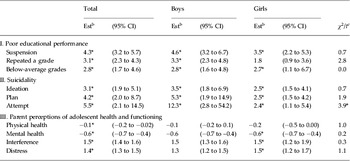
Lifetime ADHD is significantly associated with all the measures of functioning considered here (Table 3). The ORs for ADHD predicting the three dichotomous measures of poor educational performance (suspension, repeating a grade, below-average grades) are in the range 2.8–4.3 and are equivalent for boys and girls (χ 2 1 = 0.0–2.8, p = 0.10–0.99). The ORs for ADHD predicting suicide ideation and plans are 3.1 and 4.2 respectively, and are equivalent for boys and girls (χ 2 1 = 0.6–1.9, p = 0.17–0.42), whereas the OR for ADHD predicting suicide attempts is significantly higher among boys (12.3) than girls (2.4; χ 2 1 = 3.9, p = 0.049).
Gross (i.e. without controls for secondary co-morbid disorders) associations between DSM-IV/CIDI ADHD and adverse outcomes (n = 6483) a

CIDI, Composite International Diagnostic Interview; ADHD, attention deficit hyperactivity disorder; CI, confidence interval.
a A multiple regression model was used to predict each outcome. The predictors were lifetime ADHD and controls for the sociodemographic variables in Table 1. The models for below-average grades and the parent perceptions were estimated at the person level and referred to current functioning at the time of interview. The model for below-average grades used a logistic link function to predict a dichotomous outcome whereas the models for parent perceptions used a linear link function to predict continuous (standardized to a mean of 0 and variance of 1 in the total sample) outcomes. The models for the other outcomes were estimated at the person-year level to predict lifetime outcomes in a discrete-time survival framework using a logistic link function. The predictors in the survival models were treated as time varying (i.e. turned on only at age of onset). Person-year was coded as a series of year-specific dummy predictor variables in the survival models.
b The coefficients in Parts I and II are odds ratios predicting dichotomous outcomes, those in Part III are linear regression coefficients predicting standardized (mean of 0, variance of 1) continuous outcomes.
c The χ 2/t tests evaluate the significance of sex differences in effects of ADHD. χ 2 tests are used for dichotomous outcomes and t tests for continuous outcomes.
* Significant at the 0.05 level, two-sided test.
ADHD is associated with significantly reduced perceived (by parents) physical (12% of a s.d.) and mental (56% of a s.d.) health. These association are equivalent for boys and girls (t = 0.2–1.0, p = 0.38–0.85). ADHD is associated with significantly increased interference with activities due to psychological problems (s.d. = 1.49) and significantly increased distress due to psychological problems (s.d. = 1.37). These associations are equivalent for boys and girls (t = 0.2–1.1, p = 0.29–0.80).
Direct effects of ADHD and indirect effects through secondary DSM-IV/CIDI disorders
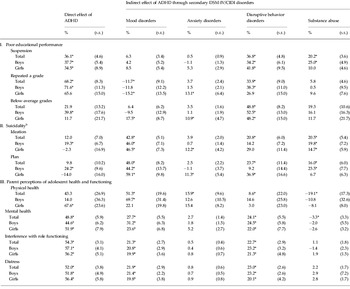
The extent to which the gross associations of ADHD with the outcomes considered here are mediated by temporally secondary DSM-IV/CIDI disorders varies substantially across outcomes (Table 4). Direct effects of ADHD explain more than 50% of the gross associations of ADHD with repeating a grade in school (71.6% among boys and 65.6% among girls), perceived physical (67.6% among girls) and mental (51.9% among girls) health, interference with role functioning (57.1% among boys and 56.2% among girls) and distress (53.5% among boys and 56.4% among girls), and smaller but nonetheless statistically significantly components of the gross associations of ADHD with school suspension (37.7% among boys and 34.5% among girls), below-average grades (39.8%, only boys), suicidal ideation and plans (19.3% and 24.2% respectively, only boys) and perceived mental health (44.6%, only boys). Direct effects of ADHD are statistically insignificant, in comparison, in predicting below-average grades (only girls), suicidal ideation and plans (only girls), and parent perceptions of adolescent physical health (only boys).
Decomposition of gross associations between DSM-IV/CIDI ADHD and adverse outcomes into direct effects of ADHD and indirect effects of ADHD through secondary DSM-IV/CIDI disorders (n = 6483) a

CIDI, Composite International Diagnostic Interview; ADHD, attention deficit hyperactivity disorder; s.e., standard error.
a The decompositions are of the associations between total ADHD and the outcomes in Table 3. The coefficients in each row are standardized to sum to 100%, which represents the total effect of ADHD as reported in the first column of Table 3.
b No results are reported for attempted suicides because the number of attempted suicides was too small for reliable analysis; that is, none of the component coefficients in the decomposition was statistically significant even though the total effect in Table 3 was significant.
* Significant at the 0.05 level, two-sided test.
Indirect effects of ADHD on educational outcomes are predominantly through temporally secondary disruptive behavior disorders (26.9–52.5%) whereas indirect effects on suicidality are predominantly through temporally secondary mood disorders (42.8–59.1%). Indirect effects of ADHD on most other outcomes, in comparison, are through a mix of both temporally secondary mood (19.8–31.2%) and disruptive behavior (20.1–24.5%) disorders. Indirect effects of ADHD through temporally secondary anxiety disorders are consistently insignificant among boys but are statistically significant, albeit relatively modest in substantive terms, among girls in predicting repeating a grade in school, below-average grades and suicide ideation and plans (13.1, 10.9, 12.2 and 11.3% respectively). Finally, indirect effects of ADHD through temporally secondary substance disorders are statistically significant among boys only in predicting school suspension, suicide ideation and plans (25.0, 19.8 and 23.5% respectively) and among girls only in predicting suicide ideation (14.6%).
Discussion
The basic patterns of ADHD prevalence and sociodemographic distribution in the NCS-A are consistent with previous US studies, establishing broad comparability between the NCS-A and existing literature. In brief, the NCS-A lifetime ADHD prevalence estimate (8.1%) is within the range of previous US national surveys (Dey et al. Reference Dey, Schiller and Tai2004; CDC, 2005, 2010; Pastor & Reuben, Reference Pastor and Reuben2008; Bloom et al. Reference Bloom, Cohen and Freeman2010; Schieve et al. Reference Schieve, Gonzalez, Boulet, Visser, Rice, Braun and Boyle2012). The same is true of the NCS-A 12-month prevalence estimate (6.3%) (Polanczyk et al. Reference Polanczyk, de Lima, Horta, Biederman and Rohde2007; Willcutt, Reference Willcutt2012) other than for a considerably higher 12-month prevalence estimate (8.6%) in another US national survey (Froehlich et al. Reference Froehlich, Lanphear, Epstein, Barbaresi, Katusic and Kahn2007; Merikangas et al. Reference Merikangas, He, Brody, Fisher, Bourdon and Koretz2010) that was subsequently shown to use an ADHD measure that was upwardly biased (Lewczyk et al. Reference Lewczyk, Garland, Hurlburt, Gearity and Hough2003). The significantly higher prevalence of ADHD among girls than boys in the NCS-A is perhaps the most consistently documented sociodemographic difference in ADHD prevalence in both clinical (Novik et al. Reference Novik, Hervas, Ralston, Dalsgaard, Rodrigues Pereira and Lorenzo2006) and epidemiological (Froehlich et al. Reference Froehlich, Lanphear, Epstein, Barbaresi, Katusic and Kahn2007) studies. The finding that ADHD is associated with non-intact family structure is also consistent with other community surveys (Hurtig et al. Reference Hurtig, Ebeling, Taanila, Miettunen, Smalley, McGough, Loo, Jarvelin and Moilanen2007) and with prospective studies that find child–adolescent ADHD to be a risk factor for parent marital conflict and dissolution (Wymbs et al. Reference Wymbs, Pelham, Molina, Gnagy, Wilson and Greenhouse2008; Schermerhorn et al. Reference Schermerhorn, D'Onofrio, Slutske, Emery, Turkheimer, Harden, Heath and Martin2012). Our failure to find significant associations of ADHD with race/ethnicity, urbanicity and parental education is largely consistent with previous community studies (Froehlich et al. Reference Froehlich, Lanphear, Epstein, Barbaresi, Katusic and Kahn2007; Bussing et al. Reference Bussing, Mason, Bell, Porter and Garvan2010), although regional studies, which tend to use convenience samples, yield more mixed results (Wolraich et al. Reference Wolraich, Hannah, Pinnock, Baumgaertel and Brown1996; Gaub & Carlson, Reference Gaub and Carlson1997; Angold et al. Reference Angold, Erkanli, Farmer, Fairbank, Burns, Keeler and Costello2002).
The NCS-A finding that ADHD is significantly associated with numerous temporally secondary co-morbid mental disorders is consistent with other cross-sectional surveys (Pliszka, Reference Pliszka2000; Kadesjo & Gillberg, Reference Kadesjo and Gillberg2001; Steinhausen et al. Reference Steinhausen, Novik, Baldursson, Curatolo, Lorenzo, Rodrigues Pereira, Ralston and Rothenberger2006) and also with most (Costello et al. Reference Costello, Mustillo, Erkanli, Keeler and Angold2003; Molina & Pelham, Reference Molina and Pelham2003; Bussing et al. Reference Bussing, Mason, Bell, Porter and Garvan2010; Chronis-Tuscano et al. Reference Chronis-Tuscano, Molina, Pelham, Applegate, Dahlke, Overmyer and Lahey2010), but not all (Copeland et al. Reference Copeland, Shanahan, Costello and Angold2009), longitudinal community surveys. The finding that the strongest of such associations are with conduct disorder and oppositional defiant disorder is also consistent with previous studies (Pliszka, Reference Pliszka2000; Connor et al. Reference Connor, Steeber and McBurnett2010), as is the finding that these associations are largely comparable for boys and girls (Fergusson et al. Reference Fergusson, Horwood and Lynskey1993a ).
As noted in the introduction, an extensive literature documents that ADHD is significantly associated with numerous adverse outcomes similar to those in the NCS-A (e.g. Kadesjo & Gillberg, Reference Kadesjo and Gillberg2001; James et al. Reference James, Lai and Dahl2004; Strine et al. Reference Strine, Lesesne, Okoro, McGuire, Chapman, Balluz and Mokdad2006; Frazier et al. Reference Frazier, Youngstrom, Glutting and Watkins2007; Sourander et al. Reference Sourander, Klomek, Niemela, Haavisto, Gyllenberg, Helenius, Sillanmaki, Ristkari, Kumpulainen, Tamminen, Moilanen, Piha, Almqvist and Gould2009; Chronis-Tuscano et al. Reference Chronis-Tuscano, Molina, Pelham, Applegate, Dahlke, Overmyer and Lahey2010; Larson et al. Reference Larson, Russ, Kahn and Halfon2011; Pingault et al. Reference Pingault, Tremblay, Vitaro, Carbonneau, Genolini, Falissard and Cote2011; Impey & Heun, Reference Impey and Heun2012; Klein et al. Reference Klein, Mannuzza, Olazagasti, Roizen, Hutchison, Lashua and Castellanos2012). However, we also noted that much ambiguity surrounds the risk pathways in these associations due to the high co-morbidity of ADHD with numerous temporally secondary mental disorders. Although several previous studies addressed this issue by showing that statistical adjustments for co-morbidity reduce the associations of ADHD with various indicators of impairment (Fergusson et al. Reference Fergusson, Lynskey and Horwood1993b ; Flory & Lynam, Reference Flory and Lynam2003; Bauermeister et al. Reference Bauermeister, Shrout, Ramirez, Bravo, Alegria, Martinez-Taboas, Chavez, Rubio-Stipec, Garcia, Ribera and Canino2007; Arias et al. Reference Arias, Gelernter, Chan, Weiss, Brady, Farrer and Kranzler2008; Torok et al. Reference Torok, Darke and Kaye2012), the most convincing studies of this sort focused on the cross-classification of ADHD only with other externalizing disorders (typically conduct disorder and/or oppositional defiant disorder) in school samples and examined effects only on measures of school performance (Daley & Birchwood, Reference Daley and Birchwood2010). The NCS-A analysis is, to our knowledge, the first attempt to carry out a formal decomposition of indirect effects through a wider range of temporally secondary mental disorders in explaining the gross associations of ADHD with a more diverse set of outcomes in a community epidemiological survey.
Our finding that the direct effect of ADHD is a key component of the gross associations of ADHD with educational outcomes is consistent with several other community studies of childhood ADHD and adolescent school performance, although, as noted in the previous paragraph, the latter studies typically controlled only for other disruptive behavior disorders (Fergusson et al. Reference Fergusson, Lynskey and Horwood1997; Rapport et al. Reference Rapport, Scanlan and Denney1999). Questions can be raised about the ADHD subtypes that account for these effects (i.e. inattentive, hyperactive-impulsive, combined) and about the component mechanisms that mediate these effects (e.g. working memory, behavioral inhibition, sluggish cognitive tempo) (Raiker et al. Reference Raiker, Rapport, Kofler and Sarver2012; Barkley, Reference Barkley2013), but these questions extend beyond the limits of the NCS-A because of the unreliability of the NCS-A distinction between AD and HD subtypes and the absence of information on ADHD component mechanisms.
The NCS-A finding that temporally secondary disruptive behavior disorders and, to a lesser extent, substance disorders (for school suspension among boys) account statistically (although not necessarily causally) for significant components of the gross associations of ADHD with the measures of poor educational performance considered here are less consistent with previous research, which has typically, although not always (Monuteaux et al. Reference Monuteaux, Faraone, Gross and Biederman2007), found that the significant associations of disruptive behavior disorders with adolescent school performance disappear when ADHD is controlled (Fergusson et al. Reference Fergusson, Lynskey and Horwood1997; Rapport et al. Reference Rapport, Scanlan and Denney1999). However, it is important to note that the NCS-A measures of educational performance are broader than the objective academic test measures typically used as outcomes in studies of the effects of ADHD on school performance. Disruptive behavior disorders have been found to be more important in predicting outcomes indicative of broader failures in role performance in the domains of occupational and marital functioning (Fergusson et al. Reference Fergusson, Boden and Horwood2010), and later antisocial behaviors (Gunter et al. Reference Gunter, Arndt, Riggins-Caspers, Wenman and Cadoret2006; Elkins et al. Reference Elkins, McGue and Iacono2007; Pardini & Fite, Reference Pardini and Fite2010). The NCS-A results are broadly consistent with those other studies in finding significant indirect effects of ADHD through temporally secondary disruptive behavior disorders not only on the educational outcomes considered here but also on perceived mental health, interference with role functioning and distress due to emotional problems. The fact that these indirect effects were found to be comparable for boys and girls is consistent with the small amount of previous literature on this issue (Fergusson et al. Reference Fergusson, Boden and Horwood2010; Rucklidge, Reference Rucklidge2010; Hasson & Fine, Reference Hasson and Fine2012). We are unaware of any previous research, in comparison, that speaks to the NCS-A findings that the indirect effects of ADHD through temporally secondary anxiety and substance disorders are weaker, less consistent and more differentiated by adolescent sex (i.e. effects through anxiety disorders only on repeating a grade, below-average grades, and suicidality and only among girls; and effects through substance disorders only on suspension from school and suicidality and only among boys) than are the indirect effects of ADHD through temporally secondary mood or disruptive behavior disorders.
Our results should be interpreted in light of several limitations. First, DSM-IV disorders were assessed with a fully structured diagnostic interview rather than a clinical interview, although this limitation is tempered somewhat by the good concordance between survey diagnoses and blinded clinical diagnoses (Kessler et al. Reference Kessler, Avenevoli, Green, Gruber, Guyer, He, Jin, Kaufman, Sampson and Zaslavsky2009c ). Second, the outcome measures were limited in scope and not validated, leading to an incomplete assessment of the adverse effects of ADHD. Given the focus on adolescents, we were also unable to consider adverse effects of ADHD on adult impairments in employment, finances, marriage and parenting (Fayyad & Kessler, in press). Third, the use of cross-sectional data to assess lifetime disorders and AOO and to make inferences about dynamic associations presumably led to underestimation of lifetime prevalence, imprecision in AOO reports that resulted in uncertainties in the estimates of temporal priorities between ADHD and the disorders characterized here as temporally secondary. Fourth, the non-experimental nature of the NCS-A makes it impossible to reject the hypothesis that unmeasured common causes of ADHD, secondary disorders and the outcomes considered here accounted for the associations we found. This means that, even though we were able to document that temporally secondary disorders account statistically for substantial components of the gross associations between ADHD and the outcomes considered here, there is no guarantee that these are causal effects.
Despite these limitations, our results demonstrate clearly that temporally secondary co-morbid disorders figure prominently in the associations of ADHD with most of the outcomes considered here. Such findings raise the possibility that interventions aimed either at preventing secondary disorders from occurring or at detecting and treating these disorders when they do occur might help to reduce the adverse effects of ADHD even when the ADHD itself is refractive. Little is known about this possibility, as controlled studies have not evaluated the effects of such intervention. However, this seems a potentially fruitful line of investigation given that co-morbidity with temporally secondary disorders is the norm among patients with ADHD (Taurines et al. Reference Taurines, Schmitt, Renner, Conner, Warnke and Romanos2010), that this co-morbidity complicates ADHD treatment (Ollendick et al. Reference Ollendick, Jarrett, Grills-Taquechel, Hovey and Wolff2008), and that at least some treatments have shown effectiveness in reducing core symptoms of both ADHD and its co-morbidities (Connor et al. Reference Connor, Steeber and McBurnett2010).
Supplementary material
For supplementary material accompanying this paper visit http://dx.doi.org/10.1017/S0033291713002419.
Acknowledgments
Preparation of the current report was sponsored by Shire Pharmaceuticals. The NCS-A is supported by the National Institute of Mental Health [NIMH; U01-MH60220, R01-MH66627 (A.M.Z.) and U01MH060220-09S1] with supplemental support from the National Institute on Drug Abuse (NIDA), the Substance Abuse and Mental Health Services Administration (SAMHSA), the Robert Wood Johnson Foundation (RWJF; Grant 044780), and the John W. Alden Trust. A complete list of NCS-A publications can be found at www.hcp.med.harvard.edu/ncs. A public use version of the NCS-A dataset is available for secondary analysis. Instructions for accessing the dataset can be found at www.hcp.med.harvard.edu/ncs/index.php. The NCS-A is carried out in conjunction with the WHO World Mental Health (WMH) Survey Initiative. We thank the staff of the WMH Data Collection and Data Analysis Coordination Centers for assistance with instrumentation, fieldwork and consultation on data analysis. The WMH Data Coordination Centers have received support from NIMH (R01-MH070884, R13-MH066849, R01-MH069864, R01-MH077883), NIDA (R01-DA016558), the Fogarty International Center of the National Institutes of Health (FIRCA R03-TW006481), the John D. and Catherine T. MacArthur Foundation, the Pfizer Foundation, and the Pan American Health Organization. The WMH Data Coordination Centers have also received unrestricted educational grants from Astra Zeneca, BristolMyersSquibb, Eli Lilly and Company, GlaxoSmithKline, Ortho-McNeil, Pfizer, Sanofi-Aventis, and Wyeth. A complete list of WMH publications can be found at www.hcp.med.harvard.edu/wmh/.
Declaration of Interest
In the past 3 years Dr Kessler has been a consultant for Integrated Benefits Institute, Janssen Scientific Affairs, Sanofi-Aventis Groupe, Shire US Inc., and Transcept Pharmaceuticals. During the same time period Dr Adler has received grant/research support from Abbott Laboratories, Bristol-Myers Squibb, Merck & Co., Shire, Eli Lilly, Cephalon, National Institute of Drug Abuse, Chelsea Therapeutics, Organon, and Theravance. He has served on advisory boards and as a consultant to Abbott Laboratories, Novartis Pharmaceuticals, Shire, Eli Lilly, Ortho McNeil/Jannsen/Johnson and Johnson, Merck, Organon, Sanofi-Aventis Pharmaceuticals, Psychogenics, Mindsite-uncompensated, AstraZeneca, Major League Baseball, i3 Research, Alcobra Pharmaceuticals, Otsuka, and Theravance. He has served as a consultant to EPI-Q, INC Research, United Biosource, Otsuka, and Major League Baseball Players Association. He has an options grant with Alcobra Pharmaceuticals. Dr Russo is a full-time employee and shareholder of Shire Pharmaceuticals.