

Job search has a vital function in the labour market but some important influences on it are poorly understood. While there is evidence that it is affected by economic conditions (Chindamo, Reference Chindamo2011; Osberg, Reference Osberg1993), age (Dionne & Dube, Reference Dionne and Dube2005), unemployment duration (Blau, Reference Blau1992), education (Wanberg, Kanfer, & Rotundo, Reference Wanberg, Kanfer and Rotundo1999) and gender (Jones, Reference Jones1989; Kulik, Reference Kulik2000), there has been little investigation of the impact of disability on job search behaviours or outcomes. The impact of disability on labour market participation is an important policy and equity issue, and better understanding of it will enhance institutional efforts to improve participation, particularly of older workers.
Disability is a significant cause of labour market disadvantage. People with disabilities have lower rates of workforce participation and higher unemployment than other workers (Australian Bureau of Statistics [ABS], 2010a; ABS 2011a). In 2009 almost half (46%) of Australian working-age people with a disability were not in the workforce, and 80% of them experienced at least one employment restriction, such as job type, working hours and workplace assistance (ABS, 2012). The difference in workforce participation between people with and without a disability increased with age, and people aged 55 to 65 years with a disability had the lowest participation rate of all the groups (ABS, 2012). This is not surprising, given that the disability rate increases with age (ABS, 2010a). In 2009, 18% of 45 to 54 year olds and 31% of 55 to 65 year olds had a disability (ABS, 2012). Unfortunately, the disadvantage of having a disability is especially marked in older workers who may also face age discrimination (Berthoud, Reference Berthoud2003).
Age discrimination may be a significant impediment to finding work because many employers have limited interest in recruiting workers aged over 45 (Billett, Dymock, Johnson, & Martin, Reference Billett, Dymock, Johnson and Martin2011). Indeed, a large number of mature-age job seekers felt that they were considered too old by employers, or that there were no jobs in their line of work (ABS, 2010b). Consistent with the existence of discrimination, older workers and those with disabilities are less successful at finding work (Dionne & Dube, Reference Dionne and Dube2005). Further, older workers with a disability are less likely to move off support payments, such as the Disability Support Pension in Australia (Cai, Ha, & Wilkins, Reference Cai, Ha and Wilkins2007), and those aged over 50 are strongly overrepresented among recipients of these payments (Landt & Pech, Reference Landt and Pech2000).
Gender differences in job search and employment may also be related to disability. Women have lower earnings and labour force participation than men, disadvantages that may be compounded by disability (Gerschick, Reference Gerschick2000; Jones, Reference Jones2008). However, men may also face disability-related barriers. Older men are overrepresented in the increasing number of Disability Support Pension recipients in Australia (Argyrous & Neale, Reference Argyrous and Neale2001). They are also more often employed in manual, labour-intensive industries that carry greater risks of disability and are more likely to preclude return to work after acquiring a disability (Berthoud, Reference Berthoud2003).
Age and gender differences extend to time spent searching for work. Being both older or female can negatively influence job search patterns (Jones, Reference Jones1989; Kulik, Reference Kulik2000; McFadyen & Thomas, Reference McFadyen and Thomas1997). Time spent searching for work decreases with age (McFadyen & Thomas, Reference McFadyen and Thomas1997) and women spend less time searching than men (Kulik, Reference Kulik2000). By contrast, greater education is positively associated with job search intensity (Wanberg et al., Reference Wanberg, Kanfer and Rotundo1999). Barnes (Reference Barnes2007) notes the inaccessibility, until recently, of higher education to those with a disability. Burchardt (Reference Burchardt2005) also found that young people with a disability are less likely to achieve their educational ambitions.
Research to date indicates that many unemployed people with a disability want to work, with just under half of recipients of disability support payments in New Zealand interested in looking for work (Beynon, Reference Beynon2006). Labour force participation is an important means to fulfil innate human needs and to achieve a valued social status (Alderfer, Reference Alderfer1972). In a large sample of people with disabilities, Konrad, Moore, Doherty, Ng, and Breward (Reference Konrad, Moore, Doherty, Ng and Breward2012) found that unemployed persons searching for work had the lowest life satisfaction and the highest level of perceived workplace discrimination compared to permanent employees, temporary employees, and the long-term unemployed. These findings suggest that people with disabilities may be less motivated to look for work due to perceived barriers and the negative psychological effect of unemployment. Those with a disability may also feel negatively about being forced to work (Morris, Reference Morris2006; Peace, Wolf, Crack, Hutchinson, & Roorda, Reference Peace, Wolf, Crack, Hutchinson and Roorda2004). Despite evidence that a significant proportion of unemployed persons with a disability want to work, how they engage in job search is poorly understood.
People with a disability are as likely to perform all types of job search as those without, except applying directly to an employer (Ali, Schur, & Blanck, Reference Ali, Schur and Blanck2011). This evidence highlights the broad similarity between the types of job search used by those with and without a disability. Although people with a disability have similar desire for employment and want similar types of work to those with no disability, disabled job seekers are more pessimistic about finding work (Ali et al., Reference Ali, Schur and Blanck2011). The ABS (2010b) identified a group they labelled ‘discouraged job seekers’, which includes those who are not employed and would like paid work, but are not searching because they do not think they would find a job. The two key factors they report that prevent them from actively looking for work are (a) they are ‘considered to be too old by employers’, and (b) ‘ill health and disability discourages employers’ (ABS, 2010b). Understanding the interaction between these beliefs and the job search patterns of discouraged job seekers has important policy implications.
There has been little or no research on the job search behaviours and employment outcomes of those with a disability. There is consequently a significant gap in knowledge about disability and labour market participation. This article addresses this gap by examining the relationships between disability, rates of job search, and employment outcomes. It also investigates preferred hours of work and job search intensity, employing data from a two-wave survey of older Australians conducted in 2009 and 2011. A subsample of unemployed individuals was used to examine the impact of disability, age, gender, and education on job search behaviours, preferred hours of work, job search intensity and employment outcomes. The analysis was based on the following hypotheses:
• Hypothesis 1: Rates of job search will be negatively associated with having a disability, lower educational attainment, greater age, and being female.
• Hypothesis 2: Lower preferred hours of work will be associated with these factors.
• Hypothesis 3: Job search intensity will also be negatively associated with these factors.
• Hypothesis 4: Better employment outcomes will be associated with higher rates of job search but negatively associated with disability, lower education attainment, greater age, and being female.
Methodology
Sampling and Participants
This study is part of a larger project examining the health and workforce participation of Australians aged between 45 and 65. Data were collected from a stratified random sample of 1541 participants drawn from a database of 4.8 million Australian households. Analysis by an independent demographic consultancy indicated that the sample was socioeconomically and geographically representative of the wider Australian population with the exclusion of very isolated regional communities.
Participants were surveyed in 2009 and just over two years later in 2011. The Australian unemployment rates at these times were 5.5% and 5.2% respectively (ABS, 2009; ABS, 2011b). An independent research company was commissioned to conduct computer assisted telephone interviews. Verbal consent was obtained at the start of each interview. At the conclusion of the Wave 1 interview consent was also sought to follow up for a second survey. The researchers had no contact with participants and the data were de-identified.
It was intended that the sample would be stratified for equal numbers of participants who were (a) employed or not in paid employment and (b) aged 45 to 54 or 55 to 65. In view of difficulties recruiting nonemployed persons aged 45 to 54, another database with better coverage of this group was used, but the target of 400 participants was not reached. Data from the 681 participants who were not in paid employment, including 250 persons aged 45 to 54 and 431 aged 55 to 65 at Wave 1 were used in this study.
Only 131 unemployed participants from Wave 1 completed the Wave 2 survey. There was an attrition rate of 82.2% for the whole sample and 80.8% for the nonemployed sample. Attrition did not differ significantly by disability, gender, or education level but the rate was significantly higher for older participants (85.6%) than for younger participants (72.4%, χ2 = 17.785, p < .05). Part or all of this difference results from participants being excluded at Wave 2 if they were then aged over 65. The length of the survey and the time between waves may also have contributed to the attrition rate.
Measures
Several predictor variables were measured. Disability status was assessed by asking participants if they had a disability that limited their daily activities (‘yes’ or ‘no’). Dichotomised variables were also used to measure education (high school completion or less, further education), marital status (single, living with a partner) and age (45–54, 55–65). Time since last paid job measured in years, and residential location (rural or metropolitan) were also measured.
Four job search variables were measured: (a) whether participants were seeking work, (b) preferred weekly working hours, (c) job search intensity, and (d) employment between Wave 1 and Wave 2. Participants were asked if they were looking for work at the time of each survey, using a dichotomous job search variable. To assess preferred hours of work, participants were asked the following question: ‘If you were free to choose, how many hours would you ideally like to work each week?’. Job search intensity was measured using two items asking participants to rate the time and energy spent searching for work. (i.e., ‘I spend a lot of time looking for another job’; and ‘I put a lot of energy into looking for another job’). Both were measured on a 5-point Likert scale ranging from 1 (strongly disagree) to 5 (strongly agree). The high correlation, r(132) = 0.90, p < .05, between the components justified combination into a single variable (Leech, Barrett, & Morgan, Reference Leech, Barrett and Morgan2005). Employment outcomes were assessed at Wave 2 by asking existing participants (those who had completed Wave 1) whether or not they were currently in paid employment. Those who had found employment and had maintained it, and also those who had not, could therefore be identified. Those who were not in paid employment at Wave 2 were also asked when they last had any paid job, which was used to assess whether they had paid work between Wave 1 and Wave 2.
Data Analysis
Both cross-sectional and longitudinal analyses were used. The cross-sectional element allowed for point-in-time factors and behaviours to be measured, which could then be compared to longitudinal outcomes. The longitudinal element enabled examination of the characteristics of a group of unemployed persons over time (Crosby, DiClemente, & Salazar, Reference Crosby, DiClemente and Salazar2006) and provided for outcomes to be assessed (Balnaves & Caputi, Reference Balnaves and Caputi2001).
Each variable was screened for missing data, outliers and other distributional anomalies. A single outlier on the preferred hours variable was reduced to one unit above the next highest score (Cohen, Cohen, West, & Aiken, Reference Cohen, Cohen, West and Aiken2003). Descriptive statistics for all variables were examined. Job search intensity was not normally distributed but various transformations did not substantially improve the distribution and the untransformed variable was used. Differences in the rate of job search between the disability groups were tested using chi square tests. Differences in disability between age, gender, and education level groups were examined. Logistic regression was used to predict job search rates. This logistic regression was repeated using Wave 2 outcome data to test for longitudinal prediction.
Only participants who were searching for work were included in the analysis of preferred hours of work and job search intensity. A simple least squares regression was performed to examine the effects of disability, age, gender, and education level on preferred hours of work. A similar analysis was performed for job search intensity. The relatively small number of participants who provided data in both Wave 1 and Wave 2 precluded a detailed longitudinal analysis of the preferred hours and job search intensity variables.
Logistic regression was used to determine the effects of job search, disability, age, gender, and education level on whether participants found employment between Wave 1 and Wave 2. Whether these same factors predicted loss of employment at Wave 2 after having found work was also examined using logistic regression. All analyses were performed in SPSS Version 19 for Windows.
Results
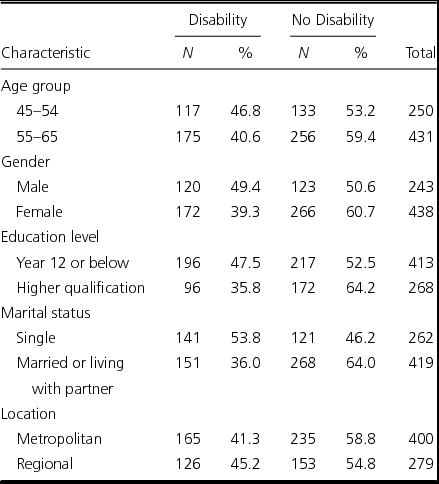
Table 1 presents the demographic characteristics of the Disability group and No Disability group. Significant differences existed between the groups in relation to gender (χ2 = 6.53, p < .05), marital status (χ2 = 20.81, p < .05) and education (χ2 = 8.99, p < .05). Participants with a disability were more likely to be male, single, and have a lower level of education. No significant differences existed between participants in metropolitan or regional locations, or between age groups. The mean time since last paid employment was 9.05 years (SD = 8.61) for the Disability group and 7.11 years (SD = 8.65) for the No Disability group. Participants with a disability had been out of work for an average 1.94 years longer than those without a disability (t(676) = 2.9, p < .05).
Demographic Characteristics of Disability and No Disability Groups

Search Rate
The rate of job search was significantly higher among participants aged 45 to 54 (34%) than those aged 55 to 65 (10.9%; χ2 = 54.01, p < .05), which is consistent with expectations of reduced search as retirement rates increase. There were no significant differences in search rates by gender (χ2 = 2.56, p > .05) or education level (χ2 = 1.44, p > .05).
There was no significant difference between the Disability group and No Disability group in the rate of job search (χ2 = 1.67, p > .05). However, more complex relationships were present in relation to age and education level. There was no significant difference between disability groups for those aged 55 to 65 (χ2 = 0.36, p > .05), but differences existed for those aged 45 to 54 (χ2 = 8.32, p < .05). In the younger group, only 24.8% of those with a disability were looking for work, compared to 42.1% without. The lack of significant difference in the older group appeared to be due to low rates of job search in this group, regardless of disability. Disability had a significant effect on the rate of job search for those who completed Year 12 or lower qualification (15.3% for the Disability group, 26% for the No Disability group; χ2 = 5.49, p < .05), while not for those with higher qualifications (χ2 = 0.1, p > .05). Gender did not affect the relationship between job search and disability in this way.
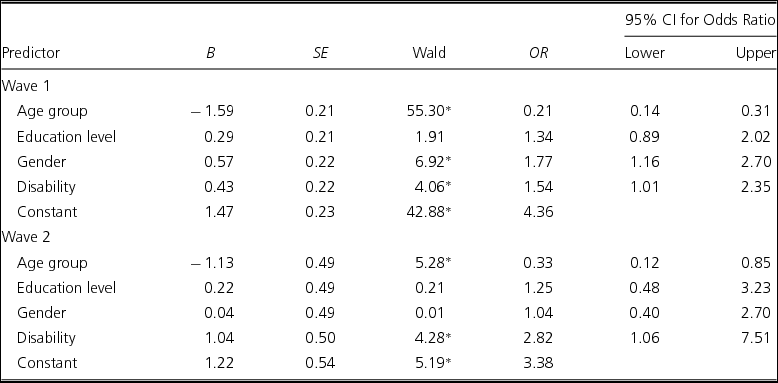
Table 2 presents the results of logistic regression analyses using disability status, age group, gender, and education level to predict whether participants were searching for work. The Wave 1 model indicates that disability, age and gender were significant predictors. Between 9.1% (Cox & Snell R 2) and 14.6% (Nagelkerke R 2) of variance in rates of job search were explained. Odds ratios (OR) indicate that men (OR 1.77) and the No Disability group (OR 1.54) were more likely to search for work while the older group was less likely to (OR 0.21).
Logistic Regression Analysis Predicting the Rate of Job Search
Note: Wave 1, χ2 = 65.140 (df = 4, p < .05); Wave 2, χ2 = 8.756 (df = 4, p > .05). B = non-standardised regression coefficients. SE = standard error. Wald = observed Wald χ2. OR = odds ratio. CI = confidence intervals.
* p < .05
The Wave 2 model indicates that disability and age were significant predictors of job search. The older group (OR 0.33) was less likely to search for work while the No Disability group (OR 2.82) was more likely to. Gender and education level were not significant predictors. Neither the full model nor a reduced model containing only the significant predictors was significant. The proportion of variance explained by the model was relatively small (between 7.3% and 11.2%).
Preferred Hours
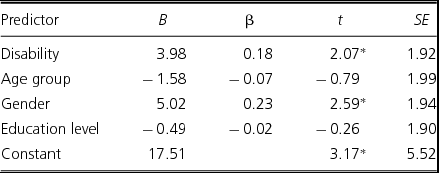
Predictors of preferred weekly working hours were examined using simple least squares regression analysis. The results are presented in Table 3. The model was significant but explained a relatively small proportion of the variance (8.1%) in preferred hours (R 2 = .08, adjusted R 2 = .05, F(4, 124) = 2.72, p < .05). Gender and disability were both significant predictors, with gender (β = .23) explaining a greater share of variability than disability (β = .18). The results indicated that women (mean preferred hours of 26.3 hours, SD = 9.6) had significantly lower preferred hours of work than men (M = 30.7, SD = 11.9). Those with a disability (M = 25.8, SD = 10.6) also had lower preferred hours than those without (M = 29.7, SD = 10.8). Age group and education level were not significant predictors.
Multiple Regression Analysis Predicting Preferred Hours of Work
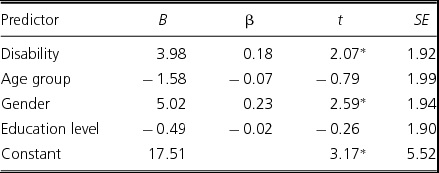
Note: B = nonstandardised regression coefficient. β = standardised regression coefficient. t = observed t value. SE = standard error.
* p < .05
The attrition rate precluded thorough longitudinal analysis of this variable and job search intensity. However, an ANOVA was performed for the 25 participants for whom there were Wave 2 data on preferred hours. No significant main or interaction effects were identified for any of the variables.
Job Search Intensity
Job search intensity was then examined. The results of a simple least squares regression analysis indicated no significant effects of disability, age group, gender or education level on job search intensity (R 2 = .02, adjusted R 2 = −.01, F(4, 127) = 0.54, p > .05). As with preferred hours of work, the large attrition rate prevented extensive longitudinal analysis. ANOVA indicated there were no significant differences in job search intensity at Wave 2 between the disability, age, gender and education level groups. No significant interaction effects were present. These findings were consistent with Wave 1 analysis.
Employment Outcomes
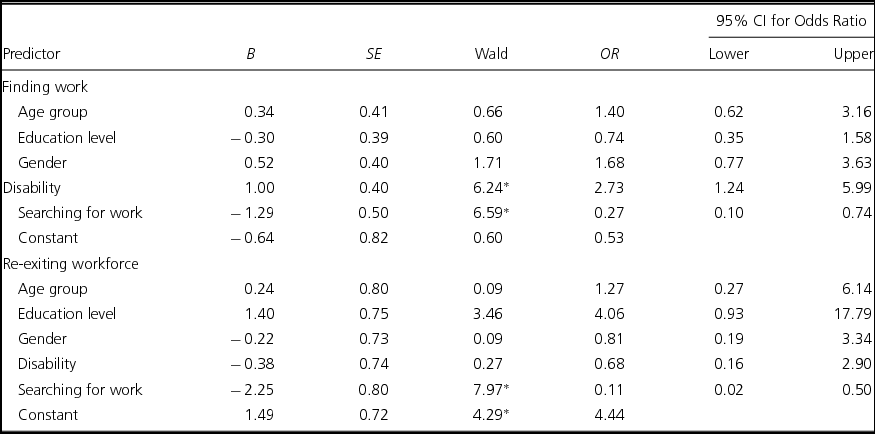
Of the 131 participants surveyed at both Wave 1 and Wave 2, 60 had found either full- or part-time work between surveys. Twenty-one of the 29 looking for work at Wave 1 had been successful. Logistic regression identified two significant predictors of the likelihood of finding employment. The model was significant and the proportion of variability explained ranged from 13.1% to 17.5%. The results are summarised in Table 4. Whether participants were actively searching for work at Wave 1 predicted employment outcomes, with those who were not searching less likely to have entered employment (OR 0.27). Disability was also a significant predictor; those without a disability were 2.73 times more likely to find work. Age group, gender, and education level were not significant predictors. Data regarding preferred hours of work and job search intensity were limited to the 29 participants who were looking for work in Wave 1. This small sample size precluded analysis of the impact of these predictors on employment outcomes.
Logistic Regression Analysis Predicting Employment Outcomes
Note: Finding work, χ2 = 18.389 (df = 5, p < .05); Re-exiting workforce, χ2 = 12.529 (df = 5, p < .05). B = nonstandardised regression coefficients. SE = standard error. Wald = observed Wald χ2. OR = odds ratio. CI = confidence intervals.
* p < .05
Sixty participants who responded at Wave 2 had found paid employment since Wave 1, although 45 of them were no longer employed by Wave 2. Logistic regression was used to examine the factors influencing participants re-exiting of the workforce. The model was significant (p < .05) and explained between 18.8% and 27.9% of the variability in re-exiting the workforce. The only significant predictor was whether participants were searching for work at Wave 1, with those who were looking less likely to have subsequently re-exited the workforce (OR 0.11). Disability, gender, age group and education level had no significant impact (see Table 4). Given the small sample size, care should be taken in interpreting this result.
Discussion
Disability acts to inhibit aspects of the job search process including rates of job search, preferred hours of work and employment outcomes. The disadvantage in employment and participation experienced by older Australians with a disability can be explained in part by poorer results on these key job search variables. While factors other than disability also had varying impacts across outcome measures, none had as consistent a negative impact as disability. Gender significantly affected rates of job search and preferred hours of work, while the effect of age was limited to rates of job search. Education level had no significant impact on any outcome measure.
The effects of disability on the rate of job search were partially confounded by the impact of age, with differences between disability groups only appearing amongst the younger participants (aged 45–54). Few older participants were searching for work regardless of disability, which is consistent with the general declines in job search and workforce participation with age documented elsewhere (ABS, 2010b; McFadyen & Thomas Reference McFadyen and Thomas1997). While lower rates of job search for people with disabilities have been reported elsewhere (Ali et al., Reference Ali, Schur and Blanck2011), further investigation of the interactive effects of age and disability, especially amongst workers younger than 45, would be valuable.
Gender had effects on job search rates in the cross-sectional analysis of Wave 1 data, but these results were not confirmed in the longitudinal analysis. The findings from Wave 1 are consistent with wider evidence of higher levels of workforce participation and job search by males (Purcell, Reference Purcell2010; Terefe, Reference Terefe2001). Perhaps surprisingly, education level did not predict rate of job search in either wave of analysis. However, the present findings do support the first hypothesis regarding the negative effects of disability, gender and age on rates of job search.
A clear difference was found in the preferred hours of work of those with and without disabilities, which was consistent with the second hypothesis and previous findings that those with a disability are more likely to be employed in part-time work than their peers without a disability (Wilkins, Reference Wilkins2004). This finding is also consistent with figures reported by the ABS (2005), suggesting that employed working age people with a disability were more likely to work part-time. Similarly, gender differences replicate previous findings about part- and full-time work (Terefe, Reference Terefe2001). The lower preferred hours indicate that at least part of the difference in the number of hours worked can be attributed to factors associated with individual preferences. However, the relatively small proportion of variance explained by disability and gender indicates that other factors have important roles.
While job search behaviours and intensities have been examined, little research has been done on wider constraints on job search, such as poor health and family conflict (Wanberg, Glomb, Song, & Sorenson, Reference Wanberg, Glomb, Song and Sorenson2005). More specifically, this is particularly pertinent for disability, as few studies go beyond a cursory examination of its impact, if it is examined at all. Future research would benefit from a more in-depth examination of variables such as financial strain, social networks, health, work and family and their relationships with job search and disability.
The unanticipated absence of an age effect contrasts with well established data indicating a shift from full-time work with age (ABS, 2010b). Our findings indicate that, among those not in paid employment, age has no impact on preferred hours. However, only participants aged 45 to 65 were examined and this restricted range of variability may have limited power to detect effects. A study which also included younger workers may find different results. The finding that age, education, and gender had no impact on search intensity contradicted the third hypothesis, and is inconsistent with other research (McFadyen & Thomas, Reference McFadyen and Thomas1997; Wanberg et al. Reference Wanberg, Kanfer and Rotundo1999). Gender differences are particularly well established (Jones, Reference Jones1989; Kulik, Reference Kulik2000). The failure to find a difference in this study may be related to the measurement of intensity. It was based on subjective responses to Likert scales, while other studies have measured how many hours were spent searching each week or the types of search engaged in. The present questions may have measured subjective perceptions of job search, rather than objective behaviour. Nonetheless, the findings indicate that participants perceived similar levels of search intensity, irrespective of differences in age, gender or educational level. Future studies might fruitfully explore the relationships between objective and perceived search intensities and determine their relative impacts on employment outcomes. However, the present finding that there was no difference in reported intensities appear to support Ali and colleagues’ (2011) conclusions that there is wide similarity in the type of job search behaviours performed by both those with and without disability.
As previously reported (Osberg, Reference Osberg1993), many participants found work even though they reported that they were not searching for it. However, those who were searching were more likely to have gained employment. That many were once more unemployed reflects the high degree of churning in and out of employment previously found amongst workers with disabilities (Cai et al. Reference Cai, Ha and Wilkins2007; Tseng, Vu, & Wilkins Reference Tseng, Vu and Wilkins2008). The failure to find an age effect on employment outcomes is surprising, and contradicts other research assessing participants aged over 16 (Dionne & Dube, Reference Dionne and Dube2005). Once again, restriction of attention to older workers may explain the failure to find this effect.
The finding that disability has a significant impact on employment outcomes is consistent with previously reported evidence (Dionne & Dube, Reference Dionne and Dube2005). It is likely that this impact can be partly explained by lower rates of job search among those with disabilities. However, results indicate that the disadvantage extends beyond this factor. It is not only that less people with a disability are looking for work, but that they face other barriers to gaining employment. Most importantly, the present findings suggest that the lower participation of those with a disability in the workforce is linked to lower rates of job search by this population in the first instance, followed by lower preferred hours of work for those who do engage in search and lower rates of success in finding employment. In addition to job seeking practices, other barriers to participation faced by people with disabilities have been identified in previous research. Kaye, Jans, and Jones (Reference Kaye, Jans and Jones2011) surveyed HR professionals and managers asking why they thought employers may not be as likely to hire or retain people with disabilities. Several reasons were proposed, including, employer's lack of awareness of how to accommodate workers with disabilities, costs of accommodating these workers, fears around legal liability and financial risk of workplace injury and concerns about job performance (Kaye et al. Reference Kaye, Jans and Jones2011). It is clear that multiple disadvantages exist for those with a disability.
The large attrition rate is of concern in interpreting the longitudinal results. Older participants in particular had higher levels of attrition, which was at least in part due to the exclusion criteria. Given that survey length and the time gap between surveys are negatively associated with contact rates in telephone surveys (Lynn, Buck, Burton, Jackle, & Laurie Reference Lynn, Buck, Burton, Jackle and Laurie2005), future studies could reduce the length of surveys and the time between surveys to improve response rates. It was also more difficult to recruit younger participants who are not in paid employment, resulting in unequal group sizes. The large sample size reduces the impact of this problem however.
Our measure of disability was also subjective and did not distinguish the type or severity of the disability. Self-reports about workforce participation can be affected by social desirability and participants justifying their choices (Aarts & de Jong, Reference Aarts and de Jong1992). There are concerns about the potential to overestimate the rate of disability and its effects (Burkhauser & Daly, Reference Burkhauser and Daly1998; Jones, Reference Jones2008), particularly among older workers (Bound & Burkhauser, Reference Bound, Burkhauser, Ashenfelter and Card1999). However, self-report disability measures are widely used in existing research and many argue that they are appropriate given that disability is subjective in nature (Dwyer, Reference Dwyer1999; Kreider, Reference Kreider1999). In addition, there were no data to determine how long participants who were employed at Wave 2 had been in paid work. Consequently, the proportion of those in work who had sustained employment over an extended period could not be determined.
Conclusions
Disability is a significant barrier in the job search process. The present results indicate it influences three key stages of the employment process: the rate of job search, preferred hours of work and success in securing employment. While job search intensity and rate of exiting the workforce after gaining employment were not significantly affected, disability still permeated the processes of job search and employment. Given the limited attention disability has received in research on the job search process, this evidence should provide impetus for further investigation of disability effects.
The present findings indicate that disability and, to a lesser degree, age and gender play significant roles in shaping the job search processes of older workers who are not in employment. These factors can create multiple disadvantages for individuals and diminish their ability to fully engage in employment and society. Understanding the difficulties and barriers they encounter is crucial in improving participation and employment outcomes among individuals and wider workplace participation and productivity.