The new type of coronavirus disease 2019 (COVID-19), which first appeared in Wuhan, China, and spread to the world, has become a pandemic all over the world. Reference Huang, Wang and Li1 As emergency departments (EDs) are the first units for patient admissions, they have played an active role in the identification and treatment of the disease. The definitive diagnosis of the disease has been established by real-time reverse-transcription polymerase-chain-reaction (PCR) test. However, a possible diagnosis was established with clinical suspicion, blood test results indicating viral infection, and the evaluation of the findings in computed chest tomography (chest CT). The effective use of blood tests and tomography is of great significance in the early initiation of the treatment. It is observed that the early initiation of the treatment positively influences the prognosis in patients considered as possibly having a diagnosis of COVID-19. Reference Luo, Ang and Chan2
The clinical course of COVID-19 has a wide spectrum range. In some people, it may run its course with slight symptoms such as fever, cough, and fatigue; in others, it may progress to critical conditions such as sepsis, respiratory failure, acute respiratory distress syndrome, heart failure, and septic shock. Reference Liang, Liang and Ou3 It has been revealed that advanced age and comorbidities cause poor prognosis in the course of the disease, and most of the deaths from COVID-19 occur in patients at an advanced age and with comorbidities. Reference Wu, Chen and Cai4 Findings in the laboratory tests such as neutrophil to lymphocyte ratio (NLR), C-reactive protein (CRP), ferritin, and d-dimer and chest imaging have been reported to be correlated with the prognosis of the disease. Reference Lippi and Plebani5,Reference Francone, Iafrate and Masci6 Prediction of the probable prognosis of the diagnosed patients will contribute to determining the treatment to be given and the place of treatment (home, ward, intensive care unit [ICU]). In this manner, patients whose clinical condition is good at the time of admission but may worsen quickly can be determined and prevented from reaching a critical stage with appropriate follow-up and treatment, and the mortality rate can be decreased.
In this study, we aim at evaluating the demographic data, symptoms, comorbidities, laboratory tests, and chest CT scans of the patients diagnosed with COVID-19 and determining the parameters to predict the requirement of ICU admissions after the initial examination.
Methods
Study Design
This retrospective observational study was carried out in the ED of Beylikduzu State Hospital between March 15, 2020, and April 15, 2020. The study facility was a 360-bed state hospital with a monthly ED census of approximately 40,000. Our ED has 2 separate observation rooms, 6 beds in the critical (red) area and 32 beds in the non-critical (yellow) area. The institutional review board approved the analysis and issued a waiver of consent (Ethics Committee Ruling number: 12/06/2020 - 2407).
Selection of Patients
Patients who had presented to the ED between March 15 and April 15, 2020, and been diagnosed with COVID-19 as a result of the PCR test and were above 18 years of age were included in the study. Patients younger than 18 years of age, with negative PCR results, and incomplete clinical information, blood tests, and CT results were excluded from the study. Patients’ age, gender, application complaints, vital signs (fever, pulse, blood pressure, respiratory rate, and O2 saturation), comorbidities, blood test results (CRP, NLR, D-dimer, ferritin), and chest CT results were recorded. It was recorded where the follow-ups were carried out (home, isolated ward, or ICU) and how the disease came to an end (recovery/death). Thus, the capability of the clinical characteristics, findings, and results at admission to predict the poor prognosis in patients diagnosed with COVID-19 and its effect on ICU admissions will be investigated.
Measurements
In the laboratory of our hospital, normal limits for blood tests were determined as CRP 0-5 mg/L, D-dimer 0-0.5mg/L, ferritin 13-150 ng/mL. As an indicator of infection, NLR cutoff value was accepted as 3 (10 3/µL), and patients were assessed in 2 groups as 3> and 3≤. To determine the lung involvement of the disease, chest CT was performed on the patients. For all the 5 lobes of the lungs, less than 25% involvement was considered as mild infiltration, and 25% or more involvement as diffuse infiltration. Chest CT results were analyzed by 2 independent researchers. In case of disagreement, a third researcher was consulted. With these results, the treatments was initiated in those patients who were considered as possible positive diagnosis, and those patients were followed up at their homes, in isolated wards at the hospital, or in isolated intensive care units.
PCR test was implemented in patients considered as possible positive diagnosis, and patients with positive PCR results were evaluated as definitive diagnosis. Patients followed in ICU were given non-invasive or invasive respiratory support in addition to medical treatment. Patients who were isolated at home or found suitable for switching from isolation in ward to isolation at home were called for PCR control when their quarantine periods were over (approximately 14th day), and the course and outcome of the disease were followed. Clinical outcomes (discharge/death) of patients were received from the Hospital Information Management Systems (HIMS) and discharge reports of our hospital. The effect of clinical characteristics, laboratory tests, and imaging results of COVID-19 patients on ICU admissions will be researched.
Statistical Analysis
Categorical data were presented as frequency and percentage. The frequencies of categorical variables were compared using the chi-squared and Fisher exact tests as appropriate. Continuous variables were tested for distribution using the Kolmogorov–Smirnov test. The asymmetrically distributed variables were analyzed with the Mann–Whitney U test and expressed as the median interquartile range (IQR; 25%-75%). For the prediction indicators, an optimum cutoff point can be determined by calculating Youden Index. The cutoff point that achieves this maximum Youden Index is referred to as the optimal cutpoint. Youden Index is the main summary statistic of the receiver operating characteristic (ROC) curve used in the interpretation and evaluation of an indicator, which defines the maximum potential effectiveness of a diagnostic test. The area under the curve (AUC) of ROC was compared using Delong test. AUC 0.9 to 1 was defined as excellent accuracy, 0.8 to 0.9 as very good, 0.7 to 0.8 as good, 0.6 to 0.7 as sufficient, 0.5 to 0.6 as bad, and < 0.5 as poor (useless test). Binary logistic regression analysis with a backward stepwise approach was used to determine the presence of statistically significant association between laboratory indicators and ICU admission. The odds ratio was calculated for significantly associated variables. A 2-sided P-value 0.05 was regarded as statistically significant. All data analyses were performed using SPSS version 22.0 software (SPSS Inc., Chicago, IL, USA).
Results
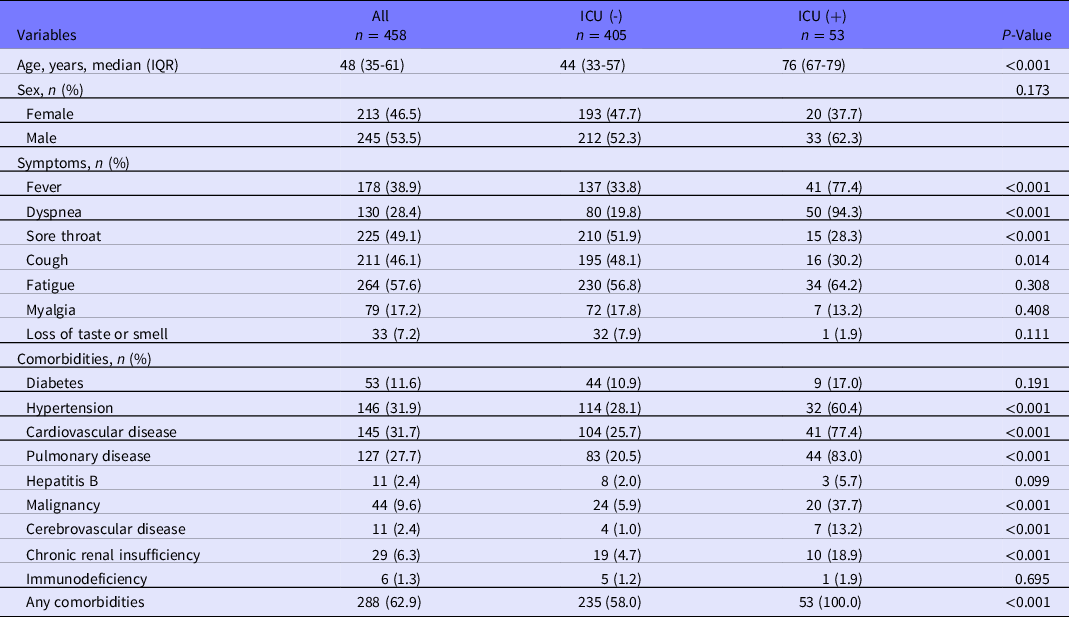
A total of 458 patients diagnosed with COVID-19 were included in this study: 405 patients were categorized with non-severe disease, which did not require ICU follow-up; 53 of them had a severe condition and were admitted to ICU. The median (IQR) age of the patients was 48 y (35-61), 213 (46.5%) were female. The median (IQR) age value of the patients who were followed up in ICU owing to the severe course of the disease was 76 (67-79), which was significantly higher than those without ICU need (P < 0.001). The most common symptoms were fatigue (57.6%), sore throat (49.1%), cough (46.1%), and fever (38.9%). There was at least 1 comorbidity in 288 (62.9%) of the patients and all the patients followed in the ICU. Of the comorbidities, hypertension (31.9%), cardiovascular diseases (31.7%), and lung diseases (27.7%) were the top 3. There is a significant correlation in the analysis between the presence of any comorbidity and ICU need (P < 0.001). The demographic characteristics, symptoms, and comorbidity characteristics of the patients are stated in Table 1.
Demographics, symptoms, and comorbidities of patients with COVID-19

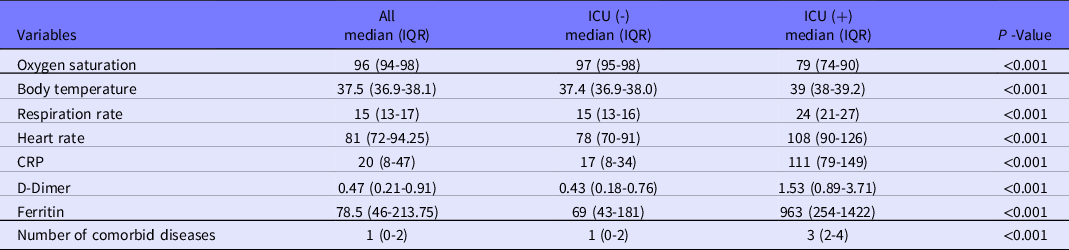
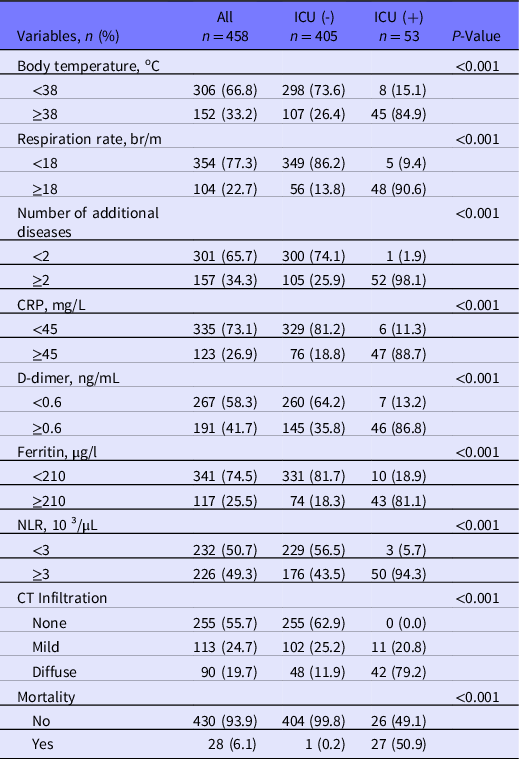
When vital signs, laboratory results, and number of comorbidities of the patients were reviewed, body temperature, respiration rate, CRP, D-dimer, ferritin values, and number of comorbidities were significantly higher in patients admitted to the ICU than others; and their O2 saturations were lower (Table 2). According to the Youden Index, cutoff values were determined as 38oC for body temperature, 18 breaths/min for respiration rate, 45 mg/L for CRP, 0.6 ng/dL for D-dimer, 210 μg/L for ferritin, and 2 for multiple comorbidities. The AUC values of those cutoff points were 0.810, 0.943, 0.902, 0.833, 0.891, and 0.909, respectively (P < 0.05). The fact that the examined variables were above the cutoff values we determined was significantly common among the patients in ICU (P < 0.001). When chest CT scans were evaluated, 90 (19.7%) patients had diffuse infiltration, 113 (24.7%) patients had mild infiltration, and 255 (55.7%) patients had no infiltration. Of the 53 patients admitted to ICU, 11 (20.8%) had mild infiltration, whereas the remaining 42 (79.2%) patients had diffuse infiltration. Regarding follow-up, 310 (67.7%) of the patients were isolated at home, 95 (20.7%) were followed in the ward, 23 (5.0%) under non-invasive ventilation in the ICU, and 30 (6.6%) with further airway support in the ICU. Regarding mortality, it was found that 430 (93.9%) patients recovered, and 28 (6.1%) patients died. Information about the determined cutoff values, CT infiltration, and mortality between the groups are stated in Table 3.
Vital signs, laboratory results, and number of comorbid diseases of patients with COVID-19

Distribution of the variables according to the determined cutoff values, CT infiltration and mortality

Abbreviations: PCR, polymerase chain reaction; CRP, C-reactive protein; NLR, neutrophil lymphocyte ratio; CT, computed tomography.
As a result of these evaluations, multiple regression analysis was carried out to evaluate the effect of the variables on ICU need. A statistically significant correlation was found between the presence of dyspnea (OR: 12.55), tachypnea (RR ≥ 18) (OR: 14.54), multiple comorbidities (≥ 2) (OR: 23.39), diffuse infiltration in CT (OR: 14.52), and CRP (≥ 45 mg/L) (OR: 4.71), and the need for ICU admission. The model formed with these parameters largely explains patients who need ICU admission with the value of R2 = 0.84 (Model Summary: -2 Log likelihood: 71.053; Cox and Snell R2 = 0.430; Nagelkerke R2 = 0.840) (Table 4).
Multivariate binary regression analysis for ICU care requirement among patients with COVID-19

Note: Model Summary: -2 Log likelihood: 71.053; Cox and Snell R Reference Luo, Ang and Chan2 = 0.430; Nagelkerke R2 = 0.840.
Abbreviations: OR, odds ratio; 95% CI for OR, lower and upper bound of 95% confidence interval.
Discussion
Effective early evaluation of the patients with a need for intensive care is significant for the healthcare system to function as long as possible. Reference Doanay, Elkonca, Seyhan, Yılmaz, Batırel and Ak7 In this retrospective cohort study, we examined the value of demographic data, vital parameters, laboratory tests, and imaging results of patients diagnosed with COVID-19 in the ED in predicting the need for ICU admission. In our study, we discovered that the presence of dyspnea and tachypnea (RR ≥ 18), having 2 or more comorbidities, diffuse infiltration in chest CT, and CRP ≥ 45 mg/L explained the patients who needed ICU admission by 84%.
The coronavirus pandemic has led to a serious public health problem worldwide, especially caused a serious crowding on EDs and ICUs. 8 It is important to predict the intensive care needs and mortality of patients. In line with this purpose, previously known scoring systems such as Sequential Organ Failure Assessment (SOFA), quick SOFA (qSOF, and National Early Warning Score (NEWS) have been used, and new scoring models such as the quick COVID-19 Severity Index (qCSI) have been developed. Reference Liu, Yao, Qiu and He9–Reference Haimovich, Ravindra and Stoytchev11 qCSI, which consists of 3 parameters (respiratory rate, breaths/min; pulse oximetry; O2 flow rate, L/min), is an effective score to be used for predicting the bedside respiratory failure. In our study, the presence of dyspnea and tachypnea were found to be effective in predicting the ICU admission need of the patients.
CRP is an acute phase inflammatory protein produced by the liver. It can be elevated in various conditions such as an inflammation, cardiovascular disease, and infection. Reference Sproston and Ashworth12 There are studies where serum CRP values were used to designate the prognosis of COVID-19 patients. Reference Luo, Zhou and Yan13 In the study of Fang Liu et al., the disease has a more severe course in COVID-19 patients with CRP ≥ 41.8 mg/L. Reference Liu, Li and Xu14 In the study conducted by Wei Chen et al., a positive correlation was identified between CRP levels and COVID-19 severity. They emphasized that a value of CRP ≥ 16.6 mg/L prolonged hospital stay. Reference Chen, Zheng, Liu, Yan, Xu and Qiao15 In the study of T. Herold et al., it was concluded that high interleukin (IL) -6 and CRP (> 97 mg/L) values could be successful in determining mechanical ventilation and respiratory failure in 80% of patients. Reference Herold, Jurinovic and Arnreich16 In our study, a positive correlation was found between CRP over 45 mg/L (OR: 4.71) and the need for ICU admission. However, it should be remembered that various factors such as age, gender, smoking status, body weight, lipid levels, blood pressure, and liver damage can influence serum CRP levels. Reference Sproston and Ashworth12
When the comorbidities of the patients were reviewed in our study, it was observed that the patients mostly had hypertension (31.9%), cardiovascular disease (31.7%), lung diseases (27.7%), and diabetes (11.6%). We concluded that patients with a comorbidity needed more intensive care than those without comorbidities, and 2 or more comorbidities were quite effective in predicting the need for intensive care (OR: 23.39). Those with diabetes and cardiovascular and lung diseases not only have a risk of having the disease at a severe level, but also have an increased risk of death. Reference Sanyaolu, Okorie and Marinkovic17 It has been reported that 86% of the patients who died in New York due to COVID-19 had at least 1 comorbidity, and the most common comorbidities were hypertension (55.4%) and diabetes (37.3%). 18 In a meta-analysis study on COVID-19 comorbidities, it was reported that the most common comorbidities identified in these patients were hypertension (15.8%), cardiovascular and cerebrovascular diseases (11.7%), and diabetes (9.4%). Less common comorbidities were infection together with HIV and hepatitis B (1.5%), malignancy (1.5%), respiratory diseases (1.4%), kidney disorders (0.8%), and immunodeficiencies (0.01%). 19 In a multicenter study carried out in China, it was reported that having a comorbidity was associated with a poor prognosis compared to patients without any comorbidities, and more comorbid conditions were associated with worse clinical outcomes. Reference Guan, Liang and Zhao20
PCR test is used to diagnose COVID-19. Reference Huang, Wang and Li1 For imaging, chest CT can give specific findings for the disease; multifocal ground-glass opacities and consolidation in the peripheral distribution are the most common findings. Reference Lei, Li, Li and Qi21 There are studies indicating that chest CT can be as sensitive as PCR test to diagnose the disease. In a study conducted on 1,014 patients who underwent both PCR test and chest CT for the evaluation of COVID-19 in Wuhan, a “positive” chest CT for COVID-19 was reported to have a sensitivity of 97%. Reference Ai, Yang and Hou22 In our study, it was concluded that more than 25% diffuse infiltration in chest CT could be used as a significant parameter to predict the need for intensive care in patients.
Limitations
There are some limitations in our study. First, this was a single-center study executed on a relatively small population and needs to be confirmed in a larger, multi-center cohort. Our data were obtained from an electronic registration system, which brings about limitations with respect to providing incomplete or old information. Retrospective studies are inherently devoid of the control of variables; therefore, prospective cohorts are needed to confirm our study data. Finally, no external validation was performed in our study. External validation studies are needed to ensure the extensive usability of our results.
Conclusions
As a result, clinical worsening and need for intensive care may emerge in COVID-19 patients who present to EDs. Despite the highlighted limitations, this study provided information about the parameters that could be used to predict the severity of COVID-19 cases. It has been concluded that the presence of dyspnea and tachypnea, elevated CRP, presence of 2 or more comorbidities, and diffuse infiltration in chest CT may predict the need for ICU admissions of the patients, who presented to the EDs.
Data availability statement
The authors agree to the conditions of publication including the availability of data and materials in our manuscript.
Author contributions
Concept: S.B.; Design: S.B., E.K.; Supervision: S.B.; Materials: E.K.; Data: E.K., S.B.; Analysis: S.B., E.K.; Literature search: E.K.,S.B.; Writing: E.K., S.B.; Critical revision: S.B., E.K.
Funding statement
The authors received no financial support for the research, authorship, and/or publication of this article.
Conflict(s) of interest
Authors declare that they have no conflicts of interest.
Ethical standards
The principles outlined in the Declaration of Helsinki have been followed. This study was approved by the local ethics committee. Written informed consent was not necessary because no patient data has been included in the manuscript