Precision medicine is the practice of identifying suitable treatments for patients based on the molecular understanding of their disease. The term is often used interchangeably with personalized medicine or stratified medicine (Reference Larry Jameson and Longo1). The molecular understanding refers to biomarkers which are predictive of the effect of a drug, these markers can be identified by in vitro diagnostics also known as companion diagnostics. Companion diagnostics are defined as essential for the safe and effective use of the precision medicine (2). For this reason, precision medicines and their respective companion diagnostics are considered co-dependent technologies, as the effectiveness of the precision medicine therapy is achieved only when two entities (i.e., the pharmaceutical product and the diagnostic test) are used in conjunction with one another (Reference Merlin, Farah, Schubert, Mitchell, Hiller and Ryan3). Ideally when conducting a health technology assessment (HTA) of two co-dependent technologies, both entities should be co-assessed. This is however not straightforward when considering reimbursement decision making.
Patient access to precision medicine through the public insurance system has notoriously been hampered due to divergent reimbursement practices between the pharmaceutical product and the companion diagnostic test (4;5). Different stakeholders, different HTA frameworks and different decision timelines for reimbursement often apply, as was the case for Belgium. Here, the reimbursement procedure for an in vitro diagnostic was embedded in the general reimbursement procedure for medical acts. In this procedure, the assessment is carried out by the Working group Clinical Biology and the appraisal by the Technical Medical Council (TMC) of the National Institute for Health and Disability Insurance (RIZIV-INAMI). The final decision is then taken by the minister of Social Affairs and consequently ratified by the King of Belgium. Due to the lack of a legal timeframe for the procedure, it can take up to 18 months for a new in vitro diagnostic to be reimbursed and even longer when budgetary concerns arise (6). For the pharmaceutical reimbursement procedure, the assessment and the appraisal are carried out by the Drug Reimbursement Committee of RIZIV-INAMI and the final decision is taken by the minister of Social Affairs. This process is subdued to a strict legal timeframe of approximately 6 months (suspensions not included) (6). This has led to situations where the pharmaceutical is reimbursed, whereas the decision for reimbursement of the companion diagnostic has not yet been made (Reference Miller, Ashton-Chess, Spolders, Fert, Ferrara and Kroll4–Reference Wurcel, Perche, Lesteven, Williams, Schäfer and Hopley7). In Belgium for example, the reimbursement of Xalkori ® was approved in 2013 whereas the companion diagnostic test for the identification of the ALK fusion gene was authorized for reimbursement only in 2019.
In order to resolve this issue, in July 2019 the Belgian legislator incorporated the reimbursement procedure of companion diagnostic medical acts into the reimbursement procedure of the pharmaceutical product (8). The Drug Reimbursement Committee will now make joint reimbursement-decisions on the pharmaceutical product and the companion diagnostic medical act based on co-assessment of both entities. In 2014, guidelines for submitting reimbursement demands have already been adapted to include information on the companion diagnostic to enable such co-assessment. Crucial for the co-assessment is the clinical utility which is claimed to be provided by the companion diagnostic test. The test should be able to select those patients who will benefit from the precision medicine with a high degree of certainty. It does so by measuring a biomarker that predicts the response to and/or toxicity of the drug. Ultimately, the value of a companion diagnostic is determined by an accurate selection of these patients based on this biomarker, so as not to exclude anyone who will benefit from therapy or include those who will not.
The HTA of co-dependent technologies has been described by several national HTA agencies. The National Institute for Health and Care Excellence (NICE) of England distinguishes two approaches. In the case where the companion diagnostic of the pivotal trial is used in clinical practice, NICE concludes that only the cost of the companion diagnostic testing is considered in the assessment of the cost-effectiveness of the drug. In the case where another test or multiple tests are used in clinical practice, complex modeling can be necessary to link the test accuracies to comparative effectiveness data through the linked evidence approach. This linked evidence approach was developed by the Australian Medical services and Pharmaceutical benefit advisory committees (Reference Merlin, Farah, Schubert, Mitchell, Hiller and Ryan3). This approach takes the assumption that the comparative effectiveness of the therapy is solely correlated with the performance of the test, which allows for a comparison of different diagnostic tests. The approach can also be useful if key evidence of clinical utility of the predictive biomarker is missing. This is the case when either an enrichment clinical trial design was used (includes only the patient positive population) or a randomized-all clinical trial, which was inconclusive on the predictive utility of the biomarker. Both the Haute Autorité de Santé (HAS) and the Institut für Qualität und Wirtschaftlichkeit im Gesundheitswesen (IQWIG) conclude that occasionally from these data a strong rationale could emerge to establish the clinical utility of the biomarker. However, both agencies remain reluctant to recommend the use of a companion diagnostic based on this practice, regardless if the test is regulatory required (9;10). Given these considerations, a comprehensive co-assessment framework was created by Merlin et al. (Reference Merlin, Farah, Schubert, Mitchell, Hiller and Ryan3–11) to inform reimbursement decisions in the Australian healthcare system.
With the changes in the reimbursement procedures of the Belgian reimbursement agency, the Drug Reimbursement Committee has to expand its assessment competencies of pharmaceuticals to co-assessment competences of pharmaceuticals and companion diagnostics to enable informed reimbursement decision making. In order to facilitate this transition of the Drug Reimbursement Committee, this study aims to characterize and to evaluate the assessment reports of precision medicines previously submitted within the context of the Belgian reimbursement application procedure for pharmaceuticals according to the “2014” adapted guidelines. From this exercise, we are able to formulate specific recommendations to improve the assessment of precision medicines in the novel procedure.
Methods
This retrospective study consists of an evaluation of the HTA practices of the pharmaceutical assessment committee of RIZIV-INAMI in Belgium. For this purpose, an evaluation of the precision medicine assessment reports drafted by the committee to inform reimbursement-decisions in the Belgian healthcare system took place.
Two criteria were defined for inclusion of the assessment reports in this study: first, the drug and the biomarker are listed in the precision medicine reimbursement list “Chapter VIII” and the benefit catalog for precision medicine testing “Nomenclature Article 33ter”. Second, the request for reimbursement had to be submitted no later than 5 years prior to the start of the study, January 2019. All assessment reports that met these inclusion criteria were included in this research. We chose a 5-year cut-off point as the guidelines for submitting reimbursement demands were adapted to include information on the companion diagnostics in 2014. No substantive modification to these requirements was made since.
The included pharmaceuticals were categorized according to their value claim. Applicants make a value claim when applying for reimbursement of their pharmaceutical product. These value claims are classified as “providing additional benefit” (class I—drugs) or “no additional benefit” (class II—drugs) compared to other reimbursed treatments. A separate classification exists for generics (class III—drugs) and orphan drugs. The pharmaceutical assessment committee evaluates pharmaceuticals based on the principles of evidence-based medicine and considers therapeutic value, medical and societal need, and the budget impact on the Belgian insurance system for class I, class II, and orphan drugs. In addition, a cost-effectiveness study is required for class I drug claims (12).
The included assessment reports were evaluated and compared against the HTA framework developed by Merlin et al. (further called the Merlin framework) for evaluating co-dependent technologies in Australia (Reference Merlin, Farah, Schubert, Mitchell, Hiller and Ryan3). This framework was chosen as it is the most comprehensive framework on co-assessments available within literature and the Australian reimbursement practice will closely resemble the new Belgian co-assessment procedure. The Merlin framework consists of five domains: (A) context of submission of the technology and the co-dependent relationship between the pharmaceutical and the companion diagnostic, (B) clinical evidence and utility, (C) translation of the clinical evidence to population of interest, (D) cost-effectiveness analysis, and (E) budget impact analysis (Supplementary material—Framework). The framework distinguishes between direct evidence of clinical utility of the test being available or not, specifying levels of evidence that can be met based on clinical trial designs. If no appropriate trial has been carried out to establish the clinical utility of the test, indirect evidence is considered to evaluate the clinical utility, also known as the linked evidence analysis (3–13;14).
The published Merlin framework was adapted to fit the Belgian reimbursement context. Of the 79 assessment criteria specified in the original publication, 78 were retained for this analysis as the criteria “(1) who is the test sponsor” would technically be the pharmaceutical applicant within the Belgian system (Supplementary materials—Framework). Each assessment report was evaluated on the criteria being sufficiently addressed and thus present, or not. Sufficiently, in this regard, means if distinct requirements were fulfilled as specified by the Merlin framework (Reference Merlin, Farah, Schubert, Mitchell, Hiller and Ryan3). In case of uncertainty, the criterion was reported not addressed in the assessment report. A non-disclosure agreement was set up with RIZIV-INAMI and access to the assessment reports was granted for the purpose of this research. Assessment reports were evaluated by three researchers simultaneously and the criteria, which were present in the assessment report, were attributed under mutual agreement. Data collection was performed in February and March of 2019.
Results
Characterization of Assessment Reports
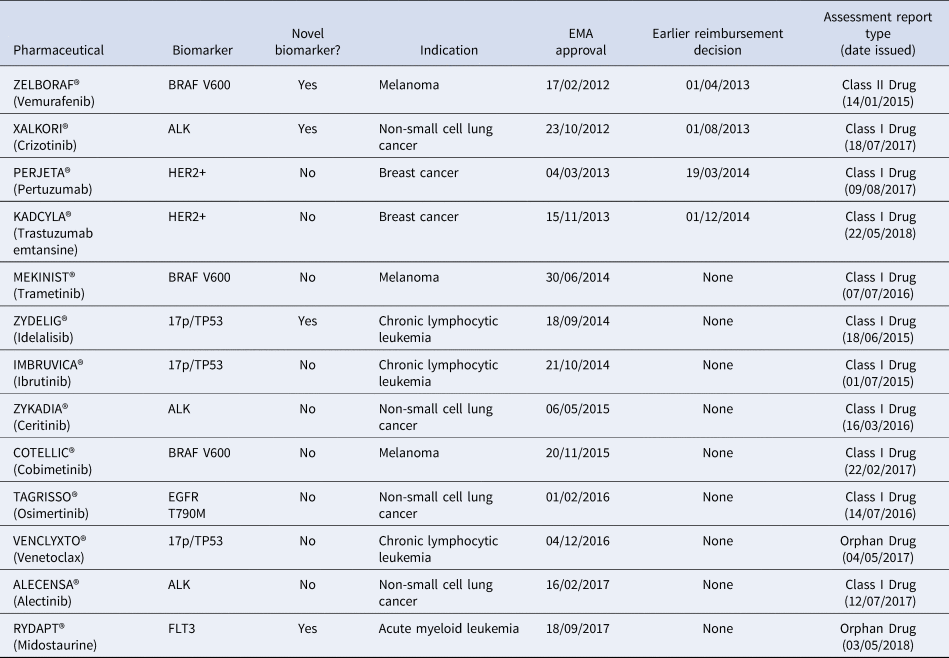
This research included thirteen assessment reports for precision medicines that were drafted between January 2014 and January 2019 by the Belgian pharmaceutical assessment committee to inform reimbursement decision making (Table 1). All of the assessed pharmaceuticals were approved for indications within the domains of oncology or hemato-oncology. Four pharmaceuticals, which obtained earlier reimbursement decisions, ZELBORAF®, XALKORI®, PERJETA®, and KADCYLA®, had their assessment report updated and amended with either completed trial data and/or with real world data on Belgian patients. This research identified four assessment dossiers covering the evaluation of a therapy introducing a novel biomarker, and thus the introduction of a novel patient stratification within the healthcare system. All of the reimbursement applications were approved in the Belgian reimbursement system.
Overview of included pharmaceutical assessment reports for evaluation

EMA, European Medicine Agency.
Novel biomarker: the biomarker was not assessed earlier by the pharmaceutical assessment committee.
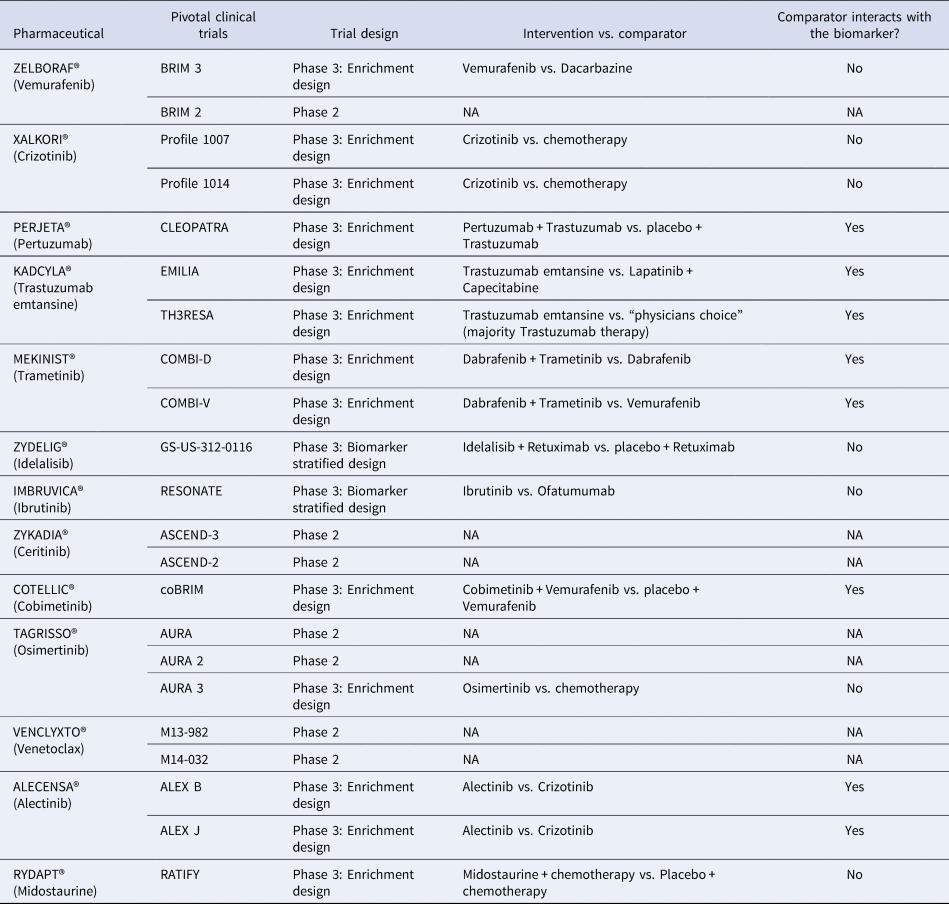
The efficacy evidence submitted by the applicant and included in the assessment reports was classified according to trial design and comparator (Table 2). Assessment reports contained varying levels of evidence ranging from two clinical phase three trials: XALKORI®, KADCYLA®, and ALECENSA®, one clinical phase three trial: ZELBORAF®, PERJETA®, ZYDELIG®, COTELLIC®, TAGRISSO®, ALECENSA®, or solely phase two trials: VENCLYXTO®. The included phase three trials were most often enrichment design trials. Only two phase three clinical trials, for IMBRUVICA® and ZYDELIG®, could be identified utilizing the biomarker-stratified design. In these phase three trials the novel pharmaceutical under investigation was either administered as a combination or as a stand-alone therapy. Comparators were either precision medicines targeting the same biomarker or established therapies such as chemotherapies.
Efficacy evidence available in assessment reports

NA, not applicable.
Evaluation of Assessment Reports
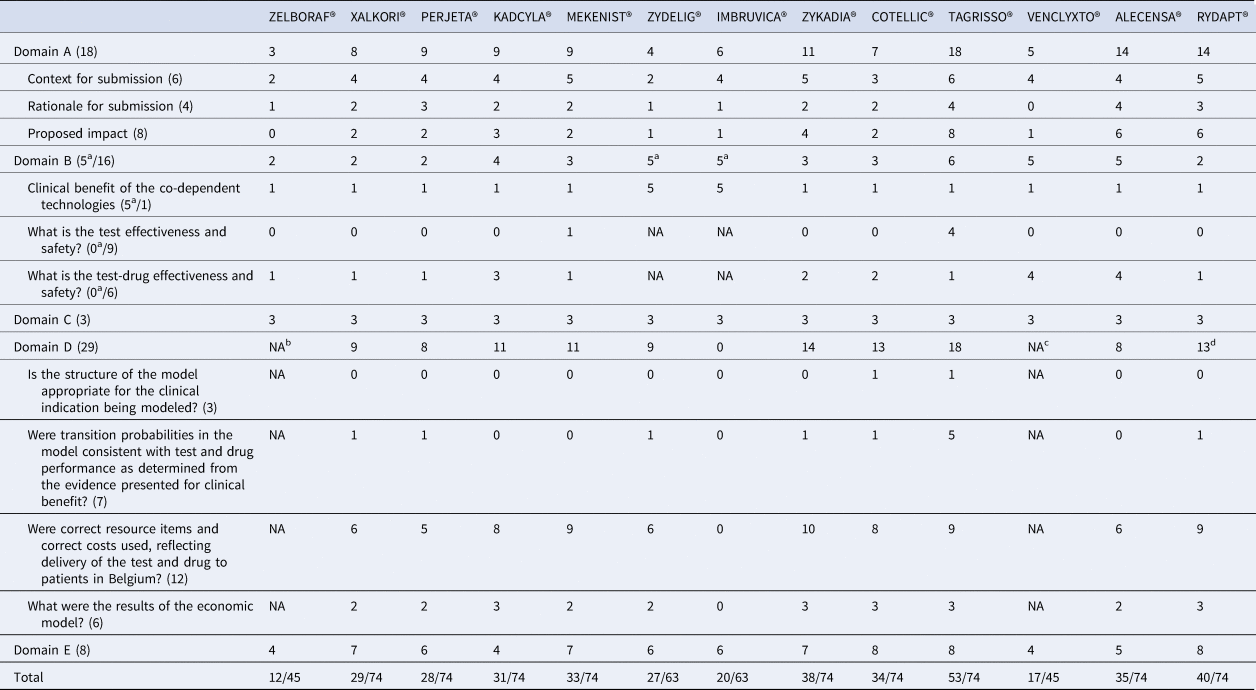
The evaluation of thirteen assessment reports was conducted using the seventy-eight criteria Merlin framework for assessing co-dependent technologies adapted to the Belgian context of assessment (Table 3) (Supplementary materials).
Evaluation of the assessment reports using the Merlin framework

NA, not applicable.
(A) Context of submission of the technology and the co-dependent relationship between the pharmaceutical and the companion diagnostic; (B) clinical evidence and utility; (C) translation of the clinical evidence to population of interest; (D) cost-effectiveness analysis; and (E) budget impact analysis.
a Direct evidence available, only five criteria apply.
b No cost-effectiveness study required due to benefit claim class II.
c No cost-effectiveness study required due to orphan drug status.
d Orphan drug with cost-effectiveness study.
For the assessment of the first domain (A) of the Merlin framework about the context of submission of the technology and the co-dependent relationship between the pharmaceutical and the companion diagnostic, eighteen assessment criteria needed to be addressed. These criteria were met inconsistently across all reports with scores ranging from 17 percent up to 100 percent (Table 3).
Assessment domain (B) covered the effectiveness of the therapy and the clinical utility of the test. Five criteria applied if direct evidence was available and sixteen criteria when this was not the case. Only two assessment reports could be identified using direct evidence of clinical utility for the respective companion diagnostic tests, namely for ZYDELIG® and IMBRUVICA®, where all five criteria were covered in the assessment report. However, for all other assessment documents for which no direct evidence was available, sixteen criteria were addressed via a linked evidence approach that considers the effect of the precision medicine only in the biomarker positive patient subpopulation as determined by the test. These criteria were addressed poorly (Table 3). Furthermore, no bias assessment tools were identified in the assessment reports.
Assessment domain (C) covers the translation of evidence to the Belgian population, which then can be utilized in the cost-effectiveness study. Here a perfect score was obtained for all assessment dossiers (Table 3).
Assessment domain (D) evaluates the cost-effectiveness study. This domain was not assessed for ZELBORAF®, a class II drug and VENCLYXTO®, an orphan drug. In this regard, RYDAPT® is also classified as an orphan drug for patients with acute myeloid leukemia with FLT3-mutation, however here the applicant provided a cost-effectiveness study which was included in the assessment report of the pharmaceutical assessment committee. For this domain no perfect score was obtained for any assessment report. Criteria involving costs and effects of the pharmaceutical product scored well, whereas those for test characteristics were most often lacking in the assessment.
Assessment domain (E) evaluates the budget impact on the statutory healthcare system. Perfect scores were identified for COTELLIC®, TAGRISSO® and RYDAPT®.
Discussion
This study aimed to characterize and evaluate precision medicine HTA reports of the Belgian pharmaceutical reimbursement committee. This evaluation was based on the Merlin framework for evaluating co-dependent technologies, which was adapted to fit the Belgian context (Reference Merlin, Farah, Schubert, Mitchell, Hiller and Ryan3). Thirteen assessment reports met the inclusion criteria and were consequently described based on general characteristics (Table 1) and efficacy evidence provided in the report (Table 2). The evaluation of these assessment reports yielded varying results per assessment domain of the framework, most notably domains A, B, and D, which evaluate the clinical utility and the cost-effectiveness of the precision medicine practice (Table 3).
Although objective requirements were utilized to determine if the subject conveyed in the criteria under investigation was assessed, we acknowledge that these requirements were stringently specified by the Merlin framework. Criteria across all assessment reports had some, but not all requirements fulfilled and thus the criteria were consequently deemed “not present” in the assessment report. Nevertheless, this research does not pertain to verify the quality of the assessment reports in a quantitative way, it rather conveys an impression on areas for improvement.
By taking into account the results in Table 3, we identified discrepancies between the reported criteria in the assessment reports for domain A (context and co-dependent relationship). This could indicate that the general drug application guidelines maintained by RIZIV-INAMI would benefit from further specification, to decrease the variability between assessment reports (15).
Domain B establishes the clinical utility of the co-dependent technology and assesses the efficacy in the targeted population. Here, only two pharmaceuticals utilized the pivotal clinical trial based on the randomized-all design (i.e., direct evidence of clinical utility), whereas all others utilized the enrichment trial design (i.e., indirect evidence of clinical utility). Other evaluation criteria apply in either case as to establish the clinical utility of the companion diagnostic. Here the Merlin framework introduces the linked evidence approach to bridge the indirect evidence gap. This practice is not considered in the assessment guidelines of RIZIV-INAMI, although some criteria might adhere to the practice in the current framework such as the specification of test performance for predictive markers (15). Performance in domain B was nevertheless poor due the non-systematic way of reporting and/or acquiring of available evidence. Of note, if a novel pharmaceutical, recently approved for market access, applies for reimbursement, a systematic literature review on the drug effectiveness would only be informative for indirect comparisons with common reference treatments. If this is not the case, then the company possesses all the evidence currently available. Conducting a systematic review would be of no further benefit and should therefore not be considered during the initial assessment. In addition, the requirement to perform a bias assessment via published tools lacked in the assessment reports and thus contributed to the poor scores in this domain. These are crucial for validating study results and could reveal uncertainties, which affect outcomes. The inclusion of such a tool in the assessment process could therefore be of benefit to the overall assessment of the co-dependent technology.
For domain C a perfect score was obtained. Here however, the necessary information was presented in the company submitted cost-effectiveness model from which only the reviewer comments and basic information is retained in the assessment report. The cost-effectiveness model document is therefore integrally part of the assessment report.
Domain D, which assesses the cost-effectiveness model, performed poorly as well. This is due to the linked evidence approach, which the Merlin framework incorporates in the cost-effectiveness model as to link the outcomes of the enrichment design clinical trials to the companion diagnostic test performance. The current Belgian assessment practice does not incorporate this approach systematically, as only one assessment report (TAGRISSO®) could be identified using the approach out of eleven assessment reports with indirect evidence of clinical utility. Without clear guidance on the subject, the decision is left for companies that apply for reimbursement to determine how to construct their cost-effectiveness model. Most of the cost-effectiveness models did not include the companion diagnostic testing phase. By consequence, the inclusion of other companion diagnostics, which were not used in the pivotal clinical trials, is thus also missing from the current assessment framework (15). We do however make note of other publications in literature emphasizing the importance of including the testing phase and how this impacts cost-effectiveness models of precision medicines (Reference Doble, Tan, Harris and Lorgelly16–Reference San Miguel and Hulstaert18). By now, these practices should have been accustomed to when modeling the cost-effectiveness of precision medicines for any purpose. Furthermore, the Merlin framework specified multiple criteria related to the cost of testing which were not considered in the RIZIV-INAMI framework as it only considers lump sum fees for the direct cost of testing to the Belgian healthcare system. Finally, considering the budget impact domain E, overall performance was adequate with occasionally cost information of the test lacking from the budget impact.
Context of the Assessment
Medical devices and pharmaceuticals are subject to European regulations for market authorization. The European CE-label, which is necessary for companion diagnostics to participate in the market, can readily be obtained through notified bodies. From the point of view of a healthcare payer like RIZIV-INAMI or a pharmaceutical company applying for reimbursement, it is not straightforward to know which CE-labeled companion diagnostics are used or will be used in clinical practice. This is because European reimbursement systems refund tests through means of a medical act, which does not reference a specific companion test to be used nor does the European Medicines Agency (EMA) drug label. In theory, the physician conducting the test is free to decide which CE-labeled companion diagnostic or even a laboratory-developed test will be used. This of course hampers a thorough assessment of a co-dependent technology pair to determine its cost, effects in the population and cost-effectiveness. Crucial for the assessment is thus determining which companion diagnostics are used in clinical practice by surveying clinical laboratories and incorporate this information in the assessment report (Reference Byron, Crabb, George, Marlow and Newland19).
For pharmaceuticals, the EMA grants market approval to pharmaceuticals and determines the companion diagnostic status in the drug label. It does this by formulating the requirement for a validated test to be carried out to identify the biomarker of interest. Following our study, this requirement to test is often based on enrichment trial design as was also shown for pharmaceuticals approved by the Food and Drug Administration (FDA) of the United States (Reference Vivot, Boutron, Béraud-Chaulet, Zeitoun, Ravaud and Porcher20). The companion diagnostic test becomes thus a requirement to be conducted from a regulatory point of view as the drug only has been shown to be effective in the biomarker positive population. However from a HTA point of view, agencies HAS and IQWIG rightfully state they cannot recommend testing if uncertainty of the clinical utility is not resolved, in order to avoid exclusion of patients who might benefit from therapy and thus unnecessarily allocate scarce healthcare budget to recommend a unnecessary testing strategy (9;10).
Given these considerations from a HTA perspective, the reimbursement appraisal and recommendation still has to be made from the perspective of a reimbursement agency. If the precision medicine provides sufficient value for reimbursement in the patient positive population, the consequences of not reimbursing the companion diagnostic through a medical act, might hamper patient access to the precision medicine. If such companion diagnostic tests are nevertheless reimbursed a distinction could be made between those with proven predictive utility and those with predictive utility based on assumptions. The agency could make a distinction in terms of coverage schemes (e.g., coverage with evidence development vs. direct access to the national benefit basket) (21) or even enquire for co-funding of the test from the pharmaceutical company because the benefit of the test is not proven. Both options could incentivize companies to develop evidence on the clinical utility.
In this regard, systematically implementing the use of the linked evidence approach to quantify the effect of the test on the patient outcomes and map the uncertainties in the assessment report on costs and outcomes could aid the value assessment and thus better inform reimbursement decisions.
Limitations and Further Research
A limitation to this research was the lack of evaluation of the assessment reports of the companion diagnostics, which are evaluated at the level of the Technical medical Council (i.e., Technisch Geneeskundige Raad—Conseil Technique Médical) in Belgium. However, until recently (August 2019), no standard template assessment report has been available to inform the decision for reimbursement at the level of technical medical council, hence no systematic evaluation of such assessment reports for the companion diagnostics included in this study could have been carried out. We thus were reliant on the information of the companion diagnostic, which was submitted to the Drug Reimbursement Committee by the pharmaceutical industry sponsor.
Assumptions on the clinical utility based on mechanism of action, which in clinical development justifies the use of the enrichment trial design, should be validated after market approval and market access have been obtained. It would be of interest to identify if past assumptions on clinical utility of biomarkers have been refuted in literature, for example, in a study administrating precision medicines to marker negative patients. To our knowledge no such review has been published, though the available evidence might be scarce due to ethical concerns that the targeted drug won't work in the biomarker negative population.
Conclusions
By conducting this evaluation, we identified areas for improvement of the current Belgian assessment practices to be addressed in the novel procedure which informs precision medicines and companion diagnostic reimbursement decisions. A series of recommendations were made to amend the Belgian practice where necessary: (i) Amending HTA guidelines in Belgium may better accommodate for co-dependent technologies. Incorporating the linked evidence approach can aid the assessment of clinical utility and allow for multiple companion diagnostics to be compared in the cost-effectiveness model when direct evidence is lacking. In addition, a requirement for the applicant to identify those diagnostics used in clinical practice with their test performance can aid the assessment as well. (ii) Incorporating bias assessment tools such as the Cochrane risk of bias tool for clinical trials and the QUADAS2-tool for accuracy studies is recommended (22;23). (iii) Reducing the variability of reporting between assessment reports by clearly specifying assessment criteria will improve the observed variability. The assessment of precision medicines with companion diagnostics will remain an exercise in decision making under uncertainty, however with these recommendations this uncertainty should be well understood and where possible quantified to aid the value assessment upon which the reimbursement decision is based.
Supplementary Material
The supplementary material for this article can be found at https://doi.org/10.1017/S0266462320000604
Acknowledgments
We wish to thank two researchers who were involved in the data collection, Jan-Philip Peene and Justine Moerman and the personalized medicine strategy fund (PROMISE Fund) of KU Leuven for their valuable input in this research.
Financial Support
Research Foundation Flanders funded this research through means of a doctoral scholarship.
Conflicts of Interest
Dr. Simoens reports that he is one of the founding members of the KU Leuven Personalized Medicine Strategies (PROMISE) Fund. All other authors have nothing to disclose.