



1 Introduction
Let K be a compact subset of
 $\mathbb {C}^{n}.$
The polynomial convex hull of a compact set K is denoted by
 $\widehat {K}$
and define by
 $\widehat {K}:=\{z\in \mathbb {C}^{n}:|p(z)|\le \sup_{K}|p|\;\; \forall p\in \mathbb {C}[z_1,\ldots ,z_{n}]\}$
. K is said to be polynomially convex if
 $\widehat {K}=K$
. We say a compact
 $K\subset \mathbb {C}^n$
is rationally convex set if
 $K=\{z\in \mathbb {C}^{n}:|f(z)|\le \sup_{K}|f|\;\; \forall f\in Rat(K)\}$
, where
 $Rat(K)$
is the collection of all rational functions in
 $\mathbb {C}^n$
with poles outside K. In the case of the complex plane, a compact set K is polynomially convex if and only if the complement of K is connected. No such characterization is known in the higher dimensions, and for a given compact in
 $\mathbb {C}^n$
, it is, in general, very challenging to decide whether it is polynomially convex. Therefore it is natural to consider the problem for particular classes of compact sets. In this paper, we consider totally real compact subsets in certain Levi-flat hypersurfaces in
 $\mathbb {C}^2$
. Recall that a
 $C^{1}$
-smooth submanifold M of
 $\mathbb {C}^{n}$
is said to be totally real at
 $p\in M$
if
 $T_{p}M\cap iT_{p}M=\{0\},$
where the tangent space
 $T_{p}M$
is viewed as a real linear subspace of
 $\mathbb {C}^{n}.$
The manifold M is said to be totally real if it is totally real at all points of M. Totally real submanifolds play an important role because of the following reasons.
-
(i) Such manifolds are locally polynomially convex (see [Reference Nirenberg and Wells12]).
-
(ii) Any continuous function on a compact subset K of a totally real submanifold M of
 $\mathbb {C}^n$
can be uniformly approximated by holomorphic function on K. If K is polynomially convex, then the holomorphic functions can be replaced by the polynomials (see [Reference Hörmander and Wermer10]).

A closed totally real disc is a compact subset of a
 $\mathcal {C}^1$
totally real submanifold, diffeomorphic to the closed planar disc. A totally real disc in
 $\mathbb {C}^2$
need not be polynomially convex as the following example shows.
Example 1.1 Wermer [Reference Hörmander and Wermer10].
Let
 $M:=\{(z, f(z))\in \mathbb {C}^2 : z\in \mathbb {C}\},$
where
 $$ \begin{align*}f(z)=-(1+i)\bar{z}+iz\bar{z}^2+z^2\bar{z}^3.\end{align*} $$
Clearly, M is totally-real. The totally real disc
 $K:=\{(z, f(z))\in \mathbb {C}^2 : z\in \overline {\mathbb {D}}\}$
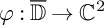
is not polynomially convex because the analytic disc
 $\varphi :\overline {\mathbb {D}}\to \mathbb {C}^2$
defined by
 $\varphi (z)=(z,0)$
is attached to M.
Studies of polynomial convexity of totally-real discs which are of graph form are done by Wermer [Reference Wermer22], O’Farrell and Preskenis [Reference O’Farrell and Preskenis13], [Reference O’Farrell and Preskenis14], and Duval [Reference Duval3]. Duval’s theorem is particularly interesting. We mention it here.
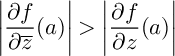
Result 1.2 (Duval).
Let
 $M=\{(z,f(z))\in \mathbb {C}^2: z\in \overline {\mathbb {D}}\}$
, where f is
 $\mathcal {C}^1$
-smooth in a neighborhood of
 $\overline {\mathbb {D}}$
. Assume
 $\left |\dfrac {\partial f}{\partial \overline {z}}(a)\right |>\left |\dfrac {\partial f}{\partial z}(a)\right |$
for all
 $a\in \overline {\mathbb {D}}$
. Then M is polynomially convex.
The study of totally real discs, which are not, in general, of graph form, also appears in the context of removable singularities of CR-functions. A deep result in this direction is due to Jöricke [Reference Jöricke11].
Result 1.3 (Jöricke).
Any
 $\mathcal {C}^2$
-smooth totally real disc in the boundary of the unit ball in
 $\mathbb {C}^2$
is removable.
Combining a result due to Lupacciolu and Stout (see [Reference Stout20]) it is evident that any
 $\mathcal {C}^2$
-smooth totally real disc in
 $\partial \mathbb {B}^2$
is polynomial convex. Stout mentioned in [Reference Stout20] that a similar argument will work for the
 $\mathcal {C}^2$
-smooth totally real discs that lie in the boundary of a strictly pseudoconvex domain
 $\Omega $
such that
 $\overline {\Omega }$
is polynomially convex. In general, it is not known whether a totally real disc that lies in the boundary of smooth pseudoconvex domain is polynomially convex. In [Reference Alexander1], Alexander proved the following result:
Result 1.4 (Alexander).
Any
 $\mathcal {C}^2$
-smooth totally real disc contained in
 $\{(z_1,z_2)\in \mathbb {C}^2:|z_1|=1\}$
is polynomially convex.
Polynomially convex hull of compacts that are subsets of hypersurfaces that are fibered over circle are also studied extensively (see [Reference Duval and Lawrence4], [Reference Forstnerič5], [Reference Słodkowski17], [Reference Słodkowski18]).
After the works [Reference Jöricke11] and [Reference Alexander1] were done, Jöricke asked the following question in the problem book [Reference Havin and Nikolski9].
Question 1.5. Which closed, totally real discs in
 $\mathbb {C}^2$
are polynomially convex?
The hypersurface that Alexander considered in [Reference Alexander1] is Levi-flat. This motivates us to look at some more examples of Levi-flat hypersurfaces and totally real discs lying in them. Recall that a hypersurface is said to be Levi-flat if the Levi form of its defining function vanishes identically on the hypersurface. We also give partial answers to Jöricke’s question in some cases, and pose some conjectures (see Conjectures 5.5 and 5.6). Our first result demonstrates the polynomial convexity of totally real disc that lies in certain non-singular Levi-flat hypersurface. This generalizes Alexander’s result. More precisely, we present the following theorem.
Theorem 1.6. Let
 $\Omega $
be a Runge domain in
 $\mathbb {C}^2$
and h be a holomorphic function on
 $\Omega .$
Let
 $M:=\{ z\in \Omega :|h(z)|=1\}$
with
 $dh(z)\not = 0$
for all
 $z\in M.$
Then every totally real
 $\mathcal {C}^2$
-smooth disc in M is polynomially convex.
It follows from Theorem 1.6 that any totally real disc that lies in the non-singular part of the boundary of a complex non-degenerate polynomial polyhedron in
 $\mathbb {C}^2$
is polynomially convex (see [Reference Gorai and Mondal8] for the details about complex nondegenerate polynomial polyhedron). The following is also a simple corollary of Theorem 1.6. It deals with compact subsets that lies in the zero set of pluriharmonic functions. This needs simple connectedness of the domain as an assumption.
Corollary 1.7. Let
 $\Omega $
be a simply connected Runge domain in
 $\mathbb {C}^2$
and h be a real-valued pluriharmonic function on
 $\Omega .$
Let
 $M:=\{ z\in \Omega : h(z)=0\}$
with
 $dh(z)\not = 0$
for all
 $z\in M.$
Then every totally real
 $\mathcal {C}^2$
-smooth disc in M is polynomially convex.
We now focus on another class of Levi-flat hypersurfaces which is of the form of trivial vector bundle over
 $\mathcal {C}^2$
-smooth curves in the complex plane. This also generalizes Result 1.4.
Theorem 1.8. If
 $h:\mathbb {C}\to \mathbb {R}$
be a smooth map and
 $E_{h}:=\{x+iy\in \mathbb {C}:h(x,y)=0\}.$
If
 $dh\ne 0$
on
 $E_{h},$
then every
 $\mathcal {C}^2$
-smooth totally real disc in
 $M:=E_{h}\times \mathbb {C}$
is polynomially convex.
It also follows from Theorem 1.8 that every totally real
 $\mathcal {C}^2$
-smooth disc in
 $\mathbb {R}\times \mathbb {C}$
is polynomially convex. Also, in [Reference Rudin15, Theorem 5.8], there is a characterization of compacts K in
 $\mathbb {R}^n\times \mathbb {C}$
for which
 $\mathscr {P}(K)=\mathcal {C}(K),$
where
 $\mathcal {C}(K)$
denotes the space of continuous complex valued functions on
 $K,$
and
 $\mathscr {P}(K)$
denotes be the space of all uniform limits of polynomials on
 $K.$
From this result, we can conclude that any totally real disc in
 $\mathbb {R}\times \mathbb {C}$
is polynomially convex.
In the second part of the paper, we consider general compact subsets that lie inside certain Levi-flat hypersurfaces. The compacts now may not be totally real. We need some definition to state our results in this part. The following definitions can be found in Stolzenberg [Reference Stolzenberg19].
Definition 1.9. Let K be a compact subset of
 $\mathbb {C}^n.$
If
 $f:K\to \mathbb {C}\setminus \{0\}$
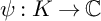
is of the form
 $f=\exp (\psi )$
for some continuous map
 $\psi :K\to \mathbb {C}$
we say that
 $\ln (f)$
is defined and
 $\psi $
is a branch of
 $\ln (f).$
Definition 1.10. Let K be a compact subset of
 $\mathbb {C}^n$
. K is said to be simply-coconnected if, for every map
 $f:K\to \mathbb {C}\setminus \{0\}$
,
 $\ln (f)$
is defined.
Remark 1.11.
K is simply-coconnected if and only if
 $\check {H}^{1}(K;\mathbb {Z})=0.$
Hence, any contractible set is simply-coconnected.
Definition 1.12. Let V be an analytic variety in
 $\mathbb {C}^n$
. V is said to be a Runge variety if for every
 $K\subset V$
,
 $\widehat {K}\subset V.$
Definition 1.13.
K is said to be polynomially convex in dimension one if, for every one-dimensional Runge variety V such that
 $K\cap V$
is compact,
 $K\cap V$
is polynomially convex.
We are now in a position to present our first theorem in this part.
We also present a result analogous to Theorem 1.8 for general compact sets.
Theorem 1.14. Let
 $h:\mathbb {C}\to \mathbb {R}$
be a smooth map and
 $E_{h}:=\{x+iy\in \mathbb {C}:h(x,y)=0\}$
with
 $dh\ne 0$
on
 $E_{h}.$
Let K be a connected simply-coconnected compact subset of
 $M:=E_{h}\times \mathbb {C}$
such that each fiber
 $K_c=\{w\in \mathbb {C}: (c,w)\in K\}$
is polynomially convex. Then K is polynomially convex.
In Theorems 2.4 and 1.14, the assumption that each fiber is polynomially convex is not trivial in general and is difficult to check.
We now turn our attention to singular Levi-flat hypersurfaces. A singular hypersurface is said to be Levi-flat if its regular part is Levi-flat. First, we provide an example of a non-polynomially convex compact subset that is totally real except at the singular point of the hypersurface. It shows that the singularities in the Levi-flat hypersurface have a role in determining polynomial convexity.
Example 1.15. Let us consider
 $M:=\{(z_1,z_2)\in \mathbb {C}^2:|z_1|=|z_2|\}$
,
 $K:=\{(z_1,z_2)\in \mathbb {C}^2:|z_1|=\mathsf {Re} z_2,0\le \mathsf {Re} z_2\le 1, \mathsf {Im} z_2=0\}\subset M.$
Then K is not polynomially convex because
 $\{(z_1,z_2)\in \mathbb {C}^2:|z_1|\le 1, \mathsf {Re} z_2=1,\mathsf {Im} z_2=0\}\subset \widehat {K}.$
Note that K is contractible.
Let
 $\Omega $
be a Runge domain in
 $\mathbb {C}^2$
and
 $h:\Omega \to \mathbb {C}$
be a holomorphic function and
 $M:=\{z\in \Omega :|h(z)|=1\}.$
Let
 $M^{*}:=\{z\in G:|h(z)|=1\}$
be the regular part of
 $M,$
where
 $G:=\Omega \setminus \{z\in \Omega :\;\;dh(z)=0\}$
and the singular set
 $M_{sing}:=M\setminus M^*$
.
Theorem 1.16. Let K be a totally real
 $\mathcal {C}^2$
-smooth disc in
 $M^{*}.$
Then K is polynomially convex if and only if
 $\widehat {K}\cap M_{sing}=\emptyset .$
As an application of Theorem 1.16, we provide a necessary and sufficient condition for totally real discs in a particular type of Levi-flat hypersurface of the form
 $\{(z_1,z_2)\in \mathbb {C}^2: \mathsf {Re} (z_{1}^m+z^{n}_{2})=0\}$
,
 $m, n\geq 2$
, to be polynomially convex. For
 $n=2, m=2$
it is one of the normal forms of the Levi-flat quadrics in the list given in [Reference Burns and Gong2].
Corollary 1.17. A totally real disc K in the singular Levi-flat hypersurface
 $M:=\{(z_1,z_2)\in \mathbb {C}^2: \mathsf {Re} (z_{1}^m+z^{n}_{2})=0\}$
is polynomially convex if and only if
 $(0,0)\notin \widehat {K}.$
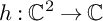
Proof of Corollary 1.17 follows from Theorem 1.16 by considering the holomorphic function
 $h:\mathbb {C}^2\to \mathbb {C}$
defined by
 $h(z_1,z_2):=e^{z^{m}_1+z^{n}_2}.$
In this case,
 $\{(z_1,z_2)\in \mathbb {C}^2: |h(z_1,z_2)|=1\}=M$
and
 $M_{sing}=\{(0,0)\}.$
Next, we return to the Levi-flat hypersurface
 $\{(z_1, z_2) \in \mathbb {C}^2 : |z_1| = |z_2|\}$
and provide a necessary and sufficient condition for a totally real disc lying in it to be polynomially convex. This hypersurface also provides another normal form of Levi-flat quadrics in
 $\mathbb {C}^2$
in the list of [Reference Burns and Gong2].
Theorem 1.18. A totally real disc K in
 $M:=\{(z_1,z_2)\in \mathbb {C}^{2}:|z_1|=|z_2|\}\setminus \{(0,0)\}$
is polynomially convex if and only if either
 $\widehat {K}\cap \{(z_1,z_2)\in \mathbb {C}^2:z_1=0\}=\emptyset $
or
 $\widehat {K}\cap \{(z_1,z_2)\in \mathbb {C}^2:z_2=0\}=\emptyset .$
We now state a corollary in the setting of the boundary of Hartogs triangle.
Corollary 1.19. A totally real disc K in the non-singular part of the boundary of the Hartogs triangle
 $\{(z_1,z_2)\in \mathbb {C}^2: |z_1|<|z_2|<1\}$
is polynomially convex if and only if either
 $\widehat {K}\cap \{(z_1,z_2)\in \mathbb {C}^2:z_1=0\}=\emptyset $
or
 $\widehat {K}\cap \{(z_1,z_2)\in \mathbb {C}^2:z_2=0\}=\emptyset .$
A proof of Corollary 1.19 follows from Result 1.4 and Theorem 1.18.
Let
 $h:\mathbb {C}\to \mathbb {R}$
be a smooth function and
 $E_{h}:=\{z\in \mathbb {C}:h(z)=0\}.$
Let
 $E^{*}_{h}:=\{z\in G: h(z)=0\}$
be the regular part of
 $E_{h},$
where
 $G:=\mathbb {C}\setminus \{z\in \mathbb {C}:h(z)=0,dh(z)=0\}.$
By
 $(E_h)_{sing},$
we denote the singular part of
 $E_h.$
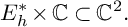
Theorem 1.20. Let K be a totally real disc in the singular hypersurface
 $E^{*}_{h}\times \mathbb {C}\subset \mathbb {C}^2.$
Then K is polynomially convex.
The proof of Theorem 1.20 follows from Theorem 1.8.
Remark 1.21. We owe an explanation of why we are focusing on general Levi-flat hypersurfaces when the Levi-flat hypersurfaces in our theorems are quite particular in nature. We have the following two reasons:
-
(i) In view of Forstnerič and Laurent-Thiébaut [Reference Forstnerič and Laurent-Thiébaut6, Proposition 3.1] and Theorem 1.6, we get that for any simply connected Levi-flat hypersurface M where the Levi-foliation is defined by a smooth closed one-form, totally real discs in M are polynomially convex.
-
(ii) The complete list of the local normal form of Levi-flat quadratic real hypersurfaces in
$\mathbb {C}^n$
is provided in Burns–Gong [Reference Burns and Gong2, Theorem 2.3]. The list of defining functions in
$\mathbb {C}^2$
is as follows:-
(a)
$z^2_1+2z_1\bar {z}_1+\bar {z}^2_1$
+h.o.t, -
(b)
$z^2_1+2\lambda z_1\bar {z}_1+\bar {z}_1~$
+h.o.t,
$\lambda \in (0,1),$
-
(c)
$\mathsf {Re} z_1\mathsf {Re} z_2$
+h.o.t, -
(d)
$\mathsf {Re} (z_{1}^2+z^{2}_{2})$
+h.o.t, -
(e)
$|z_{1}|^2-|z_{2}|^2$
+h.o.t.
-





If we consider the global Levi-flat hypersurfaces
 $M:=\{z \in \mathbb {C}^2 : \rho (z) = 0\}$
, where
 $\rho $
is defined by the quadratic part of the defining function, we see that our theorems cover all of them. Precisely, Theorem 1.20 covers (a), (b), (c), Corollary 1.17 addresses case (d), and Theorem 1.18 addresses case (e).
Remark 1.22. If we consider the hypersurface
 $M:=\{z\in \mathbb {C}^2: \rho (z)=c\}$
for some
 $c\ne 0$
, where
 $\rho $
is as described in (ii), then every totally real smooth disc in M is polynomially convex.
2 Technical results
In this section, we first collect some results from the literature that will be used in our proofs. The following result can be found in [Reference Stolzenberg19, Corollary 27].
Result 2.1 (Stolzenberg).
Every rationally convex simply-coconnected set is polynomially convex in dimension one.
We also make use of the following result [Reference Stolzenberg19, p. 269, assertion (12)].
Result 2.2 (Stolzenberg).
Let K be a compact subset of the purely one-dimensional analytic variety V in
 $\mathbb {C}^{n}$
such that
 $\widehat {K}\subset V.$
Then K is rationally convex.
The following result is also from Stolzenberg [Reference Stolzenberg19, Corollary 2.20].
Result 2.3 (Stolzenberg).
Let X be a compact subset of
 $\mathbb {C}^{n}.$
If X is simply-coconnected and there is a function, f, holomorphic in a neighborhood of
 $\widehat {X}$
such that
 ${f(X)\cap f(\widehat {X}\setminus X)=\emptyset ,}$
then X is polynomially convex.
The following theorem is a simple application of Result 2.3.
Theorem 2.4. Let P be a holomorphic polynomial in
 $\mathbb {C}^2.$
Let
 $M:=\{(z_1,z_2)\in \mathbb {C}^2:|P(z_1,z_2)|=1\}$
with
 $dP(z)\not = 0$
for all
 $z\in M,$
and
 $K\subset M$
be compact, simply-coconnected. If
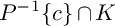 $P^{-1}\{c\}\cap K$
is polynomially convex for all
 $c\in \partial \mathbb {D},$
then K is polynomially convex.
Proof. Since
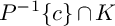 $P^{-1}\{c\}\cap K$
is polynomially convex for all
 $c\in \partial \mathbb {D},$
hence
 $P(K)\cap P(\widehat {K}\setminus K)=\emptyset $
. Again K is simply-coconnected, therefore, by Result 2.3, we can say that K is polynomially convex.
The following is due to Stolzenberg (see [Reference Gorai7, Lemma 2.3]).
Result 2.5 (Stolzenberg).
Let E be a compact subset of
 $\mathbb {C}^{n}.$
Assume that
 $\mathscr {P}(E)$
contains a function
 $\phi $
such that
 $\phi (E)$
has empty interior and
 $\mathbb {C}\setminus \phi (E)$
is connected. Then E is polynomially convex if and only if
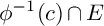 $\phi ^{-1}(c)\cap E$
is polynomially convex for each
 $c\in \phi (E).$
The following result from Stout’s book [Reference Stout21, Lemma 1.6.18] will also be useful in our proofs.
Result 2.6. Let X be a compact, polynomially convex subset of
 $\mathbb {C}.$
Then every point of
 $\partial X$
(boundary of X) is a peak point for the algebra
 $\mathscr {P}(X).$
The following result is due to Samuelsson and Wold [Reference Samuelsson and Wold16, Proposition 4.7]. We will use this result crucially in our proofs.
Result 2.7 (Samuelsson-Wold).
Let X be a compact subset of
 $\mathbb {C}^{n}$
and
 $F:\mathbb {C}^{n}\to \mathbb {C}^{m}$
be the uniform limit on X of entire functions. Let
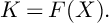 $K=F(X).$
If
 $\alpha \in K$
is a peak point for the algebra
 $\mathscr {P}(K),$
then
 $$ \begin{align*} F^{-1}\{\alpha\}\cap\widehat{X}=\widehat{F^{-1}\{\alpha\}\cap X}. \end{align*} $$
Next, we mention a couple of standard results from the theory of ordinary differential equations. Consider the system of differential equation
 $$ \begin{align} \begin{cases} \frac{dx}{dt}=F(x,y)\\ \frac{dy}{dt}=G(x,y). \end{cases} \end{align} $$
Result 2.8 (Poincaré).
Every closed path of the system (2.1) necessarily surrounds at least one critical point.
Result 2.9 (Poincaré–Bendixson).
Let
 $\Omega $
be a bounded region of the phase plane together its boundary, and assume that
 $\Omega $
does not contain any critical points of the system (2.1). If
 $V:=(x(t),y(t))$
is a path of (2.1) that lies in
 $\Omega $
for all
 $t\ge t_{0},$
then V is either itself a closed path or it spirals toward a closed path as
 $t\rightarrow \infty .$
Thus in either case the system (2.1) has closed path in
 $\Omega .$
Next, we state and prove a few lemmas that will be used in our proofs. The first one is easy but useful in our context.
Lemma 2.10. Let
 $\Omega $
be a Runge domain in
 $\mathbb {C}^n$
and f be a holomorphic function on
 $\Omega .$
Then every level set of f is a Runge variety.
Let M be a three-dimensional smooth submanifold of
 $\mathbb {C}^2$
and N be a two-dimensional totally real submanifold of M with (possibly empty) boundary. A field of lines on N is defined as follows: for every
 $p\in N,$
 $$ \begin{align*} L_{p}=T_{p}N\cap T^{\mathbb{C}}_{p}M. \end{align*} $$
Here,
 $T^{\mathbb {C}}_{p}M$
is the unique complex line through p that is tangent to M (where
 $T^{\mathbb {C}}_{p}M=T_{p}M\cap iT_{p}M$
). The curves that are always tangent to the lines
 $L_{p}$
are the leaves of the foliation of N that is defined by this line field. In other words, a curve
 $\gamma :(a,b)\to M$
is included in a leaf of the foliation if and only if the derivative
 $\gamma '(t)$
falls on the line
 $L_{\gamma (t)}$
for every
 $t\in (a,b).$
This gives a foliation of class
 $\mathcal {C}^{1}$
of
 $N,$
also known as the characteristic foliation of N (see Stout [Reference Stout21, p. 258] for details).
Lemma 2.11. Let
 $\Omega \subset \mathbb {C}^2$
be a domain and
 $\rho :\Omega \to \mathbb {R}$
is
 $\mathcal {C}^2$
-smooth and
 $d\rho \ne 0$
on
 $M:=\{z\in \Omega :\rho (z)=0\}.$
Let K be a totally real
 $\mathcal {C}^2$
-smooth disc in the 3-dimensional manifold
 $M.$
Then there exists a characteristic foliation on
 $K.$
Proof. Since K is a totally real disc in
 $M,$
there exists a neighborhood U of
 $\mathbb {\overline {D}}$
and a totally real smooth submanifold N of
 $\mathbb {C}^2$
and a
 $C^{2}$
-smooth diffeomorphism
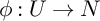 $\phi :U\to N$
such that
 $\phi (\mathbb {\overline {D}})=K.$
By shrinking U (if necessary), we can assume U is also contractible and we take
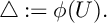 $\triangle :=\phi (U).$
Therefore,
 $\triangle $
is also a
 $\mathcal {C}^2$
-smooth totally real disc in M which contains
 $K.$
We take
 $$ \begin{align*} \phi(t,s)=(\phi_1(t,s),\phi_2(t,s),\phi_3(t,s),\phi_4(t,s)). \end{align*} $$
Therefore,
 $$ \begin{align*}d\phi|_{(t,s)}= \begin{pmatrix} A(t,s) & B(t,s)\\ \end{pmatrix},\end{align*} $$
where
 $$ \begin{align*}A(t,s)=\begin{pmatrix} \frac{\partial \phi_{1}}{\partial{t}}(t,s) & \frac{\partial \phi_{2}}{\partial{t}}(t,s) & \frac{\partial \phi_{3}}{\partial{t}}(t,s) & \frac{\partial \phi_{4}}{\partial{t}}(t,s) \\ \end{pmatrix}^{T}\end{align*} $$
and
 $$ \begin{align*}B(t,s)= \begin{pmatrix}\frac{\partial \phi_{1}}{\partial{s}}(t,s) & \frac{\partial \phi_{2}}{\partial{s}}(t,s) & \frac{\partial \phi_{3}}{\partial{s}}(t,s) &\frac{\partial \phi_{4}}{\partial{s}}(t,s) \\ \end{pmatrix}^{T}.\end{align*} $$
Let
 $\lambda =a(t,s)\frac {\partial }{\partial t}+b(t,s)\frac {\partial }{\partial s}$
be a non-vanishing vector field on
 $U.$
Since
 $\lambda $
is a non-vanishing vector-field on U and
 $\phi $
is a diffeomorphism, therefore,
 $\nu =a(t,s)A(t,s)+b(t,s)B(t,s)$
is also a non-vanishing vector field on
 $\triangle .$
Now we will see that the above vector field
 $\nu $
gives a
 $\mathcal {C}^{1}$
-smooth characteristic foliation on
 $K.$
To see this we do some computations here: Let
 $\nu _{\alpha }\in T_{\alpha }^{\mathbb {C}} M.$
Then
 $$ \begin{align*} & \langle J(a(t,s)A(t,s)+b(t,s)B(t,s),\nabla \rho)\rangle=0 ~, \\ &\implies a(t,s)\langle JA(t,s),\nabla \rho\rangle+b(t,s)\langle JB(t,s),\nabla \rho\rangle=0, \end{align*} $$
where J is the standard complex structure on
 $\mathbb {C}^2,$
and
 $\langle ,\rangle $
is the standard real inner product. A natural choice for the functions a and b is the following:
 $$ \begin{align} \begin{cases} a(t,s)=\langle JB(t,s),\nabla \rho\rangle~ \text{ and}\\ b(t,s)=-\langle JA(t,s),\nabla \rho\rangle. \end{cases} \end{align} $$
From (2.2), we get that
 $$ \begin{align*} a(t,s)&=-\frac{\partial\phi_{2}}{\partial s}\frac{\partial\rho}{\partial x}+\frac{\partial\phi_{1}}{\partial s}\frac{\partial\rho}{\partial y}-\frac{\partial\phi_{4}}{\partial s}\frac{\partial\rho}{\partial u}+\frac{\partial\phi_{3}}{\partial s}\frac{\partial\rho}{\partial v}~~~\text{and }\\ b(t,s)&=\frac{\partial\phi_{2}}{\partial t}\frac{\partial\rho}{\partial x}-\frac{\partial\phi_{1}}{\partial t}\frac{\partial\rho}{\partial y}+\frac{\partial\phi_{4}}{\partial t}\frac{\partial\rho}{\partial u}-\frac{\partial\phi_{3}}{\partial t}\frac{\partial\rho}{\partial v}. \end{align*} $$
Since
 $\phi $
is
 $C^{2}$
-smooth and
 $\rho $
is
 $C^{\infty }$
smooth, therefore from the above calculation we get that
 $a(t,s)$
and
 $b(t,s)$
are smooth functions. We assign each point
 $\alpha \in K$
to
 $\nu _{\alpha }\in \mathcal {L}_{\alpha }:=T_{\alpha }K\cap T_{\alpha }^{\mathbb {C}} M.$
Since K is a totally real disc in three dimensional manifold
 $M,$
dimension of
 $\dim _{\mathbb {R}}\mathcal {L}_{\alpha }=1~\forall \alpha \in K.$
Therefore, the above assignment is smooth one-dimensional distribution on
 $\triangle .$
Since every one-dimensional distribution is integrable and hence gives the characteristic foliation on
 $K.$
Lemma 2.12. If
 $\rho (z):=|h(z)|^2-1,$
where h is a holomorphic function in a neighborhood of K in the Lemma 2.11, then h is constant along each leaf of the characteristic foliation of
 $K.$
Proof. Let the integral curve
 $\gamma (t):=\left (\gamma _1(t)+i\gamma _2(t),\gamma _3(t)+i\gamma _4(t)\right ):(a,b)\to \triangle $
in
 $\triangle $
be a leaf of the characteristic foliation on
 $\triangle .$
Then
 $\gamma '(t)\in T_{\gamma (t)}K\cap T_{\gamma (t)}^{\mathbb {C}} M~~\forall t\in (a,b).$
Note that
 $\nabla \rho |_{\gamma (t)}=\left (\frac {\partial \rho }{\partial x},\frac {\partial \rho }{\partial y},\frac {\partial \rho }{\partial u},\frac {\partial \rho }{\partial v}\right )|_{\gamma (t)}$
is the normal to M at
 $\gamma (t).$
Since
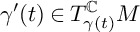 $\gamma '(t)\in T_{\gamma (t)}^{\mathbb {C}} M$
,
 $i\gamma '(t)\in T_{\gamma (t)}M.$
Therefore,
 $$ \begin{align*} \langle\gamma'(t),\nabla\rho|_{\gamma(t)}\rangle=0=\langle i\gamma'(t),\nabla\rho|_{\gamma(t)}\rangle. \end{align*} $$
Hence
 $\langle \gamma '(t),\nabla \rho |_{\gamma (t)}\rangle =0$
implies
 $$ \begin{align} &\gamma'_1(t)\frac{\partial \rho(\gamma(t))}{\partial x}+\gamma'_2(t)\frac{\partial \rho(\gamma(t))}{\partial y}+\gamma'_3(t)\frac{\partial \rho(\gamma(t))}{\partial u}+\gamma'_4(t)\frac{\partial \rho(\gamma(t))}{\partial v}=0, \end{align} $$
and
 $\langle i\gamma '(t),\nabla \rho |_{\gamma (t)}\rangle =0$
implies
 $$ \begin{align} & -\gamma'_2(t)\frac{\partial \rho(\gamma(t))}{\partial x}+\gamma'_1(t)\frac{\partial \rho(\gamma(t))}{\partial y}-\gamma'_4(t)\frac{\partial \rho(\gamma(t))}{\partial u}+\gamma'_3(t)\frac{\partial \rho(\gamma(t))}{\partial v}=0. \end{align} $$
We get from (2.3) and (2.4) that
 $$ \begin{align*} \left(\gamma'_1(t)+i\gamma'_2(t)\right)\frac{\partial \rho(\gamma(t))}{\partial z}+\left(\gamma'_3(t)+i\gamma'_4(t)\right)\frac{\partial \rho(\gamma(t))}{\partial w}=0. \end{align*} $$
This implies
 $$ \begin{align*} \left(\gamma'_1(t)+i\gamma'_2(t)\right)\frac{\partial h(\gamma(t))}{\partial z}+\left(\gamma'_3(t)+i\gamma'_4(t)\right)\frac{\partial h(\gamma(t))}{\partial w}=0, \end{align*} $$
which implies
 $$ \begin{align*} h\circ\gamma=c, \end{align*} $$
where c is some constant. Therefore, we can say that each integral curve of
 $\nu $
in K lies in
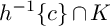 $h^{-1}\{c\}\cap K$
for some constant
 $c.$
3 Nonsingular Levi-flat hypersurfaces
In this section, we provide proofs of Theorem 1.6, Corollary 1.7, Theorem 2.4, and Theorem 1.14. We first define
 $\rho (z):=h(z)\overline {h(z)}-1$
and K be a smooth totally real disc in
 $M:=\{z\in \Omega : \rho (z)=0\}.$
Since
 $dh(z)\not = 0$
, M is a real 3-dimensional submanifold of
 $\Omega \subset \mathbb {C}^{2}.$
Then the complex dimension of the complex tangent space
 $T^{\mathbb {C}}_{\alpha }M$
of M is
 $1$
for each
 $\alpha \in M.$
Proof of Theorem 1.6
Since
 $dh|_{\alpha }\not =0$
on
 $h^{-1}\{c\}$
,
 $\{z\in \Omega :h(z)=c\}$
is a complex manifold of pure dimension 1. In view of Lemma 2.10, we can say that
 $h^{-1}\{c\}$
is a Runge variety for each
 $c\in \partial \mathbb {D},$
and we denote
 $K_{c}:=h^{-1}\{c\}\cap K.$
The following two cases hold.
Case I:
 $ \check {H}^{1}(K_{c},\mathbb {Z})=0.$
This implies
 $K_{c}$
is simply-coconnected (see Remark 1.11). Since
 $h^{-1}\{c\}$
is a Runge variety, by using Result 2.2, we get that
 $K_{c}$
is rationally convex. Therefore, by using Result 2.1, we can say that
 $K_{c}$
is polynomially convex in dimension one. Since
 $h^{-1}\{c\}$
is a one-dimensional Runge variety, therefore,
 $K_{c}\cap h^{-1}\{c\}=K_{c}$
is polynomially convex.
Case II:
 $ \check {H}^{1}(K_{c},\mathbb {Z})\ne 0.$
The leaves of the characteristic foliation of
 $\triangle $
are curves
 $\eta $
such that for all t,
 $\eta '(t)\in T_{\eta (t)}K\cap T_{\eta (t)}^{\mathbb {C}} M.$
On the disc
 $\triangle ,$
there are nowhere vanishing vector fields V (see Lemma 2.11) such that the vector
 $V_{x}$
is tangent to the leaf through x of the characteristic foliation at all points
 $x\in \triangle .$
Thus, the solution curves of the differential equation
 $x'=V_{x}$
are contained in leaves of the foliation. According to the Poincaré–Bendixson theorem (Result 2.9), all of the integral curves for this foliation are arcs, homeomorphic to the interval
 $[0,1],$
with endpoints on
 $\partial \triangle .$
In fact, let
 $\gamma $
be an integral curve for this foliation. If
 $\gamma $
lies in
 $\triangle ,$
then there exists a closed integral curve
 $\widetilde {\gamma }$
for a non-vanishing vector field
 $\widetilde {V}$
on
 $U,$
(where
 $\phi (U)=\triangle $
). Therefore, by Result 2.9, either
 $\widetilde {\gamma }$
is closed, or it spirals toward a closed path as
 $t\to \infty .$
Therefore, by Result 2.8, there exists a critical point in
 $U.$
This is a contradiction because
 $\widetilde {V}$
is nowhere vanishing vector field on
 $U.$
Note that
 $\triangle $
contain all fibers
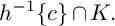 $h^{-1}\{c\}\cap K.$
Since
 $\check {H}^{1}(K_{c},\mathbb {Z})\not =0$
,
 $\triangle \setminus K_{c}$
is not connected. Take
 $\alpha \in K\setminus K_{c}$
and
 $\gamma $
is integral curve passing through
 $\alpha .$
We claim that
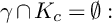 $\gamma \cap K_{c}=\emptyset :$
if possible, assume that
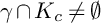 $\gamma \cap K_{c}\ne \emptyset $
and
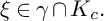 $\xi \in \gamma \cap K_{c}.$
Since each integral curve lies in
 $h^{-1}\{c_1\}$
for some constant
 $c_1\in \partial \mathbb {D},$
let
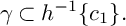 $\gamma \subset h^{-1}\{c_1\}.$
Then we have
 $h(\alpha )=c_{1}.$
On the other hand
 $h(\xi )=c$
and
 $\xi \in \gamma .$
But we know that h is constant along each integral curve (by Lemma 2.12). This is a contradiction to the assumption that
 $\gamma \cap K_{c}\not =\emptyset .$
Therefore,
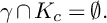 $\gamma \cap K_{c}=\emptyset .$
This proves the claim. Next we claim that
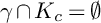 $\gamma \cap K_{c}=\emptyset $
is not possible. By Poincaré–Bendixson theorem (Result 2.9) each integral curve
 $\gamma $
through
 $\alpha $
joins
 $\alpha $
to the boundary of
 $\triangle .$
But
 $\triangle \setminus K_{c}$
is not connected, hence
 $\gamma \cap K_{c}=\emptyset $
is not possible. Therefore,
 $ \check {H}^{1}(K_{c},\mathbb {Z})\ne 0$
is not possible, that is Case II can not happen.
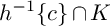
Since K is contractitble, K is simply-coconnected (by (1.11)). Also, each fiber
 $h^{-1}\{c\}\cap K$
is polynomially convex. Therefore, by Result 2.3, K is polynomially convex.
Proof of Corollary 1.7
Since
 $\Omega $
is simply-connected, there exists a holomorphic function f on
 $\Omega $
such that
 $h(z)=\mathsf {Re} f(z).$
We define
 $g(z):=e^{f(z)}$
on
 $\Omega .$
Then
 $\{z\in \Omega :|g(z)|=1\}=\{z\in \Omega : h(z)=0\}= M.$
Since
 $\Omega $
is Runge and
 $ g$
is holomorphic on
 $\Omega ,$
therefore, by Theorem 1.6, every totally real smooth disc contained in
 $ \{z\in \Omega :|g(z)|=1\}$
is polynomially convex. Hence, every smooth totally real disc in
 $\{z\in \Omega : h(z)=\mathsf {Re} f(z)=0\}$
is polynomially convex.
Proof of Theorem 1.8
First, we claim that integral curves for the characteristic foliation for M are the curves contained in
 $P^{-1}\{c\}$
for some
 $c,$
where
 $P:\mathbb {C}^2\to \mathbb {C}, (z_1,z_2)\mapsto z_1$
is the projection map. To see this, let
 $(x,y,u,v)$
be the coordinates of
 $\mathbb {R}^{4}=\mathbb {C}^2.$
Let us define
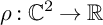 $\rho :\mathbb {C}^2\to \mathbb {R}$
by
 $\rho (x,y,u,v)=h(x,y),$
then
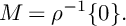 $M=\rho ^{-1}\{0\}.$
The normal vector to M at
 $(x,y,u,v)$
is given by
 $$ \begin{align} \nabla\rho|_{(x,y,u,v)}=\left(\frac{\partial\rho}{\partial x},\frac{\partial\rho}{\partial y},\frac{\partial\rho}{\partial u},\frac{\partial\rho}{\partial v}\right)\bigg|_{(x,y,u,v)}=\left(\frac{\partial h}{\partial x},\frac{\partial h}{\partial y},0,0\right). \end{align} $$
Let
 $\gamma (t)=(x(t), y(t), u(t), v(t))$
be a integral curve for the characteristic foliation for
 $M.$
Since
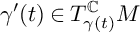 $\gamma '(t)\in T_{\gamma (t)}^{\mathbb {C}} M$
,
 $i\gamma '(t)\in T_{\gamma (t)}M,$
therefore,
 $$ \begin{align*} \langle\gamma'(t),\nabla\rho|_{\gamma(t)}\rangle=0=\langle i\gamma'(t),\nabla\rho|_{\gamma(t)}\rangle. \end{align*} $$
These, together with (3.1), gives us that
 $$ \begin{align*}\begin{pmatrix} \frac{\partial h}{\partial x} & \frac{\partial h}{\partial y} \\[1.5ex] \frac{\partial h}{\partial y} & -\frac{\partial h}{\partial x}\\ \end{pmatrix}\begin{pmatrix} x'(t) \\ y'(t)\\ \end{pmatrix}=\begin{pmatrix} 0 \\ 0\\ \end{pmatrix}.\end{align*} $$
Since
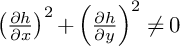 $\left (\frac {\partial h}{\partial x}\right )^2+\left (\frac {\partial h}{\partial y}\right )^2\ne 0$
on
 $M,$
we get that
 $x'(t)=0=y'(t).$
This implies
 $x(t)=c_1,~~ y(t)=c_2$
for some
 $(c_1,c_2)\in E_{h}.$
Hence
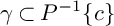 $\gamma \subset P^{-1}\{c\}$
which proves our claim.
Let K be a smooth totally real disc in
 $M.$
Following the proof of Theorem 1.6, we can prove that each fiber
 $K_{c}=P^{-1}(c)\cap K=(\{c\}\times \mathbb {C})\cap K$
is polynomially convex. To see this, let us define
 $K_{c}:=P^{-1}\{c\}\cap K$
and
 $V_{c}=\{z\in \mathbb {C}^2:z_1=c\}.$
Case I:
 $ \check {H}^{1}(K_{c},\mathbb {Z})=0.$
This implies
 $K_{c}$
is simply-coconnected (see Remark 1.11). Since
 $V_{c}$
is a Runge variety, by using Result 2.2, we get that
 $K_{c}$
is rationally convex. Therefore, by using Result 2.1, we can say that
 $K_{c}$
is polynomially convex in dimension one. Since
 $V_{c}$
is a one-dimensional Runge variety, therefore,
 $K_{c}\cap V_{c}=K_{c}$
is polynomially convex.
Case II:
 $ \check {H}^{1}(K_{c},\mathbb {Z})\ne 0$
. By the similar argument as Theorem 1.6,
 $ \check {H}^{1}(K_{c},\mathbb {Z})\ne 0$
can not happen.
Therefore,
 $K_{c}=P^{-1}\{c\}\cap K$
is polynomially convex. K is polynomially convex then follows from Result 2.3.
Proof of Theorem 1.14
Let
 $P:\mathbb {C}^2\to \mathbb {C}, P(z_1,z_2)=z_1$
be the projection map. By assumption each fiber
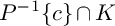 $P^{-1}\{c\}\cap K$
is polynomially convex. We now claim that each point of
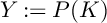 $Y:=P(K)$
is a peak point for the algebra
 $\mathscr {P}(Y).$
First, we show that
 $Y\subset \{\alpha \in \mathbb {C}:h(\alpha )=0\}.$
Let
 $\alpha \in Y,$
then there exists
 $(\xi ,\eta )\in K\subset E_{h}\times \mathbb {C}$
such that
 $P(\xi ,\eta )=\alpha .$
This implies
 $\xi =\alpha $
and since
 $(\xi ,\eta )\in E_{h}\times \mathbb {C}$
,
 $h(\xi )=0$
that is,
 $h(\alpha )=0.$
Therefore,
 $Y\subset \{\alpha \in \mathbb {C}:h(\alpha )=0\}.$
Since
 $dh\ne 0$
on
 $E_{h},$
hence
 $E_{h}$
is a smooth submanifold of
 $\mathbb {C}$
of real dimension one. Note that
 $Y=P(K)$
is a connected subset of
 $E_{h}.$
Case I: Assume
 $\mathbb {C}\setminus P(K)$
is connected. Then,
 $P(K)$
is polynomially convex. By Result 2.6, we get that each point of
 $\partial P(K)=P(K)$
is a peak point for the algebra
 $\mathscr {P}(P(K)).$
Case II: Assume
 $\mathbb {C}\setminus P(K)$
is not connected. Then,
 $\widehat {P(K)}$
is the union of
 $P(K)$
with all bounded components of
 $\mathbb {C}\setminus P(K).$
Since
 $P(K)$
is connected, hence
 $\partial \widehat {P(K)}=P(K).$
By Result 2.6, we can say that each point of
 $P(K)$
is a peak point for the algebra
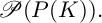 $\mathscr {P}(P(K)).$
By Result 2.7, we get that
 $$ \begin{align*} P^{-1}\{c\}\cap\widehat{K}=\widehat{P^{-1}\{c\}\cap K} \end{align*} $$
for all
 $c\in \mathbb {C}.$
Therefore,
 $P(K)\cap P(\widehat {K}\setminus K)=\emptyset .$
Since K is simply-coconnected, by Result 2.3, K is polynomially convex.
4 Singular Levi-flat hypersurfaces
In this section, we provide the proofs of the theorems concerning singular Levi-flat hypersurfaces. First, we give a proof of Theorem 1.16.
Proof of Theorem 1.16
If K is polynomially convex, then obviously
 $\widehat {K}\cap M_{sing}=\emptyset .$
Conversely, assume that
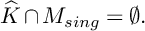 $\widehat {K}\cap M_{sing}=\emptyset .$
Since
 $dh|_{\alpha }\not =0,$
on
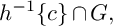 $h^{-1}\{c\}\cap G,$
then
 $\{z\in G: h(z)=c\}$
is a complex manifold of pure dimension
 $1.$
By Lemma 2.11, there exist characteristic foliation of
 $K,$
and by Lemma 2.12, we get that the function h is constant along each leaf of the characteristic foliation of
 $\triangle .$
Let us define
 $K_{c}:=h^{-1}\{c\}\cap G\cap K$
and
 $V_{c}=\{z\in \mathbb {C}^2:h(z)=c\}.$
Since
 $K\cap M_{sing}=\emptyset ,$
therefore
 $K_{c}=V_{c}\cap K.$
Hence, it is enough to show that
 $V_{c}\cap K$
is polynomially convex.
Case I: Assume that
 $\check {H}^{1}(K_{c},\mathbb {Z})=0.$
This implies
 $K_{c}$
is simply-coconnected (see Remark 1.11). It is easy to see that
 $V_{c}$
is a Runge variety. Then by using Result 2.2, we get that
 $K_{c}$
is rationally convex. Therefore, by using Result 2.1, we can say that
 $K_{c}$
is polynomially convex in dimension one. Since
 $V_{c}$
is a one-dimensional Runge variety, therefore,
 $K_{c}\cap V_{c}=K_{c}$
is polynomially convex.
Case II: Assume that
 $ \check {H}^{1}(K_{c},\mathbb {Z})\ne 0$
. By the similar argument as Theorem 1.6,
 $ {\check {H}^{1}(K_{c},\mathbb {Z})\ne 0}$
can not happen.
Therefore,
 $K_{c}=h^{-1}\{c\}\cap K$
is polynomially convex. K is polynomially convex then follows from Result 2.3.
We now give a proof of Theorem 1.18.
Proof of Theorem 1.18
If K is polynomially convex, then obviously
 $\widehat {K}\cap \{(z_1,z_2)\in \mathbb {C}^2:z_1=0\}=\emptyset $
and
 $\widehat {K}\cap \{(z_1,z_2)\in \mathbb {C}^2:z_2=0\}=\emptyset .$
Conversely, assume that
 $\widehat {K}\cap \{(z_1,z_2)\in \mathbb {C}^2:z_1=0\}=\emptyset $
or
 $\widehat {K}\cap \{(z_1,z_2)\in \mathbb {C}^2:z_2=0\}=\emptyset .$
Without loss of generality, we assume that
 $\widehat {K}\cap \{(z_1,z_2)\in \mathbb {C}^2:z_2=0\}=\emptyset .$
Consider the domain
 $G:=\mathbb {C}^{2}\setminus \{(z_1,z_2)\in \mathbb {C}^2:z_2=0\}$
and holomorphic function
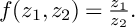 $f(z_1,z_2)=\frac {z_1}{z_2}.$
Then
 $M:=\rho ^{-1}\{0\},$
where
 $\rho (z_1,z_2)=\frac {\overline {z_1}}{\overline {z_2}}{\frac {z_1}{z_2}}-1.$
Since
 $df|_{\alpha }\not =0$
on
 $f^{-1}\{c\},$
the analytic set
 $\{z\in G:f(z)=c\}$
is a complex manifold of pure dimension
 $1.$
By Lemma 2.11, there exist characteristic foliation of
 $K,$
and by Lemma 2.12, we get that the function P is constant along each leaf of the characteristic foliation of
 $\triangle .$
We define
 $K_{c}:=f^{-1}\{c\}\cap K$
and
 $V_{c}=\{(z_1,z_2)\in \mathbb {C}^2:z_1=cz_2\}.$
Since
 $K\cap \{(z_1,z_2)\in \mathbb {C}^2:z_2=0\}=\emptyset ,$
therefore
 $K_{c}=V_{c}\cap K.$
Hence, it is enough to show that
 $V_{c}\cap K$
is polynomially convex.
Case I:
 $ \check {H}^{1}(K_{c},\mathbb {Z})=0.$
This implies
 $K_{c}$
is simply-coconnected (see Remark 1.11). Since
 $V_{c}$
is a Runge variety, by using Result 2.2, we get that
 $K_{c}$
is rationally convex. Therefore, by using Result 2.1, we can say that
 $K_{c}$
is polynomially convex in dimension one. Since
 $V_{c}$
is a one-dimensional Runge variety, therefore,
 $K_{c}\cap V_{c}=K_{c}$
is polynomially convex.
Case II:
 $ \check {H}^{1}(K_{c},\mathbb {Z})\ne 0$
. By the similar argument as Theorem 1.6,
 $ \check {H}^{1}(K_{c},\mathbb {Z})\ne 0$
can not happen.
Therefore,
 $K_{c}=f^{-1}\{c\}\cap K$
is polynomially convex. K is polynomially convex then follows from Result 2.3.
5 Examples and concluding remarks
In this section, we provide some examples supporting the theorems in this paper.
Example 5.1. Let
 $E_{a,b}:=\{z\in \mathbb {C}:{a^2}{x^2}+{b^2}{y^2}=1\}$
 $(a,b\in \mathbb {R}),$
and
 $M=E_{a,b}\times \mathbb {C}$
be a hypersurface
 $\mathbb {C}^2$
. Then, by Theorem 1.8, every totally real smooth disc in M is polynomially convex.
Example 5.2. Let us consider
 $M:=\{(z_1,z_2)\in \mathbb {C}^2:|z_2+\phi (z_1)|=1\}$
,
 $K:=\{(z_1,z_2)\in \mathbb {C}^2:z_2=e^{i(\mathsf {Re} z_1)^2}-\phi (z_1),|z_1|\le 1\}\subset M,$
where
 $\phi $
is a polynomial in
 $z_1.$
Using Theorem 2.4, we can show that K is polynomially convex. Note that K is not totally real (at
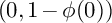 $(0,1-\phi (0))$
. K is the image of the closed unit disc under the smooth map
 $\xi \to (\xi ,e^{i(\mathsf {Re} \xi )^2}-\phi (\xi )),$
which is essentially the graph of
 $e^{i(\mathsf {Re} z_1)^2}-\phi (z_1)$
over the closed unit disc. Hence, K is simply-coconnected (in fact, contractible). It remains to show that each fiber
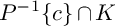 $P^{-1}\{c\}\cap K$
is polynomially convex, where
 $P(z_1,z_2)=z_2+\phi (z_1)$
. We compute:
 $$ \begin{align*} P^{-1}\{c\}\cap K&=\{(z_1,z_2)\in \mathbb{C}^2:z_2+\phi(z_1)=c, z_2=e^{i(\mathsf{Re} z_1)^2}-\phi(z_1),|z_1|\le 1\}\\ &= \{(z_1,z_2)\in \mathbb{C}^2:z_2+\phi(z_1)=c, \mathsf{Re} z_1=\pm t,|z_1|\le 1\}\\ &= \mathsf{Gr}_{h}(L_{1}\cup L_{2}), \end{align*} $$
where
 $h=c-\phi (z_1)$
,
 $L_{1}\cup L_{2}$
is polynomially convex. Therefore, being a graph of a polynomial over a polynomially convex set,
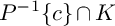 $P^{-1}\{c\}\cap K$
is polynomially convex.
Example 5.3. Let
 $P(z_1,z_2)=\frac {1}{2}(z_1+z_2)$
and
 $M:=\{(z_1,z_2)\in \mathbb {C}^2:|P(z_1,z_2)|=1\}.$
Let us consider
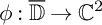 $\phi :\overline {\mathbb {D}}\to \mathbb {C}^2$
be a map defined by
 $\phi (t,s)=(\cos {t}+t,\sin {s}+s,\cos {t}-t,\sin {s}-s).$
Then
 $\phi $
is a diffeomorphism and hence
 $K:=\phi (\overline {\mathbb {D}})$
is a simply-coconnected compact subset of
 $M.$
Note that
 $P^{-1}\{c\}\cap K=\{(c+\overline {\xi },c-\overline {\xi }):|\xi |\le 1\}$
is polynomially convex. Using Theorem 2.4, we conclude that K is polynomially convex.
Example 5.4. Let
 $h:\mathbb {C}\to \mathbb {R}$
be defined by
 $h(x,y)=x^2+y^2-1$
and
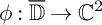 $\phi :\overline {\mathbb {D}}\to \mathbb {C}^2$
be defined by
 $\phi (t,s)=(\cos {t},\sin {t},(t-3)^3,(s-2)^3).$
Then
 $\phi $
is a diffeomorphism. Hence
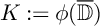 $K:=\phi (\overline {\mathbb {D}})$
is a simply-coconnected compact subset of
 $E_{h}\times \mathbb {C}.$
Let
 $P(z_1,z_2)=z$
be the projection map. Then
 $P^{-1}\{c\}\cap K=\{(z_1,z_2): z_1=c,z_2=((t-3)^3,(s-2)^3)), t^2+s^2\le 1\}$
is polynomially convex for all
 $c\in \mathbb {C}.$
Using Theorem 1.14, we conclude that K is polynomially convex.
We now make some concluding remarks. The hypersurfaces considered in this paper are all globally Levi-flat, that is pseudoconvex from both sides. In all the non-singular hypersurfaces considered here, any totally real disc lying in them turned out to be polynomially convex. This encourages us to make our first conjecture.
Conjecture 5.5. Any totally real disc lying in a non-singular Levi-flat hypersurface in
 $\mathbb {C}^2$
is polynomially convex.
The comments in Remark 1.21 allow us to make our next conjecture.
Conjecture 5.6. Any totally real disc K that lying in a singular Levi-flat hypersurface is polynomially convex if
 $\widehat {K}$
does not have a non-empty intersection with the singular set.
We end with the following general question.
Question 5.7. Characterize the totally real discs in singular Levi-flat hypersurfaces in
 $\mathbb {C}^2$
which are polynomially convex.
Funding statement
The first named author was initially supported partially by a MATRICS Research Grant (MTR/2017/000974) and now is supported partially by a Core Research Grant (CRG/2022/003560) of SERB, Dept. of Science and Technology, Govt. of India. The work of the second named author is partially supported by an INSPIRE Fellowship (IF 160487), Dept. of Science and Technology, Govt. of India, and by IISER Kolkata and recently by a research grant of SERB (Grant No. CRG/2021/005884), Dept. of Science and Technology, Govt. of India.
Data availability statement
Data sharing is not applicable to this article as no data set were generated or analyzed during the current study.



