Introduction
Youth reactions to terrorism and disasters include an array of internalizing and externalizing conditions and impaired functioning.Reference Fremont 1 , Reference Norris, Friedman, Watson, Byrne, Diaz and Kaniasty 2 Children depend on their parents for care and protection, and parents are a primary support for children following disasters.Reference Bonanno, Brewin, Kaniasty and La Greca 3 Youth needs are likely to increase in the context of disasters at a time when their parents face challenges in addressing the physical and social consequences of an event. Because of their own reactions and the burdens imposed by an event, parents may be limited in their ability to support and reassure their children.Reference Fremont 1 , Reference Bonanno, Brewin, Kaniasty and La Greca 3 This is likely to be especially true for parents who are directly exposed to the disaster and for those who develop psychiatric disorders post-event.
This Brief Report describes a pilot study of survivors of the September 11, 2001 World Trade Center (New York USA) attacks who reported their own reactions and the reactions of their children three years post-event. The primary hypothesis of the study was that children’s reactions—posttraumatic stress symptoms, behavior changes, and school functioning—would be associated with their parents’ psychiatric status. Secondary hypotheses were that children’s reactions would be associated with direct exposure to the disaster in children and/or their parents, parent-child separation due to the disaster, and disaster-related school absence. The results are considered in light of the influence of parental factors (eg, parent psychopathology or parenting) on children’s disaster outcomes.
Methods
As described in a previous article,Reference North, Pollio and Smith 4 a volunteer sample of 379 World Trade Center survivors was recruited from employees of eight organizations that were substantially affected by the attacks, three agencies located in the World Trade Center towers, an agency 1.5 blocks away, a commercial airline, and three disaster-response agencies. Institutional Review Board (IRB) approval for the study was provided by the University of Oklahoma Health Sciences Center (Oklahoma City, Oklahoma USA) and the University of Texas Southwestern Medical Center (Dallas, Texas USA), and all participants provided informed consent as part of study recruitment. Approximately three years after the September 11th attacks, the participants were interviewed about their own experiences related to the attacks and the experiences of their children who were three to 17 years of age at the time of the attacks. A total of 188 youths were identified by 116 of the 379 participants and represent the sample for the analysis described in this report.
The 116 adult study participants were interviewed with the Diagnostic Interview Schedule [DIS] for the [Diagnostic and Statistical Manual] DSM-IV (DIS-IV) Reference Robins, Cottler, Compton, Bucholz, North and Rourke 5 providing full diagnostic assessment of pre- and post-disaster psychiatric disorders, including posttraumatic stress disorder (PTSD), major depression, panic disorder, generalized anxiety disorder, alcohol use disorder, and drug use disorder, in parents according to the fourth edition of the DSM criteria. 6 Participants were also interviewed with the Disaster Supplement to the DIS,Reference North, Pfefferbaum, Robins and Smith 7 which obtained information on parent demographics and disaster experiences and on the number of children between ages three and 17 years at the time of the attacks, including each child’s age, sex, disaster-related experiences, disaster-related posttraumatic stress symptoms (five yes/no items), behavior changes (including increased fearfulness) after the disaster (eight yes/no items), and changes in school functioning (two yes/no items querying increased behavior problems at school and decline in grades after the disaster). Summary variables reflecting the total count of positive responses were created for child disaster-related posttraumatic stress symptoms and for child behavior changes after the disaster. Because some parents provided data for more than one child, the total number of parents represented in the tables is 188 (one for each child in the sample), not 116 (the total number of parents with at least one child in this study).
SAS version 9.4 (SAS Institute; Cary, North Carolina USA) was used for statistical analysis. A dichotomous variable was created from the child age variable to signify older children (ages 13-17 years) and younger children (ages three to 12 years). Results are presented as raw numbers and proportions, means, and standard deviations (SD). Dichotomous variables were compared using 2-sided χ2 tests. Statistical significance level was set at α=0.05.
Four main multivariate models were created to predict the four child outcomes, with one dependent variable per model: disaster-related posttraumatic stress symptoms, post-disaster behavior changes, increase in behavior problems at school, and decline in grades (also a dependent variable in two separate models). Independent covariates simultaneously entered into each model included selected demographic and disaster-related variables and parents’ post-disaster psychiatric disorders. The dependent variables from the first two main models were included as independent variables for the last two main models. Variance inflation testing using the “/VIF” function of “PROC REG” was conducted to ensure an acceptable level of multicollinearity (generally<1.8) among the independent variables included in the models. Independent covariates that were not significantly associated with the outcome in any of the models were removed from subsequent models: number of children in the household, sex of the child, parent race/ethnicity, parent marital status, parent education, child disaster exposure, and parent direct disaster exposure. Parent sex was not included as a separate covariate because it was embedded in the separate maternal and paternal post-disaster disorder variables.
The final models predicting number of child disaster-related posttraumatic stress symptoms and number of child post-disaster behavior changes included only independent covariates that had significant associations with the dependent variable in at least one of the models: child age group, child separated from parent because of disaster, disaster-related school absence, maternal post-disaster psychiatric disorder, and paternal post-disaster psychiatric disorder as independent variables. The two models with dependent variables for school functioning also included the number of disaster-related posttraumatic stress symptoms and the number of post-disaster behavior changes in the independent variable list. These models used the generalized linear mixed models (GLMM) procedures in SAS (PROC GLIMMIX) with a “SOLUTION” option for fixed effects in the model statement, which linked children within families using a family ID specifier in a “RANDOM” statement.
Results
Of the total sample of 379 participants, 31% (n=116) provided data on their children who comprised the 188 collective youths in this study. Compared to the 263 participants without child data, the 116 interviewed parents who reported data on their children included more parents who were fathers (58% vs 43%; χ2=7.44; P=.006), married (72% vs 42%; χ2=29.41; P<.001), and lacking a college education (41% vs 30%; χ2=4.89; P=.027). Study participants with and without child data did not differ significantly on age, race/ethnicity, or pre- or post-disaster psychiatric disorders.
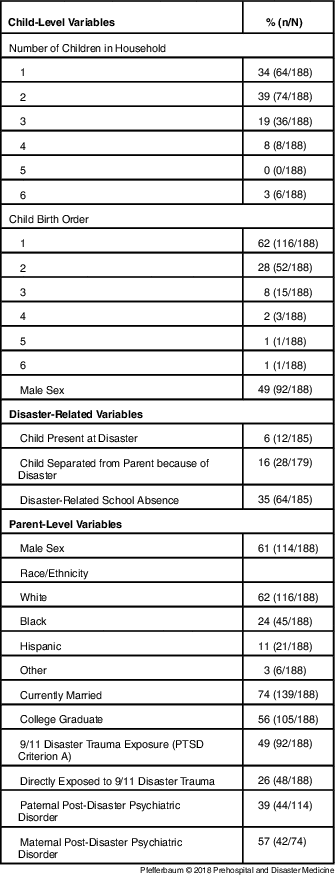
Table 1 provides the characteristics of the sample of 188 children within 116 families. The sample of youths was approximately one-half male with a mean (SD) age of 10.6 (SD=4.4) years at the time of the attacks. The mean (SD) number of children in a family was 2.1 (SD=1.1), ranging from one to six. Few children were present during the disaster, and about one in six were separated from their parent because of the disaster. Approximately one-third of the youth missed school because of the disaster. Parent variables in Table 1 refer to characteristics of the parent who was interviewed about each child. Parents with more than one child were represented repeatedly across children of the same family in the dataset. Therefore, the 116 parents providing data on children in this study were represented as 188 parents of the children in the study. Among these parents, fathers predominated over mothers in numbers represented. The mean (SD) age of the parents was 45.2 (SD=6.9) years, ranging from 29 to 62 years. More than one-half of the parents were white and most were married. More than one-half had college degrees; the mean (SD) number of years of education (counting General Equivalency Degree as 12 years) was 15.6 (SD=3.2) years, ranging from 10 to 29 years. Almost one-half of the parents had a post-disaster psychiatric disorder. Specifically, 40% (76/188) had a pre-disaster disorder and 46% (86/188) had an incident (new) post-disaster psychiatric disorder (not shown in table). Significantly more mothers than fathers had a post-disaster disorder (McNemar S=7.00; df=1; P=.008). Major depression was the most prevalent post-disaster disorder among the parents (27%), and disaster-related PTSD was second in prevalence (11%; not shown in table).
Characteristics of the Sample

Abbreviation: PTSD, posttraumatic stress disorder.
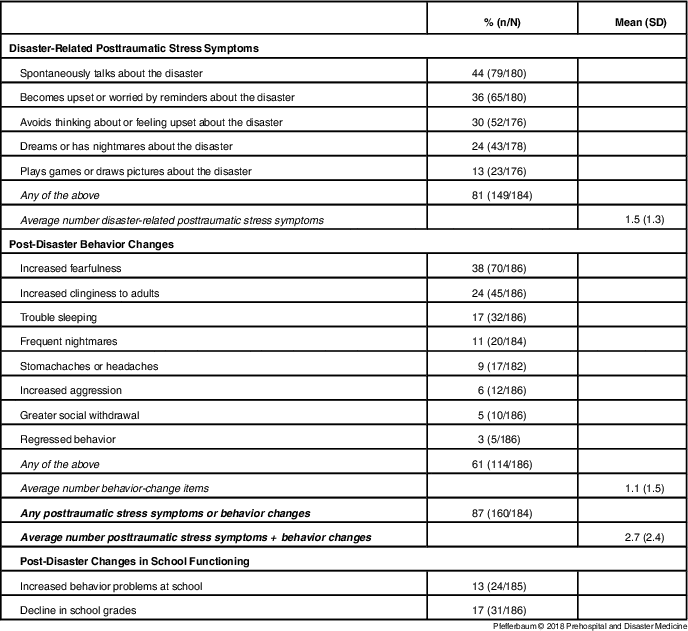
Table 2 presents findings on the children’s disaster-related posttraumatic stress symptoms, post-disaster behavior changes, and changes in school functioning (school behavior and grades) as reported by their parent. More than three-fourths of the children had at least one disaster-related posttraumatic stress symptom, the most common of which were talking about the disaster and being upset or worried by disaster reminders. More than one-half of the children experienced at least one post-disaster behavior change, the most common of which were increased fearfulness and increased clinginess to adults. The vast majority of the children had at least one disaster-related posttraumatic stress symptom or post-disaster behavior change, with a median of two posttraumatic stress symptoms or behavior changes per child. A minority of the children were reported to have changes in school functioning reflected in increased school behavior problems or a decline in grades.
Child Disaster-Related Posttraumatic Stress Symptoms, Behavior Changes, and Changes in School Functioning

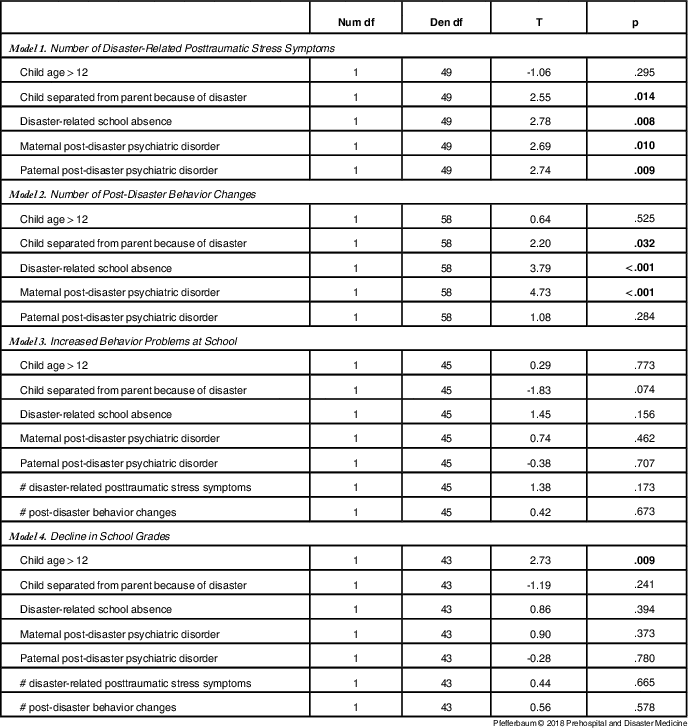
Table 3 provides results of the four main multivariate models separately predicting children’s disaster-related posttraumatic stress symptoms, post-disaster behavior changes, increased behavior problems at school, and decline in grades, respectively (one dependent variable per model), including independent covariates with significant association with the dependent variable in at least one of the models, as described in the Methods section. In the first model, number of child disaster-related posttraumatic stress symptoms was positively associated with separation from the parent because of the disaster, disaster-related school absence, and both maternal and paternal post-disaster psychiatric disorders. In the second model, number of child post-disaster behavior changes was positively associated with separation from the parent because of the disaster, disaster-related school absence, and a maternal post-disaster psychiatric disorder. In the third model, increase in behavior problems at school was not associated with any of the model’s independent variables. In the fourth model, decline in grades was significantly associated with greater age of the child.
Multivariate Models Predicting Child Disaster-Related Posttraumatic Stress Symptoms, Post-Disaster Behavior Changes, Increased Behavior Problems at School, and Decline in School Grades

Discussion
The primary hypothesis that children’s reactions would be associated with their parent’s psychiatric status was supported. The results add to a growing child-trauma literature documenting a relationship between parent and child reactions, with parent posttraumatic stress symptoms associated with various child outcomes, including posttraumatic stress symptoms, depressive symptoms, behavior problems, and distress, even (as with most children in this study) in the absence of trauma exposure in the children.Reference Lambert, Holzer and Hasbun 8 , Reference Leen-Feldner, Feldner, Knapp, Bunaciu, Blumenthal and Amstadter 9 Disaster studies reveal a relationship between children’s reactions and those of their parents,Reference Fremont 1 , Reference Bonanno, Brewin, Kaniasty and La Greca 3 even after controlling for common exposures.Reference Cobham, McDermott, Haslam and Sanders 10 For example, a recent study of parent-child dyads in a September 11, 2001 World Trade Center registry found a relationship between parent posttraumatic stress symptoms and increased child behavior problems, especially peer problems and emotional symptoms, six to seven years after the attacks.Reference Mann, Li, Farfel, Maslow, Osahan and Stellman 11
Few disaster studies have compared the influence of parent gender on their children’s reactions.Reference Kiliҫ, Kiliҫ and Aydin 12 - Reference Shi, Zhou and Geng 14 The results of the current study—that both maternal and paternal psychiatric disorder predicted posttraumatic stress symptoms in youths, yet only maternal psychiatric disorder predicted youth behavior changes—provide additional preliminary evidence that maternal and paternal factors may have distinct influences on their children in the context of disasters. Of note, significantly more mothers than fathers in the current study had post-disaster psychiatric disorders, which may have influenced the results.
The association between parent and child disaster reactions may reflect a common biological basis for emotions and emotional processes;Reference Lambert, Holzer and Hasbun 8 , Reference Masten and Narayan 15 shared or similar disaster exposures or experiences;Reference Kerns, Elkins, Carpenter, Chou, Green and Comer 16 and parental role modeling for adaptive and maladaptive cognitions, affect, behavior,Reference Kerns, Elkins, Carpenter, Chou, Green and Comer 16 and coping.Reference Kerns, Elkins, Carpenter, Chou, Green and Comer 16 , Reference Compas and Epping 17 Posttraumatic stress symptoms in parents can affect their parenting, which in turn potentially mediates the effect of their reactions on their children’s reactions.Reference Samuelson, Wilson, Padrón, Lee and Gavron 18 Parenting stress—reflected in negative feelings about oneself as a parent and the perception of one’s child as difficult to parent—is related to a history of trauma exposure in the parent and to internalizing and externalizing problems in their children.Reference Samuelson, Wilson, Padrón, Lee and Gavron 18
Parents are the primary support figures for their children, in general, a role that is even greater after a disaster when children’s need for protection and safety increase.Reference Costa, Weems and Pina 19 After a traumatic event, parents have a key role in providing resourcesReference Gargano, Locke and Brackbill 20 and supportReference Gil-Rivas, Kilmer, Hypes and Roof 21 for their children and in helping their children process traumatic experiences.Reference Kerns, Elkins, Carpenter, Chou, Green and Comer 16 , Reference Gil-Rivas, Kilmer, Hypes and Roof 21 Parental responses to their children’s distress and psychological needs influence their children’s reactions.Reference Gil-Rivas and Kilmer 22 The challenges on parents are magnified following disasters when, in addition to caring for their children, parents also must address the consequences of the event and their own reactions and needs. These challenges may be especially great depending on parental disaster exposures, experiences, and reactions. Parents who are impaired by their own disaster reactions and those who develop psychiatric illnesses, like many of the parents in this study, may be less emotionally available to their children. A Boston Marathon bombing (Boston, Massachusetts USA; 2013) study revealed significant associations between caregiver distress and children’s functioning, even after controlling for shared traumatic exposure, and caregiver distress moderated relationships between children’s exposure and child posttraumatic stress symptoms and conduct problems, especially in the children of highly distressed caregivers.Reference Kerns, Elkins, Carpenter, Chou, Green and Comer 16
A recent review revealed that remission or improvement in depression symptoms in mothers was associated with improvement in their children’s emotional and behavioral symptoms and functioning, with improvement maintained over months to years.Reference Gunlicks and Weissman 23 Thus, reducing parents’ symptoms should increase their emotional availability to their children and enhance their ability to address their children’s needs.Reference Scheeringa and Zeanah 24
Parent-Child Separation
Separation from parents because of the disaster was an important determinant in children’s posttraumatic stress symptoms and post-disaster behavior changes in the current study. Because parents typically buffer and provide support to their children, parent-child separation during an event is likely to affect parent-child attachment and children’s reactions and recovery. The effects of separation may vary depending on the child’s developmental level, with young children more likely than older children and adolescents to react intensely to separation or disrupted environments.Reference Masten and Narayan 15 A Hurricane Katrina (Gulf Coast, USA; 2005) study found that threats to the parent-child attachment relationship through, for example, loss of or separation from the parent, along with event and loss exposure, predicted posttraumatic distress in preschool children.Reference Osofsky, Kronenberg, Bocknek and Hansel 25 Many of the children in the current sample were older—school-aged children and adolescents—and their separation from parents may have been less enduring than was that in the children in the Katrina sample, but their symptoms—fearfulness and clinging behavior—were consistent with separation distress.
School Absence and School Functioning
Disaster-related school absence predicted posttraumatic stress symptoms and behavior changes in the children of the participants in the current study. While parent-reported behavior problems at school were not associated with any of the predictors examined, greater age was associated with poorer school performance. It may be that the school setting provided structure and nurturance to support recovery in these children, perhaps more effectively for younger children.
Study Strengths and Limitations
A strength of this study of a sample recruited from organizations affected by or related to the September 11th attacks is that it provided pilot data on a relatively large number of children, many of whose parents were direct survivors with psychiatric sequelae. Although full diagnostic assessment of psychiatric disorders was conducted with the adult participants, brief non-standardized instruments were used to assess their children’s reactions. The cross-sectional design also was a limitation. The use of parents as the single source of information about their children was the greatest limitation, especially with respect to children’s internalizing symptoms, and for parents with major depression,Reference De Los Reyes and Kazdin 26 like many in this sample. Parental perceptions of their children’s reactions are likely to be influenced by their own stresses and reactions, which is particularly important in this sample given the prevalence of parental psychopathology. Parent distress is a strong predictor of parent-reported child posttraumatic stress symptoms, and parental trauma symptoms are related to both under- and over-reporting of child posttraumatic stress symptoms,Reference Valentino, Berkowitz and Stover 27 although this parent-child discrepancy is likely to decrease over time.Reference Schreier, Ladakakos, Morabito, Chapman and Knudson 28 Given that most of the youth reactions examined in this study were internalizing, under-reporting of these symptoms by parents was particularly likely.
Conclusion
Because parents are central to the development and emotional well-being of their children and provide primary caretaking and support for children post-disaster, addressing the needs of parents is critical to their ability to assist their children.Reference Kerns, Elkins, Carpenter, Chou, Green and Comer 16 Given the challenges in providing disaster interventions directly to children, especially when resources are limited, addressing parent psychopathology and distress (even in the absence of focusing on children’s symptoms) may benefit children.Reference Kerns, Elkins, Carpenter, Chou, Green and Comer 16 This does not, however, eliminate the need to deliver interventions directly to symptomatic children when possible. Future work is needed to elucidate differential advantages of child-focused, parent-focused, and/or family-based interventions in the disaster context.
Acknowledgement
The authors thank Erin A. Van Enkevort, PhD, Assistant Professor, Department of Psychiatry, The University of Texas Southwestern Medical Center, for statistical consultation.