Introduction
CHD is the most common congenital malformation in China, with an estimated incidence rate of 8.9 cases per 1000 live births. Reference Zhao, Ma and Ge1 Despite significant advances in surgical techniques, perioperative care, and intensive care medicine, which have collectively improved the survival rate of newborns undergoing cardiac surgery, prolonged mechanical ventilation remains a prevalent postoperative complication. Reference Blinder, Thiagarajan and Williams2 Prolonged mechanical ventilation is associated with increased risks of adverse events, such as increased mortality and significant consumption of medical resources. Reference Blinder, Thiagarajan and Williams2,Reference Heibel, Graham and Mahle3
The unique physiological characteristics of neonates, including immaturity of the central nervous system, changes in immune response, and increased inflammatory response, may exacerbate postoperative organ dysfunction and complicate weaning from mechanical ventilation. Reference Sangsari, Saeedi and Maddah4 At present, there is limited evidence on reliable predictive factors for prolonged mechanical ventilation in the neonatal population after cardiac surgery. The accurate risk stratification of this vulnerable group still poses challenges, but there is a critical need for it. Reference AlRabeeah5
The present study aimed to identify preoperative and intraoperative factors associated with prolonged mechanical ventilation in neonates after cardiac surgery, and to develop a predictive model for early identification of high-risk individuals. This predictive model may support tailored clinical interventions and improve postoperative outcomes.
Materials and methods
Study population
After approval by the institutional review board and the waiver of consent, 397 electronic medical records of neonates who underwent cardiac surgery between January 2018 and July 2024, were reviewed. Twelve patients (3.0%) were excluded due to missing or incomplete data. The final cohort consisted of 385 neonates, who were then randomly allocated into development and internal validation sets.
Exclusion criteria were listed as follows: (i) isolated surgical ligation of patent ductus arteriosus; (ii) insufficient clinical data for analysis; and (iii) mortality or discharge against medical advice within 7 days post-surgery.
Intraoperative and postoperative management
The methodology for intraoperative and postoperative management was consistent with our prior work. Reference Lu, Wei and Cai6
Data collection and definition
All patient data were extracted from the electronic medical record system of the institution listed below.
Preoperative data: sex, birth weight, complete blood count (red, white, and platelet cells), coagulation profile (fibrinogen and prothrombin time), metabolic markers (total bilirubin, albumin, lactate, glucose, serum creatinine, and blood urea nitrogen), creatine phosphokinase, along with clinical conditions such as neurological dysfunction, pulmonary hypertension, airway anomalies, left ventricular dysfunction, pneumonia, necrotising enterocolitis, hyaline membrane disease, mechanical ventilation, and emergency surgery status. Laryngotracheobronchial, tracheal stenosis, or tracheal or bronchial malacia were termed airway anomalies. At our centre, we routinely performed preoperative fiberoptic laryngoscopy or bronchoscopy in neonates suspected of having airway anomalies before cardiac surgery.
Intraoperative data: age and weight at surgery, Society of Thoracic Surgeons–European Association for Cardio-Thoracic Surgery mortality category, surgical approach, lowest core temperature, duration of cardiopulmonary by-pass, aortic-cross-clamp and deep hypothermic circulatory arrest, volumes of red blood cells, plasma, and platelets transfused, along with lactate level, blood glucose level, and vasoactive-inotropic score measured at surgery conclusion.
Postoperative data:postoperative hospital stay duration, use of extracorporeal membrane oxygenation, mortality status at discharge (recorded as yes/no), and the specific cause of death. We defined radical surgery as a complete anatomical correction or definitive repair of the congenital cardiac defect during the neonatal period. The vasoactive-inotropic score was computed using standardiSed units (μg/kg/min) with the formula: vasoactive-inotropic score = dobutamine + dopamine + 10 × milrinone + 100 × norepinephrine + 100 × epinephrine. Reference Butts, Scheurer and Atz7 Society of Thoracic Surgeons–European Association for Cardio-Thoracic Surgery mortality categories were classified according to the criteria established by Jacobs et al. Reference Jacobs, Jacobs and Thibault8 Prolonged mechanical ventilation was characterised as mechanical ventilation duration beyond 7 days, based on the 75th percentile of postoperative mechanical ventilation duration.
Statistical analysis
Categorical data were expressed as frequency and percentage and analysed with Fisher’s exact, Pearson chi-square, or Mann–Whitney U tests, depending on the distribution of the data. Continuous variables are summarised using median interquartile range, mean + standard deviation, or Student’s t-test.
A multivariate logistic model was developed, incorporating variables that had a P-value of 0.05, to identify independent predictors associated with prolonged mechanical ventilation. The model’s discriminative power was evaluated using a receiver operating characteristic curve. Calibration was evaluated via Hosmer–Lemeshow goodness-of-fit testing and visualised through calibration graphs. Decision curve analysis was used to examine the clinical usefulness of different probability thresholds. A nomogram was built for individualised risk prediction based on the final regression model. The generalised linear model (glm) function was used for logistic regression, while the nomogram was conducted and the calibration curves were plotted using functions within the rms package. Decision curve analysis was conducted using the rmda package. R software (version 3.6.2, Vienna, Austria) was used for analysis.
Results
Patient characteristics
540 neonates undergoing cardiac surgery were initially included between January 2018 and July 2024. After excluding 115 who underwent isolated patent ductus arteriosus ligation, 28 who died or were discharged against medical advice within 7 days postoperatively, and 12 with insufficient data for analysis, 385 neonates were included in the final analysis, including 241 males and 144 females with a median birth weight of 3.05 kg. The median age and weight at surgery were 11 days and 3.16 kg, respectively.
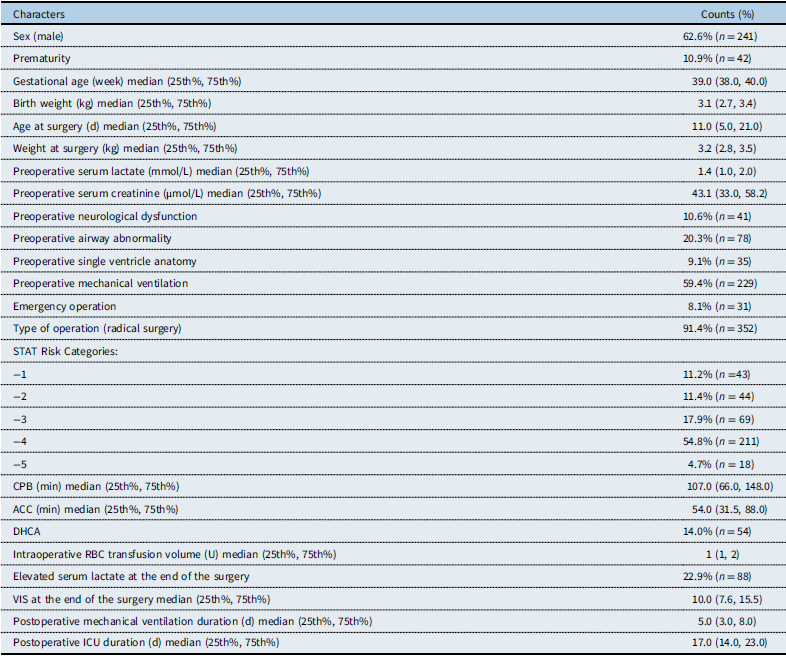
Preoperative and intraoperative clinical characteristics included airway abnormalities in 78 (20.3%) patients, single ventricle physiology in 35 (9.1%), Society of Thoracic Surgeons–European Association for Cardio-Thoracic Surgery mortality categories 4 or 5 in 229 (59.4%), emergency surgery in 31 (8.1%), and preoperative mechanical ventilation in 152 (39.5%). Among the main surgical procedures, arterial switch operations with or without ventricular septal defect repair (92 cases) was the most frequent procedure, followed by coarctation of the aorta with or without ventricular septal defect repair (69 cases), total anomalous pulmonary venous return repair (65 cases), atrial septal defect and/or ventricular septal defect repair (56 cases), pulmonary atresia or stenosis repair (32 cases), modified Blalock Taussig shunt (27 cases), correction of interrupted aortic arch (20 cases), correction of tetralogy of Fallot (8 cases), common arterial trunk repair (4 cases), pulmonary artery brock (3 cases), pulmonary artery banding (3 cases), norwood procedure (2 cases), rastelli procedure (2 cases), atrial tumour resection (1 case), and abnormal origin of pulmonary artery repair (1 case). Deep hypothermic circulatory arrest was utilised in 54 (14.0%) patients, elevated intraoperative lactate was observed in 88 (22.9%), and corrective surgery was performed in 352 (91.4%) neonates. The median volume of red blood cells transfused intraoperatively was 1 U, and the median vasoactive-inotropic score at the end of surgery was 10.
Prolonged mechanical ventilation was required in 106 (27.5%) neonates. No mortality occurred during the initial seven postoperative days among ventilated cohort. Additional characteristics are detailed in Table 1.
Patient characteristics of 385 neonates

Table 1. Long description
The table presents characteristics of 385 neonates, focusing on various medical and demographic factors. It includes 18 rows and 2 columns, with headers ‘Characters’ and ‘Counts (%)’. Row 1: Sex (male), 62.6 percent (n = 241). Row 2: Prematurity, 10.9 percent (n = 42). Row 3: Gestational age (week) median (25th percent, 75th percent), 39.0 (38.0, 40.0). Row 4: Birth weight (kg) median (25th percent, 75th percent), 3.1 (2.7, 3.4). Row 5: Age at surgery (d) median (25th percent, 75th percent), 11.0 (5.0, 21.0). Row 6: Weight at surgery (kg) median (25th percent, 75th percent), 3.2 (2.8, 3.5). Row 7: Preoperative serum lactate (mmol per L) median (25th percent, 75th percent), 1.4 (1.0, 2.0). Row 8: Preoperative serum creatinine (μmol per L) median (25th percent, 75th percent), 43.1 (33.0, 58.2). Row 9: Preoperative neurological dysfunction, 10.6 percent (n = 41). Row 10: Preoperative airway abnormality, 20.3 percent (n = 78). Row 11: Preoperative single ventricle anatomy, 9.1 percent (n = 35). Row 12: Preoperative mechanical ventilation, 59.4 percent (n = 229). Row 13: Emergency operation, 8.1 percent (n = 31). Row 14: Type of operation (radical surgery), 91.4 percent (n = 352). Row 15: STAT Risk Categories -1, 11.2 percent (n = 43). Row 16: STAT Risk Categories -2, 11.4 percent (n = 44). Row 17: STAT Risk Categories -3, 17.9 percent (n = 69). Row 18: STAT Risk Categories -4, 54.8 percent (n = 211). Row 19: STAT Risk Categories -5, 4.7 percent (n = 18). Row 20: CPB (min) median (25th percent, 75th percent), 107.0 (66.0, 148.0). Row 21: ACC (min) median (25th percent, 75th percent), 54.0 (31.5, 88.0). Row 22: DHCA, 14.0 percent (n = 54). Row 23: Intraoperative RBC transfusion volume (U) median (25th percent, 75th percent), 1 (1, 2). Row 24: Elevated serum lactate at the end of the surgery, 22.9 percent (n = 88). Row 25: VIS at the end of the surgery median (25th percent, 75th percent), 10.0 (7.6, 15.5). Row 26: Postoperative mechanical ventilation duration (d) median (25th percent, 75th percent), 5.0 (3.0, 8.0). Row 27: Postoperative ICU duration (d) median (25th percent, 75th percent), 17.0 (14.0, 23.0).
Data are presented as number (percentage) and median (25th,75th percentile).
SD = standard deviation; ACC = aortic cross-clamp; RBC = red blood cell; CPB = cardiopulmonary by-pass; VIS = vasoactive-inotropic score; DHCA = deep hypothermic circulatory arrest.
Univariate and multivariate analysis
Univariate analysis identified twelve factors significantly associated with prolonged mechanical ventilation, as detailed in Table 2. These included preoperative serum lactate, serum urea nitrogen, neurological dysfunction, airway abnormalities, and mechanical ventilation; type of operation; durations of cardiopulmonary by-pass, aortic-cross-clamp, and deep hypothermic circulatory arrest; intraoperative red blood cell transfusion volume; elevated intraoperative lactate levels; and vasoactive-inotropic score at the end of surgery.
Univariate risk analysis for PMV in neonates after cardiac surgery

Table 2. Long description
A table comparing variables between non-PMV (n = 279) and PMV (n = 106) groups in neonates after cardiac surgery. The table is divided into preoperation, intraoperation, and postoperation sections. Preoperation variables include sex, prematurity, birth weight, haemoglobin, white blood cells, platelets, prothrombin time, fibrin, total bilirubin, creatinine phosphokinase, albumin, serum lactate, blood glucose, serum creatinine, serum urea nitrogen, neurological dysfunction, pulmonary hypertension, airway abnormalities, left ventricular dysfunction, pneumonia, necrotising enteritis, hyaline membrane disease of lung, mechanical ventilation, and emergency surgery. Intraoperation variables include age at operation, weight at operation, STAT 2 or higher, type of operation, minimum body temperature, CPB, CLAMP, DHCA, RBC transfusion volume, platelet transfusion volume, serum lactate at the end of surgery, elevated serum lactate at the end of surgery, blood glucose at the end of surgery, and VIS at the end of surgery. Postoperation variables include postoperative ICU stay and death. Each variable is listed with corresponding values for non-PMV and PMV groups, along with P values indicating statistical significance.
Data are presented as number (percentage) and median (25th,75th percentile).
RBC = red blood cell; CPB = cardiopulmonary by-pass; VIS = vasoactive-inotropic score; DHCA = deep hypothermic circulatory arrest; STAT = Society of Thoracic Surgeons–European Association for Cardio-Thoracic Surgery; ECMO = extracorporeal membrane oxygenation.
Multivariable logistic analysis revealed six independent predictors of prolonged mechanical ventilation: preoperative airway abnormalities (odds ratio = 2.280, 95% confidence interval 1.217–4.271, P = 0.010), preoperative mechanical ventilation (odds ratio = 2.244, 95% confidence interval 1.283–3.925, P = 0.005), radical surgery (odds ratio = 0.220, 95% confidence interval 0.091–0.533, P < 0.001), intraoperative red blood cell transfusion volume (odds ratio = 1.529, 95% confidence interval 1.065–2.195, P = 0.021), intraoperative elevated lactate levels (odds ratio = 2.352, 95% confidence interval 1.256–4.403, P = 0.008), and higher vasoactive-inotropic score at the end of surgery (odds ratio = 1.060, 95% confidence interval 1.023–1.199, P = 0.001). Furthermore, prolonged mechanical ventilation was significantly associated with prolonged hospitalisation (median 23 vs. 16 days, P < 0.0001) and increased in-hospital death (12.3% vs. 1.1%, P < 0.0001).
Development and validation of the predictive model
Based on the results of forward stepwise multivariate logistic analysis, a nomogram was built to facilitate early postoperative prediction of prolonged mechanical ventilation after cardiac surgery. Points assigned to each variable in the nomogram were derived from the regression coefficients of the predictors. As depicted in Figure 1, higher point values—indicating greater probability of prolonged mechanical ventilation—were associated with the presence of preoperative airway abnormalities, preoperative mechanical ventilation, palliative surgery, increased volumes of red blood cell transfusion, elevated intraoperative lactate levels, and a higher vasoactive-inotropic score at the end of surgery. By accumulating the scores corresponding to each predictive factor, the total score can be calculated to predict an individual’s risk of developing prolonged mechanical ventilation, thereby enabling early clinical intervention.
Nomogram for the prediction of PMV. To validate the model internally and minimise overfitting, 1000 repeated bootstrap attempts were applied. The verification showed that the area under the ROC curve (AUC) was 0.784, reflecting satisfactory discriminative ability (Figure 2).

Receiver operating characteristic (ROC) curve for the prediction of PMV. Furthermore, the Hosmer–Lemeshow test revealed good agreement (P = 0.2965). Calibration curve and DCA both demonstrated excellent concordance between predicted probabilities and actual outcomes, supporting the clinical relevance of the nomogram.

Discussion
Neonates undergoing surgical correction for CHD face substantial risks of postoperative complications and mortality. Reference Protopapas, Padalino and Tobota9,Reference Cattapan, Jacobs and Bleiweis10 While these adverse outcomes are well-documented, predicting which individuals are at highest risk remains challenging, owing largely to considerable interpatient variability in cardiac anatomy and physiological reserve. In our cohort, among neonates who survived to discharge, 27.5% required mechanical ventilation for ≥7 days postoperatively.
Previously identified risk factors for prolonged mechanical ventilation following congenital heart surgery in infants include age under 30 days at operation, elevated vasoactive-ventilation-renal scores, Technical Performance Score, infections, major noncardiac congenital anomalies, pleural effusion or chylothorax, and the need for reintubation. Reference Cashen, Costello and Grimaldi11–Reference Rose, McGinlay and Amin13 However, existing evidence mainly comes from studies involving older infants, and the representativeness of neonatal cases is limited. Given that neonates may be a unique and vulnerable subgroup at higher risk of prolonged mechanical ventilation, with different underlying pathophysiological and risk characteristics, this study aimed to identify perioperative factors correlated with prolonged mechanical ventilation in a homogeneous group of neonates after cardiac surgery. Clarifying modifiable risk factors can provide information for targeted quality improvement efforts and guide future research aimed at improving outcomes for this high-risk population.
Our analysis showed that airway abnormality and vasoactive-inotropic score elevation were both independent predictors of prolonged mechanical ventilation. Airway abnormalities could cause harm to cardiopulmonary interactions in the postoperative period. For instance, extended ventilator support in infants after cardiac surgery has been associated with tracheobronchomalacia. Reference Johnson, Fierro and Panitch14 The findings corroborate a multicentre study conducted by Benneyworth et al., with airway abnormality noted to be an independent predictor of extubation failure in neonates with cardiac disease. Reference Benneyworth, Mastropietro and Graham15 Our results for vasoactive-inotropic score were consistent with findings from previous studies in mixed-age cohorts. According to Gaies et al., if a vasoactive-inotropic score was greater than 15 in the first 24 hours after surgery, then it would result in longer mechanical ventilation, prolonged ICU stay, and higher 30-day mortality in infants, including neonates. Reference Gaies, Gurney and Yen16 In a similar manner, Zhang et al. showed that neonates’ prolonged ventilation was significantly predicted by preoperative mechanical ventilation, high VIS, and significant lactate levels at 24 hours postoperatively. Reference Zhang, Li and Li17 When analysed together, these findings highlight that both airway assessment and early postoperative vasoactive-inotropic score assessment could form part of clinical risk stratification for prolonged mechanical ventilation in neonates with cardiac pathology.
Zuo et al. recently analysed clinical records of 202 neonates who underwent surgery with cardiopulmonary by-pass at Beijing Anzhen Hospital over the period of 2019 and 2023. Reference Zuo, Zhang and Lv18 Their analysis found that perioperative blood transfusion is a significant modifiable risk factor for prolonged mechanical ventilation, moreover, red blood cell transfusion volume and longer ventilation duration had a dose-dependent relationship. Because of their low circulating blood volume and immature metabolic pathways, neonates are especially prone to the complications of transfusion. As per the writers, the massive volume transfusion can dilute the coagulation factors which can cause postoperative bleeding and resternotomy. Unlike earlier studies, our analysis found that surgical complexity (Risk Adjustment for Congenital Heart Surgery, version 1 (RACHS-1) classification) and duration of intraoperative support did not independently predict prolonged mechanical ventilation. The difference could be due to variations in the way prolonged ventilation is defined.
Rising levels of lactate had been shown to be an indicator of poor tissue perfusion in patients undergoing cardiac surgery. Reference Draben19 Neonates undergoing cardiac interventions often experienced hyperlactatemia, a condition linked to higher postoperative morbidity and mortality. Reference Ulate, Yanay and Jeffries20 Physiologically, high lactate levels indicated a variety of underlying pathophysiological problems, such as low cardiac output and decreased systemic oxygen delivery. Extended respiratory and cardiovascular supports were frequently required in these situations, which were associated with poor clinical results. Reference OConnor and Fraser21 In support of this evidence, our results showed that the presence of elevated levels of lactate was significantly connected to a prolonged duration of mechanical ventilation.
This study developed and validated a nomogram for the prediction of post-operative prolonged mechanical ventilation in neonates after cardiac surgery. The identification of 6 independent risk factors for prolonged mechanical ventilation in children was done using multivariate logistic regression. The identified risk factors included preoperative airway abnormalities, preoperative mechanical ventilation (MV), type of operation, intraoperative red blood cells volume, high intraoperative lactate levels, and high vasoactive-inotropic score at the end of the surgery. The developed nomogram assigns a risk score to each predictor, and the total of these scores predicts the individual risk of prolonged postoperative stay. This model could be clinically relevant based on its discriminative ability and concordance-index in our population.
Limitations
There are potential limitations in how our findings can be interpreted. To begin with, the single-institution design of this study might limit the applicability of its results as clinical practices, including the ventilation weaning strategies and perioperative management approaches. The amount of blood transfused was expressed in units rather than mL/kg, as our institutional database collected transfusion information in units. This is a potential limitation for our study in that the blood transfusion data could not be normalised to weight (mL/kg). Furthermore, some other potentially influential variables such as vasoactive-ventilation-renal score and the Technical Performance Score were not part of the analysis and our model missed out on capturing extubation failure, multiple ventilation courses, and tracheostomy dependence. The post-operative period, such as complications such as diaphragmatic dysfunction, chylothorax, sepsis, acute kidney injury, fluid overload, pleural effusion, and reoperation, was a potential time dependent mediator, increasing risk of prolonged mechanical ventilation. Consequently, our model created a strong baseline risk stratification tool for early resource allocation. Overall, it had less predictive value as the postoperative ICU stay increased. In the end, the retrospective design raised the prospect of unobserved confounding and selection bias. Notwithstanding, our findings were consistent with those of recent studies in newborns with CHDs, and these findings need to be verified and expanded through future studies at multiple institutions.
Conclusions
The newly developed nomogram serves as a practical tool for individualised risk stratification, offering clinicians a data-driven approach to anticipate postoperative outcomes and tailor therapeutic interventions. Further validation through large-scale, multi-institutional studies is recommended to confirm its generalisability and promote broader clinical adoption.
Acknowledgements
The authors acknowledge the support given by the Departments of Perfusion, Anesthesiology, Cardiothoracic Surgery and Intensive Care Unit of Guangdong Provincial People’s Hospital. Their assistance was crucial to the completion of this study.
Financial support
This study did not receive any form of funding.
Competing interests
The whole authors declare that they do not have any competing interests.
Ethical standard
This study was based upon the Declaration of Helsinki, and it received approval from the Medical Ethics Committee of Guangdong Provincial People’s Hospital (KY2025-360-01). The informed consent was waived due to the observational nature of the study. This would not harm patients’ rights or welfare. All patient data were anonymous and strictly confidential.