INTRODUCTION
The relationship between parasitism and behaviour of hosts has gained increasing attention among ecologists during recent years. A number of studies have concentrated on parasite-induced behavioural alterations of host which enhance parasite transmission (Moore, 2002). Many studies have treated avoidance or defence behaviour of hosts (Hart, 1997) where the behavioural pattern has a direct purpose to avoid exposure to parasitism or to reduce the number of established parasites. In addition, the behavioural traits of hosts which increase exposure to parasites have also been studied (Barnard and Behnke, 1990). For instance, in the brook trout, the individuals which spent more time swimming acquired a higher number of copepods Salmincola edwardsi in laboratory experiments (Poulin et al. 1991).
In the current paper, we present experimental and observational evidence for the effect of burrowing behaviour of the host clam, Anodonta piscinalis (Unionidae), on the abundance of the copepod parasite, Paraergasilus rylovi. Burrowing is an important factor contributing to individual success in bivalve clams. Deeper burrowing may confer a refuge from predators (Taylor and Eggleston, 2000; Tallquist, 2001). On the other hand, deep burrowing may induce a cost in terms of reduced ventilation or reduced access to the water column for food as suggested by Saloom and Duncan (2005). It has been suggested that burrowing and crawling behaviours may have reproductive functions in unionid clams, mature clams reducing their burrowing depth during the spawning period to increase fertilization success (Amyot and Downing, 1998; Saarinen and Taskinen, 2003). As parasitism may have a crucial impact on survival, growth and reproduction in bivalves (Taskinen and Valtonen, 1995; Taskinen, 1998; Jokela et al. 2005) it is important to examine how burrowing behaviour can affect exposure to parasitism in bivalve clams.
The infective stages of P. rylovi, copepodids, invade or are sucked into the host clam via inhalant siphons. The unionid clam A. piscinalis live in shallow freshwater habitats. Like other unionids, A. piscinalis have relatively short siphons, so they usually burrow to depths where they are just beneath the sediment surface or are extended a little above it (McMahon, 1991; Saarinen and Taskinen, 2003). We have previously shown that there is variation in the burrowing depth between A. piscinalis individuals (Saarinen and Taskinen, 2003). Thus, it could be hypothesized that burrowing behaviour of A. piscinalis could potentially affect its exposure to P. rylovi infection.
Paraergasilus rylovi is an ergasilid copepod. Adult females of P. rylovi parasitize the gills of clam, and are specific to one host species, A. piscinalis (Saarinen and Taskinen, 2004). The virulence of P. rylovi in A. piscinalis is not known, but the ergasilids of fish feed on gill tissues and blood (Bush et al. 2001). Ergasilids may cause deformation or necrosis of the gill filaments and, sometimes, high host mortality among fishes (Bauer et al. 1973). Taskinen and Saarinen (1999) found reproductive, glochidia-bearing female A. piscinalis to be more heavily parasitized by P. rylovi than the non-reproducing females. In addition, Saarinen and Taskinen (2005a) showed that the number of P. rylovi was higher in clams stressed with low oxygen. These results indicate that susceptibility to P. rylovi infection is condition dependent. In addition to condition, also the genetic factors influence the susceptibility. We found that P. rylovi was better adapted to its local host population in a reciprocal transplant experiment (Saarinen and Taskinen, 2005b). Our field observations (Saarinen and Taskinen, 2004) and experimental results (Saarinen and Taskinen, 2005b) indicated clear habitat-dependence in abundance of P. rylovi, probably due to variation in exposure rate in different habitats.
The aims of the current study were (1) to study the correlation between host burrowing depth and abundance of P. rylovi in natural populations of A. piscinalis, and (2) to investigate experimentally the preferred burrowing depth of A. piscinalis and its consequences on P. rylovi abundance.
MATERIALS AND METHODS
Field study
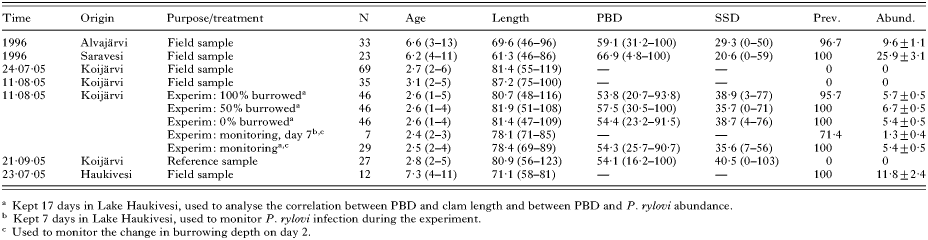
In June and August 1996, A. piscinalis were collected by a scuba diver between depths of 1·5 and 3 m from Lake Alvajärvi (62 °19′N, 25 °43′E) and Lake Saravesi (62 °25′N, 26 °00′E), close to the city of Jyväskylä, Finland. Details of the samplings and materials are given in Table 1. The diver removed each clam and immediately marked the line of the sediment surface on the shell using a sharp file. Clams were individually stored while diving. Clams were transported to the laboratory where they were aged by counting the annual rings on the shell (see Haukioja and Hakala, 1978). The height of the above-sediment part of the shell (i.e. sediment-siphon distance, SSD) and the length of the clam were measured in the laboratory. The gonads were prepared by pressing a piece of tissue between 2 large glass plates, and examined for larval trematodes using a dissection microscope and transmitted light. The same method was used for counting the number of P. rylovi from the gills. In addition, the occurrence of glochidia larvae in the gills was observed visually.

Saarinen and Taskinen (2003) used these materials to study monthly, population-dependent and clam species-dependent differences in burrowing behaviour. In the present paper, we re-analyse these data to examine the relationship between host burrowing depth and P. rylovi abundance which was not included in the paper by Saarinen and Taskinen (2003). We excluded those clam individuals from Lake Saravesi material that were infected by the digenean parasite Rhipidocotyle fennica since trematode infection may markedly affect the host by rendering it sterile (Taskinen and Valtonen, 1995).
Experimental study
We collected clams from an uninfected site (Lake Koijärvi, eastern Finland, 61 °53′N, 29 °11′E) and transported them to an infected site (Lake Haukivesi, 61 °56′N, 28 °49′E, 30 km north-west from Lake Koijärvi) where the clams were allowed to get infected with P. rylovi naturally. To verify that P. rylovi did not occur in Lake Koijärvi we collected a total of 131 A. piscinalis on July 24, August 11 and September 21, 2005, respectively (Table 1). To verify the occurrence of P. rylovi in Lake Haukivesi, 12 A. piscinalis were collected on 23 July, 2005 (Table 1). Clams were transported to the laboratory, examined and measured as described above.
To study the natural burrowing depth of clams in Lake Koijärvi, 27 A. piscinalis were collected on 21 September, 2005 (Table 1). These clams are thereafter referred as ‘reference clams’. The scuba diver documented burrowing depth of clams by marking the line of the sediment surface on the shell using a sharp file. Dissected clams were handled as above.
For the experiment, 175 Anodonta piscinalis were collected from Lake Koijärvi on 11 August 2005, and placed into five 60 litre containers with lake water. Clams were individually marked on the shell using a boring tool; aged and their lengths were measured using a caliper rule. On 12 August 2005, clams were transported to Lake Haukivesi, where they were allocated to the following treatment groups: (1) 100% burrowed, (2) 50% burrowed and (3) 0% burrowed in a way that each group contained an equal number of small and large individuals (Table 1). The 100% burrowed clams were placed into the sediment so that the highest part of the shell was 1 mm below the sediment surface. In addition, totally burrowed clams were placed at a 10 ° angle to horizontal, which corresponds to the observed natural burrowing angle of totally burrowed A. piscinalis (Saarinen and Taskinen, 2003). The 50% burrowed clams were placed at a 70 ° angle, so that 50% of the clam length was below the sediment surface. This corresponds to the natural burrowing angle of approximately 50% burrowed A. piscinalis. The 0% burrowed clams were placed resting on their side on the sediment which is an unnatural position for A. piscinalis (Saarinen and Taskinen, 2003). Clams were placed on the bottom of the littoral zone at 1·5 m depth in 23 plastic basins (12 litre, diameter 34 cm) filled one third with sand, 2 clams (1 small and 1 large individual) from each treatment group to 1 basin, 138 clams in total.
Clams were allowed to take a new burrowing position freely and to become infected naturally by P. rylovi. The reproductive period of P. rylovi is between June and August (Saarinen and Taskinen, 2004), and new infections are established in August (Saarinen and Taskinen, 2005a). After 17 days, on 29 August 2005, burrowing depths were marked by a diver as described above and the clams collected and transported to the laboratory where they were examined and measured.
To monitor the behaviour and parasitism of clams, additional 36 clams (Table 1) were placed in 6 plastic basins, 2 basins with 100% burrowed clams, 2 basins with 50% burrowed clams and 2 basins with 0% burrowed clams. A scuba diver categorized the burrowing depth of these clams on day 2 after the beginning of the experiment as follows: totally burrowed, partly burrowed and totally exposed. On day 7 after the beginning of the experiment, 7 of the clams were collected, transported to the laboratory and handled as above in order to monitor the infection of clams by P. rylovi.
Statistical analyses
The proportionate burrowing depth (PBD, %) was calculated as follows: [(length-SSD)/length]×100%, where SSD was sediment-siphon distance, i.e. the height of the above-sediment part of the shell. The mean abundance of parasite refers to the mean number of parasites among all studied host individuals (Bush et al. 1997). Means are given with ±1 standard error of the mean.
Differences in the mean abundances were analysed using the analysis of variance (ANOVA) or the analysis of covariance (ANCOVA) with clam length as a covariate. Pearson's correlation analysis or partial correlation analysis was used to study relationships between two continuous variables. Statistical analyses were performed using SPSS statistical package (SPSS Inc., Chicago. Illinois).
RESULTS
Field study
Clam ages and lengths, and P. rylovi prevalences and abundances are given in Table 1. The mean PBD of clams from Lake Alvajärvi and Lake Saravesi was 59·1±3·3 and 66·9±5·5%, respectively. SSD, the distance between sediment surface and the highest part of the clam shell, where the siphons are located, varied from 0 to 50 mm and from 0 to 59 mm, respectively. As estimated by the occurrence of glochidia larvae in the gills of female clams, all of the clams from both lakes belonged to a mature age group.
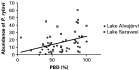
To analyse the correlation between PBD and parasite abundance in Lake Saravesi and Lake Alvajärvi, we combined the data from the two lakes. In addition, we used partial correlation analysis to partial out the effect of clam length, as the burrowing depth depends on clam size (Saarinen and Taskinen, 2003). Combination of the data from both lakes and both months was allowable as the results by Saarinen and Taskinen (2003), using the same field data, showed that neither the month of collection (June vs August) nor the population (Lake Alvajärvi vs Lake Saravesi) affected the burrowing depth of A. piscinalis. Furthermore, prior to combination, we studied the population∗length interaction by using ANCOVA where population was used as a random factor and clam length as a covariate. The interaction was not significant (F=0·103, D.F.=1,52, P=0·749) indicating that PBD-length slopes did not differ between the lakes, also allowing combination of the data. Results of the correlation analysis indicated that there was a significant positive relationship between PBD and abundance of P. rylovi (Pearson's r=0·307, P=0·023, n=53, effect of clam length partialed out). Proportionally deeper burrowed clams were more abundantly infected with P. rylovi (Fig. 1).

Fig. 1. Abundance of Paraergasilus rylovi infection in relation to the proportionate burrowing depth (PBD, % of the clam length below the surface of the sediment) of the host clam, Anodonta piscinalis, collected from Lake Alvajärvi and Lake Saravesi in 1996. The correlation between the PBD and abundance of P. rylovi was significant as analysed using partial correlation (controlling for clam length, see Results section). However, the data presented in the figure are not length-adjusted and the line represents the result of linear regression calculated using data not adjusted for length.
Experimental study
Clam ages and lengths, and P. rylovi prevalences and abundances are given in Table 1. Clams from Lake Koijärvi (n=131) were not infected with P. rylovi (Table 1). Prevalence and mean abundance of P. rylovi in Lake Haukivesi (n=12) were 100% and 11·8±2·4, respectively. Prevalence and mean abundance of P. rylovi among Lake Koijärvi clams kept 17 days in Lake Haukivesi (n=168) were 99% and 5·8±0·2, respectively. The difference in the abundance of P. rylovi between Lake Haukivesi clams and Lake Koijärvi clams kept 17 days in Lake Haukivesi was statistically significant (1-way ANOVA, F=28·325, D.F.=1, 179, P<0·001). None of the clams from Lake Koijärvi (ntot=305, all samples including the experimental clams, monitoring clams and reference clams) were infected by trematode parasites. As estimated by the occurrence of glochidia larvae in the gills of female clams, all of the clams collected from Lake Koijärvi belonged to a mature age group.
Within 2 days marked changes were observed among the 36 clams monitored for their burrowing behaviour. All of the clams placed 100% burrowed had surfaced so that they were only partly burrowed. All of the clams that were placed 50% burrowed were partly burrowed, except for 1 clam that was burrowed totally. None of the 0% burrowed clams kept their original position but were either partly or totally burrowed (1 individual). Five (71·4%) of the 7 monitoring clams collected and dissected on day 7 were infected with P. rylovi, the mean abundance being 1·3±0·4.
PBD at the end of the experiment varied from 21 to 100%. SSD varied from 0 to 77 mm. Among the reference clams of the same origin, PBD varied from 16 to 100%, and SSD from 0 to 103 mm. Burrowing depth in the beginning of the experiment did not have any effect on the final position of the clams (Table 1). Differences in the final PBD between the clams placed in 100, 50 and 0% burrowed position were not significant (1-way ANCOVA, F=1·119, D.F.=2, 138, P=0·330). The effect of the covariate, clam length, was significant (F=42·435, D.F.=1, 138, P<0·001). Mean PBD of the experimental clams (55·2±1·4%, treatment groups combined) and reference clams of same origin (54·1±4·7%) did not differ from each other (1-way ANCOVA, F=0·172, D.F.=1, 165, P=0·678) while the effect of the covariate, clam length, was again significant (F=70·925, D.F.=1, 165, P<0·001). The relationship between PBD and clam length was negative both in experimental and reference clams (see below).
The correlation between PBD and clam length was statistically significant for Lake Koijärvi clams kept 17 days in Lake Haukivesi (Pearson's r=−0·409, P<0·001, n=168). Smaller clams were proportionally deeper burrowed than the bigger ones. A similar pattern was observed also among the reference clams collected from Lake Koijärvi (Pearson's r=−0·796, P<0·001, n=27).
Burrowing position in the beginning of the experiment did not have any effect on the abundance of P. rylovi infection at the end of the experiment. Mean abundance of parasitism among clams placed in 100, 50 and 0% burrowed position was 5·7±0·5, 6·7±0·5 and 5·4±0·5, respectively (1-way ANCOVA, F=2·146, D.F.=2, 138, P=0·121). The effect of the covariate, clam length, was also not significant (F=0·912, D.F.=1, 138, P=0·341).
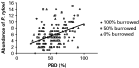
The correlation between PBD at the end of the experiment and abundance of P. rylovi was statistically significant (Pearson's r=0·430, P<0·001, n=168, effect of clam length partialed out, both the experimental and monitoring clams included). Proportionally deeper burrowed clams were more abundantly infected with P. rylovi (Fig. 2).

Fig. 2. The abundance of Paraergasilus rylovi in relation to the proportionate burrowing depth (PBD, % of the clam length below the surface of the sediment) of the host clam, Anodonta piscinalis, at the end of the experiment performed in 2005. The clams were initially put to three different burrowing depths – totally burrowed, 50% burrowed and totally exposed – depicted by diamonds, squares and triangles, respectively. The correlation between the PBD and abundance of P. rylovi was significant as analysed using partial correlation (controlling for clam length, see Results section). However, the data presented in the figure are not length-adjusted and the line represents the result of linear regression calculated using data not adjusted for length.
DISCUSSION
The main result of the present study was the higher parasite abundance in deeper burrowed clams, both in the experiment and in the field samples. In addition, parasite abundance was not related to host length. First, it can be concluded that the transmission of P. rylovi to A. piscinalis is probably not passive. As the volume of water filtered increases by the size of A. piscinalis (Kryger and Riisgard, 1988), the exposure to – and abundance of – P. rylovi should increase by clam size if the transmission was a passive process. Instead, the abundance of P. rylovi in the experiment was not related to clam size which suggests that P. rylovi transmission to A. piscinalis may be based on an active searching for a suitable host. Second, it may be concluded that the deeper burrowed clams are more exposed or more susceptible to P. rylovi infection. The duration of exposure to parasites in the experiment was relatively short, 17 days. In addition, the mean abundance of P. rylovi in experimental and monitoring clams had not reached the abundance observed among Lake Haukivesi clams by the end of the experiment, suggesting that the infection process may still have been unfinished. This could mean that the factors affecting exposure may have been more important in explaining the current result than those related to susceptibility.
How would deep burrowing increase the exposure of A. piscinalis to P. rylovi infection? Bolster (1954) observed copepodids of Mytilicola intestinalis to swim downward and escape light. In line with this, Mytilus edulis individuals which were growing or cultured off the bottom, had lower infestation rates by M. intestinalis than individuals which lived at the bottom (Hockley, 1951). Since the bivalves live in the bottom, bottom-seeking behaviour of the copepod parasites of bivalves, such as P. rylovi, would increase the probability to find a suitable host. In this case a positive correlation between proportionate burrowing depth and abundance of P. rylovi would be found in A. piscinalis. However, burrowing of cockles Austrovenus stutchburyi did not have any effect on the prevalence of infection of the copepod Pseudomyicola spinosus (Poulin et al. 2000). Therefore, the relationship between burrowing depth of the bivalve host and the infection rate by their parasitic copepods may differ depending on the host-parasite association.
An alternative hypothesis is that the increasing burrowing depth of A. piscinalis may increase clam susceptibility to parasitism. If the feeding efficiency decreases with burrowing depth, as found by de Goeij and Luttikhuizen (1998) for Macoma balthica, it could be assumed that the host's ability to control the infection (immune response) would become impaired with increased burrowing depth. In our previous study (Saarinen and Taskinen, 2005a), we showed that susceptibility of A. piscinalis to P. rylovi infection is condition-dependent, and that stress has a long-lasting, increasing effect on host susceptibility to P. rylovi infection. Thus we can not reject the idea that some burrowing-induced condition-dependent factors may have contributed to the present results, especially in the field populations.
The proportionate burrowing depth of uninfected reference clams did not differ from that of infected experimental clams of the same origin. This indicates that burrowing of the experimental clams affected parasitism rather than the parasites altering burrowing of the clams. The experimental clams were not infected by trematodes, which are known to adaptively manipulate host behaviour by molluscs (e.g. Thomas and Poulin, 1998). Furthermore, trematode-infected individuals were excluded from the natural population material collected from Lake Alvajärvi and Lake Saravesi. Thus, trematode infections did not influence the present results.
The experimental design was such that the clams were allowed to choose their preferred burrowing depth. Thus, the burrowing depth was not controlled by the researchers which can be regarded as a disadvantage. On the other hand, the clams were allowed to perform their natural burrowing behaviours as suggested by the equal mean PBD of clams in the experiment and in the lake of origin. In addition, the present design allowed us to figure out the fast, complete change in the PBD which was observed within 2 days. The change in PBD was independent of the original position of the clams. Furthermore, the design allowed us to observe the large variation in PBD which indicates a strong, individual preference with respect to burrowing depth in A. piscinalis. Our results from the experiment and observations from the field suggest that the main factor influencing PBD in A. piscinalis was the size of the clam. There was a negative correlation between PBD and clam length, smaller clams being deeper burrowed. If burrowing in A. piscinalis has a predation-avoidance function, as has been suggested for some other bivalves (Taylor and Eggleston, 2000; Tallquist, 2001), the smaller clams should, indeed, be deeper burrowed due to the size-selective predation by the muskrat, Ondatra zibethicus, on A. piscinalis observed by Jokela and Mutikainen (1995). However, clam length as such did not have an effect on the abundance of P. rylovi infection.
Burrowing behaviour may have an important role in fitness of an individual clam. Deep burrowing may be advantageous for avoidance of predation while ventilation and feeding may require the opposite (Taylor and Eggleston, 2000; Tallquist, 2001; Saloom and Duncan, 2005). In addition, burrowing may have a reproductive function in unionid clams, as the results by Amyot and Downing (1998) suggested that mature clams were in a more exposed position during the spawning period, presumably to increase fertilization success. Our present results indicate that parasitism can be another factor which is dependent on the burrowing depth. Thus, it would be important to investigate the optimal burrowing depth, and the inducible responses in the burrowing of bivalves in temporally and spatially varying conditions with respect to predation, feeding, reproduction and parasitism. In addition, it would be valuable to study the possible active host-searching and bottom-seeking behaviour of the parasite, P. rylovi, which were suggested by the present results.
We thank J. C. Holmes, R. I. Jones, A. Karvonen, R. Poulin and E. T. Valtonen for valuable comments on the manuscript. The study was financed by Maj and Tor Nessling Foundation (M.S.) and the Ministry of Agriculture and Forestry of Finland (J.T.).