Introduction
Meta-analyses of studies reporting rates of psychotic symptoms and experiences in the general population suggest the existence of an extended psychosis phenotype (Linscott & van Os, Reference Linscott and van Os2010), representing the behavioral expression of distributed genetic and non-genetic risk for psychotic disorder (van Os et al. Reference van Os, Linscott, Myin-Germeys, Delespaul and Krabbendam2009). Although the data suggest a psychometric ‘continuum’, there is also evidence for an underlying latent categorical, non-continuous structure of the population (i.e. regardless of the presence of this continuum, the population may still be composed of several subgroups) (Kaymaz & van Os, Reference Kaymaz and van Os2010; Linscott & van Os, Reference Linscott and van Os2010).
Psychosis proneness seems to be age related, peaking in adolescence and decreasing after that period (Verdoux et al. Reference Verdoux, van Os, Maurice-Tison, Gay, Salamon and Bourgeois1998; Peters et al. Reference Peters, Joseph and Garety1999). High rates of subclinical psychotic experiences have been reported in both clinical (Altman et al. Reference Altman, Collins and Mundy1997; Yung et al. Reference Yung, Buckby, Cotton, Cosgrave, Killackey, Stanford, Godfrey and McGorry2006) and general population samples of adolescents (McGorry et al. Reference McGorry, McFarlane, Patton, Bell, Hibbert, Jackson and Bowes1995; Wigman et al. Reference Wigman, Vollebergh, Raaijmakers, Iedema, van Dorsselaer, Ormel, Verhulst and van Os2009; Yung et al. Reference Yung, Nelson, Baker, Buckby, Baksheev and Cosgrave2009). Longitudinal studies in general population samples, using follow-up intervals from 6 months to 8 years, have shown that, in most adolescents, psychotic experiences disappear over time and do not persist into adulthood (Dhossche et al. Reference Dhossche, Ferdinand, van der Ende, Hofstra and Verhulst2002; Hanssen et al. Reference Hanssen, Bak, Bijl, Vollebergh and van Os2005; Wiles et al. Reference Wiles, Zammit, Bebbington, Singleton, Meltzer and Lewis2006; Dominguez et al. Reference Dominguez, Wichers, Lieb, Wittchen and van Os2011).
However, in a minority of adolescents, subclinical psychotic experiences progress to clinical psychotic illness. There is evidence from two birth cohorts (Poulton et al. Reference Poulton, Caspi, Moffitt, Cannon, Murray and Harrington2000; Welham et al. Reference Welham, Scott, Williams, Najman, Bor, O'Callaghan and McGrath2009), three general population cohorts (Hanssen et al. Reference Hanssen, Bak, Bijl, Vollebergh and van Os2005; Werbeloff et al. Reference Werbeloff, Drukker, Dohrenwend, Levav, Yoffe, van Os, Davidson and Weiser2009; Dominguez et al. Reference Dominguez, Wichers, Lieb, Wittchen and van Os2011) and other longitudinal work (Chapman et al. Reference Chapman, Chapman, Kwapil, Eckblad and Zinser1994) that subclinical psychotic experiences may precede the diagnosis of psychotic disorder and hospital admission for schizophrenia by many years. Suggested moderators in representative population samples of risk for clinical outcome are the severity of psychotic experiences (Poulton et al. Reference Poulton, Caspi, Moffitt, Cannon, Murray and Harrington2000; Hanssen et al. Reference Hanssen, Bak, Bijl, Vollebergh and van Os2005; Welham et al. Reference Welham, Scott, Williams, Najman, Bor, O'Callaghan and McGrath2009), early social functioning (Werbeloff et al. Reference Werbeloff, Drukker, Dohrenwend, Levav, Yoffe, van Os, Davidson and Weiser2009), the type of coping the person develops (Bak et al. Reference Bak, Myin-Germeys, Hanssen, Bijl, Vollebergh, Delespaul and van Os2003), the degree of persistence of psychotic experiences over time (Dominguez et al. Reference Dominguez, Wichers, Lieb, Wittchen and van Os2011), alterations in development and cognitive ability (Dominguez et al. Reference Dominguez, Can Saka, Lieb, Wittchen and van Os2010), the degree of admixture with affective dysregulation (van Rossum et al. Reference van Rossum, Dominguez, Lieb, Wittchen and van Os2009), and distress associated with experiences (Bak et al. Reference Bak, Myin-Germeys, Delespaul, Vollebergh, de Graaf and van Os2005; Jacobs et al. Reference Jacobs, Myin-Germeys, Derom, Vlietinck and van Os2005; Garety et al. Reference Garety, Bebbington, Fowler, Freeman and Kuipers2007). In other words, not just the presence of psychotic experiences per se, but rather the psychopathological, developmental and psychological context may moderate the likelihood of a clinical outcome (Kaymaz & van Os, Reference Kaymaz and van Os2010).
Much uncertainty remains, however, about how psychosis proneness develops over time in representative general population samples. A longitudinal developmental approach, modeling the trajectories of experiences over time, in relation to the development of health-care use, may offer more insight in the time course of psychosis phenotypes, and feed theory on latent subgroups underlying the extended psychosis phenotype (Linscott & van Os, Reference Linscott and van Os2010) and also on possible high-risk approaches targeting these groups (Rössler et al. Reference Rössler, Riecher-Rossler, Angst, Murray, Gamma, Eich, van Os and Gross2007). For example, Mackie et al. (Reference Mackie, Castellanos-Ryan and Conrod2010) followed 409 adolescents, aged 14 years, with elevated scores on one of four personality risk factors (hopelessness, anxiety-sensitivity, impulsivity and sensation seeking), for 2 years and distinguished three trajectories of subclinical psychosis: a persistent, an increasing and a low subgroup. Research is needed to examine whether this approach can be extended to a more representative general adolescent population sample and a longer time-span.
The present study addressed two issues. First, the development of subclinical positive psychotic experiences over time in early adolescents from the general population (10–16 years) was investigated by studying growth curves of subclinical psychotic experiences over time. Second, the resulting trajectories were examined for differences in (i) relation to need for care, (ii) factors that the previous literature suggests predict transition to clinical psychotic disorder (including affective dysregulation, social functioning, attention, early development, distress, severity and persistence of experiences), (iii) environmental risks associated with clinical psychotic disorder such as urbanicity (March et al. Reference March, Hatch, Morgan, Kirkbride, Bresnahan, Fearon and Susser2008), ethnic minority status (Cantor-Graae & Selten, Reference Cantor-Graae and Selten2005), early trauma (Read et al. Reference Read, van Os, Morrison and Ross2005), adolescent cannabis use (Henquet et al. Reference Henquet, Murray, Linszen and van Os2005) and (iv) parental report on subclinical psychotic experiences over time.
Method
Sample
Adolescents were participants of the TRacking Adolescents' Individual Lives Survey (TRAILS), a prospective cohort study among adolescents in the general Dutch population. TRAILS investigates the development of mental and somatic health from pre-adolescence into adulthood. Three data collection waves were completed: T1 (2001–2002), T2 (2003–2004) and T3 (2005–2007). Detailed information on sample and selection procedures can be found elsewhere (de Winter et al. Reference de Winter, Oldehinkel, Veenstra, Brunnekreef, Verhulst and Ormel2005; Huisman et al. Reference Huisman, Oldehinkel, de Winter, Minderaa, de Bildt, Huizink, Verhulst and Ormel2008). At T1, 2230 children participated (mean age 11.1 years, s.d.=0.6, 51% girls). At T2, 96% of these participants (n=2149, mean age 13.6 years, s.d.=0.5, 51% girls) and at T3, 81% of the original number of participants (n=1816, mean age 16.3 years, s.d.=0.7, 52% girls) were reassessed. The mean number of months was 29.5 between T1 and T2 (s.d.=5.4, range 16.7–48.1) and 32.6 (s.d.=7.1, range 11.0–53.0) between T2 and T3.
Measures
The subscale ‘thought problems’ of the Youth Self Report (YSR; Achenbach, Reference Achenbach1991a) and the Child Behavior Checklist (CBCL; Achenbach, Reference Achenbach1991b) was used at all time points to assess early subclinical psychotic experiences. These validated (Verhulst et al. Reference Verhulst, van der Ende and Koot1997a, Reference Verhulst, van der Ende and Kootb) questionnaires have been developed to assess multiple informant child psychopathology and questions are the same in both variants. Items can be rated as not present (0), sometimes present (1) or very often present (2) in the past 6 months. Although this subscale is assumed to be tapping into subclinical psychotic experiences (Dhossche et al. Reference Dhossche, Ferdinand, van der Ende, Hofstra and Verhulst2002; Welham et al. Reference Welham, Scott, Williams, Najman, Bor, O'Callaghan and McGrath2009), not all individual items may reflect psychosis. Therefore, this self-report subscale was optimized in a pre-study in an independent sample (n=5422) of 12–16-year-old adolescents (ter Bogt et al. Reference ter Bogt, van Dorsselaer and Vollebergh2003). Three items on skin picking, storing up things and sleeping less than other children were excluded based on their low Spearman inter-item correlations with the other items (all <0.140 in the total sample and <0.100 in the subsample with minimally one thought problems endorsement) (Streiner, Reference Streiner2003), leaving the following nine items: taking one's mind off things (9), thinking about self-harm (18), hearing things that others do not (40), twitching/nervous behavior (46), repeating certain behaviors (66), seeing things that others do not (70), displaying behavior that others find strange (84), having ideas that others find strange (85) and sleeping problems (100). Mean inter-item Spearman correlation was now 0.16–0.20 at all time points and thus acceptable. Furthermore, three (one for each measurement point) one-factor confirmatory factor analyses (CFAs) were carried out to investigate whether these nine items together would represent a single dimension. A one-factor model fitted the data well at T1 [χ2(22)=102.08, p<0.001, Comparative Fix Index (CFI)=0.966, Root Mean Square Error of Approximation (RMSEA)=0.040], T2 [χ2(22)=159.82, p<0.001, CFI=0.926, RMSEA=0.056] and T3 [χ2(22)=111.58, p<0.001, CFI=0.925, RMSEA=0.050]. Therefore, these nine items were used for both self-report and parental report of thought problems of the YSR and CBCL respectively.
The mean of all items of three other subscales [anxiety/depression (13 items), social problems (11 items) and attention problems (nine items)] of the YSR were also used (as proxies reflecting affective dysregulation, social functioning and cognitive functioning respectively); these subscales showed acceptable internal consistency [Cronbach's α for all scales on all waves ranged from 0.68 to 0.83, with the exception of social problems at T3 (α=0.64)].
The Community Assessment of Psychic Experiences (CAPE) positive experiences subscale (20 self-reported items) was used to assess psychotic experiences at T3 (Stefanis et al. Reference Stefanis, Hanssen, Smirnis, Avramopoulos, Evdokimidis, Stefanis, Verdoux and van Os2002; Konings et al. Reference Konings, Bak, Hanssen, van Os and Krabbendam2006). The CAPE is based on the Peters et al. Delusions Inventory (PDI; Peters et al. Reference Peters, Joseph and Garety1999), modified to include hallucinatory experiences. Each item in the CAPE rates two aspects of psychotic experiences [(i) frequency and (ii) associated distress], both rated on a four-point scale of never/not distressed (1) to nearly always/very distressed (4). The frequency and distress items together showed good internal consistency (Cronbach's α=0.93). The five subdimensions of this positive scale [i.e. hallucinations (Cronbach's α=0.82), delusions (α=0.86), paranoia (α=0.79), grandiosity (α=0.65) and paranormal beliefs (α=0.61)], identified in earlier research and computed as the sum of all frequency items of that specific subdimension (Wigman et al. Reference Wigman, Vollebergh, Raaijmakers, Iedema, van Dorsselaer, Ormel, Verhulst and van Os2009), were used as five continuous outcome measures. Youth health-care use was assessed by parental report. At T1, questions were phrased as (i) ‘Have you ever consulted (…) relating to the emotional or behavioral problems of your child?’ and (ii) ‘What was the age of your child at first contact with this health care professional?’ At T2 and T3, health-care questions reflected the interval since the last interview. Total health-care use was defined as the sum of all health-care consultations. Additionally, total health-care use was subsequently split into four categories (as recognized by the Dutch Care Authority): general care, specialized mental health care, youth/social care and informal care (such as a self-help group or religious counsellor). The proportion of adolescents that consulted any of these institutions was used in the analyses.
The occurrence of life events before the age of 11 years was calculated as the sum of moving, hospitalization, sickness or death (of self, family or friends), parental divorce or being away from home for at least 3 months by parent report (all yes/no), plus a rating of the number of negative events experienced between (i) 0 and 5 years and (ii) 6 and 11 years by self-report (scale 0–10). Trauma between 11 and 16 years was based on T2 and T3 assessments and calculated as the sum score of victim of violence, gossip, bullying or sexual harassment during the past 2 years by self-report (all yes/no) at T2 plus two ratings at T3: a rating of the number of negative events children experienced in the past 2 years by self-report (scale 0–10) and a rating of the stressfulness of the child's life by parent report (scale 0–10). Early development was indexed as the sum of parental report to questions of ‘Did your child have problems with …’ eating, sleeping or concentration during the toddler period and of their child talking/walking late compared to other children and experiencing (all yes/no).
Analysis
Analyses were conducted with Mplus 5.1 (Muthén & Muthén, Reference Muthén and Muthén1998–2007). First, the development of self-reported thought problems over time (T1, T2 and T3) was analysed by latent growth modeling (LGM). LGM is a variant of structural equation modeling, in which two latent growth factors are identified, representing intercept (i.e. initial score) and slope (i.e. change in score over time) (Duncan et al. Reference Duncan, Duncan, Stryker, Li and Alpert1999). Indicators were set to load 1 on the intercept and to load 0 on slope at T1, to load 1 on slope at T2, and factor loading was freely estimated at T3. Means and variances of intercept and slope were estimated.
To evaluate the model, several fit indices were used (Brown, Reference Brown2006). For good model fit, χ2 should be low; the CFI should be >0.90 for an acceptable model fit and >0.95 for a good model fit; and the RMSEA should be <0.08 for an acceptable model fit and <0.05 for a good model fit. Full information maximum likelihood (FIML) estimation was used for model estimation and, given that data were non-normally distributed, a mean-adjusted χ2 that is robust to non-normality was calculated (Brown, Reference Brown2006). Subsequently, different growth trajectories were assessed within this general growth model by conducting a latent class analysis (LCA), which identifies a set of mutually exclusive latent classes that account for the distribution of cases occurring within a cross-tabulation of observed variables (McCutcheon, Reference McCutcheon1987). Thus, LCA was used here to find the smallest number of classes of individuals with similar developmental trajectories of thought problems. The number of classes is decided based on several indices. A model with n classes is chosen if the Akaike Information Criterion (AIC) and the Bayesian Information Criterion (BIC) are low(est), the entropy (H) is acceptable (>0.80) to good (>0.90), and a model with one extra class is no longer significant according to the Lo–Mendell–Rubin Likelihood Ratio Test (LMR-LRT) statistic. Factor loadings and (residual) variances of intercept and slope and their covariance were constrained to be equal for all classes.
Construct validity of the trajectories representing psychosis was assessed by testing for association with the five subdimensions of the CAPE positive symptom frequency dimension, using MANOVA with trajectory membership as the fixed factor and the CAPE subdimension frequency scores as dependent variables. Partial eta squared (ηp2) was reported as an estimate of effect size (with 0.01 <ηp2<0.06=small, 0.06<ηp2 <0.14=medium and ηp2>0.14=large effect size).
Second, thought problems developmental trajectories were examined with respect to health-care use, known predictors of clinical transition to psychotic disorder, and known risk factors for clinical psychotic disorder. Six MANOVAs were performed with trajectory membership as a fixed factor and mean levels of (i) anxiety/depression, (ii) social problems, (iii) attentional problems, (iv) parental report of thought problems, (v) distress scores of the five CAPE subdimensions and (vi) proportion of adolescents who had consulted health-care institutions as dependent variables. Using multinomial logistic regression, the following known environmental risk factors for psychotic disorder were examined in relation to the different developmental trajectories: ethnic minority status (Dutch/non-Dutch, self-reported), urbanicity (three levels of increasing urbanicity, defined by number of inhabitants), life events before 11 years and trauma between 11 and 16 years (both in quintiles), cannabis use before 16 years ever and the amount of cannabis ever used (number of times cannabis was used: never, sometimes and often).
Results
Model development
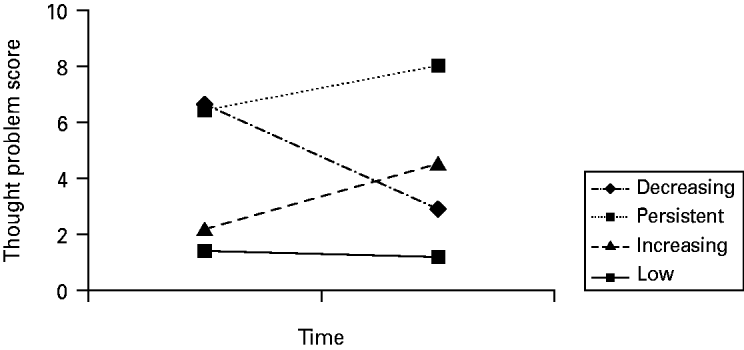
An unspecified growth model was found to describe the data well (i.e. a model in which growth between two adjacent time points is linear, but the overall growth across time points cannot be described by one simple straight line). In this model, the overall shape of growth from T1 over T2 to T3 is allowed to be non-linear by freely estimating the slope growth parameter of T3 instead of fixing its value in a linear way (i.e. with the value 2). This model, depicted in Fig. 1, showed good model fit, with χ2(1)=1.238, p=0.26, a CFI of 0.999 and RMSEA of 0.010.
Visual representation of mean intercept and mean slope of the four trajectories: low, decreasing, increasing and persistent levels of thought problems over time.

General development of thought problems over time
The unstandardized mean intercept was 2.17 [95% confidence interval (CI) 2.07–2.27]. The maximum score of the 12-item thought problems scale is 24, with a clinical cut-off score positioned at a value of 5 (Achenbach, Reference Achenbach1991a) (calculated for nine items, this would be 9/12×5=3.75). The intercept, therefore, was in the lower range of the scale and well below cut-off. The mean slope was significant (p<0.001) and negative (unstandardized mean slope of −0.41, 95% CI −0.51 to −0.31), indicating that the reported number of thought problems decreased significantly, but moderately, over time.
Different developmental trajectories
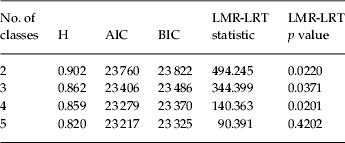
Several subsequent LCAs were executed with increasing numbers of classes (Table 1) to distinguish distinct developmental trajectories. A model with four classes described the data well because this model was significant and showed a good entropy value. Furthermore, AIC and BIC decreased when increasing the number of classes from three to four. Although these values were even lower for a model with five classes, this model was not significantly better than a model with four classes. Average class probabilities were high (0.84–0.94), indicating that participants were correctly assigned to their respective latent classes.
Criteria for deciding the number of classes within the repeated measures of thought problems

H, Entropy measure, which can vary between 0 and 1, with higher values indicating clearer discrimination of classes; AIC, Akaike's Information Criterion; BIC, Bayesian Information Criterion; LMR-LRT, Lo–Mendell–Rubin Likelihood Ratio Test.
The four classes represented different developmental trajectories (Fig. 1). The first class with the largest number of participants (n=1804, 82% of the sample) was characterized by a low mean intercept (unstandardized mean intercept=1.44, 95% CI 1.31–1.57) and a shallow negative slope (unstandardized mean slope −0.28, 95% CI −0.42 to −0.15), and labeled the ‘low’ group. The second class (n=204, 9%) was characterized by a high intercept (unstandardized mean intercept=6.69, 95% CI 6.07–7.30) and a steep negative slope (unstandardized mean slope=−3.81, 95% CI −4.48 to −3.13), that is a decrease in thought problems over time, described as the ‘decreasing’ group. The third class (n=163, 7%) was characterized by an average intercept (unstandardized mean intercept=2.2, 95% CI 1.81–2.62) and a steep positive slope (unstandardized mean slope=2.24, 95% CI 1.66–2.83), that is an increase in thought problems over time, and was labeled the ‘increasing’ group. The fourth class (n=41, 2%) was a characterized by a high intercept (unstandardized mean intercept=6.28, 95% CI 4.94–7.82) and a significant positive slope (unstandardized mean slope=1.64, 95% CI 0.10–3.18). This group was called the ‘persistent group’.
Males and females were not equally distributed over the four classes [χ2(3)=0.004, p<0.001]. In the low and decreasing groups, 49% and 51% respectively were girls. In the increasing and persistent groups, 66% and 68% respectively were girls.
Associations with the CAPE frequency and distress scores
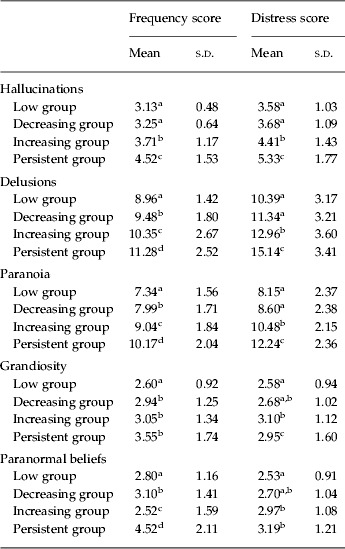
Class membership was strongly associated with T3 frequency scores of hallucinations [F(3, 1633)=79.34, p<0.001, ηp2=0.13], delusions [F(3, 1633)=49.59, p<0.001, ηp2=0.08], paranoia [F(3, 1633)=74.95, p<0.001, ηp2=0.12], grandiosity [F(3, 1633)=19.37, p<0.001, ηp2=0.03], and paranormal beliefs [F(3, 1633)=31.36, p<0.001, ηp2=0.05]. A dose–response pattern was found; the persistent group scored highest, followed respectively by the increasing group, the decreasing group and the low group on all subdimensions.
CAPE distress associated with psychotic experiences was only assessed in participants who reported any psychotic experiences. Of those participants, 15% of the low group had experienced any level of associated distress. In the decreasing group the corresponding value was 23%, whereas in the increasing and persistent groups the proportions were 45% and 51% respectively. Class membership was significantly associated with the distress scores of hallucinations [F(3, 416)=22.27, p<0.001, ηp2=0.14], delusions [F(3, 416)=23.06, p<0.001, ηp2=0.14], paranoia [F(3, 416)=35.13, p<0.001, ηp2=0.20], grandiosity [F(3, 416)=15.75, p<0.001, ηp2=0.10], and paranormal beliefs [F(3, 416)=6.35, p=0.001, ηp2=0.04]. Again, a dose–response pattern was found (Table 2).
Associations between membership of the four groups (low, decreasing, increasing and persistent thought problems) and CAPE frequency and distress scores, for each subdimension and group

CAPE, Community Assessment of Psychic Experiences; s.d., standard deviation.
Different superscript letters refer to significant differences (p<0.05) of mean scores between groups within subdimensions; if two subdimension scores are labelled with the same letter, the scores of this subdimension do not differ between these two groups. If two scores are labelled with different letters, these scores differ.
Associations with use of health care
The four trajectories did not differ in mean age of first contact with total health care [F(3, 887)=1.12, p=0.34], use of total mental health care or any of the four subcategories of care, except for mental health care at T3 [F(3, 187)=2.80, p=0.041]; here the persistent group reported significantly more use of mental health care than the other groups. Furthermore, non-significant consistent trends were seen; the persistent group consistently reported the highest level of use of care, followed by the increasing group, the decreasing group and the low group.
Associations with factors associated with transition to clinical psychotic disorder
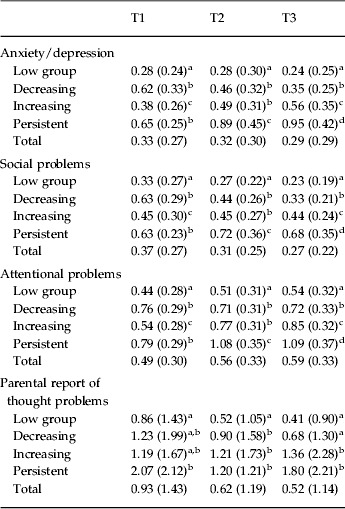
The four trajectory groups differed in mean level of anxiety/depression at T1 [F(3, 1617)=101.63, p<0.001], T2 [F(3, 1617)=82.02, p<0.001), and T3 (F(3, 1617)=122.49, p<0.001]. Similarly, they differed in mean level of social problems at T1 [F(3, 1617)=84.83, p<0.001], T2 [F(3, 1617)=75.35, p<0.001] and T3 [F(3, 1617)=92.47, p<0.00], and also in mean level of attentional problems at T1 [F(3, 1617)=71.41, p<0.001], T2 [F(3, 1617)=67.94, p<0.001] and T3 [F(3, 1617)=73.63, p<0.001] (Table 3). The comparison of post-hoc contrasts showed that the trajectory groups differed from each other at all time points, with the persistent group consistently showing the highest scores on all dimensions by T3.
YSR subscale scores of anxiety/depression, social problems, attentional problems and parental report of CBCL thought problems of the four groups (low, decreasing, increasing and persistent thought problems) at T1, T2 and T3

YSR, Youth Self Report; CBCL, Child Behavior Checklist.
Values given as mean item score (standard deviation) for YSR and mean sum score (standard deviation) for CBCL.
Different superscript letters refer to significant differences (p<0.05) of mean scores between groups within subdimensions; if two subdimension scores are labelled with the same letter, the scores of this subdimension do not differ between these two groups. If two scores are labelled with different letters, these scores differ.
Parental report
The four trajectories differed in mean level of thought problems reported by parents at T1 [F(3, 1113)=6.19, p<0.001], T2 [F(3, 1113)=11.86, p<0.001] and T3 [F(3, 1113)=24.66, p<0.001]. Parents of the persistent group reported the highest levels of thought problems in their offspring at all measurements, followed by the increasing group, the decreasing group and the low group (Table 3).
Known risk factors for psychotic disorder
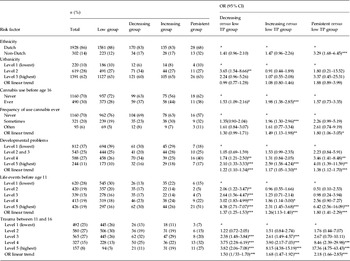
Persistent group membership was associated significantly with ethnic minority group status (Table 4). Urbanicity was not consistently associated with belonging to the four groups, although a non-significant trend was seen. Cannabis use before age 16 significantly predicted decreasing or increasing group membership, but not persistent group membership. The amount of cannabis ever used predicted, in a dose–response fashion, increasing or persistent levels of thought problems over time. Developmental problems, life events before age 16 years and exposure to trauma between ages 11 and 16 years all significantly predicted decreasing, increasing or persistent group membership in a dose–response fashion.
Odds ratios (ORs) for decreasing, increasing and persistent groups with increasing load of risk factors, with the low group as the reference group

TP, Thought problems; CI, confidence interval.
Risk factor levels are constructed as described in text; OR linear trend is the summary increase in risk with one unit change in risk factor.
a Reference category.
* p<0.05, ** p<0.01, *** p<0.001.
Discussion
The present study is, to our knowledge, the first to investigate developmental trajectories of mild positive psychotic experiences in a large, representative general population sample of adolescents, followed from age 10 to age 16 years. Four distinct developmental trajectories of thought problems over time were distinguished, labeled low, decreasing, increasing and persistent groups. The results suggest that both the increasing and particularly the persistent group represent the most important developmental patterns from a clinical and high-risk perspective, as these trajectories display persistent expression of subclinical psychosis, have the strongest associations with factors known to predict transition to clinical psychotic disorder, including the highest levels of severity of distress and secondary distress associated with psychotic experiences, the highest level of social problems, increasing levels of attentional problems and affective dysregulation, and a pattern of association with environmental risks that predict onset of clinical psychotic disorder. Furthermore, parental report of thought problems in the adolescents was consistently highest for these two groups, indicating higher levels of observable psychotic experiences and supporting the validity of the self-report measure of psychotic experiences. Of these two groups, the persistent group seems to be the most relevant from a high-risk perspective. Although few significant differences were found for use of health care, the persistent group displayed a clear trend of using more health care, and in fact used more mental health care at the end of the follow-up period. A trend towards dose–response was found for almost all measurements of psychopathology, the persistent group scoring highest, followed by, in order of decreasing strength of association, the increasing, the decreasing and the low groups.
Expression of psychotic experiences over time is dynamic
Earlier studies have suggested that cross-sectional measurements of subclinical psychotic experiences may not be useful as a specific risk factor for later clinical psychotic outcomes (Correll et al. Reference Correll, Lencz, Smith, Auther, Nakayama, Hovey, Olsen, Shah, Floey and Cornblatt2005), in part because they are so common (Yung et al. Reference Yung, Nelson, Baker, Buckby, Baksheev and Cosgrave2009). Furthermore, results are inconsistent with regard to whether psychotic experiences have a specific (Poulton et al. Reference Poulton, Caspi, Moffitt, Cannon, Murray and Harrington2000) or a more general (Dhossche et al. Reference Dhossche, Ferdinand, van der Ende, Hofstra and Verhulst2002) predictive value for later psychopathology. The current results, in agreement with the findings of Mackie et al. (Reference Mackie, Castellanos-Ryan and Conrod2010), suggest that, for the purpose of creating subgroups enriched in risk, a focus on dynamic trajectories of psychotic experiences over time may be more useful than creating categories based on cross-sectional information. Both genetic and environmental effects on psychiatric phenotypes are developmentally dynamic during the adolescent phase, with evidence for both innovation (new effects ‘coming on line’) and attenuation (reduction in the influence of effects over time) (Kendler et al. Reference Kendler, Gardner and Lichtenstein2008). Indeed, evidence suggests that the expression of subclinical psychotic experiences peaks during adolescence/young adulthood and then declines over the life course (Verdoux et al. Reference Verdoux, van Os, Maurice-Tison, Gay, Salamon and Bourgeois1998). The current study confirmed this pattern for the adolescent life phase by demonstrating that, for the majority of the adolescent population, the rate of psychotic experiences decreased over time. A small group of adolescents, however, showed a contrasting pattern of an increase or a persistence in their level of psychotic experiences over time. The persistent group may represent individuals on a neurodevelopmental pathway to psychosis (Murray & Lewis, Reference Murray and Lewis1987; Weinberger, Reference Weinberger1987), because these participants consistently reported high levels of thought problems and other pathology post-baseline, whereas the increasing group may represent an affective pathway to psychosis, thought to be more reactive to environmental risk factors (Myin-Germeys & van Os, Reference Myin-Germeys and van Os2007). The existence of both an increasing and a decreasing group further illustrates the dynamics of subclinical psychosis in adolescence and suggests that protective factors may operate in addition to those that increase risk.
Persistence of psychotic experiences
Recent studies indicate that environmental risk factors may cause persistence of subclinical psychotic experiences in some individuals (Cougnard et al. Reference Cougnard, Mercelis, Myin-Germeys, de Graaf, Vollebergh, Krabbendam, Lieb, Wittchen, Henquet, Spauwen and van Os2007), and that greater levels of persistence in turn predict greater risk of transition to clinical psychotic disorder (Dominguez et al. Reference Dominguez, Wichers, Lieb, Wittchen and van Os2011). Persistence of psychotic experiences may be related to an underlying process of dopamine sensitization, associated with repeated exposure to environmental risk factors acting on a final common pathway (Boileau, et al. Reference Boileau, Dagher, Leyton, Gunn, Baker, Diksic and Benkelfat2006; Collip et al. Reference Collip, Myin-Germeys and van Os2008; van Winkel et al. Reference van Winkel, Stefanis and Myin-Germeys2008). Only the persistent developmental trajectory was consistently associated with many factors that predict or are associated with transition to clinical psychosis. Given that the decreasing and the increasing trajectories were similarly but less strongly associated with developmental problems and stressful/traumatic events, the results suggest that early developmental vulnerability associated with later psychotic disorder may only become expressed in combination with additional exposure to multiple environmental risks, giving rise to persistence of psychotic experiences, followed by onset of need for care and health-care use, in agreement with evidence from other longitudinal work in representative population samples (Cougnard et al. Reference Cougnard, Mercelis, Myin-Germeys, de Graaf, Vollebergh, Krabbendam, Lieb, Wittchen, Henquet, Spauwen and van Os2007; Dominguez et al. Reference Dominguez, Can Saka, Lieb, Wittchen and van Os2010, Reference Dominguez, Wichers, Lieb, Wittchen and van Os2011).
The finding that parental report of thought problems in adolescents was lower than adolescent self-report is in line with earlier work (Laurens et al. Reference Laurens, Hodgins, Maughan, Murray, Rutter and Taylor2007). In addition, earlier studies have found that parental reports, in particular, of persisting symptoms are predictive of later psychotic pathology (Scott et al. Reference Scott, Martin, Bor, Sawyer, Clark and McGrath2009; Welham et al. Reference Welham, Scott, Williams, Najman, Bor, O'Callaghan and McGrath2009), in line with the current finding that the groups most at risk more often were described by their parents as having persistent psychotic experiences.
Environmental risk factors and their interactions with early developmental vulnerability may thus represent a useful focus for early intervention and prevention, because these determine the probability of a persisting and even deteriorating trajectory over time. Definition of risk based on cross-sectional information may be less suitable, given the risk of stigma and labeling (van Zelst, Reference van Zelst2009) on the basis of a state that most probably represents a transitory experience over time and shows dynamic patterns. While acknowledging the risk of stigma and labeling, the data nevertheless support the idea of following children with (psychotic) problems for a longer period of time, assessing a broader range of psychopathology, in addition to the possibility of targeting interventions based on certain environmental exposures (Bak et al. Reference Bak, Myin-Germeys, Hanssen, Bijl, Vollebergh, Delespaul and van Os2003). The persistent group, considered at highest risk for clinical outcome, may represent the target group for early intervention; the increasing group, considered at high risk for psychosis, may represent the target group for prevention.
Methodological issues
The results should be interpreted in the context of the strengths and limitations of this study. The major strength is that, to our knowledge, this is the first study that assesses the longitudinal development of individual experiences over time with growth modeling in a large, representative adolescent general population sample, and addressing multiple domains of psychopathology and also clinically relevant measures. Given that the more pathological groups were small, they would have been overlooked when analyzed at the level of the group as a whole.
The most important limitation is that the study only covered the age range of 10–16 years and did not cover the full critical age for psychosis and transition to psychotic disorder, nor did it use clinical interview to assess transition to formally defined psychotic disorder. Another important issue is that the thought problems subscale measures a broader range of psychopathology and does not specifically target psychotic symptoms. However, the trajectories can be assumed to represent subclinical psychotic experiences, as suggested by associations with the CAPE frequency scores, a validated instrument for the assessment of psychotic experiences (Konings et al. Reference Konings, Bak, Hanssen, van Os and Krabbendam2006). The largest differences in CAPE scores between the trajectories can be found in the dimensions of hallucinations, delusions and paranoia, which previous work suggests are the dimensions with the greatest potential clinical impact (Wigman et al. Reference Wigman, Vollebergh, Raaijmakers, Iedema, van Dorsselaer, Ormel, Verhulst and van Os2009). Furthermore, ηp2 was high, particularly for these subdimensions, suggesting that the variance in these (psychotic) dimensions can be explained largely by development of thought problems. Further validation comes from the fact that membership of the decreasing, the increasing and particularly the persistent group was associated with several known risk factors for psychotic disorder and symptoms. Another limitation is that only anxious/depressed, and not manic or negative, symptoms were assessed. Social problems and attentional problems were chosen as representing respectively developmental social and neurocognitive measures; however, these measures are imprecise and an approximation at best. The choice for the attentional problems scale of the YSR as representing attentional dysfunction follows earlier research (Welham et al. Reference Welham, Scott, Williams, Najman, O'Callaghan and McGrath2010); we extended this approach by selecting the social problems scale as representing developmental social functioning. Although measures of health-care use were available as an indicator of clinical outcome, the exact reason for consulting health-care institutions was not known. Distinguishing several subgroups in a sample with LCA should not be seen directly as an indicator that the population consists of several subgroups (Bauer & Curan, Reference Bauer and Curran2003). More research is needed, to investigate whether these subgroups truly represent the class-like heterogeneity in the population they suggest. The finding that the present four trajectories are differentially related to several known risk factors for psychosis and other measures of psychopathology may be considered a valid starting point; more research is needed, however, to expand these findings to other risk factors, both environmentally and genetically. Finally, measures of psychopathology in the present study were based entirely on self-report questionnaires. Self-report will lead inevitably to less accurate information, although previous studies have shown that both self-report and clinical interviews represent a reliable method to assess mild psychotic experiences (Allardyce et al. Reference Allardyce, Suppes and van Os2007; Kelleher et al. Reference Kelleher, Harley, Murtagh and Cannon2009). Further research may extend the present study by investigating dynamic patterns of expression of psychotic experiences in a psychometrically more rigorous manner and by investigating which risk and protective factors play a role in the longitudinal development of psychotic experiences.
Acknowledgments
This work was supported by the Dutch Scientific Organization (NWO) (400-04-436).
Declaration of Interest
J. van Os is/has been an unrestricted research grant holder with, or has received financial compensation as an independent symposium speaker from, Eli Lilly, BMS, Lundbeck, Organon, Janssen-Cilag, GSK, AstraZeneca, Pfizer and Servier, companies that have an interest in the treatment of psychosis. F. C. Verhulst is director at the Department of Child and Adolescent Psychiatry, Erasmus University Medical Center, Sophia Children's Hospital, which publishes the Dutch translations of the Achenbach System of Empirically Based Assessment and from which he receives remuneration.