‘Over your cities grass will grow’: an introduction
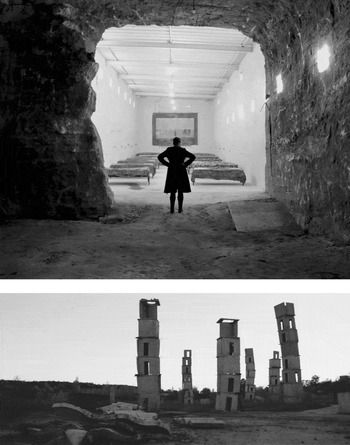
This paper has been stimulated by questions which have arisen from the practice of the subfield of archaeology which has become known as the ‘archaeology of the contemporary past’, but addresses itself to issues which concern the very nature and practice of archaeology as a discipline in its broadest sense in the 21st century. I want to begin by reflecting on a sequence from the documentary film Over your cities grass will grow (2010, dir. Sophie Fiennes), which explores the work of the German painter and sculptor Anselm Kiefer at La Ribaute, his 35-acre studio complex at Barjac in southern France, and its subsequent abandonment. Kiefer's artistic practice is concerned with the past and its relationship with the present. He established his studio on the site of a disused silk factory in 1993, and consequently renovated it to build a series of workshops, spaces for the storage of archives and artistic materials, and sites for the display of his monumental sculptures and canvases, which often incorporate found industrial materials and other substances such as shellac, ash, clay and straw. One scene in the film shows Kiefer directing a large-scale mechanical excavation around a series of concrete pillars which have been poured into the earth to create subterranean catacombs – one of a string of excavations with which he created a network of underground tunnels and labyrinths below the surface of the studio and its grounds to house his paintings and installations. The final part of the film shows his creation of a series of hauntingly dilapidated concrete towers during his abandonment of the studio complex, which now stand as part of this deserted landscape of surface and subterranean ruins which he created over the course of his one-and-a-half-decade residency on the site (figure 1).
(Top) Sophie Fiennes on location at La Ribaute near Barjac, France, in 2008 during the making of the film Over your cities grass will grow showing part of the underground labyrinth built by Anselm Kiefer to house his paintings and installations. Photo by Remco Shaw, © Amoeba Film Ltd, Ribotte Paris 2010. (Bottom) Landscape of ruins – concrete towers built by Anselm Kiefer and left standing following his abandonment of the studio at La Ribaute. Still from the film Over your cities grass will grow © Amoeba Film Ltd, Ribotte Paris 2010.

The scene in which Kiefer directs the excavation to create the catacombs as a ‘modern ruin’ caused me to reflect on the project of the archaeology of the contemporary past as it has tended to be articulated by its practitioners, its relationship to the project of modernity and what I have come to see as one of the central paradoxes of its practice (see also Hicks 2010; Voss 2010; Graves-Brown, forthcoming). On the one hand, the work of the archaeologist of the contemporary has been articulated as one of making the familiar ‘unfamiliar’, or one of distancing the observer from their own material world – the creation of modernity as ruin, and the proximal as distant; a work of alienation. On the other hand, archaeologists who work on the archaeology of the recent and contemporary past have also articulated their mission as being about closing the distance between past and present; about making the past more accessible and egalitarian; and about recovering lost, subaltern voices – the creation of the distant or unknowable as proximal or known. Archaeologists of the contemporary past, like Kiefer at La Ribaute, are engaged in the work of producing contemporary ruins to draw attention to the work of the present in the production of the past. This is because archaeology has been constructed as a discipline which concerns itself with the disused, the abandoned, and the ‘past’, and thus the application of archaeology to the present has the effect of instantly making it appear distant and redundant. Indeed, this active process of creating distance between the present and the past is precisely embodied in the oxymoronic phrase ‘contemporary past’. I suggest that it is the existence of this paradox and the interplay of these two opposing aims which has led to a situation in which the archaeology of the contemporary is caught in a cycle of continual self-justification. I believe this is a function of archaeology's investment in modernist tropes, in particular excavation and the depth metaphor for research and discovery. The simultaneous push–pull of and with the past is a symptom of archaeology's investment in the modernist trope of archaeology-as-excavation, and the modernist metaphor of excavation-as-investigation, alongside its construction as a discipline which is concerned with the abandoned, the disused and the dead. I suggest that it is only by moving away from the trope of archaeology-as-excavation and towards an alternative metaphor of archaeology-as-surface-survey and as a process of assembling/reassembling that we will be able to move forward in developing a viable archaeology in and of the present. This has important implications not only for the archaeology of the present, but for archaeology in all of its forms, as it would involve a fundamental reorientation of archaeology away from the past and towards the present and future which would see it forgo its search for origins to focus instead on the present and only subsequently on the circumstances in which the past intervenes within it; it would involve a complete disciplinary reshuffling away from an emphasis on particular archaeological periods to one in which the archaeology of the deep past is equally implicated within an archaeology of the present, and vice versa. Here I join other recent calls for a more present- and future-oriented archaeology (e.g. Dawdy 2009; Graves-Brown 2009) as a way both of making archaeology more relevant to contemporary society and of addressing some of the most negative aspects of its modernist, colonial origins. It is only by doing this that practitioners will be able to move away from the question of ‘why’ we should study the present, to focus on the question of ‘how’. Such an approach would reorient the archaeology of the present so that it is no longer marginal but becomes fundamental to the discipline of archaeology as a whole in the 21st century, allowing it to take a central role in the development of innovative contemporary theory and social, economic and environmental policy. It is this broad intellectual project with which this article is concerned.
The archaeology of the contemporary past: a history of a subfield
A recent discussion on the Contemporary and Historical Archaeology in Theory (CHAT – see further discussion below) email discussion list about the position of the ‘archaeology of the contemporary past’ in relation to ‘mainstream’ archaeology suggested that although many archaeologists who work on the archaeology of the present and recent past still feel marginalized within archaeology as a whole, few could point to any published critique of the subfield. While many recounted the ongoing feeling that they needed to constantly justify their focus on the recent past, few could point to any specific published criticism of the subfield itself. In response to this discussion I decided to explore the ways in which the various key publications in the subfield have been received, and their formal reviews in archaeological journals, as a means of gauging the way in which the discipline has perceived the subfield as it has developed. In the first part of this paper, I will look briefly at the development of the subfield, drawing closely on the historical review first published in Harrison and Schofield (2010; see also Harrison and Schofield 2009). My intention is to demonstrate that, contrary to what many seem to express in their regular justifications of the subfield, there have been no significant intellectual grounds raised for the critique of an archaeology of the present and recent past, and no significant published critique of its pursuit as an archaeological subdiscipline. I will then go on to suggest that this asymmetry between the abundance of published self-justification and the absence of published critique derives from a fundamental paradox in its mission which is retarding the development of the subfield as an integral aspect of the discipline of archaeology itself.
As Buchli (2007, 115) points out, archaeologists and anthropologists have long taken an interest in contemporary material culture, pointing in particular to Pitt-Rivers's studies of contemporary rifles while working as a military officer, and Kroeber's study of changes in contemporary women's dress lengths. Nonetheless, throughout most of the 20th century, archaeology concerned itself almost exclusively with the study of the deeper past (producing a definition of archaeology as something that should concern itself only with that which is ancient, or ‘archaic’; see further discussion in Lucas 2004; 2005; 2006). The interest in ethnoarchaeology within the New Archaeology formed the background to what are generally acknowledged (Graves-Brown 2000a, 2; Buchli and Lucas 2001a, 3; Buchli 2007, 115) to be the first formal publications on the archaeology of the contemporary past, titled ‘Modern material culture studies’ (Rathje 1979) and Modern material culture. The archaeology of us (Gould and Schiffer 1981). These publications grew out of the research developed by Schiffer and Rathje at the University of Tucson, Arizona and separately by Gould at the University of Honolulu, Hawaii during the 1970s. Where most ethnoarchaeological research had been undertaken with communities who employed traditional technologies in a contemporary setting, the student programmes developed at Tucson and Hawaii, and the projects outlined by Rathje in ‘Modern material culture studies’ and by contributors to Modern material culture were largely concerned with the description and analysis of contemporary material cultures in modern, industrialized societies.
We might imagine these works to have been received sceptically, but published reviews of Modern material culture were, if somewhat critical of individual chapters, overwhelmingly positive about the role of archaeology in modern material culture studies as a part of ethnoarchaeology, and about the importance of the study of the present to archaeology as a whole. For example, Schuyler (1982, 939) wrote in American anthropologist,
Modern Material Culture . . . is the first book to concern itself with the ethnoarchaeology of contemporary civilization . . . it is a successful survey of what, based on initial offerings of scholars like Meltzer and Eighmy, might well expand into a significant area of scholarship.
In American antiquity, Stuart (1983, 646) went even further, to suggest that ‘the study of modern material culture is an idea whose time has come; as a vision it is exciting, even though it has not yet matured into methodological clarity’. Neither of the two published reviews I was able to locate was critical of the ‘idea’ of applying archaeology to the study of contemporary societies, and both were enthusiastic about the prospects of the subfield.
At the same time, Rathje's provocative article ‘Modern material culture studies’ (which also appeared in revised form in Modern material culture) outlined an ambitious agenda for the development of an archaeology of contemporary material culture. He suggested that archaeology should be defined as the study of ‘the interaction between material culture and human behaviour or ideas, regardless of time or space’ (Rathje 1979, 2), and as such, research on the recent past or present was as much a part of the archaeological mission as research into the deep past. He anticipated that ‘the archaeology of today’ (ibid., 4) could make contributions to the teaching and testing of archaeological principles and to the development of models that relate our own society to past societies. Further, it should be seen as a sort of ‘rescue archaeology’ of contemporary life, helping to address what might become future gaps in knowledge as the material and archaeological record of contemporary life is being destroyed around us. For Rathje, modern material culture studies represented ‘a final step in the transformation of archaeology into a unified, holistic approach to the study of society and its material products’ (ibid., 29).
Nonetheless, for many years, work such as this remained idiosyncratic in terms of its archaeological focus on the present. The initial North American efflorescence of research on the archaeology of modern material culture was generally not followed up by the establishment of further research projects. While research by Rathje (e.g. Rathje and Murphy 1992; 2001; Rathje 2001), Gould (e.g. 2007) and Schiffer (e.g. 1991; 2000) continued, and indeed all three scholars established a central place for themselves within the development of North American archaeological theory and method, much ethnoarchaeology throughout the 1980s and early 1990s remained focused on traditional forms of technology, and on the use of ethnoarchaeological models for the explanation of cultural change in the past (see e.g. David and Kramer 2001). However, an interest in archaeological approaches to the contemporary past re-emerged amongst British ‘postprocessual’ archaeologists in the 1980s. For example, Hodder (1987) undertook a study of the social meaning of bow ties in a contemporary British pet food factory, as a case study for modeling the relationship between social practices, material culture, and meaning in human societies. Similarly, in Reconstructing archaeology, Shanks and Tilley (1992) also explored contemporary material culture through a study of the design of Swedish and English beer cans. In their introduction to this case study, they criticized the authors of the chapters in Modern material culture for being too empiricist in their approach, suggesting that they ‘failed to realize the potential of the study of modern material culture as a critical intervention in contemporary society . . . with transformative intent’ (ibid., 172). In addition to particular postprocessual studies of contemporary material culture, another important aspect of postprocessualism in the development of the archaeology of the contemporary past was the way in which it turned the archaeological lens on the process of ‘doing’ archaeology itself, through its emphasis on archaeology as a critical engagement with the production of the past in the present.
Again, it is worth reflecting on the central place that these three scholars and these two works subsequently established for themselves within mainstream anglophone archaeology in subsequent decades. Hodder's and Shanks and Tilley's explorations of contemporary material culture were seen as legitimate exercises in the development of broader social archaeological theory, and these three scholars have come to occupy a central place in contemporary archaeological scholarship. The idea of using archaeology to study contemporary material culture was not considered problematic, with the contemporary case studies appearing in both books alongside case studies in prehistory. Contemporary material culture was considered a legitimate topic for archaeological investigation, and while Johnson (1989), for example, criticized Shanks and Tilley's study of beer cans, his criticism rested on their treatment of agency as a concept, rather than on the contemporaneity of the case study itself.
Another decade passed before the publication of two key books that have been central to the establishment of the archaeology of the contemporary past as a subdiscipline in the anglophone world – Matter, materiality and modern culture, edited by Paul Graves-Brown (2000b), and Archaeologies of the contemporary past, edited by Victor Buchli and Gavin Lucas (2001b). Both volumes were part of a significant shift in orientation away from the ethnoarchaeological focus of most of the earlier work on the archaeology of the contemporary past and towards a more specific focus on contemporary life, which now characterizes the subfield. These two books established key themes that came to characterize the archaeology of the contemporary past over the subsequent decade. Graves-Brown (2000b) suggested that the role of an archaeology of the recent past was to make the familiar ‘unfamiliar’, to destabilize aspects of contemporary quotidian life which would otherwise be overlooked. Buchli and Lucas (2001a, 9) also emphasized this aim, suggesting that ‘there is a sense in which turning our methods back on ourselves creates a strange, reversed situation – a case of making the familiar unfamiliar’. In addition, Buchli and Lucas (2001a; 2001c; 2001d; 2001e) and their contributors pointed to the linked themes of production/consumption, remembering/forgetting, disappearance/disclosure, and presence/absence. A theme very prominent throughout Archaeologies of the contemporary past was that of the subaltern, and the idea that archaeology has a major role to play in foregrounding those aspects of contemporary life at the margins that are constantly being overwritten by dominant narratives:
In addressing the issue of the non-discursive realm the archaeological act comes directly into contact with the subaltern, the dispossessed and the abject. This is not simply in terms of the usual archaeological preoccupation with material remains, but the practical and social act of uncovering that which has once been hidden. The two converge here both literally and figuratively (Buchli and Lucas 2001a, 14).
Once again, it is interesting to read the published reviews of this volume, as they are generally overwhelmingly positive about the idea of using archaeology to study contemporary societies. Reviews were published by Rothschild (2003) in American anthropologist and Claasen (2002) in Journal of anthropological research (interestingly, both authors had written chapters two decades before for Modern material culture studies). Claasen herself notes that the book is, for her (as someone who attended classes with Schiffer and Rathje) full of ‘déjà vu experiences’, but ‘those of you who have come to archaeology since 1985 will find the admonishments and foci radical’ (Claasen 2002, 554). Rothschild connects the editors’ claim that archaeology can be brought to bear on issues of the present with the work of other established scholars such as Henry Glassie, Daniel Miller and Michael Schiffer, and cites the establishment of the Journal of material culture as another important step in the same direction. The only sceptical review of the volume I was able to locate came from outside the discipline of archaeology, in the Journal of design history, which notes that
archaeology's returns diminish as one comes closer to the present and less and less new knowledge is uncovered . . . [although] the challenges of mediating between the recent past and contemporary society's need to understand are important, and there is no doubt that archaeologists can contribute (Wakelin 2002, 61–62).
Even more enthusiasm was shown for the overall project of an archaeology of the 20th century in reviews of Buchli's book The archaeology of socialism (2000), published at around the same time, which was deemed important enough to warrant a 20-page review feature in Cambridge archaeological journal with comments by Leone, Shanks, Olivier, Thomas, McGuire and Rathje and an overview and response from the author (Buchli 2002). While Matter, materiality and modern culture had an agenda which extended beyond archaeology to encompass cross-disciplinary material culture studies more generally, it also garnered reasonably positive reviews in the archaeological literature. In Cambridge archaeological journal, Johnson (2001, 135) noted,
I came away excited and stimulated about the possibilities for more theoretically informed studies of modern material culture that explored themes of matter and materiality in ways that told us about contexts and topics in both modern present and historic and prehistoric past.
Whether such published reviews are indeed an adequate measure of how the discipline feels towards the subfield, which many practitioners still feel is treated unequally by other archaeologists and subjected to informal prejudice through its marginal placement at conferences and its absence from disciplinary self-representations more broadly, my point in this section is to note that no significant intellectual grounds have been raised on which to base a critique of the idea of applying archaeology to the study of the present or recent past. Despite some sense of unease both within the subfield itself and within archaeology more broadly, reviewers accept the fundamental premise that archaeology can contribute something to the study of the contemporary world. Most of the scholars involved in developing the subfield have gone on to assume important, if not central, places within archaeology, particularly in the development of archaeological theory. The idea that the archaeology of the present and recent past can and should form a conventional part of our archaeological practice which can help us understand not only the deep past, but also the recent past and the present in its own right, has remained unchallenged within western European and Anglo-American archaeological traditions for well over three decades.
The archaeology of the recent and contemporary past has seen a relative explosion over the past decade. Significant edited collections which deal specifically with the subfield have been published by McAtackney, Palus and Piccini (2007), Holtorf and Piccini (2009), Harrison and Schofield (2009; 2010), Schofield (2010) and Fortenberry and Myers (2010); along with noteworthy articles in a range of journals including Current anthropology, the Journal of material culture, World archaeology and Archaeologies; and even whole monographs dealing with significant contemporary archaeological projects (e.g. Andeassen, Bjerck and Olsen 2010). A major step was the development of the Contemporary and Historical Archaeology in Theory (CHAT) conference group in Bristol in 2003 (see further discussion in Holtorf and Piccini 2009, 19). This group now hosts an annual conference that considers issues relating to both historical archaeology and the archaeology of the contemporary past, and has acted as a forum for the development and presentation of a significant proportion of the research that has subsequently come to define this field. Of equal significance has been the rise of a field of forensic archaeology and anthropology in the US, the UK, Europe, Australia and Latin America that has seen archaeology develop as a way of documenting mass graves, war crimes, disappearances and state-sponsored repression (see extended review of this field in Crossland 2011). Another important influence has been the increasing interest of the public in the conservation of modern heritage, and archaeology's role in contributing to this (e.g. Bradley et al. 2004; Schofield and Cocroft 2007; Penrose 2007).
And yet, while we have seen that the archaeology of the recent past and present has been accepted as a part of archaeology for three decades, and has undergone a veritable boom over the past decade, many archaeologists who work in this subfield have felt a need to continually defend the present or recent past as a subject for archaeological analysis. Indeed, when we wrote After modernity (Harrison and Schofield 2010), we still felt the need to provide a long justification for the very existence of the subfield. This raises for me an important question – why is it that the archaeology of the recent past and present has been seen to sit uncomfortably within the archaeological project as a whole by those very researchers who are engaged in it? In the next part of the paper I would like to argue that this is actually a symptom of the subfield's relationship with the past on the one hand and the project of modernity on the other.
Archaeology, alienation and the ruins of modernity
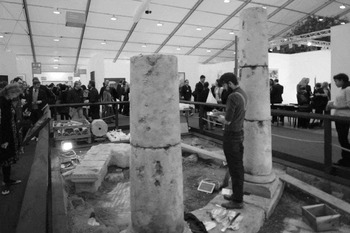
I have already noted that one oft-repeated aim of the archaeology of the present and recent past concerns making the familiar ‘unfamiliar’ (Graves-Brown 2000a; Hicks and Beaudry 2006; Hicks 2010; see discussion in Graves-Brown, forthcoming). This aim acknowledges archaeology as a discipline which creates distance between its object and the archaeologist-as-observer. Indeed, this role of archaeology as alienating is acknowledged by a number of contemporary artistic projects which play on archaeological metaphors to force the viewer to question their assumptions about themselves. At the 2010 London Frieze Art Fair, for example, the artist Simon Fuijiwara created a series of mock excavations titled Frozen city which purported to document a Roman settlement which had existed on the site during the period AD 43–190 which concerned itself exclusively with the production and trade of art (figure 2). In the panels which accompanied a series of viewing platforms which looked across the subterranean archaeological excavations, he playfully satirized the excess and decadence of the contemporary art world using archaeology as a tool to simultaneously produce a sense of distance and ‘otherness’ by turning the archaeological lens on ourselves. A similar theme was evident in the artist Mark Dion's Tate Thames dig (Dion 1999; see discussion in Renfrew 2003, 84; and Harrison and Schofield 2010, 116). In a very real sense, this is what many archaeologists have sought to do through their work on the present – to draw attention to the everyday by making it ‘uncanny’ and to explore archaeology itself as a contemporary cultural phenomenon. One of the problems is that in doing so, archaeologies of the contemporary past have played out one of the fundamental modernist underpinnings of the discipline – the production of a past which is distant, alien and ‘other’ to ourselves (Graves-Brown, forthcoming). This has undermined any aim which the archaeology of the contemporary past might have of reducing the distance between past and present, and making the past more accessible, egalitarian or knowable.
Simon Fujiwara, Frozen city, Frieze Art Fair, London 2010. © Simon Fujiwara, courtesy of Simon Fujiwara and Galerie Neue Alte Brücke, Frankfurt am Main.

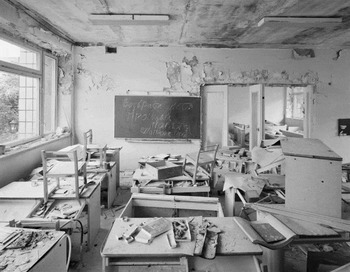
Another aim of the archaeology of the contemporary past has been articulated most strongly by Alfredo González-Ruibal (2005; 2006a; 2007; 2008; González-Ruibal and Hernando 2010; see also Andreassen, Bjerck and Olsen 2010), and concerns its sustained attack on modernity. He argues that the role of the archaeology of the contemporary past should be to emphasize modernity as an ‘unfinished project’ (c.f. Latour 1993; Law 1994) by drawing attention to its fragile underpinnings. In González-Ruibal's work, ruin becomes a symbol of the failure of the modernist project, and drawing attention to ruin forces an engagement with the idea that modernity is not universal or inevitable. However, one of the problems with the way in which many archaeologists have tended to engage with modern ruins is that they have often been drawn into a mode of representation where modern ruins are aestheticized and equated with romantic notions of the ruin (e.g. Edensor 2005). The trope of ‘modernity-in-ruin’ places modernity itself in the past, making it appear both inevitable and uncomplicated, as yet another aspect of human social evolutionary history. One of the ways the archaeology of the contemporary past has implicated itself in this process is through its relationship with a particular mode of photography which presents ruin in an explicitly nostalgic manner, and in the process romanticizes it. This style of photography is perhaps exemplified by the work of photographer Robert Polidori (e.g. 1993; 2006; see figure 3), in which the elegance and romanticism of ruination is often emphasized, and where the modern ruin can be read as a reflection on the distance between the present and recent past and the speed of modern social and technological change (itself another form of modernist distancing – see Virilio 1986; Tomlinson 2007). This nostalgic mode of representation is part of a broader interest in the ‘beauty’ of modern urban ruination which also finds expression among contemporary ‘UrbEx’ or ‘urban explorers’ and other amateur and professional urban photographers (e.g. Romany 2010). Dawdy (2010) has noted the ways in which archaeologists have become deeply invested in the idea of a rupture between antiquity and modernity which such a mode of engagement tends to emphasize. This photographic trope of romantic, abandoned modern ruin appears in the work of many archaeologists of the contemporary past, not the least my own (see, for example, our image of the Star Wars film set in Harrison and Schofield 2010, 210; or the image of the abandoned theme park in ibid., 276). By representing modernity as past and in ruin, there is a danger that it is simultaneously domesticated and made to appear both inevitable and benign.
Robert Polidori, Classroom, Pripyat, 2001. © Robert Polidori, courtesy of Robert Polidori and Edywnn Houk Gallery, New York and Zurich. Published in Polidori (2006, cover and 41).

Thomas (2004; 2009; see also Olsen and Svestad 1994; Shanks, Platt and Rathje 2004) has argued that archaeology is intimately connected with modernity, indeed that archaeology could only have emerged as a distinct discipline under the particular social and intellectual conditions of modernity. He points not only to the connection between archaeology and the foundation stories of modern nation states, but to the reliance within archaeological thought on distinctively modern perceptions of the relationship between new knowledge and material things. He also notes the ways in which archaeology (and ‘excavation’ in particular) has continually been drawn upon by other modern disciplines as a metaphor for understanding the relationship between knowledge and its intellectual pursuit, through a string of linked images relating to concealment and discovery. He sees archaeology and modernity as connected by a series of preoccupations, including the ordering of time and the idea of a normative with which to contrast a non-normative (or ‘other’), by ideas of human development, the relationship between historical change and human reason, and analytical and comparative perspectives (Thomas 2004, 224–26).
For Gavin Lucas, the central problem of modernity revolved around the search for a new authority on the past, and the creation of a field of prehistory which was defined as the study of material culture which had been removed from the realm of tradition and which sat outside it:
The core dilemma of modernity was how to understand the world without turning to tradition – how to find a new authority which resided outside of tradition – effectively, outside of time. As part of this search for a new authority in studying the past, archaeology developed the analysis of material culture which subsequently produced in the nineteenth century the concept of a new past. Prehistory was this new past, unrelated to tradition and paradoxically a very modern past (Lucas 2004, 118, original emphasis).
Lucas suggests that the archaeology of the very recent past should be seen as an engagement with an unconstituted present. This forces us to pay attention to the way in which archaeology is a mode of cultural production in the present (Lucas 2004, 118). I would like to add something to Lucas's discussion by suggesting that by undertaking an archaeology of the present, we not only draw attention to archaeology as a mode of cultural production, but we also address ourselves directly to the project of modernity and explore the processes by which it might be argued to be incomplete (after Latour 1993; Law 1994; Scott 1998). This shifts us away from an idea of the archaeology of the present as an investigation into modernity ‘in decline’ (Harrison and Schofield 2010), and instead towards the archaeology of the present as an investigation into modernity as partial, fragile and unfinished. However, to do this we must engage with modernity in very particular ways – not as something which is romantically falling into ruin, and hence both inevitable and anaesthetized against its influence in the present, but rather the opposite, as an unrealized social and material project. Only in this way can we fulfil the potential for archaeology to undermine the modernist project by drawing attention to its failings and fragile underpinnings (see also González-Ruibal 2005; 2006a; 2007; 2008; Dawdy 2010). By focusing on modernity as an active and unfinished project, we raise the spectre of an archaeology which engages explicitly with the future (see also Dawdy 2009). In this sense, such an archaeology could realize ontologies of the future of the sort which have been advocated by contemporary cultural critics such as Frederic Jameson (2005) and others (e.g. Augé 2004; see also Graves-Brown 2009).
Such an approach seems, to me, to be beyond objection. In addition to undermining modernity itself, it would allow us to engage with various aspects of the modernist project in which archaeology has become deeply implicated, in particular its association with the foundation stories of modern nation states (Appadurai 2001; Schnapp, Shanks and Tiews 2004, 1), its mobilization of a unilinear discourse of human development (Thomas 2004, 225), its production of otherness (e.g. Thomas 2001) and its yearning for the reconstruction of completeness (Hamilakis 2004, 55). However, I agree with Thomas (2004, 224) that this is not about abandoning archaeology entirely, but a project of reworking archaeology so that it produces a more embodied, diverse, even egalitarian engagement with the everyday past, highlighting its imminence and our role in its production in the present. Our aim should be to foreground the archaeology of the present within our discipline to produce an archaeology of everyday presents and possible futures; an archaeology for and of ‘now’. This does not require us to look outside archaeology for a new series of metaphors or tropes. Indeed, these are to be found in an emphasis on the trope of archaeology-as-surface-survey in preference to the trope of archaeology-as-excavation, and by drawing on the idea of archaeology as a process of assembling and reassembling. I outline these alternate metaphors for an archaeology of the present in more detail below.
The tropes of archaeology: excavation, surface survey and assemblage analysis
So far I have argued, following others (Thomas 2004; Shanks, Platt and Rathje 2004; Lucas 2004; 2006), that archaeology, as a modernist discipline par excellence, has consistently appealed to a series of linked metaphors – excavation, stratigraphy, typology, discovery and the search for origins. In doing so, it has sought to produce a present which is disengaged from the past. I want to suggest here that if we were to reimagine an archaeology of the present which eschews this obsession with stratigraphic depth for an emphasis on the present and its surfaces, we might help create a more socially useful and future-oriented archaeology. Drawing on Lucas's discussion of archaeology as an engagement with an unconstituted present (2004), I suggest that an archaeology in and of the present must be viewed first as a critical engagement with the present and only subsequently as a consideration of the spaces in which the past intervenes within it. As I explain below, this means a shift away from the idea of an ‘archaeology of the contemporary past’, towards an ‘archaeology in and of the present’. To utilize a familiar archaeological metaphor, I suggest that we think about the present as a surface – a physical stratum that contains not only the present, but all its physical and imagined pasts combined (see also Olivier 2000; Witmore 2004; Gonzáles-Ruibal 2008, 262; Schnapp, Shanks and Tiews 2004, 10; Harrison and Schofield 2010, 283). In focusing our attention on the present and its surfaces, I suggest two alternative metaphors to excavation which derive directly from archaeology itself – surface survey and the assemblage – to help frame this model.
Archaeology as surface survey Lucas (2001; see also Trigger 1996; Lucas 2005) has shown how the invention of stratigraphic excavation as a field method was central to the development of evolutionary models in archaeology. Thomas (2004) writes that the depth/surface metaphor of archaeology was subsequently drawn upon to provide an allegory for the modernist pursuit of knowledge more generally, exploring Freud's work as an ‘archaeology of the mind’ by way of example (see also Thomas 2009). From this discussion he concludes,
It could be argued that the disciplinary orientation towards depth, concealment, mystery and revelation is quite obstructive, for it enhances a belief that the past is entirely separate from the present: it is ‘somewhere else’ that needs to be accessed in a particular way. This essentialist view of the past could be compared with the post-Cartesian view of the mind, hidden away in the interior of the person. In the same way, it is unhelpful to imagine that the past is a substance that is secreted in dark places awaiting its recovery. The remains of the past are all around us, and we inhabit the past in important ways (Thomas 2004, 170; original emphasis).
While excavation is perhaps best known as a metaphor for archaeological investigation, surface survey has always played an important role in the discipline. Field walking, surface site distribution mapping and aerial reconnaissance have played an equally important role alongside excavation in the production of archaeological knowledge. If we begin to think of the surface as a metaphor for an unconstituted present, a space in which the past, present and future are combined and are still in the process of becoming, archaeological surface survey emerges as an allegory for a creative engagement with the present and the spaces in which the past intervenes within it. Like the traces of field ditches and embankments which archaeologists reconstruct from aerial surface survey, archaeology can only engage with the past where it is visible at the surface, refracted through the lens of the present. In this way, archaeology becomes a discipline which turns its attention to the surfaces of things, to the ‘here’ and ‘now’. Archaeology is no longer a trope for alienation and estrangement, but becomes present- and future-oriented. It is no longer about an ‘other’, but instead about ‘us’.
Archaeology as the study of surface assemblages and a process of assembling/reassembling In thinking of the trope of archaeology-as-surface-survey, it is also helpful to consider another metaphor of the assemblage, a conventional way of thinking about the material remains which are found together on the surface of an archaeological site. Indeed, I want to go further to explore the trope of archaeology as a process of the study of surface assemblages, and of assembling and reassembling. Doing this helps shift the emphasis away from the metaphor of stratigraphic depth to focus our attention on the present and its material remains, to ‘flatten’ our engagement with the surface, both in terms of stratigraphy and in terms of the asymmetries in our practice which emphasize the agency of humans over the agencies of other elements of the material world. In doing so, I refer to a notion of assemblage which is specifically archaeological but which simultaneously draws on a Deleuzean notion of the assemblage by way of Manuel DeLanda's ‘assemblage theory’ (2006; Bennett 2010; see further discussion in Harrison in prep. a) and which incorporates a sense of the symmetrical relationships between people and things (after Latour 1993; 2005; Murdoch 1997; Serres 2008; see Olsen 2003; 2010; Witmore 2006b; Webmoor 2007; Webmoor and Witmore 2008).
The first way of understanding the term ‘assemblage’ is a familiar archaeological one, in which the assemblage is defined as a group of artefacts found in association with each other in a single context. The formation of an archaeological assemblage is perceived to be the result of both natural and cultural processes. Michael Schiffer (1972; 1976) famously described the taphonomic processes by which a group of things are transformed into an archaeological assemblage by way of cultural (‘C-transforms’) and natural (‘N-transforms’) transformations. He referred to this as the movement from the systemic context (the original set of relationships between human behaviours and material things) to the archaeological context (the archaeological assemblage which is studied by the archaeologist). ‘C-transforms’ include a range of cultural processes, such as intentional or non-intentional discard, recycling or reuse, while ‘N-transforms’ include processes such as biological and chemical weathering and decay. In surface survey, the context is more complex than in stratified deposits, and in the case of a deflated surface, the surface assemblage might contain a mix of artefacts from a number of different time periods. Such archaeological sites might be understood as palimpsests, the assemblages at the surface of which are mixed and contain traces from a number of different occupations which are jumbled together. Implicit within an archaeological use of the term is the idea of the assemblage as a contemporary construction, i.e. the assemblage is created as part of an engagement of an archaeologist's contemporary classificatory gaze with a series of material remains from the past. It arises out of the relationship between past and present, and between a contemporary external observer and a set of activities carried out by particular people and particular ‘things’ in the past (e.g. Shanks 1992; Shanks and McGuire 1996; Pearson and Shanks 2001).
The second notion of the assemblage draws on Manuel DeLanda's (2006; see also Bennett 2010) articulation of Deleuze and Guattari's ‘assemblage theory’. Deleuze and Guattari (e.g. 2004) used the term ‘assemblage’ to refer to a series of heterogeneous groupings in which the grouping itself could be distinguished as a whole from the sum of its parts. Importantly, such groupings are mixed, and social or cultural groupings are not distinguished from natural ones (or vice versa). Assemblage theory exists as an alternative to the metaphor of society as a living organism which dominated social theory throughout the 20th century. In perceiving social structures as assemblages as opposed to organisms, DeLanda (2006) indicates that the properties of such natural/cultural groupings are not the result of the functions of the components themselves, but instead exist as the product of the exercising of their capacities – they are not an inevitable outcome of the function of their components (i.e. they are not logically necessary), but a product of their particular histories and their relationships with other parts of the assemblage (i.e. they are contingently obligatory) (ibid., 11). Unlike organisms, assemblages are not governed by a central ‘nervous system’ or head. In this way, agency is distributed across and through the assemblage, as well as within it.
Far from simply being a semantic point, DeLanda (2006) shows how replacing the organismic metaphor with that of an assemblage has a series of implications for the way in which we study material and social relationships in the past and present. Thinking of assemblages as heterogeneous groupings of humans and non-humans has the effect of flattening the hierarchy of relationships which exists within post-Enlightenment modernist philosophies which separate matter and mind (e.g. Latour 1993; 2005; Viveiros de Castro 2004; Harvey 2005; Serres 2008). This progresses an earlier stated aim of moving away from an idea of the past and present as stratified, towards a notion of the past and present as a single surface. In the same way that the past is immanent within the present on this surface plane, all of the components of the assemblages at the surface are equally implicated in the production of the past and present. Bennett's (2010) discussion of assemblage theory also draws out another key issue. In thinking of the present as a series of heterogeneous socio-technical assemblages, unlike the organismic metaphor, we are able to identify both relationships of functional flow and more volatile relationships of friction and conflict (ibid., 23). In perceiving social groupings as organisms, we tend to emphasize the relationships which lead towards the functioning of the whole. The notion of an assemblage allows for relationships which are not necessarily directed towards the functioning of the whole, but which might indeed cause a network to stall or even cease functioning. In relation to this point it is important to emphasize the ways in which agency is distributed throughout the assemblage, which functions as a ‘federation’ of actants, in which all material and non-material things are participants (Bennett 2010). Indeed, Latour speaks of a ‘parliament of things’ (1993, 144–45) to describe such collectives (see further discussion in Olsen 2010).
I want to stress here that my emphasis on surfaces, surface assemblages and the process of assembling and reassembling as opposed to that of stratigraphic excavation and depth is not intended as a criticism of archaeological method, but of the way in which we represent what archaeology is and does. Clearly, excavation is an important archaeological field methodology, but even excavation can be rethought not as a process of retrieval from obscured depths, but indeed as a process of creating and exposing a series of archaeological surfaces. Similarly, the concept of assemblage plays an important role in excavation as well as surface collection, in the sorting and classification of finds, the filing of records, and the organization and reorganization of data and all of the other forms of information which are produced as a result of this process. I am influenced here by the insights produced by reflective attention to the ‘craft’ of archaeology (c.f. Shanks and McGuire 1996; Gero 1996; Hodder 2000; Hodder and Berggren 2003) and ethnographies of archaeological practice which explore archaeology and its relationship with other modern scientific fields and laboratory practices (e.g. Edgeworth 2003; 2006; Yarrow 2003), drawing on the work of science and technology studies more generally (e.g. Latour and Woolgar 1979; Latour 1987; 1993; Woolgar 1988). This distinction is fundamentally a metaphorical one, and is not intended to restrict the sorts of field or laboratory practices which we employ to pursue our aims. Nonetheless, the distinction has far-reaching implications for the way we conceptualize the role of archaeology and how we present it to the public.
Discussion: from ‘the archaeology of the contemporary past’ to the archaeology of the present
To think of archaeology as the study of surface assemblages emphasizes archaeology not only as a creative act in the present – a process of assembling and reassembling – but as a discipline which is concerned explicitly with the present itself. This present is not fixed or inevitable, but is still in the process of becoming; it is active and ripe with potential. An archaeology of the surface thus becomes a study of assemblages of humans and non-humans which are the product of a series of historical processes by which they are jumbled together in the present. To name these collectives ‘assemblages’ recognizes explicitly the archaeological act of classification, the application of an archaeological gaze to the surface. It also explicitly recognizes the heterogeneity of the collectives, the fact that they represent multiple, palimpsest pasts and have implicit within them multiple potential futures, and flattens not only our perception of stratigraphic depth, but also the common practice of giving priority to humans over non-humans in these collectives. To study surface assemblages in the present means to recognize the agency of humans, non-humans and the collectives themselves as charged with latent potential, as generative of new pasts and futures in the present.
I have already implied that part of what holds archaeology back from directing its attention to the present and the future is its relationship with the past, and its construction of the present as ‘contemporary past’. While archaeology as an academic discipline has been defined as the study of things which have ceased to function (see also Lucas 2004), an archaeology in and of the present should not be limited to those things which have ceased, which have been abandoned, closed down or discarded, but should also be concerned with the study of contemporary objects and places which are still in operation, which are themselves still actively operating and form part of the assemblage on the surface of the world (Harrison and Schofield 2010). Thinking of the metaphor of assemblage allows us to conceptualize archaeology as a discipline concerned with surface collectives that include people and things, the living and the dead, the operative and defunct. It is not important whether these coincident persons and non-persons all belong to the same context or time, their coincidence is itself creative and generative of possible futures.
From the past to the future for the archaeology of the present
I have so far argued that the ‘archaeology of the contemporary past’ has been hindered by the pervasive modernist trope of archaeology-as-excavation, as alienating and distancing from the present. I have suggested that to move the issue forward we should emphasize instead the trope of archaeology-as-surface-survey and its concern with assemblages to refocus the discipline on the present and future. Doing so will allow us to move beyond questions of ‘why’ archaeology should refocus its attention on the present, to consider ‘how’ we might do this. Part of this process involves abandoning the ‘contemporary past’ itself as an unhelpful and potentially alienating notion. Indeed, I would argue that archaeologists have become implicated in a ‘crisis of accumulation’ (cf. Nitzan 1998) of the past (Harrison in prep. b; see also Augé 2004; Connerton 2009). Rather than managing the past, as the familiar phrases ‘Cultural Heritage Management’ or ‘Cultural Resource Management’ might imply, we have been involved in what seems like an unending production of the past which has led to the heterogeneous piling up of multiple, overlapping pasts in the present. Clearly, not all potential pasts are equally useful. This does not mean to say that those pasts are not still contained in the present. Indeed, as Birth (2006, 169) notes, ‘the immanent past can influence the reproduction of knowledge and subjectivity, as much as present concerns can shape the past’. But we must be much more selective about the usefulness of these pasts we are implicated in creating.
Perhaps more importantly, such a move would have broader implications in forcing a reorientation of the discipline as a whole towards the application of archaeological techniques to the present and future, and a consideration of the past only where it intrudes in this present. Shannon Lee Dawdy has already argued powerfully in this journal that archaeology should turn its attention more explicitly to the future through an engagement with ‘specific social and environmental problems of the present day’ (2009, 140; see also Shanks and Witmore 2010). Work on the archaeology of contemporary homelessness (e.g. Zimmerman, Singleton and Welch 2010), to take one example, shows how archaeological methods might be applied to the present to help develop future social policy. The work of the Garbage Project (e.g. Rathje 2001; Rathje and Murphy 2001) is another example. But what we need more than anything is for the potential of the archaeology of the present to be truly demonstrated by way of a series of detailed, longitudinal studies which can really reveal its capability to engage not only with issues of present social concern, but also with all of the pasts which are implicated in that present. We would no longer think of archaeology as the pursuit of origins or as focused on particular time periods at the expense of others, but rather as a process of working from the present and its surface assemblages longitudinally across all of the pasts and potential futures which it contains. Archaeology would abandon its focus on particular periods to work more fluidly across time and space, with a focus on the production of an intimate present and future, rather than a distant, unknowable past. Rather than the ephemeral nature of some of the work that has been done on the recent past and present in archaeology, we need a commitment to the sort of comprehensive, long-term, comparative studies which could help this field of research take centre stage in a renewed vision of archaeology of and for the 21st century. In doing so, we would work towards the development of an archaeology of the present, for the future. It is our responsibility to advance research programmes which demonstrate this potential which has remained largely undeveloped over the last three decades of the subfield and to rework the tropes of archaeology to allow us to do this.
Conclusion: archaeologies in and of the present
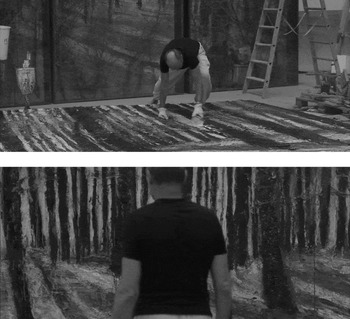
In conclusion, I would like to return to the studio in Barjac, and an image of Kiefer working the surface of one of his paintings in the film (figure 4). I have explored at length a metaphor which is based in the visual representations and practical experience of archaeological fieldwork itself. In doing so I have been influenced by various scholars who have written on visual images in archaeology and ways of thinking in and through ‘things’ in archaeological practice (e.g. Cochrane and Russell 2007; Olsen 2010; Pearson and Shanks 2001; Shanks 1992; Witmore 2004; 2006b). However, it strikes me that the artist's studio also provides a rich visual/material metaphor with which to ‘frame’ this discussion of archaeological tropes, with the potential to reinforce some of the issues which I have already discussed. As Kiefer works his brush across the painting, he engages actively in the creation of a surface by the simultaneous application and removal of material which is assembled and reassembled on a visual plane. Archaeology involves the same kind of creative engagement with the surfaces of things – the making and remaking of material palimpsests which mediate the production of the past, present and future. These are tactile planes, thick with the traces of assembling and reassembling materials in a number of different ways. The traces of these processes remain on the surface in the form of brush marks which reveal the artistic process. For archaeologists, these traces remain in the physical records we produce – from the artefacts themselves to site reports and other forms of knowledge which are made and remade as a result of this engagement with the surface. Like the act of painting, the archaeological act thus becomes an engagement with the present's surface: the mediation of the past as a creative engagement with the present and future.
(Top) Anselm Kiefer painting at his studio La Ribaute near Barjac, France. (Bottom) Anselm Kiefer in front of painting. Stills from the film Over your cities grass will grow © Amoeba Film Ltd, Ribotte Paris 2010.

The archaeology of the contemporary past has existed as a subfield of archaeology for well over three decades, and yet it has failed to realize its potential due to its investment in the modernist trope of archaeology-as-excavation and the idea of the archaeological process as distancing and alienating. I argue that by investing in an alternative trope of archaeology-as-surface-survey and the accompanying trope of the archaeological record as surface assemblage, we can reorient the discipline to address itself to the present and future. To do so requires us to abandon the idea of the ‘contemporary past’ to focus instead on an archaeology of and in the present; to shift archaeology away from the study of the ruin, the derelict and the abandoned to become a discipline which is concerned with both the ‘living’ and the ‘dead’. Indeed, our failure to do this hitherto has led to an obsession with the novelty of the application of archaeology to the present itself, producing a field of research which has appeared at times both superficial and piecemeal in nature. I argue that what we need more than anything else is a series of detailed, long-term, longitudinal studies which demonstrate the actual contribution archaeology can make to understanding the present, rather than a series of justifications for it. By reorienting our work in this way, the archaeology of the present and future will take a central place within the discipline as a whole, and allow archaeology to engage with issues of contemporary and future social and ecological concern.
Acknowledgements
This paper was stimulated by discussions which originated in the Contemporary and Historical Archaeology in Theory discussion list contemp-hist-arch@jiscmail.ac.uk. I thank Sarah Tarlow and the other editors of the journal for their encouragement to pursue these discussions here in a more structured way. Paul Graves-Brown, John Schofield, Uzma Rizvi and two anonymous referees provided comments on earlier versions of this paper which helped me substantially in revising it for publication. Spoken versions of this paper were presented at seminars at Boston University and Columbia University in 2010 and the University of Sydney in 2011 and I thank faculty members and students who attended these talks for their comments and critical observations. The final version of this paper was presented as part of the plenary session at the US Theoretical Archaeology Group conference Archaeology of and in the Contemporary World at the University of California, Berkeley, in May 2011, and comments and discussion at the conference contributed to the ideas developed in my reply. I thank the organizers for inviting me to present at the conference and the Archaeological Research Facility at the University of California, Berkeley for making it possible for me to participate in it.