When the 226-ton dhow Fateh al-Khayr pulled into the harbor in Kuwait in June 1994, there was much to celebrate. It had been more than forty years since the dhow was last in Kuwait. In the years since it was first sold to an Iranian captain in 1952, Fateh al-Khayr had changed hands (and lives) several times: after a brief second wind as an oceangoing dhow, it was outfitted with a motor and used to shuttle goods around the Persian Gulf. It was only in February 1994 that Yacoub al-Hijji, the preeminent maritime historian of Kuwait, learned that the dhow was still active in the transport of goods between Iran and Dubai. He went to see it with his own eyes, and after several rounds of pictures, round trips, verifications, and funding proposals Fateh al-Khayr began its journey back to Kuwait.Footnote 1 It needed serious refurbishing, but on 9 April 1996 the dhow was unveiled to the public, and to much fanfare: the Emir of Kuwait, Jaber al-Sabah, visited the dhow, accompanied by one of its former captains. For the next several weeks, newspapers teemed with stories of the dhow, its rediscovery, and its return home. The timing of the discovery of Fateh al-Khayr, it became clear, was highly fortuitous: the only dhow that had survived from the pre-oil days had burned during the Iraqi invasion of Kuwait in 1990. In a country for whom the sea formed such a crucial part of the national lore, this was a problem. The discovery of the Fateh al-Khayr offered the possibility of filling the void, giving government officials and patriots alike a tangible symbol of pre-oil Kuwait to hold onto.
The Fateh al-Khayr is not the only one of its kind, or even of its name. Roughly 1,000 miles southeast of Kuwait, in the port city of Sur, in Oman, stands another dhow; it, too, is called the Fateh al-Khayr. It is a different kind of dhow: a stately looking ghanja, peculiar to the shipbuilders of Sur, with ornate wood carvings on its stern. Its history, however, is surprisingly similar: it was built in 1951 by a Suri shipwright and sailed for only four years before being sold in Bahrain, outfitted with a motor, and resold to a Yemeni merchant. It returned to Sur in 1993, and after being refurbished to its pre-motorized state was put on display as the last surviving Suri ghanja.Footnote 2 The Fateh sits perched on the waterfront; just a few miles inland from it, a group of Suri maritime historians established a small, two-room museum that displays the artifacts of Sur's maritime past, replete with pictures of the last generation of nakhodas in the port. Like its Kuwaiti cousin, the Suri Fateh is a highly visible symbol of Oman's maritime past. And like the Kuwaiti Fateh, visitors to the dhow are prohibited from climbing onto its deck. Both dhows have become artifacts wrested from the sea and its history and reclothed in the garb of the nation.
But there have been other Fatehs, too, and with very different stories. In the mid-19th century, life on the high seas in the Indian Ocean was marked by scores of encounters between British naval patrolmen and Arab dhows suspected of involvement in the slave trade, often ending in the capture and burning of a vessel at the hands of the naval officers. Many of these dhows hailed from Sur, a small port in what is today Oman, which developed an outsized reputation as a transshipment point for slaves coming from East Africa to Arabia. Sur nominally fell under jurisdiction of the Sultan of Muscat, whose family had long committed itself to the suppression of the slave trade from East Africa to Arabia in exchange for British assurances of protection.Footnote 3 British officials pressed their Omani ally to take action and in 1898 handed him a list of thirty individuals whom they suspected of involvement in an elaborate ruse to cover up their involvement in the slave trade. Two of the people on the list were Jum‘a bin Sa‘id and Khalfan bin Ahmad, respectively the owner and the nakhoda of a dhow named Fateh al-Khayr. For his part, the sultan was nonplussed. “God knows,” he wrote, “there may be twenty people in Sur named Jum‘a bin Sa‘id or Khalfan bin Ahmad, and likewise twenty dhows named Fateh al-Khayr!”Footnote 4
Although these vignettes are separated by space and time, the stories of the (twenty-)three Fateh al-Khayrs force the historian to consider the place of the Gulf in the context of oceanic history. Together they illustrate the challenges that scholars face when trying to reconcile fixed, territorial notions of society—and of nation—with a history of circulation, entanglement, and imbrication with contending imperial projects. They demand that we revisit how the historiography of the region has contended with the sea and ask us to redraw boundaries: between Arabia and the Indian Ocean, between the nation and the sea, and between dhows, the people who sailed on them, and the empires they encountered.
There has been a sea change in scholarship on the Gulf, one that seeks to wrest it from its long-derided corner in the study of Middle Eastern history and to restore the Gulf to the Indian Ocean world to which it has historically belonged. Here, I highlight that shift, and I explore the historical potential of thinking “transregionally,” of what it means to more fully weave the history of the Gulf into that of East Africa and South and Southeast Asia and the ramifications of orienting it away from the terrestrially grounded literature in which it has long been situated. From the ocean, we can see the Gulf's transregional history wash up on the shores of the Indian Ocean rim; as an area of history and politics, the Indian Ocean offers a world into which we can unfurl the Gulf's past and present.Footnote 5
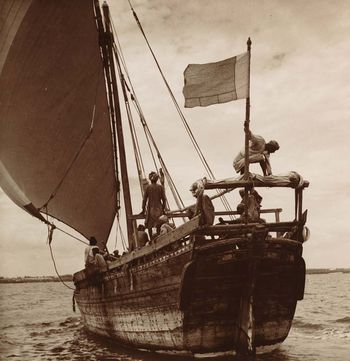
The promise of oceanic history, I argue, is both academic and political: first, the scholarship opens up the possibility of new narratives of the Gulf's past, suggesting new periodizations, fruitful avenues of historical inquiry, and new readings of old sources that enable productive contemplation of questions of circulation, connection, and entanglement. But more than that, an oceanic history of the Gulf allows historians to push against the discourses of nativism that have pervaded the public sphere in the Gulf states. It suggests a history of the Gulf in which the past is scattered along a vast littoral and woven into a much broader transregional tapestry, and it refuses to retrofit the Gulf's past into the national narratives that have dominated Gulf history writing. In the sultan's answer to the British officials—in the circumstance of many dhows named Fateh al-Khayr—lies the possibility of many pasts, many itineraries, and many new horizons for the Gulf in the age of oceanic history (Fig. 1).
“Stern and left side of a dhow with a bi-colored flag,” The Humphrey Winterton Collection of East African Photographs, Melville J. Herskovits Library of African Studies, Northwestern University, Object 36-1-8 (http://hdl.handle.net/2166.DL/inu-wint-36-1-8; accessed 3 March, 2020).

The Middle East Historian and the Sea
Historians are now squarely in the midst of the “global” turn, for better or for worse—but mostly for better. However, despite numerous programmatic declarations, there has not yet been a clear consensus on what global history is: like their colleagues in transnational or world history, global historians are interested in connections and circulations, in moving between scales of analysis, and in interregional entanglements. The end result has been a scholarly endeavor to write history that is unshackled from the nation–state and interrogates the stability of previously held geographical categories.Footnote 6 Historians of the Middle East and of the Islamic world more broadly have been eager to embrace this turn; work on “global Islam,” “the global Middle East,” and all manner of globalisms abounds. Yet this literature rarely considers anything prior to the 1970s as global; the term is still deeply intertwined with the history of globalization itself.
For the historian, then, there has emerged a more sophisticated set of categories for understanding the more-than-local and not-quite-imperial past. One of these categories, oceanic history, has enjoyed a remarkable surge in popularity. There is now a highly developed literature on the Mediterranean, which is in many ways an old stomping ground for Middle Easternists.Footnote 7 Alongside that, however, has emerged a growing body of scholars drawing the Arabian Peninsula into the Indian Ocean world, including a vibrant literature on the Red Sea. Connections across different maritime spaces have thus generated a fair amount of interest among historians of the Middle East and have produced robust conversations that have worked to destabilize the traditional geographic boundaries of nation–states, empires, and continents that had long shaped research on the region.Footnote 8
This is welcome news, given the promise that oceanic history, at least in its most current conceit, holds for historians’ biding interest in decentering Europe in world-history narratives. Despite its Braudelian origins, the first wave of scholarship on oceanic history, particularly in the Mediterranean Sea and the Indian Ocean, was in its crudest form just another variant of imperial history, one that unfolded in a maritime space.Footnote 9 Even as the field began asking more nuanced questions about transregional connections, some historians still harbored the suspicion that it was no more than “old wine in new bottles (‘good old’ colonial history repackaged as ocean-based ‘world’ history).”Footnote 10 That, however, is decidedly no longer the case: today, the best examples of scholarship in oceanic history (in the Mediterranean, Indian Ocean, Atlantic, and beyond) highlight circulations, connections, and entanglements within and across oceans that call into question or collapse altogether the static geographical and civilizational containers that had characterized much of the older world history approaches.
Within this broad literature, scholars have found the Indian Ocean to have particularly robust theoretical and methodological implications for the study of history. More than a decade ago, Sugata Bose suggested the possibility of conceptualizing the Indian Ocean as “an inter-regional arena,” animated by flexible geographical boundaries, durable networks, and a centuries-long circulation of people, goods, and ideas.Footnote 11 Since then, historians have enthusiastically expanded upon this idea: the Indian Ocean has emerged as a site for historians to explore a range of lateral networks, South-South connections, and alternative universalisms.Footnote 12 Beyond its potential as a methodological laboratory, the Indian Ocean also offers up a site of competing universalisms and worldviews: “a privileged vantage point from which to track a changing world order.”Footnote 13
For the historian of the Middle East, the stakes of Indian Ocean history have been a little less apparent. If the Mediterranean has been the most obvious choice of oceanic arena because of its deep entrenchment in the literature and its proximity to the usual suspects of the historiography—Turkey, Egypt, and the Levant—the Indian Ocean continues to hold promise as an arena of transregional connection. It is from the Indian Ocean, asserts Michael Christopher Low in a provocative essay, that “a host of Other Middle Easts in the Arabian Peninsula, the Red Sea, and the Gulf (including parts of Iraq and Iran)” might become more visible.Footnote 14 And as Engseng Ho suggests, spaces like the Indian Ocean “can provide tractable concepts for a new round of research to shed light on the social shapes of societies that are mobile, spatially expansive, and interactive with one another.”Footnote 15 By looking out across the Indian Ocean, then, historians open up the possibility of seeing new spaces, shapes, and entanglements across what we call the Middle East.
Scholars working on different parts of the Arab and Persianate worlds have recognized the potential that the Indian Ocean offers and have slowly begun to seize on it. Historians studying print culture and nationalism, long-established pillars in the literature on the Middle East, have found new material and raised new research questions in India and East Africa.Footnote 16 Historians also have come to embrace the connections and circulations that brought together Iran, India, and the Indian Ocean.Footnote 17 And meanwhile anthropologists working on migrant labor in the Middle East have drawn on the Indian Ocean literature to generate new insights into questions of transnationalism and migration.Footnote 18
But the Indian Ocean is more than just a scholarly fascination; it is an actors’ category, and one that is alive with history, particularly for the region's Arabs. When the 15th-century mariner Ahmad ibn Majid wrote his famed treatise on the principles of navigation, it was the Indian Ocean (Bahr al-Hind) that formed its backdrop.Footnote 19 And for ibn Majid and the generations of Arab navigators who came after him, Bahr al-Hind was not a single body of water; it was a composite of many smaller seas, each with its own dwellers, dynamics, challenges, and opportunities. Writing the history of the Indian Ocean, then, is in part grappling with the very real actors, connections, imaginaries, and histories that drew people from the shores of the Middle East into and across its many seas.
This turn has already made ripples in the historiography of the broader Arabian Peninsula. For roughly two decades now, work on Yemen has firmly established it as an important site of Indian Ocean history, as an exporter of merchants, scholars, texts, and commodities and as one of the frontiers of European colonialism in the Arabian Peninsula.Footnote 20 The Red Sea, which has long been recognized as the principal artery linking the Mediterranean to India, has now emerged as a major area of research for historians interested in the interlinked histories of empire, global capitalism, and the hajj, and also a site from which one might reflect on the epistemologies of the discipline more broadly.Footnote 21 The oceanic turn has thus generated a multitude of currents around the Arabian Peninsula and has reshaped how scholars conceive of its histories.
Among the principal beneficiaries of this turn has been Saudi Arabia, which had long been denied any meaningful oceanic connections beyond early political and military entanglements between the house of Saud, the Qasimi rulers of Ras al-Khaima and Sharjah, and the East India Company.Footnote 22 Things have changed, however: more recent research highlights the ways in which the inhabitants of the Saudi interior moved around the ports of the Western Indian Ocean, and also (perhaps most notably) the circulation of scholars and merchants (and, by extension, texts and ideas) into the Hejaz from South Asia, Southeast Asia, and East Africa, by way of the hajj.Footnote 23 Far from being an insular peninsula, then, Saudi Arabia, and particularly its western coast, is being established as a central node of the Indian Ocean world. By contrast, scholarship on the Gulf more broadly has not been nearly as motivated by the oceanic turn. To be sure, there is some work on the Gulf's oceanic history, much of which I survey below, but the historiography on the region has not yet gotten its feet wet in the same way that work on the Red Sea or South Arabia has.
A Gulf Apart
It is no secret that the historiography of the Gulf has long been the poor cousin to its counterparts in Turkey, the Levant, and North Africa. In its representation in both academic publications and academic conferences, the Gulf has trailed far behind other regions of the Middle East, as a subfield of Middle Eastern studies in general and in the field of Middle Eastern history in particular. For those working on Gulf history, the jeremiad has by now become well-rehearsed: the Gulf is absent from Middle Eastern history surveys until the discovery of oil. The pre-oil past has been declared largely irrelevant to the established Middle Eastern history narrative; the Gulf was what Michael Christopher Low aptly characterized as “a varied landscape of tenuously integrated frontier provinces, semi-autonomous and indirect rule, and wide swaths of territory entirely beyond even the most nominal claims of Ottoman sovereignty.”Footnote 24 As such, it was marginal and hardly worth serious consideration; from early on, surveys on the history of the Middle East preferred to leave it out altogether, and when they did include it there was (again) little beyond the arrival of oil companies and migrant workers in the 20th century. The 19th-century history of the Gulf, to say nothing of the preceding centuries, has been hardly worth a footnote in a narrative that has been dominated by the Ottoman and post-Ottoman Arab world.Footnote 25 Scholars had long located the principal anchors of modern Middle Eastern history—empire, scholarly circles, nationalist movements, and even colonialism—elsewhere.
The absence of the Gulf in the narrative of modern Middle Eastern history is all the more striking when one considers how central it has long been for discussions of the region's ancient and early medieval past. Scholarship on the ancient history of the Arabian Peninsula relies heavily on material unearthed in the Gulf and has long established the Gulf as a hub of transregional connection. Literature produced in the Gulf during the Abbasid period (works like Bozorg ibn Shahriyar's Kitab ‘Aja'ib al-Hind and Abu Zayd al-Sirafi's Akhbar al-Sin wa-l-Hind) form a part of the medieval canon, and the works of early travelers and geographers like al-Mas‘udi and ibn Battuta invariably included long discussions of the region.Footnote 26 With few exceptions, however, this has not translated into scholarly interest in the region; few recent works of medieval Middle Eastern history involve the Gulf, and for work on the period following the emergence and spread of the Ottoman Empire it has all but completely fallen off the map.
Left on the sidelines of Middle Eastern history, scholars working on the Gulf largely turned inward. There was no established imperial framework to write within, and most embraced the methodological nationalism that was characteristic of the broader field. Studies on individual Gulf states proliferated over the course of the 1980s and 1990s; there is no shortage of histories of Kuwait, the United Arab Emirates, Bahrain, etc., even as they remain dwarfed by studies on other countries in the Middle East. Although these works considerably deepened historians’ knowledge of the Gulf, they inadvertently exacerbated the perception that the study of Gulf history was at best parochial and, for those looking to advance their academic careers, inadvisable. Even the literature on Iran, which forms virtually an entire subfield in its own right, has little to say about the country's southern littoral. The Persian coast has long been neglected in favor of a more Tehran-oriented vision of the nation in which the sea is peripheral.Footnote 27 Only a smattering of works exist in English that take on the history of the Iran's coast, and virtually all of these are on the early modern period.Footnote 28 Work in Farsi is more substantial, but has done little to establish the Gulf as an arena of Iranian history, to say nothing of the Indian Ocean world more broadly.Footnote 29
Yet throughout the 1990s and 2000s historians continued to produce excellent work on the region: writing on Ottoman and British imperial history in the Gulf has forced historians to rethink the ways in which imperial power operated through local political configurations, and has recentered local actors in stories in which the protagonists had long been thought to come from elsewhere.Footnote 30 Other work has done much to direct historians’ attention to the economic and urban development of the Gulf prior to the advent of oil, highlighting the ways in which merchants developed and headed institutions that gave shape to the changing port cities.Footnote 31 Still others have rewritten the political history of the early 20th century, pointing to the existence of active political movements that imagined alternative paths of economic development; in doing so, they issue a serious challenge to the hackneyed narrative of political quiescence that rentier economists established so long ago.Footnote 32
Perhaps the most relevant development to the discussion here has been the recent trend focusing on the Gulf's transregional connections, both historical and contemporary. Historians have pointed to the strong ties between the Gulf and Indian Ocean, even as the boundaries that Middle Eastern studies placed on their work limited their ability to fully pursue them. The Gulf's economic and political ties to India have long been acknowledged, particularly by historians writing on Basra; the history of Indian merchants in the Gulf also has generated a fair amount of interest.Footnote 33 Historians of Oman, too, have highlighted the long-standing Omani imperial presence in East Africa, a history that their Africanist colleagues have been attentive to for many decades.Footnote 34 More recent work by Gulf historians has built on this old body of work, energizing the field with new explorations of the historical threads that bind the Gulf to the Indian Ocean. A spate of recent publications has highlighted new sources and narratives on Omani migration and commerce in East Africa, and others have narrated a history of capitalism and regulation that connects the Arabian Peninsula to India and East Africa.Footnote 35 Meanwhile, ongoing work by graduate students and recently minted PhDs has told new stories of circulation, historical and contemporary, both within the Gulf and beyond it.Footnote 36 As the editor of a recent volume on the wider contours of Gulf history writes, “the history of the Gulf in its most prosperous ports was, and still is, a history of cross-cultural encounters.”Footnote 37
The Arabic-language historiography on the Gulf, too, has readily acknowledged the connections between the Gulf and the wider Indian Ocean. There is now a generative literature that explores the economic and social ties that bound the Gulf to India and East Africa; studies on merchants, statesmen, and mariners that circulated around the Indian Ocean abound, and historians in the Gulf have come to incorporate local archives and family collections into their writings, many of which fall into the trap of vanity projects. Historians in the Gulf, however, are perhaps even more hamstrung by a methodological nationalism than those in the Anglo-American academy have been. The overwhelming majority of the histories produced within the Gulf propagate a narrative in which the nation as a category remains stable, even as its members circulate within a broader arena. Although people may have traveled around the Indian Ocean and even lived and married abroad, their identities and sense of self are already formed and unchanging. In their encounters with other communities, they simply ricochet off one another, as if they were billiard balls; no meaningful cultural exchange, let alone hybridization, ever occurs. As a result, we are left with a vibrant literature on oceanic connections, but one that is stripped of any of the promises of a meaningful oceanic history.
Nor is there a sense that the histories of any of the other Indian Ocean communities or states is relevant to the nation being discussed: a recent history of Kuwaitis in India, for example, takes into account few of the political and economic transformations that shaped the subcontinent during the 19th and 20th centuries.Footnote 38 Similarly, histories of Omani settlement in East Africa only account for the inhabitants of East Africa insofar as they form the frontiers of Omani imperial expansion. Although they are attentive to the history of British colonialism and how the economic booms and busts of the modern era shape the lives of Arabs in East Africa, the nationalist movements on the East African coast and the local political actors who shaped those histories—in short, the very transformation of what it meant to be an Arab in East Africa itself—have no place in the Omani narrative.Footnote 39 On at least one occasion, these oversights generated embarrassment, as in 2013, when Omani television produced a documentary series on Omani East Africa called Min al-Sawahil. In one episode, the host and history enthusiast Muhammad al-Marjabi found himself confronted with the limits of his interpretation of the past when one interviewee expressed anger over the denial of his application for Omani citizenship; the glorified narrative of Oman's past could only get the producers so far.Footnote 40
This is, in part, a product of the institutional landscape of the Gulf states. Universities around the Gulf seldom teach global history surveys, much less encourage research in the subject. Within history departments, the overwhelming focus is either on national history or Islamic history; the transnational and global turn has yet to meaningfully shape historical research. Research centers are often no better: with few exceptions, they are funded by the governments themselve, and produce state-sanctioned historical narratives that accord well with a national self-image, often hagiographies of the ruling family. Unaffiliated scholars (and there is an active world of independently funded scholarship in the Gulf) stick close to the narratives being generated by universities and research centers. Nobody wants to break the mold; instead, local historians clamor to insert their own family's or community's stories into an established national narrative.Footnote 41
In all of these cases the inability to contend with the ramifications that a transregional past has on how one writes history has placed tangible limitations on the scholarship. As an appendage of Middle Eastern history, the Gulf has been largely inconsequential; it has been unable to contribute to the field's prevailing historiographical concerns, and the debates that it has offered have not been received with any enthusiasm by the field more broadly. As a field in and of itself, it has teetered on the edge of parochialism: shorn of any meaningful connection with the broader Middle East, historians of the Gulf have resorted to fine-tuning debates about British imperialism or the coming of oil that have by now shown their age, even as the emergence of petro-states in the Middle East and global economy has had enormous implications for how one writes the history of empire and global capitalism.Footnote 42 The emphasis on the intertwined histories of oil and state, however, tends to double down on a terrestrial (and often national) framework for writing history, couched as it may be within a broader international political economy. More concerning, however, is that this work unintentionally reinforces the notion that the Gulf has no meaningful history before or beyond oil; thus the Gulf is further marginalized in the long arc of Middle Eastern history. The limits that a land-based and Middle East–centered approach have placed on what historians can say about the Gulf have now become clear. So too has the potential of an altogether new historiographical frontier that Gulf historians have shown an interest in but have not yet come to fully embrace: the Indian Ocean.
The Indian Ocean's Gulf
When the Omani Sultan Faisal bin Turki al-Busa‘idi wrote to the British consul that there may have been twenty dhows named Fateh al-Khayr, he unwittingly pointed to the many loose threads of a history that scholars are just beginning to pick up, even if they have long acknowledged their existence. For with the oceanic turn in the discipline of history there has emerged a palpable current in the historiography of the Gulf, one that has come to embrace the Indian Ocean as an important arena for Gulf history. Approaches to the Gulf's oceanic history have ranged widely: scholars have asked questions about the political histories that connect the Gulf to other Indian Ocean littorals and have offered textured accounts of the circulation of people, goods, ideas, and regulations—what one scholar recently characterized as illuminating “the practices and perceptions of those moving and trading, as well as imagining, regulating, and discussing such exchanges, across seas and oceans.”Footnote 43 As the field of Indian Ocean history grows to a swell, waves of scholarship crash on the shores of the Gulf.
The implications for how we locate and write the history of the Gulf are enormous, and the historiographical vistas that the Indian Ocean opens up are wide. With the oceanic turn, historians have the opportunity to dislodge the Gulf from the sidelines of an Ottoman-dominated historiography and break down the geographical barriers that have long kept that historiography in a subregional ghetto. As part of the Indian Ocean, the Gulf can be more effectively connected to other regions with which it shares deep and long-standing ties: to India, to South Arabia, and to East Africa. The fact of connection alone is, of course, not enough; rather, the promise lies in the transformative potential that the connections hold for how we might think of different topics in Gulf history: the histories of trade, of empire, of piracy, and of slavery, to say nothing of longer-standing debates surrounding economy and society in the region. If the promise of an Indian Ocean history lies in its potential as an interregional arena, its realization necessitates that historians reflect more deeply on the long arc of region formation: on the changing density of the ties that bind the Gulf to the wider Indian Ocean and on their capacity to reframe old questions and engage broader debates as well as the bigger questions of periodization, sources, and method. From the Gulf we may productively explore the circulations, connections, and entanglements that have shaped the debate on global history.
In its most basic form, this requires that those working on the Gulf supplement the traditional Middle Eastern history curriculum with a deeper engagement with the sprawling literatures on South Asia, South Arabia, and East Africa, to say nothing about the growing literature on the Indian Ocean world itself. Writing the history of the Gulf into the Indian Ocean and vice versa means taking those histories seriously and appreciating how political, economic, and legal transformations (among others) in India or East Africa would have reverberated in life in the Gulf. The point, however, is not simply to connect events and processes in the Gulf to other shores—again, connection is not enough on its own—but rather to wrench these from the very local contexts in which they have been understood and read them against a much broader backdrop, wresting the literature from the provincialism that has dogged it for so long. Put simply, it is to ask what the history of the Gulf would look like if we read it from Bombay, Zanzibar, Aden, Mombasa, or Calicut—and vice versa.
The possibilities that emerge from this thought exercise are endless, and any list that I draw up here can only illustrate the potential. Instead it might be worthwhile to think in broad terms and imagine what remapping the Gulf might mean for how we organize its history chronologically: to think of what new periodizations might emerge. In the established timeline of modern Middle Eastern history (the rise of the Ottoman and Safavid gunpowder empires, their entanglements with Europeans, 19th-century intellectual movements, reforms, and ultimately the World Wars and the transformation of the political landscape of the region) the Gulf rarely emerges before the discovery and export of oil in the mid-20th century, denying the region's inhabitants anything other than a staunchly presentist history. The markers that Gulf historians have relied upon are only slightly better: the most recent survey of the region's history divided its pre-oil past into an era before 1500, a period between 1500 and 1720 marked by encounters between Muslim and European empires, an “era of political turbulence” between 1720 and 1820, a period of British supremacy between 1820 and 1920, and “the formation of modern nation states” between 1920 and 1956.Footnote 44 Although these markers are unquestionably more helpful than those borrowed from Middle Eastern history, they do little to make it legible to anyone outside of the subfield.
However, if we situate the region within the periodizations accepted by Indian Ocean historians of the early modern and modern periods, the context for its pre-oil past becomes much clearer.Footnote 45 The rise and decline of the Portuguese empire in the Indian Ocean during the 16th and 17th centuries, for example, was of tremendous consequence for political life in the Gulf. It was during that time that the region witnessed the rise of the Omani Ya‘rubi dynasty and its expansion along the East African coast and the assertion of quasi-independent governors or emirs around the coasts of the Gulf, each under varying degrees of Ottoman or Safavid suzerainty.Footnote 46 The steady expansion of the East India Company in South Asia and from there into enclaves along the coasts of the Gulf and South Arabia (principally Aden) also profoundly reshaped the political geography of the Gulf. Treaty-making by the company favored some ports over others, opening up particular political futures while blocking off others.Footnote 47 At the same time, the gradual emergence of the Pax Britannica in the Indian Ocean transformed markets in Arabia and East Africa, linking them more firmly to growing industrial centers in India and pegging their futures to the booms and busts that invariably characterized Indian business history.Footnote 48 Far from being a peripheral player in the politics of the Middle East, then, the Gulf was being increasingly swept up in the changing tides of world history.
Reading the history of the Gulf as part of the Indian Ocean also allows new historical connections and homologies to more forcefully assert themselves. The institutional makeup of the small shaykhdoms that dotted the coasts of the Gulf resembled other port cities around the Indian Ocean world much more than they did inland towns and cities. There, merchants often constituted the most influential group, drawing on their far-flung resources to develop bodies of clients and establish themselves in the urban political sphere.Footnote 49 Among these was the customs master, an influential merchant-cum-customs farmer who served as broker between the realms of commerce and administration.Footnote 50 Commercial actors in the Indian Ocean also were often able to develop autonomous juridical institutions to regulate mercantile affairs, keeping matters of transregional trade largely out of the hands of rulers but drawing them in when necessary.Footnote 51 Moreover, like other small port city–states around the ocean basin, these ports competed with one another to assert themselves in a changing imperial seascape: as new regional and world empires made their ways into the Indian Ocean world, political actors in the Gulf actively sought to cultivate relationships with them to leverage resources in more local power contests.Footnote 52 Global empires wove themselves into the fabric of political life in the Gulf, and political entrepreneurs reconfigured their overlapping local, regional, and transregional ambitions to take advantage of imperial competition. In this respect, the political histories of Gulf port cities are more analogous to those of East Africa, India, or South Arabia than those of the urban centers of the Middle East, or even the more rural towns.
Perhaps unsurprisingly, nowhere is the oceanic history of the Gulf clearer than in the arena of economic life. Until recently, the economic history of the Gulf had been written as if it were a local or regional affair: historians principally have been concerned with the pearl fisheries, and although they acknowledge that dhows from the Gulf did sail to Indian Ocean ports with very few exceptions there is not much sense of what they did there and what the broader context for those voyages might have been. But by following the dhows to ports around India, South Arabia, and East Africa, by looking at the cargoes they carried and the waves of letters, notes, receipts, accounts, and logs that they generated over the course of their journeys, the historian obtains a much more textured account of economic life. There, around the coasts of the Indian Ocean, one can peer into the realm of the regional market, money transfers, contracts and obligations, insurance bills, commercial instruments, and texts printed to help Gulf merchants and mariners navigate it all: in short, the world of the Indian Ocean bazaar, and all of the long histories that animated it. For Middle East historians and historians of capitalism alike, these are largely uncharted waters, and ones that were largely blocked from our sightline by the boundaries that area studies erected around this oceanic world. And beyond the bazaar there existed a veritable cornucopia of circulating individuals, texts, and ideas, all of which animated much more deeply sedimented histories that bridged the Gulf with its oceanic hinterland. These unexplored histories are only just now being written, but what they have already made clear is that the inhabitants of the Gulf did not limit themselves to their shallow corner of the Western Indian Ocean; they actively participated in a wider political, intellectual, legal, and economic arena.
With this background, thinking in oceanic terms ought to have deep implications for how historians of the Gulf approach their sources. Partly due to digitization, the region is currently witnessing something of a renaissance in the publication of historical sources: there are now scores of available travel narratives, hundreds of manuscripts, thousands of letters, and an astonishing number of digitized records from the India Office and other repositories, truly an embarrassment of riches. As in the case of the Kuwaiti Fateh al-Khayr, many of these are presented as artifacts of a national heritage, illustrations of the grandeur of the nation's past. We might read these artifacts and documents alike as remnants of a history that has been scattered across a broad canvas. Rather than take them as single expressions of a nation's past, we ought to read them against the backdrop of the transregional history to which they belong. For some, this makes immediate sense: there is no reading the dhow, the account ledger, or the trading manual as somehow separate from the world of circulation that generated them. At other times, however, this means thinking about how those who had no occasion to travel might have been attuned to this world of circulation: through letters, by seeing visitors pass through their towns, or by partaking in its commerce. The Indian Ocean world was present in the everyday, in the mundane, even if not in the most obvious of ways.
Land, Sea, and the Challenge of Autochthony
Yet not all transregional connections are worthy of celebration, and not all have been equally highlighted. As Engseng Ho notes, “once made, connections can be cultivated, thickened, used, abused, bound, or broken, and can reconnect again.”Footnote 53 With every circulation came a point of friction, with every connection a rupture, and with every story of cosmopolitanism one of hierarchy and racism. The histories of the Indian Ocean are not just of possibilities realized, but also of trajectories foreclosed and of lives, fortunes, and futures lost. In their making, breaking, and remaking, the connections across the Indian Ocean reflected the tensions of 20th-century history itself and generated high-stakes contests over the right to a place within the national narrative.
At least some of the voyages of the Fatehs remind us of this. Lurking beneath all of the empires, traders, and circulations that animated the Gulf's oceanic history was a more sordid history of forced crossings: of slavery. The subject has not received much attention, and what little work done on it in the past has tended to treat is as if it were a local phenomenon, limited in its historiographical ramifications beyond the antislavery campaigns that it set in motion. More recent work, however, has managed to establish slavery as an issue that animates centuries of transregional connectivity across the Indian Ocean. Historians have linked the changing nature of the slave trade in the Gulf to transformations in economic life in East Africa and changes in the global economy writ large.Footnote 54 The act of transporting enslaved individuals on dhows also ensnared Gulf merchants and mariners in a much wider web of entanglement with European imperial officials, naval officers, and juridical actors; the vistas are truly wide.Footnote 55
But the history of slavery is not just one of the trade in enslaved people; it also is of the inability (or perhaps unwillingness) of the national narrative to contend with the topic.Footnote 56 There exist virtually no studies in Arabic on the history of slavery in the Gulf; historians, perhaps unsurprisingly given the politics of publication there, either mention it only in passing or avoid it altogether. Before the opening of the Bin Jelmood House (a museum devoted to the history of slavery in the Gulf) in Doha, Qatar, there had not been so much as an exhibit on the topic. And even the Bin Jelmood House, although a valiant endeavor, relegates the topic to the pre-oil past. It draws parallels between the history of slavery and labor migration in the 20th century, but it does not reckon with the status of formerly enslaved people within the nation itself.Footnote 57 The contrast with the literature on slavery in the United States and the Atlantic (which itself has entailed much soul-searching) is striking.
The unwillingness to contend with other pasts—other voyages—extends to those who transported the slaves as well. At the beginning of this piece, I recalled an anecdote surrounding the mariners of Sur, many of whom were accused of involvement in the slave trade. Part of what had frustrated British officials who were chasing Suri dhows (among them that of Jum‘a bin Sa'id, the captain of the Fateh al-Khayr) around the Indian Ocean was that the Suris would often hoist the French flag, effectively barring the naval officers from searching them without French consular permission. When questioned about their use of the tricolour, most responded that they were, in fact, bona fide French subjects, that they owned property or had family in Madagascar, Mayotte, Djibouti, or other French possessions around the Indian Ocean. And indeed, these were mariners who, although based in Oman, spent most of their time circulating the Indian Ocean world. The incredulity that their responses elicited had less to do with their truthfulness than it did a changing world of jurisdictional politics in the early-20th century.Footnote 58 The growing discourses of territorial sovereignty were unwilling to accommodate these transregional forms of belonging, much like the later discourses of autochthony for which they laid the foundation are unable to countenance them. And as with forced migration of enslaved individuals, the contemporary implications of refusing to deal with an oceanic past can be insidious; one only needs to consider the stripping of citizenship of minority groups in the Gulf to understand just how catastrophic they can be.Footnote 59
The story of the Gulf and Indian Ocean, then, is not just about the making of a world of connection and circulation; it is about its slow unmaking as well, and the broader ramifications of that history. For Indian Ocean historians, part of the work has been to understand how inhabitants of that arena navigated the process of decolonization and the turbulent emergence of nationalism, particularly in places that had been shaped by a long history of migration and circulation.Footnote 60 In the Gulf, the concomitant emergence of nationalism and an oil economy, coupled with a very slow process of decolonization, lent a particular hue to the process by which ties between the Gulf and Indian Ocean were broken and remade. That history has yet to be written, but the work that historians so far have done has painted a picture of political possibilities foreclosed: of the quashing of political ambitions by actors whose goals clashed with those of a British Empire in its twilight and of former clients and allies of the British Empire cast aside in a changing geopolitical landscape.Footnote 61 One must take care not to contrast a rose-colored image of a cosmopolitan past with a vilified nativist present; the pre-oil Gulf, like other parts of the Indian Ocean, was not shorn of racism or nativism, and to suggest as much would be dishonest.Footnote 62 Moreover, overemphasizing the ruptures that came with the arrival of oil risks ignoring the long period of overlap between the maritime and oil economies of the Gulf and the slow process of institutional change that characterized it.
As extended as it may have been, this period of transformation left the Gulf public sphere under a dark cloud. As the intertwined arena of material wealth, politics, and ideology shifted, so too did the ways in which groups spoke about themselves. It was during these turbulent times that the region witnessed the rise of a distinctly nativist discourse: the idea that particular groups of people were original settlers in the region, whereas others were more recent migrants, and often of questionable pedigree and loyalty. Although this story has in the past been told as one of an encroaching politics of Arab nationalism, also at stake was the vision of the nation in a time of national economy, and after the withdrawal of the British, and the place of a maritime past in that vision. Like coastal East Africa (and not dissimilar to partition-era India), the Gulf's position at the intersection of a range of different social imaginaries—maritime, Arab nationalist, communist—opened the arena to the emergence of a very particular discourse of nativism.Footnote 63 This, in turn, fostered heated debates over membership in the body politic: over citizenship, but also over history itself. There emerged a pitched battle over the place of different communities in each nation's history, one in which the region's minorities found themselves having to vie for their place in national narratives that had established Sunni Arab autochthony as an historical fact. Private printers around the Gulf churned out one self-published book after another defending the claims that different minority groups had to the nation's past.Footnote 64 At times, these tensions had deadly consequences; one only need think of the violence that discourses of nativism produced in Bahrain.Footnote 65 It is perhaps no wonder that Gulf historians have largely kept quiet about the history of slavery, when contending with it would cast a shadow over the celebratory narratives of nation-building that dominate the public sphere.
In all of this, the dhow stood as an empty vessel into which state-sponsored discourses could be poured, much as it does today. Its presentation as a symbol of the nation actively severs it from its transregional past. It elides the fact that many of those who sailed on board the dhow came from elsewhere and, indeed, that the very timber out of which it was constructed came from across the sea. The history of the dhow may thus be read as explicitly anti-national, and at the very least anti-terrestrial. And indeed, its display as a national artifact acts to deliberately exclude South Asians, East Africans, and even South Arabians from participating in the historical narrative. Stripped of its transregional fabric, the dhow has neither purpose nor history; the Gulf nationals who visit it have become tourists to themselves.Footnote 66
Conclusion
When the Sultan of Muscat quipped that there were may have been twenty dhows named Fateh al-Khayr, he was taking a defensive stance: after all, how might he be expected to police the jurisdictional maneuverings of a group of mariners that circulated from one port to another, especially given how many there were and how far away they seemed from the seat of his power? For in each Fateh al-Khayr and in every voyage it took lay multiple worlds of circulation, mobility, and entanglement of which he oversaw only a small corner; to borrow Sugata Bose's phrasing, there were a hundred horizons, and Jum‘a bin Khalid with his Fateh (sought by British officials) moved through them all. It is in these worlds, in the hundred horizons of the Indian Ocean, that we may reimagine the history of the Gulf, expanding our conception of the boundaries of the Gulf as we know it. No longer does it make sense to write a history of the Gulf that ends at the Straits of Hormuz or Ras al-Hadd. If Gulf markets, merchants, mariners, scholars, and statesmen were to be found in Karachi, Bombay, Calicut, Aden, Mombasa, and Zanzibar, then so too the history of the Gulf itself, which was scattered along the beaches and dockyards of the Western Indian Ocean.
The intellectual promise of an oceanic history of the Gulf is inviting. For those interested in studying the Gulf, this oceanic turn unravels the region's historical scroll, opening new frontiers for research in a subfield that has, with some notable exceptions, come to feel a little stale. This approach opens up new archives, generates new narratives, and highlights a range of actors and processes that have long been left in the historical lurch. For those outside the field, it battles the “rags-to-riches” narrative that has become so pervasive and relegated the Gulf to the margins of Middle Eastern studies. Seen from the Indian Ocean, the wealth produced by oil is no less spectacular, but it did not suddenly transform the region from an historical backwater to an important node of global capitalism. Rather, it continued a much longer history of connection and circulation and reconfigured the stakes of economic and political life in the region.
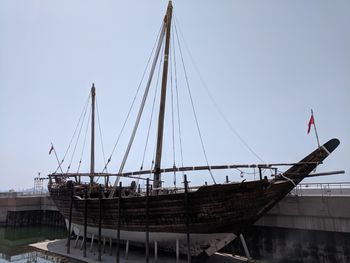
Bringing back the oceanic history of the Gulf (for after all, it has always been there) also holds the political promise of allowing a deeper engagement with prevailing discourses of autochthony in the Gulf. For it is in that arena and its reconfiguration during the 20th-century processes of decolonization, oil, and nationalism that we are able to see how those discourses emerged, how certain political possibilities were enabled and others foreclosed and how narratives emerged that placed the losers on the sidelines of history. In this regard, the Gulf is wholly unexceptional; historians of East Africa, of India, and of Southeast Asia, to say nothing of the Caribbean and other regions, have long pointed to similar processes.Footnote 67 It is unsurprising that the two Fateh al-Khayr dhows, one in Kuwait and the other in Sur, sit perched by the sea totally stripped of their oceanic past (Fig. 2).
The Fateh al-Khayr at the Kuwait Scientific Center, Salmiya, Kuwait (photograph by author).

Taking up the sultan's invitation to think about the many Fatehs and their histories is no small task. I suspect that the landlubbers among us will stick to the geographies we are most comfortable with; there is, after all, a long and venerable tradition of terrestrially grounded Middle Eastern history. However, those who believe there is a future for oceanic history in the Middle East may do well to look to the Gulf as one of its staging grounds; reorienting ourselves to the Indian Ocean does not mean that we leave the Middle East behind, but that we venture out into the more distant horizons of the Arab world.
Acknowledgments
The author would like to thank the editors and reviewers at IJMES for their thoughtful engagement with the piece. He would especially like to thank Laura Goffman, Ahmad al-Maazmi, Lindsey Stephenson, and Robyn Morse for their critical feedback on earlier drafts.