1. Introduction
Soft robot is a new type of robot made entirely of soft materials allowing them to have an edge over their traditional rigid counterparts [Reference Iida and Laschi1–Reference Laschi, Mazzolai and Cianchetti3]. Building robots out of soft materials makes them more compliant, which enables them to adapt to different environments and to have complex motions. In addition to that, these soft robots can navigate and squeeze through tight space with less mechanical restrictions and without sustaining physical damage.
These characteristics make the soft type of robot more attractive in several applications that require a very high degree of mechanical flexibility. Among the applications that can benefit from using soft robots are industrial robotic gripper [Reference Shintake, Cacucciolo, Floreano and Shea4–Reference Sinatra, Teeple, Vogt, Parker, Gruber and Wood6], medical [Reference Cianchetti, Laschi, Menciassi and Dario7–Reference Tse, Chen, Hovet, Ren, Cleary, Xu, Wood and Monfaredi9], agricultural [Reference Chowdhary, Gazzola, Krishnan, Soman and Lovell10–Reference Armanini, Junge, Johnson, Whitfield, Renda, Calisti and Hughes12], and pipe inspections [Reference Liu, Song, Fang, Zhao and Cao13–Reference Tang, Du, Jiang, Shao, Dong, Liu and Zhao14]. Pipelines are important parts of many industrial buildings and facilities such as oil refineries, chemical plants, nuclear power plants, and water treatment plants. The pipelines are used to transfer materials such as gases, different types of liquids, chemicals, and many other substances. Keeping the pipelines in good condition requires regular inspection and maintenance. In many plants, pipelines are very complex, which makes inspections laborious and difficult [Reference Beuker, Brockhaus, Ahlbrink and McGee15, Reference Hu and Guo16]. This is where the pipe inspection robot becomes important. Most of the pipe inspection robots are made of rigid structures with various locomotion strategies. These include wheeled robot, tracked robot, pipe inspection gauge robot, screw type robot, and legged/walking type robot [Reference Gargade, Tambuskar and Thokal17–Reference Chablat, Venkateswaran and Boyer20]. Rigid in-pipe inspection robots have some limitations in terms of the ability to adapt to different pipe diameters and navigate through complex bends or corners. Seeing this opportunity, many researchers have investigated the possibility of using soft types of robots to navigate inside pipelines.
This paper reviews the state of the art in the current soft robot technology specifically for in-pipe navigation. Although there are papers that review in-pipe navigation robots, those papers cover the traditional robots made of rigid materials with their own specific locomotion strategies. Soft robots on the other hand require different types of material, structure, locomotion strategies, and actuation techniques. To the best of the author’s knowledge, this is the first paper to specifically focus on the soft robot for in-pipe navigation.
The rest of this paper is organized as follows. In the first section, various materials of the soft in-pipe navigation robot are reviewed. Next, the structures of the different types of soft in-pipe robots are reviewed. In the section that follows, various locomotion strategies used by those robots to navigate inside pipelines are compared followed by another section discussing the actuation techniques. A table comparing various characteristics of the soft robot is also presented in this section. The final section discusses the findings and also concludes this paper.
2. Materials
A soft robot, by definition, is made of soft and compliant materials. Structures made of soft materials have an infinite degree of freedom and are able to undergo extreme deformation without sustaining structural damage, which contributes to their physical robustness. In addition, the high degree of compliance of the soft materials allows the structure to change shape and adapt to different environments. The environment inside pipelines can be unpredictable due to variations in pipe diameter, junction and corners, mineral deposits, blockages, and various surface conditions. Therefore, choosing the correct material is important to ensure that the soft in-pipe navigation robot can traverse complex pipelines without problems.
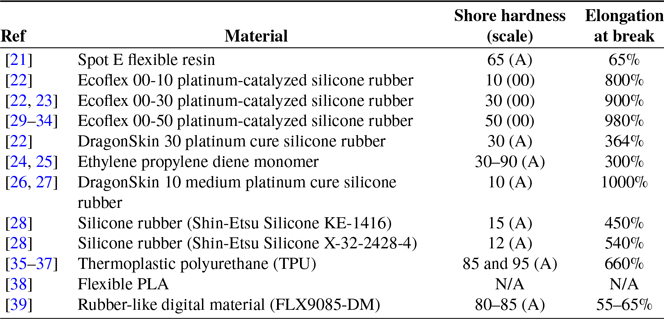
In literature, there are many types of soft materials used to fabricate soft in-pipe navigation robots. The type of material used depends on the type of structure and the actuation mechanism. Joyee et al. used flexible polymer resin (Spot E) having Shore hardness of 65 on the A scale with 65% elongation at break for their inchworm robot body to allow for the robot body to elastically bend [Reference Joyee, Szmelter, Eddington and Pan21]. Zhang et al. used a combination of platinum-catalyzed silicone rubber Ecoflex 00-30, DragonSkin 30, and Ecoflex 00-10 (Smooth-On, USA) for their robot’s inflatable air chambers [Reference Zhang, Pan, Heung, Chiu and Li22]. The Ecoflex 00-30 and Ecoflex 00-10 have the Shore hardness of 30 and 10 on the 00 scale, respectively, with the elongation at break of 900% and 800%. The DragonSkin 30 has a Shore hardness of 30 on the A scale and the elongation at break up to 364%. The Ecoflex 00-30 was also used by Jiang et al. to fabricate the anchoring surface of their robot to increase friction between the robot and the pipe wall [Reference Jiang and Pei23]. Yamato et al. used a combination of polyurethane (PU) and ethylene propylene diene monomer (EPDM) to build the flexible body parts of the robot (bendable tube and flexible ribbon) [Reference Yamamoto, Konyo and Tadokoro24, Reference Ravishankar25]. The EPDM has a hardness range of 30–90 on the A scale with the elongation at break of up to 300%. Verma et al. utilize DragonSkin 10 medium silicon rubber, which has the Shore hardness of 10 on the A scale with the elongation at break of 1000% for the inflatable air chambers of their tube-climbing robot [Reference Verma, Ainla, Yang, Harburg and Whitesides26]. Digumarti et al. used almost the same material having the same hardness and elongation at break, which is DragonSkin 10 to build the inflatable air chambers for their EuMoBot [Reference Digumarti, Conn and Rossiter27]. Takayama et al. built the inflatable air tubes for their twisted bundled tube in-pipe mobile robot using silicone rubber (Shin-Etsu Silicone) having a Shore hardness of 12 and 15 on the A scale with the elongation at break of 540% and 450%, respectively [Reference Takayama, Takeshima, Hori and Omata28].
Another group of researchers, Joey et al., built inflatable air chambers of their earthworm-inspired soft robot using Ecoflex 00-50 platinum-catalyzed silicone rubber having a hardness of 50 on the 00 scale with an elongation at break of 980% [Reference Ge, Calderón, Chang and Pérez-Arancibia29]. Similar material was used by Zhang et al., Yamamoto et al., and Calderón et al. to fabricate the inflatable air chambers for their soft robots [Reference Zhang, Wang, Wang, Meng and Liang30–Reference Calderón, Ugalde, Chang, Zagal and Pérez-Arancibia33]. Niu et al., on the other hand, used the same material to fabricate the flexible body for their magnetic-embedded worm-like soft robot [Reference Niu, Feng, Xie, Jiang, Sheng, Yu, Baoyin and Zeng34]. Liu et al. used a 3D printable thermoplastic polyurethane (TPU) (Ninjaflex) soft material to construct their soft robot’s inflatable air chambers [Reference Liu, Xu, Ong, Zhu and Lu35]. Similar materials with the Shore hardness of 85 and 95 on the A scale with the elongation at break of 660% were used by Yeh et al. to fabricate elastic ribbons for their soft in-pipe crawling robot [Reference Yeh, Chen and Juang36, Reference Yeh, Chou, Huang, Yu and Juang37]. Jiang et al. used a composite material consisting of PVC-coated nylon woven fabric and paper to form an origami-based inflatable air chamber [Reference Jiang and Pei23]. This composite material itself is flexible but non-stretchable. However, the whole structure is made stretchable by utilizing the Kresling crease origami pattern. Hu et al. used the same approach by constructing an origami-based inflatable structure out of non-stretchable material (flexible PLA) [Reference Hu and Li38]. Mark et al. used a rubber-like digital material (FLX9085-DM) having a Shore hardness of 80–85 on the A scale and an elongation at break of 55% to 65% to fabricate the auxetic metamaterial and the extendable air chamber for their soft robot [Reference Mark, Palagi, Qiu and Fischer39].
Common soft and stretchable materials for soft in-pipe navigation robots.

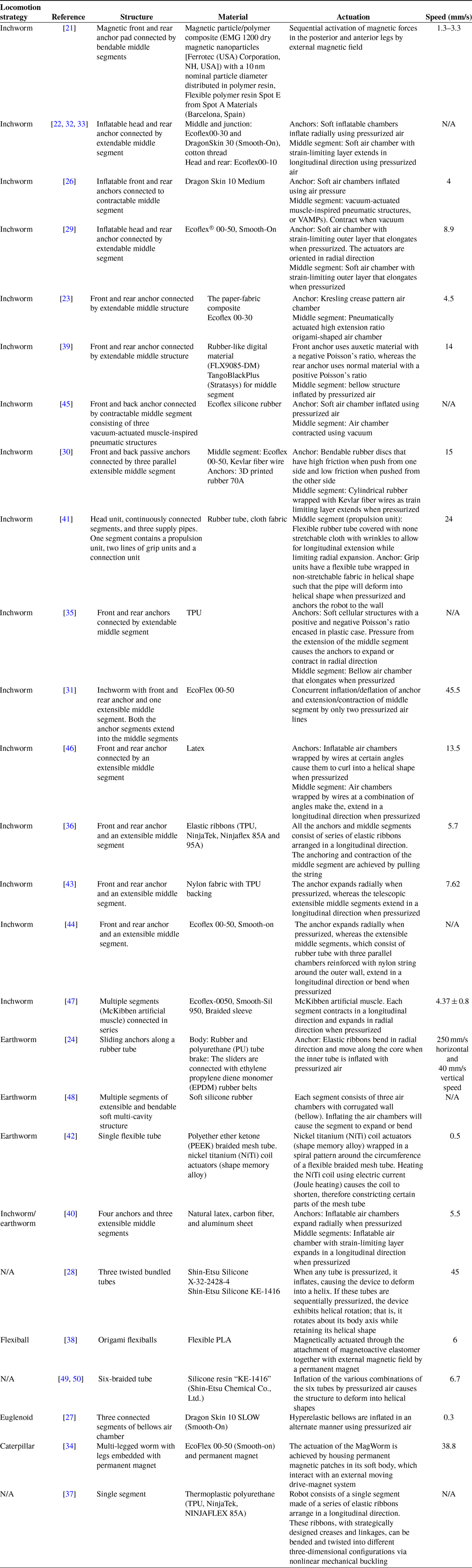
From the literature, it was found that various types of soft materials were used to fabricate different parts of the soft in-pipe navigation robot with a hardness ranging from 10 on the 00 scale to 95 on the A scale and with the elongation at break ranging from 55% to as high as 1000%. The materials with lower hardness and high elongation at break tend to be the material of choice to fabricate inflatable air chambers of the in-pipe robot. Softer material allows for lower air pressure to be used to inflate the chamber. The high elongation at break, on the other hand, allows the chamber to tolerate high inflation without sustaining any damage. Table I shows the summary of the soft and stretchable materials used for the soft in-pipe navigation robots.
Even though most of the parts and structures of the soft in-pipe robots are fabricated from soft and stretchable materials, there are certain structures and actuator types that are made of non-stretchable materials. For inflatable air chambers that use origami or bellow-like structures, harder and non-stretchable materials can be used. The stretchability of these types of structures is derived from the crease or corrugated patterns built into the structure, not from the inherent stretchability of the materials itself. Paper-fabric composite made by bonding a piece of paper and a PVC-coated nylon woven fabric together as in ref. [Reference Jiang and Pei23] can produce a highly flexible yet non-stretchable material for the aforementioned purpose. Certain actuators that consist of soft inflatable air chambers have flexible but non-stretchable materials such as cotton thread [Reference Zhang, Pan, Heung, Chiu and Li22], Kevlar fiber wire [Reference Zhang, Wang, Wang, Meng and Liang30], carbon fiber [Reference Kamata, Yamazaki, Tanise, Yamada and Nakamura40], cloth fabric [Reference Miyasaka, Kawano and Tsukagoshi41], or aluminum foil [Reference Kamata, Yamazaki, Tanise, Yamada and Nakamura40] wrapped around or embedded inside the outer wall of the chamber to restrict the expansion of the chamber in the chamber’s radial direction. Another actuator has a special type of material known as shape memory alloy (SMA) wrapped around soft chambers to constrict the chamber during actuation [Reference Seok, Onal, Cho, Wood, Rus and Kim42]. An SMA is a type of alloy that can memorize its original shape. The alloy can be deformed in any shape at room temperature. Upon heated to a certain temperature, it will return to the original memorized shape. Elastic ribbons and other structures that experience elastic bending that are typically used as spring in soft robots are made of harder materials with lower stretchability such as TPU as they have a higher spring constant as compared to the softer materials.
3. Structure
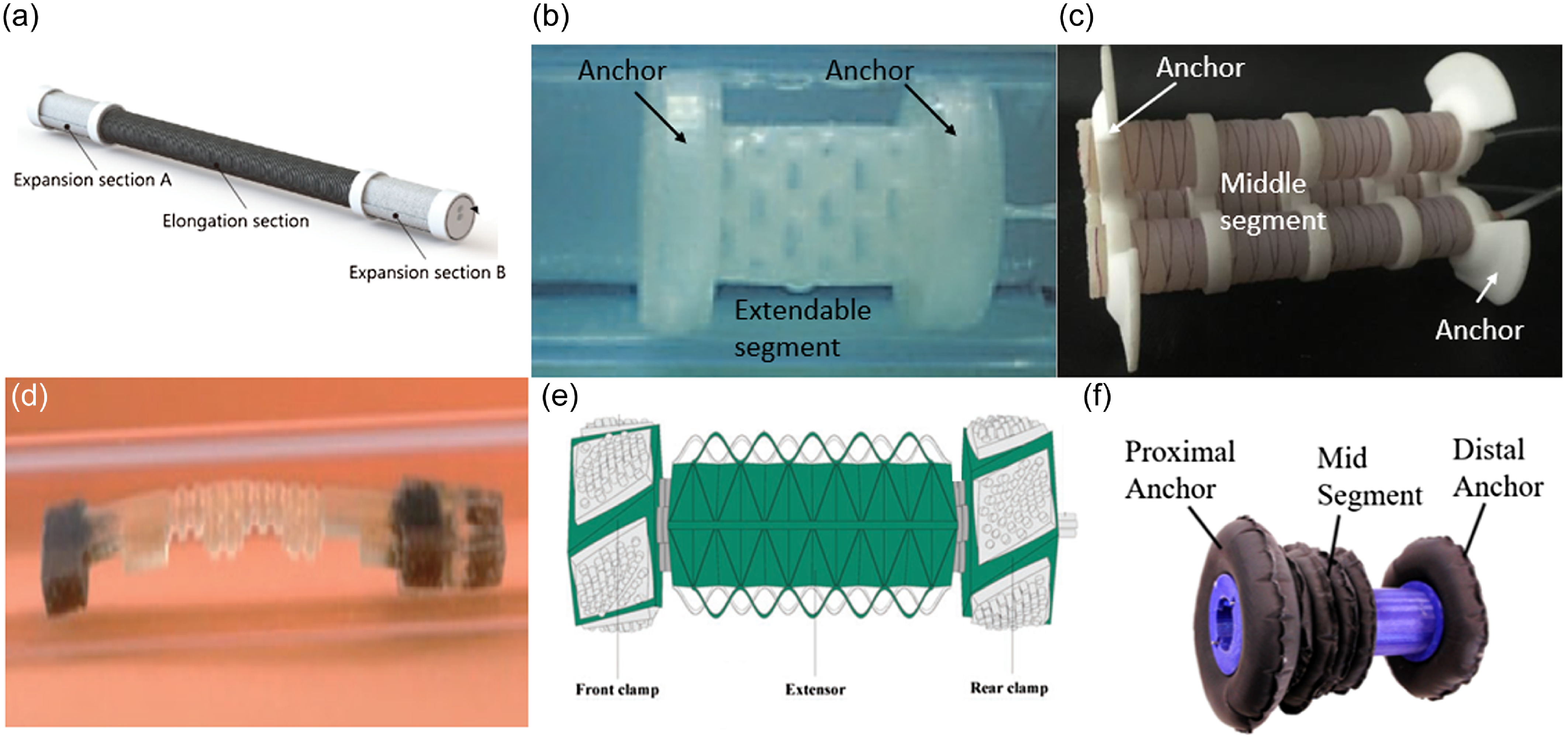
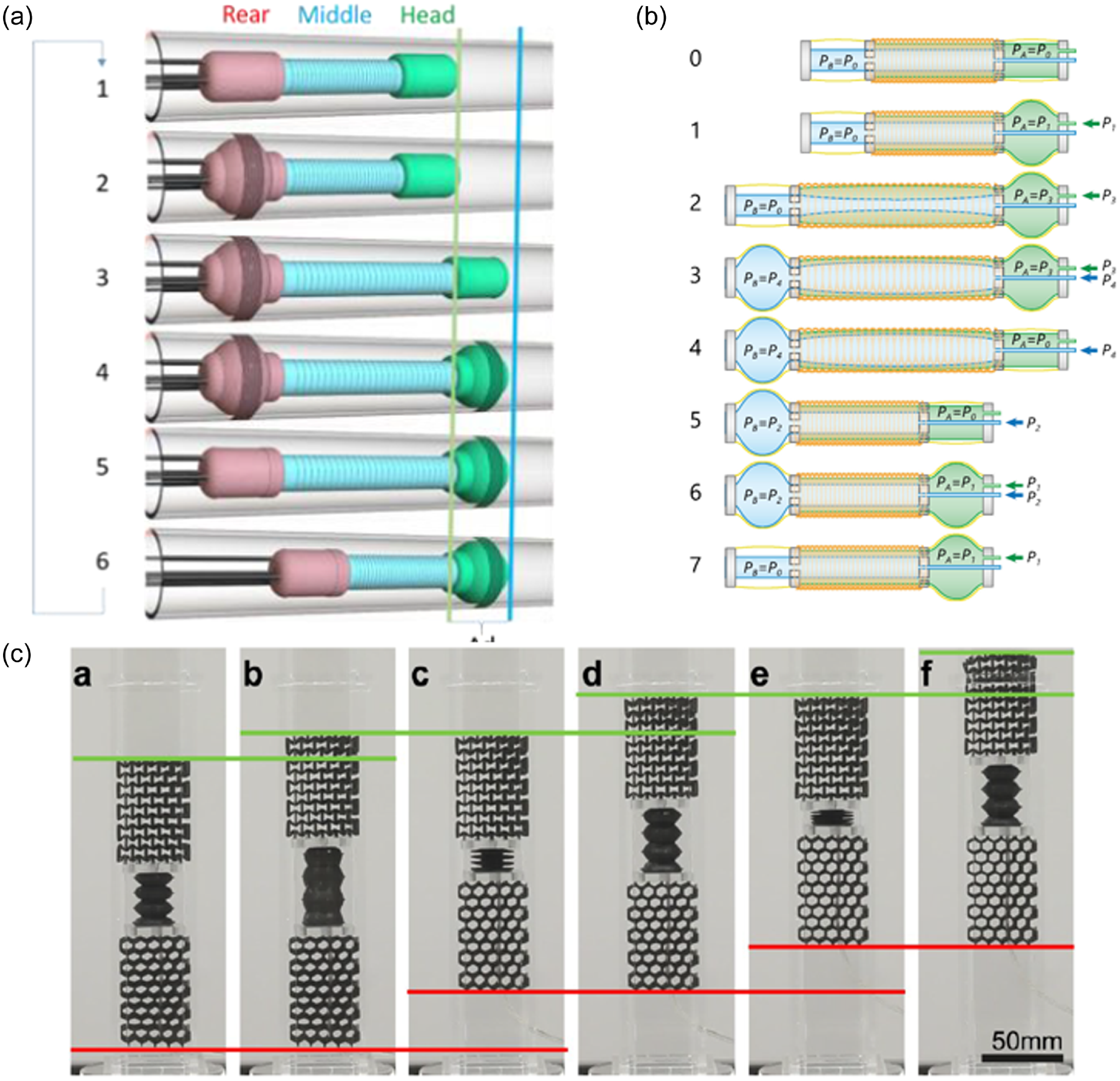
Traditional rigid in-pipe navigation robots have a wide range of structure designs depending on the size, actuator type, and locomotion strategy. Soft in-pipe navigation robots on the other hand tend to share some common structural designs, owing to the fact that many of these types of robots use the same locomotion strategy (i.e., inchworm and earthworm). The most common structure design found in the soft in-pipe navigation robot consists of a front and rear anchor structure connected by an extensible (or contractable) and bendable middle segment as shown in Fig. 1. This structure is inspired by an inchworm. The difference between an extensible segment and a contractable segment is that the extensible segment will extend or expand in a longitudinal direction when actuated while the contractable segment will contract when actuated.
Inchworm-inspired soft in-pipe navigation robot with front and rear active or passive anchors connected by extendable, retractable, or bendable middle segment by (a) Yamamoto et al. [Reference Yamamoto, Sakama and Kamimura31], (b) Verma et al. [Reference Verma, Ainla, Yang, Harburg and Whitesides26], (c) Zhang et al. [Reference Zhang, Wang, Wang, Meng and Liang30], (d) Joyee et al. [Reference Joyee, Szmelter, Eddington and Pan21], (e) Jiang et al. [Reference Jiang and Pei23], and (f) Adams et al. [Reference Adams, Sridar, Thalman, Copenhaver, Elsaad and Polygerinos43].

The biomimetic soft robot by Joyee et al. consists of a front and rear anchor pad embedded with magnetic nanoparticles as shown in Fig. 1(d) [Reference Joyee, Szmelter, Eddington and Pan21]. The two anchor pads are connected by a bendable middle segment. The biomimetic soft robot by Zhang et al. and the soft robot Inspired by burrowing worms designed by Calderón et al. consist of an inflatable front and rear anchor connected by an expandable middle air chamber segment [Reference Zhang, Pan, Heung, Chiu and Li22, Reference Calderón, Ugalde, Zagal and Pérez-Arancibia32, Reference Calderón, Ugalde, Chang, Zagal and Pérez-Arancibia33]. The same type of structure was also found in refs. [Reference Jiang and Pei23, Reference Ge, Calderón, Chang and Pérez-Arancibia29, Reference Yamamoto, Sakama and Kamimura31, Reference Liu, Xu, Ong, Zhu and Lu35, Reference Adams, Sridar, Thalman, Copenhaver, Elsaad and Polygerinos43–Reference Hu and Cheneler45]. Figure 1(a), (e), and (f) shows the soft in-pipe navigation robots that use this kind of structure. A slightly different design is found in [Reference Zhang, Wang, Wang, Meng and Liang30], where a passive front and rear anchor was used instead of inflatable anchors as shown in Fig. 1(c). Yet another slightly different design is found in ref. [Reference Miyasaka, Kawano and Tsukagoshi41], where the anchors form a helical shape instead of a simple radial inflation. A similar approach was also proposed by Gilbertson et al. for their serially actuated soft robot [Reference Gilbertson, McDonald, Korinek, Van de Ven and Kowalewski46]. A soft tube-climbing robot by Verma et al. consists of an inflatable front and rear anchor connected by a contractable middle segment as shown in Fig. 1(b) [Reference Verma, Ainla, Yang, Harburg and Whitesides26]. Another author also developed an in-pipe navigation robot consisting of front and rear anchors connected by a contractible middle segment [Reference Yeh, Chen and Juang36]. However, the anchors and the middle segment were constructed from a series of elastic ribbons.
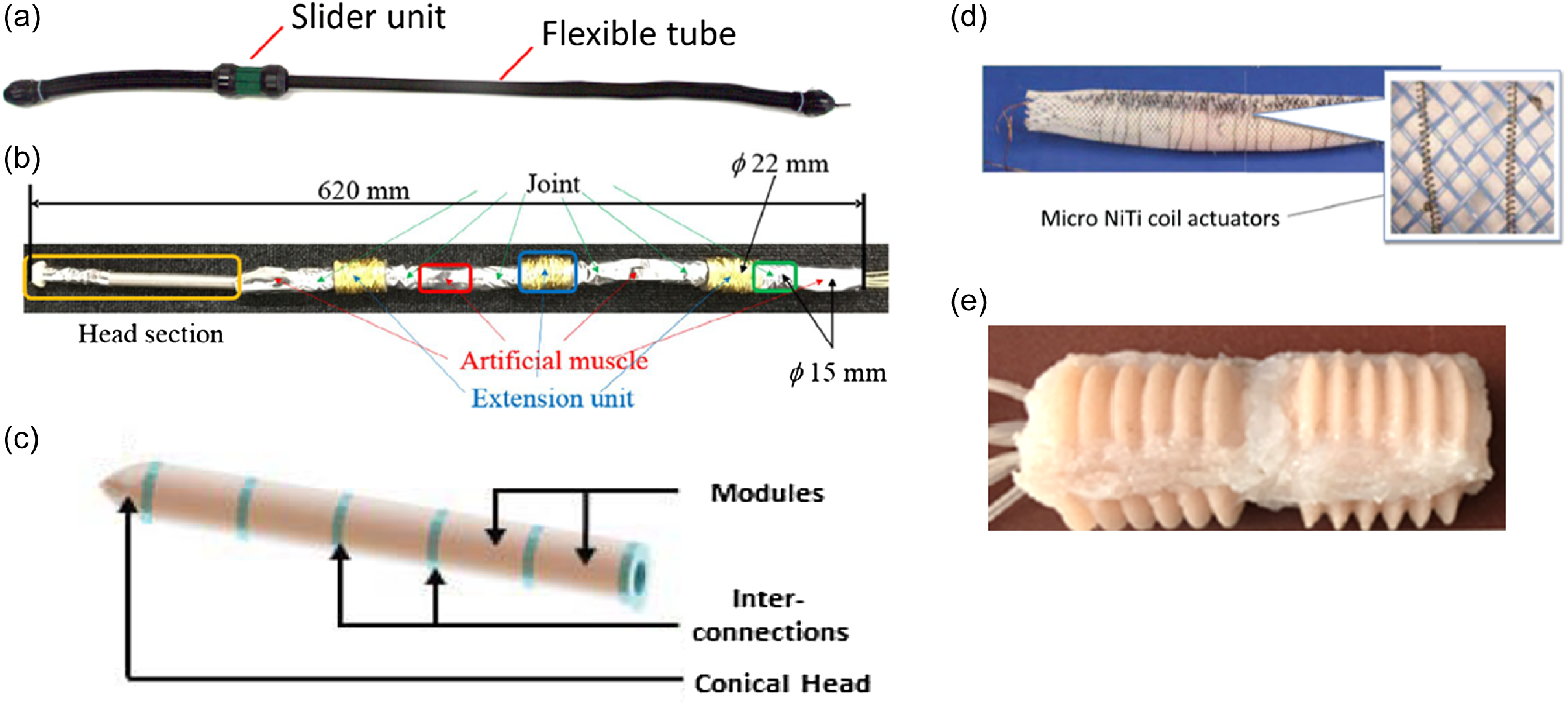
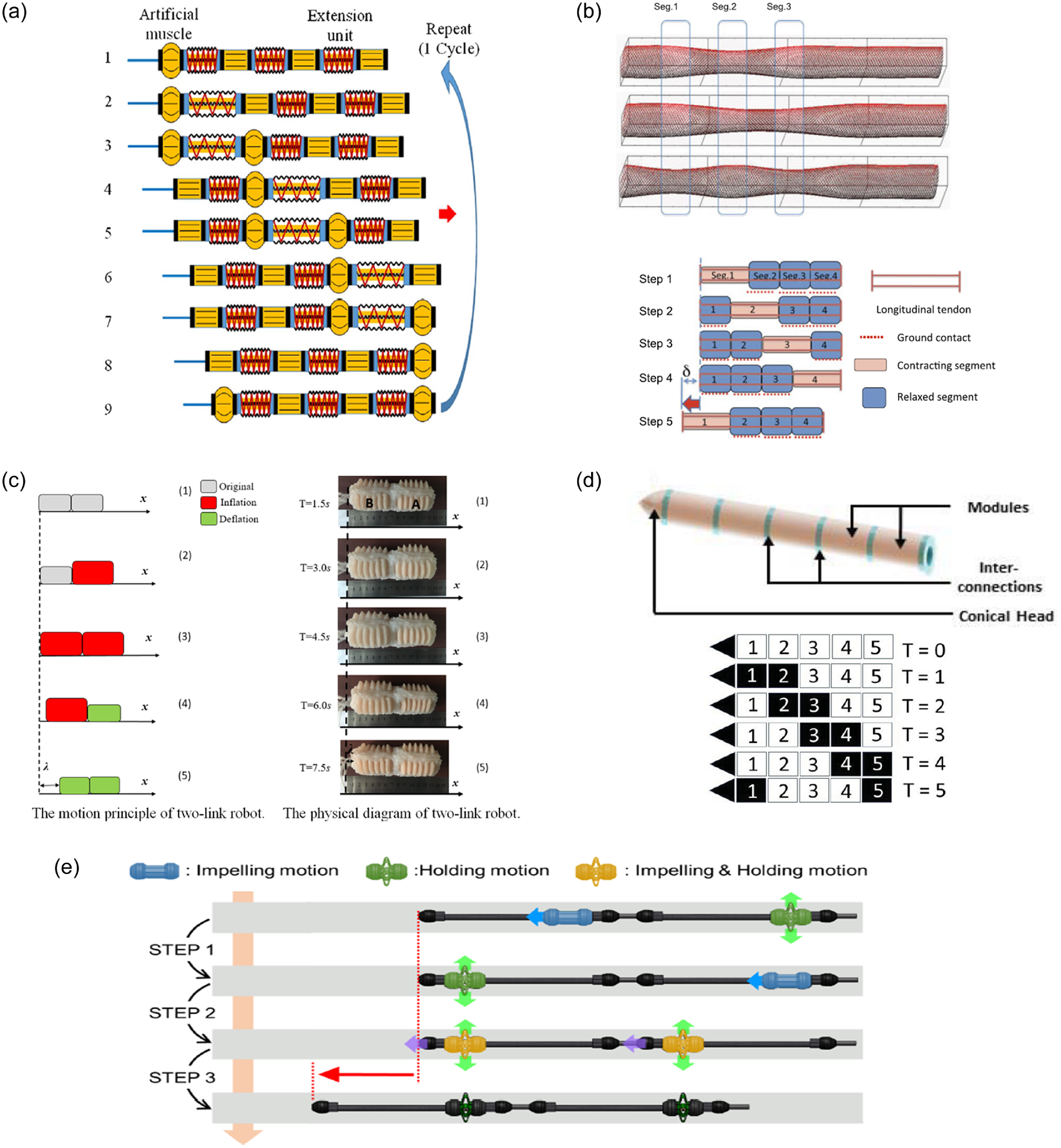
Some robots’ structure is inspired by an earthworm to produce a travelling peristaltic wave. Yamamoto et al. developed a high-speed in-pipe robot, which consists of a long flexible body and anchor structures that slide along the body as shown in Fig. 2(a) [Reference Yamamoto, Konyo and Tadokoro24]. Some other earthworm-inspired robot structures are constructed from multiple similar segments connected in series. This approach is found in ref. [Reference Kamata, Yamazaki, Tanise, Yamada and Nakamura40] where three inchworm-inspired segments are connected in series as shown in Fig. 2(b). Das et al. constructed a robot that consists of multiple segments consisting of an air chamber connected in series as shown in Fig. 2(c) [Reference Das, Babu, Palagi and Mazzolai47]. Tang et al. also constructed their robot from multiple segments, where each segment consists of multiple cavities that allow the segment to inflate and bend (Fig. 2(e) [Reference Tang, Lu, Wang, Ma, Chen and Feng48]. Seok et al. on the other hand developed an earthworm-inspired soft robot whose body also consists of a single continuous tubular segment [Reference Seok, Onal, Cho, Wood, Rus and Kim42]. SMA coils are wrapped around the body at multiple locations as shown in Fig. 2(d).
Earthworm-inspired soft in-pipe navigation robots built with traveling anchors by (a) Yamamoto et al. [Reference Yamamoto, Konyo and Tadokoro24], (b) Kamata et al. [Reference Kamata, Yamazaki, Tanise, Yamada and Nakamura40], (c) Das et al. [Reference Das, Babu, Palagi and Mazzolai47], (d) Seok et al. [Reference Seok, Onal, Cho, Wood, Rus and Kim42], and (e) Tang et al. [Reference Tang, Lu, Wang, Ma, Chen and Feng48].

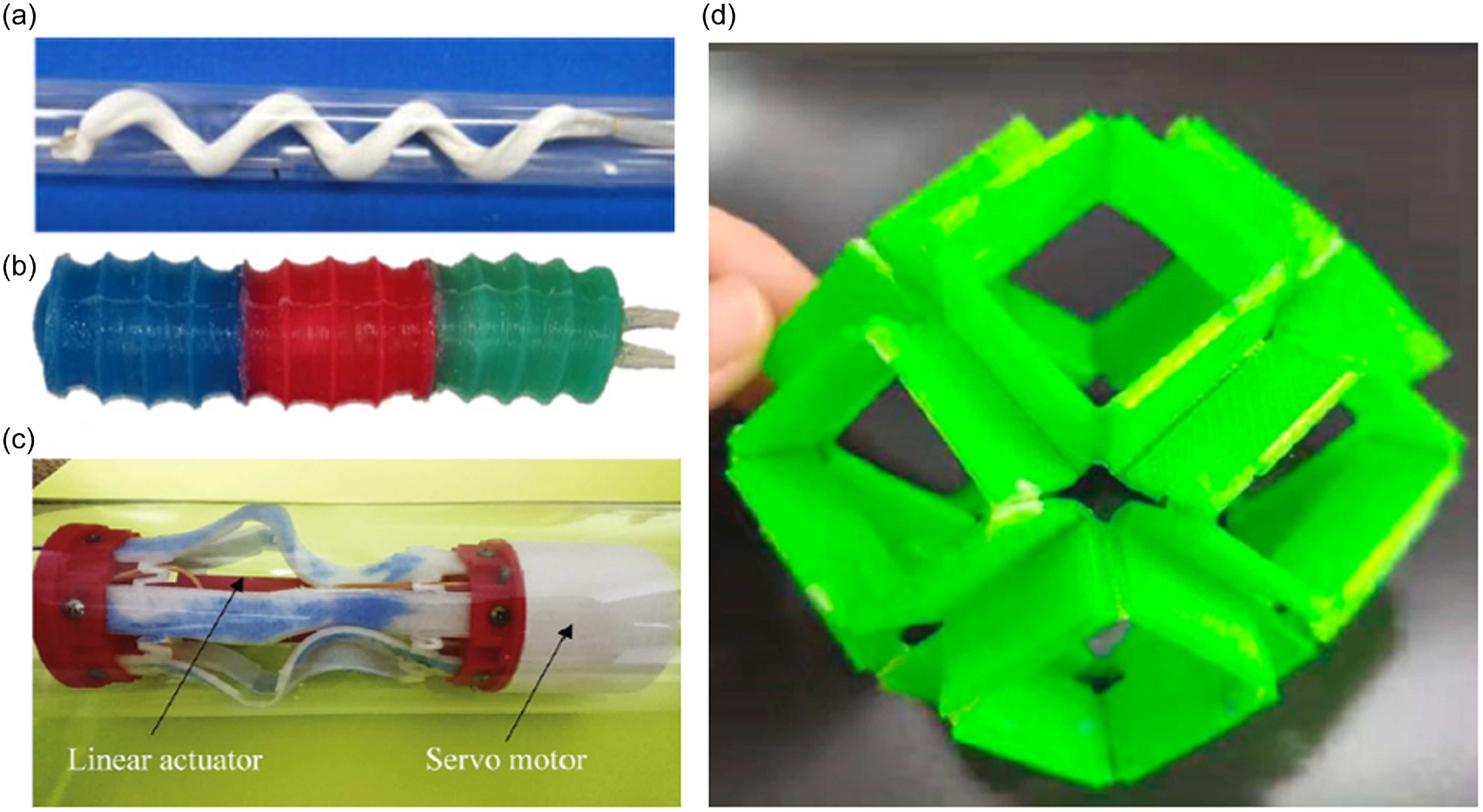
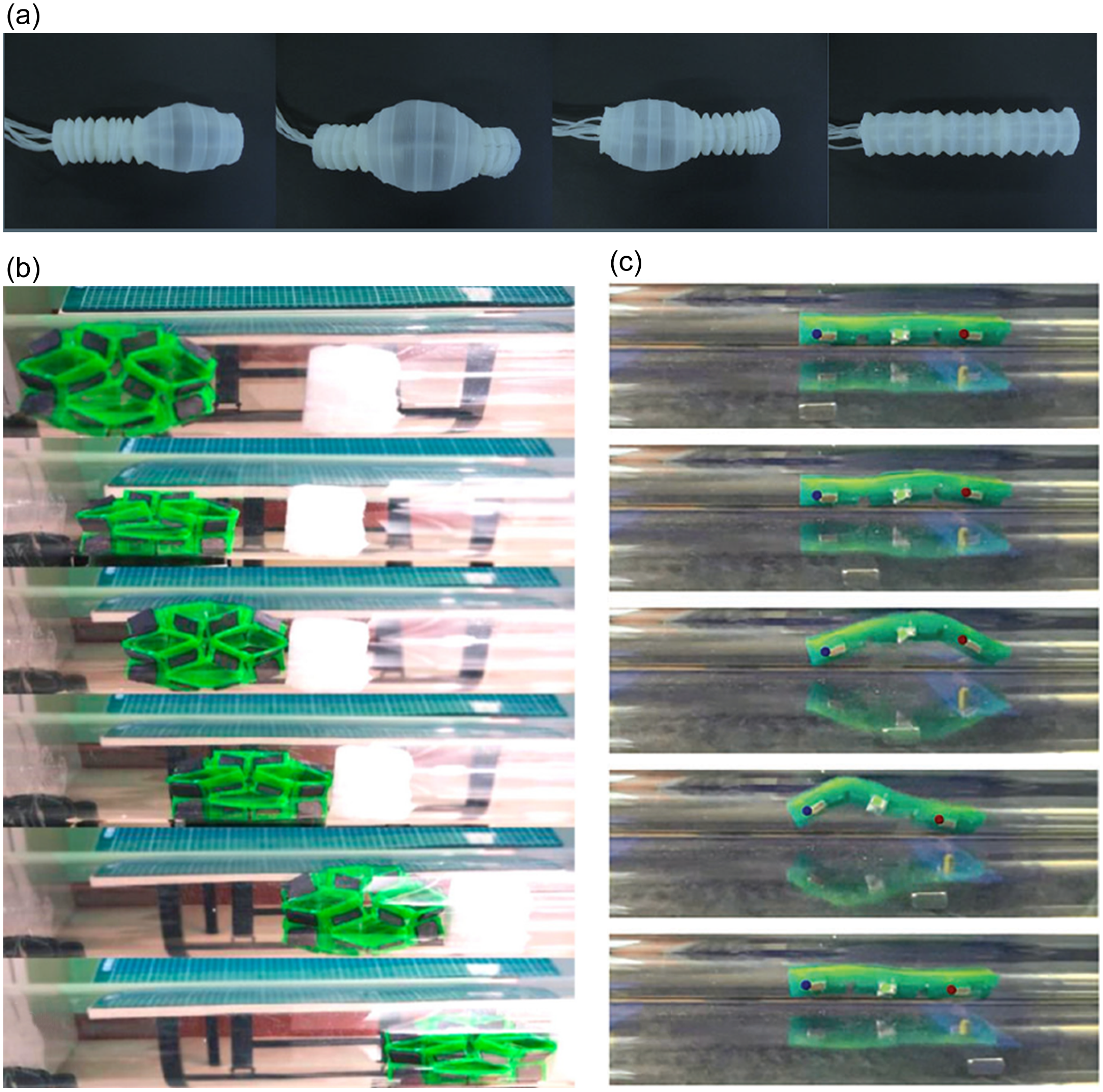
Takayama et al. adopted a different robot design, which consists of a single continuous body segment constructed from twisted bundled inflatable tubes (Fig. 3(a)) [Reference Takayama, Takeshima, Hori and Omata28, Reference Takeshima and Takayama49, Reference Takeshima and Takayama50]. Digumarti et al. developed a robot inspired by unicellular flagellates (euglenoid), which consists of three similar segments connected in series where each segment consists of a single air chamber as shown in Fig. 3(b) [Reference Digumarti, Conn and Rossiter27]. Another researcher proposed a single segment structure consisting of a series of flexible elastic ribbons as shown in Fig. 3(c) [Reference Yeh, Chou, Huang, Yu and Juang37]. Yet another unique structure was adopted by Hu et al. for their robot, which consists of a single ball-shaped origami structure (Fig. 3(d)) [Reference Hu and Li38]. A worm-like soft robot by Niu et al. consists of a single continuous flexible body segment [Reference Niu, Feng, Xie, Jiang, Sheng, Yu, Baoyin and Zeng34]. The body is embedded with permanent magnets at several locations to form the robot’s leg. Overall, the majority of the soft in-pipe navigation robots found in the literature adopted an almost similar structural design consisting of front and rear anchors connected by extensible, contractable, or bendable middle segments to mimic the structure of an inchworm. Even though there are variations in the design of the anchor and the middle segment, the purpose is the same, which is to produce the inchworm-like locomotion. Only a few researchers proposed non-conventional approaches in their robot design.
Soft in-pipe robot structures inspired by different organisms by (a) Takayama et al. [Reference Takayama, Takeshima, Hori and Omata28], (b) Digumarti et al. [Reference Digumarti, Conn and Rossiter27], (c) Yeh et al. [Reference Yeh, Chou, Huang, Yu and Juang37], and (d) Hu and Li [Reference Hu and Li38].

4. Locomotion strategy
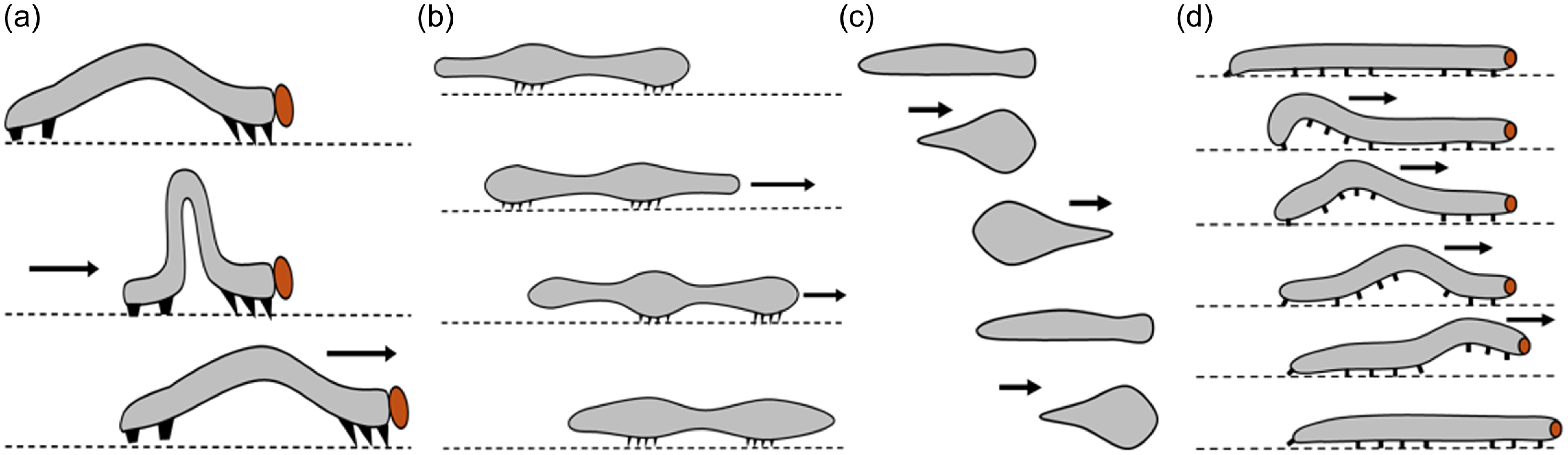
Locomotion strategy is the most important part of the soft in-pipe navigation robot. The fact that the robot is made of soft materials precludes the use of the conventional locomotion method such as the wheel. Nature provides many examples of how locomotion can be achieved without using wheel mechanisms. Several modes of locomotion found in nature includes flying, walking, crawling, hopping, and swimming. For large land animals, walking is the primary mode of locomotion, which is achieved using legs consisting of muscles and bones. Smaller land animals on the other hand use a variety of locomotion modes, which include walking, crawling, and hopping. Walking and hopping modes of locomotion are commonly used by animals that have rigid endoskeletons (skeletons inside the body) or exoskeletons (skeletons outside the body). On the other hand, the animals that do not have rigid skeletons use the crawling mode of locomotion to move. Crawling is a mode of locomotion in which the abdomen or the body of an animal is in contact with the surface on which the animal is moving. From the literature, most of the soft in-pipe navigation robots are inspired by inchworm or earthworm locomotion strategy. Even though both the inchworm and earthworm locomotion are of the crawling type, their actuation strategy is different. Figure 4 illustrates the locomotion of some of the soft invertebrates.
Locomotion of (a) inchworm, (b) earthworm, (c) euglenoid, and (d) caterpillar.

An inchworm-inspired soft in-pipe locomotion strategy by (a) Zhang et al. [Reference Zhang, Pan, Heung, Chiu and Li22], (b) Yamamoto et al. [Reference Yamamoto, Sakama and Kamimura31], and c) Mark et al. [Reference Mark, Palagi, Qiu and Fischer39].

4.1. Inchworm-inspired locomotion
An inchworm has a fixed front and rear anchor connected by a bendable middle segment. The locomotion sequence starts with releasing the rear anchor, bending the middle segment to pull the rear anchor forward, securing the rear anchor, releasing the front anchor, straightening (extending) the middle segment to push the front anchor forward, and securing the front anchor as shown in Fig. 4(a). This sequence is repeated during the locomotion. Reversing this sequence produces a backward motion. This locomotion strategy was used by Joyee et al. for their 3D-printed biomimetic soft robot shown in Fig. 1(d) [Reference Joyee, Szmelter, Eddington and Pan21]. Although an inchworm uses the bending of the abdomen to pull or push the anchor forward, many soft in-pipe navigation robots use the longitudinal elongation or contraction to push or pull the front and rear anchor forward to achieve the same locomotion. Robots that use this actuation strategy for locomotion are also categorized under inchworm-inspired in-pipe robots. Zhang et al. adopted this locomotion strategy as shown in Fig. 5(a), where the tail is anchored while the middle segment is extended longitudinally to push the head forward. Next, the head is anchored, and the tail is released, while the middle segment is contracted, pulling the tail forward [Reference Zhang, Pan, Heung, Chiu and Li22]. Similar locomotion is found in refs. [Reference Jiang and Pei23, Reference Ge, Calderón, Chang and Pérez-Arancibia29, Reference Yeh, Chen and Juang36, Reference Adams, Sridar, Thalman, Copenhaver, Elsaad and Polygerinos43, Reference Zhang, Fan, Yang, Cao and Liao44, Reference Gilbertson, McDonald, Korinek, Van de Ven and Kowalewski46]. Some inchworm-inspired soft in-pipe robots use slightly different variations of locomotion sequence whereby the anchoring is done concurrently with the extension or contraction of the middle segment. Extension of the middle segment causes the rear anchor to expand radially and the front anchor to contract, thus pushing the robot forward. On the other hand, contraction of the middle segment causes the rear anchor to contract and the front anchor to expand radially. This has the benefit of reducing the number of pressurized air tubes connected to the robot from three to two. This strategy was used in refs. [Reference Yamamoto, Sakama and Kamimura31, Reference Mark, Palagi, Qiu and Fischer39] as shown in Fig. 5(b) and (c).
4.2. Earthworm-inspired locomotion
While many soft in-pipe navigation robots are inspired by an inchworm, some of them are inspired by an earthworm locomotion. Unlike the inchworm, which has a fixed front and rear anchor, an earthworm has anchors that travel along its body as shown in Fig. 4(b). An earthworm forms an anchor by expanding some parts of its body in radial direction, and this expansion travels along the body like a peristaltic wave [Reference Quillin51]. These expanded parts of the body are in contact with the ground, forming the anchor. In addition to that, there are small structures called setae, which are small retractable needles that help the anchor to stick to the ground [Reference Edwards and Arancon52]. The wave of the expanded anchors travels from the front to back relative to the worm’s body but is stationary relative to the ground. This produces the forward motion for the earthworm.
Yamamoto et al. utilized an earthworm-inspired locomotion principle in their in-pipe robot shown in Fig. 6(e) [Reference Yamamoto, Konyo and Tadokoro24]. The robot consists of two anchors that can slide along a flexible tube. First, the front anchor slides to the front, while the back anchor holds the robot stationary. Next, the back anchor slides forward, while the front anchor holds the robot stationary. Finally, the flexible tube slides forward, while both anchors are in a holding position. Seok et al. tried to replicate the earthworm traveling wave in their peristaltic soft robot by sequentially contracting multiple sections of the robot’s body as shown in Fig. 6(b) [Reference Seok, Onal, Cho, Wood, Rus and Kim42]. Kamata et al. built a soft in-pipe robot that can mimic both an inchworm and an earthworm’s locomotion (Fig. 6(a)). This robot has four anchors connected by three extendable middle segments [Reference Kamata, Yamazaki, Tanise, Yamada and Nakamura40]. By sequentially extending the middle segment and inflating the anchor, the robot mimics the traveling wave of an earthworm. On the other hand, by extending all the three segments simultaneously and only utilizing the front-most and rear-most anchor, the robot mimics the locomotion of an inchworm. Other robots that utilize the earthworm-inspired locomotion are shown in Fig. 6(c) and (d).
Earthworm-inspired locomotion strategy in soft in-pipe navigation robot by (a) Kamata et al. [Reference Kamata, Yamazaki, Tanise, Yamada and Nakamura40], (b) Seok et al. [Reference Seok, Onal, Cho, Wood, Rus and Kim42], (c) Tang et al. [Reference Tang, Lu, Wang, Ma, Chen and Feng48], (d) Das et al. [Reference Das, Babu, Palagi and Mazzolai47], and (e) Yamamoto et al. [Reference Yamamoto, Konyo and Tadokoro24].

4.3. Other biologically inspired locomotion
Despite inchworm- and earthworm-inspired locomotion being the most popular locomotion strategies for soft in-pipe navigation robots, some researchers are inspired by different animals such as euglenoid and caterpillars. As opposed to an earthworm, which has multiple anchors traveling along the earthworm’s body, an euglenoid has only one anchor that travels along its body from the front to the back to propel the body forward as shown in Fig. 4(c). Digumarti et al. adopted a locomotion strategy inspired by the euglenoid’s movement illustrated in Fig. 7(a) [Reference Digumarti, Conn and Rossiter27]. This robot consists of three inflatable segments that are inflated in sequence starting from the front segment followed by the middle segment and ending with the rear segment to mimic the traveling wave. Niu et al. built a soft in-pipe navigation robot inspired by a multi-legged worm like a caterpillar as shown in Fig. 7(c) [Reference Niu, Feng, Xie, Jiang, Sheng, Yu, Baoyin and Zeng34]. Unlike an earthworm, which generates a longitudinal traveling wave along the body, a caterpillar creates a single transverse traveling wave by bending a part of its body upward that travels from the rear to the front as illustrated in Fig. 4(d). By bending a section of its body upward, it shortens the body in a longitudinal direction, therefore pulling the body forward.
Soft in-pipe navigation robot inspired by different creatures by (a) Digumarti et al. [Reference Digumarti, Conn and Rossiter27], (b) Hu and Li [Reference Hu and Li38], and (c) Niu et al. [Reference Niu, Feng, Xie, Jiang, Sheng, Yu, Baoyin and Zeng34].

4.4. Non-biologically inspired locomotion
Some researchers did not take nature as inspiration for their robot’s locomotion. Takayama et al. built an in-pipe navigation robot that deforms into a helical shape when actuated [Reference Takayama, Takeshima, Hori and Omata28]. The helical-shaped body also rolls with respect to the axis of the body, therefore producing a net forward motion. Another researcher, Hu et al., built an in-pipe robot using an origami flexiball-inspired metamaterial actuator (Fig. 7(b)) [Reference Hu and Li38]. The robot’s motion is caused by the velocity difference and variation in static friction between the elongation and flattening of the structure during the reciprocating stroke. The actuator will move forward when the static frictional force blocks the elongation from front to back.
5. Actuation techniques
Soft robots employ different actuation mechanisms as compared to traditional rigid robots due to the fact that the soft robot actuators are made of soft materials. Different parts of the same robot also may employ different actuation mechanisms depending on the locomotion strategy. For soft in-pipe navigation robots that use inchworm-inspired locomotion, the anchor actuation mechanism can be different from that of the middle segment. Middle segments that are designed to produce bending motion use actuation mechanisms that are different from the middle segments designed to produce longitudinal extension. In general, the actuation techniques for soft in-pipe navigation robots can be broadly categorized into several categories.
5.1. Soft fluidic actuator
A soft fluidic actuator is a type of soft actuator that is driven by fluid in the form of either liquid or gas. Actuators driven by air or gas are called pneumatic actuators, whereas those driven by liquid are called hydraulic actuators. Pneumatic soft actuators are the most common type of actuator in soft robots. This type of actuator consists of soft air chambers that are actuated using either pressurized air or vacuum. The shape and the direction of inflation are determined by the shape of the chamber, the wall structure, and the integration of strain-limiting layers on the wall.
5.1.1. Pneumatic soft actuators with unconstrained chambers
The most popular method of pneumatic soft actuation in soft in-pipe robots is by using air chambers made of highly stretchable material without any strain-limiting layer or fibers wrapped around the wall [Reference Zhang, Pan, Heung, Chiu and Li22, Reference Yamamoto, Sakama and Kamimura31–Reference Calderón, Ugalde, Chang, Zagal and Pérez-Arancibia33, Reference Zhang, Fan, Yang, Cao and Liao44, Reference Hu and Cheneler45]. This allows the chamber to inflate in any direction including in radial direction. This actuation is commonly used in the anchor structure of the inchworm-inspired robot. Expansion in radial direction of the pipe causes the wall of the chamber to press against the pipe wall, increasing the friction between the surface of the chamber and the pipe wall. This soft air chamber can also be made into several long tubes that are twisted or braided together into one bundle. Inflating a certain combination of tubes at a time causes the bundle to curl into a helical shape [Reference Takayama, Takeshima, Hori and Omata28, Reference Takeshima and Takayama49, Reference Takeshima and Takayama50]. Another type of actuator consists of a cuboid-shape structure made of soft stretchable material [Reference Verma, Ainla, Yang, Harburg and Whitesides26]. Inside this structure, there is an array of cuboid-shaped chambers or voids that are connected to a vacuum line. The chambers are arranged in such a way that when vacuum or negative pressure is applied, the chambers will collapse in a longitudinal direction, causing the whole actuator to contract in this direction. Once the vacuum is removed, the actuator returns to its original length due to the elastic nature of the material.
5.1.2. Pneumatic soft actuators with strain-limiting chamber wall
Certain pneumatic soft actuators for soft in-pipe robots are designed to inflate or deform in a particular direction while preventing deformation in other directions. For example, the most common design to produce longitudinal extension consists of a soft cylindrical chamber where the wall is wrapped with strain-limiting fiber. This type of chamber is made of a highly stretchable elastomer with low hardness. When pressurized air is supplied into the chamber, the fiber on the chamber wall prevents the chamber from expanding in radial direction while allowing the chamber to expand in the longitudinal direction. This type of actuator is commonly used for the middle segment of the inchworm-inspired robot as found in refs. [Reference Zhang, Pan, Heung, Chiu and Li22, Reference Ge, Calderón, Chang and Pérez-Arancibia29, Reference Yamamoto, Sakama and Kamimura31–Reference Calderón, Ugalde, Chang, Zagal and Pérez-Arancibia33]. Some robots utilize three of such mechanisms in parallel to allow for the middle segment to bend when traversing pipe corners [Reference Zhang, Wang, Wang, Meng and Liang30, Reference Zhang, Fan, Yang, Cao and Liao44]. The bending radius and bending direction can be controlled by controlling the amount of extension of the individual cylinder. Another method uses a soft tube wrapped with strain-limiting fibers around the tube wall at certain different angles such that when the tube is inflated, it curls into a spiral shape. This method is used as an anchor structure in refs. [Reference Miyasaka, Kawano and Tsukagoshi41, Reference Gilbertson, McDonald, Korinek, Van de Ven and Kowalewski46]. The higher the pressure, the larger the radius of the spiral. When the radius of the spiral wants to grow larger than the diameter of the pipe, it presses against the wall of the pipe, creating a large friction between the tube and the pipe wall.
5.1.3. Pneumatic soft actuators with structured chamber wall
Another common pneumatic soft actuation mechanism in soft in-pipe robots is by using a bellow type air cylinder. The bellow type of cylinder is a cylinder with a corrugated wall or a wall with an accordion fold pattern. This pattern allows the cylinder to expand in a longitudinal direction while preventing the radial expansion without requiring any strain-limiting fiber wrapped around or embedded inside the wall. Unlike the former cylinder design, this bellow cylinder is made of non-stretchable materials or materials with low stretchability. This design of actuation is used in refs. [Reference Digumarti, Conn and Rossiter27, Reference Liu, Xu, Ong, Zhu and Lu35, Reference Mark, Palagi, Qiu and Fischer39, Reference Adams, Sridar, Thalman, Copenhaver, Elsaad and Polygerinos43, Reference Tang, Lu, Wang, Ma, Chen and Feng48]. Besides the bellow cylinder, some robots use an origami type of cylinder that serves the same purpose, which is to allow for a longitudinal expansion while preventing the radial expansion when inflated by pressurized air [Reference Jiang and Pei23]. An origami cylinder has a special folding pattern around the wall of the cylinder that guides the folding direction of the wall, hence determining the direction of expansion or contraction of the cylindrical chamber. Just like the bellow cylinder, the origami cylinder is constructed from non-stretchable materials or materials with low stretchability. Both the bellow and origami cylinder can be actuated by either pressurized air or vacuum. Actuation by pressurized air causes the cylinder to extend in a longitudinal direction and return to its original length when the cylinder is depressurized. Actuation by vacuum on the other hand causes the cylinder to contract in a longitudinal direction when actuated and return to its original length when the vacuum is removed.
5.2. Tendon-driven soft actuator
Certain actuators can achieve longitudinal or radial expansion and contraction without using pressurized air or vacuum. One such actuator consists of an array of elastic ribbons arranged around the longitudinal axis of the robot and oriented parallel to the axis [Reference Yeh, Chen and Juang36, Reference Yeh, Chou, Huang, Yu and Juang37]. This arrangement acts as a compressive spring mechanism. A cable (tendon) running in the middle of the actuator controls the contraction and relaxation of the actuator. Pulling the cable causes the two ends of the elastic ribbon array to be pulled closer to each other, causing the ribbons to bend, therefore contracting the actuator along the longitudinal direction and expanding the actuator in radial direction. Releasing the cable restores the length of the actuator due to the elastic nature of the ribbon. The pulling and releasing of the cable are realized using an electric motor. This type of actuator is used in both the anchor and the middle segment of the inchworm-inspired robot.
5.3. Shape memory alloy actuator
Another technique of actuation uses an SMA to actuate the in-pipe navigation robot. In the earthworm-inspired in-pipe robot [Reference Seok, Onal, Cho, Wood, Rus and Kim42], the actuator consists of a flexible mesh tube wrapped by a nickel titanium (NiTi) SMA around the outer wall. The SMA was made into small, coiled wire and wrapped around the flexible tube. Heating the SMA wire causes it to shorten, thereby constricting the tube and creating a traveling wave along the tube. The heating of the SMA is achieved using a method called Joule heating, where an electric current is passed through the wire, causing it to heat up. Once the SMA cools down, the original length of the wire is restored by the elasticity of the tube wall.
5.4. Magnetic field-driven soft actuator
In addition to the formerly discussed method of anchor mechanism that are actuated from inside the robot, there are robots that are designed to be actuated from external magnetic fields [Reference Joyee, Szmelter, Eddington and Pan21, Reference Niu, Feng, Xie, Jiang, Sheng, Yu, Baoyin and Zeng34, Reference Hu and Li38]. These robots have magnets embedded inside the anchors or several locations inside the robot’s body. The movements of the anchors are therefore driven by the movement of the magnetic field. In ref. [Reference Joyee, Szmelter, Eddington and Pan21], the robot consists of an elastic middle segment where magnets are embedded inside or on the surface of both ends of the segment. The segment is actuated using an external magnetic field that controls the movement of both ends of the segment. By moving both ends of the segment closer to each other, the segment bends. Conversely, by moving both ends away from each other, the segment straightens. Similarly, in ref. [Reference Niu, Feng, Xie, Jiang, Sheng, Yu, Baoyin and Zeng34], the caterpillar-inspired in-pipe robot uses an external magnet to move the magnet-embedded robot legs inside a pipe. In ref. [Reference Hu and Li38], the external magnetic field is used to control the deformation of the robot body made of magnetoactive polymer.
5.5. Passive actuator
All the aforementioned actuators are classified as active types of actuators whereby the actuation is achieved by their own dedicated power source provided by pressurized air, vacuum, magnetic field, tendon, or SMA. There is another class of actuator called a passive actuator where there is no dedicated power source. This class of actuator passively reacts to the deformation of other segments of the robot or the movement of the robot’s body. One example of such an actuator uses two types of metamaterials that have unique internal structures [Reference Liu, Xu, Ong, Zhu and Lu35, Reference Mark, Palagi, Qiu and Fischer39]. One metamaterial was designed to have a positive Poisson’s ratio, while the other one was designed to have a negative Poisson’s ratio, which is also known as an auxetic metamaterial. A material with a positive Poisson’s ratio expands in radial direction when it is compressed in the longitudinal direction. On the other hand, a material with a negative Poisson’s ratio contracts in radial direction upon being subjected to a compressive force in the longitudinal direction. This complementary mechanical property can be used to construct the front and rear anchors. In ref. [Reference Mark, Palagi, Qiu and Fischer39], the front anchor is constructed from the metamaterial with a negative Poisson’s ratio (auxetic metamaterial), whereas the rear anchor uses the metamaterial with a positive Poisson’s ratio. The compressive force is provided by the extension of the middle segment of the robot. When the middle segment is extended, it pushes against the front anchor, causing it to contract radially and therefore reducing the friction between the anchor and the wall. The extension of middle segment also exerts a compressive force on the rear anchor, causing it to expand radially to anchor the robot to the pipe wall. This actuation propels the robot forward. This type of anchor is also known as passive anchor because it does not need a separate actuator as it relies on the actuation of the middle segment.
Another type of passive anchor uses a disk-shaped structure, whose diameter is slightly larger than the inner pipe diameter [Reference Zhang, Wang, Wang, Meng and Liang30]. This structure has a smooth surface on one side and a rough surface on the other side. Since the diameter of the disk is larger than the pipe diameter, the disk bends either forward or backward inside the pipe, causing either the rough or the smooth surface to come in contact with the pipe wall. The rough surface provides more friction between the anchor and the wall compared to the smooth surface. The front anchor and back anchor are designed to have a smooth surface facing the front of the robot and a rough surface facing the back of the robot. When the middle segment of the robot is extended, it pushes the front anchor forward, causing the anchor to bend backward. This bending causes the smooth surface of the anchor to be in contact with the pipe wall, allowing the anchor to slide. The back anchor, on the other hand, is pushed backward. This results in the anchor bending forward, which causes the rough surface to be in contact with the pipe wall to achieve anchoring. When the middle segment is contracted, the reverse happens. The front anchor bends forward, and the rear anchor bends backward. This sequence of actuations propels the robot forward inside the pipe. Table II summarizes different types of soft in-pipe navigation robots.
6. Discussion
6.1. Material
In terms of the material, platinum-catalyzed silicone rubber is the most popular choice of soft material for the robot’s actuator owing to its low Shore hardness ranging from 10 on the 00 scale up to 10 on the A scale. These materials also have a high elongation at break ranging from 300% up to 1000%. These properties allow for a lower air pressure to be used on the actuators to produce large longitudinal or radial expansion. Lower air pressure operation leads to lower overall cost of the robot because smaller air pumps can be used. The high elongation at break gives the materials higher durability in the sense that they can tolerate a higher degree of deformation without sustaining damage. This class of material is preferred for actuators consisting of soft air chambers with a strain-limiting layer to control the direction of the chamber deformation. However, there is a drawback of using low air pressure for actuation. Low air pressure produces low actuation force, which subsequently affects the strength of the robot’s locomotion. This limitation is undesirable in applications that require the robot to carry some loads onboard or to pull or push some loads. For example, if a soft in-pipe robot is intended to perform a cleaning task by removing and pushing blockages inside the pipeline, then having a weak locomotion will cause the robot to be stuck.
Summary of different type of soft in-pipe navigation robot.

Harder elastomers on the other hand are preferred for actuators that depend more on the flexibility of the material and less on the stretchability such as the origami-based actuators, bellow actuators, the actuators that utilize an array of elastic ribbons, flexible and bendable middle segment, or metamaterial actuators. Chambers made of these materials can withstand a higher air pressure and therefore can produce higher actuation force. The Shore hardness ranges from 30 to 90 on the A scale with the elongation at break as low as 55%. However, lower elongation at breaks makes them less durable. In view of this, more research is required to produce elastomers of this class with higher durability. In fact, there has been research carried out to develop a soft actuator material that can self-heal or self-repair as reported in ref. [Reference Liu, Wang, Yuan and Fei53]. This self-healing characteristic is especially important for in-pipe robots because conditions inside pipelines can be rough due to hard mineral deposits, which can be damaging to soft materials.
As for the strain-limiting materials, fiber wires are the popular material to be embedded inside the wall of the soft inflatable air chamber. The fiber wire is preferred for embedded material because it allows the elastomer matrix to get in between and fully enclose the fibers. The fiber used for this purpose must be strong and durable enough to resist the inflation of the chamber in radial direction without breaking. Kevlar fiber wire and carbon fiber have this durability and are therefore a material of choice for this purpose. Woven fabric and aluminum foil are also used as strain-limiting layers for soft in-pipe navigation robot actuators. However, these materials are wrapped on the outer wall of the inflatable air chambers instead of being embedded directly into the chamber wall. This is due to the fact that the gap between the woven fibers of the fabric is too small for the elastomer matrix to get in between. So, the adhesion or bonding between the elastomer matrix and the fabric is very weak. In the case of aluminum foil, the adhesion is even worse because of the highly smooth and polished surface of the foil. Unlike fiber wire, the woven fabric and aluminum foil must have crease patterns or wrinkles to allow for the layer to be stretched in a certain direction.
All the previously discussed materials have fixed mechanical properties including the hardness and the elongation at break. Besides all those materials, there are certain materials that have been engineered to have tunable mechanical properties. Examples of this material are electrorheological material [Reference Dong, Niu and Qi54] and magnetorheological material [Reference Bastola, Paudel, Li and Li55]. The former is a type of material whose viscosity changes when subjected to an electric field, whereas the latter is a type of material that changes its viscosity when subjected to a magnetic field. Another type of composite material makes use of particle jamming or granular jamming technique to change its stiffness [Reference Hu, Liang and Zeng56]. The material structure consists of a soft chamber filled with particles. Under a normal condition where air is allowed to fill the chamber, the particles become loose, allowing the material structure to deform easily. However, when the air is sucked out of the particle-filled chamber, the particles are jam-packed, making the material structure harder. These materials with tunable mechanical properties are some of the great alternatives to the existing soft materials to devise soft actuators for soft in-pipe robots.
6.2. Structure and locomotion strategy
In terms of the structure and the locomotion strategy, many of the soft in-pipe navigation robots are inspired by an inchworm, where the robots have front and rear anchors connected by the extendable or bendable middle segment. Even though a biological inchworm moves by bending its body, any robot that crawls by pushing or pulling the front and rear anchors is classified under inchworm-inspired locomotion regardless of whether the pushing and pulling of the anchors are achieved by bending or by pure longitudinal extension or longitudinal contraction of the middle segment of the robot. This is the easiest method of bioinspired crawling type of locomotion as it allows for forward and reverse motion using three or even two independent actuators. A fewer number of actuators is highly preferred because only a few air supply lines need to be tethered to the robot, therefore reducing the size of the tether line. The speed of the locomotion depends on the step length and the speed of the actuation sequence. The step length depends on the length and the percent elongation of the middle segment when actuated. In addition to its simplicity, this type of robot can provide some degree of postural stability on a certain part of the robot on which inspection tools can be mounted. This is especially true for an in-pipe robot built for pipeline inspection. The stable surface ensures that the inspection tools remain at a certain pose (e.g., at the center of the pipe) during the locomotion. Besides, inchworm-inspired robots can produce a strong locomotion, which depends on the restoration force of the middle segment combined with the strong anchoring force of the front and the rear anchors on the pipe wall. This is important for an in-pipe robot that needs to push or pull a certain amount of load while navigating inside the pipeline. However, the inchworm-inspired locomotion has the drawback of producing a noncontinuous motion when the robot switches between the pushing and pulling actuations, which is undesirable for applications that require a smooth inspection operation.
Earthworm-inspired locomotion, on the other hand, is not as popular as the inchworm-inspired locomotion owing to its more complex structure and actuation method. Some researchers classified their inchworm-inspired robots as earthworm-inspired robots since the middle segment of the robots extends instead of bending like the body of an inchworm. An earthworm has anchors that travel along the worm’s body as opposed to the fixed front and rear anchors of an inchworm. The reason for its relatively low popularity is that producing smooth traveling anchors along the robot’s body using an array of discrete air chambers is challenging. To generate a smooth and continuous traveling wave requires a large number of discrete air chambers that need to be actuated individually, which increases the number of air supply lines and the complexity of the controller. Some researchers cascaded several inchworm-inspired segments to form a long in-pipe robot that can mimic the traveling anchors of the earthworm, which also increases the number of actuators. Earthworm-inspired locomotion also has the disadvantage of producing noncontinuous motion.
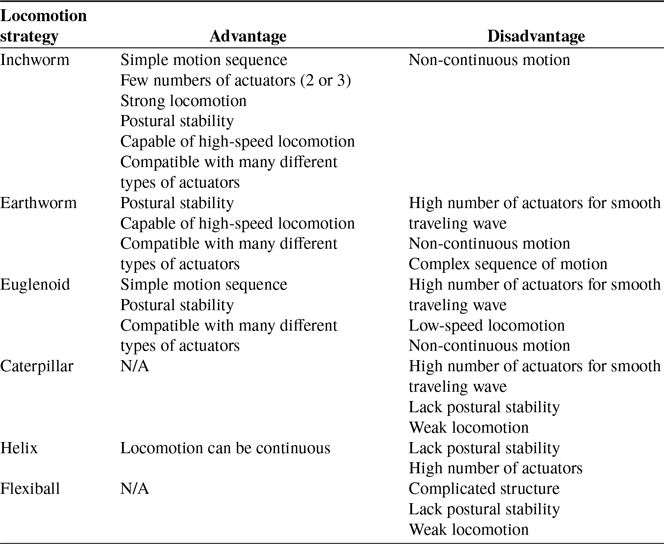
Some researchers also tried to mimic other types of biological creatures like euglenoid and caterpillars, while several other researchers did not take inspiration from any biological creatures at all. Euglenoid locomotion technique also relies on the traveling anchor along its body and therefore has the same drawback as that of the earthworm. However, unlike the earthworm-inspired robot, the euglenoid has only three chambers to produce the traveling wave. So, the distance that the robot can move in one wave cycle is shorter, making it slower as compared to inchworm-inspired or earthworm-inspired robots. The caterpillar-inspired in-pipe robot, on the other hand, has an array of legs, which function as anchors, on only one side of its body. In this case, the anchors do not cover the entire circumference of the pipe wall. In addition to that, the pressure that the legs exert on the wall depends on the strength of the external magnetic field. Without the external magnetic field, the robot will have very low traction on the wall, which results in very weak locomotion. So, the robot will not be able to carry, push, or pull any load. The lack of postural stability is another drawback of caterpillar-inspired locomotion techniques since the whole length of the robot’s body experiences transverse wave motion during the locomotion. The same is true for the helical locomotion technique, which generates forward motion by rolling the helical robot body on the pipe wall. This structure and locomotion strategy lacks postural stability in the sense that there is no stable surface on the robot to mount sensors and inspection instruments as the robot’s body rolls and curls continuously during locomotion. The same drawback is shared by the origami flexiball in-pipe robot, where the robot’s motion is generated from the restoration of flexiball from a compressed state by an external magnetic field. The cycle of this robot’s motion involves an alternate application and removal of the external magnetic field on the robot to compress and restore the flexiball. During the momentary removal of the magnetic field, the robot is not anchored to the pipe wall at all. This is problematic if the robot is to climb an inclined or vertical pipe, in which case, the robot will fall during this period of the motion cycle. In its current state, this method of locomotion only works in a horizontal pipe. For the method to work in vertical pipes, the robot must be anchored to the wall during the entire locomotion cycle. Table III summarizes the advantages and disadvantages of various locomotion strategies for soft in-pipe navigation robots.
Advantages and disadvantages of various locomotion strategies.

Apart from the formerly mentioned animals from which the in-pipe robot locomotion is inspired, there are several other animal species that naturally live and crawl above the ground but are capable of navigating inside tunnels and tubular structures. Examples of such creatures are lizards, spiders, and cockroaches. These are legged creatures. So far, no soft in-pipe navigation robot has been inspired by legged creatures understandably because most legged creatures have endoskeletons or exoskeletons that are rigid or noncompliant, which disqualifies them from being sources of inspiration for a soft robot. However, it is possible to devise a soft structure that resembles and functions as a leg for a soft in-pipe navigation robot to crawl inside a pipe. Another interesting creature that is capable of squeezing and crawling inside a pipe is an octopus, which utilizes suction cups on its tentacles to grip on a surface. But the idea of squeezing inside a pipe is not an attractive attribute for an in-pipe robot that needs to carry inspection sensors or instruments. For this type of robot, some postural stability on a certain part of the robot is required to mount the inspection tools. This postural stability remains a challenge for a completely soft robot in general.
Overall, a locomotion strategy that can be achieved using a simple structure and fewer number of actuators and has postural stability has been the strategy of choice for soft in-pipe robots. One important characteristic that is lacking in most of the locomotion strategies is the continuity in the robot’s motion. The future research should focus more on developing a locomotion strategy for soft in-pipe robots that can produce a smooth continuous motion in addition to having postural stability akin to the traditional wheeled in-pipe robots. This will allow for various instruments to be mounted on board that will greatly extend the functionality of the soft in-pipe robot beyond just simple navigation.
6.3. Actuation technique
Based on the literature, the majority of soft in-pipe navigation robots utilize one class of soft actuators known as soft fluidic actuators. This class of actuators is driven by fluid under pressure. The most popular type of fluid for in-pipe navigation robots is the air under positive pressure, and the soft actuators driven by the pressurized air are called pneumatic soft actuators. This is the simplest way of transferring power to the robot without involving any rigid structures on the robot side. The pressurized air can be transferred from an air pump to the robot using flexible air tubes. The most popular type of pneumatic soft actuators used for this type of robot consists of soft inflatable air chambers that inflate and deflate in certain directions to create movements. This type of actuator has the advantage of being simple and lightweight and can be made entirely of soft materials. Furthermore, the soft air chambers can be designed to produce a large and strong deformation (actuation force) at different actuator sizes. The strength of the actuation depends on the magnitude of the air pressure and the material hardness. The harder the material, the larger the air pressure used to inflate the chamber, and the larger the actuation force will be. Soft robots driven by pneumatic soft actuators can be made very small, which is limited only by the fabrication capability and the size of the air tubes. A pneumatic soft actuator is versatile in the sense that it can be designed to produce different types of motions, which include elongation, radial expansion, bending, and even twisting. The fact that it is driven by air makes it safe to be operated in many different environments including underwater and inflammable areas. However, the main difficulty with pneumatic soft actuators is leakage prevention. Unlike traditional rigid pneumatic actuators where the pneumatic cylinder is made of strong metals or other hard materials, a pneumatic soft actuator is made of weaker soft materials that puncture relatively easily upon contact with sharp objects. Furthermore, the air pressure must be properly regulated to be within the actuator’s pressure limit to avoid explosion or damage to the actuator.
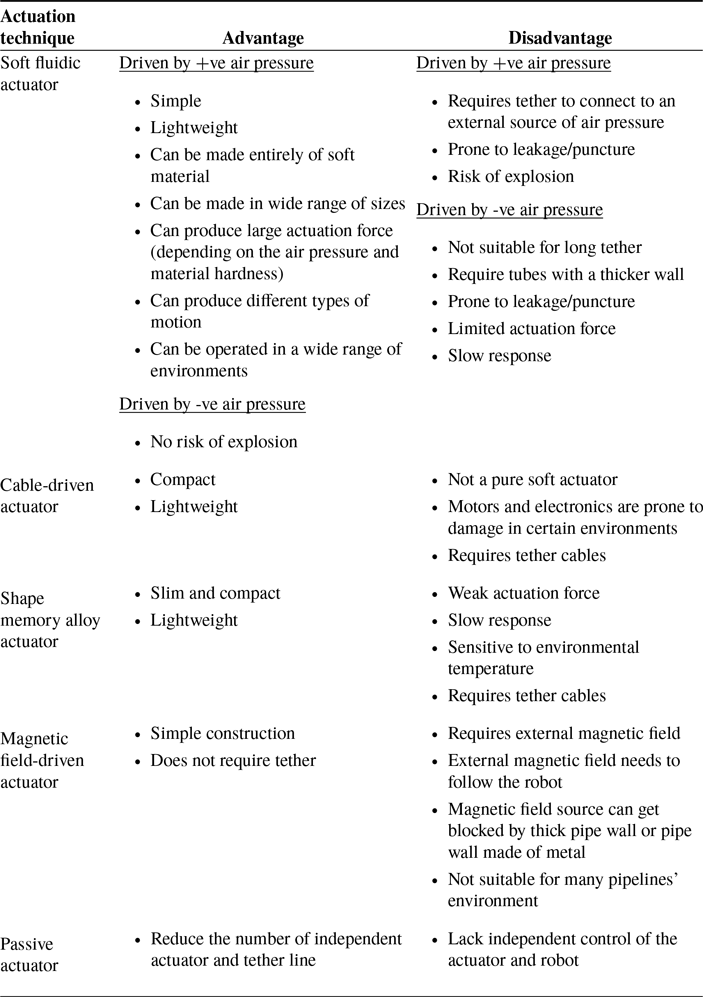
Advantages and disadvantages of the different actuation techniques used in soft in-pipe robots.

Another type of soft fluidic actuator uses negative air pressure or vacuum pressure instead of positive air pressure. This type of actuator also consists of air chambers that deflate when evacuated. This actuation method using the negative pressure has the advantage of being safer than the one that uses the positive pressure because of zero risk of explosion. This method of actuation is less popular than the one that uses positive pressure. One of the reasons is that controlling the actuator using negative pressure or vacuum over a long tube is challenging as the response will be slower. Furthermore, the tube wall needs to be harder or thicker to prevent the tube from collapsing from the negative pressure. Therefore, a robot’s tether line made from a bundle of multiple hard tubes is less flexible, which reduces the capability of the robot to navigate inside a long and complex pipeline.
Besides the pneumatic type of actuators, some soft in-pipe robots utilize a cable-driven actuator where the contraction of the actuator is controlled by pulling and releasing the cable. However, this type of actuator requires a combination of soft and rigid materials to mount and house the motor that drives the cable. So, the robot that uses this type of actuator is not a purely soft robot. In the case where electric motors are used to drive the cable, the motors and the accompanying electronics must be properly sealed against the environment inside pipelines to prevent damage. The actuation force depends on the torque of the motor. Another soft in-pipe robot uses an SMA as the actuator. The SMA needs to be used in combination with elastic materials to restore the actuator to its original shape. Unlike the soft fluidic type of actuators, the SMA actuator can be made very slim. However, SMA actuators have some drawbacks that prevent their widespread use in soft robots. SMA has a slow response time as it requires some time to heat up and cool down. Aside from that, it also has limited force output and is therefore suitable for only small and lightweight actuation. In addition to that, the performance is dependent on the temperature because the alloy is actuated by subjecting it to high temperature through Joule heating. Another less popular method of actuation is by using an external magnetic field. However, this method is unpractical in the sense that the driving magnetic field should be placed outside of the pipe wall but close enough to the robot in order to control the robot. This means that the source of the magnetic field needs to follow the robot closely from outside of the pipe, which is extremely challenging. Furthermore, the strength of the magnetic field that penetrates the pipe wall is influenced by the material and the thickness of the wall. This method of actuation becomes even more impractical in the case where the robot needs to navigate buried pipelines.
Despite the different benefits of each of the actuation techniques for the soft in-pipe navigation robot, they share one common drawback. The power source and the control electronics of the actuators are not built into the robot. This is due to the fact that most of the power sources and electronics components, which include the air pump, vacuum pump, valves, battery, and controller board, are made of rigid materials. Current technology still does not allow many of these elements to be constructed entirely of soft materials. Incorporating these rigid elements inside soft robots will eliminate some of the advantages associated with a soft robot. Because of this restriction, the soft in-pipe navigation robots are connected to the power source and the electronics through a tether. For robots that are actuated using pressurized air or vacuum, the tether is in the form of air tubes, whereas for robots that are electrically actuated, the tether is in the form of electric wires. A tethered in-pipe robot has a limitation in terms of the range that the robot can move inside the pipe, which depends on the length of the tether. A long tether presents another challenge to the robot as it adds additional load that the robot needs to pull, therefore slowing down the robot. For the in-pipe robots that are actuated using pressurized air or vacuum, the long air tubes will introduce a delay to the robot response as the air takes a long path from the pump to the robot. With regard to this issue of remote power sources, there are actuators that do not have any dedicated power source for actuation. This type of actuator is called a passive actuator, which is actuated by the deformation of other actuators or the movement of the robot. This type of actuator has the benefit of reducing the number of independent actuators on the soft in-pipe robot, therefore reducing the number of tether lines required by the robot. The main drawback of passive actuators is that they cannot be independently controlled. The inchworm-inspired soft in-pipe navigation robots that utilized the passive actuator for the anchors lack the ability to reverse or change the direction of the robot’s motion. Table IV summarizes the advantages and disadvantages of the different actuation techniques used in the current soft in-pipe navigation robots.
Besides the different types of soft actuation methods employed by the current soft in-pipe navigation robots, there are still many more types of soft actuators used in soft robotics that have not been utilized for in-pipe navigation robots. These include dielectric elastomer actuator [Reference O’Halloran, O’malley and McHugh57, Reference Farmer and Medina58], ionic polymer metal composite actuator [Reference Jo, Pugal, Oh, Kim and Asaka59], and shape memory polymer [Reference Zhao, Qi and Xie60]. Dielectric elastomer is a type of elastomer that deforms under the influence of an electric field. To make an actuator, this elastomer is sandwiched between two compliant electrodes similar to the structure of a parallel plate capacitor. The two electrodes generate an electric field, which causes the elastomer to decrease in thickness and increase in surface area. An ionic polymer metal composite actuator has a similar structure as the dielectric elastomer actuator except that the electrodes are made of a thin metal sheet whereas the dielectric is made of ionic polymer. When voltage is applied across the electrodes, the actuator bends. A shape memory polymer on the other hand works the same way as the SMA except that the material is made of a polymer.
7. Conclusion
This paper reviews the current state of the art in the soft in-pipe navigation robot. Soft in-pipe navigation robots have some advantages not offered by the traditional rigid in-pipe robots. The advantages include robustness, lightweight, and high adaptability. This review compares different soft in-pipe navigation robots in terms of material used, structure, locomotion strategy, and actuation techniques, which provides information and guidelines for researchers in this field to improve the current soft in-pipe navigation robot technology and help them focus on very specific aspect of the soft in-pipe navigation robot design. Even though several aspects of the design are also applicable to other types of soft robots, some aspects, which include the structure and locomotion strategy, are unique to in-pipe navigation. The structure and locomotion strategy, in turn, affect the selection of the actuation techniques and the materials. The most popular design for a soft in-pipe navigation robot is inspired by an inchworm with fixed front and rear anchors and an extendable middle segment and is actuated using soft fluidic actuator. As for the material, platinum-catalyzed silicone rubber is the most popular type of material for actuators because of the low hardness and high elongation at break, which is desirable for a soft fluidic actuator. Despite the current design and material selection, there is still plenty of room for improvement. There are many other actuation techniques for soft robots that have not been applied to the in-pipe navigation robot, which opens up a huge opportunity for further research in this field.
Author contribution
Glady Amen: investigation, methodology, writing the original draft. Mohd Shahrimie Mohd Asaari: writing –review and editing. Mohamad Tarmizi Abu Seman: methodology. Abdul Sattar Din: funding acquisition, resources, supervision, validation, methodology, writing.
Financial support
This research is supported by Universiti Sains Malaysia (USM) short-term grant 304/PELECT/6315477.
Competing interests
The authors declare no conflicts of interest exist.
Ethical approval
None.