
Introduction
The eastern and southern coasts of the Black Sea have, in more than one sense, mythical status in the history of iron metallurgy, featuring prominently in the Graeco-Roman mythical metallurgical imagination. The story of Jason and the Golden Fleece has made gold the more widely celebrated resource, but references to iron also appear in a variety of texts from Aeschylus (Prometheus bound l.714; Sommerstein Reference Sommerstein2008) and Apollonius of Rhodes (Argonautica: II.1002–1008; Rieu Reference Rieu1971) to Pseudo-Aristotle (On marvellous things heard: §48; Hett Reference Hett1936). In some cases, the context suggests that these references are based, in part, on ethnographic observations of the region around the Black Sea in Classical and early Hellenistic periods (fifth to third centuries BC) (Hunter Reference Hunter1993: 95). Ethnohistoric accounts in Xenophon (Anabasis: V.5.1; Brownson & Dillery Reference Brownson and Dillery1998) and Strabo (Geography: XII.3.19; Jones Reference Jones1917) also refer to iron metallurgy in this region. The literature often mentions a group called the Chalybes as workers and perhaps even inventors of iron (e.g. Callimachus’ Aetia IV.fr. 110.47–50; Trypanis et al. Reference Trypanis, Gelzer and Whitman1973; see Bittarello Reference Bittarello2016: 511–13). Although the historical geography of the region is debated, and Classical accounts of the Chalybes cannot be taken as purely factual, many sources locate this group to the south or south-east of the Black Sea (Tsetskhladze Reference Tsetskhladze1995: 321; Bittarello Reference Bittarello2016: 499–503). The texts offer tantalising details about the technology and organisation of iron production around the Black Sea. The Argonautica refers to a highly specialised iron-producing society that had abandoned agricultural pursuits in favour of metallurgical activity, and a passage in On marvellous things heard describes a production sequence involving sand and water that might be a reference to the water-assisted processing of black sands to concentrate iron-rich minerals (see Khakhutaishvili Reference Khakhutaishvili2009: 107–10, 121).
Archaeological evidence for iron production in the south-eastern Black Sea area has proven elusive, even though the ancient references have stimulated intense speculation in the archaeometallurgical literature (e.g. Forbes Reference Forbes1950: 34, 453–54; Tylecote Reference Tylecote1981; Pigott Reference Pigott1989: 69; Yalçin Reference Yalçin1999: 184; Pleiner Reference Pleiner2000: 36–37; Buchwald Reference Buchwald2005: 76, 78–79), enhancing the quasi-legendary reputation of Black Sea iron production. Limited archaeometallurgical fieldwork in northern Turkey has focused predominantly on copper smelting, and the few iron-smelting sites mentioned were thought to date to the nineteenth century AD (Seeliger et al. Reference Seeliger, Pernicka, Wagner, Begemann, Schmitt-Strecker, Eibner, Öztunali and Baranyi1985: 601; Lutz et al. Reference Lutz, Pernicka, Wagner and Wartke1994). More substantial investigations were undertaken in western Georgia, beginning in the early 1960s (Gzelishvili Reference Gzelishvili1964) and revealing numerous metal production sites, complete with slag heaps, furnaces and working platforms (Khakhutaishvili Reference Khakhutaishvili2009). Recent fieldwork and laboratory analyses have, however, shown that these were copper-smelting sites (Erb-Satullo et al. Reference Erb-Satullo, Gilmour and Khakhutaishvili2014, Reference Erb-Satullo, Gilmour and Khakhutaishvili2015, Reference Erb-Satullo, Gilmour and Khakhutaishvili2018).
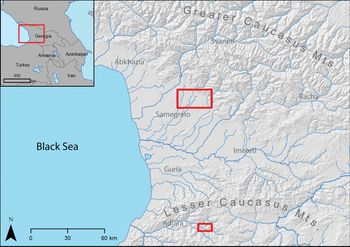
Our archaeometallurgical surveys in the present-day regions of Adjara and Samegrelo (Figure 1) have discovered ancient iron-smelting sites not previously described in Soviet-period publications. Although the sites are located to the east of where many scholars locate the Chalybes—in an area known in Classical times as Colchis—they are probably indicative of a broader South-eastern Black Sea metallurgical tradition. Radiocarbon dating has shown that these sites date primarily to two periods: the mid to late first millennium BC, a period roughly contemporaneous with the references in ancient texts, and the eleventh to fourteenth centuries AD, when the Kingdom of Georgia reached its apogee as the preeminent power in the Caucasus (Erb-Satullo et al. Reference Erb-Satullo, Gilmour and Khakhutaishvili2018). This article explores the technology and spatial organisation of Black Sea iron production during these two periods, through field survey and laboratory analysis. While the main products of these smelting operations were probably solid-state bloomery iron, evidence for highly reducing furnace conditions and the vitreous character and low iron content of some slags are reminiscent of blast furnace technologies.
Map of the Eastern Black Sea area showing the two survey areas (see Figure 2) and modern region names (figure by N. Erb-Satullo).

Survey and chronology of Black Sea iron-smelting sites
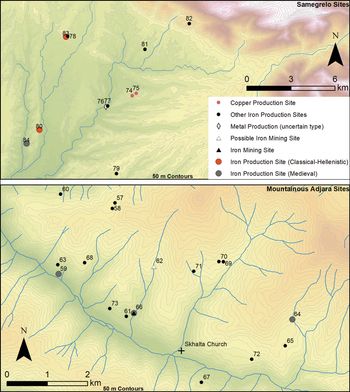
Given the abundance of sites in the archaeometallurgical landscapes of the South-eastern Black Sea region, and the lack of securely dated, analytically verified iron-smelting remains, we favoured a wide-ranging survey approach over intensive excavation of any single site. Detailed information about site locations and descriptions can be found in the online supplementary material (OSM). One area of iron smelting was identified in the modern-day region of Samegrelo (Figure 2). Eight sites with iron metallurgy were mapped here, although sites 78 and 83 probably form part of a single complex. Three of these sites were previously radiocarbon-dated using charcoal that was fully encased within chunks of surface-collected slag. Two sites (80 and 83) date to the late fifth to third centuries BC, while site 84 belongs to the medieval period (eleventh to twelfth centuries AD) (for further discussion of radiocarbon dates, see the OSM and Erb-Satullo et al. Reference Erb-Satullo, Gilmour and Khakhutaishvili2018).
Maps of metal-production sites in highland Adjara and Samegrelo. Digital elevation data are derived from ASTER (a product of METI and NASA) (figure by N. Erb-Satullo).

The location of Classical-/Hellenistic-period iron-smelting sites within the landscape differs from that of the bronze industry of the Late Bronze to Early Iron Age, when copper smelting generally took place away from settlements (Erb-Satullo et al. Reference Erb-Satullo, Gilmour and Khakhutaishvili2017: 121–23). In the Classical/Hellenistic period, site 83 and neighbouring site 78 are characterised by scatters of slag on the margins of a hilltop settlement with numerous linear stone features and depressions. Iron-production remains at sites 79, 81 and 82 are similarly positioned next to larger complexes with walls, mounds, ditches and other traces of pre-modern activity. Although this spatial arrangement may suggest a date similar to that of site 83, the absence of well-dated surface ceramics and radiocarbon dates leaves the question open.
These observations may indicate that the spatial organisation of metal production changed during the first millennium BC, coinciding with a series of broader social and technological changes. Increasing contact with the Mediterranean world via the Greek colonies, the appearance of new materials, such as iron and glass, and the rise of elites—as demonstrated by the gold-filled graves of Vani—are key developments in this period (see Kacharava & Kvirkvelia Reference Kacharava and Kvirkvelia2008), although it remains unclear how the organisation of metal production fitted into these broader transformations.
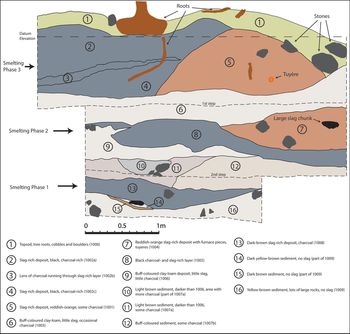
In the mountainous Adjara region of Georgia, our survey found medieval iron-smelting sites at elevations of 650–1200m asl (Figure 2). Sixteen sites with remains of iron metallurgy (one of which also had definite mining remains) and one further possible mining site were identified, often on very steep terrain. While some sites were disturbed by modern activities, others yielded large assemblages of iron-production debris, including slags, tuyères (tubes through which air is forced into a furnace), furnace fragments and ores. At site 59, for example, a modern road cut exposed a 2.5m vertical section of a slag heap, with evidence for three distinct phases of smelting (Figure 3).
Drawing of section exposed by modern road cut at site 59 (figure by N. Erb-Satullo).

Mining probably took place very close to these sites. At site 66, for example, a large slag heap was situated immediately adjacent to mining remains, as evidenced by hollowed-out areas of rock exposing iron-rich minerals. Other possible traces of mining were also identified farther up the ravine (site 62). Iron-saturated water in the adjacent streams sometimes stains the downstream rocks a distinctive reddish-orange, a feature that probably aided ancient prospectors. Three sites in Adjara were previously dated to the medieval period (twelfth to fourteenth centuries AD), using charcoal derived from the slag heaps (Erb-Satullo et al. Reference Erb-Satullo, Gilmour and Khakhutaishvili2018). Bayesian modelling of stratified radiocarbon dates from site 59 shows an interval of 0–32 years between the final two smelting phases (at 95% confidence; see the OSM Figure S2), which probably indicates the seasonal use of the site over several years. Although the number of dated sites is small, these results point to the economic impact of the political consolidation of Georgia in the twelfth to thirteenth centuries, even in remote mountain areas. Many medieval constructions, including bridges, fortresses and monasteries, are attested in Adjara, and the main elements of the nearby Skhalta Church complex (location on Figure 2) date to the thirteenth century (Chichileishvili Reference Chichileishvili2000). Georgia suffered a series of invasions and outbreaks of disease in the thirteenth and fourteenth centuries that effectively ended its regional hegemony (Rayfield Reference Rayfield2012: 118–63). The latest dated iron-smelting site in Adjara (site 66) belongs to the fourteenth century, suggesting a possible connection with this loss of power (Erb-Satullo et al. Reference Erb-Satullo, Gilmour and Khakhutaishvili2018: 176).
Iron-production debris
Classical/Hellenistic remains
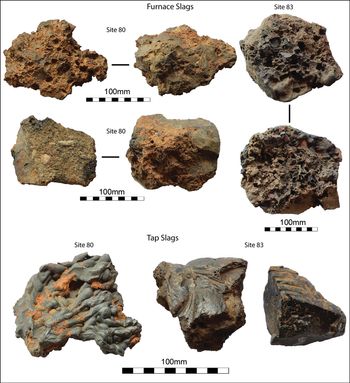
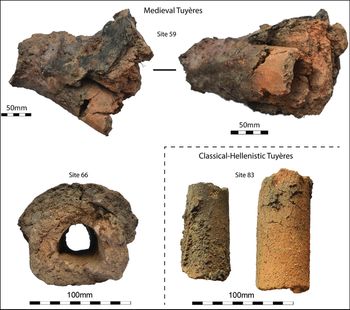
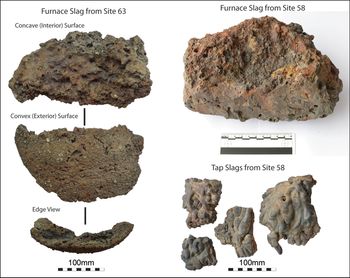
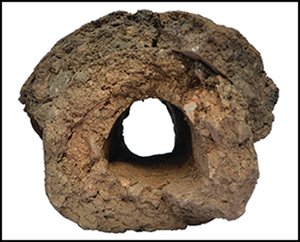
The character of iron-smelting debris at Classical/Hellenistic-period smelting sites shows considerable variability (Figure 4). One type takes the form of large chunks or masses of slag, most of which were probably formed by slag dripping down through the hotter zones around the tuyères and solidifying at the base and margins of the furnace. Other slag types had morphologies characteristic of tap slags drained in a molten state from the furnace. At site 83, some tap slags were extremely glassy, ranging in colour from black to greyish blue (Figure 4, bottom centre and right). Macroscopically, some of these examples more closely resemble blast furnace slags than typical bloomery slags. The quantities of glassy slag suggest that they were not an accidental occurrence. Although none of the fully vitreous slags encased charcoal that would have permitted direct dating, glassy slags were often found alongside crystalline slags. Thus, there is little to suggest that they date to a different period. Moreover, the slag (sample 8302) from which two radiocarbon samples came (AA105845 and AA107058, see Table S2, dated to the Classical/Hellenistic period) has a similar chemical composition to the glassy slags. Aside from slags, site 83 also yielded tuyère fragments with a 20–30mm bore diameter and a 40–50mm overall diameter, and a small fragment of iron ore (Figure 5).
Slags from Classical/Hellenistic sites; two examples of glassy slag are shown on the bottom right (figure by N. Erb-Satullo).

Examples of medieval and Classical/Hellenistic tuyères with fused furnace material (figure by N. Erb-Satullo).

Medieval remains
Medieval iron-smelting slags fell into two distinct categories. Furnace slags, which probably cooled within the furnaces, often have a curving concavo-convex shape that reflects the shape of the furnace base. By contrast, tap slags show ropey flow textures and often take the form of masses of fused rivulets that cooled as they flowed from the furnace (Figure 6).
Furnace and tap slags from medieval smelting sites (figure by N. Erb-Satullo).

Numerous fragments of medieval tuyères and furnace wall were also recovered. Several tuyères were fused with pieces of furnace wall, providing some indication of how they were inserted into its structure (Figure 5). Occasional finds of squared-off furnace pieces suggest that the furnaces were constructed of roughly formed, probably unfired mud-bricks, although the survey identified no in situ furnace structures. Numerous pieces of ore were found in the slag heaps at site 59 and 66, a finding that is consistent with the close proximity of mining and smelting activities at the latter site. Although the iron oxide minerals discarded in the slag heap may have been deemed unsuitable for smelting, they nonetheless provide some information about the ores that were smelted.
Methods of chemical and mineralogical analysis
Thirty-nine samples of slag and eight samples of ore from eight sites (57, 58, 59, 66, 79, 80, 83, 84) were mounted in polished blocks for microscopic analysis (for lists of samples and sites, see the OSM). All but five samples were selected from radiocarbon-dated sites in order to link technological practices securely to specific periods. Microscopic techniques were used to identify crystalline phases and describe their morphologies. The presence and proportions of various iron oxides and metallic iron in the slags can help characterise the reducing conditions in the furnace. Magnetite (Fe2+Fe23+O4) indicates less reducing conditions, while wüstite (Fe2+O) and metallic iron (Fe0) indicate progressively more reducing environments.
Microanalysis to aid in phase identification was carried out using an energy-dispersive X-ray detector attached to the scanning electron microscope (SEM-EDS). To characterise the bulk chemistry of the molten portion of the slags, area analyses were undertaken on a minimum of four different areas within the slag, avoiding unmelted inclusions and large voids wherever possible, and then averaged. Spot analyses of several vitreous slags were also made via wavelength-dispersive (WDS) electron microprobe. The identification of the chemical and mineralogical constituents of the slags and ores helps characterise the production technologies and to identify the types of iron produced by these smelting furnaces.
Results of the slag/ore analysis
Classical/Hellenistic slags
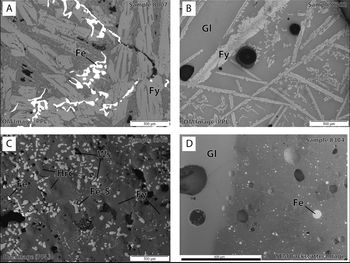
Slags from present-day Samegrelo contained a range of different phases and microstructures (Figure 7 & Table S3). Some slags had microstructures characteristic of bloomery smelting slag, with fayalite laths and spongy, metallic iron phases. Iron oxides, predominantly wüstite and hercynite, were also present. In other slags, however, iron oxides are virtually absent, suggesting strongly reducing atmospheres that converted nearly all ‘free’ iron oxides not bound in the fayalite or hercynite into metallic iron (see Muralha et al. Reference Muralha, Rehren and Clark2011). This lack of iron oxides, and correspondingly higher silica content, may also derive from technical ceramics (melted furnace material and/or tuyères), or the use of lower-grade ores (Rehren et al. Reference Rehren, Charlton, Chirikure, Humphris, Ige, Veldhuizjen, LaNiece, Hook and Craddock2007). These two possibilities are not necessarily mutually exclusive, as higher temperatures, more reducing conditions and increased melting of technical ceramic often correlate.
Microstructures of Classical/Hellenistic slags from sites 80 (A) and 83 (B–D) in Samegrelo. Abbreviations: Fe) metallic iron; Fy) fayalite; Ws) wüstite; Fe-S) iron sulphide; Hrc) hercynite; Gl) glassy phase (figure by N. Erb-Satullo).

Some slags from site 83 were either entirely glassy or contained poorly formed crystalline phases. Most of the fully vitreous examples are probably tap slags, although smaller fragments were difficult to identify with certainty. Rounded prills of metallic iron were observed in a majority of the samples from site 83. Sample 8304 contained a large cluster of rounded metallic iron prills, interspersed within an area higher in silica and aluminium relative to the main glassy slag matrix (Figure 7D). This indicates the in situ reduction of an ore fragment that did not fully homogenise with the rest of the melt. The uniform spherical character of the iron prills strongly suggests that at least some of them were once liquid. Nital etching of the prills revealed a mixture of ferrite, pearlite and steadite, suggesting the presence of phosphorus, as well as carbon up to ~0.8 wt% (estimated via microstructure) (Figure S5). Vitreous slags, particularly as a major component of the slag assemblage, are atypical in bloomery smelting operations. The somewhat unusual character of the slags is also reflected in their chemical compositions (Tables S4 & S6), some of which are lower in iron than typical bloomery smelting slags. This is particularly true for site 83, where only one sample exceeded 40 wt% FeO, as measured by EDS. Nevertheless, the overall iron content is significantly higher than blast furnace slags, which usually have less than 10 wt% FeO, and often have more calcium than the smelting slags in this study (Tylecote Reference Tylecote1987: 331–32; Rostoker & Bronson Reference Rostoker and Bronson1990: 105). The chemistry, microstructure and macroscopic appearance of these slags thus share some similarities with blast furnace slags, but although liquid iron was occasionally produced, it was probably not the main product of the smelt.
Medieval slags
Medieval iron-smelting remains also displayed microstructural and chemical variability (Figure 8 & Table S2). While wüstite- and fayalite-rich slags were identified, many samples, especially furnace slags, had few iron oxide or fayalite phases. Instead, these consisted of metallic iron within a vitreous slag, sometimes together with small clusters of leucite crystals, indicating strongly reducing conditions that converted all ‘free’ iron oxides to metal. Often these metallic aggregates preserve relict morphologies of the ore minerals.
Microstructures of medieval slags from site 59 in Adjara. Abbreviations: Fe) metallic iron; Fy) fayalite; Ws) wüstite; Hrc) hercynite; Lc) leucite; Gl) glassy phase (figure by N. Erb-Satullo).

Small (<50μm) iron sulphide particles were observed in many medieval furnace slags. In one instance, iron sulphides were clearly intermingled with a cluster of iron oxides, which represent either partially reacted ore or, more probably, corroded aggregates of what was once metallic iron. Regardless, the micro-contextual association of these phases suggests that the sulphides were introduced to the furnace charge as a component of the ore (Figure S3).
Chemically, the medieval slags from Adjara display notable differences from the earlier Samegrelo slags (Table S5). Relative to the latter, the former are characterised by higher calcium, sulphur and phosphorus contents, and a lower manganese content. These differences probably relate to the raw materials used in smelting (predominantly ores, but perhaps also ceramics used in metallurgical processes and fuel ash), as the medieval slags from Samegrelo are chemically closer to the first millennium BC slags from the same region.
Nital etching of large iron aggregates in samples 5906 and 6606 reveal complex microstructures. Sample 6606 is characterised by large phosphorus-bearing iron grains with intergranular steadite and iron sulphides (Figure 9A–B). A ~10mm metal lump in sample 5906 has a heterogeneous microstructure, indicating variable carbon, sulphur and phosphorus content. In places, rounded pearlite colonies form a thick dendritic structure interspersed by a carbon- and phosphorus-containing eutectic structure (analogous to steadite or ledeburite in the binary Fe-P and Fe-C systems) (Figure 9C). The dendritic structure suggests that parts of this metal aggregate cooled from a liquid state. Laths of cementite with an interstitial phosphorus-containing eutectic structure appear elsewhere in sample 5906, indicating a localised high-carbon area that was also liquid (Figure 9D). Microstructural analysis of sample 5906 demonstrates that although bloomery iron was probably the primary intended product, the furnaces were operated in such a way that they occasionally produced liquid iron. The production of liquid iron was probably facilitated by the carbon and phosphorus content of the metal, which would have lowered the melting temperature relative to pure iron.
Optical photomicrograph of iron aggregates in samples 6606 (A–B) and 5906 (C–D) from highland Adjara; etched with Nital. Abbreviations: Fe-S) iron sulphide; Std) steadite; Prl) pearlite; Cmt) cementite (figure by N. Erb-Satullo).

Ores
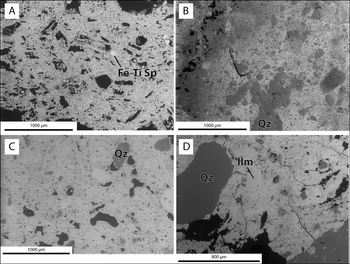
One reddish ore fragment was analysed from the Classical/Hellenistic period site 83 in modern Samegrelo (Figure 10D). It is a porous mass of hematite and other iron oxides, interspersed with quartz with occasional inclusions of ilmenite whose presence would rule out a bog iron origin; it may be consistent with a laterite deposit (Pigott Reference Pigott1989: 69), but investigation of the ore formations themselves would be necessary to confirm this.
SEM images of ore samples from highland Adjara: A) sample 6601; B) sample 6610; C) sample 5905; and from Samegrelo (D: sample 8301). Abbreviations: Qz) quartz; Ilm) ilmenite; Fe-Ti Sp) iron-titanium spinel (figure by N. Erb-Satullo).

The analysis of seven medieval ore samples from sites 59 and 66 revealed that they consist of varying proportions of iron oxides and quartz (Figure 10). Hematite is a common form of iron oxide, but various weathering products are also present. Lath-like pseudomorphs of now-altered crystals and titanium-bearing iron oxide inclusions—probably a solid solution between magnetite and ülvospinel—were noted in sample 6601 (Figure 10A), and strongly suggest that this ore sample was formed through a natural process of alteration, chemical weathering and leaching. Although low levels of sulphur were detected by EDS in all samples, particularly sample 6610, iron sulphide was never observed microscopically as a discrete phase. Comparing the Adjara ores to the ore from Samegrelo demonstrates a pattern similar to that of the slags, with those from Adjara containing more sulphur and phosphorus, but less manganese. As a whole, the analysis of the ores—both Classical/Hellenistic and medieval—provided no support for possible textual references concerning the exploitation of iron-rich magnetite sands (Pseudo-Aristotle On marvellous things heard §48; Hett Reference Hett1936; Pleiner Reference Pleiner2000: 89), which differ significantly from the ore fragments identified here.
Discussion
Our analyses of slag and other production debris unequivocally show that iron smelting took place in the South-eastern Black Sea region during the fifth to third centuries BC and the eleventh to fourteenth centuries AD. For both periods, the quantities of slag, the presence of tap slags, the identification of relict ore microstructures, and fragments of ore all indicate smelting as the primary activity, although smithing may have also taken place at some sites. These findings conclusively rule out the possibility that metalworkers in the region only forged raw iron imported from elsewhere. The evidence demonstrates the existence of a complex iron-smelting industry contemporaneous with the Classical texts that reference it; there are also clear mechanisms, in the form of Greek colonial activities and military campaigns, for the transmission of accounts about that industry back to the Mediterranean world. The connection between the texts and archaeology could hardly be more definitive.
The basic iron-smelting technology observed at the Classical/Hellenistic and medieval sites is bloomery smelting, with some distinctive technological features. The production of liquid iron in bloomery smelting operations is generally well documented, both experimentally and archaeologically (Tylecote et al. Reference Tylecote, Austin and Wraith1971: 356; David et al. Reference David, Heimann, Killick and Wayman1989; Pleiner Reference Pleiner2000: 132; Charlton et al. Reference Charlton, Crew, Rehren and Shennan2010: 365). It is notable, however, that some furnaces were operated in such a way that they produced both glassy low-iron slags and slags where most or all of the ‘free’ iron not bound up in fayalite or hercynite was metallic iron, rather than wüstite or magnetite. While some slags are more iron-rich, the proportion of vitreous, low-iron slags with fewer ‘free’ iron oxides is significant, particularly at site 83. The recurring presence of these lower iron, mostly glassy slags has several possible explanations, including high reducing conditions; the melting of ceramics used in metallurgical processes; and perhaps the use of low-iron, higher silica ores. The mostly vitreous slags often contain metallic iron phases, suggesting that the low overall iron content of the slags was a product of high reducing conditions, rather than solely the melting of furnace material or tuyères.
Higher reducing conditions do not necessarily mean that these furnaces yielded larger blooms for the same input of ore. The significant quantities of metallic iron trapped in the slags (i.e. not coalesced in the bloom) is perhaps a result of viscous, low-iron, high-silicon slags. Low-iron slags, however, are often associated with more carbon-enriched blooms (Tylecote et al. Reference Tylecote, Austin and Wraith1971; Rehder Reference Rehder2000: 125–26; Charlton et al. Reference Charlton, Crew, Rehren and Shennan2010: 356–57). One cost of this approach is that more charcoal is needed per unit of ore. Given the abundant forests in the region, this was perhaps more a question of labour supply to produce the charcoal, rather than of fuel availability.
While the Classical/Hellenistic sites currently provide the earliest dated evidence for iron smelting in the South-eastern Black Sea area, iron smelting probably began somewhat earlier. Eighth- to sixth-century BC mortuary complexes, for example, have yielded large quantities of iron objects, in shapes suggesting local production (e.g. Papuashvili Reference Papuashvili, Mehnert, Mehnert and Reinhold2012). The origins of iron metallurgy in the broader Near East, however, should be sought farther to the south-east, in Anatolia, where texts and archaeological remains suggest a considerably earlier iron metallurgical tradition (see review in Erb-Satullo Reference Erb-Satullo2019). Unfortunately, a lack of investigation in north-eastern Turkey inhibits speculation about the nature of technological transmission between Colchis and Anatolia.
It is tempting to compare the iron-smelting industry in the mid to late first millennium BC with the copper-smelting landscapes in the late second and early first millennia BC, with an eye towards possible connections. The occasional appearance of iron sulphides in the slags analysed here is intriguing, as copper sulphides, iron sulphides and iron oxides are often found in different parts of the same ore deposit. Conversely, the association of iron-smelting debris and larger complexes of walls, mounds, terraces and ditches at sites 78, 79, 81, 82 and 83 has no parallel at earlier copper-smelting sites in the same region. This patterning implies organisational differences between the two industries. Specifically, iron smelting seems to have taken place adjacent to settlements, rather than in specialised sites closer to the ore deposits. These differences may reflect chronological changes in the organisation of metal production over the first millennium BC, or between the bronze and iron industries.
Given the high regard for iron metallurgy in the Southern Black Sea region documented in Graeco-Roman sources, how do these smelting technologies compare to those of neighbouring areas in the Near East and Eastern Mediterranean? Unfortunately, there are few, if any, securely documented iron-smelting sites in these areas during either the Classical/Hellenistic or medieval periods. Although mid- to late first-millennium BC remains of iron metallurgy have been identified in the Aegean (Photos Reference Photos1989; Yalçin Reference Yalçin1993; Cevizoğlu & Yalçin Reference Cevizoğlu, Yalçin, Çilingiroğlu and Sagona2012), these are mostly interpreted as smithing rather than smelting sites. The lack of Classical Greek comparanda (Pleiner Reference Pleiner2000: 39) is particularly unfortunate, as it leaves us with virtually no Aegean frame of reference—at least in terms of smelting—through which to view the Black Sea iron-smelting traditions.
Much of the recent analytical work on iron metallurgical debris from the Near East relates to remains from the first half of the first millennium BC (e.g. Eliyahu-Behar et al. Reference Eliyahu-Behar, Yahalom-Mack, Gadot and Finkelstein2013). Tenth- to ninth-century BC smelting remains at Tell Hammeh in the Southern Levant are nonetheless relevant due to the presence of vitreous, low-iron slags at the site. These were interpreted as representing melted tuyères and furnace lining (Veldhuijzen Reference Veldhuijzen2005: 183–86, 252–53; Veldhuijzen & Rehren Reference Veldhuijzen, Rehren, LaNiece, Hook and Craddock2007). The frequency with which these slag types appear constitutes a key difference, however. While they form approximately 1 per cent of the total assemblage at Tell Hammeh, they are more common at site 83. In this respect, site 83 is reminiscent of several Late Antique/early medieval smelting sites in Italy and France, where glassy low-iron slags appear in higher frequencies (Mahé-Le Carlier et al. Reference Mahé-Le Carlier, Dieudonné-Glad and Ploquin1998; Pleiner Reference Pleiner2000: 248–49; Cucini Tizzoni & Tizzoni Reference Cucini Tizzoni, Tizzoni and Nørbach2003). Site 83 may therefore be the earliest known instance of an iron-production site with these characteristics.
Medieval iron smelting has been well studied in continental Europe (see Pleiner Reference Pleiner2000). Conversely, medieval iron-smelting sites in the Near East and Central Asia are poorly investigated archaeologically. Consequently, it is not entirely clear where and when the blast furnace first appeared in these two regions (Craddock Reference Craddock, Craddock and Lang2003: 239–40). Further investigations are necessary to identify the ways in which medieval European, Near Eastern and Central Asian iron metallurgical traditions may have circulated in borderland regions such as the Caucasus.
Conclusion
Field survey, radiocarbon dating and the analyses of production debris constitute the first detailed study of iron-smelting technologies in the South-eastern Black Sea region, an area that achieved legendary status for its iron metallurgy in Classical and Hellenistic times. We document two periods of iron smelting, the first contemporaneous with Greek texts mentioning the Chalybes (fifth to third centuries BC), the second corresponding to the medieval period (eleventh to fourteenth centuries AD).
These iron-smelting industries are largely based on solid-state (bloomery) smelting, although in both periods the furnaces were operated in such a way that they occasionally produced liquid metal. At Classical/Hellenistic site 83 in particular, the large quantities of glassy slag suggest that iron smelting was regularly carried out under highly reducing conditions. Further research is necessary to determine how liquid iron was produced, to estimate the overall phosphorus and carbon content of a typical bloom, and to assess the degree of intentionality on the part of the metalworkers with respect to the production of liquid iron and the introduction of alloying elements. Our analysis of production debris and ore fragments identified no evidence for the smelting of iron-rich sands. Instead, a soft, relatively porous ore, which probably formed through a process of weathering and leaching, was exploited.
The discovery of mid- to late first-millennium BC iron-smelting remains should not be considered a literal confirmation of Classical references to the Chalybes. After all, the sites investigated are slightly to the east of where many authors locate this group (Tsetskhladze Reference Tsetskhladze1995: 321), and the current study found no evidence for the exploitation of iron-rich sands. It may be that the accounts of the region's ethnogeography represent an imperfect reflection of a more complex reality, given that they were written by outsiders. Perhaps there was some ambiguity between the ‘Chalybes’ as an ethnic community and the ‘Chalybes’ as a social group of specialised metalworkers with a broad geographic distribution in the south-eastern Black Sea region. This—as already suggested by others (Bittarello Reference Bittarello2016: 499)—would explain some of the vagueness in the historical geography of the region. The idea of the Chalybes as a group of specialised metalworkers also fits the descriptions in the Argonautica better than a territorially bounded discrete ethno-political unit. Given that these well-developed, complex iron-smelting industries existed precisely when contacts with the Greek world were strong and when Classical texts first mention Black Sea iron smelting, it is reasonable to suggest that this archaeologically documented metallurgical tradition provided inspiration for these accounts.
Our results also have implications for understanding Greek colonial activity in the region. Previous research had argued against metals as a motivating factor because it was thought that there was no local, Classical-period smelting (Tsetskhladze Reference Tsetskhladze1995). It is not yet possible to say whether iron smelting in the mid to late first millennium BC formed part of a continuous local tradition that endured to the medieval period, or whether the metallurgical history in the region is characterised by episodic exploitation. Only the discovery, mapping, dating and analysis of iron-smelting remains can provide a more complete picture of the region that captured the metallurgical imagination of the Graeco-Roman world.
Acknowledgements
The authors would like to thank Amiran Kakhidze and Anthony Gilmour for their support during fieldwork; Richard Newman (Museum of Fine Arts, Boston) who provided access to the SEM; and Victoria Smith (University of Oxford), who provided the microprobe data. Timothy Rood and Guy Westwood (University of Oxford) provided helpful comments on the texts, and David Killick (University of Arizona) offered valuable advice on microscopy. Funding was provided by an NSF Graduate Research Fellowship (DGE0644491 and DGE1144152) and an NSF Doctoral Dissertation Improvement Grant (BCS-1338893); the Davis Center for Russian and Eurasian Studies; and by the Jens Aubrey Westengard Fund.
Supplementary material
To view supplementary material for this article, please visit https://doi.org/10.15184/aqy.2020.16