One well-known characteristic of learners of a second language (L2) is that the intonation of the L2 differs to some degree from what is considered the native or target norm (e.g., Anderson-Hsieh, Johnson, & Koehler, Reference Anderson-Hsieh, Johnson and Koehler1992; Jilka, Reference Jilka2000; Magen, Reference Magen1998; Mennen, Reference Mennen2004; Munro, Reference Munro1995; Munro & Derwing, Reference Munro and Derwing1995; Trofimovich & Baker, Reference Trofimovich and Baker2007; Willems, Reference Willems1982). Such deviations from the target language norm are often attributed to an influence from or transfer of the learners’ first language (L1), although other explanations, such as universal patterns and developmental processes of intonation acquisition, have also been recognized (see Mennen, Reference Mennen, Trouvain and Gut2007, and Mennen, A. Chen, & Karlsson, Reference Mennen, Chen, Karlsson, Dziubalska-Kołaczyk, Wrembel and Kul2010, for an overview). Transfer from the L1 has also been suggested as an explanation for the occasionally reported L2 learners’ difficulties adopting language-appropriate pitch range (e.g., Backman, Reference Backman1978; Jilka, Reference Jilka2000; Scharff-Rethfeldt, Miller, & Mennen, Reference Scharff-Rethfeldt, Miller and Mennen2008). Despite growing evidence for crosslanguage differences in this particular dimension of intonation production (e.g., Keating & Kuo, Reference Keating and Kuo2012), only a few studies have investigated how pitch range is produced in a L2, and, as a result, very little is known about the extent of deviation from or success in producing target language norms. Our goal is therefore to characterize the pitch range produced by L2 learners and to investigate the extent to which learners adopt native values of the target language pitch range or are influenced by transfer from the L1. The next section first provides a review of research on crosslanguage comparisons of pitch range, followed by a review of previous work on L2 pitch range. Then the methods used to quantify pitch range and the framework used in our study are introduced. The final sections present our study, which focuses on pitch range production in female German learners of L2 English.
BACKGROUND
Crosslanguage Studies of Pitch Range
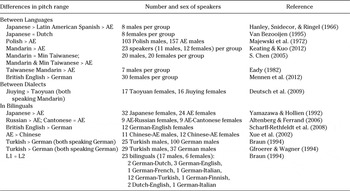
Pitch range can be defined as “the range of pitch employed by a particular speaker at a particular time and [it] can be specified by a minimum and maximum pitch” (Clark, Reference Clark2003, p. 9). It can be expressed as the difference between some bottom line and some top line from the fundamental frequency (i.e., the physical correlate of pitch, abbreviated as F0) values used by a speaker during speech (Patterson, Reference Patterson2000). In simple terms, pitch range refers to the variation in F0 values that are used in speech. There is a common assumption that languages differ in the overall pitch ranges they characteristically use, with some languages being reported as having a wider range than others (e.g., Braun, Reference Braun1994; A. Chen, Gussenhoven, & Rietveld, Reference Chen, Gussenhoven and Rietveld2004). Empirical evidence for the existence of such crosslanguage differences has only fairly recently started to emerge. Quantitative studies investigating crosslanguage differences in pitch range only started to appear in the 1960s and mostly involved comparisons of American English with various other languages (Keating & Kuo, Reference Keating and Kuo2012). Table 1 gives an overview of the findings of cross-language studies of pitch range, listing the languages that were compared and the direction of the crosslanguage differentiation. As can be seen, there are considerable differences in the number of participants per language group, which makes the comparisons less than straightforward. Comparisons are further complicated by diverging methodologies, particularly in studies employing different measures to calculate pitch range. For example, some studies measure the difference between maximum and minimum F0, others exclude the top 5% or 10% of this difference, and yet others use mean F0 or standard deviations of F0.
Overview of the findings of crosslanguage studies of pitch range

Note.
AE = American English; “>” means “larger than”; “=” means “equal to.”
Nevertheless, some generalizations can be made, particularly with reference to the studies with larger participant numbers, which are likely to be more reliable than the studies with smaller participant pools. First, these larger studies show that there is empirical support for crosslanguage differences in pitch range. When groups of speakers of one language (such as Polish or Mandarin Chinese) are compared, the pitch range employed is wider than that employed by speakers of, for instance, American English (S. Chen, Reference Chen2005; Keating & Kuo, Reference Keating and Kuo2012; Majewski, Hollien, & Zalewski, Reference Majewski, Hollien and Zalewski1972). Second, such differences are not restricted to comparisons of tone versus nontone languages (e.g., S. Chen, Reference Chen2005, for Min Taiwanese vs. American English; Keating & Kuo, Reference Keating and Kuo2012, for Mandarin vs. American English) but also apply to comparisons of different nontone languages (e.g., Majewski et al., Reference Majewski, Hollien and Zalewski1972, for Polish vs. American English; Mennen, Schaeffler, & Docherty, Reference Mennen, Schaeffler and Docherty2012, for German vs. British English). Third, there is some evidence to suggest that pitch range can vary between dialects. Deutsch, Jinghong, Sheng, and Henthorn (Reference Deutsch, Jinghong, Sheng and Henthorn2009) found that female speakers from two villages in a remote area of China (where different dialects of Mandarin Chinese are spoken) differed in the pitch ranges employed when they spoke Standard Mandarin. It was argued that an individual’s pitch range “varies as a function of his or her linguistic community and so reflects an influence of long-term exposure to the speech of others” (Deutsch et al., Reference Deutsch, Jinghong, Sheng and Henthorn2009, p. 212). Finally, there is evidence that the reported crosslanguage differences are unlikely to be caused by organic or physiological differences between the groups of speakers. This evidence comes in particular from bilingual studies in which the same speakers are compared in both their languages (Altenberg & Ferrand, Reference Altenberg and Ferrand2006; Scharff-Rethfeldt et al., Reference Scharff-Rethfeldt, Miller and Mennen2008; Xue, Hagstrom, & Hao, Reference Xue, Hagstrom and Hao2002; Yamazawa & Hollien, Reference Yamazawa and Hollien1992), thus avoiding physiological differences across groups. Other evidence comes from the fact that most crosslanguage studies controlled for sex and age, and some specifically tested the influence of body size or height and found them not to be related to the pitch range differences (e.g., Majewski et al., Reference Majewski, Hollien and Zalewski1972; Mennen et al., Reference Mennen, Schaeffler and Docherty2012).
Second Language Acquisition of Pitch Range
In a survey of empirical studies published in international journals in the area of L2 speech learning between 1969 and 2008, Gut (Reference Gut2009) suggests that deviations from the target language are often observed in L2 production of intonation. This may also be the case for the L2 acquisition of pitch range. For instance, Willems (Reference Willems1982) investigated intonational deviations in the L2 English produced by 12 native speakers of Dutch by instrumentally comparing the learners’ production of English utterances with those produced by 14 monolingual English speakers. Pitch range was listed as one of nine main deviations from the monolingual English speakers that were found in this particular group of L2 learners. This deviation was attributed to transfer from L1 Dutch, which was observed to have a narrower pitch range than English.
This finding provides support for earlier claims based on informal observations of a narrower pitch range in the interlanguage of Dutch learners of L2 English (Jenner, Reference Jenner1976). Jilka (Reference Jilka2000) also found evidence of deviations, with a wider pitch range in the L2 German utterances spoken by American learners compared to those produced by native German speakers. Similarly, Backman (Reference Backman1978) compared the pitch range of 12 male Venezuelan learners of English as a L2 with that of four American English-speaking males in productions of yes-no questions, wh-questions, and declaratives. The L2 learners were found to employ an overall narrower pitch range than the native English speakers, most prominently in the wh-questions. Chinese learners of L2 English also generally appear to employ a narrower pitch range than native speakers of English (Juffs, Reference Juffs1990). Gut (Reference Gut and Müller2007) found similar evidence of a narrower pitch range in a large number of L2 learners of English and L2 learners of German, as compared to native English and German speakers, respectively. However, as these male and female L2 learners had widely differing native languages (17 different native languages for the L2 learners of English and 24 for the L2 learners of German) that may have differed from the target language in various ways, it is unclear whether this reduced pitch range can be interpreted as an influence from the L1. Finally, as previously discussed, a few studies have investigated whether simultaneous or early sequential bilingual speakers who have access to two languages that differ in pitch range are able to produce these differences when switching between languages. The majority of these studies found that bilingual speakers differ in the pitch range used in their two languages (e.g., Yamazawa & Hollien, Reference Yamazawa and Hollien1992, for Japanese-American English bilinguals; Xue et al., Reference Xue, Hagstrom and Hao2002, for Chinese-American English bilinguals; Altenberg & Ferrand, Reference Altenberg and Ferrand2006, for Russian-American English bilinguals; Scharff-Rethfeldt et al., Reference Scharff-Rethfeldt, Miller and Mennen2008, for German-British English bilinguals).
Taken together, the studies give relatively consistent evidence for the existence of deviations in the production of L2 pitch range. However, the results are drawn from small or, in some cases, extremely small participant numbers. This is problematic because pitch range is known to show a high degree of interspeaker variability (e.g., Ladd, Reference Ladd2008). Therefore, an important methodological consideration in crosslanguage and L2 studies of pitch range is to compare larger groups of speakers to compensate for this variability. Because none of the studies has used large participant numbers, findings of deviations in pitch range need to be corroborated by further evidence.
Measuring Pitch Range
The majority of studies on crosslanguage and L2 acquisition of pitch range rely on measures that are related to long-term distributional (LTD) measures of F0. Long-term distributional measures of F0 are based on the distribution of F0 within a given speech sample. Measures that have been used for crosslanguage and L1-L2 comparisons include, among others, mean (e.g., Altenberg & Ferrand, Reference Altenberg and Ferrand2006; Keating & Kuo, Reference Keating and Kuo2012; Majewski et al., Reference Majewski, Hollien and Zalewski1972; Van Bezooijen, Reference Van Bezooijen1995), median (Hanley, Snidecor, & Ringel, Reference Hanley, Snidecor and Ringel1966; Scharff-Rethfeldt et al., Reference Scharff-Rethfeldt, Miller and Mennen2008), standard deviation or pitch sigma of F0 (Hanley et al., Reference Hanley, Snidecor and Ringel1966; Majewski et al., Reference Majewski, Hollien and Zalewski1972), maximum minus minimum F0 (Backman, Reference Backman1978; Keating & Kuo, Reference Keating and Kuo2012; Scharff-Rethfeldt et al., Reference Scharff-Rethfeldt, Miller and Mennen2008), and many more (for an overview, see Mennen et al., Reference Mennen, Schaeffler and Docherty2012). Such measures provide information about global phonetic differences in F0 between languages.
An alternative to the long-term F0 distribution approach is to view pitch range differences as fundamentally linked to specific tones in the F0 contour that, in turn, are thought to be linguistic in nature according to the autosegmental-metrical model of intonational phonology (Ladd, Reference Ladd2008; Pierrehumbert, Reference Pierrehumbert1980). The autosegmental-metrical model, which is adopted in this study, Footnote 1 recognizes both a phonological and a phonetic component in intonation. It interprets intonation contours as sequences of underlying high (H) or low (L) tonal targets that form the phonological representation of the contour. The actual contour results from an interpolation of these underlying tones when they are realized by a speaker. In this view, tonal events (which are often turning points, such as local F0 peaks or valleys) in intonation contours are linked to underlying phonological tones or tonal targets (Ladd, Reference Ladd2008; Pierrehumbert, Reference Pierrehumbert1980). The tonal targets can be categorized into two types: pitch accents and boundary tones. Pitch accents are tonal events that associate with metrically strong (prominent) syllables and, for notational purposes, are usually marked by an asterisk (*). Boundary tones are associated with structural positions, such as phrase boundaries, and mark the edges of phrases, such as intonational phrases (IPs) or utterances. These are usually marked by the symbol “%”. Tonal targets can occur as single L or H tones or as a combination of tones, and IPs consist of at least one pitch accent and a boundary tone.
This link between specific tones in a F0 contour and underlying phonological tonal targets has begun to be utilized to devise an alternative to measuring pitch range in terms of long-term F0 distribution. These alternative linguistic measures (based on H and L tonal targets such as H*, L*, L%, etc.) have been found to more successfully characterize differences in pitch range across speakers than the more commonly used LTD measures (Patterson, Reference Patterson2000). More recently, it was found that these measures are also better suited to determine the basis of crosslanguage differences in pitch range than LTD measures (Mennen et al., Reference Mennen, Schaeffler and Docherty2012). Specifically, Mennen et al. (Reference Mennen, Schaeffler and Docherty2012) showed that the differences in pitch range between native English and German speakers were not evidenced globally but depended on where in the intonation contour pitch range was measured. Compared to English speakers, German speakers did not have an overall compressed pitch range with a general narrowing of the difference between a bottom line and top line of F0 values. Instead, it was found that German speakers had a compressed pitch range at the beginning of IPs but an expanded pitch range in later parts of IPs in comparison to English speakers. This was found to be related to the language-specific realization of underlying H and L tonal targets at different points in the intonation contour. This finding was contrary to expectation, as the study was motivated by the existence of strong anecdotal evidence for global differences between the two languages, with pitch range in English believed to be wider than in German. Such position-sensitive differences in crosslanguage pitch range are hard to capture with the global LTD measures that are usually employed in pitch range comparisons and may therefore have been obscured in previous studies.
Aims and Hypotheses of the Present Study
Taken together, the research presented in the previous sections raises a number of issues. It suggests in particular that L2 learners may have difficulties adopting the language-appropriate pitch range of the target language. Although this difficulty is usually attributed to transfer from the L1, the relevant studies are based on comparisons of small participant numbers and diverging methodologies. Moreover, previous research has relied almost exclusively on LTD measures, and it has generally been assumed that pitch range is some kind of overall language-specific phonetic setting that is transferred globally from the L1 to the L2 (e.g., Deutsch et al., Reference Deutsch, Jinghong, Sheng and Henthorn2009; Deutsch, North, & Ray, Reference Deutsch, North and Ray1990; Keating & Kuo, Reference Keating and Kuo2012). However, this assumption has been called into question—at least for German versus English—by the recent evidence for crosslanguage, position-sensitive pitch range differences (Mennen et al., Reference Mennen, Schaeffler and Docherty2012). This raises the question as to whether L2 learners are able to acquire such position-sensitive properties of pitch range and whether L1 transfer or an approximation of the target language occurs at a global or position-sensitive level.
In light of this background, the aim of this study is to characterize the pitch range produced by a relatively large group of female German learners of L2 (British) English and to identify to what extent the learners deviate from or adopt language-appropriate values of the target language. In particular, it will be established whether the L2 learners completely or partially adopt language-specific pitch range values that are global or position sensitive in nature—that is, that are tied to the phonetic realization patterns of H and L tones at different points in intonation contours. By using the linguistic measures described previously, it will be possible to distinguish between the global and position-sensitive types of L1 approximation, and, where these deviations from monolingual English are found, it will be possible to examine whether this may be due to L1 transfer.
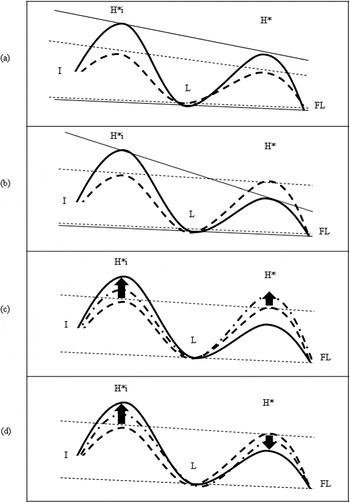
Figure 1 exemplifies schematically the global versus position-sensitive crosslanguage differences in pitch range. Footnote 2 Panel (a) illustrates a global pitch range difference between two hypothetical languages. Panel (b) illustrates a position-sensitive difference as observed for German versus English by Mennen et al. (Reference Mennen, Schaeffler and Docherty2012), with the dashed contour illustrating the German pattern. Panels (c) and (d) will be explained in the next few paragraphs in relation to the potential effect of crosslanguage differences on L2 production.
Schematic illustration of global versus position-sensitive crosslanguage differences in pitch range and their potential effect on L2 production.

As the literature suggests that transfer of pitch range is common, German learners would be expected to show at least some deviations from the target in their pitch range production. On the basis of the previously described literature, it is an open question whether L2 learners will be sensitive to crosslanguage differences that are tied to the L1 phonetic realization patterns of H and L tones at different points in intonation contours or whether they pick up on differences that are more global in nature. That is, we posit that German learners may approximate the target either by adapting their pitch range values globally to the target values or by adapting them on a position-sensitive basis.
Under a global adaptation hypothesis, and assuming that the L1 is the starting point, German learners would be expected to progress toward the target by globally expanding their pitch range. This is indicated in Figure 1, panel (c). The expectation would be to see uniform changes across the whole of the IP, with an increase in the overall distance between the top line and bottom line. Crucially, this would lead to an approximation toward the target at the start of the IP but to major deviations from the target in later parts of the IP.
Under a position-sensitive adaptation hypothesis, German learners would be expected to progress toward the target by adjusting their pitch range differently depending on the position in an intonational contour. This would result in an expansion of their pitch range in earlier parts of IPs and a compression of their pitch range in later parts of IPs. In this scenario, no overall increase in distance between the top line and bottom line should be found; rather, the results should display an expansion of some underlying tonal targets and not others. This is indicated in Figure 1, panel (d).
METHOD
Speakers
A total of 81 speakers took part in this study. All speakers were female and had a comparable education level, with most of them studying for (and some having achieved) university degrees. None of the participants had any known hearing problems or speech or voice disorders. They were all paid a small fee for their participation.
There were three groups of speakers. The first group (group NE) was comprised of 30 functionally monolingual speakers of Southern Standard British English. Footnote 3 Their age ranged between 19 and 38 years, with a mean age of 23.2. The second group was comprised of 30 functionally monolingual speakers of Northern Standard German (group NG). Their age ranged between 20 and 29, with a mean age of 22.8. The participants in these two groups were drawn from the Mennen et al. (Reference Mennen, Schaeffler and Docherty2012) study, which compared pitch ranges of English and German female speakers, as described in the introduction. For ease of reference, participants in these two groups will be referred to as native English and native German speakers, respectively.
The third group comprised 21 adult German learners of L2 English (group L2E) who had been born and raised in Germany. They were all sequential (successive) dual language learners according to popular definitions, all having been considerably above the age of four before being introduced to the L2 (e.g., Genesee & Nicoladis, Reference Genesee, Nicoladis, Hoff and Shatz2007). The age of the participants in this group ranged from 17 to 36, with a mean age of 24.6. They were living at various locations in the United Kingdom at the time of recording and were recruited from universities and colleges in those locations.
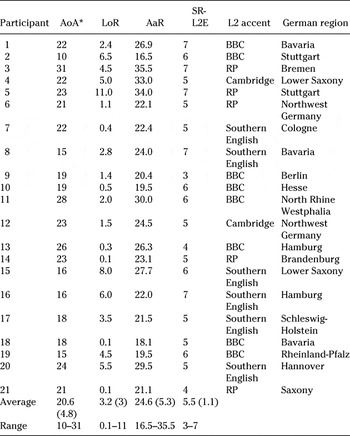
Our criteria for recruitment to the L2E group was that speakers were (a) female German learners of L2 English, (b) residing in the United Kingdom at the time of recording, (c) of a similar age range to speakers in groups NE and NG, and (d) sequential dual language learners. We did not specifically control for their length of residence (LoR) or their age of arrival (AoA) in the United Kingdom. However, as these are variables known to play a role in predicting the relative difficulty that learners will have when producing L2 speech, participants were asked about their AoA and LoR in the United Kingdom (in years) at the time of recording. As we wanted to ensure that the learners had been exposed to, or were acquiring, the same variety of English (i.e., Southern Standard British English), we explicitly made this clear by advertising for female German learners of L2 English who had been exposed mainly to Southern British English, rather than to any other variety of English. At the time of recording, we also asked them what variety they were speaking and acquiring and excluded any speaker that stated a different variety. From the summary of participant variables in Table 2, it can be seen that all participants in L2E group were residing in England (mostly in Cambridge) at the time of recording, and they reported that they were acquiring Southern Standard English, BBC English, Received Pronunciation (RP), or Cambridge English. Ideally, we would also have liked to control for the regional variety of the learners’ L1. However, controlling for both the L2 target variety and the L1 regional variety dramatically reduced the pool of speakers to choose from, so we had to abandon the L1 regional variety from our selection criteria. However, as regional variety might have an influence on F0 production, we asked participants to report their region of origin in Germany, as listed in Table 2. Finally, participants were also asked to rate their ability to speak the L2 on a 7-point scale, with 1 indicating “very poor” ability and 7 indicating “native speaker” ability (see Table 2). No specific assessment of the participants’ proficiency was conducted other than the self-assessment of their ability to speak the L2. However, all speakers were or had been attending courses at a university or college for which English was the medium of communication, and they were able to converse fluently in the L2 (as evidenced in the recordings). We would therefore judge them to be of moderate to advanced proficiency. This was in line with the scores for the participants’ self-assessment of their ability to speak the L2, with an average score of 5.5 (SD = 1.1) and no individual score below 3.
Participant variables for each of the speakers in group L2E along with the group averages, standard deviations (in parentheses), and ranges, as well as the L2 accent that learners reported acquiring and learners’ German region of origin

Note.
AoA = age of arrival in the United Kingdom in years; LoR = length of residence in the United Kingdom in years; AaR = age in years at the time of recording; SR-L2E = self-rating of ability to speak English (1 = “very poor” to 7 = “native speaker”).
a In some cases, participants did not live in the United Kingdom continuously after their first arrival; some left for a period of time and then returned.
Materials, Procedure, and Recordings
All recordings took place in sound-treated rooms using professional recording equipment (i.e., flash or digital audio recorder, depending on the location) with an external condenser microphone. The sampling frequency was, in all cases, 44.1 Hz. All participants were asked to read out the Dog and Duck passage (Brown & Docherty, Reference Brown and Docherty1995) or its German translation (Mennen et al., Reference Mennen, Schaeffler and Docherty2012), along with some other materials not reported here. The Dog and Duck passage was chosen because it is a lively text, and we therefore expected that it would elicit a range of intonation patterns and variations in pitch range. Although we are aware that there may be differences in intonation between read and spontaneous speech, these differences tend to be small, and they do not offset the advantage of control over possible confounding factors and the ability to ensure comparable data crosslanguages (Baken & Orlikoff, Reference Baken and Orlikoff2000). The participants were given time to practice reading the passage before the actual recording took place. Participants in group NG read the German version of the passage, and participants in groups NE and L2E read the English version.
To allow for direct comparisons, we followed the procedure adopted by Mennen et al. (Reference Mennen, Schaeffler and Docherty2012) and isolated the first five sentences of each version of the passage (corresponding to approximately six or seven IPs) for each speaker. Footnote 4 Although care was taken to make the German and English versions of the passage as similar as possible, some differences between the texts that are related to inherent differences between the two languages remain. We discuss these here, as they could possibly affect our subsequent measures of pitch range. First, there may have been differences between the passages in their respective length, and this, in turn, could potentially have an effect on declination patterns and thus may affect pitch range measures. In terms of syllables, the German passage is slightly longer than the English one, with 60 and 51 syllables, respectively. Per sentence, mean syllable count was 10.2 for English and 12 for German. However, as our pitch range measures were calculated over IPs rather than sentences, we also calculated the number of IPs per language and their duration (in seconds). There are also more IPs in German than in English (speakers averaged 6.9 for NG vs. 5.7 for NE, t(48.9) = −4.39, p < .001), indicating that the German speakers divided the slightly longer passage into more IPs. Mean IP duration, however, was found not to differ significantly across the two languages (speakers averaged 1.38 s for NE and 1.31 s for NG, t(58) = 1.23, p = .224). We therefore concluded that it was unlikely that the differences between English and German as described in Mennen et al. (Reference Mennen, Schaeffler and Docherty2012) were caused by large differences in IP length across the two languages, confirming that the methodology from the previous study was appropriate for the present study.
Another potentially confounding factor that could have affected the subsequent crosslanguage pitch range comparisons is the phonemic content of the sentences, which, in turn, can lead to intrinsic pitch effects. As we used a German translation of the Dog and Duck passage, we were unable to control for vowel height in our German and English passages. Whalen and Levitt (Reference Whalen and Levitt1995) report an average intrinsic pitch difference of 15.3 Hz or 1.65 semitones (STs) between the close vowels [i] and [u] and the open vowel [a] for several languages. To estimate the potential influence of vowel height on our results, we scored average vowel height in both passages as follows. After excluding function words that would rarely receive stress (determiners, conjunctions, and prepositions), we scored the primary stressed vowel for each individual word for vowel height, following the conventions of the International Phonetic Alphabet vowel chart (International Phonetic Association, 2005). Open vowels (e.g., /a/) received a score of 1, close vowels (e.g., /i/ or /u/) a score of 4, and mid-open (e.g., /ɛ/ or /ɔ/) and mid-close (e.g., /e/ or /o/) vowels a score of 2 and 3, respectively. Diphthongs that showed a change from open to close (e.g., /aɪ/ or /aʊ/) were scored 2.5. The average vowel height score for English was 2.5, and for German, 2.7. This indicated only very small differences in average vowel height across the two passages, and it was therefore concluded that intrinsic pitch effects could be ignored for the comparison.
Labeling and Measurements
Fundamental frequency was measured with the speech analysis software Praat (Version 5.3.03; Boersma & Weenink, Reference Boersma and Weenink2011), using the Praat standard settings, a pitch floor of 75 Hz, a pitch ceiling of 600 Hz, and time steps of 10 ms. All extracted F0 contours were then visually inspected and manually corrected for artifacts such as octave errors or F0 values attributed to voiceless portions of the signal.
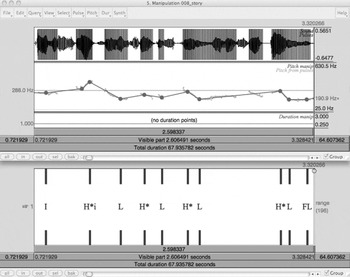
Following Mennen et al. (Reference Mennen, Schaeffler and Docherty2012), we labeled H and L tonal elements (also referred to as landmarks) in the F0 contour. This was done by manually creating a stylized version of the F0 contour using Praat’s manipulation routine. In essence, in this method the original F0 contour is redrawn into a simplified F0 contour representing only those turning points that are perceptually relevant (through an auditory comparison of the original and redrawn contour) and interpolating between them (’t Hart, Collier, & Cohen, 1990). Footnote 5 Using the autosegmental-metrical approach previously described, the perceptually relevant landmarks were then labeled as follows. Tonal events at the beginning of IPs were marked “I,” whereas IP-final boundaries were distinguished into final low (FL) or final high (FH) boundaries depending on their direction. Local minima, or valleys, and local maxima, or peaks, were labeled L or H, respectively, and were distinguished between those that associate with a prominent syllable (marked by *) and those that do not. Footnote 6 Finally, after labeling, an automatic procedure was applied that identified the label given to the first local maximum for every IP. In the case of the label H, this label was relabeled as Hi, and, in the case of H*, the label used was H*i. Thus, every IP could only have one initial peak, either H*i (the first local maximum on a prominent syllable) or Hi (the first local maximum on a nonprominent syllable). Figure 2 illustrates the result of the stylization procedure and the labeling applied. Further details of the procedure that are not immediately relevant for the current study are reported in Mennen et al. (Reference Mennen, Schaeffler and Docherty2012).
Illustration of the result of the stylization procedure and the labeling applied to a single IP. Top: signal waveform; middle: stylized pitch (F0) contour with local maxima and minima; bottom: annotations of H and L tones, time aligned to local maxima and minima.

From the landmarks, we derived three linguistic measures of pitch range—namely, H*i-FL, H*-FL, and H*i-H*. This was done by, first, determining the speaker means for all six landmarks and then calculating the speaker mean differences for the three pitch range measures. Note that, according to our definition of landmarks, there was maximally one H*i and one FL landmark per IP, whereas a single IP could contain several H* landmarks. All the H* landmarks of a speaker were included in the calculation of the average.
The first measure, H*i-FL, should be closest to a traditional pitch range measure such as maximum minus minimum F0, as (at least for native English) H*i had the overall highest F0 values we observed, and FL the lowest. The second measure, H*-FL, was one of the most interesting measures in the Mennen et al. (Reference Mennen, Schaeffler and Docherty2012) study, as it showed a significant difference in an unexpected direction—namely, a higher value for German than for English, which contradicts the assumption that English has an overall wider pitch range than German. The third measure, H*i-H*, was specifically proposed by Mennen et al. (Reference Mennen, Schaeffler and Docherty2012) as a measure that characterizes the differences between the two languages in their phonetic realization of tones at initial and later parts of the intonation contour. It was, therefore, expected to also prove to be a useful measure to distinguish between global and position-sensitive changes in pitch range.
Other possible range measures were excluded from further analysis. No ranges based on the landmarks L*, H, and Hi were calculated, as these differed considerably in their frequency of occurrence in German and English and, therefore, did not provide enough data points for reliable statistical analysis. We also did not calculate any range measures based on L (H*i-L or H*-L), because (a) we considered that H*i-L was conceptually quite similar to H*i-FL and would therefore not add important information, and (b) H*-L had a comparatively low effect size in Mennen et al. (Reference Mennen, Schaeffler and Docherty2012). Thus, to avoid unnecessarily inflating the error rate by experiment, these less important range measures were dropped from analysis.
The results from Mennen et al. (Reference Mennen, Schaeffler and Docherty2012) showed that the crosslanguage differences in pitch range observed for German and English were predominantly caused by differences in the H-type measures (e.g., H*i, H*). However, as it is an open question how L2 learners adjust their pitch range toward the target (i.e., whether they raise the H-type measures or lower the L-type measures), we also compared the absolute values of the three landmarks H*i, H*, and FL.
All pitch range measures were calculated in STs, as this will facilitate comparisons over disparate groups of speakers (e.g., across different genders) in future studies. Moreover, the measures were found to capture the crosslanguage differences between German and English marginally better when expressed on a ST scale as compared to the corresponding Hz measures in Mennen et al. (Reference Mennen, Schaeffler and Docherty2012). Comparisons between absolute landmark values were performed in Hertz.
Statistical Analysis
Normality of distribution for each measure within each language group was tested with a Shapiro-Wilk test. If there were no indications of nonnormality, a one-way ANOVA was performed, with language (NG vs. NE vs. L2E) as a factor and the various measures as the dependent variables. In the case of overall significance in the omnibus test, Tukey’s HSD test was used for pairwise comparisons.
If the Shapiro-Wilk test indicated deviations from normality in some of the samples, a Kruskal-Wallis test was used for overall comparisons (with the factor Language as before), followed by Mann-Whitney U tests with Bonferroni correction for pairwise comparisons in case of overall significance. Finally, even though we did not specifically control for the participants’ LoR or AoA, we wanted to see whether these variables were related to pitch range. We therefore tested for correlations between AoA and LoR and selected pitch range measures. Furthermore, we were interested in whether learners’ self-assessment of their ability to speak the L2 was related to targetlike realization of pitch range. Thus, we also examined the correlations between self-assessment and selected pitch range measures. As we aimed to avoid a strong influence of outliers in the AoA and LoR data, and as the self-assessment data deviated significantly from normality, we computed Spearman’s rank correlation coefficient (ρ).
To control for error rate by experiment, we applied the Benjamini-Hochberg correction (Benjamini & Hochberg, Reference Benjamini and Hochberg1995), which controls false discovery rate and is a less conservative alternative to Bonferroni correction, to all our analyses. All p values from the 12 tests (ANOVA or Kruskal-Wallis omnibus tests and correlation tests) were ranked from smallest to largest, and each p value was multiplied by the number of tests (i.e., 12) and then divided by its rank. These adjusted p values were then compared to the significance level of .05. For all omnibus tests reported in the Results section, Benjamini-Hochberg adjusted p values are given.
RESULTS
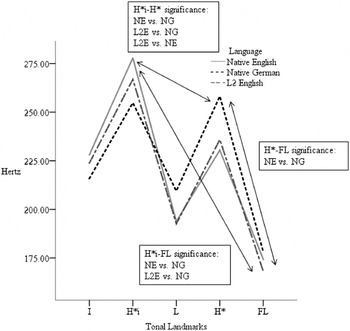
Figure 3 provides a summary of the main findings for the tonal landmarks investigated, displayed in an order that reflects their approximate succession in an IP.
Illustration of the main findings for the investigated pitch range measures and tonal landmarks, displayed in an order that reflects their approximate succession in an IP. The phrase-initial F0 (I) and other perceptually relevant points that were labeled and used to calculate pitch range are marked.

Pitch Range Measures
Initial Prominent Peaks Minus Final Lows (H*i-FL)
A Shapiro-Wilk test did not indicate significant deviations from normality in any of the groups; therefore a one-way ANOVA was performed. This test showed a significant overall difference across groups, F(2) = 6.16, adjusted p = .012, and post hoc tests showed significantly higher H*i-FL values in L2E (M = 7.9 STs, SD = 2.9) than in NG (M = 6.1 STs, SD = 1.7), p = .005. The L2E group, however, was not significantly different from the NE group (M = 8.0 STs, SD = 2.3), p = .987, showing that the L2 learners produced language-appropriate values in the L2. Values for the NE group were also significantly higher than NG values, p = .022.
Noninitial Prominent Peaks Minus Final Lows (H*-FL)
A Shapiro-Wilk test showed significant deviation from normality in the N2E group, W = .864, p = .009; therefore a Kruskal-Wallis test was performed. This test showed significance for this measure, χ2 = 11.11, adjusted p = .010. Pairwise comparisons using Mann-Whitney U tests with Bonferroni correction (significance level .025) for L2E (M = 5.7 STs, SD = 2.3) versus NG (M = 6.4 STs, SD = 1.6) and L2E versus NE (M = 4.8 STs, SD = 1.6) were not significant (L2E vs. NG, p = .108; L2E vs. NE, p = .222). The NG versus NE comparison was significant (as reported in Mennen et al., Reference Mennen, Schaeffler and Docherty2012), with NG showing significantly higher values for this measure, U = 203, p = .001.
Initial Prominent Peaks Minus Noninitial Prominent Peaks (H*i-H*)
A Shapiro-Wilk test did not indicate significant deviations from normality in any of the groups; therefore a one-way ANOVA was performed. This test showed significant overall differences, F(2) = 35.05, adjusted p = .011, and post hoc tests revealed pairwise significant differences among L2E (M = 2.2 STs, SD = 1.7) versus NE (M = 3.3 STs, SD = 1.5), p = .048; L2E versus NG (M = −0.2 STs, SD = 1.7), p < .001; and NE versus NG, p < .001.
Absolute Landmarks
Initial Prominent Peaks (H*i)
A Shapiro-Wilk test indicated deviations from normality in the NG group, W = .856, p = .001; therefore a Kruskal-Wallis test was performed. This was nonsignificant, χ2 = 6.57, adjusted p = .074; therefore no pairwise comparisons were performed. Means and standard deviations for L2E, NE, and NG were 266.9 Hz (SD = 31.1), 278.0 Hz (SD = 37.8), and 254.8 Hz (SD = 26.6), respectively.
Noninitial Prominent Peaks (H*)
A Shapiro-Wilk test indicated no deviations from normality; therefore a one-way ANOVA was performed. This revealed a significant difference between the groups, F(2) = 8.39, adjusted p = .006. Post hoc tests showed a significant difference between L2E (M = 235.9 Hz, SD = 34.3) and NG (M = 258.2 Hz, SD = 24.6), p = .014, whereas the difference between L2E and NE (M = 230.5 Hz, SD = 23.2) was not significant, p = .765, showing that the L2 learners produced language-appropriate values in the L2. The difference between NE and NG was significant, p = .001.
Final Lows (FL)
A Shapiro-Wilk test indicated no deviations from normality; therefore a one-way ANOVA was performed. This did not show any significant differences among the groups. Means and standard deviations (in parentheses) for L2E, NE, and NG were 168.1 Hz (20.0), 174.3 Hz (20.0), and 178.1 Hz (11.7), respectively, showing very similar values across the three groups.
Participant Variables
We correlated AoA, LoR, and participants’ self-assessed ability to speak the L2 with the H*i- FL and H*i-H* pitch range measures, because H*i-FL was expected to be comparable to the maximum-minimum type measures used in previous studies of pitch range differences crosslanguages, and H*i-H* should combine the most important differences between NE and NG in a single measure. The H*i-H* measure showed a significant correlation with self-assessment of ability to speak the L2, ρ = .62, adjusted p = .009, indicating that speakers who judged themselves to have a more nativelike ability conformed better to the NE target of higher H*i than H* peaks. None of the selected pitch range measures showed significant correlations with AoA and LoR.
DISCUSSION AND CONCLUSION
This study set out to characterize the pitch range produced by female German learners of L2 English at a relatively moderate to advanced level of proficiency to examine (a) the extent to which learners diverge from the target pitch range or adopt language-appropriate values, (b) whether there is evidence of L1 transfer in their production of pitch range, and (c) whether target approximation is position sensitive or global in nature. It was hypothesized that learners could progress toward the target in one of two ways: (a) by globally expanding their pitch range or (b) by adjusting their pitch range differently depending on the position in an IP. We found that the L2 learners produced pitch range values that were mostly within the values expected for the target language or were approximating the target and, as argued in this section, that the learners’ adaptation toward the target was position sensitive in nature.
For the measure H*i-FL, it was found that learners deviated significantly from NG but not NE values, indicating that the learners produced language-appropriate values of pitch range in the L2. This is in line with predictions under global and position-sensitive hypotheses, as this measure does not distinguish between these two hypotheses. That is, on the basis of this measure, we are unable to determine whether the learners had successfully adapted their pitch range toward the target in a position-sensitive or a global way. Results for the absolute landmarks related to this measure (i.e., H*i and FL) also do not allow us to distinguish between these two hypotheses, as no significant differences were found between the learners and native speakers of English either for H*i or FL.
For the pitch range measure H*-FL, we found that the learners’ values did not significantly differ either from NG or from NE values. The fact that the two native groups did significantly differ with respect to this measure suggests that the learners’ values lie somewhere in between the values for native German and English. The findings for the related absolute landmarks showed that the approximation toward the target language for H*-FL was driven by a change toward native English in H* rather than FL (with a lowering of H* toward the native language). Taken together with the results for H*i-FL, this accords with our predictions under a position-sensitive adaptation hypothesis, whereby learners are sensitive to differences in pitch range that are dependent on the position within an IP. Learners showed an expansion of their pitch range toward the target in earlier parts of IPs (as evidenced by the measure H*i-FL) but a compression in later parts (as evidenced by the measure H*-FL). If they had adapted their pitch range globally toward the target language, we would have expected their values for H*-FL to at least exceed those of NE, if not NG, values.
This conclusion is further supported by our third measure of pitch range, H*i-H*. Our results revealed that the learners’ values for H*i-H* differed significantly from both NG and NE values. Learners showed intermediate values between source and target language (with values for the learners at 2.2 STs, NG at −0.2, and NE at 3.3), which illustrates differential adaptations of pitch excursions in earlier versus later parts of the IP by the learners. This is in line with an interpretation of a position-sensitive adaptation of pitch range toward the target. Under a global adaptation hypothesis, we would have expected learners to uniformly increase their pitch range values such that the difference between H*i and H* would be relatively small.
It is interesting to note that this third measure of pitch range, H*i-H*, was the only pitch range measure for which L2 learners significantly deviated from the target and did not reach native target values. The L2 learners showed significant deviations from both NG and NE values, with values being intermediate between the two and showing an influence from the L1. Although the literature suggests that L1 pitch range transfer is common, our learners were found to be rather successful in approximating and even reaching the target. We suspect that their relative success may well be related to their level of proficiency (as further discussed later in this section).
Because no other studies have reported position-sensitive influences in the acquisition of L2 pitch range, it remains an empirical question whether the findings extend to other L2 learners with different combinations of source and target languages or different source and target regions. In our study, we were unable to control for the regions of origin in Germany of the L2 speakers (as shown in Table 2). As F0 variation is also a differentiator of regional accents (e.g., Grabe, Post, Nolan, & Farrar, Reference Grabe, Post, Nolan and Farrar2000), regional accents could potentially have affected the speakers’ L2 productions of pitch range. Similarly, although we were careful to select L2 speakers who reported that they were acquiring Southern Standard British English, there may have been differences in the English variety to which the learners were exposed. Furthermore, most learners already had some knowledge of English through secondary school instruction at the age they arrived in the United Kingdom. Future studies might want to establish whether previous instruction in secondary school and the varieties of English to which learners are exposed contribute to L2 pitch range production. Also, because in many European countries it is difficult to find monolingual speakers in the strictest sense of the word, it needs to be established to what extent language learning that takes place outside the L2 environment (e.g., through secondary education) would impact L2 pronunciation or accent. As the participants in our L2E group had some knowledge of other languages through secondary education, we cannot completely exclude influences from knowledge of other languages on the participants’ pitch range production. However, as the speakers of the NE and NG groups also had some knowledge of other languages through secondary education, similar influences should then be evident in these groups as well.
It will also take further experimentation to establish when the position-sensitive properties of pitch range are acquired in the L2 developmental process and how L2 approximation or L1 transfer is manifested in learners at the early stages of acquisition. Although it is likely that position-sensitive influences have been obscured in earlier studies due to the reliance on global LTD measures, it is possible that learners start out with producing global pitch range differences and only produce position-sensitive differences at later stages of proficiency. As our learners were judged to be of moderate to advanced proficiency, we are unable to comment on the generalizability of the findings to other proficiency levels. Our results also failed to shed light on the relation between AoA or LoR and pitch range, as none of the selected pitch range measures showed significant correlations with AoA or LoR. This is perhaps not all that surprising, given that we did not specifically control for these participant variables. It is, however, worth noting that the learners’ self-assessment of ability to speak the L2 correlated with one of the pitch range measures, H*i-H*. This suggests that speakers who judged themselves as having a more nativelike ability to speak the L2 were also more successful in producing nativelike position-sensitive differences in pitch range. Such a correlation was not observed for H*i-FL, which is a measure of pitch range that is comparable to the global LTD measures of pitch range (i.e., maximum-minimum F0) used in previous studies of L2 pitch range.
Another issue that remains to be explored is whether the observed differences in pitch range contribute to the perception of foreign accent or intelligibility and comprehensibility. It is well known that prosodic deviances contribute to perceived foreign accent, and they have even been found to influence listener judgments of intelligibility and comprehensibility (e.g., Anderson-Hsieh et al., Reference Anderson-Hsieh, Johnson and Koehler1992; Jilka, Reference Jilka2000; Kang, Rubin, & Pickering, Reference Kang, Rubin and Pickering2010; Magen, Reference Magen1998; Munro & Derwing, Reference Munro and Derwing1995; Pickering, Reference Pickering2001; Trofimovich & Baker, Reference Trofimovich and Baker2007). It has, for instance, been suggested that the intonation patterns used in the classroom by international teaching assistants may obscure the information they are trying to convey to their students (Pickering, Reference Pickering2001, p. 233). Similarly, it has been shown that a combination of indices of speech rate, pause, and intonation can contribute to listeners’ impressions of L2 oral proficiency and comprehensibility (Kang et al., Reference Kang, Rubin and Pickering2010). Some studies have investigated the relative contribution of various prosodic cues (such as intonation, rhythm, and speaking rate) to the perception of foreign accent (Jilka, Reference Jilka2000; Trofimovich & Baker, Reference Trofimovich and Baker2007). For example, Jilka (Reference Jilka2000) presented listeners with utterances produced by native and nonnative speakers of German and American English that were low-pass filtered (a manipulation technique that suppresses segmental information and renders utterances segmentally unintelligible) and low-pass filtered monotonized (a technique that involves setting speech to one pitch level or to a slightly sloping pitch level). When the native listeners rated the manipulated utterances for foreign accent, the results showed that monotonized utterances attracted higher ratings for foreign accent than low-pass filtered utterances with preserved intonation, showing that intonation was the most important prosodic cue in the perception of foreign-accented speech. It is possible that pitch range, as a dimension of intonation, may contribute to such perceptions, but this would need to be determined through perceptual experimentation.
In the absence of evidence for the contribution of deviations in pitch range production to the perception of foreign accent or to intelligibility and comprehensibility, we can only speculate as to whether or how our findings may be important for the teaching and learning of L2 pronunciation. However, our results highlight an important crosslanguage difference between German and English—namely, that pitch ranges are not evenly distributed over the whole IP. That is, English native speakers exhibit a wider pitch range at the beginning of IPs, whereas, later in the IP, their pitch range is narrower than that of native German speakers (recall Figure 1, panel [b], and Figure 3). Therefore, for German learners of L2 English to produce nativelike pitch range, they would need to considerably raise their pitch early in an utterance, as shown in Figure 1, panel (d). Teaching German learners of L2 English to generally widen their pitch range would not lead to the desired effect, as it would exacerbate the crosslanguage difference in the later parts of IPs such that they would exceed the target, as exemplified in Figure 1, panel (c). It may be more beneficial to learners to point them to the crosslanguage differences at different parts in the contour, showing that pitch range is wider at the beginning but narrower in later parts.
Finally, our results show that the use of linguistic measures in cross-language comparisons provides valuable insights into the underlying causes of L2 approximation and L1 transfer; these are insights that cannot easily be gleaned from the more commonly used LTD measures of pitch range. Further research will show whether similar gains can be made from other linguistically based measures. For instance, we have only explored measures that were derived from single tones and have made no further assumptions as to how they may combine into bitonal pitch accents (e.g., H*+L, L*+H). Future research will have to address whether differences in the type of pitch accents and their relative frequency are equally revealing as to the underlying source of the observed crosslanguage differences.