INTRODUCTION
In developed countries, a population aging with multiple chronic illnesses has focused efforts on providing integrated and interdisciplinary palliative services (Ahmedzai et al., Reference Ahmedzai, Costa and Blengini2004; Carstairs, Reference Carstairs2005). Within the Canadian context, it has been estimated that only 5% of citizens receive such services; for rural and remote citizens this figure is even lower (Canadian Institutes for Health Information, 2007). Although much has been written about interdisciplinary approaches to palliative care in urban contexts, little research to date has focused on palliative care in rural contexts (Robinson et al., Reference Robinson, Pesut and Bottorff2009). This is particularly true for understanding how roles and responsibilities are constructed and negotiated in rural areas. Roles and scopes of practice tend to be broader in rural areas because of the lack of specialist and multidisciplinary teams (Rosenberg & Canning, Reference Rosenberg and Canning2004; Wilson et al., Reference Wilson, Justice and Sheps2006; Smyth et al., Reference Smyth, Farnell and Dutu2010), and a number of recommendations have been made for developing interprofessional teams to improve access to palliative care in rural areas (Hall et al., Reference Hall, Weaver and Handfield–Jones2008; Tan et al., Reference Tan, O'Connor and Miles2009; Mills et al., Reference Mills, Francis and Birks2010).
However, it is not sufficient to simply transplant urban models of care into rural contexts. Palliative care in rural areas must take into account the important cultural dimensions of the rural context (Kelley, Reference Kelley2007; Kelley et al., Reference Kelley, Williams and DeMiglio2011). These dimensions inform what is perceived to be good palliative care and the allocation of responsibilities to meet that ideal. Ideas of good care are shaped by the lived experiences of individuals who are influenced by the political, economic, and social realities of the rural context (Kelly, Reference Kelly2003). Further, the rural context has unique capacities and values that need to be taken into account in the delivery of healthcare (Hardwig, Reference Hardwig2006). Capacities such as social solidarity, close-knit relationships, and community commitments hold potential for high-quality integrated healthcare (Nelson et al., Reference Nelson, Lushkov and Pomerantz2006). Rural life has often been characterized in relation to social obligations, self-reliance, and a strong work ethic (Gessert, Reference Gessert, Klugman and Dalinis2008; Nelson, Reference Nelson, Klugman and Dalinis2008). Shared values such as being known, being available to one another, and having a commitment to community and mutuality influence palliative care in rural areas (Pesut et al., Reference Pesut, Bottorff and Robinson2011).
These are important factors that need to be taken into account when seeking approaches to high-quality palliative care in rural areas. An understanding of these factors is difficult to obtain from aggregated healthcare services data, but rather requires an in-depth examination of the contexts from the perspectives of various stakeholders (Allan et al., Reference Allan, Waskiewich and Stajduhar2009). In 2004, the National Rural Health Association (2005) in the United States conducted a dozen site visits to rural areas to evaluate the status of palliative care in rural settings. In their report, they concluded that despite multiple barriers and challenges, “many providers in rural or frontier settings are doing a remarkable job meeting community care needs” (p. 4). A Canadian ethnographic study conducted by Wilson et al. (Reference Wilson, Fillion and Thomas2009) examining a good death in rural areas suggested that rural individuals believe they have unique perspectives about a good death, and that their deep commitment to their communities provides high motivation for ensuring this good death. Two Canadian studies exploring the experiences of rural individuals with advanced cancer point to the importance of rural place and the supportive network of the community to overall well-being (Duggleby et al., Reference Duggleby, Penz and Goodridge2010; Pesut et al., Reference Pesut, Robinson and Bottorff2010).
Building further upon these naturalistic accounts, the purpose of this study was to describe how various rural stakeholders view their responsibilities in relation to palliative care. The notion of responsibilities used here is drawn from the work of Urban Walker (Reference Urban Walker2007), who has suggested that morally good care can be informed by understanding the social practices of responsibility that are enacted within a given context. In the context of this study, we can better understand how to deliver good palliative care if we first understand the social practices of responsibility that are enacted within a rural context. In this article, we will provide a descriptive account of the responsibilities that inform and shape palliative care in rural areas. These responsibilities will be explored from the caregiver, health professional, and administrator perspective.
METHOD
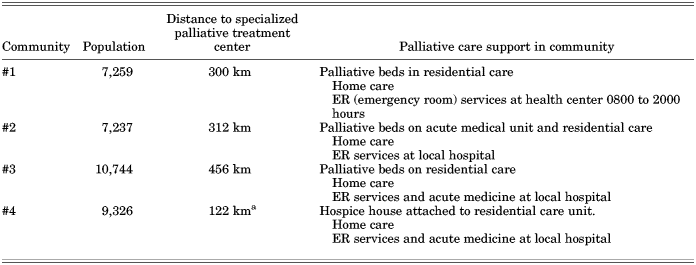
A qualitative ethnographic approach was used in this study, an approach that has the potential to provide a thick contextual description of the rural context (Prata Miller, Reference Prata Miller2006) and acknowledges the importance of social relationships to healthcare (Nelson et al., Reference Nelson, Lushkov and Pomerantz2006). The study context was four rural communities located in Western Canada. These communities were identified as rural in that they had populations of ≤10,000, and were located at least a 3 hour travelling distance by car from a specialist palliative care treatment center (see Table 1). This definition of rurality was chosen based upon the assumption that the quality of palliative care is influenced by the availability of specialist palliative care, including multidisciplinary teams with relevant expertise, hospice houses, and advanced pain and symptom management. Although a number of communities fit these criteria, these four communities were chosen based on the following: diverse geographic and cultural characteristics, a large enough population to support a rich data set, individuals in the community who had an interest in palliative care, variability of services to support palliative care, and previously established relationships with investigators through pilot work. Community #4 did not meet the criteria of distance to a specialist palliative treatment center (i.e., the community was 122 km from specialist services); however, it was one of the few rural communities that had a hospice and, therefore, we sought to learn more about how that influenced care in the community. Each community typically had one or two designated palliative beds on acute medical units and/or residential care. However, these beds were also used for other patients who required private rooms, and, therefore, were not always available to palliative care patients. Further, these beds were not staffed by palliative care personnel, but rather were included in the regular workflow of the unit. Nursing care on these units was provided through a team-based approach whereby care providers with less educational preparation were typically assigned the less acute patients (e.g., often interpreted as palliative patients).
Characteristics of communities in study

aThis community was added to the study because it was one of the few rural communities with a hospice house.
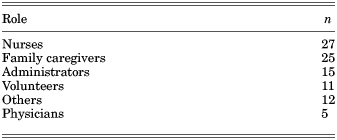
Data sources included 51 days of field work, 95 interviews, and 74 hours of direct participant observation in which the researchers worked alongside rural healthcare providers. Data were gathered between June 2009 and September 2010. Purposive and snowball sampling were used to identify interview participants. We took advantage of local knowledge by asking palliative champions in each community to assist with identifying and recruiting others in their locale with knowledge of palliative care to ensure representation of those individuals most involved in palliative care. The sample included a broad range of individuals involved in rural palliative care including family members, volunteers, nurses, physicians, social workers, healthcare administrators, occupational therapists, funeral directors, pharmacists, and clergy (see Table 2). The breakdown of the participants reflected the numbers involved in rural palliative care in the communities. For example, the five physicians represented the physicians who were recognized for palliative expertise in these communities. Direct participant observation was conducted primarily with nurses who worked with palliative care patients in an acute or home setting. Field work in the communities consisted of immersion experiences designed to enable the researchers to get to know the communities better, and included activities such as reading local papers, visiting museums, and attending functions such as the hospice care society meetings.
Research participants by role
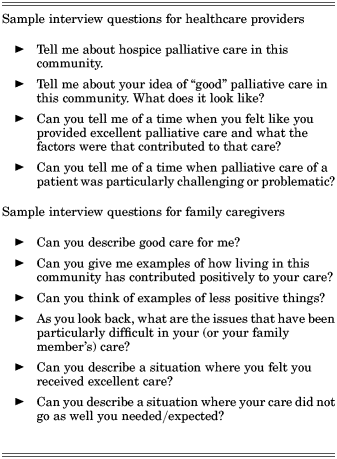
Interviews were conducted face-to-face in the communities by the principal investigator or research assistant using a semistructured interview guide (see Table 3). Questions solicited participants’ ideas of high-quality palliative care and the strengths of, gaps in, and aspirations for palliative care in their community. Participants were asked to relate stories of both positive and negative palliative care experiences. The interview guide was pilot tested on two participants and then refined. Interviews lasted from 30 to 90 minutes, were audiotaped, transcribed verbatim, checked for accuracy, and entered into NVIVO8QSR qualitative software for analysis. Field notes were written after each interview to provide context for the interview and to aid in reflection on the data. These field notes were not included as part of the thematic analysis but rather served to triangulate and deepen findings from the interviews.
Sample interview questions
Construction of the findings was informed by the ethical understandings of Urban Walker (Reference Urban Walker2007). Urban Walker, in keeping with other feminist moral philosophers, has suggested that the concept of responsibility provides an essential way to track moral practices. Morality can best be understood through understanding practices in a social context rather than through abstract theories. One gets a nuanced picture of this morality through trying to understand who is supposed to do what for whom and who is allowed to do what for whom. A descriptive understanding of these responsibilities provides important insights into those moral obligations that structure the context of care. Within the context of this analysis of rural palliative care, we can best understand “good” palliative care by providing a descriptive account of these social responsibilities. In keeping with this descriptive ethical approach, data were analyzed as follows. The guiding analytical question was: how do participants view their responsibilities for palliative care in this community, particularly in relation to one another?
Thematic analysis was performed using the principles of interpretive description (Thorne, Reference Thorne2008). After reading multiple transcripts to gain a broad view of the data, a coding framework was constructed by two investigators, which was used to code the data. The framework included broad preliminary categories that reflected important topics that surfaced in our review of initial interviews. Coded data were retrieved and examined by category of participant, comparing participant experiences within and across communities to characterize accounts that represented practices of responsibility. Themes were then developed inductively from the data for each category of participant to provide a descriptive account of social responsibilities. These themes were constructed by two investigators, and then refined by the team as descriptions and explanations of each theme were developed. Field work, field notes, and participant observations were used to further inform and triangulate findings from the interviews. Investigator reflexivity was supported through field note reflection and research team discussions, both of which informed the analysis. We used team discussions to identify assumptions that influenced emerging interpretations; explore how our status as outsiders to the study communities may have influenced data collection and analysis; and draw on our collective experience of palliative care, nursing, and rural life to raise questions about the data. Data collection occurred in two cycles over a 2 year period. After the first cycle of data collection, all participants were invited to meetings in their community to invite reactions to preliminary findings, and to identify important areas for further data collection. The analysis reported there is based on a synthesis of data from both cycles. Ethical approval for this study was obtained from the university and from the health authorities within which these communities resided.
RESULTS
Responsibility for palliative care in rural areas rests largely on family care providers, and they have important expectations of healthcare providers to assist them in performing these responsibilities. Their perspectives will be discussed first. We will then present how direct healthcare providers and administrators viewed their responsibilities, illustrating how these responsibilities form a complex web of care that serves to build rural capacity for palliative care. Quotes will be provided to ground the findings within the interview data, and have been selected based on representation of the various types of providers and on their ability to capture and illustrate significant points (F = family caregiver; N = Nurse; P = Physician; A = Administrator. Number is unique participant identifier).
Families
Families in this study experienced meaning in caring for their loved ones at end of life. Although they acknowledged the degree of burden they felt at times, this was typically outweighed by the responsibility they felt and the satisfaction they derived from having made a meaningful contribution. One husband who derived great satisfaction in caring for his wife for 3 years expressed this responsibility: “I can still walk eighteen holes, I can still pack a deer off the mountain, I still hunt and fish so I don't see any reason why I should've put her in an institution when I could do it” (F-8). To fulfill their caregiving responsibilities well, family members expressed a desire for three things from healthcare providers: assistance with pain and symptom management, designated healthcare providers with clear accountability for their loved one's care, and help with interpersonal conflict.
Assistance with Pain and Symptom Management
Within their responsibility for direct care provision, family members prioritized pain and symptom management, and, as such, expected and strived to get professional support to assist them. Poor pain and symptom management had a profound effect on memories of the palliative experience. Family members in our study seemed to have somewhat polarized views of the dying process, experiencing it as overwhelmingly good or bad. Much of this was shaped by their perceptions of whether symptoms, and in particular, pain, were well managed. For example, one participant whose husband was left in uncontrolled pain expressed the following: “That last hospitalization was a nightmare…none of that should have happened…it just added to the pain of everything else that was going on” (F-11). However, concerns were typically more about whether healthcare providers provided suitable attention to the pain and symptoms rather than whether they were alleviated. There were instances in the data in which family members acknowledged that there was unrelieved pain, but when they felt that healthcare providers had done everything they could to address it they ultimately felt supported and that their responsibility had been met. Managing symptoms also meant what one participant termed “riding the wave” (F-9). This meant recognizing that even in the palliative process there were times when symptoms such as dehydration or cardiac dysrhythmias needed to be managed as acute events. Family members spoke of “knowing” when this was part of the dying process or when it was a side effect of treatment that could be managed. Families also had their own reasons for wanting to treat symptoms aggressively, such as when they were waiting for a family member to arrive to say their last goodbyes.
Designated Providers with Clear Accountability
Family members fulfilled important responsibilities in relation to being coordinators of care and, as such, desired designated healthcare providers who could, in turn, have clear responsibility and accountability for being their point of contact with the healthcare system. Family members indicated that despite the close-knit nature of rural communities, fragmentation of care and unmet informational needs were a problem. They spoke of not getting consistent information that was timely according to their perceived needs, through a single point of contact. This was particularly difficult because family members felt that their loved ones relied on them exclusively as dying progressed, often to the exclusion of others. These family care providers expressed a desire for a single, knowledgeable person who could support them. When this did not happen, they were forced to expend significant amounts of energy seeking out information and resources, energy that they felt they did not necessarily have. Although this varied among the participants; several male care providers found that seeking information became a productive coping strategy.
To illustrate the importance of having healthcare providers who could knowledgeably guide them through the process of dying, one participant told a story of having two young family members dying several years apart from the same congenital disease. In the first situation, the community did not have a designated palliative healthcare provider. The family felt isolated, and struggled with decisions they felt were beyond their expertise, which resulted in distress. Several years later, when the second family member died, there was a general practitioner in the community with palliative care expertise, who guided them through the process. This made all the difference in their ability to fulfil their responsibilities. Critical disruptions in continuity of care often occurred when participants were forced to commute to urban centers for care. To bridge this gap, sometimes family members were able to identify individuals from their home communities who were now working in urban centers to advocate for and support them in their responsibilities as caregivers.
Help with Interpersonal Conflict
Family members often found themselves responsible for advocating on behalf of their loved one, and, therefore, expressed a need for someone to help them resolve the conflict that arose as a result of that role. The close-knit nature of rural communities results in strong subcultures within institutional settings both in residential and acute care. Accordingly, families spoke of the importance of being on the “good side” of care providers and not being labelled as the “difficult family”. This took on added importance in a context in which there were few options to change health providers or services. As one female family care provider expressed it “He never complained and neither did I. So that makes a difference to the way people operate [here]” (F-1). Another family care provider of an elderly woman who died in a residential care facility described the culture of secrecy that pervades the institutional culture. “You mind your p's and q's because you want to be really careful –right? You're not going to bite the hand that feeds your mom. And this is a very bad thing about care facilities, people fearing telling” (F-14). This fear of repercussion constrained family members’ ability to enact their responsibility to insure best care for the dying person. Some family care providers who were forced into the position of having to advocate strongly for their loved one had a sense of being shut out by professional providers, and that experience profoundly affected their trust in the system. Families who were well known in the community had a better chance of having strong advocates within the healthcare system than those who were only connected peripherally.
Direct Professional Healthcare Providers
Although a number of healthcare providers were interviewed in this study, including home support workers, social workers, pharmacists, and occupational therapists, the primary care providers in rural communities are general practitioners and nurses and, therefore, it is those responsibilities that will be highlighted here. These responsibilities consisted of interpreting their competency in relation to palliative care, negotiating their role in relation to that interpretation, and individualizing care through a bureaucratic system.
Interpreting Competency in Relation to Palliative Care
The need for healthcare providers to interpret their own competency in relation to palliative care resulted largely from the generalist nature of rural practice. The extent to which caring for dying patients is a function of healthcare providers with specialty training, as opposed to part of a continuum of generalist primary care, is a debate generated primarily in urban areas where specialists are available. A number of direct professional healthcare providers in our study had travelled to urban areas to gain palliative specialty education. However, in rural areas, even individuals with additional palliative care training may not be able to contribute that expertise because of healthcare policies. For nurses with palliative care credentialing, the ability to contribute that expertise is shaped largely by healthcare decisions such as staffing models and the locations of palliative care beds. For example, when palliative care beds are located in residential facilities, care is delivered by licensed practical nurses,Footnote 1 who may have patient loads as high as 22:1 with the assistance of care aides. This workload makes acute symptom intervention, such as managing uncontrolled pain, difficult if not impossible. This is further complicated by the lack of availability of general practitioner support in residential care facilities and of the medications that are required for some of the more complicated symptoms of dying. In this situation, the licensed practical nurses’ responsibilities for palliative pain and symptom management are limited by the resources available to them, and the solution is often to transfer the patient to acute care.
When the palliative care beds are located on acute medical units, the staffing ratios might be more supportive of palliative care, but the acuity of the unit population may mean the palliative patients are assigned a lower priority. In one of the study sites, the community had given generously to build beautiful palliative care rooms on the acute medical unit. However, family members acknowledged challenges inherent in palliative care on medical units. “At the hospital they didn't have the time. It was almost like he was at the end of their list because there wasn't any medical interventions” (F-3). Nursing skill mix also often dictates that the licensed practical nurses are assigned the “less acute” patients, who, in this situation, are the palliative care patients. In our study, there were registered nurses who had prepared themselves with palliative care certification, but they were typically not assigned to care for palliative care patients according to skill mix models. Ironically, however, the movement to promote palliative care as a speciality meant that some registered nurses who did not have this education felt ill prepared, and, therefore, were reluctant to care for individuals in palliative care beds. In other words, adopting the specialty lens allowed some nurses to abdicate responsibility for palliative care. Nursing models in home and community care illustrated similar challenges. Registered nurses in these roles were often highly skilled in palliative care but were expected to rotate between various roles (e.g., in the wound clinic) of which home palliative care was just one. This posed real challenges for continuity of care for palliative patients, and once again, those registered nurses who had additional education in palliative care were not always used to full advantage. Overall, for nurses, this meant that their responsibilities for palliative care were largely self-defined, and those who had advanced preparation were not necessarily able to use that specialization to maximal advantage.
Similar challenges faced general practitioners. Many of the issues had arisen as a result of important historical decisions around the use of specialists in rural areas. Several physicians in our study referred to a time in rural areas when medical care was delivered primarily by general practitioners who acquired additional education in specialties. Within this model, there was a strong sense of community ownership, mutual responsibility, and egalitarianism. These general practitioners did not get on-call pay, and volunteered an enormous amount of time. However, changes in healthcare in this study context have led to there being more specialists in rural areas, and to on-call fees being paid for certain specialties; although, palliative care was not one of those specialties. One physician in this study suggested that this had led to the “Starbucks®” syndrome in rural care, in which general practitioners have become more individualistic, picking and choosing the types of care they are willing or feel they are competent to provide. Several physicians in this study believed there was a diminishing sense of community commitment and voluntarism. General practitioners who had chosen to pursue further education in palliative care found they had to volunteer large amounts of time to function in that role without any guarantee that their colleagues would use their expertise. Physicians’ willingness to assign responsibility for palliative care to someone else largely depended upon whether they viewed it as a specialty or a continuum of their generalist practice. The dilemma is expressed well by one physician.
In working with your colleagues in palliative care you try not to step on people's toes. Part of it is what do you know that I don't know, like you're just a general practitioner? Why should I believe you as opposed to myself? Rural physicians tend to be rugged individualists (P-3).
In one community, the general practitioner with additional palliative care training had instituted incremental levels of referral, from assuming total care to only consulting sporadically for difficult symptom control. This allowed general practitioners to continue care while having backup for symptoms that required additional palliative care expertise.
Negotiating Roles in Relation to Competency
Part of the challenge of not having clear-cut responsibilities for palliative care was that nurses and physicians were in a constant state of negotiation. In the words of one nurse, one of the greatest challenges of rural palliative care is that no one is ultimately accountable for “seeing the big picture” (N-8). In some cases, general practitioners remained intimately involved in the process of care, even making regular home visits. However, in other situations, the home care nurses became the central coordinators of care, corresponding primarily through fax or telephone to the general practitioner. In many cases, this fluidity of responsibilities worked well, particularly if the physicians and nurses knew one another well and trusted each other's ability to provide care. However, in other cases, this situation was less than ideal, particularly if the general practitioner was not familiar with current palliative care practices or if there had been long-standing interpersonal tensions between healthcare providers. In some rural communities, physician shortages have required recruiting physicians from other countries where the philosophy and competencies of palliative care are different than in Canada. When the negotiation went poorly, leaving patients with severe unmanaged symptoms, nurses would go to extraordinary lengths to get the required orders. In one situation, a nurse called a physician hundreds of miles away, who had previously resided in the community and practiced palliative care there. In another situation, a nurse called a palliative care referral line and requested that they call the general practitioner to provide advice. Having to go to these extraordinary measures often took its toll on nurses, and resulted in a sense of isolation, something that is already a prevalent feeling for healthcare providers in rural communities. Further, nurses who took these extraordinary measures risked being left in a position of vulnerability, because they had potentially undermined the relationship with the general practitioners in their immediate communities. However, despite nurses’ best efforts, they were not always successful in obtaining the orders they needed to manage pain and symptoms. One nurse who had been unable to get sufficient analgesia for a patient in intractable pain expressed her frustration:
I was the one having to deal with it all. Like, where was the team, where was the support system, even one other person to say “you're doing the best you can, maybe no one could do this better” … . I think it gets really hard to kind of rally the troops because sometimes you are the only troop (N-1).
The negotiation between physicians and nurses involved in palliative care was further influenced by the gatekeeping roles played in rural communities. Home care nurses are often the recognized palliative care experts in rural communities, and, therefore, have a highly influential role. This role typically comes into play once formal palliative orders are signed that mandate home care nursing involvement. There were examples in the data in which general practitioners were reluctant to write these palliative care orders because it resulted in other care providers becoming intimately involved in care. This may not have been a desirable option for physicians who had cared for individuals and their families, and become closely connected to them, over a period of many years. In another situation, there was a long-term outpost nurse who had served the community for many years. When a general practitioner moved into the community desiring to set up a practice, residents resisted, fearing that it would mean the loss of their long-term nurse who had provided palliative care. Ultimately, the physician was unable to set up a practice and had to practice in a distant hospital.
Individualizing Care within a Bureaucratic System
Finally, physicians and nurses saw individualizing care within a bureaucratic system to be an important responsibility. Both physicians and nurses talked about knowing the patient and family well enough to be able to anticipate their needs, as there was no 24 hours per day/7 days per week palliative care coverage. Indeed, it was this sense of knowing and being known that providers felt was essential to their ability to provide high-quality care. In the context of this study, rural healthcare was governed by large health authorities responsible for multiple urban and rural sites. This sometimes led to tensions between health authority policy and what individual providers felt was best for their patients, who many times also happened to be friends. For example, there was a movement within these communities to situate palliative care beds within residential care. Policies stipulate that whereas there is no daily fee for acute care, once patients move into residential care there is a $30/day fee, a substantial amount for many rural individuals. One of the most common points of contention in the data was the presence of this fee, and consequently, the feeling that individuals were “paying to die”. Healthcare providers simply could not reconcile stabilizing palliative care patients in acute care for no charge, and then informing them that they would now be charged for a palliative care bed. There were situations found in the data in which healthcare providers went to extensive lengths to bend the rules to ensure that individuals were not charged this fee to die. However, this approach had drawbacks, mainly that the standing palliative care orders could not be implemented. “If they are deemed palliative those standing orders come out and then they start paying that per-diem rate” (N-7). The palliative care bed situation was further complicated by the fact that some these residential facilities were private, for-profit facilities. This was a relatively new development for these rural communities, and there was a sense that this trend constituted an abdication of responsibility that took patients outside of the carefully negotiated roles of the public system. Some providers felt that the quality of care was lower in the private system and were reluctant to send patients there. Healthcare policies such as the ones described here often meant that direct healthcare providers and administrators had somewhat differing agendas, which made it difficult for each of them to fulfill their respective responsibilities.
Administrators
Administrators talked about three primary responsibilities they carried in relation to palliative care delivery in their community: navigating the politics of palliative care, understanding the culture of the community, and communicating with the community.
Navigating the Politics of Palliative Care
Administrators faced strong and often conflicting responsibilities as they strove to meet their obligations to the health authority and their obligations to direct care providers in their communities, who were often also family and friends. Decisions related to healthcare restructuring that entailed layoffs, bed closures, and privatization of services were particularly challenging. This sense of being caught in the middle was exacerbated by the ideal of palliative care. One administrator, when questioned about the topic of rural palliative care replied, “That is a loaded one” (A-2). In each of the study communities, there was a group of champions passionate about providing high-quality palliative care. These same individuals expressed a strong sense of injustice when these ideals were not realized, creating a politicized environment around palliative care delivery.
Understanding the Culture of the Community
Each of the communities in our study had a strong identity as a community and contained a number of subcultures within that identity. It was interesting to note how many times, when asked to describe the character of their community, the participants could immediately identify that character and contrast it with surrounding communities. For example, one community was identified as a blue-collar, highly civic-minded community, another as an artistic, more individualized, community. Ethnic and religious groups identified within our communities included First Nations, Italian Catholic, South Asian Sikh, and Russian Dukhobour. Administrators indicated that an important responsibility was for them to know the culture of their community and to work within it. For example, one participant talked about the incredible generosity one community had toward healthcare, likening it to the community's favorite “pet”. Acknowledging that was important for recognizing that when changes occurred, individuals who felt strongly invested in that “pet” were going to feel a strong sense of ownership of the change.
Communicating with the Community
Finally, administrators felt a strong sense of responsibility for communicating with the community about the vision, plans, and activities of the health authority. It was quite striking for us as researchers to realize how difficult it was to disseminate information even in these small communities. Brochures or announcements over email and newspapers were generally ineffective. Hospice societies had difficulty making their services known and visible. Healthcare administrators spoke of spending significant resources to inform physicians and nurses in the community about the services available through the health authority. At one point in the study, in one of our study communities, a popular social worker's job was terminated. We returned to the community to re-interview participants about the change. The interviews illustrated well the lack of information and misinformation that attends even significant change in rural communities, an observation that was supported by an administrator. “That's our challenge. They hear little bits and pieces and they get whatever slant of whomever is telling the story. Do they get an opportunity to hear the real story? Probably not” (A-13). When administrators did make unpopular decisions the community primarily used the local media to express their disfavor.
As illustrated, quality rural palliative care depends upon a complex web of interdependent responsibilities. It is often the complex negotiation of these responsibilities that serves to fill in the gaps that occur in rural healthcare services.
DISCUSSION
The goal of this analysis was to provide a descriptive account of responsibilities in rural palliative care. In keeping with Urban Walker's (Reference Urban Walker2007) account of moral practices of responsibility, we sought to explore how family caregivers, healthcare providers, and administrators viewed practices of responsibility, both in terms of what they expected of others and of what they expected of themselves in relation to others. Such an account is useful in that it reveals the moral landscape upon which good care is constructed and negotiated, an important consideration when building policy and practice for palliative care in rural areas.
Although the data provided a comprehensive look at palliative care in four communities, the findings need to be considered in light of several limitations. All of the study communities were of a similar size within a single province. Experiences may also differ in settings where publically funded healthcare systems are not the norm. The sampling method of having champions identify those who should be interviewed meant that the participants were often those who were most visible in the community. Although these individuals had intimate knowledge of palliative care in their community, they were also strong advocates, and, as such, had a particular perspective about what constituted appropriate care; we did not seek for diverse viewpoints from those who were less familiar with palliative care. We know little about those who were less connected to palliative services.
Our findings point to distinctive features of rural palliative care practices and provide insights into the complex ways that rurality influences understandings of responsibility in palliative care. In adopting the primary caregiving role, families described a constellation of expectations of healthcare providers that enabled them to do their job well. Healthcare providers, in the absence of specialized palliative teams and resources, described how they negotiated and adapted their responsibilities to fill in potential gaps in care. Administrators described knowing their communities and carrying dual responsibilities to those communities and to the health authority. Three areas are particularly relevant for this discussion: the positive and negative effects of having the type of flexible responsibilities described here; the adaptations that rural providers make to ensure compassionate care; and the policies that have unintended negative consequences on the quality of care.
Flexible Responsibilities
The flexibility of the responsibilities we observed had both positive and negative effects. On the positive side, the flexibility within which responsibilities for palliative care were assumed and practiced helped to bridge gaps in care that often exist in rural settings. Individuals were willing to step in, to go above and beyond the call, to ensure that quality care was provided. These practices were possible because of long-standing and close relationships, and being a part of (rather than apart from) the community. This type of voluntarism has been referred to as “stealth voluntarism” (Hanlon et al., Reference Hanlon, Halseth and Ostry2011), because it is often difficult to recognize, arises as a result of underlying conditions such as service deficits, and is often “masked behind personal and professional commitments to help” (p. 42). Hanlon et al. have suggested that this type of voluntarism has a high personal and professional cost, but also contributes to the bonds of attachment that healthcare providers feel for their communities. These findings were borne out in our study, in which healthcare providers felt both a burden of care and a deep sense of meaning from going above and beyond in their community. It further explains the discomfort that some participants felt with healthcare providers who did not have the same level of attachment to the community, such as foreign-trained physicians, specialists brought in to the community, or private for-profit companies who provided residential care. If this type of voluntarism does provide intrinsic rewards and is a source of shared morality within rural communities, we need to understand further the role that it plays before dismissing it as a health service delivery problem of service deficits, or as an ethical problem of dual personal/professional relationships.
Although the flexibility inherent in healthcare provider roles helped to fill in health service delivery gaps, there were disadvantages to this flexibility. How communication flows in a rural community is an excellent example of how flexibility can bring both advantages and disadvantages. Arnaert et al.'s (Reference Arnaert, Seller and Wainwright2009) study of rural home care nurses delivering palliative care found that communication between healthcare providers about palliative care patients was generally unstructured and sometimes haphazard. Wilson et al. (Reference Wilson, Fillion and Thomas2009), however, in their ethnographic study, emphasized the positive aspects of this free-flowing communication, as it facilitated a quick response from the most appropriate individuals. In our study, when responsibilities were not clearly delineated, there was an increased chance of fragmented care, power struggles, and gaps in service. This was particularly significant when family members expressed that one of their greatest needs was a reliable, single point of contact with the healthcare system. Their lack of consistent information, support, and advocacy made enacting their responsibilities as care providers more challenging. Our findings support those of others who have suggested that the politics related to control and decision making that play out in rural palliative care can lead to lower quality care (Crooks et al., Reference Crooks, Castleden and Hanlon2011). Further, if morality is born out of shared understandings of “assigning, accepting, and deflecting responsibility” (Urban Walker, Reference Urban Walker2007, p. 235) then confusion of responsibilities can lead to moral distress. Participants in this study expressed distress when responsibilities did not play out as they expected, and this distress was acute when patients and families suffered as a result.
Rural Adaptations to Ensure Compassionate Care
Several studies done within the Canadian context have pointed to the inherent capacity of rural communities for high quality palliative care (Kelley, Reference Kelley2007; Kelley et al., Reference Kelley, Williams and DeMiglio2011; Pesut et al., Reference Pesut, Bottorff and Robinson2011). The practices of responsibility highlighted in this study should raise suspicion about views of rural capacity for palliative care based upon limited data (e.g., aggregated healthcare utilization) or on deficit models of rural communities. For example, Menec et al. (Reference Menec, Nowicki and Kalischuk2010) analyzed the likelihood of hospitalization in urban and rural areas, and suggested that the increased hospitalizations at the end of life for people in some rural and remote regions may happen because these areas are disadvantaged by the lack of availability of healthcare resources. Although this finding was supported to some extent in our data, there was also an adaptive element that facilitated high-quality palliative care. Nurses and others bent rules to keep palliative care patients in hospital to avoid transfers to palliative care beds where patients would be charged $30 per day. This illustrates how something that on the surface can appear to be a disadvantage, when observed more closely, may reflect an important adaptation to ensure compassionate palliative care. Further, these findings challenge those who suggest that palliative care services increasingly deteriorate as distance from urban based centers increases (Schuurman et al., Reference Schuurman, Crooks and Amram2010) and that rural palliative care needs are best served by hubs specializing in palliative care (Crooks et al., Reference Crooks, Castleden and Schuurman2009). Although from an urban model of palliative care these conclusions make sense, our findings indicate that responsibilities for palliative care are taken seriously in rural communities by families, health providers, and administrators, and that, overall, the work of palliative care in these communities was not uninformed or consistently substandard. Our findings echo those of others that suggest that networks of relationships and dedicated providers contribute to high quality palliative care in rural areas (Rosenberg & Canning, Reference Rosenberg and Canning2004; Pesut et al., Reference Pesut, Bottorff and Robinson2011).
Unintended Policy Consequences
Ironically, the very web of responsibilities that ensured good care in light of limited resources was also easily disrupted by policies originating from outside of the community. Communities were particularly vulnerable to developing substandard care when policies originating from health authorities or other governing bodies (e.g., per diem fees, closures of facilities, staffing skill mix, and specialist on-call fees) disrupted long-standing negotiated responsibilities. What was viewed as an important system adaptation and standardization from an urban perspective often had unintended negative consequences from a rural perspective. An example of this was the location of palliative care beds within private for-profit residential facilities. The negotiated responsibilities that enabled healthcare providers to be flexible and adaptable to support capacity were disrupted when patients were transferred out of the public system into the private system, and in the opinion of some, the quality of care suffered. The angst some felt over the privatization of palliative care was only exacerbated by the fact that the private system was viewed as operating outside of the realm of the broader social responsibilities in the rural community (e.g., in its hiring practices). Administrators felt this tension, as they had accountability to health authorities for supporting this model of care even though the model was unpopular with some in the community. Responsibilities from a managerial point of view (e.g., fiscal or human resource decisions) were not necessarily congruent with the practices of responsibility as seen by the other stakeholders in palliative care.
Farmer et al. (Reference Farmer, Philip and King2010) found similar misaligned perspectives in their study of health service provision for older adults in rural Scotland. They concluded that these misaligned perspectives often existed because community members tended to view services such as health, social care, and transport as interconnected, and focused primarily on local solutions so that individuals could be cared for within their communities. Managers, however, tended to see services within silos and focused on a more utilitarian perspective that emphasized centralization and the sharing of services across communities. In the case described in our study, managers of healthcare saw the benefits of privatizing residential care, whereas community members preferred the social obligations characteristic of the publicly funded model that had been the norm in the community.
It was this more utilitarian perspective that often drove the healthcare changes described in our study. The impact of these changes could be devastating and long standing. Devastating because once responsibilities were unravelled, they were not easily replaced. Rural resources are finite, particularly valuable human resources. Long standing because many rural individuals reside in their communities over a lifetime and, therefore, they remember healthcare changes that impacted their lives deeply. This is one of the most important findings from this study. Much previous research in rural palliative care has emphasized programmatic deficits in rural palliative care and focused on innovative models of delivery (Robinson et al., Reference Robinson, Pesut and Bottorff2009). However, what has not been well documented are the ways in which healthcare policies serve to undermine rural capacity. This is an area that warrants further study.
CONCLUSION
Supporting high quality palliative care in rural areas requires an in-depth understanding of the rural context and how individuals perceive and play out their responsibilities in relation to palliative care. Findings from this study illustrate how families, healthcare providers, and administrators work together in fluid and complex ways to support high-quality palliative care in their communities. However, the very fluidity of responsibilities necessary to navigate the rural context can also work against high-quality care and can easily be disrupted by externally imposed healthcare changes. The commitment to practices of responsibility in relation to palliative care and the way that community members make the best of their circumstances to provide palliative care need to be recognized and supported. Proposed policy and practice changes should undergo a careful analysis of their potential impact on the long-standing negotiated responsibilities that characterize rural palliative care.
ACKNOWLEDGMENTS
This work was supported by the Canadian Institutes of Health Research (grant number EOG 90308). Dr. Pesut is supported by a Canada Research Chair.