INTRODUCTION
The class Turbellaria includes primarily free-living forms in marine and freshwater benthic habitats. Marine turbellarians, falling under the order Polycladida are called as polyclads. These are the most colourful and graceful creatures found in tropical shallow water and intertidal areas although they are also recorded in temperate and deep-sea environments (Quiroga et al., Reference Quiroga, Bolanos and Litvaitis2006). These polyclads are characterized anatomically by having a branched and irregular gut and a pharynx plicatus.
In India, studies regarding polyclads are very few. These studies have been neglected for a time, and therefore very little is known about their diversity from India. The earliest work was done by Laidlaw (Reference Laidlaw1902) from the Laccadive Islands and afterwards the only studies were done by Sreeraj & Raghunathan (Reference Sreeraj and Raghunathan2011, Reference Sreeraj and Raghunathan2013) from the Andaman and Nicobar Islands and Apte & Pitale (Reference Apte and Pitale2011) from the Lakshadweep Islands. This clearly illustrates a huge gap of around one hundred years between the studies carried out on these animals in India.
The genera Pseudoceros (Lang, 1884) and Tytthosoceros (Newman & Cannon Reference Newman and Cannon1996) come under the family Pseudocerotidae (Lang, 1884). This family is characterized by the presence of pseudo (false) tentacles, ruffled pharynx and horseshoe-shaped eye cluster. Both Pseudoceros and Tytthosoceros have only one male pore, unlike Pseudobiceros (Faubel, 1984) and Thysanozoon (Grube, 1840), which have two male pores. Members of the family Pseudocerotidae are the most brilliantly coloured of the coteyleans and are easily found during day time. These pseudocerotids can be recognized solely on the basis of their colour patterns and the reliability of the use of these colour patterns for species diagnosis has been confirmed with molecular data (Litvaitis & Newman, Reference Litvaitis and Newman2001).
MATERIALS AND METHODS
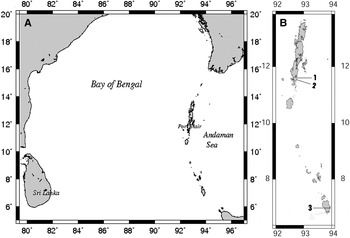
Specimens were hand-collected using a paint brush from the intertidal areas of the Andaman and Nicobar Islands (Figure 1). Specific locations and geographical information are given with each species. Specimens were photographed in situ using a Sony Cybershot TSC900 with housing, collected in separate containers and brought to the laboratory where photographs were taken for live specimens. Animals were fixed in 10% formalin buffered with seawater after relaxing them in 5% alcohol. The morphological features and measurements were examined using a stereo zoom microscope (Lecia, DFC-500). Species were identified based on key characters and other morphological features (Newman & Cannon, Reference Newman and Cannon1996, Reference Newman and Cannon1998, Reference Newman and Cannon2003, Reference Newman and Cannon2005). All the identified materials were deposited in the National Zoological Collections at the Zoological Survey of India, Andaman and Nicobar Regional Centre.
(A) Position of Andaman and Nicobar Islands; (B) survey sites: 1. Carbyn's Cove; 2. Burmanallah; 3. B. quarry.

RESULTS
SYSTEMATICS
Phylum PLATYHELMINTHES Gegenbaur, 1859
Clade RAHABDITOPHORA Ehlers, 1986
Order POLYCLADIDA Lang, 1884
Suborder COTYLEA Lang, 1884
Family PSEUDOCEROTIDAE Lang, 1884
Genus Pseudoceros Lang, 1884
Pseudoceros irretitus Newman & Cannon, Reference Newman and Cannon1998.
MATERIAL EXAMINED
One adult specimen, size ~20 mm, found under a rock in the intertidal area of Burmanallah, South Andaman, India (110 34′02.57′′N 920 44′18.04′′E), date: 9 November 2012, coll. by Sudhanshu Dixit; Registration No. ZSI/ANRC/ 8261.
DESCRIPTION
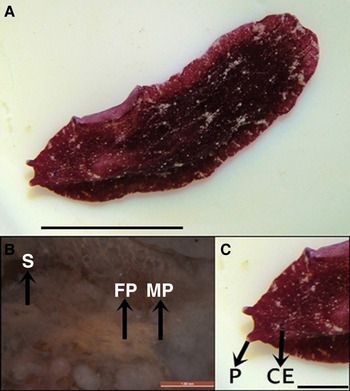
Background colour bright red with fine reticulate pattern of white lines and irregularly scattered large and small white dots (Figure 2A). Light red ventrally (Figure 2B). Pseudotentacles are small. Body with few ruffles. Cerebral eyes present in cluster of about 20 eyes (Figure 2C).
(A) Live specimen of Pseudoceros irretitus showing characteristic white reticulate pattern; (B) ventral view; (C) pseudotentcles and eyes. CE, cerebral eyes; FP, female pore; MP, male pore; P, pseudotentacles; S, sucker. Scale bars: A, 1 cm; B, 1 mm; C, 5 mm.

REMARKS
Found resting on sandy seabed under a rock in the intertidal area. Previously recorded from Australia, Indonesia, Japan and Micronesia.
Pseudoceros cruentus Newman & Cannon, Reference Newman and Cannon1998.
MATERIAL EXAMINED
One specimen, size ~ 15 mm, found attached on brown colonial ascidian underside of a rock in the intertidal area of Carbyn's Cove, South Andaman, India (11037′50.91′′N 92045′07.28''E), date 23 March 2013, coll. by Sudhanshu Dixit; Registration No. ZSI/ANRC/8641.
DESCRIPTION
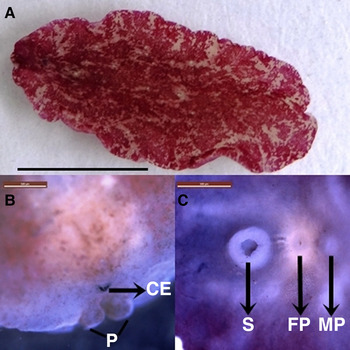
Background colour deep red with cream microdots, irregular patterns and blotches all over the body (Figure 3A). Body rounded oval and very soft, light red ventrally. Margin not conspicuously ruffled. Pseudotentacles small and very close to each other. Cerebral eyespot small with about 20–25 eyes (Figure 3B).
(A) Live specimen of Pseudoceros cruentus; (B) pseudotentacles and eyes; (C) ventral view. CE, cerebral eyes; FP, female pore; MP, male pore; P, pseudotentacles; S, sucker. Scale bars: A, 1 cm; B, 500 μm; C, 500 μm.

REMARKS
Found resting on brown colonial ascidian Didemnum psammatode (Sluiter, 1895). Secretes red mucus-like substance when disturbed. Previously recorded from Australia, Indonesia, Japan, Micronesia, Papua New Guinea and South Africa.
Genus Tytthosoceros Newman & Cannon, Reference Newman and Cannon1996
Tytthosoceros lizardensis Newman & Cannon, Reference Newman and Cannon1996.
MATERIAL EXAMINED
One specimen sexually mature, size ~80 mm, found clinging with a rock in the intertidal area of B. quarry, Campbell Bay, Great Nicobar Island, India (7000′11.28′′N 93056′45.73″E), date: 21 December 2012, coll. by Sudhanshu Dixit; Registration No. ZSI/ANRC/8267.
DESCRIPTION
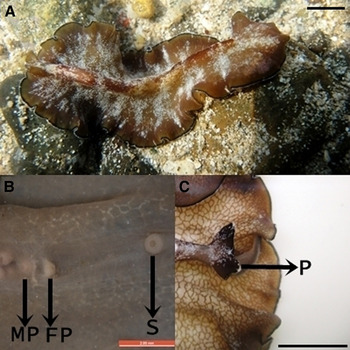
Background colour dark brown with cream mottling and numerous dots (Figure 4A). Body raised medially, ear-like pseudotentacles with white tips and cream mottling in between (Figure 4C). Cerebral eyes horseshoe shaped with about 100–110 eyes. Outer margin black, very narrow with white microdots. White transverse streaks on margin. Margin highly ruffled. Ventral surface light brown in colour (Figure 4B).
(A) Live specimen of Tytthosoceros lizardensis; (B) ventral view; (C) pseudotentacles and eyes. FP, female pore; MP, male pore; P, Pseudotentacles; S, Sucker. Scale bars: A, 1 cm; B, 2 mm; C, 5 mm.

REMARKS
Found attached to a rock partly immersed in water, very large (about 80 mm). Previously recorded from Australia, South Africa, Indonesia and the Philippines.
CONCLUSIONS
Due to difficulty in finding as well as in preservation, polyclad flatworms are one of the least studied faunal groups in India. In contrast to the Indo-Pacific and Great Barrier Reef regions where about 600 species were recorded (Newman & Cannon, Reference Newman and Cannon2003), in India a much smaller number of species have been recorded to date (Laidlaw, Reference Laidlaw1902; Apte & Pitale, Reference Apte and Pitale2011; Sreeraj & Raghunathan, Reference Sreeraj and Raghunathan2011, Reference Sreeraj and Raghunathan2013) and it seems that these are much unexplored marine animals, which await serious investigation. Polyclads are very simple organisms in terms of their morphology and body plan in comparison to other organisms but still our knowledge about their taxonomy and behaviour is very poor. More surveys and studies have to be carried out in order to understand and to document these colourful creatures from the Indian region.
ACKNOWLEDGEMENTS
The first author thanks C.R. Sreeraj for his valuable comments and help during this work. The authors thank the Ministry of Environment and Forests, Government of India for providing the necessary facilities for carrying out the work. Our gratitude is also expressed to the Director, Zoological Survey of India for the support provided.