Introduction
Recent studies in the family Pyrenulaceae have revealed that systematic revision at the genus level is necessary. For instance, the genus Pyrenula Ach. (Acharius Reference Acharius1814), with the largest number of species in the family, is not monophyletic. Other genera currently accepted in Pyrenulaceae for which sequences are available, namely Anthracothecium, Lithothelium and Pyrgillus, are nested within Pyrenula s. lat. (Gueidan et al. Reference Gueidan, Villaseñor, De Hoog, Gorbushina, Untereiner and Lutzoni2008, Reference Gueidan, Aptroot, Cáceres and Binh2016; Aptroot Reference Aptroot2012; Weerakoon et al. Reference Weerakoon, Aptroot, Lumbsch, Wolseley, Wijeyaratne and Gueidan2012). Several genera are included in the family based on phenotype features but without any molecular data, such as Clypeopyrenis, Distopyrenis, Pyrenowilmsia and Sulcopyrenula (Lücking et al. Reference Lücking, Hodkinson and Leavitt2017). In addition, the monospecific genus Polypyrenula D. Hawksw. (Hawksworth Reference Hawksworth1985) had been placed provisionally in Pyrenulaceae (Hawksworth Reference Hawksworth1983, Reference Hawksworth1985; Harris Reference Harris1995; Lumbsch & Huhndorf Reference Lumbsch and Huhndorf2010).
Thus far, Polypyrenula was known with certainty only from the type collection of Microthelia sexlocularis Müll. Arg. This consists of two small pieces of bark collected by Fée almost 200 years ago from a medicinal plant brought to Europe from the Caribbean, identified as Croton cascarilla (L.) L. An earlier collection from the same substratum and originally identified by Fée (Reference Fée1825) as Verrucaria epidermidis var. albissima was also considered to represent this taxon (Hawksworth Reference Hawksworth1983; Aptroot Reference Aptroot1991). Clements (Reference Clements1909) first established the generic name Polythelis for Microthelia sexlocularis, thereby generating an illegitimate later homonym of Polythelis Arthur, established only three years earlier for an unrelated rust fungus. This was probably in the course of Clements's work on his book and therefore Clements was presumably unaware of this pre-existing name. Hawksworth (Reference Hawksworth1985) subsequently introduced the replacement name Polypyrenula and the combination P. sexlocularis (Müll. Arg.) D. Hawksw. Aptroot (Reference Aptroot1991) reasoned that the earlier epithet albissima applied to this taxon and proposed the combination P. albissima (A. Massal.) Aptroot, which was based on a misconception as explained below.
Regarding the ecology and distribution of P. sexlocularis, Hawksworth (Reference Hawksworth1983) argued that the reported phorophyte name, Croton cascarilla, was a synonym of C. eluteria, a species presumed to be restricted to the Bahamas, but that the name C. cascarilla had generally been misapplied to C. linearis, an apparently more widespread species. The taxonomy of these plants remains unresolved (Webster Reference Webster1993; Van Ee & Berry Reference Van Ee and Berry2010) but this group of species is characteristic for the Caribbean. Given that most tropical crustose lichens have little to no phorophyte specificity (Cáceres et al. Reference Cáceres, Lücking and Rambold2007; Rosabal et al. Reference Rosabal, Burgaz and Reyes2013), it is unlikely that P. sexlocularis is restricted to a single phorophyte species, as suggested by Hawksworth (Reference Hawksworth1983), or even a single genus, although a distribution restricted to the Caribbean may be conceivable. Aptroot (Reference Aptroot1991) assumed a rather narrow distribution, considering the species possibly extinct. Potential phorophyte specificity also depends on whether the taxon is lichenized or not: if lichenized, there should be no strict specificity but rather a preference for certain bark types depending on structure and pH, among other characters; if non-lichenized, specificity depends on the source of carbohydrates for the fungus (i.e. whether saprotrophic or even parasitic). Previous studies considered Polypyrenula to be doubtfully lichenized (Aptroot Reference Aptroot1991; Gueidan et al. Reference Gueidan, Aptroot, Cáceres and Binh2016), although Hawksworth (Reference Hawksworth1983) suggested it might be associated with Trentepohlia.
Polypyrenula sexlocularis is unique in having ascospores with a pronounced basal euseptum (formed from the septal plate, the septal material is deposited starting from the centre towards the periphery, more or less parallel to the separating membrane), followed by 3–4 distosepta (lacking a septal plate and formed from the endospore, the septal material is deposited from the periphery to the centre, usually more densely near the edges, resulting in asymmetrical thickness). However, due to the poor state of the type collection, the apothecial anatomy of this taxon has not been studied in detail (Hawksworth Reference Hawksworth1983). The unusual disposition of the ascospore septa, together with the poorly conserved nature of the type collection and some misconceptions about the underlying material, has provoked several nomenclatural changes over the years. At least two different epithets (albissima, sexlocularis) in six different genera (Verrucaria, Sagedia, Pyrenula, Microthelia, Polythelis, Polypyrenula) have been applied to this taxon, most of them incorrectly (see below).
Often the type of ascospore septation is diagnostic at the genus, family or even order level for many lineages of lichenized and non-lichenized Ascomycota (Hawksworth Reference Hawksworth1983; Aptroot Reference Aptroot2012; Sweetwood Reference Sweetwood, Lücking, Nelsen and Aptroot2012). Families such as Pyrenulaceae and Trypetheliaceae have species with both eusepta and distosepta but the eusepta are reduced instead of pronounced (Aptroot Reference Aptroot1991; Aptroot et al. Reference Aptroot, Lücking, Sipman, Umaña and Chaves2008; Sweetwood et al. Reference Sweetwood, Lücking, Nelsen and Aptroot2012). The ascospores of P. sexlocularis resemble some species of Splanchnonema (Pleosporales: Pleomassariaceae) that have a pronounced submedial euseptum in addition to distosepta (Barr Reference Barr1982).
The discovery of several new collections of Polypyrenula from Mexico and Bolivia is reported here, greatly extending the range of this species and allowing us to study its characteristics in detail. Observations of the hamathecium structure indicate it is more likely that Polypyrenula belongs to Trypetheliaceae in the Dothideomycetes than to Pyrenulaceae in the Eurotiomycetes. Unpublished results from this study were included in the current classification of Polypyrenula in Trypetheliaceae (Lücking et al. Reference Lücking, Hodkinson and Leavitt2017). In this paper we present original morphological and molecular evidence for the inclusion of Polypyrenula in Trypetheliaceae, and provide a new understanding of its nomenclature, distribution and ecology.
Materials and Methods
Anatomical studies
Specimens from Mexico were studied at Oregon State University, USA using standard techniques with an Olympus SZ61 dissecting microscope and an Olympus BX41 compound microscope, both connected to a NIKON D5300 digital camera. Specimens from Bolivia were studied at the Universidade Federal Mato de Grosso do Sul, Brazil. Sections were mounted and measured in tap water, and KOH and IKI reagents were used when necessary at 10% and 0.3%, respectively, following Bungartz (Reference Bungartz, Nash, Ryan, Gries and Bungartz2002). Lichen products were identified using spot tests (Hale Reference Hale1979) and thin-layer chromatography (TLC), with solvent system C, following established methods (Culberson & Ammann Reference Culberson and Ammann1979; Culberson & Johnson Reference Culberson and Johnson1982; Orange et al. Reference Orange, James and White2010).
Taxon sampling
Two samples of Polypyrenula sexlocularis collected from Mexico were used to generate new sequences for each of the following markers: nuclear ribosomal internal transcribed spacer region (ITS), a fragment of nuclear large subunit rDNA (nuLSU) and a fragment of the mitochondrial small subunit rDNA (mtSSU). Initial BLAST searches showed members of Trypetheliaceae to be the closest relatives. Based on this, two analyses were performed. Firstly, we included our nuLSU sequences in the analysis of Wijayawardene et al. (Reference Wijayawardene, Crous, Kirk, Hawksworth, Boonmee, Braun, Dai, D'souza, Diederich and Dissanayake2014) to place the new sequences within Dothideomycetes and test their position relative to Trypetheliaceae (see Supplementary Material Fig. S1, available online). Secondly, we performed an analysis within the framework of the most recent phylogeny of Trypetheliaceae (Nelsen et al. Reference Nelsen, Lücking, Aptroot, Andrew, Cáceres, Rivas Plata, Gueidan, da Silva Canêz, Knight and Ludwig2014; Hyde et al. Reference Hyde, Hongsanan, Jeewon, Bhat, McKenzie, Jones, Phookamsak, Ariyawansa, Boonmee and Zhao2016; Lücking et al. Reference Lücking, Nelsen, Aptroot, Barillas de Klee, Bawingan, Benatti, Binh, Bungartz, Cáceres and Canêz2016), with an emphasis on the basal lineages of the family. We included a total of 171 sequences, 85 of mtSSU and 86 of nuLSU, for 82 ingroup species, including representatives from all of the genera of Trypetheliaceae currently published in GenBank (Supplementary Material Table S1, available online). Cladosporium cladosporioides and relatives were selected as outgroup following Nelsen et al. (Reference Nelsen, Lücking, Aptroot, Andrew, Cáceres, Rivas Plata, Gueidan, da Silva Canêz, Knight and Ludwig2014) and Lücking et al. (Reference Lücking, Nelsen, Aptroot, Barillas de Klee, Bawingan, Benatti, Binh, Bungartz, Cáceres and Canêz2016).
DNA extraction, PCR amplification, and sequencing
Total DNA was isolated from the new collections using the Sigma-Aldrich REDExtract-N-Amp Plant PCR Kit (St. Louis, Missouri, USA) following the manufacturer's instructions, except only two ascomata per sample were used in 15 μl of extraction buffer followed by 15 μl of dilution buffer. The whole ITS and portions of mtSSU and nuLSU were amplified and sequenced using the following primers: ITS1F/ITS4 (White et al. Reference White, Bruns, Lee, Taylor, Innis, Gelfand, Sninsky and White1990; Gardes & Bruns Reference Gardes and Bruns1993), mrSSU1/mrSSU3R (Zoller et al. Reference Zoller, Scheidegger and Sperisen1999) and AL2R/LR6 (Vilgalys & Hester Reference Vilgalys and Hester1990; Mangold et al. Reference Mangold, Martín, Lücking and Lumbsch2008) respectively.
Each 10 μl PCR reaction consisted of 5 μl R4775 Sigma-Aldrich REDExtract-n-Amp PCR Ready Mix, 0.5 μl of each primer (10 μM), 3 μl water, and 1 μl undiluted DNA. The PCR cycling conditions for ITS were: 94 °C for 5 min, followed by 35 cycles of 94 °C for 30 s, 52 °C for 45 s and 72 °C for 105 s, followed by 72 °C for 5 min. The PCR cycling conditions for mtSSU and nuLSU were: 95 °C for 5 min, followed by 35 cycles of 95 °C for 1 min, 53 °C (for mtSSU) or 57 °C (for nuLSU) for 1 min and 72 °C for 105 s, followed by 72 °C for 10 min. Then 2 μl of each PCR product was visualized on 1.5% TBA agarose gel stained with GelRed (Biotium). Samples showing single bands were cleaned directly from PCR products with ExoSAP-IT® (Affymetrix, Santa Clara, CA, USA). If double bands were visible, the PCR product was gel-extracted and cleaned with GELase (Epicentre Biotechnologies, Madison, WI, USA) following the manufacturer's instructions.
Samples were sequenced at Eurofins MWG Operon LLC (Louisville, KY, USA). Each 12 μl reaction consisted of 2.4 μl of primer (at 10 μM), and either 2 μl undiluted PCR product cleaned with ExoSAP-IT and 7.6 μl water or 2.4 μl of primer (at 10 μM) and 9.6 μl DNA cleaned with GELase.
Phylogenetic analysis
New sequences were edited in Geneious 8.1.9 (Kearse et al. Reference Kearse, Moir, Wilson, Stones-Havas, Cheung, Sturrock, Buxton, Cooper, Markowitz and Duran2012). All sequences of mtSSU and nuLSU were aligned independently using the multiple sequence alignment algorithm MAFFT 7 (Katoh & Standley Reference Katoh and Standley2013). Ambiguously aligned columns were removed using trimAl 1.2 (Capella-Gutierrez et al. Reference Capella-Gutiérrez, Silla-Martínez and Gabaldón2009) on the automated 1 settings. Single locus analyses were performed to visually test for topological incongruence. A maximum likelihood (ML) analysis of all genes partitioned by locus was performed in the RAxML-HPC BlackBox 8.2.10 (Stamatakis Reference Stamatakis2014), with 552 bootstrapping replicates as automatically determined by RAxML using a saturation criterion. In addition, a Bayesian analysis was performed in MrBayes 3.2.6 (Huelsenbeck & Ronquist Reference Huelsenbeck and Ronquist2001), with two independent runs of two million generations each, resampling every 1000 trees, 25% burn-in, and heated chains of 0.2. Both analyses were carried out with the GTR GAMMA model and run on the Cipres Gateway server (Miller et al. Reference Miller, Pfeiffer and Schwartz2010). The final Bayesian tree was plotted using Geneious and edited in Photoshop CS6.
Results
Phylogenetic analysis
The new sequences generated in this study comprise two of ITS, two of mtSSU and two of nuLSU, all from Mexican material. The combined data set consisted of 82 ingroup species (Supplementary Material Table S1, available online) and 838 unambiguously aligned characters (357 from mtSSU and 481 from nuLSU); ITS was not included in the analysis due to the lack of sufficient reference sequences for the other taxa. The final topology for the Trypetheliaceae (Fig. 1) was consistent with previous studies (Nelsen et al. Reference Nelsen, Lücking, Aptroot, Andrew, Cáceres, Rivas Plata, Gueidan, da Silva Canêz, Knight and Ludwig2014; Lücking et al. Reference Lücking, Nelsen, Aptroot, Barillas de Klee, Bawingan, Benatti, Binh, Bungartz, Cáceres and Canêz2016).
Phylogeny of the family Trypetheliaceae based on a Bayesian analysis of the markers mtSSU and nuLSU. Support values are shown as numbers if maximum likelihood bootstrap values are ≥ 75 and as bold branches if Bayesian posterior probabilities are ≥ 0.95. Bold names and arrow show the position of Polypyrenula sexlocularis. The alphanumeric codes following the species names represent the DNA associated with the voucher specimens and are derived from GenBank. Full details of each species are given in Supplementary Material Table S1 (available online).

Our analysis showed that Polypyrenula sexlocularis belongs in the Trypetheliaceae, in the basal clade that also includes species of Bogoriella, Constrictolumina, Julella and Novomicrothelia. Polypyrenula and Alloarthopyrenia italica formed an unsupported sister clade but the relationships of Polypyrenula with the other lineages in this basal portion of the tree remain unresolved.
Taxonomy
Polypyrenula sexlocularis (Müll. Arg.) D. Hawksw.
Bull. Br. Mus. Nat. Hist., Bot. 14, 165 (1985).—Microthelia sexlocularis Müll. Arg., Mém. Soc. Phys. Hist. Nat. Genève 30(3), 38 (1888); Polythelis sexlocularis (Müll. Arg.) Clem., Gen. Fung., 173 (1909).—Polypyrenula albissima Aptroot, Biblioth. Lichenol. 44, 102 (1991); as ‘(A. Massalongo) Aptroot’ [nom. illeg., see below]; type: [Caribbean], unknown locality, on [medicinal] bark of Croton cascarilla brought to Europe, s. dat., Fée s. n. (G—holotype!).
Non Verrucaria epidermidis var. albissima Fée ex Müller, Mém. Soc. Phys. Hist. Nat. Genève 30(3), 39 (1888); type: ‘Habitat in America supra epidermidem Crotonis cascarillae (Linn.)’, (not seen); = Pyrenula sp.?
Non Verrucaria epidermidis var. albissima Ach., K. Vetensk-Acad. Nya Handl. 30, 149 (1809).—Sagedia albissima (Ach.) A. Massal., Ric. Auton. Lich. Crost. (Verona), 161 (1852).—Pyrenula albissima (Ach.) Trevis., Spighe Paglie, 18 (1853); type: Sweden, unknown locality, on birch bark [BM-ACH 281-282(3); lectotype fide Aguirre-Hudson, Bull. Br. Mus. Nat. Hist., Bot. 21, 106 (1991); H-ACH 0774A—isolectotype]; = Leptorhaphis epidermidis (Ach.) Th. Fr.
Polypyrenula sexlocularis. A & B, thallus; C, section of ascoma showing Trentepohlioid algal cells; D, hamathecium showing anastomosing pseudoparaphyses and ascospore with two eusepta; E, ascus; F & G, ascospores; H, ascospores, with reduced septum (right) and with pronounced euseptum (left). Collection numbers: A, C, E–G, Miranda 2736; B & D, Miranda 1791; H, Miranda 2539. Scales: A & B = 1 mm; C = 100 μm; D–H = 10 μm. In colour online.
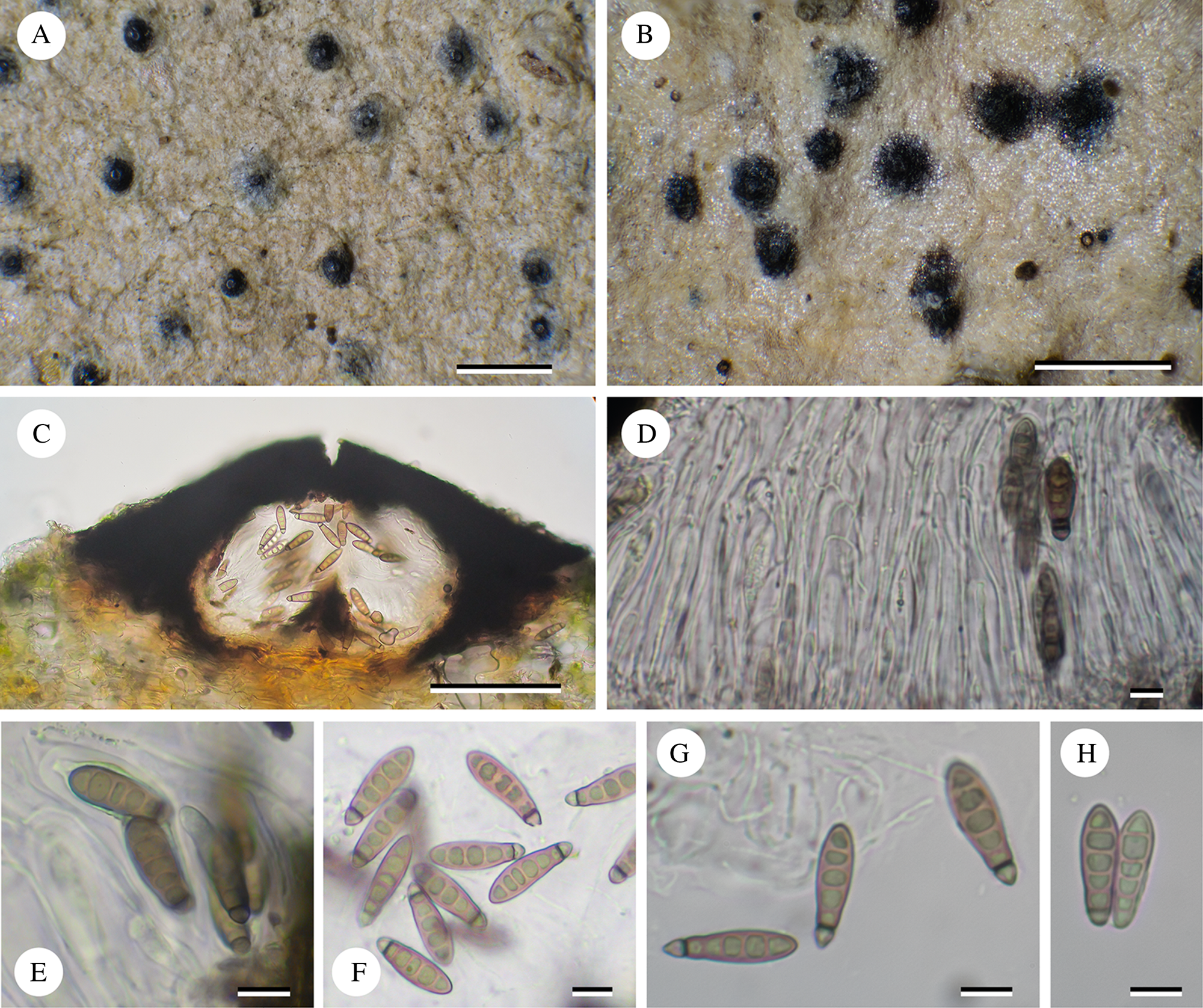
Thallus ecorticate, endoperidermal, thin, whitish grey to brownish, without pseudocyphellae, black hypothallus sometimes present at contact points with other lichens. Photobiont trentepohlioid; however, not always present.
Ascomata perithecioid, solitary, erumpent from the substratum, sometimes partly covered by bark cells, 0.20–0.35 mm wide; usually with a well-defined involucrellum and then 0.35–0.55(–0.65) mm in total. Ostiole apical, brownish black, up to 0.06 mm wide. Wall without crystals, proper exciple apically and laterally carbonized but basally only reddish brown. Hamathecium not inspersed, IKI−, pseudoparaphyses branched and anastomosing, 0.5–1.4 μm diam., no septation seen in water at ×400, embedded in a gelatinous matrix. Asci bitunicate, subcylindrical, tholus not amyloid, ocular chamber wide and rounded, (6–)8-spored, 62–70 × 15 μm, not seen after discharge. Ascospores biseriate in the asci, elongate-ellipsoid, with rounded ends, reddish brown (greyish in KOH) but basal cell frequently paler, 20–30(–35) × 5.8–8.7 μm (means = 24.58, 7.29; standard deviations = 3.1, 0.65; n = 45), 1(–2) pronounced and transverse basal euseptum that may constrict the cell, 3–5 transversal distosepta; basal euseptum forming first, followed by the distosepta, then later the pigmentation, endospore thick up to 1.3 μm, lumina rounded to angular but not astrothelioid, spore wall smooth, gelatinous sheath not seen.
Pycnidia not observed.
Chemistry
KOH−, UV−. No substances detected by TLC.
Remarks
Most of the ascospores observed in the material had a pronounced basal euseptum, although it was common to see ascospores from the same ascoma with the euseptum reduced (Fig. 2H). Two ascospores of different thalli had two pronounced basal eusepta instead of one (Fig. 2D). Previously, Hawksworth (Reference Hawksworth1983) found 4–6 spores per ascus but our samples agreed with Müller's (Reference Müller1888) description in having (6–)8 spores per ascus.
Over the centuries, the nomenclature of this taxon has suffered a series of misconceptions that began with Fée (Reference Fée1825) misapplying the name Verrucaria epidermidis var. albissima Ach., originally established for a temperate European taxon (Acharius Reference Acharius1809), to tropical material. As so often occurs, subsequent authors, such as Müller (Reference Müller1888) and Zahlbruckner (Reference Zahlbruckner1922), considered Fée's misidentification a separately established name and, consequently, a later homonym, ‘Verrucaria epidermidis var. albissima Fée’, which is not only incorrect, since Fée clearly referred to Acharius's name (and hence its type), but also inadmissible by the Code. According to ICN Art. 48.1, the case ‘When an author adopts an existing name but definitely excludes its type, a later homonym that must be attributed solely to that author is considered to have been published’ refers to very specific instances but not to misapplied names (i.e. misidentifications). Fée (Reference Fée1825) simply believed that his tropical material was conspecific with the type of Verrucaria epidermidis var. albissima Ach.: ‘Habitat in America supra epidermidem Crotonis cascarillae (Linn.), nec non [as well as] in Europa supra epidermidem destructam variarum arborum … Cette variété est commune sur la cascarille’ (Fée Reference Fée1825: 84).
Müller's (Reference Müller1888) and Zahlbruckner's (Reference Zahlbruckner1922) error was based on Massalongo's combination of the infraspecific epithet albissima into Sagedia, as Sagedia albissima (Massalongo Reference Massalongo1852), which was deemed the legitimate replacement name for the presumed homonym and served as a basis for the combination of this epithet into Pyrenula, as ‘P. albissima (A. Massal.) Trevis.’ (Trevisan Reference Trevisan1853) and subsequently into Polypyrenula, as ‘P. albissima (A. Massal.) Aptroot’ (Aptroot Reference Aptroot1991). ICN Art. 58.1 does not apply for two reasons. Firstly, the presumed later homonym ‘Verrucaria epidermidis var. albissima Fée’ does not exist when the work of Fée (Reference Fée1825, Reference Fée1837) is consulted. The first to establish this name was Müller (Reference Müller1888) and much later this name was again quoted by Zahlbruckner (Reference Zahlbruckner1922). Hence there was no case of illegitimacy on the basis of which Art. 58.1 could be invoked for the combinations given by Massalongo (Reference Massalongo1852) and Trevisan (Reference Trevisan1853), both published long before Müller (Reference Müller1888). One must consider the name ‘Verrucaria epidermidis var. albissima Fée’ to have been validly established by Müller (Reference Müller1888) and ascribed to Fée, but then to be cited as Verrucaria epidermidis var. albissima Fée ex Müller (ICN Art. 46. 3), with a publication date identical to that of Microthelia sexlocularis Müll. Arg., which therefore takes priority at the rank of species. Secondly, Massalongo (Reference Massalongo1852) did not quote the name ‘Verrucaria epidermidis var. albissima Fée’ but cited the basionym of his combination as Verrucaria epidermidis var. albissima Ach., including its type and leaving no doubt as to the application of his combination to the taxon including the type of Acharius's name (ICN Art. 7.3). For the same reason, the presumed combination ‘Pyrenula albissima (A. Massal.) Trevis.’ is neither valid nor a replacement name (as ‘P. albissima Trevis.’), since Trevisan (Reference Trevisan1853) provided a mechanical combination and did not exclude the name Verrucaria epidermidis var. albissima Ach. from synonymy; it must be cited as P. albissima (Ach.) Trevis. and applies to the taxon typified by the type of Verrucaria epidermidis var. albissima Ach. (ICN Art. 7.3).
Aptroot (Reference Aptroot1991) proposed the combination ‘Polypyrenula albissima (A. Massal.) Aptroot’, which must be treated as a replacement name under ICN Art. 58.1, as Polypyrenula albissima Aptroot, but not based on Massalongo (Reference Massalongo1852) as Acharius's type was excluded, but instead on the notion that Müller (Reference Müller1888) first established the illegitimate later homonym Verrucaria epidermidis var. albissima Fée ex Müller. Since Aptroot (Reference Aptroot1991) did not cite the correct replaced synonym (i.e. Verrucaria epidermidis var. albissima Fée ex Müller (Reference Müller1888)) but cited the name erroneously from Fée's (Reference Fée1825) earlier publication, the name Polypyrenula albissima Aptroot is invalid as a replacement name according to ICN Art. 41.8(c). The type of Microthelia sexlocularis was part of the original material of the name Verrucaria cascarillae Fée (Reference Fée1837), and Fée (Reference Fée1837) clearly indicated that the material previously identified by him as Verrucaria epidermidis var. albissima was a different specimen, although he considered it possibly conspecific with V. cascarillae. Also, Müller (Reference Müller1888) clearly referred to that different specimen as the basis for the name Verrucaria epidermidis var. albissima Fée established by him. Hence, according to ICN 58.1, Aptroot's name is to be treated as ‘… the name of a new taxon with a different type …’ and is consequently validly published. It is, however, illegitimate since Aptroot (Reference Aptroot1991) cited the name Microthelia sexlocularis Müll. Arg. in synonymy, a name that should have been adopted (ICN Art. 52.1), as it has priority over Verrucaria epidermidis var. albissima Fée ex Müller.
While the temperate Verrucaria epidermidis var. albissima Ach. has been established as a synonym of Leptorhaphis epidermidis (Ach.) Th. Fr. (Harris Reference Harris1973; Aguirre-Hudson Reference Aguirre-Hudson1991), the taxonomic status of Fée's tropical material originally identified as V. epidermidis var. albissima and later illustrated by Massalongo (Reference Massalongo1852, fig. 316) remains unresolved. The spores were illustrated as fusiform with pointed ends, with three distosepta but without a euseptum, and more or less brown in colour, and the hamathecium was shown as mostly unbranched and lacking anastomoses. These characters point to a species of Pyrenula with an ecorticate, white thallus, such as the widespread P. microcarpa Müll. Arg. Indeed, Trevisan (Reference Trevisan1853) recombined albissima into Pyrenula based on Massalongo's (Reference Massalongo1852) description.
Müller (Reference Müller1888) found that the type material of Fée's Verrucaria cascarillae was a mix of no less than seven species, three corresponding to existing names at the time: Pseudopyrenula diluta (Fée) Müll. Arg., Arthopyrenia cinchonae (Ach.) Müll. Arg. (now Constrictolumina cinchonae (Ach.) Lücking et al.) and Pyrenula guayaci (Fée) Müll. Arg. (now Parapyrenis guayaci (Fée) Aptroot). The other four were established as new species: Microthelia dominans Müll. Arg., Arthopyrenia feeana Müll. Arg. (now Anisomeridium feeanum (Müll. Arg.) R. C. Harris), Porina cascarillae Müll. Arg. and Microthelia sexlocularis Müll. Arg., the last providing the valid epithet for the species studied here. Müller (Reference Müller1888) considered the material identified by Fée (Reference Fée1825) as V. epidermidis var. albissima to represent pycnidia of M. sexlocularis, which contrasts with Massalongo's (Reference Massalongo1852) depiction of asci and ascospores for the same material.
Distribution and ecology
Polypyrenula sexlocularis was so far known with certainty only from the type collection, stated as growing on Croton cascarilla (Fée Reference Fée1837). As outlined above, the substratum indicates a likely origin in the Caribbean, where Croton cascarilla and other species of this complex (C. eluteria, C. linearis) are widespread (Webster Reference Webster1993; Van Ee & Berry Reference Van Ee and Berry2010). However, new collections were found along the Pacific Coast of Mexico and in Bolivia, suggesting that this species is widespread in the Neotropics and probably overlooked, since its morphology is rather nondescript and corresponds to that of several other genera that are often under-collected due to their rather uniform phenotype, such as Anisomeridium, Bogoriella, Constrictolumina, Polymeridium and Pseudopyrenula.
All new samples were associated to some degree with dry areas, especially with seasonally dry tropical forests, which corresponds with the wide distribution of this biome in the Caribbean. This ecosystem typically consists of more than 50% deciduous trees, has an extended dry season of three to eight months, a mean annual precipitation of 400–2000 mm, mean annual temperature above 25 °C, and an elevation from sea level to 2000 m (Trejo & Dirzo Reference Trejo and Dirzo2000; Sánchez-Azofeifa et al. Reference Sánchez-Azofeifa, Quesada, Rodríguez, Nassar, Stoner, Castillo, Garvin, Zent, Calvo-Alvarado and Kalacska2005; Portillo-Quintero & Sánchez-Azofeifa Reference Portillo-Quintero and Sánchez-Azofeifa2010). Most of this ecosystem in the Neotropics is found in Mexico, followed by Bolivia, with important areas in the West Indies and similar forest-types such as Caatinga in Brazil (Pennington et al. Reference Pennington, Lewis and James2006; Portillo-Quintero & Sánchez-Azofeifa Reference Portillo-Quintero and Sánchez-Azofeifa2010; DRYFLOR et al. Reference Banda-R, Delgado-Salinas, Dexter, Linares-Palomino, Oliveira-Filho, Prado, Pullan, Quintana and Riina2016).
In Mexico, Polypyrenula sexlocularis is a rare species mostly found in secondary forests, with only one out of seven samples originating from mature forest. It was associated with the following phorophytes: Apoplanesia paniculata, Caesalpinia caladenia, Gliricidia sepium, Heliocarpus pallidus and Leucaena lanceolata. Most samples were found at elevations below 340 m, but one Bolivian sample (M. Kukwa 11367) was found at 1500 m.
Specimens examined
Mexico:Jalisco: La Huerta, Chamela Biological Station (CBS), 300 m W of Tejón Trail, 600 m, 19°30′11″N, 105°2′52″W, mature seasonally dry tropical forest, elev. 44 m, 2010, Miranda 1791 (MEXU); surrounding areas of CBS: Ejido Santa Cruz, 19°35′57″N, 105°2′55″W, secondary seasonally dry tropical forest, elev. 118 m, 2010, Miranda 2736 (MEXU); ibid., very disturbed seasonally dry tropical forest, 19°35′22″N, 105°2′4″W, elev. 144 m, Miranda 3823, 3828, 3829, 3886 (MEXU); Ejido Caimán, secondary seasonally dry tropical forest, 19°28′3″N, 105°56′11″W, elev. 54 m, 2010, Miranda 2539 (MEXU).—Bolivia:Dept. Santa Cruz: Prov. Cordillera, PNANMI Kaa-Iya del Gran Chaco, near Peto Blanco, park guard's station, 18°56′26″S, 60°22′39″W, Chiquitano forest, elev. 340 m, 2011, A. Flakus 23655 (LPB, KRAM); Prov. Guarayos, RN de Vida Silvestre Ríos Blanco y Negro, Plan de Manejo AISU, 15°09′13″S, 62°47′57″W, lowland Amazon forest, elev. 240 m, 2009, leg. A. Flakus 13730 & P. Rodriguez (LPB, KRAM). Dept. Tarija: Prov. Burnet O'Connor, 28 km from Entre Ríos, near Soledad, 21°41′00″S, 64°07′29″W, Tucumano-Boliviano montano forest, elev. 1500 m, 2012, M. Kukwa 11367 (UGDA, LPB).
Discussion
Hawksworth (Reference Hawksworth1983) provided the first thorough description of Polypyrenula sexlocularis (as Polythelis sexlocularis), but the underlying material was so scarce that he could not verify details such as hamathecium structure. He suggested that the delicate tapering of the interascal filaments was very similar to the true paraphyses of Pyrenula and proceeded to accommodate the taxon in Pyrenulaceae. Based on Hawksworth's description, Harris (Reference Harris1989) and Aptroot (Reference Aptroot1991) considered the hamathecium to represent cellular pseudoparaphyses and moved the genus to Requienellaceae. Harris (Reference Harris1995) decided to restrict Requienellaceae to Requienella, which is currently placed in Sordariomycetes in the order Xylariales (Jaklitsch et al. Reference Jaklitsch, Gardiennet and Voglmayr2016), and he also moved Polypyrenula back to Pyrenulaceae.
Our observations based on new collections show that the hamathecium of P. sexlocularis is more consistent with traberculate pseudoparaphyses (thin interascal filaments that are branched and anastomosing, without visible septation at ×400), which supports the inclusion of the taxon in Trypetheliaceae. Although the type material cannot be thoroughly examined for this feature, the description by Müller (Reference Müller1888) stated that the interascal filaments are anastomosing (‘connexæ’).
In our preliminary phylogenetic analysis (Supplementary Material Fig. S1, available online), P. sexlocularis was positioned among the core genera of Trypetheliaceae; however, the analysis included a limited representation for each of most orders of Dothideomycetes, creating alignment artifacts due to low resolution and widespread taxon sampling. In the final phylogenetic analysis (Fig. 1) that included both mtSSU and nuLSU markers and focused the sampling on Trypetheliaceae, we established that P. sexlocularis is not part of what was traditionally considered as Trypetheliaceae but is positioned among the early diverging lineages of the family, together with other genera only recently included in this family based on molecular data (Nelsen et al. Reference Nelsen, Lücking, Mbatchou, Andrew, Spielmann and Lumbsch2011, Reference Nelsen, Lücking, Aptroot, Andrew, Cáceres, Rivas Plata, Gueidan, da Silva Canêz, Knight and Ludwig2014; Lücking et al. Reference Lücking, Nelsen, Aptroot, Barillas de Klee, Bawingan, Benatti, Binh, Bungartz, Cáceres and Canêz2016). The taxon shares with the other basal lineages the ecorticate thallus, exposed black perithecioid ascomata, at least in part euseptate spores that are not astrothelioid, and often weakly to non-lichenized thalli (Nelsen et al. Reference Nelsen, Lücking, Aptroot, Andrew, Cáceres, Rivas Plata, Gueidan, da Silva Canêz, Knight and Ludwig2014; Aptroot & Lücking Reference Aptroot and Lücking2016; Hyde et al. Reference Hyde, Hongsanan, Jeewon, Bhat, McKenzie, Jones, Phookamsak, Ariyawansa, Boonmee and Zhao2016; Lücking et al. Reference Lücking, Nelsen, Aptroot, Barillas de Klee, Bawingan, Benatti, Binh, Bungartz, Cáceres and Canêz2016). Polypyrenula is the only genus in the family with pronounced eusepta in combination with distosepta.
Currently, the family Trypetheliaceae is composed of 17 recognized genera (Hyde et al. Reference Hyde, Hongsanan, Jeewon, Bhat, McKenzie, Jones, Phookamsak, Ariyawansa, Boonmee and Zhao2016; Lücking et al. Reference Lücking, Hodkinson and Leavitt2017), more than 400 species and c. 800 predicted species, making it the second largest family of tropical corticolous lichens (Aptroot et al. Reference Aptroot, Cáceres, Johnston and Lücking2016). In particular, the basal lineages in the family are poorly understood and have few DNA sequences available, which might explain the lack of support at the base of the phylogeny. More data are needed for these lineages to test their delimitation and monophyly, and to establish their mutual relationships; the data so far suggest that recently established genera such as Bogoriella and Constrictolumina remain polyphyletic.
For this study, although not included in our analyses, we decided to also provide the ITS sequences of P. sexlocularis for future barcoding purposes, regardless of the infrequent use of the ITS region in this family. Despite ITS being the recommended genetic barcode for fungi (Schoch et al. Reference Schoch, Seifert, Huhndorf, Robert, Spouge, Levesque and Chen2012), the number of sequences available is extremely low for Trypetheliaceae and other large tropical crustose families, such as Graphidaceae and Pyrenulaceae. The use of ITS in broad phylogenies may represent a problem because its high variability makes unambiguous alignments difficult, which might be the reason why recent studies in the Dothideomycetes did not include this marker (Nelsen et al. Reference Nelsen, Lücking, Grube, Mbatchou, Muggia, Rivas Plata and Lumbsch2009, Reference Nelsen, Lücking, Mbatchou, Andrew, Spielmann and Lumbsch2011, Reference Nelsen, Lücking, Aptroot, Andrew, Cáceres, Rivas Plata, Gueidan, da Silva Canêz, Knight and Ludwig2014; Hyde et al. Reference Hyde, Jones, Liu, Ariyawansa, Boehm, Boonmee, Braun, Chomnunti, Crous and Dai2013; Wijayawardene et al. Reference Wijayawardene, Crous, Kirk, Hawksworth, Boonmee, Braun, Dai, D'souza, Diederich and Dissanayake2014). However, exemplar studies on species complexes in Trypetheliaceae such as Trypethelium eluteriae (Luangsuphabool et al. Reference Luangsuphabool, Piapukiew, Parnmen, Nelsen, Lumbsch and Sangvichien2016) show that in this case, the ITS region provides excellent resolution. Expanding the ITS sequence representation of Trypetheliaceae will allow the inclusion of these species in biotic, environmental and ecological studies that rely on molecular barcoding. We therefore strongly encourage other researchers to include the ITS marker in their studies of pyrenolichens.
With the new collections now available, P. sexlocularis cannot be considered extinct. In fact, six out of the seven samples from Mexico were found in disturbed forests, suggesting that this species might be able to adapt itself to the current conditions of seasonally dry tropical forests: small relicts of pristine areas surrounded by a majority of secondary forests (Quesada et al. Reference Quesada, Sánchez-Azofeifa, Alvarez-Añorve, Stoner, Avila-Cabadilla, Calvo-Alvarado, Castillo, Espírito-Santo, Fagundes and Fernandes2009). Thus, in contrast to the ecosystem as a whole (Janzen Reference Janzen1988; Portillo-Quintero & Sánchez-Azofeifa Reference Portillo-Quintero and Sánchez-Azofeifa2010), this lichen may not be particularly endangered. Polypyrenula sexlocularis should be considered an overlooked species. Given that it was found in Mexico, the Caribbean and Bolivia, we expect it to occur throughout the Neotropics in forested ecosystems with a dry season.
Acknowledgements
Financial support for the first author was provided by CONACYT (Reg. 217222) and SEP (scholarship BC-2239. Este artículo se ha realizado con el apoyo de beca de la Secretaría de Educación Pública y del Gobierno Mexicano). Funding for fieldwork was granted to M. A. Herrera-Campos by PAPIIT-UNAM (project IN225808) and CONABIO (Project FB1647/JF157). We are grateful to the personnel of the Chamela Biological Station for logistical support and to the Posgrado en Ciencias Biologicas, UNAM. Ivania Cerón Souza and Andy Jones helped with molecular work. Francisco Mora Ardilla helped with phorophyte identification. Martin Kukwa kindly allowed us to use his specimen from Bolivia. We are grateful to the communities of Santa Cruz and Caimán in Jalisco, Mexico for the warm welcome to their land and for allowing us to collect samples under the project MABOTRO (Semarnat-Conacyt 2002 C01-0597) of Patricia Balvanera Levy and Miguel Martínez Ramos. Bruce McCune kindly reviewed and made corrections to the manuscript. We would like to thank the personnel of the herbaria BM, G, H, MEXU and OSC for facilitating loans and access to material for this study, as well as two anonymous reviewers for useful suggestions on the manuscript. A. Flakus is greatly indebted to all staff at the Herbario Nacional de Bolivia, Instituto de Ecología, Universidad Mayor de San Andrés, La Paz, for their generous long-term cooperation. We would also like to thank the SERNAP (http://sernap.gob.bo), and all protected areas staff, for providing permits for scientific studies.
Supplementary Material
For supplementary material accompanying this paper visit https://doi.org/10.1017/S0024282919000422