Familial hypercholesterolaemia is an autosomal dominant disorder caused by mutations in either low-density lipoprotein receptor, apolipoprotein B, or proprotein convertase subtilisin/kexin type 9.Reference Ned and Sijbrands 1 One of the characteristics of familial hypercholesterolaemia is a high-serum low-density lipoprotein cholesterol concentration, and the incidence of premature coronary heart disease is about 20-fold without treatment. Ischaemic symptoms such as pectoris angina and myocardial infarction always occur during childhood. Approximately 20% of heart attacks that take place in patients under the age of 45 are due to familial hypercholesterolaemia.Reference Dorsch, Lawrance and Durham 2 The prevalence of familial hypercholesterolaemia is 1 in 300–500 in the population.Reference Hopkins, Toth and Ballantyne 3 On the basis of the symptoms and inherited characteristics, familial hypercholesterolaemia can be divided into homozygous familial hypercholesterolaemia and heterozygous familial hypercholesterolaemia. The prevalence of these familial hypercholesterolaemias is 1/1,000,000 and 1/500, respectively. Low-density lipoprotein cholesterol concentrations in patients with homozygous familial hypercholesterolaemia are almost fourfold to sixfold higher compared with those of normal persons. Lipid concentrations in heterozygous familial hypercholesterolaemic patients are not very high and are not obviously different from other types of lipid metabolism disorders. Lesions of the aortic root, especially supravalvular aortic stenosis, are also characteristics of homozygous familial hypercholesterolaemia. It is unknown whether the coronary artery in familial hypercholesterolaemic patients with supravalvular aortic stenosis is more easily impaired compared with patients without it.
Transthoracic echocardiography is a noninvasive procedure extensively used in adolescents with homozygous familial hypercholesterolaemia.Reference Nemes, Balázs and Csanády 4 , Reference Pizzuto, Voci and Bartolomucci 5 Coronary flow velocity reserve is a reliable measure of coronary artery function criterion and can be acquired by transthoracic echocardiography. A recent study found that a coronary flow velocity reserve less than 2.0 indicates coronary artery stenosis, and it also has a good correlation with coronary angiography.Reference Vegsundvag, Holte and Wiseth 6
The current study enrolled adolescents diagnosed with familial hypercholesterolaemia who were younger than 16 years of age with no obvious ischaemic symptoms. This study was designed to determine the characteristics of these patients and evaluate the relationship between coronary artery haemodynamic reserve and lipid concentrations.
Materials and methods
Subjects
Eleven adolescents aged between 6 and 15 years without obvious ischaemic heart disease symptoms and diagnosed with homozygous familial hypercholesterolaemia and aortic supravalvular stenosis were enrolled in this study. The control group comprised seven patients diagnosed with heterozygous familial hypercholesterolaemia. The criteria for establishing homozygous familial hypercholesterolaemia according to Santos et alReference Santos, Miname and Martinez 7 were used: (1) plasma cholesterol concentrations above 600 milligrams per decilitre or low-density lipoprotein cholesterol concentrations above 500 milligrams per decilitre; (2) occurrence of tendon xanthomas before the age of 20; and (3) evidence of vertical transmission of hypercholesterolaemia. Aortic supravalvular stenosis was diagnosed if the patient had aortic calcified plaques and an aortic supravalvular velocity above 2.0 metres per second.Reference Al-Ghamdi, Melendez and Massel 8 All patients with homozygous familial hypercholesterolaemia met the above criteria. This study was approved by the Institutional Review Board of our institution, and all subjects gave informed consent before the study.
Transthoracic echocardiography
A modified left parasternal view was acquired in patients in the left lateral position. Echocardiographic images were obtained around the midclavicular line in the fourth and fifth intercostal space. The distal portion of the left anterior descending coronary artery was visualised by the colour Doppler technique. Blood flow velocity was measured by pulsed-wave Doppler echocardiography, and the Doppler sample volume was placed on the colour signal in the distal left anterior descending coronary artery. Baseline coronary flow velocity was acquired before injection of adenosine. Peak diastolic velocity and mean diastolic velocity were measured after adenosine injection of 140 micrograms per kilogram per minute for a total of 3 minutes. Heart rate, blood pressure, and electrocardiogram were all monitored during this procedure. The coronary flow velocity reserve was calculated as the ratio of hyperaemic to basal mean diastolic flow velocity.
Aortic supravalvular stenosis was diagnosed by transthoracic echocardiography when aortic calcified plaques were found and aortic supravalvular velocity was above 2.0 metres per second. Aortic velocity was measured by transthoracic echocardiography at the five-chamber view. All these subjects underwent 64-slice computer tomography examinations.
Statistical analysis
Data are presented as mean plus or minus standard deviation and were compared with the two independent sample t-test. Linear regression was performed between coronary flow velocity reserve and lipid concentrations in both groups. Statistical Package for the Social Sciences 13.0 for windows (SPSS Inc.) was used to analyse the data, and a p-value less than 0.05 was considered statistically significant.
Results
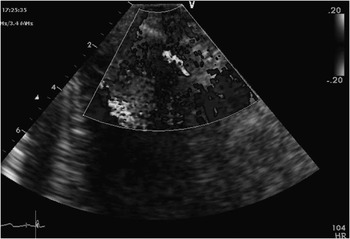
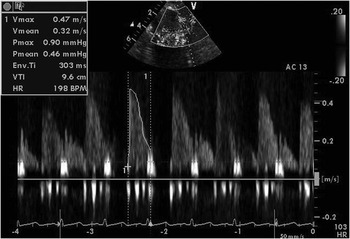
All patients underwent stress echocardiography, and left anterior descending coronary artery flow was successfully detected without any complications (Fig 1). Pulse Doppler recorded basal and hyperaemic mean coronary flow velocities during the diastolic phase (Fig 2).
A graph showing distal flow of the left anterior descending coronary artery.

A graph showing pulse Doppler spectrum of the left anterior descending coronary artery after adenosine injection in a representative patient. The hyperaemic mean diastolic velocity is 0.32 metres per second in this patient.

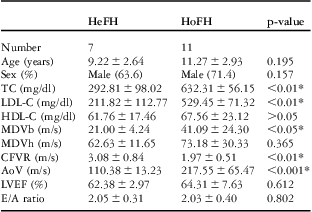
Table 1 shows age, serum lipid concentrations, and coronary flow velocity parameters in the two groups. Homozygous familial hypercholesterolaemic patients with supravalvular aortic stenosis and those without it had no significant differences in age, high-density lipoprotein cholesterol, hyperaemic mean diastolic flow velocity, left ventricular ejection fraction, and E/A ratio. Low-density lipoprotein cholesterol and total cholesterol concentrations were higher in homozygous familial hypercholesterolaemic patients than in heterozygous familial hypercholesterolaemic patients. The coronary flow velocity reserve in homozygous familial hypercholesterolaemic patients was lower than that of heterozygous familial hypercholesterolaemic patients (3.08 versus 1.97, p < 0.01).
Blood lipid concentrations and dynamics of coronary flow in homozygous familial hypercholesterolaemia and heterozygous familial hypercholesterolaemia patients.

AoV = aortic velocity; CFVR = coronary flow velocity reserve; HDL-C = high-density lipoprotein cholesterol; HeFH = heterozygous familial hypercholesterolaemia; HoFH = homozygous familial hypercholesterolaemia; LDL-C = low-density lipoprotein cholesterol; LVEF = left ventricular ejection fraction; MDVb = basal mean diastolic velocity; MDVh = hyperaemic mean diastolic velocity; TC = total serum cholesterol
*P-value below 0.05 marks statistical significance
Data are presented by mean plus or minus standard deviation
We also found that basal mean diastolic flow velocity was faster in homozygous familial hypercholesterolaemic patients than in heterozygous familial hypercholesterolaemic patients (p < 0.05).
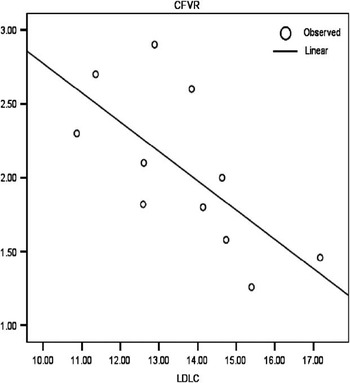
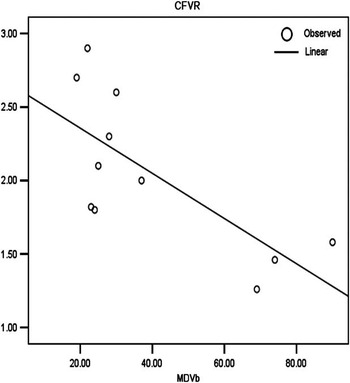
Figure 3 showed the correlation between coronary flow velocity reserve and low-density lipoprotein cholesterol concentrations in homozygous familial hypercholesterolaemic patients. Figure 4 shows the correlation between coronary flow velocity reserve and basal mean diastolic velocity. Coronary flow velocity reserve had a strong correlation with low-density lipoprotein cholesterol concentrations and basal mean diastolic flow velocity in homozygous familial hypercholesterolaemic patients. Pearson's correlations were minus 0.721 and minus 0.725 (p < 0.05), respectively.
This graph shows the relationship between coronary flow velocity reserve and low-density lipoprotein cholesterol in homozygous familial hypercholesterolaemic patients. Coronary flow velocity reserve was negatively correlated with low-density lipoprotein cholesterol concentrations. The Pearson correlation was minus 0.721 and p-value less than 0.05. CFVR = coronary flow velocity reserve; LDLC = low-density lipoprotein cholesterol.

This graph shows the relationship between coronary flow velocity reserve and basal mean coronary velocity. Coronary flow velocity reserve was negatively correlated with basal mean diastolic velocity. The Pearson correlation was minus 0.725 and p-value less than 0.05. CFVR = coronary flow velocity reserve; MDVb = basal mean diastolic velocity.

Computer tomography examinations showed aortic calcification plaques in all homozygous familial hypercholesterolaemic patients, but there were no significant calcification plaques in the coronary artery. In nine homozygous familial hypercholesterolaemic patients, plaques compromised the left or right coronary artery ostia. Plaques were also found in heterozygous familial hypercholesterolaemic patients, but plaques were located at the aortic root and did not compromise the coronary artery ostia.
Discussion
Coronary flow velocity reserve was acquired in the distal portion of the left anterior descending coronary artery by transthoracic echocardiography in the present study. Myocardial fractional flow reserve is also an index of the functional severity of coronary stenosis, which is calculated from pressure measurements taken during coronary angiography.Reference Pijls, Van Gelder and Van der Voort 9 The cutoff point of the fractional flow reserve is 0.75, which is similar to the value of 2.0 for the coronary flow velocity reserve; lower values are associated with inducible ischaemia.Reference Abe, Tomiyama and Yoshida 10 With similar sensitivity and positivity to fractional flow reserves acquired during coronary angiography, convenience and noninvasion are the advantages of transthoracic echocardiography.
It was found in the present study that coronary flow velocity reserve was negatively correlated with low-density lipoprotein cholesterol concentrations in homozygous familial hypercholesterolaemic patients, whereas there was no similar finding in heterozygous familial hypercholesterolaemic patients. High concentrations of low-density lipoprotein cholesterol can damage vessel endothelial cells through high viscosity combined with shear force. These effects reduce the coronary reserve even without obvious plaques on the coronary wall. In addition, high-density lipoprotein concentration exerts protective effects on endothelial cells,Reference Toth and Davidson 11 which could also influence the coronary flow velocity. However, there was no difference in high-density lipoprotein cholesterol concentrations between homozygous and heterozygous patients.
Another finding in this study was that coronary flow velocity reserve was negatively correlated with basal mean diastolic flow velocity, whereas there was no similar finding in heterozygous familial hypercholesterolaemic patients. In the present study, it was shown that higher basal mean diastolic velocity of homozygous familial hypercholesterolaemic patients had a blunted increase in peak velocity after adenosine injection compared with heterozygous familial hypercholesterolaemic patients, whereas in our previous studyReference Zhang, Yang and Li 12 results showed similar basal mean diastolic velocity and decreased hyperaemic mean diastolic velocity in homozygous familial hypercholesterolaemic patients than in controls. Homozygous familial hypercholesterolaemic patients with aortic stenosis had lower coronary flow velocity reserve than homozygous familial hypercholesterolaemic patients without aortic stenosis, which meant aortic stenosis was the reason for decreased coronary flow velocity reserve. Coronary flow velocity can be influenced by aortic flow as reported in a previous study.Reference Gaillard, Garcia and Kadem 13 Gaillard et alReference Gaillard, Garcia and Kadem 13 designed an in vitro model to imitate coronary flow combined with aortic valve stenosis. The presence of aortic stenosis induced an increase in the maximum and mean coronary flow rates (97% and 73%, respectively). In the present study, results of computer tomography demonstrated that plaques compromised the ostia of the coronary artery. Therefore, supravalvular aortic stenosis and plaques compromising the ostia of the coronary artery was the reason for increased basal coronary velocity, which induced rather than decreased the coronary flow velocity reserve.
Our study has some limitations. Coronary flow velocity reserve was acquired only in the left anterior descending coronary artery. It was difficult to observe the posterior descending and lateral circumflex coronary arteries. Even though sensitivity and specificity of the coronary flow velocity reserve below 2.0 were 86% and 89%, respectively, in one coronary artery vessel we could not exclude patent stenosis in the other coronary artery, except for the left anterior descending coronary artery. Owing to the fact that the age of the children enrolled was not above 16 years, they did not receive coronary angiography. This might be the reason that coronary flow velocity reserve was just below 2.0 in homozygous familial hypercholesterolaemic patients.
Another limitation is that we could not differentiate between the conduit function of the epicardial coronary and microvascular function because both microcirculation abnormalities and coronary artery stenosis can reduce coronary flow velocity reserve. For the same reasons as above, we could not perform angiography to confirm coronary stenosis.
Conclusion
Transthoracic echocardiography is a useful technique for assessment of coronary flow velocity reserve. The current study found that the coronary flow velocity reserve of homozygous familial hypercholesterolaemic adolescents with supravalvular aortic stenosis had decreased below 2.0 and it was negatively associated with low-density lipoprotein cholesterol concentrations and basal mean diastolic flow velocity. Aortic stenosis and plaques compromised the ostia of the coronary artery and caused increased basal mean diastolic coronary velocity with blunted increase in peak velocity, which decreased the coronary flow velocity reserve.
Acknowledgements
This work was supported by research grants from the National Natural Science Foundation of China Research (Grant no. 81170793) and the Natural Science Foundation of Beijing, China (Grant no. 7092016).