Introduction
This paper presents clear evidence suggesting growing numbers of black and minority ethnic (BME) young people involved in elite classical music education in England, and evidence suggesting girls equal or outnumber boys in elite youth orchestras and specialist music schools. Although it is good to see this representation, there are questions around the limited and conditional nature of the inclusion offered. For example, is this representation reflected in the amount of music by non-white and female composers featuring in the programmes of professional orchestras and broadcasters? The research discussed in this article, part of a larger project looking at key roles and repertoire in classical music, suggested it is not. This paper focuses on the professional orchestral and broadcast repertoire and argues that it is failing to reflect the make up of young people being educated in the elite classical music field.
Using data from the 2017/18 concert seasons of 10 major orchestras, a complete week’s airplay from Classic FM and British Broadcasting Corporation (BBC) Radio 3 and the London Promenade Seasons from 2014 to 2018, this research explored the comparative representation of different groups in the English orchestral and broadcast classical music repertoire. It focused on two areas. First, it examined the representation of BME composers, and particularly composers of African heritage (including African, African American, African British/European and dual heritage/African). And second, it explored the representation of female composers.
Using Bourdieu’s concepts of field and doxa, the research examined how the field of classical music in England has adapted to external pressures for gender equality and BME inclusion, while at the same time maintaining the core advantages given to white males. It suggested that the classical music world sees inclusion as largely about allowing female and BME musicians’ entry into the field as performers, while excluding them from positions of cultural influence. Certainly, the analysis of the 4897 pieces programmed, and the 681 composers who wrote them, suggested this was the case. The data demonstrated that over time the field of classical music has been unable to dismantle its notions of white male dominance. This research focused on cultural influence in terms of composers represented and repertoire. Other areas for similar research might include representation in other key roles such as conductors, principle players, managers and programmers.
Elite music education in England
Funding and provision
In a review of music education in England, Henley (Reference HENLEY2011) saw provision as a pyramid. Since Henley, there seems to have been an escalating crisis of provision at the bottom of the pyramid (ASCL, 2016; Daubney & Mackrill, Reference DAUBNEY and MACKRILL2018). In a survey of over 650 state secondary schools, Daubney and Mackrill (Reference DAUBNEY and MACKRILL2018) highlighted a series of worrying changes between 2012 and 2016, including reduced teaching hours, falling staffing levels and fewer schools offering General Certificate of Secondary Education Music. But at the top, a space occupied by children ‘who are exceptionally talented’ (Henley, Reference HENLEY2011: 12) provision has flourished.
In spite of a decade of austerity for the arts in England (Ahrens & Ferry, Reference AHRENS and FERRY2015; Abdullah et al., Reference ABDULLAH, KHADAROO and NAPIER2018), the four specialist classical music schools (Purcell, Chetham’s, Yehudi Menuhin and Wells Cathedral Schools) continue to be supported by the UK government’s Music and Dance Scheme (MDS). Fees are means tested and some 25% of the 600 or so pupils pay nothing (DfE, 2014). The MDS also funds 11 Centres for Advanced Training (CATs) including junior conservatoires at The Royal Academy, The Royal College, The Royal Northern College, The Guildhall, Trinity-Laban and The Royal Birmingham Conservatoires. All CATs provide
awards under the Department for Education, Music and Dance scheme … for students of outstanding ability and limited financial means. (Junior RNCM, 2017: 40)
The National Children’s Orchestra’s of Great Britain (NCO) has an annual income of £1.4 million (Charity Commission, 2017) and runs five age-banded orchestras (under 10s to under 14s). The NCO runs at least 8-week-long residential courses every year. It runs a bursary system for poorer students, as does the National Youth Orchestra (NYO) where:
no-one is ever refused a place on financial grounds with 31.7% of the orchestra supported with bursaries. NYO (2016: 6)
Indeed, according to the Trustees Report (NYO, 2016), the NYO had an income of £2.1 million in 2016, a rise of nearly £400,000 compared to 2015. There are also high-quality youth orchestras including those of the City of Birmingham Symphony and The Hallé. Furthermore, children reaching the required standard will find generous scholarships at leading independent schools where music provision is lavish (ISC, 2017).
Neelands (Reference NEELANDS2005: 10) highlighted ‘Matthew’s Effect’ suggesting those already well provided for would go on to be given even more. While budgets and provision have shrunk at the bottom of the pyramid, at the top, Matthew’s Effect seems to still operate. The issue is not affordability or provision when reaching the elite level. Rather, it is how children get there in the first place. The many barriers preventing children reaching the top tier – including the lack of provision in state schools, affordability and access and parents simply being unaware of the benefits of an early musical education – are certainly complex and beyond the scope of this study. But, as the figures below will suggest, female and BME students are not under-represented in the highest levels of classical music education. With a growth in the BME middle classes and the cultivated parenting that goes with it (Vincent et al., Reference VINCENT, ROLLOCK, BALL and GILLBORN2013), it should come as no surprise that ambitious BME families, like their white counterparts, are interested in accessing the bounty on offer.
Girls in elite classical music education
Girls are over-represented in the UK’s elite youth orchestras. In 2017, the NCO’s youngest full symphony orchestra (the under 10s) was 61% girls and 39% boys, while the NCO’s eldest orchestra (under 14s) was 62% girls and 38% boys (NCO, 2017). In the NYO, the next tier up, girls remain well represented with roughly equal numbers of girls and boys in the 2017 cohort (NYO, 2018).
Certainly, girls outnumber boys in the four specialist MDS music schools. Recent figures available for three of the four schools are as follows:
Chetham’s School of Music: 163 girls/137 boys (ISI, 2017)
The Purcell School: 103 girls/74 boys (ISI, 2018)
The Yehudi Menuhin School: 38 girls/37 boys (ISI, 2013).
Clearly, then, at the elite level of music education in England, girls form the majority.
BME Groups in elite classical music education
There are certainly signs of increased BME representation at the top table of music education. One high-profile example of this was Sheku Kanneh-Mason’s victory in the BBC Young Musician of the Year Competition 2016 (BBC, 2016). Decca (Universal Music Group), no doubt sensing a commercial opportunity, signed him up almost immediately. The phenomenal rise of The Chineke! Orchestra, led by the charismatic double bassist Chi-chi Nwanoku, highlights the presence of a number of top-level classical musicians in the BME community (Chineke! Foundation, 2017). In 2017, just 2 years after its formation, The Chineke! Orchestra gave a BBC Proms concert at the Albert Hall (BBC, 2017). It was a huge success and within a few weeks the BBC informed The Chineke! Foundation that the broadcast had been ‘shared’ 59,000 times and had 9.7 million views. But also, as Kettle (Reference KETTLE2017) noted, it brought with it a new and diverse audience, rather than the usual Proms crowd.
Certainly, there is evidence that BME interest in classical music is reflected in elite music education. The NYO stated in its Trustees Report that:
One of the most inspiring aspects of NYO is the degree to which the orchestra is moving towards reflecting the diversity of the UK. (NYO, 2016: 6)
The report goes on to note that 27.6% of its 2016 orchestra came from non-white British backgrounds, a rise of nearly 9% on the previous year. The NYO figures are not broken down into specific ethnic groups. Nevertheless, when compared to figures from the 2011 census, which described the population of England and Wales as 14% non-white, 80.5% white British and 5.5% white other (ONS, 2012), the NYO has a higher than expected number of non-white players.
Non-white representation in the NCO is also higher than the 2011 Census data. In 2013, 29% of the NCO members were described as:
other than white British … of those the largest proportion are Mixed Race (12% of total membership) followed by 9% Chinese, 3% other Asian and 2% Black. (Derbyshire, Reference DERBYSHIRE2015: 12)
However, these percentages are somewhat problematic to interpret. Certainly Chinese players are over-represented compared to the 0.6% of the population identified as Chinese in the 2011 census, while other Asian groups (3% of the NCO but 6.8% in the census) are underrepresented. On the surface, it would seem that black players are also under-represented (2% of the NCO and 3.4% in the census). But this needs to be taken in conjunction with the large over-representation of Mixed-Heritage children (12% of the NCO and 2.2% in the census). Many of these players may self-identify as black or simultaneously self-identify as both black and mixed heritage (Frazer-Carroll, Reference FRAZER-CARROLL2017), or be externally identified as black (Joseph-Salisbury, Reference JOSEPH-SALISBURY2017). Certainly, well-known mixed-heritage composers are frequently identified as black by wider society – for example, Chevalier Saint-George ‘The Black Mozart’ (Smith, Reference SMITH2004: title page), Florence Price ‘the unknown composer was one Florence Price and she was black’ (Classic FM, 2017) and Samuel Coleridge-Taylor ‘the pioneering 19th-century black composer, Samuel Coleridge-Taylor’ (BBC, 2005). As Joseph-Salisbury (Reference JOSEPH-SALISBURY2017: 451), discussing young mixed-heritage males, observed
despite recognizing their mixedness, participants … felt that they were still often racialized as Black.
So how should we interpret the black and mixed percentages from the NCO? The 9.8% over-representation of mixed-heritage players and the 1.4% under-representation of black players give a combined over-representation of 8.4%. However, we are not given a breakdown of heritages in the mixed group. Nevertheless, some (and possibly most) will be of partial black heritage. Given that mixed heritage musicians and composers (see above) are frequently classified as black, there is some legitimacy in suggesting that the black representation in the NCO may be interpreted as considerably higher than the 2% figure and also considerably higher than the 3.4% census figure. While acknowledging that it is contestable and open to interpretation, it can certainly be suggested that black players are over-represented in the NCO compared to the census data. What is not contestable, however, is that BME players as a whole are over-represented in the NCO and the NYO compared to the 2011 census figures.
Bourdieu’s field and doxa in elite classical music
Terdiman (Reference TERDIMAN1987: 806) summed up Bourdieu’s conception of a field, and the practices within it, as:
referring respectively to the structure and to the characteristic activities of an entire professional world.
For this research, the field was that of ‘elite-level classical music in England’. The choice of ‘elite’ rather than ‘professional’ was deliberate because while the field included professional musicians and organisations, it also included the young people destined to become the professionals of the future (and the elite institutions involved in their education). It made sense to put pupils and professionals into the same field because instrumental music teachers in elite education (conservatoires, specialist music schools, elite youth orchestras) are generally high-ranking professionals who:
developed either with a career coming to a natural turning point, or through being invited to add conservatoire teaching to an already prestigious portfolio of activity. (Gaunt, Reference GAUNT2008: 221)
The Junior Royal Northern College of Music is typical when it states:
many tutors are accomplished performers within orchestras such as the Hallé, Royal Liverpool Philharmonic and BBC Philharmonic. (Junior RNCM, 2017: 4)
At the Junior RNCM, the tutors are drawn from the three most prestigious professional orchestras in the region.
When students reach the elite level of classical music education, they are, then, directly connected to the top professional scene via their teachers who themselves almost certainly had similar connections in their own learning experiences. This form of musical lineage can go back decades, even centuries, as this example from a New York Times music critic illustrates:
Beethoven taught Czerny, who taught the probing Polish pianist and pedagogue Theodor Leschetizky, who taught the renowned Austrian-born pianist and Beethoven champion Artur Schnabel, who taught the American pianist and pedagogue Leonard Shure, who taught me. (Tommasini, Reference TOMMASINI2004)
This lineage enables the field of elite classical music to operate similarly to Bourdieu’s description of fields in literature, art and philosophy, which are
protected by the veneration of all those who were raised, often from their earliest youth, to perform sacramental rites of cultural devotion. Bourdieu (Reference BOURDIEU1996: 184)
From an early age (the youngest NCO orchestra is the under 10 age group; the MDS music schools and CATs take children at a similar age), children in elite music education are enrolled into a lineage which, from generation to generation, passes down traditions of technique, repertoire, values and actions which might be termed doxa. The doxa, depicted by Bourdieu (Reference BOURDIEU1996: 306) as an ‘ensemble of assumptions’, leads to a common habitus that is ‘the product of the incorporation of structures of the social world’ (Bourdieu, Reference BOURDIEU1996: 328) within the field. This habitus encompasses a person’s philosophy, senses of identity and belonging, understandings of cultural and social capital and the attribution of value to practices, actions and objects (Bourdieu, Reference BOURDIEU1984), and it is nurtured by the agents in the field. The lineal transmission of values and tradition infuses the habitus into the youngest and newest members of the field and sustains the value of the habitus in its more established agents. Habitus, as Bourdieu (Reference BOURDIEU1996: 179) says,
is acquired and it is also a possession which may, in certain cases, function as a form of capital.
It is important to appreciate that this structural transmission is more than a single connection with a single teacher. Pupils will be connected with a range of professionals. For example, a viola player at a specialist music school such as The Purcell School might have a viola teacher, a piano teacher, a composition teacher, an academic music teacher, perhaps three conductors (orchestra, string orchestra, choir) and a string quartet tutor. That makes eight connections with classical music professionals within the school alone. Then there are external connections (conductors and sectional tutors in elite youth orchestras such as the NCO or NYO, luthiers, holiday masterclasses, summer schools, etc.). Each professional that connects with the pupil is a component in the pupil’s engagement with the field. If, say, the pupil engages with 10 music professionals over the course of a year, we could assume that each of those professionals has at least a similar number (though probably it would be a lot more) of lineal connections to a previous generation of the field. That would mean the pupil had a many hundreds of lineal musical connections to previous generations, with the number of linear ancestral connections multiplying with each previous generation. If we were to trace the linear connections over a century there would be thousands of agents whose influence might be funnelled through the 10 or so contemporary connections linked to a single pupil. Together, they form the complex and powerful structure that supports and maintains the doxa in the field.
Doxa is sustained by specific components. One of these, nomos, is concerned with ‘trying to impose the boundaries of the field’ (Bourdieu, Reference BOURDIEU1996: 223) in terms of the field’s defining character. This may be partly achieved by controlling the limits of orthodoxy and heterodoxy which co-exist as opinion in a ‘universe of discourse’ (Bourdieu, Reference BOURDIEU1977: 168). Bourdieu sees this universe as a universe within a universe surrounded on all sides by the doxa, which functions as the ‘universe of the un-discussed’. In other words, by allowing discussion and opinion in a restricted universe, the doxa simultaneously creates a legitimising impression (illusio) of free discourse, while certain aspects of the field’s values and character are placed beyond discussion. Bourdieu (Reference BOURDIEU1996: 172) described the illusio as:
belief in the value of the game and in its stakes – the basis of all the allocations of meaning and of value.
So, while the nomos sets the rules and values, the illusio is key to ‘the production of belief’ Bourdieu (Reference BOURDIEU1996: 166). It produces an ‘invisible collusion’ (Bourdieu, Reference BOURDIEU1996: 167) in which all members of the field willingly, though possibly through misrecognition or deception, accept the legitimacy of the ‘game and its stakes’ and the dominant beliefs or values they promote (the ‘ensemble of assumptions’ Bourdieu, Reference BOURDIEU1996: 306).
In younger fields, for example the Public Service Interpreters in Colley and Guéry (Reference COLLEY and GUÉRY2015), the illusio (and therefore the belief it promotes) is less powerful and open to manipulation by agents within the field. However, in more mature fields such as English Schooling (Griffiths, Reference GRIFFITHS2018) resistance is more difficult. Griffiths (Reference GRIFFITHS2018) demonstrated that present-day systemic inequalities in English schools, based on economic and cultural capital, have been structurally sustained in the doxa since before 1870. External organisations and systems have changed, but internal allocations of advantage and disadvantage are maintained with boundaries set by the nomos and legitimacy sustained by the illusio. As suggested above, the field of elite classical music is mature. Its lineally connected structures go back to 1750 and further. We would, then, expect a doxa that is robust, difficult to dislodge, powerful enough to sustain its legitimacy, and able to maintain advantage in its traditional locations, even in a changing world. The purpose of this research was to establish whether this is the case. Particularly, how this affects the nature and scope of inclusion for current female and BME members of the field?
This research focused on two aspects of inclusion: participation as players and the nature of cultural value. The first, as discussed above, was assessed by examining participation in elite classical music education. The nature of cultural value was measured by examining the outputs of high-profile professional classical music organisations. The public performance of music is the defining function of professional musicians. Composers, past and present, gain kudos within the field by having their music aired by the best known players and respected programmers and broadcasters. But by comparing the two chosen aspects of inclusion, the research sought to explore their location. While participatory inclusion would seem to feature prominently in the universe of discourse, does inclusion in terms of cultural value remain firmly in the universe of the un-discussed?
By studying the professional repertoire, this research sought to examine how the cultural value in the field is (or is not) adapting to changes in its membership and, in particular, in its newest membership (as seen at an elite music education level). The professional repertoire was used as a depiction of the current classical music canon. As outlined above, girls outnumber boys in elite music education, and BME groups (non-Chinese Asian groups excepted) are over-represented in the top national youth and children’s orchestras. Three key questions were explored. Has the canon changed to reflect these changes in the field’s membership? Who is, and who is not, admitted to the canon? And what is the dominant character of the canon?
The research design
This study was a survey of the professional repertoire in classical music in England, with a particular focus on the orchestral canon. This was chosen because it is the repertoire of the professional world for which elite classical music students are being prepared. It represents the endgame of elite classical music education. Furthermore, it communicates (both internally and externally) what the field considers to be of value. As Kremp (Reference KREMP2010: 2) noted, the field
… has developed around the production and the reproduction of an institutionalized canon.
Dowd (Reference DOWD2011), discussing the development of the classical music canon in the USA, argued that it was a key part of actions to create an exclusive space for an exclusive group. Dowd highlighted the role of the canon as both the selector of what was to be preserved and the gatekeeper for newcomers. By studying the current canon in England, we can explore the following questions. What does the field highlight as valuable in the music of previous eras? To what extent are newcomers allowed to enter the repertoire? And what are the characteristics of those composers allowed to remain part of the canon and those permitted entry?
The data
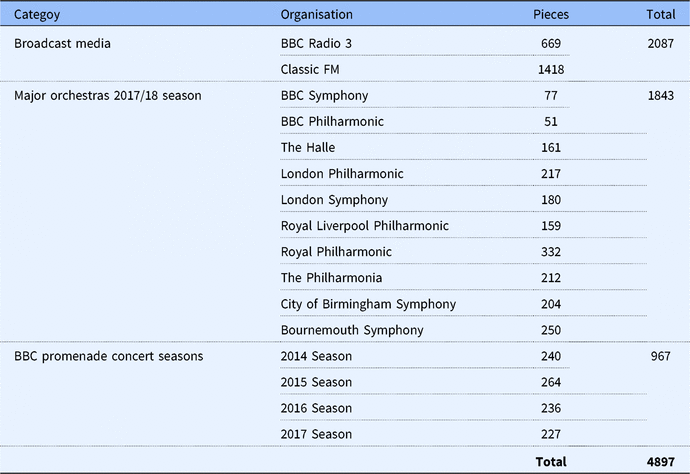
All data for this research came from publicly available sources: the Internet and printed publicity material. In total, 4897 played pieces by 681 composers were collected and categorised. Table 1 shows the number of pieces from each organisation/season. The data tables recorded the number of pieces played for each composer. If the same piece was played three times, it was recorded as three pieces played. No account was taken of the length of the pieces played. This was partly practical; it was simply beyond the scope of this project. However, it was also because the project was concerned with visibility and representation – the number of times composers appeared on programmes, schedules, posters, and in the media. Certainly, it could be argued that some composers of longer pieces, such as Mahler, might not be fairly represented. However, as longer pieces in the survey were written predominantly by white males, not recording the length of pieces was likely to lead to an over-estimate, rather than an under-estimate, of the presence of music by BME or female composers.
Organisations and Numbers of Pieces

The broadcast media consisted of all relevant pieces broadcast on BBC Radio 3 and Classic FM for a complete week (9th–15th October 2017). With the exception of the BBC Symphony Orchestra, data from the major orchestras included all the pieces from their 2017/18 concert seasons. The BBC Symphony pieces were recorded from the end of the 2017 Proms season (27th September) until 19th May 2018. The Promenade Seasons included all the relevant pieces played over the last 4 years.
The organisations surveyed predominantly programmed classical music. But there were grey areas. Film music, for instance, was included if it was presented in the classical style – particularly if, like much music by John Williams, it has entered the mainstream classical repertoire. Pieces from genres such as Jazz, Musicals, or World Music and Christmas spectaculars, Disney Celebrations or Music from the Movies (clearly money-spinners not aimed at a classical audience) were not included. Some pieces, such as West side Story, posed problems. Clearly Bernstein, with pieces such as The Chichester Psalms, was a top-ranking composer, but West side Story is labelled a musical. Here an individual judgement was made. So an Orchestral Suite or the Symphonic Dances from West Side story would be included, but the Broadway cast singing Gee, Officer Krupke would not. This was, inevitably, a subjective process. However, given the large number of pieces surveyed, it was felt that these marginal decisions did not have a noticeable effect on the overall trends.
Composers were placed into one of four eras:
1. Pre-1750
2. 1750–1900
3. 1900–Present (deceased)
4. Living composers (on 1st December 2017)
Although there is some alignment with musical periods, these periods were chosen on the basis of the likelihood, or expectation, of female and/or BME composers being represented. The hypothesis applied was that the more recent the era, the higher the likelihood of female and BME representation. Where composers crossed an era, two criteria were used in deciding where to place them: when most of their pieces were composed and where they were perceived to have been most visible. Again, there were some difficult decisions. Elgar was placed in category 3, while Debussy was placed in category 2. Some people may have a different view on this, particularly if they are basing their judgements on stylistic musical criteria. But this study focused on sociological, and particularly chronological, criteria. Debussy won the Prix de Rome in 1884 and could, therefore, be considered to have been publicly recognised and prominent well before the end of the nineteenth century. On the other hand, the majority of Elgar’s most famous works (including his three symphonies, the cello and violin concertos, Flastaff, Cockaigne, the Pomp and Circumstance Marches, Introduction and Allegro for Strings, The Apostles and The Kingdom) were composed in the twentieth century.
The 681 composers were categorised as follows:
1. Non-white – yes/no
2. African Heritage – yes/no
3. European – yes/no
4. Gender – male/female
Non-white, which could be labelled other-than-white, included black, mixed heritage, Indian and Asian groups. Where known, a composer’s ethnicity/nationality was recorded (e.g., Japanese Heritage, Chinese, African Cuban etc.). African heritage covered black and mixed-heritage people who could trace some or all of their ethnicity to Africa and/or the African diaspora. European was defined as continental Europe. A rough guide was a country’s eligibility to enter competitions such as European football tournaments (though the exception to this was Israel, which is in Union of European Football Associations for security rather than geographical reasons).
Findings and discussion
The current canon
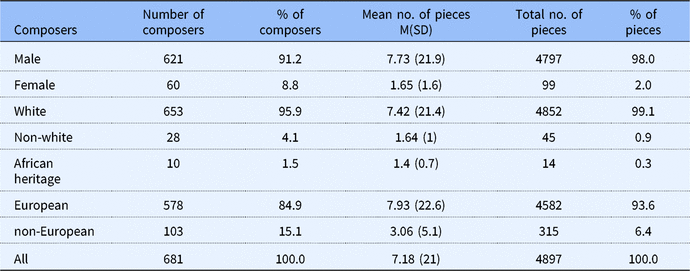
Table 2 is clear: over 99% of pieces played were by white composers, 98% were by male composers and nearly 94% were by Europeans. The 28 non-white composers had a mean of less than 2 pieces played, for white composers the mean was 7.4 pieces [t(679) = 6.76, p < .001]. Similarly, male composers had a mean of 7.7 pieces, compared to just 1.6 pieces for the 60 females [t(668) = 6.74, p < .001] and the 103 non-Europeans had a mean of marginally over three pieces, compared to nearly eight for Europeans [t(654) = 4.58, p < .001]. Without doubt, the current classical music canon remains predominantly white, male and European.
All Pieces and Composers

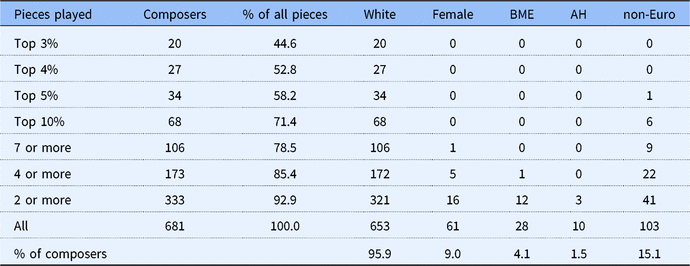
Table 3 emphasises this domination. Just 27 composers (under 4%) account for over half of the entire output. These composers, in order of the number of pieces played, were Beethoven, Mozart, Tchaikovsky, = Elgar, = J. S. Bach, Brahms, Dvorak, Debussy, Sibelius, Ravel, Shostakovich, Rachmaninov, Haydn, Stravinsky, Mendelssohn, Mahler, Vaughan-Williams, Vivaldi, Handel, Prokofiev, Chopin, Schubert, Schumann, Grieg, = Saint-Seans, = R. Strauss, = Wagner. All were European white males.
All Composers Ranked by Number of Pieces Played

The highest ranked non-European, equal 32nd with Walton, was Leonard Bernstein. The highest ranked woman (=79th) was Lilli Boulanger (and perhaps she would not have been this high if 2018 was not the anniversary of her death). The highest ranked BME composers (=133rd) were Chen Gang and He Zhanhao whose Butterfly Concerto was played five times. However, it should be noted that all five performances were given by the Royal Philharmonic during their Chinese tour and not played in England. The highest ranking African heritage composer was George Walker (=134th), with just three pieces played.
When comparing the current canon to the canons of previous generations, it becomes apparent that there are fixed pillars, immovable dominating figures, that maintain the status quo. Kremp (Reference KREMP2010: 1052) noted that:
of the 1612 composers ever played by 27 major American symphony orchestras between 1879 and 1959, only 13 composers accounted for half of the total number of performances
Twelve of the 13 (Bach, Beethoven, Brahms, Debussy, Mendelssohn, Mozart, Ravel, Schubert, Schumann, Strauss, Tchaikovsky, and Wagner) feature in the list of 27 composers that made up over half of the pieces in this study. The 13th, Berlioz, was ranked 41st.
Kremp’s analysis used data collected by John Henry Mueller and, after his death, collated by his wife Kate (Mueller, Reference MUELLER1973). Mueller includes a list of 29 composers (all white, male, Europeans) who, at various times between 1890 and 1970, have been frequently played over a specific five-year period (Mueller, Reference MUELLER1973: xliv–xlv). Of these, 22 appear in the list of 27 most played composers in this study. Only 2 of the 29 are outside the top 50 (Bruckner =54th and Franck =73rd). Kremp (Reference KREMP2010: 1052), using Mueller’s data, also found:
twelve of the twenty most played composers between 1950 and 1959 were already among the twenty most played composers between 1880 and 1889.
And this study found that the profile of dominant composers identified by Kremp in the 1880s and 1950s remains in place as we move towards the 2020s. The canon remains stubbornly male, white and Eurocentric, with a guild of 20–30 dead white men who have dominated the repertoire of the past and continue that domination in the present.
Comparing the different eras
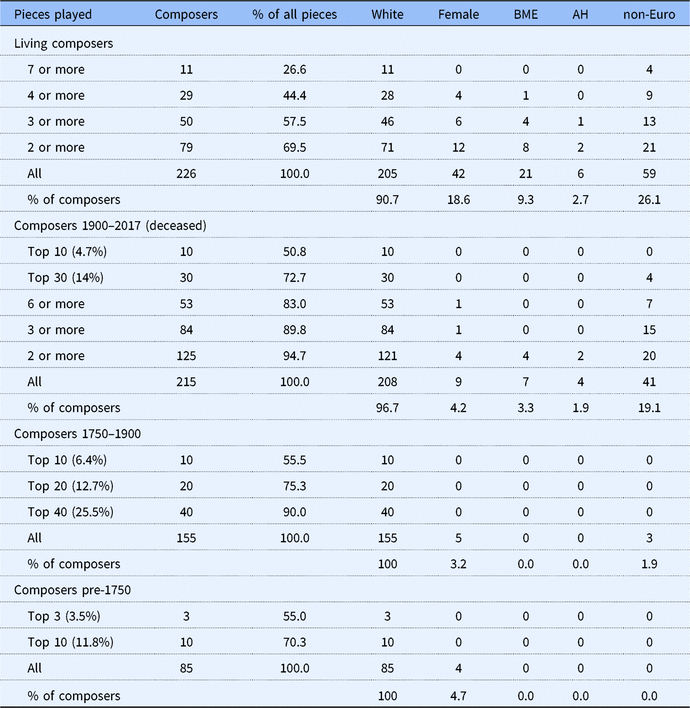
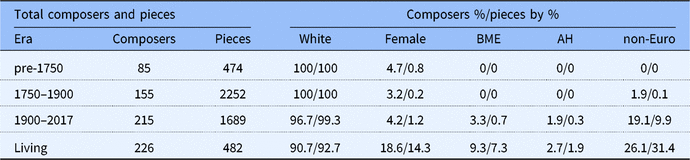
Pre-1750 and 1750–1900: As Table 4 shows, there were no BME composers played from the pre-1750 and the 1750–1900 eras. While the former might be expected, there were certainly non-white composers after 1750. Chevalier de Saint-Georges (1745–1799) composed exceptional string quartets, violin concertos and symphonies. Jose Silvestre White Lafitte (1836–1918) wrote a superb violin concerto. Edmund Dede (1827–1901), who wrote several ballets, operas and orchestral works, is among several nineteenth-century New Orleans Creole composers discussed in Sullivan (Reference SULLIVAN1988). Nevertheless, of the 2252 pieces played from the 1750–1900 era, not a single one was composed by a non-white composer (Table 5).
Composers Ranked by Number of Pieces Played

Comparing the Eras

Grove (2018) lists 37 female composers in the pre-1750 era, including 26 from the baroque period. For the 1750–1900 era, Grove lists 148 female composers (21 classical, 42 early romantic and 85 late romantic). There are, then, enough female composers from both periods to enable programmers to raise the profile of women. Table 4 shows that for the pre-1750 and the 1750–1900 eras combined only 9 (<4%) of the 240 composers were female. They accounted for just 9 (0.3%) of the 2728 pieces played. Interestingly, Table 5 shows that the percentage of female-composed music from 1750 to 1900 (0.2% of pieces) was smaller than pre-1750 (0.8%), even though Grove (2018) suggests a much higher number of known female composers from the 1750–1900 period. Female composers from 1750 to 1900 are, it seems, largely ignored.
One example is Louise Farrenc (1804–1875). She was an important member of the French nineteenth-century music scene. Friedland (Reference FRIEDLAND1974: 274) described her as ‘a forerunner of the epoch-making French musical renaissance of the 1870s’. Her opuses number over 50, she composed chamber, choral and symphonic works, and for over 30 years she was a professor of piano at the Paris Conservatoire. At least one of her works was premiered to great acclaim by no less than the violinist Joseph Joachim (Friedland, Reference FRIEDLAND1974). And yet, she had just one piece broadcast on Classic FM and not a single piece in any live concert in the survey.
1900–2017 (non-living): Given the march of the civil rights movement, women’s suffrage and the evolution of feminism, and a raft of equalities legislation and reform, one might expect the 1900–2017 (non-living) section to represent BME and female composers in higher numbers than previous eras. However, the figures suggest that for BME groups, progress is slow. Just 7 (3.3%) of the 215 non-living 1900–2017 composers were non-white and just 4 (1.9%) were of African heritage. BME composers accounted for just 11 (0.7%) out of 1689 pieces (with 5 of these coming from African heritage composers). The African heritage composers (Coleridge-Taylor, Scott Joplin, William Grant Still and Florence Price) were on the radio only and did not feature in any of the orchestral or Proms seasons surveyed. None of their five pieces was programmed in a prime concert slot. Coleridge-Taylor’s two pieces were played in BBC R3’s breakfast programme and at 11.50 pm on Classic FM (together lasting less than 15 min). Florence Price had a 4-min piece on an afternoon miscellany programme, while Still had a piece of similar length in a breakfast show. Finally, Scott Joplin was represented with a 2-min performance of the Fig Leaf Rag. Twentieth-century African heritage composers were both poorly represented and marginalised in terms of programming slots.
The case of Samuel-Taylor deserves further comment. McGinty (Reference MCGINTY2001: 197), describing Coleridge-Taylor’s visit to America, stated:
in 1904, American audiences were … aware of the status of this young musician as the foremost composer and conductor of England
Coleridge-Taylor had an international reputation. As Richards (Reference RICHARDS2001) noted, Elgar was recommending Coleridge-Taylor for commissions (including a prestigious commission for the Three Choirs Festival for which Elgar had been too busy). Stanford, the pre-eminent composition teacher at the time, had taken him on as a pupil at the Royal College of Music (RCM) where his fellow composition students included Vaughan-Williams and Holst. In fact, Holst and Coleridge-Taylor applied for the same RCM composition scholarship and it was awarded to Coleridge-Taylor (Holst, Reference HOLST1969). The esteem in which he was held is illustrated by the fact that Stanford himself conducted the first performance of Coleridge-Taylor’s early masterpiece, Hiawatha’s Wedding Feast (Richards, Reference RICHARDS2001). By the time Coleridge-Taylor died at the age of 37 he had toured America three times and composed 82 opus-numbered works (Tortolano, Reference TORTOLANO2012). He was a major English composer.
So how has the canon chosen to remember Coleridge-Taylor in comparison to his fellow pupils? Vaughan-Williams was the 17th most played composer out of all 681, with 71 pieces performed. Holst was 34th with 34 pieces played. Both Holst and Vaughan-Williams were well represented across radio, orchestral seasons and Promenade concerts. Elgar ranked fifth with 128 pieces played. But Coleridge-Taylor had just two plays (ranking = 223–335 out of 681) in spite of the fact that Hiawatha’s Wedding Feast was performed hundreds of times in the early decades of the twentieth century. One has to ask why Coleridge-Taylor slipped from the canon? Could it be down to the colour of his skin?
Women from this period fared only marginally better than BME composers. Grove (2018) lists 200 female composers working between 1900 and 1960 alone, and more than 460 are listed in the 1960–present category. Some of the latter are still living, but nevertheless, Grove’s list suggests many female composers are available from this period to programmers. However, just nine female composers were represented and their 21 pieces accounted for only 1.2% of those played. Women made up only 4.2% of composers played from this section. This is a smaller percentage than in the pre-1750 section and only 1% more than the 1750–1900 era.
The data threw up an interesting comparison between Debussy and Lilli Boulanger. Both were French, both had their death centenary in 2018, both were highly celebrated in their lifetimes and both won the prestigious Prix de Rome for musical composition (Boulanger being the first woman to do so). Boulanger had just 10 pieces played, while Debussy had 104.
Living composers: There has been some improvement in representation for female and BME composers in the current generation, but progress is limited. Over 85% of pieces played by living composers were composed by men, over 92% were by white composers and nearly 70% were from Europeans. The largest increase from pre-1750 levels was for non-Europeans who made up 26% of the living composers. However, the majority were white (68%) and/or male (80%). We see, then, that as programmers open their doors to composers from outside Europe, those allowed through continue to reflect classical music’s traditional gender and ethnic majorities.
Although the representation of women has improved, it remains woefully low. Less than one in five of living composers programmed were female and they accounted for less than one in seven pieces played. No women featured in the top 10 composers for the number of pieces played, and while 14 men had over five pieces played, only 2 women were in this position. Eleven white men, seven from Europe and four from the USA, had more than seven pieces played. No woman had more than six plays. Just 12% of the top 50 ranked composers were female.
Only four BME composers, and just one of African heritage, featured in the top 50 ranked by pieces played. Just 21 composers, some 9%, were non-white, with only 6 (less than 3%) of African heritage. BME composers accounted for just 7.3% of pieces played. For African heritage composers, it was less than 2%. While Chen Gang and He Zhanhao’s Butterfly Concerto was played five times, all these performances were on a Chinese tour. No other BME composers had more than three plays. Even George Walker (George Walker sadly died in 2018, but he was still living at the time of this research), the first African American to win the Pulitzer Prize for Musical Composition, had only three pieces played. One of these performances was the British Premiere of his Pulitzer winning composition. Walker won the prize in 1996. The British Premiere took 22 years to appear.
BME, and particularly African heritage composers, were often excluded from prime slots. Leo Brower’s two plays, both just 3 min long, were in BBC Radio 3’s Breakfast miscellany. Valerie Capers’ single piece was also in the Breakfast miscellany. Two living African heritage composers featured in the 2017 BBC Proms. One of these, Hannah Kendall, was played in a late night prom by the Chineke! Orchestra whose mission is to promote BME composers. The other, a 6-min piece by Roderick Williams, was in a lunchtime prom in the Cadogan Hall. Why did no living African heritage composers feature in any proms in the prime evening slots? The long overdue programming of George Walker apart, no African heritage composers featured in the programmes of the 10 orchestras surveyed.
Conclusions: inclusion and doxa in the field
The results of this study suggest that in the field of classical music education in England, inclusion for female and BME musicians is limited. It is based on a restricted form of field membership in which female and BME musicians are encouraged to participate as players, but with little acknowledgement of their presence in terms of influencing the culture and character of what is played. There is greater diversity than ever before in elite youth orchestras and girls continue to outnumber boys in the specialist music schools, but in terms of repertoire, the world for which these young people are being prepared continues to reinforce the importance of whiteness and maleness. The doxa, then, has operated in two distinct ways. First, it has responded to the pressures of society by changing the field’s rules of membership, albeit on a restricted basis, creating a public and visible dialogue in the universe of discourse (Bourdieu, Reference BOURDIEU1977: 168) that appears to legitimise the field as progressive and egalitarian. Second it has preserved its core value and status by what is not changed, with the content and character of the canon remaining largely in the universe of the un-discussed.
This is supported by the answers to the three key questions posed in this research. Has the canon changed to reflect the field’s membership? With 99% of pieces by white composers and 98% by male composers the answer is emphatic: no. Who is, and who is not, admitted to the canon? All of the hundred most played composers in the research were white, and 99 were male. And what is the dominant character of the canon? As the previous answer suggests it is white and male; and, as the figures for living composers suggest, the appetite for change is limited. The data included 482 pieces by living composers; 93% by white and over 85% by male composers. The doxa, the data suggests, has enabled a conditional and subservient version of inclusion that has not had a significant impact on the white male dominance of the canon. As Nwanoku (Reference NWANOKU2015: 1) noted:
Extraordinary composers and musicians such as Chevalier de Saint-Georges have been virtually written out of history. Is it any wonder that we struggle to encourage a diverse society of musicians today and tomorrow?
The data in this study suggested that BME and female composers have been marginalised in the concert and broadcast repertoire. The status of whiteness and maleness is healthily stretching its domination into the twenty-first century. Within the doxa, an outward appearance of legitimate change fuels the illusio that stifles moves towards a deeper cultural shift.
Certainly, the age of all-male orchestras has largely disappeared. In England, according to Service (Reference SERVICE2016), female players number 40%–50% in the major orchestras, though women remain under-represented in senior roles (principles, conductors, etc.). Nevertheless, it is a great improvement on the past, as illustrated by the London Philharmonic Orchestra where, harpists apart, no female players appeared in the orchestral lists from 1932 to 1943 (Russell, Reference RUSSELL1945). However, the slowness of BME representation is highlighted by the fact that it was not until 2014 that clarinettist Anthony Magill became the New York Philharmonic’s first African American principal (Cooper, Reference COOPER2014). Chi-chi Nwanoku, the founder of The Chineke! Foundation, recognised the need to push British orchestras towards diversity. Chineke!, she said, was there to provide
a space where black musicians can walk on to the stage and know that they belong, in every sense of the word. We’re creating a vision of what tomorrow’s orchestras can, and should, look like. (Nwanoku, Reference NWANOKU2015: 1)
It must be hoped that as more BME musicians come through the NCO, the NYO and the Chineke!, they will soon appear in professional orchestral ranks. Nevertheless, the field needs to support this by reflecting in this repertoire the increased diversity of pupils in elite classical music education.
So what happens now? In Homo Academicus (Bourdieu, Reference BOURDIEU1988) it is suggested that forcing the fundamental values of the doxa to change is rarely easy and, as history shows, it is characterised by conflict and sometimes violence. Women’s suffrage, the Civil Rights movement, the dismantling of apartheid, gay rights: none of these happened without bravery, persistence in the face of hostility, trailblazers and a coexistence of other movements for change. Bourdieu notes that change often occurs where there is a simultaneous point of crisis, a critical consciousness in a collection of fields. Discussing events in France in May 1968, Bourdieu (Reference BOURDIEU1988: 161) pinpoints the catalyst for the huge wave of civil unrest as
an intersection of several partly autonomous series of events arising in several fields pregnant with their own specific determinants.
Similarly, in the USA in the 1960s the civil rights movement, the feminist movement, the Vietnam protest movement, and the Hippy movement were acting independently and interjectionally to create a rejection of previous norms.
Might that happen now or in the near future? We have the Me Too movement, the Black Lives Matter campaign, the rejections of middle ground associated with Brexit and the Jeremy Corbyn phenomenon. Organisations like The Chineke! Foundation will provide rallying points. Articles such as this one can highlight the lack of cultural change. Individuals and groups will need to persist in cajoling, harassing and, if necessary, shaming the key players (programmers, conductors, funders, managers and governments) to create critical consciousness within the field. We need to be ready for the moment of intersection with pressures from fields elsewhere, which will bring about crisis and change.