Political trust is essential for policy compliance and good governance outcomes.Footnote 1 It reflects the legitimacy of a regime and significantly influences a state’s governance capacity.Footnote 2 The institutionalist approach of political trust literature argues that citizens’ level of political trust is mainly determined by their acquisition of material interests and their evaluation of the state’s governance performance.Footnote 3 This argument has received substantial support across various cultural contexts.Footnote 4 However, existing research on political trust has largely overlooked housing, the largest asset on most household balance sheets and a central determinant of daily welfare.Footnote 5 Despite the longstanding recognition that housing plays a pivotal role in the “social contract” between citizens and the state,Footnote 6 relatively little is known about how rising or volatile housing prices might affect political trust, which is a deeper orientation towards government legitimacy that goes beyond the policy preferences often linked to homeownership or changes in the housing market.Footnote 7
Prior scholarship has examined how housing, particularly homeownership, shapes citizens’ values and policy preferences, such as attitudes towards redistribution, welfare or taxation.Footnote 8 Although these findings underscore the importance of housing to political behaviour, political trust differs by capturing whether people broadly deem governmental institutions and officials to be competent, fair and responsive.Footnote 9 Consequently, studying political trust offers additional insights: shifts in housing prices might undermine or reinforce citizens’ fundamental confidence in state authorities, rather than simply altering their policy demands. Understanding this distinction is important because trust can profoundly influence governance effectiveness, crisis management and social cohesion, particularly when market upheavals generate winners and losers. If certain groups perceive housing booms as exclusively benefiting others, their trust in government as a whole may erode, generating broader risks for political stability.
In recent decades, many countries have experienced an unprecedented surge in housing prices, driving up both macroeconomic volatility and concerns about social inequality.Footnote 10 While studies explore the impact of housing on political attitudes, most focus on advanced capitalist economies, despite emerging economies facing greater fluctuations in housing prices.Footnote 11 Furthermore, political trust scholarship often highlights macroeconomic performance or media influence, paying less attention to age-based heterogeneity in housing. At different stages of the life cycle, individuals’ housing needs frequently exceed (or fail to match) their financial capacity, which in turn can shape how they evaluate government performance and, ultimately, how much trust they place in political institutions.
In this study, we contribute to the existing literature by using the unexpected and unprecedented surge in housing prices in urban China in 2009 as a case to examine the divergent effects of a housing boom on political trust across different age groups. In response to the severe economic downturn pressures from the 2008 global financial crisis, the Chinese government implemented a four trillion-yuan economic stimulus package.Footnote 12 This initiative triggered a nationwide dramatic surge in new housing prices, which increased by an average of 25 per cent in 2009, marking the largest spike on record to that date. By combining city-level statistics data and household-level data from the China Family Panel Studies (CFPS) for the period 2012–2020, we find that the distributional effects of the surge in housing prices have triggered a significant divergence in political attitudes: specifically, the sudden and dramatic increase in housing prices depressed political trust among individuals aged 45 and under at the time of the event, while it boosted trust among those aged 51 and above. Our main findings remain robust across various model specifications, different subsamples and alternative operationalizations of key variables.
We also identify the channels driving this generational divergence in political trust. Our mechanism analysis suggests the sudden increase in housing prices created winners and losers across three key domains. For younger cohorts, it led to worse living conditions, diminished housing wealth accumulation and lower perceptions of self-efficacy. In contrast, older cohorts experienced largely positive impacts in these areas, which helps explain their increased political trust.
This study makes several key contributions. First, it advances research on housing markets and political attitudes by focusing on political trust rather than just policy preferences.Footnote 13 We show how housing price surges can reshape core regime confidence, highlighting the relevance of housing for state legitimacy beyond influencing policy stances.Footnote 14 Second, we offer new insights into China’s political trust dynamics, contributing to the scholarship on hierarchical trust and macro-performance effects.Footnote 15 We demonstrate how China’s policy-driven housing boom created asset-based, generational trust differentials towards local officials, enriching understanding of how policy and social stratification produce uneven trust outcomes beyond prior focuses such as corruption.Footnote 16 Third, our analysis reveals generational specificity in crisis responses. China’s 2008 housing stimulus produced generational polarization in trust, akin to European austerity’s effects,Footnote 17 highlighting generational divergence as a key social cleavage. Lastly, we identify mechanisms, namely politicized housing aspiration–capacity mismatches fuelled by credit inflation, through which housing booms shape political trust. This underscores asset-based welfare’s importance for trust, while cautioning policymakers about the legitimacy risks associated with exclusionary growth.Footnote 18
Literature Review and Analytical Framework
Housing and its political dimensions
Housing is widely recognized as more than mere shelter; it is a cornerstone of modern society that profoundly shapes individuals’ life chances, wealth accumulation, social status and political outlook.Footnote 19 Its significance extends beyond the purely economic, positioning housing as a central concern in political economy and a key arena for state–citizen interaction, particularly in welfare societies where it embodies both a private commodity and a public good.Footnote 20 Access to decent housing directly influences daily well-being, community engagement and social capital,Footnote 21 making it a persistent feature of political agendas globally.Footnote 22 The political dimensions of housing are multifaceted, encompassing not only the implications of tenure (for example, homeownership) but also, crucially, the societal and individual consequences of housing price dynamics and their impact on wealth.
The issue of tenure is indeed central to discussions of housing politics and policy, with tenure being viewed as an institution or a set of practices that governs how housing is provided and consumed.Footnote 23 In most countries, homeownership, in comparison to renting, is both more heavily promoted by the state and more highly valued by society.Footnote 24 Homeownership is generally believed to offer greater autonomy over one’s home and to contribute to familial security and a sense of community belonging, and is widely considered a key source of individual identity and social status.Footnote 25 Peter Saunders argues that homeownership is critical to understanding modern society, as it marks an individual’s transition to property ownership and serves as an important symbol of social membership.Footnote 26 Research has shown that, compared to highly mobile renters, less mobile homeowners are more likely to invest in local amenities and social capital,Footnote 27 resulting in higher levels of both total social capital and neighbourhood social capital.Footnote 28
In many countries, homeownership is regarded as an alternative for social security, or a self-accumulating insurance. Jim Kemeny notes that in nations with underdeveloped welfare systems, owned housing serves as a partial substitute for social insurance.Footnote 29 The importance of homeownership lies in its ability to provide economic security, acting as a buffer for individuals against life’s uncertainties and risks.Footnote 30 For example, during retirement, economic downturns or periods of personal economic difficulties, owning a home functions as a form of “private insurance,” mitigating welfare losses and reducing reliance on external social support systems, thereby enhancing individual autonomy and resilience against risks.Footnote 31 However, it has been observed that governments’ promotion of homeownership as “asset-based welfare” is often associated with reductions in welfare expenditures.Footnote 32 Research based on China indicates that as housing prices increase, higher homeownership rates increase the likelihood that the government will reduce social security expenditures.Footnote 33
Beyond the relatively static status of homeownership, the fluctuation of housing prices introduces a dynamic and often more potent political dimension, primarily through its impact on household wealth. Housing typically constitutes the largest single asset on most household balance sheets,Footnote 34 making its price volatility a significant determinant of changes in household wealth. While the literature directly linking housing price fluctuations to political trust is still developing, a broader body of scholarship has established a strong connection between wealth, wealth inequality and various political dimensions. For instance, studies have shown that changes in personal or aggregate wealth can influence political participation,Footnote 35 policy preferences concerning redistribution and social welfare,Footnote 36 and even broader political orientations and satisfaction with democracy.Footnote 37 Therefore, understanding how citizens react politically to substantial changes to their housing wealth, driven by price surges or collapses, can provide crucial insights into the mechanisms linking housing market dynamics to political attitudes such as trust.
The financialization of private homeownership has been extensively implemented by governments globally as a policy tool to achieve economic goals, such as promoting economic growth, providing outlets for over-accumulated capital and addressing economic crises.Footnote 38 This process inherently magnifies the importance of housing prices, as they become key indicators of economic performance and instruments of policy intervention.
In the political sphere, housing acts as a crucial link between citizens and society, shaping their understanding of politics and influencing their attitudes towards social policies and evaluations of the political system.Footnote 39 While much research has focused on tenure-based differences, price dynamics add another layer of complexity. Stefanié André and colleagues find that in countries where homeownership is dominant, homeowners generally have higher voter turnout than renters,Footnote 40 reflecting a divergence in political motivation and policy preferences between the two groups. David Adler and Ben Ansell emphasize that some populist parties have capitalized on renters’ dissatisfaction to garner support.Footnote 41 Crucially, differences in political attitudes are not only influenced by tenure but also vary significantly with housing prices. Separately, Ansell argues that rising housing prices, often perceived as “windfalls” that increase homeowners’ permanent income (and thus, wealth), make homeowners in the US and UK less supportive of redistribution policies and less inclined to desire social insurance.Footnote 42 Similar findings have been observed in European countries when housing prices are measured relative to income, as affordability measures indicate a widening polarization between owners and renters.Footnote 43 These studies highlight how housing price movements can reshape citizens’ material interests and, consequently, their political preferences, often exacerbating existing cleavages or creating new ones based on differential exposure to housing market volatility.
In summary, while prior scholarship highlights the political dimensions of housing, especially homeownership effects, critical gaps persist. First, the link between housing price volatility and fundamental political trust is underexplored. In many non-Western countries, where traditional political participation may be less observable or salient, political trust is a crucial indicator of citizens’ political attitudes; its connection to housing price dynamics is, however, often overlooked. Second, research on how rapid housing price changes and associated wealth effects shape political attitudes in these non-Western settings is scarce. Third, existing studies often lack exploration of micro-level mechanisms linking housing price-induced shifts in wealth and life chances to changes in political trust. This study addresses these gaps by examining how a major housing price surge, through its differential wealth and life chance effects across cohorts, influenced political trust in urban China.
Political trust in China
China’s political trust landscape is often characterized by a phenomenon known as hierarchical trust, in which citizens tend to express higher trust in central authorities than in local governments or grassroots officials.Footnote 44 Scholars argue that this disparity arises partly from widespread perceptions of strong central government intentions but inadequate or inconsistent implementation at subnational levels.Footnote 45 While the root causes vary, ranging from top-down political messaging to local governance challenges, the result is a marked trust gap across different tiers of government.Footnote 46
Despite this gap, self-reported trust levels in China remain high by global standards.Footnote 47 Some studies attribute this to cultural norms emphasizing collectivism and social harmony, as well as the state’s capacity to foster economic development.Footnote 48 Nevertheless, research also suggests that such aggregate trust can exhibit variability in response to concrete policy performance, service quality and economic conditions.Footnote 49 Thus, even in a broadly high-trust context, specific policy outcomes can trigger distinct trust responses among different groups.
These nuances are particularly pertinent for housing policy. Chinese citizens tend to strongly link housing price dynamics to the performance of local governments for several interconnected reasons. First, the prevailing “land finance” (tudi caizheng 土地财政) model means local governments are heavily reliant on revenues from land sales, creating a direct incentive to influence land and, consequently, housing prices.Footnote 50 Citizens often understand that local development is funded through these mechanisms, making local officials appear as key architects of market conditions. Second, local authorities wield significant power over urban planning, land allocation, the pace of new housing supply and the provision of public amenities, all of which profoundly shape housing availability and price mechanisms.Footnote 51 Third, local governments are the primary implementers of housing market regulations and affordable housing programmes, and their effectiveness in these areas is closely scrutinized.Footnote 52 Finally, as the real estate sector involves substantial financial flows and discretionary power, it has sometimes been associated with corruption. Illicit dealings can exacerbate unaffordability or perceived unfairness, directly implicating local officials in the eyes of the public.Footnote 53 Thus, in this context, citizens’ trust in cadres often serves as a bellwether of satisfaction or discontent sparked by housing affordability, accessibility and the perceived fairness of the market’s operation. Such experiences can evoke either intensified grievances or reinforced confidence depending on who benefits from the boom.
In short, while hierarchical trust dynamics and an overall high baseline of political trust set the broader Chinese context, the pressures of a sudden housing price spike can reveal important variations in local trust. This perspective allows us to examine how an ostensibly high-trust environment can still generate substantial heterogeneity in political attitudes, particularly across age cohorts, when citizens experience rapid shifts in one of their most critical economic assets.
The link between housing price surges and political trust
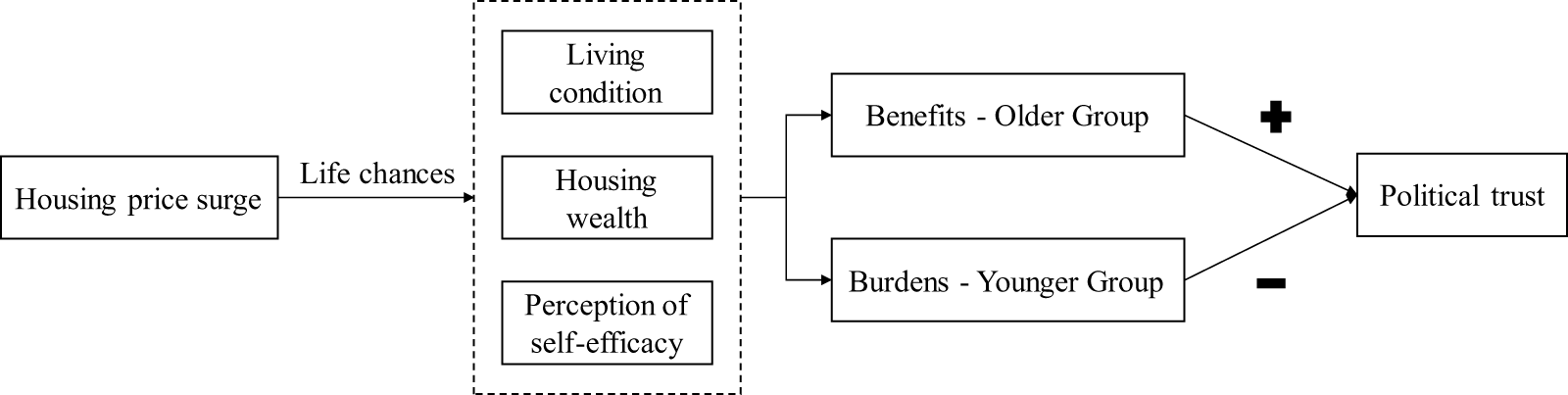
This paper posits that housing price surges create cohort-based trust differences towards local governments by reshaping perceived “life chances.” With local governments often seen as being responsible for housing prices, citizens adjust their trust accordingly. We examine how housing price surges affect political trust via interconnected mechanisms using a framework centred around “life chances,” or opportunities for a better quality of life,Footnote 54 both of which are viewed as crucial factors in urban and housing studies (see Figure 1).
An Analytical Framework of the Consequences of a Housing Price Surge for Political Trust

We argue that housing price surges influence perceived life chances, and thus local government trust, through three mechanisms blending rational and socio-psychological factors:
Mechanism 1: Living conditions and basic welfare security
Housing quality is a key indicator of living conditions. Stable, decent housing fosters rootedness and positive government evaluations,Footnote 55 as secure conditions generally correlate with higher institutional trust. Conversely, housing instability or unaffordability can breed disappointment with authorities, especially if linked to governance failures.Footnote 56 The critical role of housing was evident, for instance, during the COVID-19 crisis, where homeowners often more readily accessed community relief networks while renters or those without fixed addresses were sometimes excluded.Footnote 57 Thus, living conditions directly impact basic welfare security and, consequently, trust in government.
Mechanism 2: Housing wealth accumulation and asset security
As a primary wealth source,Footnote 58 appreciating housing can reinforce homeowners’ positive views of policymakers.Footnote 59 Those excluded may perceive inequity, which can erode trust.Footnote 60 This aligns with studies showing that inequality undermines trust through perceived unfairness.Footnote 61 Housing wealth disparities thus shape perceptions of governance and fairness, leading to divergent trust levels.
Mechanism 3: Perception of self-efficacy
Housing connects to identity and belonging.Footnote 62 Housing situations aligning with aspirations can foster positive governance views.Footnote 63 Perceived government hindrance to securing housing, however, can cause disillusionment,Footnote 64 reflecting a breached “psychological contract.”Footnote 65 Subjective evaluations such as social status and life satisfaction, which are vital for political attitudes, are significantly shaped by housing, thus influencing self-efficacy and trust.
Rising housing prices often hinder younger adults’ homeownership and asset buildingFootnote 66 and enrich established homeowners, particularly in emerging economies,Footnote 67 thereby exacerbating generational divides and perceived unfairness.Footnote 68 As Figure 1 shows, the three mechanisms of living conditions, housing wealth and self-efficacy collectively shape trust adjustments. Price surges benefit older homeowners (better life chances, self-efficacy) but burden younger groups (diminished life chances). These divergent experiences influence views on governmental fairness, driving cohort-specific trust outcomes. Housing thus acts as a key arena where life chances and policies converge to mould government confidence.
China’s Unprecedented Housing Price Surge in 2009
The 2008 global financial crisis severely impacted China’s economy,Footnote 69 with the real estate sector being the hardest hit. According to the National Bureau of Statistics (NBS), both the sale space and average sale price of new commodity housing experienced their first decline since 1998, dropping by 15.5 per cent and 1.9 per cent in 2008, respectively. In response, the Chinese government launched a four trillion-yuan economic stimulus package in November 2008, aiming to boost economic growth by expanding domestic demand and increasing infrastructure investment.Footnote 70 This plan covered various sectors, with approximately 400 billion yuan being allocated to affordable housing to stimulate the real estate market.Footnote 71
The stimulus package quickly took effect, with China’s GDP quarterly growth rate rebounding from 6.4 per cent in Q1 2009 to 12.2 per cent in Q1 2010, making it one of the few economies to maintain high growth during the global financial crisis. However, the large-scale credit infusion and proactive fiscal policies also triggered a series of issues, such as an increase in local government debt and economic structural imbalances.Footnote 72 In particular, the real estate sector experienced intensified market exuberance due to loose monetary policy, and a drastic expansion of mortgage credit and government-led investments.Footnote 73 For instance, newly issued housing mortgage loans soared to 1.4 trillion yuan in 2009, five times the amount in 2008 and double that in 2007. It was estimated that quality-adjusted residential land auction prices in eight major cities rose by approximately 100 per cent in 2009, largely fuelled by state-owned enterprises substantially overbidding in the land market.Footnote 74
Spurred by the four trillion-yuan stimulus package and related policies, the average sale price of new commodity housing nationwide soared by 24.7 per cent in 2009, with sales revenue skyrocketing by 81.3 per cent, both marking historical records. The surge in housing prices was even more pronounced in major cities. For example, in Shanghai, the average sale price of new housing increased by over 50 per cent in 2009. According to the China Economic Information Center (CEIC) database, out of the 285 cities covered, 277 cities experienced housing price increases between 2008 and 2009, with an average price growth rate of 17.7 per cent.Footnote 75
The welfare benefits and costs of the unprecedented increase in prices in 2009 were unevenly distributed across age cohorts. The older group with higher homeownership rates gained permanent income, while the younger group were saddled with a greater burden for homeownership. The impact of this dramatic housing price spike on the political attitudes of different groups warrants careful investigation.
Data and Methods
Data source and key variables
This study draws on data from the China Family Panel Studies (CFPS), a nationwide longitudinal tracking survey that encompasses 25 provincial‐level regions and about 95 per cent of the population.Footnote 76 Conducted in multiple waves (2010, 2012, 2014, 2016, 2018 and 2020), the CFPS began measuring political trust in 2012, yielding five rounds (2012–2020) for our analysis.
The primary indicator of political trust for this study comes from the CFPS, which asks respondents the following question: “How much do you trust cadres? (Cadre (ganbu 干部) refers to local government official. Let ‘0’ be very distrustful while ‘10’ be very trustworthy.)” This measure falls under Pippa Norris’s category of specific support for political actors, reflecting a core facet of political trust in the Chinese context.Footnote 77 Previous scholarship on China distinguishes between citizens’ evaluations of local versus central authorities.Footnote 78 However, in the CFPS instrument, the direct question pertains to “cadres,” thereby focusing on local-level officials. Despite potential interest in trust towards the central government, many studies analysing event-driven or policy-driven variations in Chinese citizens’ trust rely on this local government cadre metric as the best available proxy for institutional confidence.Footnote 79 We focus on local political trust in our analysis. This is justified by the fact that local governments are the primary actors in implementing housing policies, making the corresponding variable in the CFPS a relevant and appropriate measure. Recognizing that political trust is essentially an attitudinal construct requiring adequate cognitive grounding, we restricted our sample to individuals who were at least 18 years old in 2009. Following standard practice, the resulting scores were standardized to a mean of 0 and a standard deviation of 1 to facilitate interpretation.Footnote 80
This study examines the impact of the surge in housing prices on political trust. The primary measurement of the housing price surge is based on the growth rate of housing prices in each city in 2009, compared to the average housing prices over the preceding three years (2006–2008). Data for this analysis were sourced from the CEIC database. As the sudden rise in urban housing prices in China in 2009 was linked to the expansionary fiscal policy and financial stimulus initiated in 2008, we included the growth rate of completed real estate development investment in 2009 relative to the average from 2006 to 2008 as an alternative variable in robustness checks.
To accurately estimate the effect of the housing price surge on political trust, we incorporated a series of control variables at the individual, household and city levels into the model to control for other factors that may influence political trust. The individual and household-level control variables were derived from the CFPS database. City-level variables, which account for macro factors such as local economic development, population conditions and public goods provision, were sourced from the China City Statistical Yearbook. Additionally, we included foreign direct investment (FDI) as a percentage of GDP and fixed asset investment (FAI) as a percentage of GDP to capture external capital inflows and domestic investment dynamics. These percentages were calculated manually using data from the CEIC database. Both ratios can critically influence regional growth patterns and public governance outcomes.Footnote 81
Empirical strategy
We conducted group-specific estimations to analyse the impact of the housing price surge on the political trust of different age groups. The model is specified as follows:
 \begin{equation}{y_{ijt}} = \alpha + {\beta _k} \times Cohor{t_c} \times HPSI{2009_j} + \gamma {X_{ijt}} + {\lambda _j} + {\delta _t} + {\varepsilon _{ijt}}\end{equation}
Where yijt represents the political trust of individual i in city j in year t. Cohortc is a dummy variable for age groups; in this study, the group is defined as 18–25 years old, with subsequent groups defined in 5-year intervals, and the last group being those over 60 years old. HPSI2009j represents the degree of housing price surge in city j, measured by the ratio of housing prices in 2009 relative to the average prices from 2006 to 2008. βk is the primary coefficient of interest, capturing the heterogeneous effects of the 2009 housing price surge across different age groups. Xijt represents a series of control variables at the individual, family and city levels. λj represents city fixed effects, Ϭt represents year fixed effects, and Ԑijt is the error term. The main effects are accounted for within this framework, as the time-invariant HPSI2009j effect is absorbed by city fixed effects, and the cohort-specific effects are estimated directly via separate regressions.
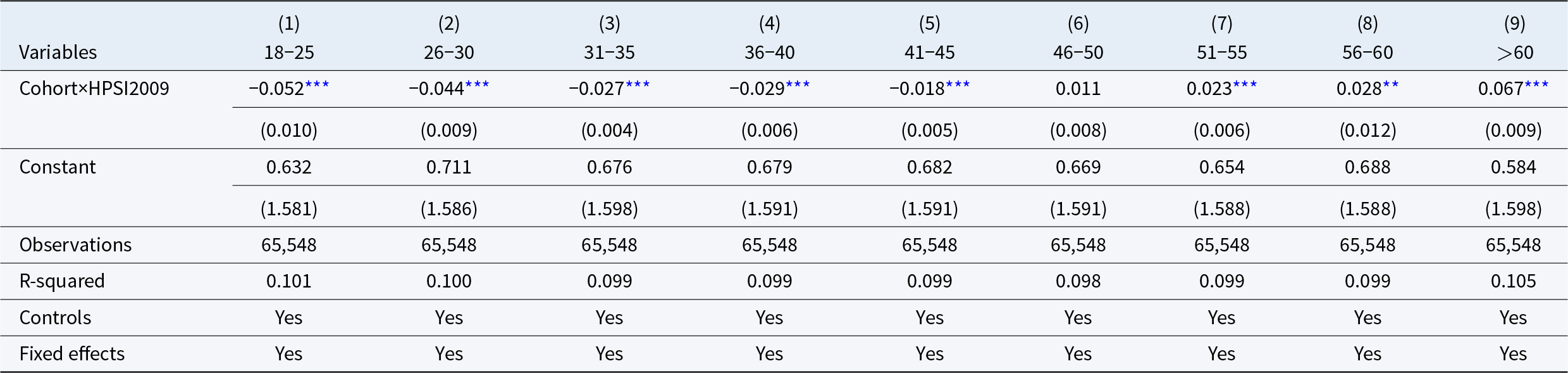
In Equation (1), the term βk × Cohortc × HPSI2009j allows the effect of the housing price surge HPSI2009j on political trust to vary across age cohorts Cohortc. Our primary results in Table 1 present these distinct, cohort-specific effects βk, obtained by running separate OLS regressions for each age subsample. This approach directly shows the heterogeneous impact. While these separate regressions are our main specification due to their intuitive clarity, they do not by themselves test for statistical differences across groups. We therefore conducted a post-estimation Chow test, which confirmed that the heterogeneity is statistically significant (see notes to Table 1). For robustness, we also estimated a fully interacted model as an alternative specification. The results, presented in the online Appendix A7 (Table A5, Column 1), are highly consistent with our main findings in Table 1, confirming that our conclusions are not sensitive to the specific modelling choice.
2009 Housing Price Surge and Subsequent Political Trust

Notes: Robust standard errors in parentheses are clustered at the city level.
*** p<0.01, ** p<0.05, * p<0.1. A Chow test for the equality of the nine coefficients across all columns is rejected at the 1% significance level (χ2(8) = 142.09, p < 0.001), providing strong statistical support for the heterogeneous effects across cohorts.
Trends in political trust and key descriptive statistics
We began by examining how political trust evolved across different age groups between 2012 and 2020. While all cohorts show an overall increase in trust levels, the surge is notably more pronounced among middle‐aged and older adults compared to their younger counterparts. For a detailed breakdown of these trends, including specific figures over time, please refer to the online Appendix A1.
Turning to our core variables of interest, the mean score for political trust (measured on a 0–10 scale) is approximately 5.02, with sufficient variation (standard deviation of 2.64) to capture meaningful differences across individuals. The housing price surge index (HPSI) averages 1.29, indicating that 2009 prices exceeded the 2006–2008 mean by nearly 30 per cent. A comprehensive table of descriptive statistics, covering all control variables and their definitions, is provided in the online Appendix A2. We also examined changes in homeownership rates across cohorts. Homeownership rates have increased across all age cohorts from 2009 to 2020, but older cohorts experienced significantly larger gains, indicating a widening generational divide in formal property ownership. This generational gap in homeownership timing and gains may contribute to the observed differences in political trust across age groups (see online Appendix A3).
Results and Discussions
Benchmark results
Table 1 presents our baseline regression results, incorporating controls at the individual, household and city levels to mitigate any omitted-variable bias. The complete set of regression outcomes is provided in the online Appendix A4.
Comparing the coefficients across different age groups, we observe a significant turning point: as age increases, the impact of the housing price surge on political trust shifts, from significantly negative to non-significant, and then further to significantly positive. This variation in the direction and significance of the coefficients indicates a clear age heterogeneity in the political impact of the housing price surge.
Specifically, the housing price surge undermines political trust among younger groups but significantly enhances political trust among older groups. For those aged under 45 in 2009, a 10 per cent increase in housing prices in their city compared to the average of the previous three years results in a 1.8 per cent to 5.2 per cent standard deviation decrease in political trust. Considering that the average housing price increase is 30 per cent, this impact is quite significant. For those aged 51 and above in 2009, a sudden increase in housing prices significantly boosts their political trust, with the absolute value of this effect being greater than the negative impact of rising housing prices on the political trust of younger groups.
These foundational results indicate that a housing price surge occurring at different life stages can have varying impacts on individuals’ future political trust. The findings underscore the importance of considering age heterogeneity when examining the relationship between economic factors and political attitudes.
Robustness checks
In addition to our primary specification, we conducted several robustness checks to ensure the reliability of our findings. We tested simpler models with varying controls, including specifications that exclude all covariates, separately add individual, household and city-level controls and remove city fixed effects (see the online Appendix A5.1). Our core results remain consistent with the comprehensive specification reported in Table 1. We also explored potential biases from population mobility by restricting the sample to those whose registered residence and current residence match, used an alternative indicator – completed real estate development investment – to measure housing price surges, excluded observations from the years following the 2015 stock market turbulence and the 2016 real estate “destocking” policy, and restricted the sample to individuals with urban hukou 户口. Finally, we ran additional models controlling for pre-crisis city GDP levels and growth rates. Full details, including figures illustrating these checks, are provided in the online Appendix A5.2; collectively, they reinforce that our core conclusions hold under a variety of model configurations and sample restrictions.
Mechanism analysis
Building on our analytical framework, this section empirically explores the three proposed channels linking housing price surges to political trust: living conditions, housing wealth and perceived self-efficacy. To do so, we proceeded in two steps. First, we investigated the mechanisms related to material outcomes by examining how the surge affected younger cohorts’ housing difficulties and net housing wealth. Second, we tested the socio-psychological channel by analysing the impact on individual self-efficacy, using subjective social status and life satisfaction as measures. Our analysis demonstrates how younger and older adults systematically differ in their exposure to these channels, thus explaining their divergent trust outcomes.
Living conditions and housing wealth
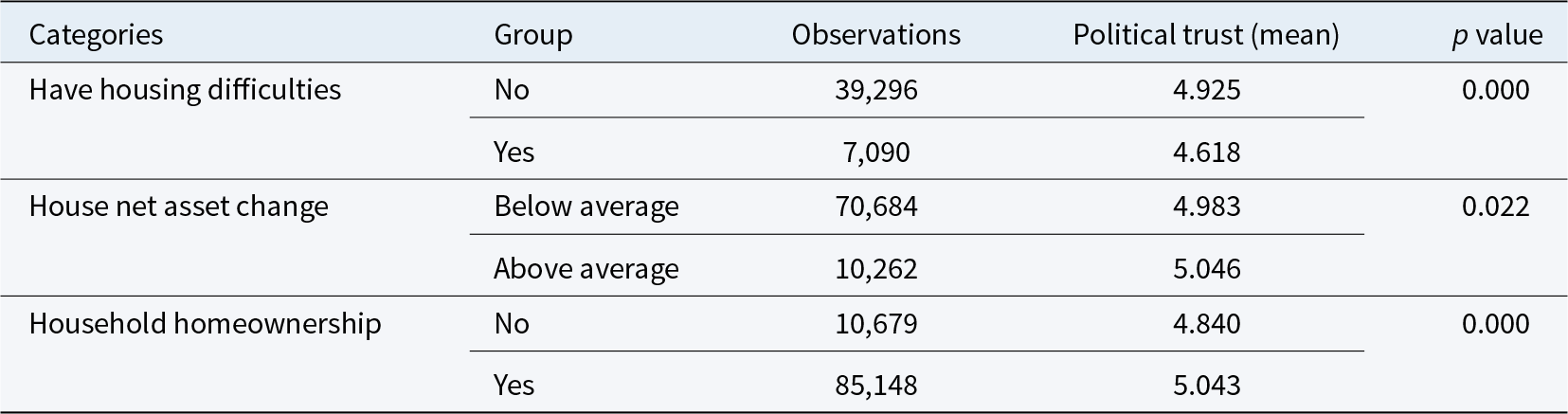
To assess how housing conditions relate to political trust, we first conducted t-tests comparing mean levels of political trust across groups defined by three key housing variables. The first variable was housing difficulties, where respondents sharing a bedroom with multiple generations or relying on temporary beds were classified as “Yes” having housing difficulties, and all others as “No.” The second variable was house net asset change, for which individuals were split into groups at the average level of net asset change in housing, distinguishing those above and below that threshold, with net asset change based on the reported value minus any remaining mortgage. Finally, household homeownership was considered, which is defined at the household level to indicate whether any household member is formally registered on a property deed.
The results in Table 2 indicate statistically significant differences in political trust across all housing conditions (p < 0.05 in t-tests for all comparisons). Individuals experiencing housing difficulties reported significantly lower political trust compared to those without such difficulties. Similarly, those with house net asset change above the average level showed a modest but significantly higher political trust compared to those below the average. Household homeownership was also positively and significantly associated with political trust, with homeowning households exhibiting notably higher trust levels than non-homeowning households. The magnitude of these differences is also noteworthy, with the mean political trust gap ranging from 0.06 to 0.30, which is equivalent to 2.3 per cent to 11 per cent of a standard deviation. In short, these findings reveal a clear pattern of significant associations: favourable housing conditions, as defined by an absence of difficulties, higher net asset growth and homeownership, are linked to higher political trust, while unfavourable conditions are associated with lower trust.
T-tests for Housing Condition Variables and Political Trust

We further investigated the housing conditions of those who do not own property rights – that is, tenants. Within the tenant group, a segment of households resides in government-provided subsidized housing. The analysis demonstrates that in comparison to general renters, those residing in subsidized housing exhibit significantly higher levels of political trust. Detailed statistical results on this finding are presented in the online Appendix A6. These results align with recent research that finds that Chinese urban residents report higher happiness when local governments promise greater dedication to improving housing affordability.Footnote 82 This observation indirectly validates our earlier conclusions, indicating that improvements in housing conditions and reductions in housing burdens contribute to enhancing citizens’ political trust.
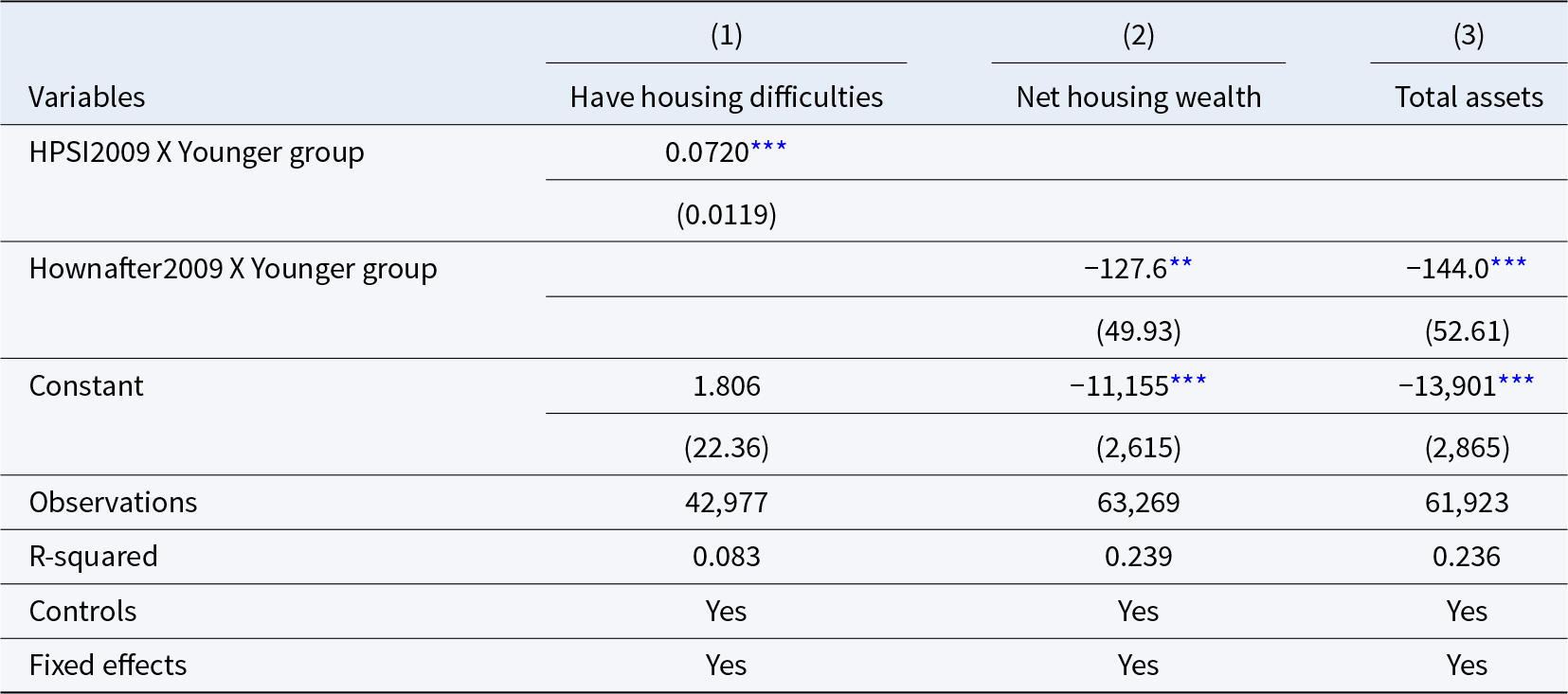
To connect these findings with the observed generational divergence, Table 3 examines the impact of the housing price surge on the living conditions and housing wealth of the younger cohorts. We focus this part of the mechanism analysis specifically on the “younger group” (≤45 in 2009) for two main reasons. First, as shown in our main results (Table 1), this is the segment of cohorts that consistently experienced a significant negative impact on their political trust. Second, the mechanism variables related to housing and wealth have a smaller effective sample size, making a focused analysis on this key group a more robust approach.
Impact of the Housing Price Surge on Living Conditions and Housing Wealth

Note: Robust standard errors in parentheses are clustered at the city level.
*** p<0.01, ** p<0.05, * p<0.1.
The findings in Table 3 reveal the channels through which the housing price surge adversely affected the younger group. The results show that a higher housing price surge significantly increased their likelihood of experiencing housing difficulties and was associated with lower net housing wealth for those who became homeowners after 2009. A similar pattern emerged for total household assets, which is plausible as housing constitutes over 70 per cent of household assets in China.Footnote 83 In sum, the housing price surge exacerbated a structural imbalance, imposing housing hardships on younger cohorts while benefiting older homeowners. This divergence in economic outcomes provides a compelling explanation for the divergent patterns in political trust.
Perception of self-efficacy
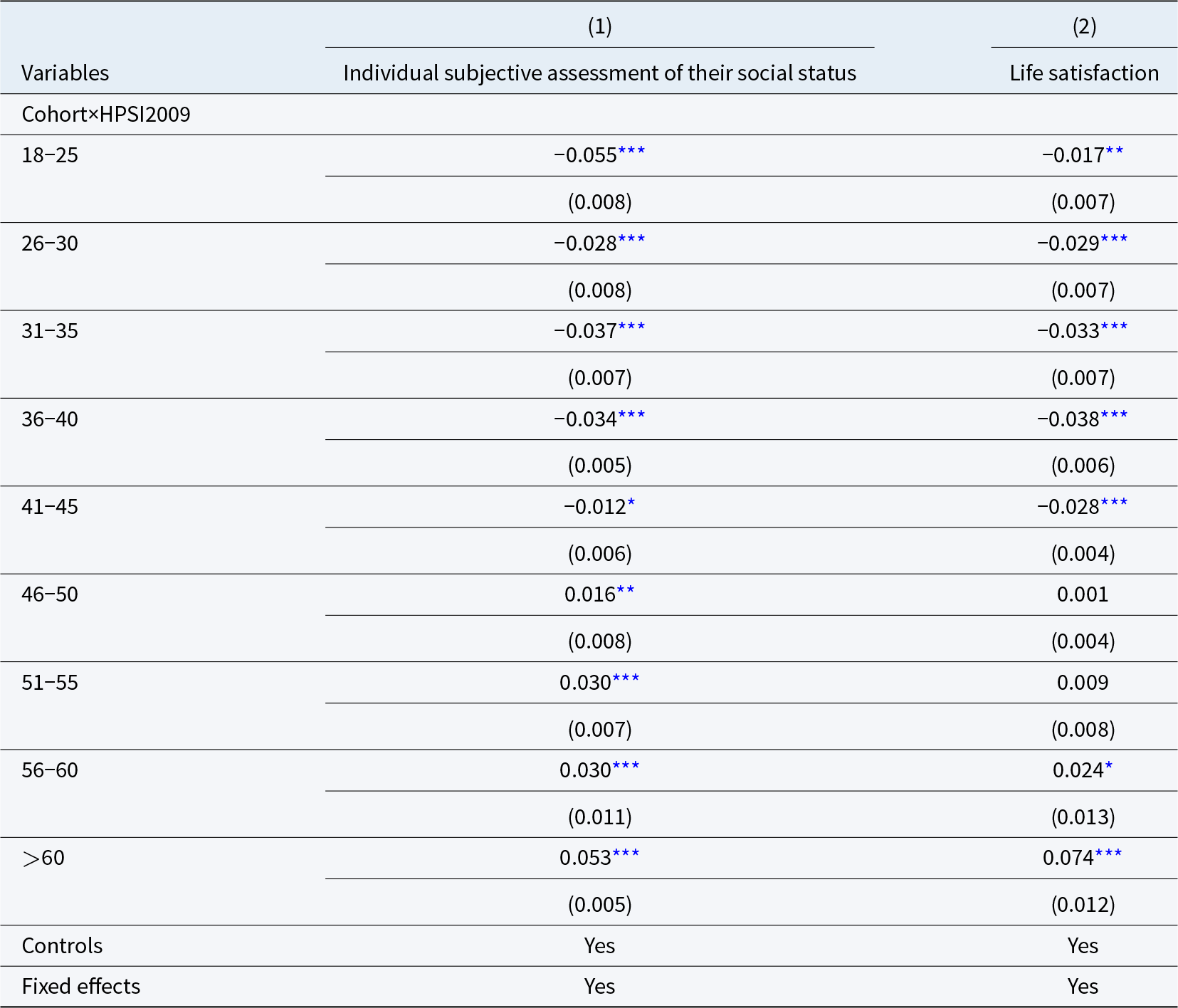
Drawing on our analytical framework, we then examined perceived self-efficacy as a potential mechanism. We use two CFPS variables: individual subjective assessment of social status and life satisfaction, both of which are standardized and measured similarly to political trust. For this analysis (Table 4), the richer data available for these self-efficacy variables allowed us to revert to the detailed age cohorts used in our baseline regressions, facilitating a more granular examination.
Impact of the Housing Price Surge on Perception of Self-efficacy

Note: Robust standard errors in parentheses are clustered at the city level.
*** p<0.01, ** p<0.05, * p<0.1.
As shown in Table 4, with respect to self-efficacy, the housing price surge made the middle-aged and younger cohorts feel lower in social status and less satisfied with their lives. Conversely, the impact on the middle-aged and elderly groups was the opposite. Overall, the influence of the housing price surge on political trust is largely realized through shaping people’s perception of self-efficacy and beliefs. However, due to the different life stages of various age groups, there are significant differences in their perceptions of the impact of the housing price surge. These differences may reflect the unequal state of housing asset ownership and housing demand across different generations.
To further corroborate the mediating roles of subjective social status and life satisfaction discussed here, we conducted a supplementary three-step mediation analysis, the results of which can be found in the online Appendix A7.
Conclusions and Discussions
Following the 2008 financial crisis, China implemented a series of economic stimulus plans, which triggered a surge in housing prices. This study employs this event as a case through which to investigate the impact of rising housing prices on political trust among different age groups. The empirical results reveal that the housing price surge had heterogeneous effects on political trust across generations. Specifically, while the rise in housing prices increased political trust among the older group, it decreased political trust among the younger generation. These findings remain robust after controlling for numerous individual and city characteristics as well as fixed effects.
The mechanism analysis suggests that the sudden hike in housing prices made the younger group, characterized by lower homeownership rates, more likely to face housing difficulties. Consequently, this group experienced lower housing wealth in the subsequent period and developed a negative perception of self-efficacy. This finding aligns with a recent study that reports that rising housing prices increased the happiness of homeowners in Chinese cities while the widespread increase in housing wealth inequality reduced overall happiness.Footnote 84
The findings of this study hold significant implications for understanding the dynamics of political trust during China’s transitional period. In the wake of the 2008 financial crisis, China implemented a series of expansionary policies that, while achieving rapid economic recovery, also triggered rising housing prices. This development exacerbated the housing pressures faced by the middle-aged and young adult population. When these demographic groups were unable to benefit from the rise in housing prices and instead had to bear the burden of high housing costs, their trust in local government officials was undermined. This case illustrates the delicate balance between short-term economic performance and long-term political stability that developing countries must navigate when addressing development issues. Good governance should strive to strike a balance between economic development and social equity, including intergenerational equity. Therefore, the Chinese government must prioritize improving the housing conditions of younger and middle-aged groups and narrow the housing wealth gap between generations as a matter of urgency.
A crucial area for future research is the impact of recent falls in housing prices on political trust, a phenomenon we cannot fully address given limited observations. Since the real estate market serves as a key macroeconomic barometer in China, the widespread price drops since 2022 warrant closer examination of their political consequences. Meanwhile, our dichotomous classification based on age and homeownership may overlook the intergenerational transfers that enable some younger adults to secure homeownership more readily. Future research with more granular information on parental housing contributions and other transfers could better illuminate how age and homeownership intersect to shape political attitudes, including trust in both local and central government.
Supplementary materials
Appendices are available online as supplementary materials at https://doi.org/10.1017/S030574102610191X.
Acknowledgement
This research was supported by funding from the National Natural Science Foundation of China (NSFC Project No. 72474131/71974125/71661137004).
Competing interests
None.
Yu ZHANG is a postdoctoral research fellow at the School of Public Policy and Management, Tsinghua University. His research focuses on housing politics, housing policy and urban governance. He has published papers and articles in academic journals such as The China Quarterly, Chinese Political Science Review, Policy Sciences and Growth and Change, as well as media outlets such as China Daily.
Jie CHEN is a professor at the School of International and Public Affairs at Shanghai Jiao Tong University and a research fellow at the China Institute for Urban Governance at Shanghai Jiao Tong University. His research focuses on housing policy, housing markets, urban development and urban governance. His research has been published in academic journals such as The China Quarterly, Leadership Quarterly, Regional Studies, Urban Studies, Housing Studies, Regional Science and Urban Economics, Real Estate Economics, Cities and Land Use Policy.