





Introduction
Quantification is a pivotal concept that allows speakers to express quantities of objects or events within their utterances. Central to this field are quantificational determiners or quantifiers—words like “all,” “some,” “many,” “few,” and numerals—which serve to specify the quantity of entities that hold a certain property within a given domain. However, while both exact and vague quantifiers indicate the size of a plural set with that property, they often leave underspecified whether the property applies to each individual member of the set or to the set as a whole. Consider, for example, a simple scenario in which a parent takes their three children to a bookshop and tells them to “choose a book to buy.” The children will understand that books are involved in the event, but how can they determine whether the parent expects them to choose one book collectively or one each? They might rely on world knowledge—for instance, that buying a book typically implies reading it, and reading is often an individual activity—and select three books, one per child. Alternatively, they might draw on contextual cues—perhaps the parent just mentioned reading a bedtime story later that evening—and choose a single book to share and read together.
Out of context, however, a sentence such as “the children are buying a book” is ambiguous between a distributive interpretation, under which each child is individually buying their own book, and a collective interpretation, under which all the children are buying the same book. Language offers the tool to distinguish the two readings: for instance, universal quantifiers such as “each” or “every” can express the distributive meaning as in “each child is buying a book.” According to the formal literature, these expressions would realize overtly a semantic operator included in the logical form of the sentence, i.e., the Distributivity operator (see Link, Reference Link, Portner and Partee1983 for the original proposal; Champollion, Reference Champollion, Gutzmann, Matthewson, Meier, Rullmann and Zimmermann2020 for a more recent overview of the literature). The D operator represented in (1) introduces universal quantification over atomic parts of a plural set, such that for every entity y that is an atomic subset of the sum x, the predicate P applies to y. If we apply it to the example sentence “the children are buying a book” as in (2a), it will trigger its distributive meaning; otherwise, its absence will lead to a collective interpretation as in (2b).
(1)
D = λPλx∀y[y ≤ x ∧ Atom(y) → P(y)]
(2)
a.
D
buying.a.book(the.children)—“each child is buying a different book”
b.
buying.a.book(the.children)—“the children are buying the same book together”
Collective interpretations can also be conveyed unambiguously with adverbs such as “together” or with expressions such as “the same book.” However, in the absence of such elements, the interpretation of a sentence is left to the hearer’s discretion. While some authors argue that any plural argument that is not explicitly distributive can give rise to both distributive and collective readings (Landman, Reference Landman and Lappin1996; Lasersohn, Reference Lasersohn1995; Winter, Reference Winter2001), a substantial body of theoretical work considers distributive readings to be marginal in such cases (Link, Reference Link, von Stechow and Wunderlich1991; Roberts, Reference Roberts1990; Scha, Reference Scha, Janssen and Stokhof1981; Schwarzschild, Reference Schwarzschild1996; see Dotlačil, Reference Dotlačil2010 for a review). Supporting this view, experimental studies on adult comprehension have shown a clear preference for collective interpretations when ambiguous sentences are presented without disambiguating linguistic or contextual cues (e.g., Dotlačil & Brasoveanu, Reference Dotlačil and Brasoveanu2021; Frazier et al., Reference Frazier, Pacht and Rayner1999; Ussery, Reference Ussery2007). Therefore, semantic and psycholinguistic research largely converges on the idea that collective meanings are more accessible than distributive ones. However, findings from developmental studies are less consistent.
Children’s comprehension of distributive quantifiers and unmarked sentences
The existing literature on the acquisition of distributivity shows that children across different languages struggle to restrict the meaning of distributive quantifiers like “each” to contexts in which distributive readings are appropriate. A landmark study by Brooks and Braine (Reference Brooks and Braine1996) presented English-speaking children aged 4 to 10 with a picture selection task, in which they matched sentences such as “each man is carrying a box” with either a distributive or a collective picture. Results showed that children began to reliably select the distributive picture over the collective one only around the age of 6. Moreover, when the pictures displayed only a partial one-to-one correspondence between agents and objects—for instance, three agents and four objects—children did not consistently interpret “each” correctly until around age 9/10. Similar difficulties have been documented in other studies in English (Musolino, Reference Musolino2009; Syrett & Musolino, Reference Syrett and Musolino2013) and in other languages, including Portuguese and Spanish (cada, Brooks et al., Reference Brooks, Braine, Jia, da Graca Dias, Bowerman and Levinson2001; Grinstead et al., Reference Grinstead, Padilla-Reyes and Nieves-Rivera2021), Dutch (ieder, elke, de Koster et al., Reference de Koster, Dotlačil, Spenader, LaMendola and Scott2017), Italian (ciascuno, Pagliarini et al., Reference Pagliarini, Fiorin, Dotlačil, Biller, Chung and Kimball2012), and Chinese (mei, Brooks et al., Reference Brooks, Braine, Jia, da Graca Dias, Bowerman and Levinson2001). These findings are also related to research on quantifier spreading (QS) errors with the universal quantifier “every,” which further shows that children overextend distributivity to contexts where it is not appropriate. In such cases, children interpret sentences such as “every boy is riding an elephant” as requiring a strict one-to-one correspondence between boys and elephants: even when the sentence is true of all boys, but one elephant is left over, they reject it as false. This pattern has been interpreted as an indication that children sometimes quantify over events rather than over individuals alone (e.g., Denić & Chemla, Reference Denić and Chemla2020; Donaldson & McGarrigle, Reference Donaldson and McGarrigle1974; Drozd & van Loosbroek, Reference Drozd, Loosbroek and Geenhoven2006; Philip, Reference Philip, Stringfellow, Cahana-Amitay, Hughes and Zukowski1996, Reference Philip, De Villiers and Roeper2011; Roeper et al., Reference Roeper, Strauss and Pearson2004, Reference Roeper, Pearson, Grace, Danis, Mesh and Sung2011; but see also Crain et al., Reference Crain, Thornton, Boster, Conway, Lillo-Martin and Woodams1996 or Skordos et al., Reference Skordos, Myers and Barner2022 for alternative accounts).
Altogether, these findings suggest that children find it challenging to grasp the semantics of distributive quantifiers, supporting the view—shared by both semantic theory and adult experimental data—that distributive readings are less accessible. This would predict that, when confronted with ambiguous sentences lacking overt distributive cues, children would prefer collective interpretations, similarly to adults. However, developmental evidence does not clearly support this prediction. There is ongoing debate about whether children show no clear preference between distributive and collective interpretations or may even favor the distributive reading. Several studies across various languages and experimental paradigms have addressed this question (e.g., Bosnić & Spenader, Reference Bosnić, Spenader, Brown and Dailey2019; de Koster et al., Reference de Koster, Hendriks and Spenader2021; Grinstead et al., Reference Grinstead, Padilla-Reyes and Nieves-Rivera2021; Knežević, Reference Kneževic2015; Mognon et al., Reference Mognon, Hagen, de Koster, Hendriks, Gong and Kpogo2022; Musolino, Reference Musolino2009; Pagliarini et al., Reference Pagliarini, Fiorin, Dotlačil, Biller, Chung and Kimball2012; Rouweler & Hollebrandse, Reference Rouweler and Hollebrandse2015; Shetreet & Novogrodsky, Reference Shetreet and Novogrodsky2020; Syrett & Musolino, Reference Syrett and Musolino2013). However, direct comparisons between these findings are complicated by differences in sentence types used across studies. Most developmental research has focused on transitive sentences with ambiguous predicates, but the types of subject and object DPs vary significantly: some studies used numerals in both subject and object position (Knežević, Reference Kneževic2015; Musolino, Reference Musolino2009), others used numerals as subjects and singular indefinites as objects (Brooks & Braine, Reference Brooks and Braine1996; Syrett & Musolino, Reference Syrett and Musolino2013), while yet others used definite plural subjects with singular indefinite objects (de Koster et al., Reference de Koster, Hendriks and Spenader2021; Grinstead et al., Reference Grinstead, Padilla-Reyes and Nieves-Rivera2021; Mognon et al., Reference Mognon, Hagen, de Koster, Hendriks, Gong and Kpogo2022; Pagliarini et al., Reference Pagliarini, Fiorin, Dotlačil, Biller, Chung and Kimball2012).
Regarding these latter structures—those involving definite plural subjects and singular indefinite objects—adults generally show a strong bias for the collective meaning in languages such as English and Spanish. For instance, in a picture selection task, Patson and Hupp (Reference Patson and Hupp2018) found that English-speaking adults choose the collective picture over the distributive one 85% of the time. Similarly, in a Truth Value Judgment Task (TVJT), Spanish-speaking adults almost always accepted the collective interpretation (Grinstead et al., Reference Grinstead, Padilla-Reyes and Nieves-Rivera2021). Dutch-speaking adults present a slightly different pattern: while they still prefer the collective interpretation, as in other languages, they are more tolerant of distributive readings, accepting them around half the time in a TVJT (de Koster et al., Reference de Koster, Dotlačil, Spenader, LaMendola and Scott2017). Children’s interpretations not only diverge from those of adults but also vary considerably across languages. In Dutch, children overwhelmingly accept distributive readings at both age 5 and 9 (de Koster et al., Reference de Koster, Dotlačil, Spenader, LaMendola and Scott2017). In contrast, Spanish-speaking children show a developmental shift: they tend to accept distributive interpretations at age 5 but move toward a strong collective preference by age 10 (Grinstead et al., Reference Grinstead, Padilla-Reyes and Nieves-Rivera2021). English-speaking children aged 4 to 5 also prefer collective interpretations, selecting them about 66% of the time—but this preference is noticeably weaker than that of adults (Patson & Hupp, Reference Patson and Hupp2018).
As for Italian, this area of research remains relatively underexplored. To our knowledge, only one study has directly examined children’s interpretations of unmarked sentences with singular indefinite objects and either definite plural or “each” subjects. In a TVJT, Pagliarini and colleagues (Reference Pagliarini, Fiorin, Dotlačil, Biller, Chung and Kimball2012) presented children aged 4 to 13 with isolated distributive or collective pictures and asked whether a sentence with a definite plural subject, as in (3), or a “each” subject, as in (4), provided an appropriate description. In sentence (3), the subject le bambine (“the girls”) is feminine and plural, agreeing with the plural verb costruiscono (“are building”). In contrast, sentence (4) features the subject ciascuna bambina (“each girl”), which combines a universal quantifier with a feminine singular noun and triggers singular agreement on the verb costruisce (“is building”). Both sentences share the singular indefinite object un castello di sabbia (“a sandcastle”). Results showed that younger children accepted “each” sentences like (4) as appropriate descriptions of both distributive and collective pictures, whereas adults accepted them only in distributive contexts, as expected. A shift toward adult-like interpretations began around age 7/8, with acceptance of the collective reading gradually decreasing, reaching adult levels by age 11. For sentences like (3), with a definite plural subject, the divergence between children and adults persisted longer: children continued to accept both distributive and collective interpretations of such sentences up to age 11, when they began to favor the collective reading, thus aligning with adult patterns in which the collective interpretation is preferred.
(3)
Le bambine costruiscono un castello di sabbia
the-FPL girl-PL build-PRS.3PL a castle of sand
“The girls are building a sandcastle”
(4)
Ciascuna bambina costruisce un castello di sabbia
each-FSG girl-SG build-PRS.3SG a castle of sand
“Each girl is building a sandcastle”
The authors also found that children’s understanding of “each” significantly predicted their likelihood of rejecting the distributive interpretation of definite plural subjects. These findings supported Dotlačil’s (Reference Dotlačil2010) theoretical account of the marginal status of distributive interpretations. Consider the contrast between sentences (3) and (4): while (3) is ambiguous between a collective and a distributive reading, (4) is unambiguously distributive and, therefore, more informative. Based on Grice’s (Reference Grice, Cole and Morgan1975) conversational maxims—specifically, the Maxim of Quantity—a cooperative speaker is expected to choose the most informative expression. Thus, in a context that licenses a distributive reading, a speaker should prefer sentence (4) over the more ambiguous (3). If the speaker instead produces (3), the hearer may infer that the stronger, more informative alternative (4) is false, giving rise to a conversational implicature favoring a collective interpretation of (3). Crucially, to compute this implicature, the hearer must know the meaning and informativeness of “each” in sentence (4). Children who have not yet acquired this knowledge cannot evaluate the relative informativeness of the two alternatives and, therefore, do not derive the same implicature as adults. As a result, they do not yet show the adults’ preference for collective interpretations of ambiguous sentences. Similar findings in other languages, such as Dutch and Spanish, further support this account (e.g., de Koster et al., Reference de Koster, Hendriks and Spenader2021; Grinstead et al., Reference Grinstead, Padilla-Reyes and Nieves-Rivera2021).
Children’s production of distributive and collective expressions
We have seen that children struggle to grasp the meaning of distributive quantifiers and, unlike adults, do not consistently show a collective preference when interpreting unmarked sentences. While much of the existing literature focuses on comprehension, only two studies have examined how adults and children express distributive and collective meanings in production. Syrett and Musolino (Reference Syrett and Musolino2016, Exp. 4) conducted a cloze test with English-speaking adult participants, who were asked to watch videos depicting either distributive or collective actions and then describe what they saw. Participants were provided with key lexical items—such as the agent and the verb—and instructed to add other words to “make a descriptive, grammatical sentence.” Results showed that collective events were typically described using unmarked sentences (e.g., “two boys lifted a block”), though participants occasionally added modifiers like “together.” In contrast, distributive events were consistently marked with expressions such as “each,” reflecting a clear tendency for disambiguating this interpretation.
More recently, Saponaro et al. (Reference Saponaro, Carioti, Riva and Guasti2025) extended this line of research by comparing production patterns in Italian-speaking adults and preschoolers. The authors drew on the well-established Principle of Transparency in language acquisition, which holds that children acquire linguistic expressions more easily when there is a clear one-to-one mapping between conceptual structure and linguistic form (e.g., Jackendoff, Reference Jackendoff1990; Slobin & Bever, Reference Slobin and Bever1982; Van Hout, Reference Van Hout, Greenhill, Hughes, Littlefield and Walsh1998; Weist et al., Reference Weist, Lyytinen, Wysocka and Atanassova1997). Following Guasti et al. (Reference Guasti, Alexiadou and Sauerland2023), they applied this principle to the production domain to explore the semantic representations underlying the expressions used by children and adults when describing distributive and collective events. In line with Syrett and Musolino (Reference Syrett and Musolino2016), results showed that adults frequently produced overt distributive markers such as ciascuno (“each”) or ognuno (“each one,” “everyone”) to convey distributive meanings, while collective descriptions were mostly left unmarked. This pattern aligns with previous findings in comprehension research: adults tend to interpret unmarked sentences such as “the boys are holding a kite” as collective and, accordingly, produce unmarked sentences for collective contexts while marking those that are distributive. Semantically, these results have been taken as evidence for the underlying Distributivity operator in the logical form, which may be lexicalized not only by quantifiers like “each” or “every” but also by expressions such as a testa (“apiece”) or adjectives such as proprio/a (“own”), as in le ragazze tirano la propria slitta (“the girls are pulling their own sled”).
In contrast, data on children’s production revealed that preschoolers rarely produce either distributive or collective markers. In Saponaro et al.’s study (Reference Saponaro, Carioti, Riva and Guasti2025), their descriptions were predominantly left unmarked. The authors proposed several possible explanations: children may have had difficulty conceptually distinguishing between collective and distributive scenarios, they may not yet have understood the communicative need to disambiguate the two readings or they may have struggled to access the appropriate linguistic forms. Indeed, existing literature on language acquisition suggests that children do not fully grasp the meaning of distributive quantifiers such as “each” until the later years of primary school (e.g., Brooks & Braine, Reference Brooks and Braine1996; de Koster et al., Reference de Koster, Dotlačil, Spenader, LaMendola and Scott2017; Pagliarini et al., Reference Pagliarini, Fiorin, Dotlačil, Biller, Chung and Kimball2012). At the same time, they fail to produce these forms reliably when required. Prior work has interpreted this developmental delay as one reason why children differ from adults in interpreting unmarked—and therefore ambiguous—sentences (e.g., Grinstead et al., Reference Grinstead, Padilla-Reyes and Nieves-Rivera2021; Pagliarini et al., Reference Pagliarini, Fiorin, Dotlačil, Biller, Chung and Kimball2012). However, no study to date has systematically examined children’s comprehension of distributive, collective, and unmarked sentences within the same experimental design nor has any addressed both comprehension and production to tease apart lexical and pragmatic sources of difficulty.
The present study
This study aims to explore the default interpretation of ambiguous sentences with definite plurals by Italian-speaking adults and children and compare their comprehension and production patterns for linguistic markers that disambiguate distributive and collective sentences. We present both a comprehension and a production task to three groups of participants—namely, preschoolers, second graders, and adults. In the comprehension task, participants have to choose between a distributive and a collective picture to match a heard sentence that is either marked for distributivity, for collectivity, or unmarked, and thus ambiguous. In the production task, they are required to describe distributive and collective pictures, either in contexts where the contrast between the two is explicitly presented or not. We first analyze the two tasks separately and then examine the relationship between comprehension and production.
The comprehension experiment addresses two main objectives. First, we aim to examine whether preschoolers and second graders can correctly select the appropriate picture for sentences explicitly marked for distributivity and collectivity. Second, we aim to assess which interpretation—distributive or collective—is more accessible to children and adults when processing ambiguous sentences with definite plural subjects in a picture selection task. This approach allows us to compare participants’ interpretation patterns when they are required to make a forced choice, rather than making an acceptability judgment (Pagliarini et al., Reference Pagliarini, Fiorin, Dotlačil, Biller, Chung and Kimball2012).
The production experiment addresses two main objectives. First, we aim to complement our comprehension data by exploring whether preschoolers and second graders have acquired the appropriate linguistic expressions to verbally describe distributive and collective scenes. Previous studies have shown that children as young as 5 have not yet developed this competence (Saponaro et al., Reference Saponaro, Carioti, Riva and Guasti2025). Thus, we investigate whether second graders have overcome some of the pragmatic and lexical limitations that prevent younger children from producing informative linguistic markers. Second, following up on Saponaro et al. (Reference Saponaro, Carioti, Riva and Guasti2025), we seek to gain insights into the underlying nature of distributive and collective representations by comparing children’s and adults’ performance. In prior production studies (Saponaro et al., Reference Saponaro, Carioti, Riva and Guasti2025; Syrett & Musolino, Reference Syrett and Musolino2016), adult participants produced more distributive than collective markers, often leaving collective descriptions unmarked. In the current study, we aim to determine whether second graders behave similarly to adults, thus suggesting that collective representations are more accessible than distributive ones.
Finally, to our knowledge, no study has yet compared production and comprehension performance in the domain of distributivity within the same experiment. On the one hand, comprehension data show that adults prefer the collective interpretation when processing ambiguous sentences (e.g., Dotlačil & Brasoveanu, Reference Dotlačil and Brasoveanu2021; Frazier et al., Reference Frazier, Pacht and Rayner1999). On the other hand, in production, they use more distributive than collective markers (Saponaro et al., Reference Saponaro, Carioti, Riva and Guasti2025; Syrett & Musolino, Reference Syrett and Musolino2016). This apparent asymmetry seems to be driven by pragmatic reasoning: given that the collective interpretation may be more readily accessible, adults recognize that using an unmarked sentence to describe a distributive scenario would create ambiguity. To avoid this, they rely on their pragmatic competence and explicitly mark distributive descriptions, in line with Grice’s Maxim of Manner (Grice, Reference Grice, Cole and Morgan1975). As a final objective, we aim to test this hypothesis more directly by comparing comprehension and production scores and to assess at what age children begin to display such pragmatic sensitivity in their linguistic behavior.
Methods
We evaluated Italian-speaking preschoolers, second graders, and adults on two experimental tasks, one targeting comprehension and the other production. We pre-registered our study (https://doi.org/10.17605/OSF.IO/643RD) and made all our materials, analysis scripts, and data publicly available (https://doi.org/10.5281/zenodo.19001543).
Participants
To have a sample size comparable to Saponaro et al. (Reference Saponaro, Carioti, Riva and Guasti2025), we collected a total of 46 adults (F = 22; M = 23; non-binary = 1; age in years M = 36.22, SD = 11.43, range = 22–68 years), 55 second graders (F = 30; M = 25; age M = 7.45, SD = 0.32, range = 6;11–8;5 years; months) and 37 preschoolers (F = 18; M = 19; age M = 5.69, SD = 0.3, range = 5;3–6;4 years; months), all Italian native speakers. We recruited adult participants on the online platform Prolific (www.prolific.com) by applying for the final dataset the following inclusion criteria: they did not have certified linguistic or auditory difficulties, Italian was their first language, and they were not exposed to two or more languages from birth. We tested children in two preschools and a primary school in the North of Italy (in Milan’s metropolitan area and the Bergamo province). In accordance with the Declaration of Helsinki, written informed consent was obtained from parents, and children gave their verbal consent to the participation. We applied the same inclusion criteria used for adults by checking demographic variables and linguistic history through a questionnaire filled out by parents. Additionally, we ensured that participants included in the final sample completed the whole experimental procedure. We assessed children’s non-verbal reasoning through Raven’s Colored Progressive Matrices (RCPM; Raven et al., Reference Raven, Raven and Court2003) and ensured that both age groups were in the normal range. All children performed above the 25th percentile (average percentile score = 94.32; SD = 11.48 for preschoolers; average percentile score = 76.8; SD = 17.6 for second graders). We also administered an adapted version of the Raven’s Matrices to adults (MaRs-IB, Chierchia et al., Reference Chierchia, Fuhrmann, Knoll, Pi-Sunyer, Sakhardande and Blakemore2019; Zorowitz et al., Reference Zorowitz, Chierchia, Blakemore and Daw2024), and we included in the final sample only those participants whose score was equal to or higher than the 25th percentile, thus excluding 14 participants.
The final samples comprised 32 adults (F = 15; M = 16; non-binary = 1; age in years M = 34.28, SD = 8.45, range = 22–55 years), 44 second graders (F = 22; M = 22; age M = 7.45, SD = 0.35, range = 6;11–8;5 years; months), and 31 preschoolers (F = 16; M = 15; age M = 5.67, SD = 0.28, range = 5;3–6;3 years; months). All three age groups were balanced for gender, and the two groups of children were comparable in terms of the first guardian’s level of education (years of education: M = 15.19; SD = 3.02 for preschoolers; M = 15.74; SD = 3.06 for second graders). The study has been approved by the Ethical Committee of the University of Milano-Bicocca.
Materials and stimuli
Comprehension task
To construct our picture selection task, we adapted several stimuli from Saponaro et al. (Reference Saponaro, Carioti, Riva and Guasti2025) and created additional items, resulting in six scenes depicting transitive actions. All scenes featured characters and actions familiar to young children (e.g., frogs pushing a cart). For each scene, we created two pictures showing the same action in two different ways: one collective, with the agents acting together on the same object, and one distributive, with the agents acting individually on separate objects (see Figure 1 for an example). Each trial was then paired with three different sentences: an ambiguous sentence, unmarked for distributivity or collectivity (see (5) below), a sentence explicitly marked for distributivity (6), and one explicitly marked for collectivity (7). Unmarked sentences consisted of a definite plural in subject position, a transitive verb, and a singular indefinite object. To compose distributive and collective sentences, we included the floating distributive quantifier ognuno (“each one”/“everyone”) and the adverb insieme (“together”). We selected ognuno over ciascuno because it is shorter in length and more frequent in Italian (Crepaldi et al., Reference Crepaldi, Amenta, Mandera, Keuleers and Brysbaert2016). To obtain minimal pairs of sentences in which the collective and distributive markers were in the same position, we inserted them in the pre-internal argument position, given that this is the only syntactic position they share, and maintained the rest of the sentence constant. By crossing six scenes and three types of sentences, we obtained 18 experimental trials.
(5)
Le ranocchie spingono un carrello—Unmarked
the-FPL frog-FPL push-PRS.3PL a-MSG cart-MSG
“The frogs are pushing a cart.”
(6)
Le ranocchie spingono ognuna un carrello—Distributive
the-FPL frog-FPL push-PRS.3PL each-FSG a-MSG cart-MSG
“The frogs are pushing a cart each.”
(7)
Le ranocchie spingono insieme un carrello—Collective
the-FPL frog-FPL push-PRS.3PL together a-MSG cart-MSG
“The frogs are pushing a cart together.”
Example picture trial with a distributive and a collective picture side-by-side. (a) Distributive picture and (b) collective picture.

Figure 1. Long description
The picture on the left is titled “a) Distributive picture”: three frogs are pushing a cart each. The picture on the right is titled “b) Collective picture”: the same frogs as in Figure 1.1 are pushing a single cart together.
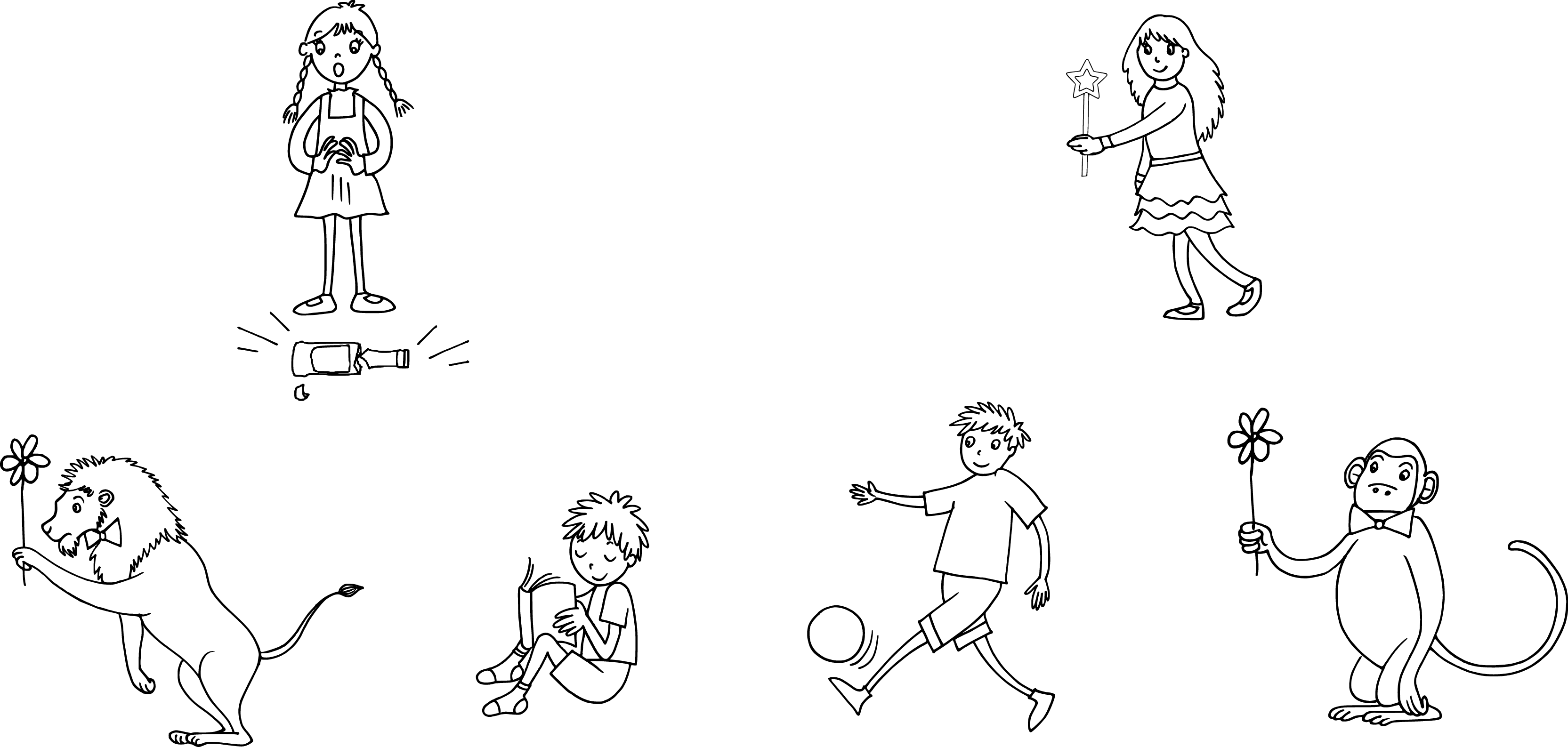
We also created six filler trials, resulting in a total of 24 trials. In filler trials, we presented two pictures side-by-side, as in experimental trials, each of them representing two or three agents engaging in different individual transitive actions. We matched each trial with a sentence describing one of the characters presented only in one of the two pictures (e.g., il leone ha un fiore in mano, “the lion is holding a flower”). Figure 2 illustrates an example of a filler trial. These trials had two functions: (1) to conceal the true purpose of the experiment from adult participants and (2) to reduce the cognitive load on children by enabling them to make a simpler choice than in experimental trials. Sentences for filler and experimental trials and task instructions were recorded by a female native speaker of Italian, who also recorded the instructions and prompts for the production task.
Example filler trial in the comprehension task.

Figure 2. Long description
The picture on the left presents a girl breaking a bottle, a lion holding a flower, and a boy reading a book. The picture on the right presents a girl holding a magic wand, a boy kicking a ball, and a monkey holding a flower.
Production task
Concerning the production task, we employed the same six scenes as in the comprehension task to allow for a fair comparison between the two experiments. Following Saponaro et al. (Reference Saponaro, Carioti, Riva and Guasti2025), we created three types of trials according to the contrast between the two pictures in each trial, resulting in three experimental conditions: mixed, where both images depicted the same action, with one performed collectively and the other distributively (see Figure 1); collective, where both images showed the same action in a collective configuration but involved different agents (Figure 3a); distributive, where both images illustrated distributive actions (Figure 3b). Each scene appeared under all three conditions, resulting in a total of 18 experimental trials. We also added six filler trials, with the pictures presented in the comprehension task, for a total of 24 trials.
Example trial by conditions in the production task (i.e., the collective and distributive conditions; see Figure 1 for the mixed condition). (a) Collective condition and (b) distributive condition.

Figure 3. Long description
The picture at the top is titled “a) Collective picture”: three frogs are pushing a single cart together on the left, and three rabbits are pushing another cart on the right together. The picture at the bottom is titled “b) Distributive picture”: three frogs are pushing a cart each on the left, and three rabbits are pushing a cart each on the right.
Procedure
Preschoolers and second graders were individually tested by an experimenter in a quiet room across two experimental sessions. In the first session, they completed Raven’s matrices and the production task, while in the second session, about a week later, they performed the comprehension task. Adults were tested in a single session online, performing first the production task, then an adapted version of Raven’s Matrices (Chierchia et al., Reference Chierchia, Fuhrmann, Knoll, Pi-Sunyer, Sakhardande and Blakemore2019; Zorowitz et al., Reference Zorowitz, Chierchia, Blakemore and Daw2024), and finally, the comprehension task. We opted to administer the production and comprehension tasks in a fixed sequence—specifically, the production task followed by the comprehension task—rather than employing a counterbalanced design. This decision was based on the hypothesis that describing distributive and collective pictures would not affect the understanding and interpretation of linguistic markers of distributivity and collectivity in the subsequent comprehension task. Conversely, we thought that presenting distributive and collective pictures paired with sentences explicitly marked with distributive or collective expressions could influence the subsequent production of those linguistic markers. The tasks were administered with the LabVanced software (Finger et al., Reference Finger, Goeke, Diekamp, Standvoß and König2017) through the same procedures across the three age groups to allow for a fair comparison between them; the only difference in the children’s tasks was the presence of a penguin puppet to create a more comfortable environment for them.
In the comprehension task, participants chose between the two pictures to match a sentence presented orally. Children clicked on the picture they wanted on a tablet, while adults completed the task either on a tablet or a laptop online. In the production task, following Saponaro et al. (Reference Saponaro, Carioti, Riva and Guasti2025), participants were asked to provide two verbal descriptions, one per picture. In experimental trials, a prerecorded voice prompted the answer by asking Cosa succede qui? (“What happens here?”) while highlighting the image on the left with a green circle. After the participant responded, the same voice followed up with E qui? (“And here?”), highlighting this time the image on the right. The elicitation question was intentionally phrased neutrally to minimize any potential influence on the participant’s response. In filler trials, participants were prompted to describe only one action per picture through the phrasing Cosa fa il/la [personaggio]? (“What does the [character] do?”). In both tasks, we adopted a fully randomized within-subjects design—rather than a counterbalanced list-based design—so that any potential influence of prior scene exposure would be randomly distributed across participants and conditions, rather than systematically confounded with any particular condition. Therefore, in both tasks, the order of trial presentation and the position (left/right) of the pictures in the trial were fully randomized.
Variable coding
In both our tasks, we focused only on experimental trials, given that we designed filler trials as distractors.
Comprehension task
In this task, we calculated a variable called “Collective Picture Choice” by assigning to each trial a value of 1 if participants selected the collective picture and 0 if they selected the distributive one. We also derived the proportion of collective picture choices over distributive picture choices by dividing the sum of collective choices by the total of trials per participant, to evaluate their consistency in the response.
Production task
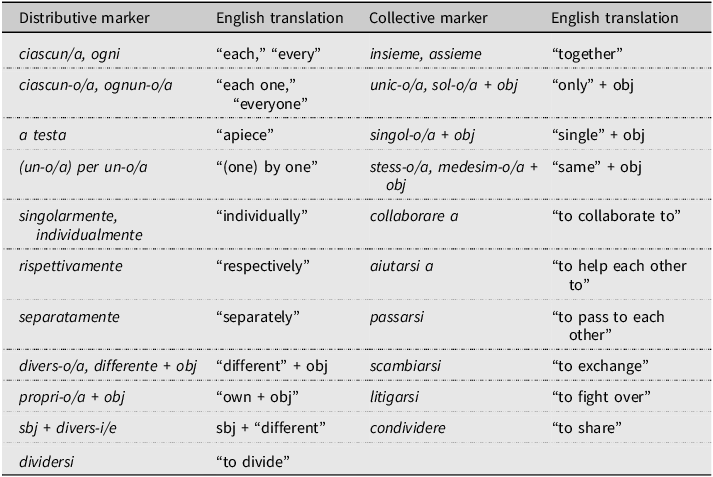
In this task, participants produced two sentences in each experimental trial, one per picture. Following Saponaro et al. (Reference Saponaro, Carioti, Riva and Guasti2025), we coded each sentence as including a linguistic expression for distributivity, an expression for collectivity, or as unmarked (i.e., lacking either of these expressions). We considered the linguistic markers reported in Table 1, identified from the literature (e.g., Brooks & Braine, Reference Brooks and Braine1996; Pagliarini et al., Reference Pagliarini, Fiorin, Dotlačil, Biller, Chung and Kimball2012; Saponaro et al., Reference Saponaro, Carioti, Riva and Guasti2025). We then created two variables to use in our models. First, we created “Trial Linguistic Marking” by coding each trial as 1 if at least one picture received a marked description (either distributive or collective) and 0 if both sentences were unmarked. Secondly, we created “Picture Linguistic Marking” only for the mixed condition, with a value of 1 if the picture description included a distributive or collective marker, depending on the picture type, and 0 if the description was left unmarked.
Distributive and collective markers considered in the coding procedure: “obj” and “sbj” stand for the object and the subject of the sentence, respectively; −o/a is the masculine and feminine of the singular form, while -i/e is the corresponding plural form

Table 1. Long description
The first column is titled “Distributive marker” and lists the Italian distributive markers considered for coding the data; the second column reports the corresponding English translation. The third column is titled “Collective marker” and lists the Italian collective markers considered for coding the data; the fourth column reports the corresponding English translation.
Comprehension and production comparison
To compare the two tasks, we computed a comprehension and a production score for each participant. The comprehension score was based on the percentage of Collective Picture Choices in the unmarked condition, reflecting how often participants interpreted unmarked sentences with a collective reading. For the production score, we considered trials from the mixed condition and calculated two proportions: the percentage of collective pictures that received a collective marker and the percentage of distributive pictures that received a distributive marker. We then derived a variable called “Delta Marking” by subtracting the distributive score from the collective one: values of 0 indicated equal use of both types of markers, positive values reflected a greater use of collective ones, and negative values a greater use of distributive ones.
Data analysis
To analyze our data, we employed the R Statistical Software (R Core Team, 2021). We focused on experimental trials after excluding filler trials, which served as distractors.
Comprehension task
To provide an overview of our data, we investigated Collective Picture Choices across age groups and sentence types. We expected adults to choose the collective picture 100% of the time in the collective condition, never in the distributive one, and more often than the distributive picture in the unmarked condition, in line with previous findings. As far as the two groups of children are concerned, we aimed to explore at what age they show an accurate knowledge of distributive and collective expressions—i.e., when they can select the collective picture in the collective condition and not in the distributive one—and whether they present an interpretation preference for unmarked sentences.
After visually inspecting the data, we analyzed our marked and unmarked sentence type conditions separately. As for marked sentences, we conducted mixed logistic regression models with Collective Picture Choice (1/0) as the dependent variable, and the interaction between Age Group (preschoolers/second gradersFootnote 1 ) and Sentence Type (collective/distributive) as fixed effects. Random effects were included to account for by-participant and by-item variance. In our design, items corresponded to the visual scenes (e.g., frogs pushing a cart) used across Sentence Type conditions; the random intercepts therefore captured variability associated with the specific scenes and accounted for potential differences in how participants responded to them across conditions. The random structure was simplified stepwise by removing the effects with the lowest variance in case of convergence issues, following Barr et al. (Reference Barr, Levy, Scheepers and Tily2013). Model selection was guided by the AIC, and Trial Number (i.e., the position of the trial within the fully randomized sequence) was evaluated as a potential covariate to control for possible learning or fatigue effects across the task. Post hoc analyses of significant interactions were conducted with Bonferroni correction for multiple comparisons.
As for unmarked sentences, to examine whether the three age groups differed in their percentage of Collective Picture Choice, we conducted a Kruskal-Wallis rank-sum test, a non-parametric alternative to ANOVA, due to violations of normality assumptions.
Production task
Concerning the production task, we first analyzed whether the three age groups differed in the number of linguistic markers produced through mixed logistic regression models. By considering as the dependent variable Trial Linguistic Marking (0 if none of the two pictures in the trial received a marked description; 1 if at least one did), we fit a model with the interaction between Contrast Type (mixed/distributive/collective) and Age Group (preschoolers/second graders/adults) as fixed effects. We included random intercepts for participants and items (i.e., the visual scenes used across Contrast Type conditions), simplifying the random-effects structure in case of convergence issues. We also assessed whether adding covariates like Trial Number would enhance the model fit, using the AIC for model comparison. To follow up on significant interactions, we conducted post hoc analyses with Bonferroni adjustments for multiple testing.
Then, we focused on answers given to the mixed condition of Contrast Type—i.e., the condition where a distributive and a collective picture were directly contrasted. To evaluate whether participants produced more markers when describing the distributive picture or the collective one, we focused on the dependent variable Picture Linguistic Marking (0/1) and we fit a mixed effect logistic regression including the interaction between Picture Type (distributive/collective) and Age Group (preschoolers/second graders/adults) as fixed effects, and participants and items as random effects, following the same model selection procedure and post hoc analysis described above.
Comprehension and production comparison
Finally, to compare participants’ performance across the two tasks within each age group, we categorized them based on their interpretation preference in the comprehension task—whether they favored the collective or distributive reading of unmarked sentences. We then examined their production patterns by analyzing Delta Marking values, which reflected the relative use of collective versus distributive markers (positive values indicate more collective marking, negative values more distributive one). These values were compared both against 0 (to assess whether participants marked one reading more than the other) and across age groups through t-tests—one-sample t-tests and independent samples t-test, respectively.
Results
Comprehension task
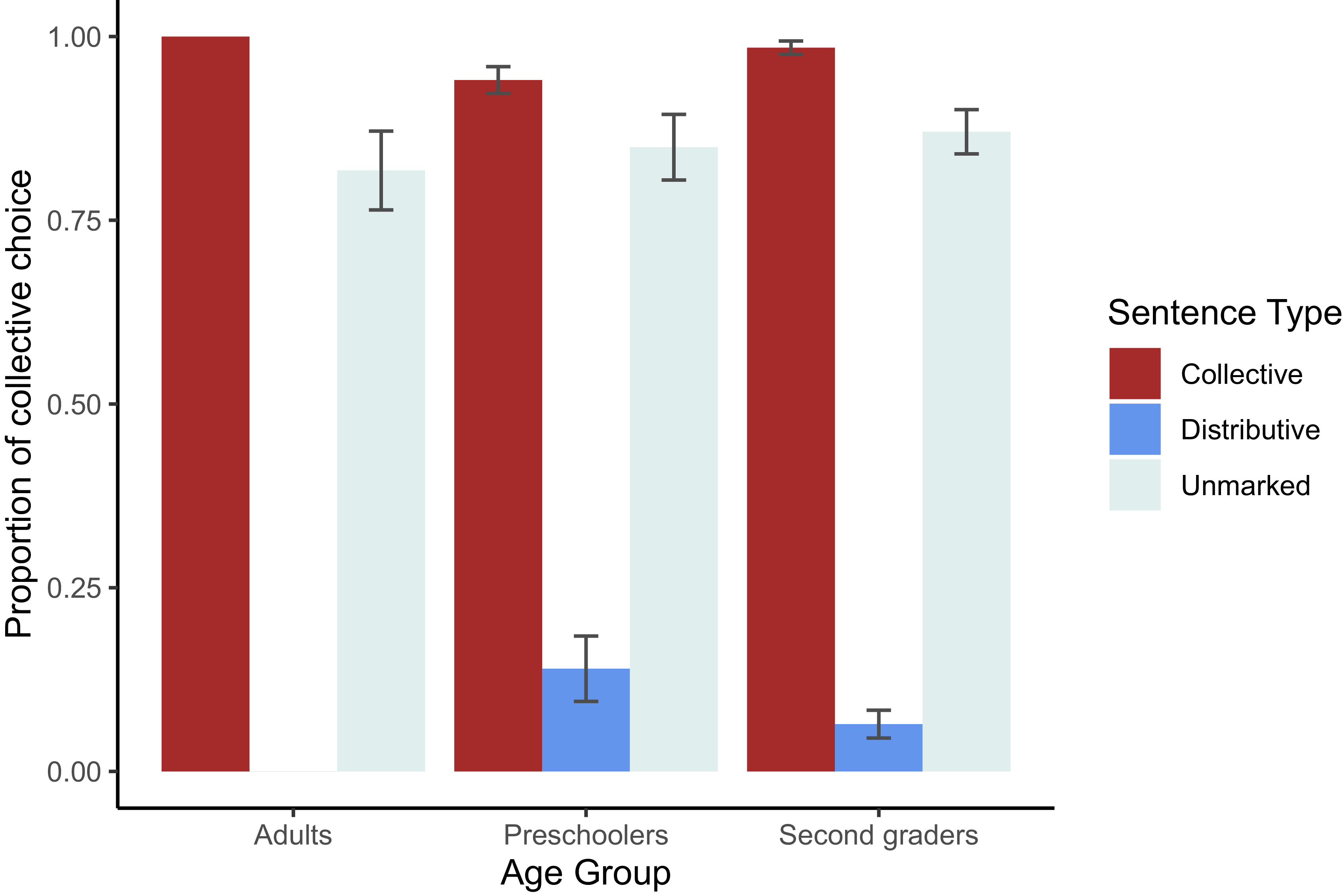
To provide an overview of our data, we first plotted the proportion of Collective Picture Choice across age groups and sentence types in Figure 4. Adults consistently chose the collective picture 100% of the time in response to collective sentences and never selected it (0%) when presented with distributive sentences, as expected. The two groups of children performed similarly, even though a few times they erroneously selected the collective picture when hearing a sentence marked for distributivity: second graders selected the collective picture 98.48% (SD = 6.03) of the time in the collective condition and 6.44% (SD = 12.56) in the distributive one; preschoolers selected it 94.09% (SD = 10.14) of the time in the collective condition and 13.98% (SD = 24.76) in the distributive one. In the unmarked condition, adults chose the collective picture to match an ambiguous sentence 81.77% (SD = 30.34), second graders 87.05% (SD = 19.99), and preschoolers 84.95% (SD = 24.85). To better understand our data, we analyzed the Sentence Type marked conditions (collective/distributive) and the unmarked one separately.
The proportion of collective picture choices over distributive ones across Age Group and Sentence Type. Error bars represent the standard error.

Figure 4. Long description
From left to right: adults got 100% in the collective condition, 81.77% in the unmarked, and 0% in the distributive. Second graders got 98.48% in the collective condition, 87.05% in the unmarked, and 6.44% in the distributive. Preschoolers got 94.09% in the collective condition, 84.95% in the unmarked, and 13.98% in the distributive.
Comprehension task: Children’s understanding of distributive and collective expressions
We now focus on children’s responses to the distributive and collective conditions to investigate their knowledge of linguistic markers. To conduct our mixed regression analysis on the variable Collective Picture Choice (1/0), the best-fitting model included the interaction of Sentence Type (distributive/collective) and Age Group (preschoolers/second graders) as fixed effects, Trial Number as a covariate, and participant-level and item-level random intercepts (∆AIC = 0.15, p = 0.17 compared to the same model without Trial Number Footnote 2 ). We found a main effect of Sentence Type (χ 2(1) = 180.105, p < 0.001), showing that children overall selected the collective picture more in the collective than the distributive condition, and a significant interaction between Sentence Type and Age Group (χ 2(1) = 9.948, p = 0.002). Post hoc comparisons showed that both preschoolers (adjusted p < 0.001) and second graders (adjusted p < 0.001) were significantly more likely to select the collective picture in the collective condition compared to the distributive one. There was no significant difference between the two age groups in either the collective (adjusted p = 0.15) or the distributive condition (adjusted p = 0.179). This was further supported by the absence of a significant effect of Age Group (χ 2(1) = 0.383, p = 0.54). Moreover, Trial Number did not influence participants’ performance (β = 0.029, SE = 0.022, z(900) = 1.356, p = 0.175).
Comprehension task: Interpretation preferences for unmarked sentences
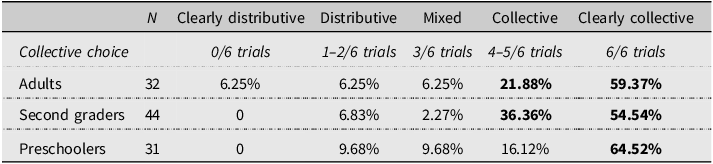
In our second analysis, we investigated the consistency with which participants selected the collective picture to match unmarked sentences, comparing performance across age groups. Table 2 presents the data for the unmarked condition, grouping participants (in percentages) by the number of trials in which they selected the collective picture.
Distribution of participants by response pattern in the unmarked condition, based on collective picture selection frequency. Participants (in percentages) were categorized as Clearly distributive (collective choice in 0/6 trials), Distributive (c. c. in 1–2/6 trials), Mixed (c. c. in 3/6 trials), Collective (c. c. in 4–5/6 trials), or Clearly collective (c. c. in 6/6 trials). Highlighted in bold are percentages higher than 20%

Table 2. Long description
Participants (in percentages) were categorized as Clearly distributive (collective choice in 0/6 trials: 6.25% adults, 0 second graders and preschoolers), Distributive (c. c. in 1-2/6 trials: 6.25% adults, 6.83 second graders, and 9.68% preschoolers), Mixed (c. c. in 3/6 trials: 6.25% adults, 2.27% second graders, and 9.68% preschoolers), Collective (c. c. in 4-5/6 trials: 21.88% adults, 36.36% second graders, and 16.12% preschoolers), or Clearly collective (c. c. in 6/6 trials: 59.37% adults, 54.54% second graders, and 64.52% preschoolers).
In the case of unmarked sentences, we can qualitatively observe from Table 2 that more than half of the participants consistently chose the collective picture in all age groups. Based on the Kruskal-Wallis test by rank, we found that the three groups did not statistically differ in their performance (χ 2(2) = 0.195, p = 0.907), as they all preferred to select the collective rather than the distributive picture to match unmarked sentences (M ADULTS = 81.77%; M SECOND-GRADE = 87.05%; M PRESCH = 84.95%). Figure 5 illustrates the scores obtained by participants.
Percentage of Collective Picture Choice to match unmarked sentences by Age Group (each dot corresponds to a single participant; the gray squares refer to the mean and the error bars to the standard error).

Production task
We first inspected which linguistic expressions adults and children produced to mark distributivity and collectivity. Adults produced a total of 500 markers (325 distributive, 175 collective), second graders produced a total of 311 (223 distributive, 88 collective), while preschoolers produced only 56 (20 distributive, 36 collective). Table S1 reported in the supplementary materials (see the Data Availability section at the end of the paper) summarizes the linguistic markers produced by the three age groups and their raw frequency. To describe distributive pictures, adults most frequently used the universal quantifiers ognuno (“each one”/“everyone”; 138 occurrences) and ciascuno (“each”; 101 occurrences). They also used other strategies, such as combining the possessive adjective proprio (“own”) with the object noun (22 occurrences; e.g., le bambine tengono il proprio aquilone, “the girls are holding their own kite”) and the adverb individualmente (“individually”; 18 occurrences). Second graders most often used ciascuno (81 occurrences), followed by the expressions a testa (“apiece”; 69 occurrences), ognuno (27 occurrences), and proprio (27 occurrences). Preschoolers produced very few distributive markers and did so inconsistently; their most frequent expression was uno per uno (“one by one”; 8 occurrences). To describe collective pictures, all three groups most frequently used the adverb insieme (“together”; adults: 125 occurrences; second graders: 45; preschoolers: 17). The second most frequent strategy for adults (15 occurrences) and second graders (21 occurrences) was modifying the object with stesso (“same”; e.g., le bambine portano la stessa scala, “the girls are carrying the same ladder”). Preschoolers instead more often used solo (“only”) combined with the object (15 occurrences; le bambine portano una sola scala, “the girls are carrying only one ladder”).
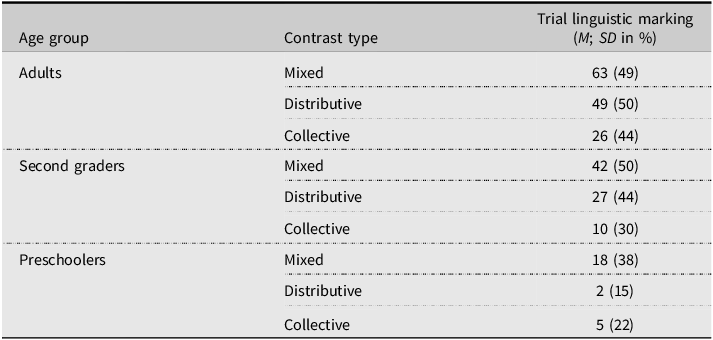
To conduct our mixed regression analysis on the variable Trial Linguistic Marking (1/0), the best-fitting model included the interaction between Contrast Type (mixed/distributive/collective) and Age Group (preschoolers/second graders/adults) as fixed effects, Trial Number as a covariate, and random intercepts for participants and items (∆AIC = 60, p < 0.001 compared to the same model without Trial Number). We found a main effect of Contrast Type (χ 2(2) = 160.032, p < 0.001) and Age Group (χ 2(2) = 26.20, p < 0.001), as well as a significant interaction between the two (χ 2(4) = 17.139, p < 0.01). Trial Number also influenced our dependent variable (β = 0.091, SE = 0.012, z(1870) = 7.515, p < 0.001), indicating increased marking over time. Table 3 summarizes the percentage of Trial Linguistic Marking obtained in each condition by each age group.
Percentage of Trial Linguistic Marking across Age Group and Contrast Type

Table 3. Long description
Adults: 63% (SD=49) in the mixed condition, 49% (50) in the distributive, and 26% (44) in the collective. Second graders 42% (50) in the mixed, 27% (44) in the distributive, and 10% (30) in the collective. Preschoolers 18% (38) in the mixed, 2% (15) in the distributive, and 5% (22) in the collective.
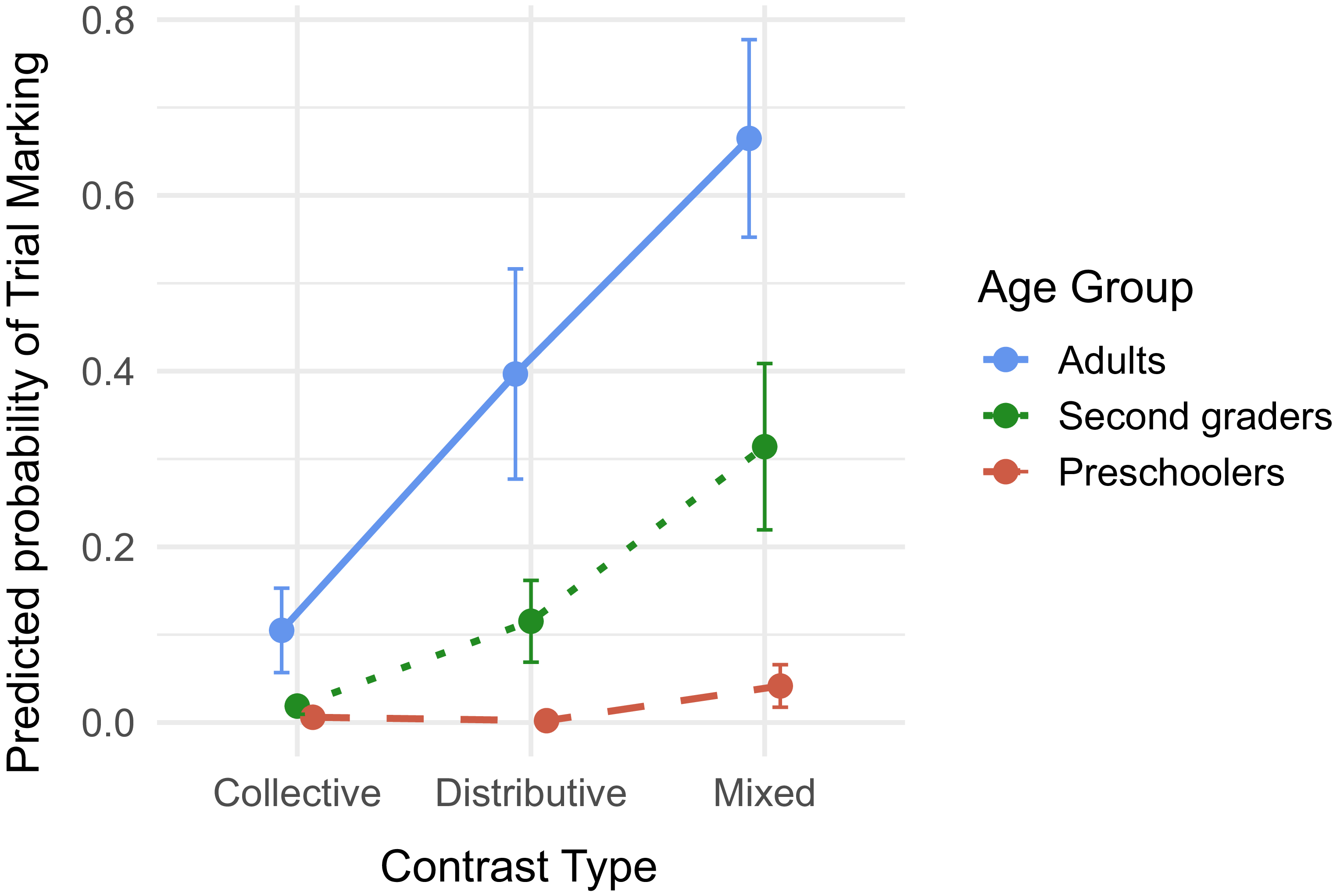
When unpacking the pairwise comparisons, we found that adults produced more marking in the mixed condition, followed by the distributive and the collective ones (mixed-distributive: adjusted p = 0.01; mixed-collective: adjusted p < 0.001; distributive-collective: adjusted p < 0.001). Second graders showed the same pattern (mixed-distributive: adjusted p = 0.001; mixed-collective: adjusted p < 0.001; distributive-collective: adjusted p < 0.001), with no significant differences compared to adults across conditions (mixed: adjusted p = 0.39; distributive: adjusted p = 0.26; collective: adjusted p = 0.189). Preschoolers also produced more marking in the mixed condition (distributive: adjusted p < 0.001; collective: adjusted p = 0.001), although to a lesser extent than both second graders (adjusted p = 0.032) and adults (adjusted p < 0.001). In contrast, they showed no difference between the distributive and collective conditions (adjusted p = 0.819). They produced significantly fewer markers than both adults (adjusted p < 0.001) and second graders (adjusted p < 0.001) in the distributive condition. In the collective one, they differed from adults (adjusted p = 0.014), but not from second graders (adjusted p = 0.906). Complete statistics are reported in Table S2 in the supplementary materials. Figure 6 shows the predicted probability of producing a linguistic marker across the levels of Contrast Type and Age Group.
Probability of Trial Linguistic Marking predicted by the interaction between Contrast Type and Age Group (the bars display the standard error).

Figure 6. Long description
The line increases from the collective to the distributive to the mixed condition for adults and second graders (it is steeper for adults), while it is almost flat for preschoolers.
Production task: A focus on the mixed condition
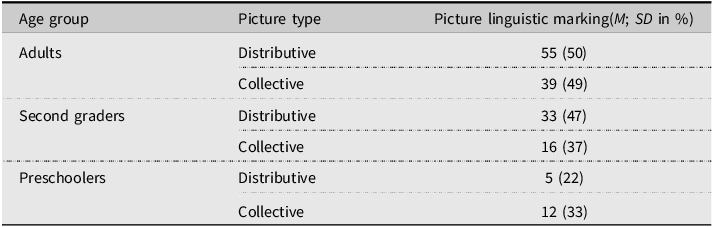
Subsequently, we focused only on the mixed condition, inspecting which picture type elicited more linguistic markers in the three age groups. The best-fitting mixed regression model included Picture Linguistic Marking (0/1) as the dependent variable, the interaction between Picture Type (distributive/collective) and Age Group (preschoolers/second graders/adults) as fixed effects, Trial Number as a covariate and random intercepts for participants and items (∆AIC = 4.6, p = 0.01 compared to the model without Trial Number). We found a main effect of Picture Type (χ 2(1) = 23.35, p < 0.001), Age Group (χ 2(2) = 22.277, p < 0.001) and a significant interaction of the two (χ 2(2) = 24.97, p < 0.001). Additionally, Trial Number positively influenced our dependent variable (β = 0.033, SE = 0.013, z(1236) = 2.545, p = 0.01), indicating that participants produced more markers as they progressed through the task. Table 4 summarizes the percentage of Picture Linguistic Marking obtained by each age group.
Percentage of picture linguistic marking across age groups and picture types

Table 4. Long description
Adults: 55% (SD=50) in the distributive condition, 39% (49) in the collective. Second graders: 33% (SD=47) in the distributive condition, 16% (37) in the collective. Preschoolers: 5% (SD=22) in the distributive condition, 12% (33) in the collective.
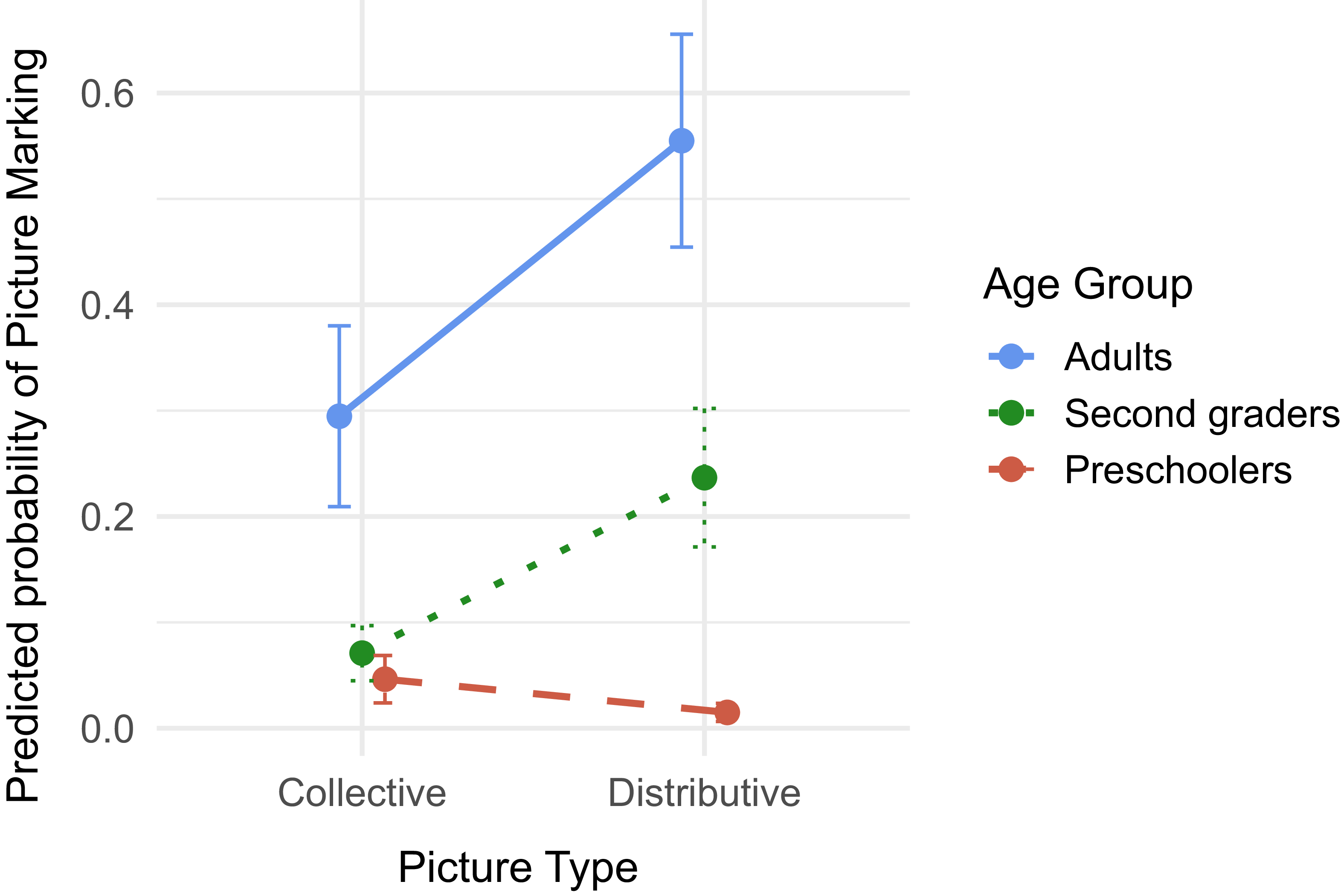
Pairwise comparisons showed that adults produced significantly more marking with distributive than collective pictures (adjusted p = 0.001), as did second graders (adjusted p < 0.001). The two groups did not differ in terms of distributive marking (adjusted p = 0.093), but adults produced more collective marking (adjusted p = 0.024). Preschoolers, by contrast, marked distributive and collective pictures similarly (adjusted p = 0.098), and produced less distributive marking than both adults and second graders (both adjusted p < 0.001). They also produced fewer collective markers than adults (adjusted p < 0.01) but did not differ from second graders (adjusted p = 0.976). Complete statistics are reported in Table S3 of the supplementary materials. Figure 7 shows the probability of marking the picture’s description as predicted by the different Picture Type and Age Group levels.
Probability of Picture Linguistic Marking predicted by the interaction between Picture Type and Age Group (the bars display the standard error).

Figure 7. Long description
The line increases from the collective to the distributive for adults and second graders (it is steeper for adults), while it is almost flat for preschoolers.
Comparing Comprehension and Production Tasks
To investigate whether participants tended to linguistically mark the interpretation that they do not find basic, we focused on those who produced at least one marker, either distributive or collective. Hence, we reduced our sample size to 25 adult participants and 30 second gradersFootnote 3 . Then, for each age group we examined participants based on their interpretation preferences for unmarked sentences in the comprehension task and their marking patterns in the production task.
As we can observe in Figure 8, in the comprehension task (red dots) 19 adults selected the collective picture more than 50% of the times, 4 less than 50% of the times and only 2 selected it at the threshold of 50%; concerning second graders, 28 chose the collective picture more than 50% of the time, while only 2 less than 50%. Then, to quantify the difference between collective and distributive markers in the production task, we computed the Delta Marking variable as described above (i.e., by subtracting the percentage of distributive markers from the percentage of collective ones).
Focusing on the blue dots, we can qualitatively suggest that both adults and children tended to produce more distributive than collective markers, given that the majority of dots are below the level of 0 (the score obtained by participants who produced the same amount of the two types of markers). When analyzing the data through t-tests, we observed that both age groups produced more distributive expressions (M ADULTS = −20.00%, SD = 30.43, t(24) = −3.286, p < 0.01; M SECONDGR = −24.44%, SD = 42.83, t(29) = −3.126, p < 0.01), with no difference between the two groups (t(53) = 0.435, p = 0.665). Therefore, we can observe that in both age groups participants tended to prefer the collective interpretation in the comprehension task, and to use more distributive markers in the production task.
Percentage of collective choices in the unmarked condition of the comprehension task (red dots) and percentage of Delta Marking (collective—distributive markers) produced in the mixed condition of the production task (blue dots), per participant, and age group. Positive values in Delta Marking refer to more collective expressions produced and negative values to more distributive expressions. A red dashed line represents 0 values, which reflect participants who produced the same percentage of distributive and collective markers.

Figure 8. Long description
The plot shows the percentage of collective choices in the unmarked condition of the comprehension task and percentage of Delta Marking (collective – distributive markers) produced in the mixed condition of the production task, per participant and age group. Overall, comprehension scores show high collective choices in the comprehension task, and scores below the 0 in the production task, meaning that participants produced more distributive than collective markers.
Discussion
In the current study, we presented two experimental tasks to three groups of Italian-speaking participants, i.e., preschoolers, second graders, and adults. All participants completed a comprehension task, in which they selected the picture that best matched a sentence marked for distributivity, collectivity, or left ambiguous between the two interpretations, and a production task, in which they were asked to describe distributive and collective scenes. In the comprehension task, we aimed to assess children’s understanding of distributive and collective expressions. Our second goal was to compare interpretation preferences in children and adults using a forced-choice paradigm, building on previous findings from Pagliarini et al. (Reference Pagliarini, Fiorin, Dotlačil, Biller, Chung and Kimball2012). In the production task, we analyzed participants’ descriptions to replicate the findings by Saponaro et al. (Reference Saponaro, Carioti, Riva and Guasti2025) with preschoolers and adults and to explore whether second graders had overcome the pragmatic and lexical limitations that constrain younger children’s ability to produce informative linguistic markers. We further examined whether second graders pattern more closely with adults, producing more distributive than collective markers. Lastly, we compared performance across comprehension and production to evaluate whether participants tend to explicitly mark the meaning they do not consider basic, and at what age children begin to display such pragmatic behavior.
Findings from the comprehension task showed that both preschoolers and second graders have a good understanding of sentences marked for either distributivity or collectivity. Both child groups could select the collective picture to match collective sentences and prefer a distributive picture to match distributive sentences. Overall, we did not find any statistical difference between the two groups, suggesting that both exhibited similarly robust knowledge of the two markers. This contrasts with the findings by Pagliarini et al. (Reference Pagliarini, Fiorin, Dotlačil, Biller, Chung and Kimball2012), who reported that children accepted collective interpretations of “each” sentences until around age 7. One possible explanation for this discrepancy lies in the choice of quantifier. While Pagliarini and colleagues used ciascuno (“each”), we employed ognuno, which is more frequent in spoken Italian and intuitively closer in meaning to “everyone” than to “each.” Although we are not aware of studies that explicitly compare the meaning of ciascuno and ognuno, it is plausible that children’s greater familiarity with the latter contributed to the higher accuracy observed in our study. Additionally, the syntactic position of the distributive quantifier differed across studies: in Pagliarini et al. (Reference Pagliarini, Fiorin, Dotlačil, Biller, Chung and Kimball2012), the quantifier appeared pre-nominally in subject position (e.g., ciascuna bambina costruisce un pupazzo di neve, “each girl is building a snowman”), whereas in our study, ognuno was floated in a post-verbal position (e.g., i conigli spingono ognuno un carrello, “the rabbits are each pushing a cart”). This structural difference may have influenced children’s performance in ways not accounted for by existing theories. It would be interesting to compare ognuno and ciascuno in a forced-choice picture selection task to explore whether children present different knowledge of the two quantifiers.
Regarding unmarked sentences, we found that all three age groups displayed a clear preference for the collective interpretation. While this collective bias was expected in adults, it was more surprising in children, given previous findings (e.g., Bosnić & Spenader, Reference Bosnić, Spenader, Brown and Dailey2019; de Koster et al., Reference de Koster, Hendriks and Spenader2021; Grinstead et al., Reference Grinstead, Padilla-Reyes and Nieves-Rivera2021; Pagliarini et al., Reference Pagliarini, Fiorin, Dotlačil, Biller, Chung and Kimball2012; Syrett & Musolino, Reference Syrett and Musolino2013). At first glance, our results may appear inconsistent with those from Pagliarini et al. (Reference Pagliarini, Fiorin, Dotlačil, Biller, Chung and Kimball2012), who found that Italian-speaking children accepted both interpretations to a similar extent. However, this discrepancy may be due to methodological differences: while Pagliarini and colleagues used a TVJT with isolated pictures, our task required participants to explicitly choose between a distributive and a collective interpretation. Altogether, these findings suggest that Italian-speaking children are capable of accepting both readings when prompted but, when asked to indicate a preference, they tend to favor the collective one, thus mirroring adult behavior. Therefore, our study suggests that—at least from early childhood onward in Italian—the collective interpretation appears more readily accessible than the distributive one in sentences with plural definite subjects, consistent with previous theoretical accounts (e.g., Dotlačil, Reference Dotlačil2010; Dotlačil & Brasoveanu, Reference Dotlačil and Brasoveanu2021; Link, Reference Link, von Stechow and Wunderlich1991; Roberts, Reference Roberts1990). Future research should examine whether this preference is already present at younger ages.
We now turn to the question of why some studies using picture selection paradigms have reported differing results than ours, showing that children speaking other languages do not display the same collective preference observed in adults (Bosnić & Spenader, Reference Bosnić, Spenader, Brown and Dailey2019; de Koster, Reference de Koster, Dotlačil, Spenader, LaMendola and Scott2017). Here, we consider two potential explanations for these inconsistencies. First, they may derive from crosslinguistic variation. For instance, existing research suggests that Dutch distributive quantifiers may be semantically weaker than their counterparts in other languages: Dutch-speaking adults sometimes accept collective interpretations of sentences marked with iedere (“each”) (de Koster, Reference de Koster, Dotlačil, Spenader, LaMendola and Scott2017). Moreover, Dutch-speaking children prefer distributive readings of unmarked sentences, unlike children acquiring other languages, who often show no strong preference between collective and distributive interpretations (Bosnić & Spenader, Reference Bosnić, Spenader, Brown and Dailey2019; de Koster, Reference de Koster, Dotlačil, Spenader, LaMendola and Scott2017). However, to date, only one study has directly compared Dutch-speaking children with children speaking another language—i.e., Serbian—showing that Dutch children had a stronger preference for distributive interpretations in an act-out task (Bosnić & Spenader, Reference Bosnić, Spenader, Brown and Dailey2019). Given that studies in this line of research employed different methodologies and stimuli, it is currently difficult to draw general conclusions. Nevertheless, our findings highlight the need for further crosslinguistic research using comparable experimental designs. Second, some authors have argued that children begin to align with adult interpretation patterns once they fully acquire the meaning of distributive quantifiers, according to the conversational implicature account (de Koster et al., Reference de Koster, Hendriks and Spenader2021; Dotlačil, Reference Dotlačil2010; Grinstead et al., Reference Grinstead, Padilla-Reyes and Nieves-Rivera2021; Pagliarini et al., Reference Pagliarini, Fiorin, Dotlačil, Biller, Chung and Kimball2012). Our results go in this direction: children in our study accurately interpreted sentences marked for distributivity and tended to assign collective interpretations to unmarked ones. However, due to limited variability in our data, we could not directly test whether an accurate understanding of “each” predicted a reduced tendency to assign distributive interpretations to ambiguous sentences.
In the production task, adults produced significantly more distributive than collective markers, replicating previous findings (Saponaro et al., Reference Saponaro, Carioti, Riva and Guasti2025; Syrett & Musolino, Reference Syrett and Musolino2016). A similar pattern emerged for second graders, but not for preschoolers. Hence, while preschoolers provided limited data, second graders were more informative, producing both distributive and collective markers but significantly more of the former. This result would hint at the presence of a D operator in the underlying representation, which may be overtly realized through distributive quantifiers or other verbal expressions. Thus, to convey the distributive meaning, both adults and children added explicit linguistic markers, whereas collective meanings were often left unmarked, implying that an unmarked sentence was sufficient. We consider this as further evidence that collective interpretations are more accessible than distributive ones, both for adults and children.
By contrast, preschoolers produced relatively few markers overall. However, they were more productive in the mixed condition—where the contrast between distributive and collective scenes was made salient—than in either the collective or distributive conditions. This suggests that they benefited from a specific feature of our experimental design that emphasized the difference. Taken together, these findings indicate that the ability to produce and effectively manage these types of markers is not yet fully developed at the age of 5. Nonetheless, the underlying tendency to use explicit markers to disambiguate pictures is beginning to emerge.
Finally, we directly compared interpretation preferences in comprehension and production patterns among participants who produced a sufficient number of linguistic markers—namely, second graders and adults. Within both groups, our findings reveal a notable asymmetry between comprehension and production: although participants generally preferred a collective interpretation of ambiguous sentences in the comprehension task, they explicitly marked distributive interpretations more frequently in production. We propose that this pattern reflects an efficient use of pragmatic principles. Both age groups appear to assume that unmarked sentences would be interpreted collectively; thus, when describing collective scenarios, they find overt marking unnecessary. In contrast, to convey a distributive meaning and avoid potential misunderstanding, they are more likely to use explicit linguistic markers. This behavior is in line with the Gricean maxim of Manner—specifically, the submaxim that speakers should avoid ambiguity in their utterances (Grice, Reference Grice, Cole and Morgan1975). Adults and second graders seem to view unmarked sentences as unambiguously collective, while they need to add linguistic markers to convey informative distributive sentences. The fact that preschoolers did not produce distributive markers, even though they clearly understood them in the comprehension task, may reflect an ongoing development of pragmatic competence. This interpretation is consistent with prior findings suggesting that full mastery of the maxim of Manner emerges only after age 5 (Okanda et al., Reference Okanda, Asada, Moriguchi and Itakura2015; Panzeri & Foppolo, Reference Panzeri and Foppolo2021). Interestingly, preschoolers produced slightly more linguistic markers in the mixed condition, where collective and distributive pictures were directly contrasted. This suggests that increased pragmatic salience may prompt greater linguistic explicitness, highlighting the role of contextual cues in children’s production. Although our study did not explicitly test this hypothesis, these observations point to the potential influence of pragmatic sensitivity on the use of disambiguating markers in early development, highlighting the need for future research.
Conclusion
The present study aimed to investigate how Italian-speaking preschoolers, second graders, and adults comprehend and produce linguistic expressions related to collective and distributive interpretations. By combining a comprehension and a production task, we provided a more complete picture of how these two aspects of meaning develop and interact across age groups. Our findings showed that all three age groups, even preschoolers, were capable of correctly understanding both distributive and collective markers and tended to interpret unmarked sentences as collective. However, clear differences emerged in production: while adults and second graders pragmatically disambiguated distributive descriptions using explicit markers—but left collective descriptions unmarked—preschoolers generally failed to produce such markers. These results suggest that the collective interpretation is more easily accessible across development and that the ability to mark distributive scenarios explicitly reflects the emergence of pragmatic competence rather than lexical knowledge alone. Although young children understand the relevant meaning, they are not yet equipped to express them effectively in context, an ability that emerges during the early school years.
Replication package
All materials, data, and statistical analysis scripts are available at: https://doi.org/10.5281/zenodo.19001543.
Acknowledgements
We thank Valentina Conforti and Laura Pinton for helping with data collection. We also thank the two anonymous reviewers for their thoughtful suggestions.
Author contributions
CS: Conceptualization, Data curation, Formal analysis, Writing – original draft, Writing – review & editing. DC: Conceptualization, Formal analysis, Supervision, Writing – review & editing. MTG: Conceptualization, Funding acquisition, Supervision, Writing – review & editing.
For the purposes of the Italian Academy, Chiara Saponaro (CS) takes responsibility for the content of this paper.
Funding statement
This paper is part of a project that has received funding from the European Research Council (ERC) under the European Union’s Horizon 2020 research and innovation programme (LeibnizDream grant, agreement number: 856421).
Competing interests
The authors declare none.





 Open access

