INTRODUCTION
The intertidal zone of the Persian Gulf and Gulf of Oman is composed of different habitats, such as mangrove, sandy-mud, muddy, sandy, rocky and muddy-sand shores dominated by mollusc shells and fragments. These diverse habitats provide suitable environment for a wide variety of burrowing organisms, especially mud shrimps. But some of these are not necessarily mud dwelling and live in habitats such as existing cavities covered with soft sediments inside boulders, within sponges and sandy-muddy areas with mollusc shells. Sometimes these organisms occupy the already existing holes and crevices in limestone (carbonate rock). These shrimps rely, as stated by Griffis & Suchanek (Reference Griffis and Suchanek1991), on burrows for shelter, reproduction, and feeding. Mud shrimps spend their entire life within their burrow, except for the larval phase, which in most species is pelagic (Griffis & Suchanek, Reference Griffis and Suchanek1991). The taxonomy of mud shrimps has been subject to much controversy in the recent decade (see Tudge et al., Reference Tudge, Poore and Lemaitre2000; Felder & Robles, Reference Felder, Robles, Martin, Crandall and Felder2009; Robles et al., Reference Robles, Tudge, Dworschak, Poore, Felder, Martin, Crandall and Felder2009). In a recent monograph by Sakai (Reference Sakai2011), two superfamilies Axioidea and Callianassoidea are treated and the latter is reconsidered to be composed of 51 genera, of which 25 are new taxa (including 17 gen. nov. and eight sensu nov.). These erected genera provide more instability and ambiguities in the taxonomy of this group.
Previously, the mud shrimp have not been studied along the Iranian coast of the Persian Gulf and Gulf of Oman. There are only three studies on the Persian Gulf including Sakai & Türkay (Reference Sakai and Türkay1995), Dworschak (Reference Dworschak2009) and a recent study by Sepahvand & Sari (Reference Sepahvand and Sari2010). This latter study was part of an earlier attempt of the present extensive project on intertidal mud shrimps of Iran to discover this group along Qeshm Island, Persian Gulf, Iran. However, several studies were carried out in the adjacent regions including the Arabian Sea by Tirmizi (Reference Tirmizi1970, Reference Tirmizi1974, Reference Tirmizi1977) and Tirmizi & Ghani (Reference Tirmizi and Ghani1978), the Red Sea by Dworschak & Pervesler (Reference Dworschak and Pervesler1988) and Dworschak (Reference Dworschak2003, Reference Dworschak2007), and material of Paratrypaea species from the Indo-West Pacific by Dworschak (Reference Dworschak2012). Therefore, the main purpose of the present study was to consider the intertidal mud shrimps of Iranian coastal waters of the Persian Gulf and Gulf of Oman from a taxonomic point of view and to consider their zoogeographical relationships to the Indo-West Pacific region and their specific habitat types.
MATERIALS AND METHODS
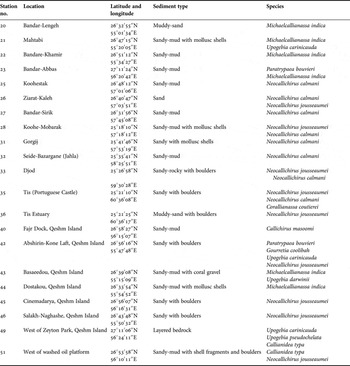
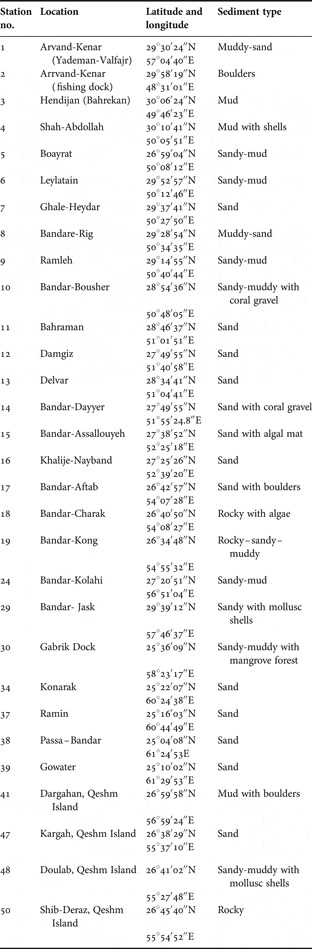
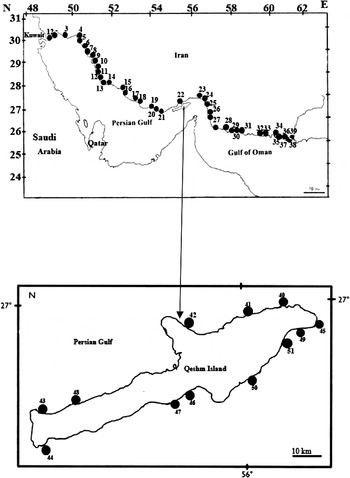
In general, collecting methods follow those of Manning (Reference Manning1975). Sampling was carried out at 51 intertidal localities from Gwater Bay (25°08′N 48°29′E) to Arvand-Kenar (29°59′N 48°29′E) between 2008 and 2011 (Tables 1 & 2). In sandy and muddy substrates, spade and yabby pumps were used for collecting the specimens, but in rock and boulder dominated habitats a lever was used for lifting boulders or splitting the layered rocks to find the exposed specimens. Collected specimens were transferred to 80% ethanol, shipped to the Zoological Museum, University of Tehran (ZUTC) and after identification deposited in the crustacean collection. For comparison, additional material from the Senckenberg Museum, Frankfurt am Main (SMF) and the Naturhistorisches Museum Wien (NHMW) were studied.
Sampling localities, habitat types and species composition of mud shrimps along the Iranian coast of the Persian Gulf and Gulf of Oman.

Sampling localities and habitat types along the Iranian coast of the Persian Gulf and Gulf of Oman with no record of mud shrimps.

In the present study, size is expressed as total length (TL in mm) from the tip of the rostrum to the end of telson and as carapace length (CL in mm) from the tip of the rostrum to the posterior median edge of carapace, measured with Vernier calipers.
The remarks are given only for main or diagnostic characters, and any characters, which show variations compared to original drawings and descriptions of the respective species.
In material examined, the stations are shown as ‘S’ with a relevant number according to the data presented for localities in Tables 1 and 2. The systematic account is arranged according to that proposed by Sakai (Reference Sakai2006) and the website of the World Register of Marine Species (http://www.marinespecies.org).
Species synonymy is given only for original descriptions and recent works.
RESULTS
SYSTEMATICS
Family CALLIANASSIDAE Dana, Reference Dana1852
Subfamily CALLIANASSINAE Dana, Reference Dana1852
Genus Paratrypaea Komai & Tachikawa, Reference Komai and Tachikawa2008
Species Paratrypaea bouvieri (Nobili, Reference Nobili1904)
Callianassa (Trypaea) bouvieri Nobili, Reference Nobili1904: 236.
Callianassa bouvieri.—Sepahvand & Sari, Reference Sepahvand and Sari2010: 45, figure 3.
Paratrypaea bouvieri.—Dworschak, Reference Dworschak2012: 41, figure 1D; 44, figure 4; 46, figure 5A–I; 47, figure 6A–J; 47 figure 7 A, B.
MATERIAL EXAMINED
ZUTC Tha. 1025 (Abshirin-Kone Laft, Qeshm Island, S 42; 8 females (♀), 3 males (♂)), ZUTC Tha. 1035 (Bandar-Abbas, S 23; 2♀, 1♂), NHMW 6591(Egypt, 4♂, 4♀).
REMARKS
The largest specimen was TL = 24.3 mm and CL = 6.1 mm. The material of the present study agrees well with that of Dworschak & Pervesler (Reference Dworschak and Pervesler1988), Sakai (Reference Sakai2005) and Komai & Tachikawa (Reference Komai and Tachikawa2008) and the recent study by Dworschak (Reference Dworschak2012). Morphologically, this species is well treated and described in the two latter works. Compared to the description provided by Sakai (Reference Sakai1999), the merus is less denticulate and the latero-medial part of the merus is composed of a long spine. The characters of the present material are also compared with Dworschak (Reference Dworschak2012) and these are in agreement with Dworschak's figures 5D, H, 6C and 7B.
HABITAT
Sandy-mud with mollusc shells.
WORLD DISTRIBUTION
West Indian Ocean from Madagascar to Persian Gulf, Chagos Archipelago, Indonesia, Japan, Kiribati and Fiji (see Dworschak, Reference Dworschak2012 for detailed localities).
Subfamily CALLICHIRINAE Manning & Felder, Reference Manning and Felder1991
Genus Corallianassa Manning, Reference Manning1987
Species Corallianassa coutierei (Nobili, Reference Nobili1904)
Callianassa (Callichirus) coutierei Nobili, Reference Nobili1904: 237.
Glypturus coutierei.—Sakai, Reference Sakai2005: 141, figure 28C, D.
MATERIAL EXAMINED
ZUTC Tha. 1041 (Tis, Chabahar, Gulf of Oman S 35; 1♀).
REMARKS
The size of this single specimen was TL = 40.3 mm and CL = 10.2 mm. The live specimens are easily recognizable by a crimson colour. The material of the present study was morphologically very close to Sakai's (Reference Sakai1999) descriptions and drawings, but the dactylus of the large chela is stout and the propodus two times as long as broad.
HABITAT
Rocky and boulder dominated shore with muddy-sand and shell fragments.
WORLD DISTRIBUTION
Hawaii (Hanauma Bay, Oahu); Mindanao, Philippines; Tahiti; Fiji Island; Goidu, Goifurfehendu Atoll, Maldives Archipelago (de Man, Reference Man1928); Indonesia (off Seba, Savu; off Laiwui, Coast of Obi Major); Gulf of Aden (Perim; Djibouti, Aden); Tulear, south-west Madagascar (Sakai, Reference Sakai2005).
Genus Michaelcallianassa Sakai, Reference Sakai, Bruce, Berggren and Bussawarit2002
Species Michaelcallianassa indica Sakai, Reference Sakai, Bruce, Berggren and Bussawarit2002
Michaelcallianassa indica Sakai, Reference Sakai, Bruce, Berggren and Bussawarit2002: 481.—Sepahvand & Sari, Reference Sepahvand and Sari2010: 47, figure 6.—Sakai, Reference Sakai2011: 450–451.
MATERIAL EXAMINED
ZUTC Tha. 1013 (Basaeedou S 43; 5♀, 3♂, 2 juveniles), 1022 (Doustakou S 44; 2♂, 2♀), 1023 (Mahtabi S 21; 10♀, 5♂), 1024 (Bandar-Lengeh S 20; 3♀, 1♂), 1045 (Bandar-Khamir S 22; 2♀) 1046 (Bandar-Abbas S 23; 1♀), SMF 25807 (Persian Gulf, holotype), NHMW 24989 (Bandar-Khamir S 22; 1♂, 1♀).
REMARKS
The largest specimen was TL= 29.2 mm and CL = 7.1 mm. The present specimens from the Persian Gulf agree well with Sakai's (Reference Sakai, Bruce, Berggren and Bussawarit2002) description except for the first pleopod of female specimens. In his work, pleopod 1 was found to be three segmented but in all the material of the present study and also the examined material deposited at the SMF, it is two segmented.
In the present study Michaelcallianassa indica was found intertidally on a sandy-mud substrate with shell fragments, but Sakai (Reference Sakai, Bruce, Berggren and Bussawarit2002) reported this species from subtidal waters in the Persian Gulf and Andaman Sea.
HABITAT
Sandy-mud, muddy-sand, sandy-mud with coral gravels and/or mollusc shells.
WORLD DISTRIBUTION
Persian Gulf and Andaman Sea (Sakai, Reference Sakai, Bruce, Berggren and Bussawarit2002, Reference Sakai2011), Persian Gulf (Sepahvand & Sari, Reference Sepahvand and Sari2010).
Genus Neocallichirus Sakai, Reference Sakai1988
Species Neocallichirus calmani (Nobili, Reference Nobili1904)
Callianassa (Cheramus) calmani Nobili, Reference Nobili1904: 237.
Neocallichirus calmani.—Sakai, Reference Sakai2011: 455.
MATERIAL EXAMINED
ZUTC Tha. 1011 (Koohestak S 25: 4♀, 2♂), 1043 (Koohestak S 25; 3♀, 2♂), 1049 (Ziarat-Kaleh S 26; 3♀), 1019 (Bandar-Sirik S 27; 11♀, 7♂), 1005 (Koohe-Mobarak S 28; 6♀, 2♂), 1027 (Gorgij S 31; 8♀, 3♂), 1008 (Jahla S 32; 2♀, 3♂), 1028 (Djod S 33; 5♀, 2♂), 1017 (Tis S 35; 3♀, 2♂), NHMW 6780 (Red Sea, 1♀, 1♂).
REMARKS
The largest specimen was CL = 41.7 mm and TL = 13.2 mm. Dorsal and ventral margins of the ischium of the large cheliped bear some denticles. In the examined material from the studied area, the merus has seven denticles proximally. The telson is rounded and 1.2 times as broad as long. The dorsal surface bears medially a transverse row of setae and a shallow mid-dorsal depression at the posterior margin. The propodus ventrally bears some denticles.
This is one of the most common callianassid species in the Gulf of Oman. The burrow of N. calmani is marked by two openings on the sand flat surface with a small mound at each opening. The body colour is white with pink chelae but in the breeding season (spring) an orange or reddish ovary is visible through the translucent cuticle of females.
HABITAT
Sandy-mud with mollusc shell fragments, and sand. In both cases the lower layer of sediments (at depth of 30–50 cm) was composed of hard clay.
WORLD DISTRIBUTION
Red Sea (de Vaugelas, Reference Vaugelas1990); Philippines (Anker & Marin, Reference Anker and Marin2009); Gulf of Aden, Persian Gulf and Gulf of Oman (Sakai, Reference Sakai2011).
Species Neocallichirus jousseaumei (Nobili, Reference Nobili1904)
Callichirus (Cheramus) jousseaumei Nobili, Reference Nobili1904: 236.
Neocallichirus indicus.—Sepahvand & Sari, Reference Sepahvand and Sari2010: 46 figure 4.
Neocallichirus jousseaumei.—Dworschak, Reference Dworschak2011: 2, figures 1–4, 6F–H.
MATERIAL EXAMINED
ZUTC Tha. 1002 (Ziarat-Kaleh S 26; 3♀, 2♂), 1003 (Ziarat-Kaleh S 26; 1♂), 1032 (Koohe-Mobarak S 28; 1♂), 1035 (Djod S 33; 3♀, 1♂), 1015 (Tis S 35; 1♀, 1♂), 1016 (Tis S 35; 1♀, 2♂), 1017 (Tis S 35; 2♀), 1034 (Tis S 35; 2♀, 3♂), 1001 (Tis Estuary S 36: 2♀, 4♂), 1031 (Abshirin-Kone Laft S 42; 2♀), 1004 (Cinemadarya S 45; 4♀, 2♂), 1006 (Salakh-Naghashe S 46; 2♀), 1036 (oil platform area S 51; 1♀, 1♂), SMF 4959 (Red Sea; 1♂), NHMW 25036 (Philippines, 1♂), NHMW 24991 (Ziarat-Kaleh S 26; 1♂).
REMARKS
The largest specimen was TL = 75.3 mm and CL = 15 mm. The material of the present study agrees well with those from SMF and NHMW. The burrow of N. jousseaumei consists of multiple ‘U’ shaped parts in which ex-current openings lack mounds and these openings were not easily detectable between the sand and shell fragments. This species prefers a habitat with limestone boulders and uses mud for covering the burrow walls under the boulders. There was usually one specimen in each burrow. The colour of the live animal was whitish beige. In adult females orange coloured ovaries were visible through the transparent cuticle. This is the largest Iranian species of mud shrimp.
Dworschak (Reference Dworschak2011), based on type material and numerous specimens from the Indo-Pacific—including that from Socotra, Yemen, and the United Arab Emirates—presented a redescription of Neocallichirus jousseaumei and found that Neocallichirus indicus is a junior synonym of the former. Material previously assigned to N. jousseaumei by Dworschak (Reference Dworschak1992) and Sakai (Reference Sakai1999) turned out to belong to a different species and was described as a new species, N. vaugelasi Dworschak, Reference Dworschak2011. Comparison of material from the present study with SMF 4959 from the Red Sea, and with the description and drawings provided by Dworschak (Reference Dworschak2011) for N. jousseaumei, revealed that they belong to this species. Material of N. jousseaumei were found in all localities (stations 26, 28, 33, 35, 36, 42, 45, 46 and 51) always under small boulders in sandy areas or in muddy-sand localities with shell fragments at lower depth.
There were always some red coloured parasitic copepods of the genus Clausidium on the carapace and chelae of the live material.
HABITAT
Sandy with boulders including a layer of hard clay under the sand to a depth of 30–50 cm.
WORLD DISTRIBUTION
Mauritius (Kensley, Reference Kensley1975); Kangeang Reef, Bay of Kankamaran; Djibouti, Gulf of Aden, Red Sea; Socotra and Persian Gulf (Sakai & Apel, Reference Sakai and Apel2002), Indonesia, Thailand, the Philippines, French Polynesia (Dworschak, Reference Dworschak2011), Tuamotu Island, Tonaki Island, Flores, Indonesia (Sakai, Reference Sakai2005): Persian Gulf (Sepahvand & Sari, Reference Sepahvand and Sari2010).
Genus Callichirus Stimpson, Reference Stimpson1866
Species Callichirus masoomi (Tirmizi, Reference Tirmizi1970)
Callianassa (Callichirus) masoomi Tirmizi, Reference Tirmizi1970: 245 figures 1 & 2. Podocallichirus masoomi.—Sepahvand & Sari, Reference Sepahvand and Sari2010: 47, figure 5.
Tirmizicallichirus masoomi.—Sakai, Reference Sakai2011: 475.
MATERIAL EXAMINED
ZUTC Tha.1012 (Fajr Dock S 40: 11♀, 9♂), NHMW 24990 (Fajr Dock S 40: 1♂).
REMARKS
The largest specimen was TL = 48.3 mm and CL = 11.8 mm. In the specimens of C. masoomi from Qeshm Island (station 40), the merus and ischium of the small cheliped are armed ventrally with denticles. In the original drawings and description of type material, it appears to be smooth or has been overlooked.
HABITAT
Sandy-mud.
WORLD DISTRIBUTION
Bholegi, West of Karachi, Pakistan; Ratnagiri, Bombay, India (Sankolli, Reference Sankolli1971): Persian Gulf (Sepahvand & Sari, Reference Sepahvand and Sari2010).
Subfamily GOURRETIINAE Sakai, Reference Sakai1999
Genus Gourretia de Saint Laurent, Reference Saint Laurent1973
Species Gourretia coolibah Poore & Griffin, Reference Poore and Griffin1979
Gourretia coolibah Poore & Griffin, Reference Poore and Griffin1979: 278.—Dworschak, Reference Dworschak2009: 130, figures 1–34.—Sepahvand & Sari, Reference Sepahvand and Sari2010: 49, figure 7.
Paragourettia coolibah.—Sakai, Reference Sakai2011: 518.
MATERIAL EXAMINED
ZUTC Tha. 1032 (Abshirin-Kone Laft S 42; 1♀); NHMW 21969 (Qatar, Persian Gulf; 1♀).
REMARKS
The size of this single specimen was TL = 60.2 mm and CL = 15.1 mm. This species was reported by Dworschak (Reference Dworschak2009) from Qatar, Persian Gulf and the specimens in the present study agree well with Dworschak's drawings and material from NHMW. This species was first found in Australia by Poore & Griffin (Reference Poore and Griffin1979). Currently, the geographical distribution of this species shows a wide gap between Western Australia and the Persian Gulf.
HABITAT
In crevices of bedrock but found in sandy habitats with shell fragments by Dworschak (Reference Dworschak2009) in Qatar.
WORLD DISTRIBUTION
Persian Gulf (Dworschak, Reference Dworschak2009; Sepahvand & Sari, Reference Sepahvand and Sari2010) and Western Australia (Poore & Griffin, Reference Poore and Griffin1979).
Family CALLIANIDEIDAE Kossmann, Reference Kossmann1880
Genus Callianidea H. Milne Edwards, Reference Milne Edwards and Cuvier1837
Species Callianidea typa H. Milne Edwards, Reference Milne Edwards and Cuvier1837
Callianidea typa H. Milne Edwards, Reference Milne Edwards and Cuvier1837: 320.—Sepahvand & Sari, Reference Sepahvand and Sari2010: 48.—Sakai, Reference Sakai2011: 203.
MATERIAL EXAMINED
ZUTC Tha. 1027 (west of Zeyton Park S 49; 1♀, 1♂) partly damaged material, ZUTC Tha. 1052 (oil platform area S 51; 1♀), SMF 7936 (Ternate, Indonesia, 1♂).
REMARKS
The largest specimen was TL = 45.1 mm and CL = 9.8 mm. The live specimens are a crimson colour in the abdomen and the cheliped and carapace colour is ivory white.
HABITAT
Within existing crevices or cavities in calcium carbonate rocks. It is noteworthy that in the crevices of the rocks in station 49 (Table 1), this species was found sympatrically with Upogebia carinicauda and U. pseudochelata but each was found in a different boulder. There were greenish coloured parasitic copepods of the genus Clausidium on the chela, carapace and abdomen of material from station 51.
WORLD DISTRIBUTION
East Indian Ocean, Australia, Japan, Taiwan, Maldives and Indonesia (for more information about localities see Sakai, Reference Sakai, Bruce, Berggren and Bussawarit2002; Komai & Tachikawa, Reference Komai and Tachikawa2008), Persian Gulf (Sepahvand & Sari Reference Sepahvand and Sari2010; Sakai, Reference Sakai2011).
Family UPOGEBIIDAE Borradaile, Reference Borradaile1903
Genus Upogebia Leach, Reference Leach and Brewster1814
Species Upogebia carinicauda (Stimpson, Reference Stimpson1860)
Gebia carinicauda Stimpson, Reference Stimpson1860: 23.
Upogebia carinicauda.—Sakai, Reference Sakai2006: 98–101.—Sepahvand & Sari, Reference Sepahvand and Sari2010: 44, figure 2.
MATERIAL EXAMINED
ZUTC Tha. 1029 (Mahtabi S 21; 3♀, 1♂), 1007 (Abshirin-Kone Laft S 42; 12♀, 10♂), 1009 (Abshirin-Kone Laft S 42; 3♀, 1♂), 1030 (west of Zeyton Park S 49; 2♀) and SMF 23043 (Kagoshima, Japan; 1♀, 1♂).
REMARKS
The largest specimen was TL = 41.6 mm and CL = 9.1 mm. The present material is morphologically close to the specimens from the SMF. In one of the stations, U. carinicauda was found in rocky (limestone) shores within holes and crevices (station 49, Qeshm Island) but in other stations (stations 21 and 42), this species was found in sandy-mud areas with shell fragments.
HABITAT
Muddy-sand with shell fragments but also found in rocks. The mound of the ex-current opening was 1–1.5 cm in height. The burrow in sand is Y-shaped or multiple U-shaped.
WORLD DISTRIBUTION
Australia, Hong Kong, South China, India, and Japan (for more information about localities see Poore & Griffin, Reference Poore and Griffin1979; Sakai, Reference Sakai1982, Reference Sakai2006) and Persian Gulf (Sepahvand & Sari, Reference Sepahvand and Sari2010; Present Study).
Species Upogebia darwinii (Miers, Reference Miers1884)
Gebiopsis darwinii Miers, Reference Miers1884: 281.
Upogebia darwinii.—Sakai, Reference Sakai2006: 101—114, figures 15–17.
MATERIAL EXAMINED
ZUTC Tha. 1033 (Basaeedou S 43; 3♀, 3♂), SMF 26521 (Red Sea; 1♂).
REMARKS
The largest specimen was TL = 30.2 mm and CL = 7.8 mm. The specimens show variations in shape, surface texture and size of the chelae. There is a single row of about 10 tubercles on the inner surface of the dactylus of pereiopod 1. In addition, there are two small rows of tubercles at the upper and lower parts of the proximal part of this main tubercle row. The upper one consists of joined tubercles. There are also variations in the fixed finger of pereopod 1.
This species shows considerable instability in its taxonomy and there are many synonyms for it (see Sakai, Reference Sakai1982, Reference Sakai2006; Ngoc-Ho, Reference Ngoc-Ho1990). The material of U. darwinii in Nobili (Reference Nobili1906) was later assigned by Ngoc-Ho (Reference Ngoc-Ho1990) to U. octoceras but Sakai (Reference Sakai2006) continued to synonymize it with U. darwinii.
HABITAT
The specimens were found among the ex-current canals of a single species of unknown sponges.
WORLD DISTRIBUTION
Red Sea, Kenya, Persian Gulf, Thailand, Indonesia and Australia (see Sakai, Reference Sakai1982, Reference Sakai2006; Ngoc-Ho, Reference Ngoc-Ho1990).
Species Upogebia pseudochelata Tattersall, Reference Tattersall1921
Upogebia (Upogebia) pseudochelata Tattersall, Reference Tattersall1921: 395.
Upogebia pseudochelata.—Sakai & Apel, Reference Sakai and Apel2002: 286.—Sakai, Reference Sakai2006: 133.
MATERIAL EXAMINED
ZUTC Tha. 1026 (west of Zeyton Park S 49; 21♀, 9♂, 4 juveniles) SMF 26523 (Socotra, Yemen; 1♀, 1♂), NHMW 24987 (west of Zeyton Park S 49; 1♂, 2♀).
REMARKS
The largest specimen was TL = 24.1 mm and CL = 6 mm. Some specimens of the present study show minor variations in characters which do not completely agree with the descriptions of Tattersall (Reference Tattersall1921) and Sakai (Reference Sakai1982), especially the rostrum appears to be longer than in described material and extends beyond the eyes. This is possibly an intrapopulational difference (V.S., personal communication with Dworschak, 2010). The anterior part of rostrum at the lateral margins bears three denticles.
In the present study, it was noteworthy that many individuals of U. pseudochelata were found in the west of Qeshm Island, in layered limestone living within small U-shaped cavities.
HABITAT
Layered limestone rocks with crevices.
WORLD DISTRIBUTION
Red Sea and Socotra (Sakai, Reference Sakai2006), Persian Gulf (Present Study).
DISCUSSION
There are few studies on mud shrimps of the Persian Gulf but there is no study on the Gulf of Oman. This survey is the first thorough study of intertidal mud shrimps of these Iranian intertidal regions. The studies by Nobili (Reference Nobili1906), Sakai & Türkay (Reference Sakai and Türkay1995) and Dworschak (Reference Dworschak2009) mostly focused on the Arabian parts of the Persian Gulf, and Tirmizi (Reference Tirmizi1970, Reference Tirmizi1974, Reference Tirmizi1977) on the Arabian Sea. A recent study by Sepahvand & Sari (Reference Sepahvand and Sari2010) on the mud shrimps of Qeshm Island, Persian Gulf resulted in a first record of seven species from 11 localities in Iran. In the present study, four more new records were added to the mud shrimps fauna of the studied area and the geographical distribution of the different species were considered along the 2440 km-long Iranian coastline.
According to Sepahvand & Sari (Reference Sepahvand and Sari2010), the mud shrimps of Qeshm Island, Persian Gulf include seven species namely, Paratrypaea (as Callianassa) bouvieri, Michaelcallianassa indica, Neocallichirus jousseaumei (as N. indicus), Callichirus (as Podocallichirus) masoomi, Upogebia carinicauda, Callianidea typa and Gourretia coolibah. The present study added another two, U. darwinii and U. pseudochelata to the list of species from Qeshm Island.
Among the Iranian mud shrimps of the present study, the most common species were Neocallichirus jousseaumei and N. calmani. The genus Upogebia with three species has the highest species richness, and the genera Callichirus, Corallianassa, Michaelcallianassa, Callianidea, Paratrypaea and Gourretia each with one species, have the lowest species richness. Most species, based on recorded localities by Sakai (Reference Sakai2005, Reference Sakai2006, Reference Sakai2011), show an Indo-West Pacific distribution pattern.
As far as distribution is concerned, Apel & Spiridonov (Reference Apel and Spiridonov1998), Apel & Türkay (Reference Apel and Türkay1999) and Naderloo & Sari (Reference Naderloo and Sari2007) demonstrated a biogeographical pattern and zoogeographical affinities for crabs of the Persian Gulf with adjacent regions. According to the observed distribution of the species, the 11 mud shrimps of the Persian Gulf and Gulf of Oman could be categorized into two regions as follows:
1. Four species are Indian Ocean species. Michaelcallianassa indica and Gourretia coolibah are each found in two discrete localities while Upogebia pseudochelata, Callichirus masoomi are endemic to the north-west Indian Ocean.
2. Seven species are Indo-West Pacific species. These include Corallianassa coutierei, Paratrypaea bouvieri, Upogebia carinicauda, U. darwinii, Neocallichirus calmani and N. jousseaumei. The first species in the list is also found in Hawaii and the last species is widely distributed in the region. One species, Callianidea typa, is also found in the wider area of the Indo-Pacific region.
For the first category, one species, Gourretia coolibah has a limited distribution and was found by Dworschak (Reference Dworschak2009) and in the present study from the Persian Gulf but, previously recorded by Poore & Griffin (Reference Poore and Griffin1979) from Western Australia. The other species, Michaelcallianassa indica was found previously from the Persian Gulf and Andaman Sea by Sakai (Reference Sakai, Bruce, Berggren and Bussawarit2002) and from the Persian Gulf in the present study. These two species show a patchy distribution with our current knowledge on their world records.
Two families, the Callianassidae (63%) and Upogebiidae (27%) have the highest species richness among mud shrimps in the studied region. The remaining family Callianideidae shows the lowest species richness with only one representative.
This reasonably high diversity is related to a long coastline and a considerable diversity of habitat types. This habitat diversity was more visible in Qeshm Island (located at the entrance of the Strait of Hormuz). The coastal area of Qeshm Island is influenced by different wave action and currents and includes several habitat types such as mangrove, sandy, muddy, rocky, coral gravel and a combination of these. The dominant species in the Gulf of Oman, continental coast of the Persian Gulf, and boulder dominated sandy-mud coasts (at Gulf of Oman and Qeshm Island) were Neocallichirus calmani, Michaelcallianassa indica and N. jousseaumei, respectively. The present study shows that mud shrimps are associated with different habitat types and were found only in 21 out of 51 stations. In ten stations (Table 1), two to four species were found sympatrically (but in different microhabitats). Despite several attempts, no mud shrimps were found along the entire coast of the north-east Persian Gulf (including Khuzestan and the eastern part of Bushehr Provinces) possibly due to the degraded nature of the habitat including dominance of very soft sediments, higher salinity or pollution (see Figure 1 and Table 2 for localities and their habitat types). The salinity on the northern coast is about 39–49‰ (Sanlaville & Prieur, Reference Sanlaville, Prieur and Schwartz2005) while this value reaches up to 57‰ on the southern coast (John et al., Reference John, Coles and Abozed1990). This is mostly due to the shallowness of the Persian Gulf. In addition, in the recent years seawater in this region is getting more saline due to the on land desalination activities by the Persian Gulf countries (Bashitialshaaer et al., Reference Bashitialshaaer, Persson and Aljaradin2011). For the pollution, several studies revealed that the heavy metal concentrations in the northern Persian Gulf including Bushehr and Khuzestan Provinces are higher than that of other regions of the Gulf (see Diagomanolin et al., Reference Diagomanolin, Farhang, Ghazi-Khansari and Jafarzadeh2004; Pourang et al., Reference Pourang, Nikouyan and Dennis2005; Karbasi et al., Reference Karbasi, Nabi-Bidhendi and Bayati2005; Dehghan-Madiseh et al., Reference Dehghan-Madiseh, Savary, Parham and Sabzalizadeh2009; Kazemi et al., Reference Kazemi, Riyahi-Bakhtiari, Kheirabadi, Barani and Haidari2011). This is mainly due to oil pollution and other anthropogenic impacts.

In the rest of the Persian Gulf, and in the entire Gulf of Oman, in each, three species were found. In the present study, three species of Upogebia were found in the Persian Gulf but no Upogebia were recorded on the Iranian coast of the Gulf of Oman. This might be related to the rough wave action of the exposed shores with a scarcity of soft sediment, which is crucial for burrow construction, and lining of the burrow walls in these species. In contrast, Qeshm Island shows the highest species diversity (nine species including three species of Upogebia), which is mostly a reflection of the habitat diversity of the Island.
The current survey was the first study on Iranian mud shrimp and provides a basis for future studies on the ecology of these species, their burrow types and their role in sediment bioturbation of the region.
ACKNOWLEDGEMENTS
We are very grateful to Professor M. Türkay and Dr P.C. Dworschak from the Senckenberg Museum, Frankfurt and Museum of Natural History Vienna, respectively, for their help and encouragement during this study. Their hospitality during visits to their Museums by V.S. and A.S. is acknowledged. Special thanks are due to Dr C. Tudge from the American University and the Smithsonian Institution, Washington, DC for his encouragement, provision of the yabby pump for sampling, help with relevant literature and his valuable comments on the manuscript. Thanks are extended to Professor K. Sakai for his kind assistance in this study. Thanks are due to Mr R. Naderloo for help with sampling and material identification, and providing some relevant literature. Sampling would have been impossible without the help of Mr A. Kazemi. Financial help and facilities were provided by the Department of Environment and Research Council of the University of Tehran—their support is highly appreciated.