Implications
Restricting the use of the antibiotic growth promoters (AGP) in animal production triggered a need to evaluate and present new growth promoter alternatives. The present study contributes in this area by evaluating two essential oil blends, the oregano essential oil (OEO) (150 and 300 mg/kg diet) and Enviva essential oil (EEO) (50 and 100 mg/kg diet), as natural phytobiotic feed additives (PFA) in growing ducks. Testing the biological activity of the proposed essential oils (Eos) could contribute the poultry industry by presenting potent alternatives for AGPs in duck production. The tested EOs displayed beneficial effects on cecal bacterial populations.
Introduction
Nowadays, much legislation in the world has been made to ban or restrict the use of synthesized antibiotics in animal feed. This is mainly to avoid the bacterial resistance against antibiotics, and to meet the increased awareness of consumers about the hazardous residuals in poultry meat and eggs. Banning or limiting the use of AGPs in poultry enterprises would result in reduced profits due to decreased performance rates (Yitbarek, Reference Yitbarek2015). In this regard, various alternatives have been proposed; including immunostimulants, enzymes, probiotics, prebiotics, organic acids and PFA (Muthusamy and Sankar, Reference Muthusamy and Sankar2015). Phytogenics are a group of plants which are used in animal diets to act as natural non-synthesized-AGP; including herbs, spices, EOs and oleoresins. Several phytogenic substances were reported to be ideal alternatives for the AGPs; they are natural, environmentally safe, not create harmful residues in poultry meat and eggs, make a favorable balance in gut microflora, stimulate feed intake (FI), improve feed utilization and enhance growth rate (GR) (Muthusamy and Sankar, Reference Muthusamy and Sankar2015; Yitbarek, Reference Yitbarek2015). Some beneficial impacts, in addition, were reported for the phytogenic group on the hepatic antioxidative status, non-specific immune response (albumin–globulin ratio), glucose (GLU), cholesterol in broiler chickens (Cho et al., Reference Cho, Kim and Kim2014; Skoufos et al., Reference Skoufos, Giannenas, Tontis, Bartzanas, Kittas, Panagakis and Tzora2016; Pirgozliev et al., Reference Pirgozliev, Mansbridge, Rose, Mackenzie, Beccaccia, Karadas, Ivanova, Staykova, Oluwatosin and Bravo2018). Among the common herbs and spices used as PFA in poultry production are oregano, thyme, garlic, horseradish, pepper, chili, cinnamon, cayenne, rosemary and anise.
A considerable interest has been paid recently to the EOs. However, only few reports have identified the quantity of the principle components (Giannenas et al., Reference Giannenas, Bonos, Christaki and Florou-Paneri2013; Zeng et al., Reference Zeng, Zhang, Wang and Piao2015). Recent studies have examined mainly commercial products which comprise mixtures of different phytogenic substances (Muthusamy and Sankar, Reference Muthusamy and Sankar2015; Skoufos et al., Reference Skoufos, Giannenas, Tontis, Bartzanas, Kittas, Panagakis and Tzora2016), though, discriminating the efficacy of each PFA type and examining its optimal dose is believed to be rudimentary (Zeng et al., Reference Zeng, Zhang, Wang and Piao2015). More specifically, the EOs have a much higher biological activity compared with the raw material they were extracted from, as they contain high concentrations of the strong bio-active compounds of the plant, such as carvacrol, thymol and cinnamaldehyde.
Oregano essential oil was reported as an effective feed additive, mainly for the prevention and treatment of diarrhea caused by Escherichia coli and Salmonella, and as a growth promoter for livestock (Tang and Chen Reference Tang and Chen2015). In vitro, the OEO has proven a high antibiotic efficacy against several pathogens found in animal and bird intestinal tract, due to containing the bioactive compounds carvacrol and thymol (Jugl-Chizzola et al., Reference Jugl-Chizzola, Spergser, Schilcher, Novak, Bucher, Gabler, Hagmuller and Zitterl-Eglseer2005); it contains approximately 60% carvacrol and 10% thymol (Koscova et al., Reference Koscova, Nemcova, Gancarcikova, Jonecova, Scirankova and Buleca2006). The OEO has been included in different studies mainly as a part of EO mixtures and showed promising growth promoter abilities and antimicrobial equilibration responses (Skoufos et al., Reference Skoufos, Giannenas, Tontis, Bartzanas, Kittas, Panagakis and Tzora2016). Studying the dietary inclusion of OEO separately is considered fundamental in discriminating its particular biological role as an AGP.
Most previous studies have tested the EOs with broilers and turkeys. Their efficacy, however, is important to be examined with the different types of poultry used in production such as ducks, geese and quails among others. Another substance, the EEO, is of interest in this study. The EEO is a new commercial EO blend which comprises 4.5% cinnamaldehyde and 13.5% thymol. To our knowledge, there are no previous studies evaluated the EEO or OEO growth promotion abilities and antimicrobial activity in growing ducks. It is hypothesized that the dietary addition of OEO and EEO is expected to exert beneficial effects on growth performance, blood biochemicals and cecal microbiota in growing ducks. The current study, therefore, was designed to evaluate the impacts of dietary inclusion of two levels of EEO (50 and 100 mg/kg) and two levels of OEO (150 mg and 300 mg/kg) on the performance, cecal microbiota and blood biochemicals of growing ducks.
Material and methods
Birds and housing environment
This study was carried out at the poultry research farm of Guangdong HAID Institute of Animal Husbandry and Veterinary (GHIAHV), Guangzhou, China. A total of 800 11-day (d)-old unsexed Cherry Valley ducklings were used in this study. The birds were weighed and housed in 20 open-sided floor pens, 40 ducklings per pen. The total area of each pen was 27 m2, of which 18 m2 were on a slatted wood floor, plus 9 m2 as a fish pond. Pelleted feed and water were provided ad libitium and a continuous lighting program was used.
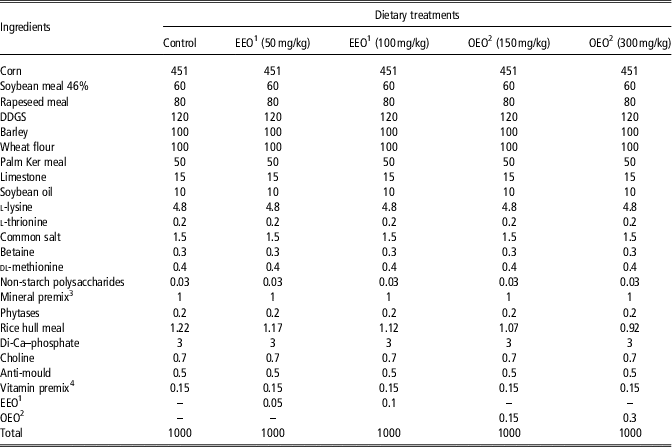
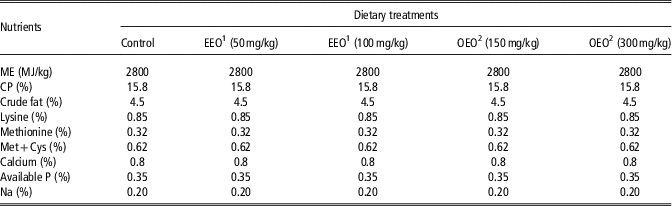
Commencing from d11 and up to 42 d of age, four replicate pens were assigned randomly to one of five pelleted dietary treatments (N=160 birds/treatment). The first group received a basal diet and was considered to be the control, whereas the other four groups received the same basal diet but incorporated 50 mg EEO/kg, 100 mg EEO/kg, 150 mg OEO/kg and 300 mg OEO/kg, respectively. The composition and calculated nutrient content of the experimental diets are shown in Tables 1 and 2, respectively. The five diets were balanced with respect to nitrogen, energy, lysine and methionine+cystine content. The OEO (comprised 5% thymol, 65% carvacrol and 30% of an inert carrier) was purchased from ROPA Pharm-China, and the EEO (comprised 4.5% cinnamaldehyde, 13.5% thymol and 82% of an inert carrier) was purchased from DANISCO DouPont (Dutch Paranal Pham International co., LTD, Ronde Tocht 48, 1507CK Zaandam, The Netherlands).
Composition of experimental diets (kilogram/ton) prepared for growing ducks

DDGS=dried distillers grains with soluble.
1 EEO=Enviva essential oil, it was purchased from DANISCO DouPont (content: 4.5% cinnamaldehyde and 13.5% thymol).
2 OEO=oregano essential oil, it was purchased from ROPA Pharm (Oregano oil 60% comprised of thymol 5% and 65% carvacrol).
3 The mineral premix contained (supplied per kilogram of diet: Zn, 100 mg; Mn, 50 mg; Fe, 80 mg; Cu, 20 mg; Co, 0.2 mg; I, 1.2 mg; Se, 0.2 mg).
4 The vitamin premix contained (supplied per kilogram of diet: vitamin A, 10 000 IU; vitamin D3, 6000 IU; vitamin E (tocopheryl acetate), 40 IU; vitamin K3, 3 mg; vitamin B1, 1 mg; vitamin B2, 8 mg; vitamin B6, 3 mg; vitamin B12, 0.02 mg; nicotinic acid, 20 mg; Ca pantothenate, 20 mg; folic acid, 2 mg; biotin, 0.2 mg).
Calculated nutrient composition of experimental diets prepared for growing ducks

ME=metabolizable energy; Met+Cys=methionine and cystine; P=phosphorus.
1 EEO=Enviva essential oil, it was purchased from DANISCO DouPont (content: 4.5% cinnamaldehyde and 13.5% thymol).
2 OEO=oregano essential oil, it was purchased from ROPA Pharm (oregano oil 60% comprised of thymol 5% and 65% carvacrol).
Growth performance variables
The initial and final BW were recorded for each replicate at 11 and 42 d of age, respectively. The FI was calculated on a replicate basis for the whole experimental period, as the difference between the offered feed and refusals and then averages. The BW gain (BWG) ((Final BW−initial BW)), GR ((BWG×100)/initial BW) and feed conversion ratio (FCR) (FI: BWG) were calculated. The number of dead birds was recorded daily, and Survivability (SURV) rates (%) were calculated for each treatment replicate ((Number of surviving birds at the end of experimental period/ initial number of birds) × 100).
Enumeration of cecal bacteria
At 42 d of age, eight ducks from each dietary treatment were randomly selected, and slaughtered to determine bacterial populations in the cecal digesta. Fresh cecal digesta samples were collected for bacterial enumeration, where 1 g of each digesta sample was mixed homogeneously with 9 ml of peptone water (0.1% volume/volume). The mixture was then serially diluted in 0.85 g/l sterile saline solution (10−5 to 10−7) for enumeration of total anaerobes, total aerobes, coliforms and lactose-negative enterobacteria using selective agar media and following conventional microbiological techniques. All microbiological analyses were performed in triplicates, in which 100 μl from each diluted sample were inoculated on standard agar Petri dish of 8 cm in diameter; the dishes having between 30 and 300 colonies were counted, and the average values were used in the statistical analysis. Results were expressed as log of colony forming units (CFU)/g of cecal digesta.
Anaerobes were quantified by using Reinforced Clostridial Medium. The inoculated plates were incubated anaerobically for up to 48 h and the anaerobic environment was generated by the candle jar sealed with Vaseline. Aerobes were enumerated through the use of Plate Count MUG Agar (Fluka 80961, Beijing, China). Coliforms and lactose-negative enterobacteria were counted on MacConkey agar as red and colorless colonies, respectively. The pink colored colonies, coliforms, are lactose fermenting bacteria which include E. coli, Enterobacter and Klebsiella. The lactose-negative bacteria include Salmonella, Proteus species, Yersinia, Pseudomonas aeruginosa and Shigella. The Macckonky and MUG inoculated plates were incubated aerobically for 24 h at 37°C. All agar media used in this research were purchased from Guangdong Huankai Microbial SCIENCE &TECH, CO., Ltd, Guangzhou, China.
Blood variables
Blood samples were collected from each of the 40 slaughtered birds in non-heparinized tubes (10.0 ml). The serum total protein (TP), albumin (ALB), total cholesterol (TC), GLU, triglycerides (TG), alanine aminotransferase (ALT) and aspartate aminotransferase (AST) were measured. Samples were analyzed by an auto-analyzer (SHIMADZU CL-8000 automatic autoanalyzer Shanghai, China) and using commercial kits purchased from Shanghai Kehua Bio-engineering Co., Ltd (KHB), Shanghai, China. Globulin (GLO) was calculated as the difference between TP and ALB.
Statistical analysis
Variables with non-normal distribution (the GR and survivability values) were arcsine-transformed before analysis. The influence of treatment on the measured variables was analyzed by ANOVA following a completely randomized design, the statistical analysis was conducted using the GLM procedure, SAS version 9.4 (Copyright (c) 2002-2012 by SAS Institute Inc., Cary, NC, USA) and Duncan’s multiple range test was used to compare treatment means wherever significant differences were detected. The statistical model was as follows: x ij = m+A i +e ij , where x ij is the value of the measured variable, m the overall mean, A i the effect of treatment (i=5 treatments) and e ij the residual (j=20 for growth variables, j=40 for bacterial count and serum variables).
Results
Growth performance
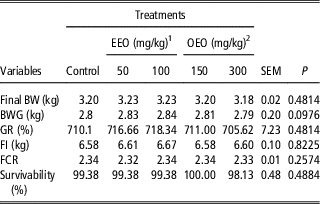
The growth performance results are shown in Table 3. The results revealed that supplementing the duck diets with 50 and 100 mg of EEO/kg or 150 and 300 mg of OEO/kg did not display any significant effect (P>0.05) on the duck growth variables, that is, the final BW, BWG, GR, FI, FCR and SURV values. The results, in addition, indicated that the tested EOs showed similar effects, where no significant difference were detected between the EEO and OEO treatments or between the two tested levels of each of them.
Effect of dietary supplementation of OEO and EEO on the duck’s growth variables

BWG=BW gain = final BW−initial BW; GR=growth rate (%) = (total BWG/ initial BW)×100; FI=total feed intake per bird; FCR=feed conversion ratio (feed : gain).
1 EEO=Enviva essential oil (content: 4.5% cinnamaldehyde and 13.5% thymol).
2 OEO=oregano essential oil (content: 5% thymol and 65% carvacrol).
Populations of cecal microbiota
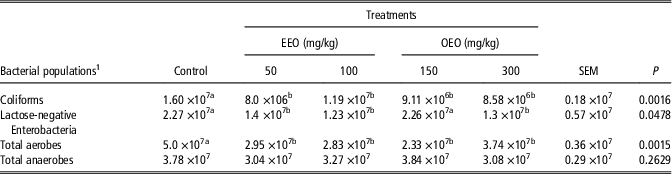
The results of the cecal bacteria enumeration are shown in Table 4. Regarding the counts of Coliforms, the obtained values in the 50 EEO, 100 EEO, 150 OEO and 300 OEO groups were lower (P<0.001) than that of the control group, which amounted to 8.00 × 10⁶, 1.19 × 10⁷, 9.11 × 10⁶ and 8.58 × 10⁶ v. 1.6 × 10⁷ CFU/g, respectively. Similarly, the total aerobes (P<0.01) and lactose-negative Enterobacteria (P<0.05) in the 50 mg EEO, 100 mg EEO, 150 mg OEO and 300 mg OEO were significantly lower than those of the control group. On the other hand, the tested treatments did not show significant effects on the total anaerobes in the cecal digesta of growing ducks.
Effect of dietary supplementation with oregano essential oil (OEO) and Enviva essential oil (EEO) on cecal microbiota of growing ducks

a,bValues within a column with different superscripts differ significantly at P<0.05.
1 Log of colony forming units per 1 g of cecal digesta.
Blood biochemicals
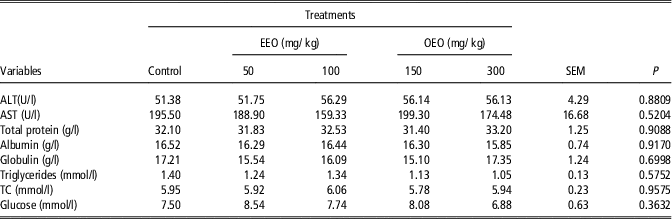
The results of duck serum bio-chemicals as affected by the dietary inclusion of EEO and OEO are shown in Table 5. The tested dietary OEO and EEO levels did not display any significant effect (P>0.05) on the assayed variables.
Effects of dietary supplementation with oregano essential oil (OEO) and Enviva essential oil (EEO) on serum biochemicals in growing ducks

ALT=alanine aminotransferase; AST=aspartate aminotransferase; TC= total cholesterol.
Discussion
Growth performance
Essential oils have a high content of strong bioactive compunds such as carvacrol, thymol and cinnamaldehyde, which were reported to exert beneficial effects on GR, feed efficiency and improved hepatic antioxidative status in broiler chickens (Skoufos et al., Reference Skoufos, Giannenas, Tontis, Bartzanas, Kittas, Panagakis and Tzora2016; Pirgozliev et al., Reference Pirgozliev, Mansbridge, Rose, Mackenzie, Beccaccia, Karadas, Ivanova, Staykova, Oluwatosin and Bravo2018). This effect is mediated by increasing nutrient absorption through stimulating intestinal mucus production, improving the activity of trypsin and amylase enzymes (Zeng et al., Reference Zeng, Zhang, Wang and Piao2015), increasing the intestinal villus height (Skoufos et al., Reference Skoufos, Giannenas, Tontis, Bartzanas, Kittas, Panagakis and Tzora2016), limiting the intestinal pathogens, reducing the bacterial toxic products stressing the bird, and stabilizing a favorable microbial balance in poultry gut (Lee et al., Reference Lee, Everts, Kappert, Yeom and Beynen2003b; Amroz et al., Reference Amroz, Wertelecki, Houszka and Kamel2006). In literature, there is a lack of information on the effect of EOs on duck’s performance. However, they have been studied widely with broilers and turkeys.
In our study, two levels were tested from each of OEO (150 and 300 mg/kg) and EEO (50 and 150 mg/kg), one represents the recommended level by the product manufacturer and the other was suggested as an additional level to contribute in confirming their presumed microbside efficacy and growth promoting ability in ducks (Table 3). The tested EO levels were in the ranges tested in previous studies with broiler chickens (Alp et al., Reference Alp, Midilli, Kocabağlı, Yılmaz, Turan, Gargılı and Acar2012; Skoufos et al., Reference Skoufos, Giannenas, Tontis, Bartzanas, Kittas, Panagakis and Tzora2016). Both tested EOs in our study, however, were not effective in promoting growth performance in ducks.
The EO treatments in the present study, in fact, were anticipated to display beneficial effects on duck’s growth performance. Even though, unlike the beneficial results obtained in some previous studies with other animal and poultry types, they did not exhibit any improvement on growth variables of ducks (Table 3). This could be attributed to differences in the types and doses of the varied EOs examined in the other studies (Russo et al., Reference Russo, Galletti, Bocchini and Carnacini1998; Daferera et al., Reference Daferera, Ziogas and Polissiou2003; Lee et al., Reference Lee, Everts, Kappert, Frehner, Losa and Beynen2003a). The obtained beneficial impacts in some studies could be associated with a cumulative effect of the different oils used in the tested mixtures. Skoufos et al. (Reference Skoufos, Giannenas, Tontis, Bartzanas, Kittas, Panagakis and Tzora2016) reported that the inclusion of EO mixtures may afford an effective synergy which lead to sustain their ability to improve performance efficiency in poultry. The response to the dietary supplementation with EOs could vary among the different poultry types, where some studies reached positive response in growth variables of other animals using the same levels of the same EOs tested in our study (Alp et al., Reference Alp, Midilli, Kocabağlı, Yılmaz, Turan, Gargılı and Acar2012; Li et al., Reference Li, Ru, Liu, Xu, Péron and Shi2012). For example, Alp et al. (Reference Alp, Midilli, Kocabağlı, Yılmaz, Turan, Gargılı and Acar2012) used the same OEO level tested in our study, 300 mg OEO/kg, with broiler chickens, which showed lower FCR (P<0.05) than that of the control. Similarly, Li et al. (Reference Li, Ru, Liu, Xu, Péron and Shi2012) found that the dietary supplementation with 100 mg EEO/kg increased BWG and improved FCR in piglets. Obtaining a positive effect from the dietary addition of EOs on growth variables and intestinal microbiota is dependant of using a proper dose. Skoufos et al. (Reference Skoufos, Giannenas, Tontis, Bartzanas, Kittas, Panagakis and Tzora2016) did not find beneficial effects of using a mixture of 150 mg of OEO/kg and 6 g of attapulgite/kg on broiler performance, but in another trial they found that using a more concentrated blend containing 300 mg OEO/kg and 3 g attapulgite/kg resulted in significant improvements in broiler GR and final BW. Therefore, using more graded levels with higher concentrations of OEO and EEO in duck’s feed can contribute in examining their presumed function and in identifying the optimal inclusion level for growing ducks.
The results of the present study showed consistency with the findings of Lee et al. (Reference Lee, Everts, Kappert, Frehner, Losa and Beynen2003a), who tested the inclusion of OEO at 50 and 100 mg/kg, Hernández et al. (Reference Hernández, Madrid, García and Megías2004) who examined a commercial EO blend containing oregano, pepper and cinnamon at 200 mg/kg and 5000 mg/kg, and Jang et al. (Reference Jang, Ko, Kang and Lee2007), who tested a commercial EO blend CRINA® Poultry; they did not reach any significant effect for their treatments on broilers growth variables. In contrast, other researchers reported beneficial effects of using the EOs on poultry performance. Among them, Lippens et al. (Reference Lippens, Huyghebaert and Cerchiari2005), who evaluated the dietary supplementation with an extract mixture of oregano, cinnamon, thyme, cayenne, pepper and citrus, Bozkurt et al. (Reference Bozkurt, Küçükyilmaz, Çatli, Çinar, Çabuk and Alçiçek2012), who used EO blends mainly containing OEO, and recently Pirgozliev et al. (Reference Pirgozliev, Mansbridge, Rose, Mackenzie, Beccaccia, Karadas, Ivanova, Staykova, Oluwatosin and Bravo2018), who tested a combination of EOs (carvacrol, cinnamaldehyde and capsicum oleoresin) at 100 mg/kg diet; all the latter authors recorded beneficial impacts for their EO treatments on broilers growth variables. As mentioned in the introduction section, most previous studies, which reached positive results, tested mixtures of EOs and herbs.
With regard to the EO effects on poultry FI, inconsistent findings were noticed in the literature; their main effect on FI is largely associated with its odor and flavor, which can stimulate or suppress the bird’s appetite. Supplementing the diets with 300, 500 or 700 mg/kg of OEO (Kirkpinar et al., Reference Kirkpinar, Ünlü and Özdemir2011), or 100 and 200 mg/kg of thyme EO (Bolukbasi et al., Reference Bolukbasi, Erhan and Ozkan2006) displayed improvements in FI values. Similar to the results of the present study, Cross et al. (Reference Cross, Mcdevith, Hillman and Agamovic2007) found that broilers fed a diet supplemented with 1000 mg/kg of OEO had a similar FI amount to that of the control birds. On the other hand, when testing the dietary inclusion of EOs, it is important to bear in mind a potential overdose effect that may provoke harmful impacts on the bird’s FI. Some studies reported negative effects of the EOs due to unfavorable taste of the diet which led to reduced FI values (Lee et al., Reference Lee, Everts, Kappert, Yeom and Beynen2003b; Brenes and Roura, Reference Brenes and Roura2010).
Intestinal microbiota
The major finding of the current study is the antimicrobial effect of EOs against the cecal microflora in growing ducks (Table 4). The selective agar media, which have been employed in the present study for the enumeration of intestinal microbiota, allow solely the growth of specific targeted bacterial species; these bacterial types were reported to be affected by dietary EOs. Kroismayr et al. (Reference Kroismayr, Sehm, Pfaffl, Plitzner, Foissy, Ettle, Mayer, Schreiner and Windisch2008) found that the dietary inclusion of two EO blends including oregano, anise and citrus at 1 and 2 g/kg diets (20 to 40 ppm EOs) reduced the intestinal contents of anaerobic and aerobic bacteria, which was attributed to its high contents of phenols, carvacrol and thymol, and terpenes as pynene and cymene. Similar to our results, Skoufos et al. (Reference Skoufos, Giannenas, Tontis, Bartzanas, Kittas, Panagakis and Tzora2016) found that feeding broilers on a basal diet containing a blend of 150 mg of OEO and 6 g of attapulgite/kg or another blend containing 300 mg OEO and 3 g attapulgite/kg showed beneficial impacts on gut microflora, where the intestinal coliform counts decreased as compared with those of birds fed a control diet without AGP. In another study, Jang et al. (Reference Jang, Ko, Kang and Lee2007) found that the thymol led to a decreased E. coli counts in broilers gut. Jamroz et al. (Reference Jamroz, Orda, Kamel, Wiliczkiewicz, Wertelecki and Skorupinska2003) reported that the bioactive compounds of the PFAs carvacrol, capsicum and cinnamaldehyde decreased both of coliforms and clostridial counts in chickens. In contrast, Cross et al. (Reference Cross, Mcdevith, Hillman and Agamovic2007) and Muhl and Liebert (Reference Muhl and Liebert2007) found that the EO blends including OEO had no effect on the microbial population in broilers digestive tract or fecal excretions. The OEO, containing 60% carvacrol and 10% thymol, has proven effective against some strains of E. coli and gut salmonella when added to chicken diets at a level of 0.05% (Koscova et al., Reference Koscova, Nemcova, Gancarcikova, Jonecova, Scirankova and Buleca2006).
With regard to the mechanism of EOs to show their microbeside effect in bird’s intestine, two main actions were reported. The first is initiated, after reaching the intestinal medium, through forming a crack and causing the cell contents of pathogenic bacteria to spill to the medium, and ultimately disrupting the microorganisms. The second action occurs via adhering to the intestinal cell wall, and blocking bacterial adhesion to the intestine by blocking the lectin–carbohydrate receptor onto the mucosal layer of the gut wall (Koscova et al., Reference Koscova, Nemcova, Gancarcikova, Jonecova, Scirankova and Buleca2006; Kroismayr et al., Reference Kroismayr, Sehm, Pfaffl, Plitzner, Foissy, Ettle, Mayer, Schreiner and Windisch2008).
Serum variables
Maintaining a normal dynamic equilibrium between the rate of catabolic and anabolic changes in the bird body is important for obtaining balanced metabolism and normal performance level (Kapelański et al., Reference Kapelański, Grajewska, Bocian, Dybala, Jankowiak and Wiśniewska2004). Blood biochemistry reflects what is happening actually within the bird body. Dietary nutrients can affect the cell homeostasis via affecting blood composition and its status. The findings of the current work revealed that the tested OEO and EEO treatments did not exert significant effects (P˃0.05) on the tested blood variables, in terms of TC, TG, GLU, TP, ALB, GLO, ALT and AST (Table 5). Contrary to the findings of the present study with growing ducks, Gulec et al. (Reference Gulec, Danabas, Ural, Seker, Arslan and Serdar2013) observed significantly higher (P<0.05) contents of TP, ALB, cholesterol, TG and bilirubin, and reduced GLU content after addition of plant oils (Thymus vulgaris and Foeniculum vulgare) compared to the control; they suggested that the EOs have the ability to enhance the non-specific immune response (albumen–globulin ratio), and reduce blood GLU concentration, which reflects their capability to reduce the effects of stressors. The results of Cho et al. (Reference Cho, Kim and Kim2014) indicated reduced blood TC in broilers fed an EO blend when compared with the obtained value in the control group. Our results were in line with those of Kroismayr et al. (Reference Kroismayr, Sehm, Pfaffl, Plitzner, Foissy, Ettle, Mayer, Schreiner and Windisch2008), who found that the EO blends including regano, anise and citrus did not affect the blood variables; they tested two products containing 20 g/kg of the EO blend at amounts of 1 and 2 g/kg of the piglet diets (20 to 40 ppm EOs).
Conclusion
The dietary addition of OEO (150 and 300 mg /kg) and EEO (50 and 100 mg/kg) did not display any significant effect on growth performance or serum variables, but they have proven beneficial antimicrobial effectiveness against cecal microbiota in growing ducks.
Acknowledgments
This research was supported by the Science and Technology Planning Project of Guangdong Province, China (No. 2014A020208052); the Science and Technology Planning Project of Guangzhou, China (No. 201510010250). Dr Khaled Abouelezz and Dr Marwa M. Abou-Hadied were recipients of research positions from the Talented Young Scientists Program (TYSP), Ministry Of Science and Technology (MOST), China.
Declaration of interest
No potential conflicts of interest declared.
Ethics statement
Guangdong HAID Institute of Animal Husbandry and Veterinary approved the study.
Software and data repository resources
None of the data were deposited in an official repository.