INTRODUCTION
The brain is a major target for HIV and the second most frequently affected organ in HIV patients (Masliah, DeTeresa, Mallory, & Hansen, Reference Masliah, DeTeresa, Mallory and Hansen2000). Frontostriatal regions appear to be specifically vulnerable. Following infection, the highest concentrations of HIV in the brain are found in the basal ganglia, subcortical regions, and frontal cortices (Wiley et al., Reference Wiley, Achim, Christopherson, Kidane, Kwok, Masliah, Mellors, Radhakrishnan, Wang and Soontornniyomkij1999). Neuroimaging studies of HIV patients frequently indicate that significant volume reductions are apparent in the frontal white matter and basal ganglia (Ances et al., Reference Ances, Roc, Wang, Korczykowski, Okawa, Stern, Kim, Wolf, Lawler, Kolson and Detre2006; Aylward et al., Reference Aylward, Henderer, McArthur, Brettschneider, Harris, Barta and Pearlson1993; Jernigan et al., Reference Jernigan, Archibald, Hesselink, Atkinson, Velin, McCutchan, Chandler and Grant1993).
Although the severity of HIV-associated neurocognitive disorders has been significantly reduced as a result of using combination antiretroviral therapy (cART), neuropsychological impairments in HIV patients continue to persist (Cysique, Maruff, & Brew, Reference Cysique, Maruff and Brew2006; Ferrando, Rabkin, van Gorp, Lin, & McElhiney, Reference Ferrando, Rabkin, van Gorp, Lin and McElhiney2003) as a result of ongoing neuroinflammatory and neurodegenerative processes. There is evidence that poorer immune function, as indicated by lower CD4 lymphocyte counts and higher viral loads, can result in greater rates of brain tissue loss over a 24-month period, even in patients on stable antiretroviral treatment (Cardenas et al., Reference Cardenas, Meyerhoff, Studholme, Kornak, Rothlind, Lampiris, Neuhaus, Grant, Chao, Truran and Weiner2009). HIV-related disease factors (i.e., CD4 counts, viral load) also correlate with the degree of cognitive impairment present in HIV patients (Childs et al., Reference Childs, Lyles, Selnes, Chen, Miller, Cohen, Becker, Mellors and McArthur1999). Furthermore, having a history of significant immune system compromise has been shown to be an important factor affecting brain function, as patients’ lowest-ever CD4 counts (i.e., nadir CD4) have also been related to cognitive impairment rates (Tozzi et al., Reference Tozzi, Balestra, Lorenzini, Bellagamba, Galgani, Corpolongo, Vlassi, Larussa, Zaccarelli, Noto, Visco-Comandini, Giulianelli, Ippolito, Antinori and Narciso2005; Valcour et al., Reference Valcour, Yee, Williams, Shiramizu, Watters, Selnes, Paul, Shikuma and Sacktor2006).
In addition to cognitive difficulties, there are increasing reports that HIV patients experience higher rates of psychological dysfunction compared with seronegative individuals (Bing et al., Reference Bing, Burnam, Longshore, Fleishman, Sherbourne, London, Turner, Eggan, Beckman, Vitiello, Morton, Orlando, Bozzette, Ortiz-Barron and Shapiro2001; Hinkin, Castellon, Atkinson, & Goodkin, Reference Hinkin, Castellon, Atkinson and Goodkin2001). Notably, some of the psychological impairments observed in HIV patients have been associated with HIV-related frontostriatal abnormalities (Paul et al., Reference Paul, Brickman, Navia, Hinkin, Malloy, Jefferson, Cohen, Tate and Flanigan2005), suggesting that these difficulties arise secondary to the neuropathological process of HIV, rather than arising purely as a psychological reaction to having been diagnosed with a chronic disease.
Psychological functioning is strongly reliant on and affected by the ability to recognize the emotional states of others, as this ability is one of the most basic and critical components to social interactions (Darwin, 1872/Reference Darwin1965). Hence, emotion recognition can be considered one of the cornerstones of healthy psychological functioning. The neural structures involved in the recognition of basic facial emotions include frontal-subcortical regions, which interact within a larger cortico-limbic system (Adolphs, Reference Adolphs2002a). Intriguingly, facial emotion recognition processes are thought to involve partly dissociable neural subsystems for recognizing different emotions (Adolphs, Reference Adolphs2002a; Calder, Lawrence, & Young, Reference Calder, Lawrence and Young2001; Posamentier & Abdi, Reference Posamentier and Abdi2003). For example, fear recognition has been shown to rely heavily on the amygdala, anger on the lateral orbitofrontal regions, and disgust on the insula and basal ganglia (Murphy, Nimmo-Smith, & Lawrence, Reference Murphy, Nimmo-Smith and Lawrence2003).
Although several studies have demonstrated disrupted facial emotion recognition abilities in patients with neuroanatomical dysfunction in fronto-subcortical systems, including individuals with Parkinson’s disease (e.g., Clark, Neargarder, & Cronin-Golomb, Reference Clark, Neargarder and Cronin-Golomb2008; Dujardin et al., Reference Dujardin, Blairy, Defebvre, Duhem, Noel, Hess and Destee2004; Lawrence, Goerendt, & Brooks, Reference Lawrence, Goerendt and Brooks2007), Huntington’s disease (Johnson et al., Reference Johnson, Stout, Solomon, Langbehn, Aylward, Cruce, Ross, Nance, Kayson, Julian-Baros, Hayden, Kieburtz, Guttman, Oakes, Shoulson, Beglinger, Duff, Penziner and Paulsen2007; Sprengelmeyer et al., Reference Sprengelmeyer, Young, Calder, Karnat, Lange, Homberg, Perrett and Rowland1996), and obsessive compulsive disorder (Sprengelmeyer et al., Reference Sprengelmeyer, Young, Pundt, Sprengelmeyer, Calder, Berrios, Winkel, Vollmoeller, Kuhn, Sartory and Przuntek1997), to our knowledge none has yet examined facial emotion recognition in HIV patients. Such a study is critical to understanding fully the nature and degree of the neuropsychiatric impairments that accompany HIV infection, as well as their functional consequences.
The current study was conducted to examine facial emotion recognition in HIV patients, with the specific objective of assessing the relation between HIV-disease factors and facial emotion recognition abilities. Although several theoretical frameworks have been put forth to classify emotions (e.g., approach-withdrawal) (Davidson, Reference Davidson1993), we focused our investigation on the so-called basic emotions (anger, disgust, fear, happiness, sadness, surprise), given the evidence implicating basal ganglia structures in the recognition of some of these emotions (e.g., disgust) (Murphy, Nimmo-Smith, & Lawrence, Reference Murphy, Nimmo-Smith and Lawrence2003; Sprengelmeyer et al., Reference Sprengelmeyer, Young, Calder, Karnat, Lange, Homberg, Perrett and Rowland1996). Based on the findings of frontostriatal abnormalities in HIV and the relation of fronto-subcortical functions to facial emotion recognition abilities, our primary hypothesis was that individuals with HIV would exhibit facial emotion recognition deficits compared to seronegative control participants. Among individuals with HIV, we hypothesized that severity of HIV-disease factors (i.e., CD4 levels) would be associated with degree of emotion recognition impairment, a finding which would be consistent with reported associations between HIV-disease factors and other neurocognitive functions (e.g., Valcour et al., Reference Valcour, Yee, Williams, Shiramizu, Watters, Selnes, Paul, Shikuma and Sacktor2006).
We were also interested in exploring the possibility that facial emotion recognition difficulties might have an impact on the psychosocial functions of individuals with HIV. Impairments in facial emotion recognition have previously been related to increased interpersonal dysfunction in other neuropsychiatric patient populations (Clark, Neargarder, & Cronin-Golomb, Reference Clark, Neargarder and Cronin-Golomb2008; Kornreich et al., Reference Kornreich, Philippot, Foisy, Blairy, Raynaud, Dan, Hess, Noel, Pelc and Verbanck2002; Shimokawa et al., Reference Shimokawa, Yatomi, Anamizu, Torii, Isono, Sugai and Kohno2001). Accordingly, we hypothesized that reductions in facial emotion recognition would be associated with reduced psychosocial functioning in HIV patients.
METHOD
Participants
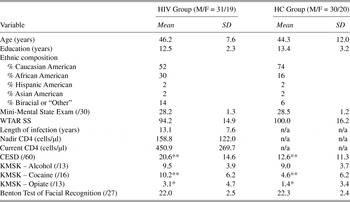
We included 50 HIV-seropositive (HIV) and 50 seronegative, healthy control (HC) individuals. Individuals in the HIV group were recruited from The Miriam Hospital Immunology Center. HC participants were recruited from acquaintances of HIV participants and from the community. All participants attained scores above the cutoff of 23 on the Mini-Mental State Exam (MMSE) (Folstein, Folstein, & McHugh, Reference Folstein, Folstein and McHugh1975); all were required to be native speakers of English. We excluded participation on the basis of reported history of uncorrected abnormal vision; developmental/learning disability; major psychiatric illness (e.g., schizophrenia, bipolar disorder); neurological illness affecting the CNS; and traumatic head injury with loss of consciousness greater than 10 minutes. Substance use exclusion criteria were current alcoholism, heroin/opiates or intravenous drug use within the past 12 months, and cocaine use within the past 3 months. The research was approved by The Miriam Hospital’s Institutional Review Board. All individuals gave their informed consent and were financially compensated for their time. See Table 1 for details of participant characteristics.
Demographic characteristics of the participant groups

Note
M/F = Male-Female; CESD = Center for Epidemiologic Studies Depression Scale; KMSK = Kreek-McHugh-Schluger-Kellogg scale. Asterisks indicate that the groups’ means are significantly different at the p < .05 (*) or p < .01 level (**).
Self-report was used to estimate disease duration in HIV patients; this information was verified against the medical record. History of cART use, nadir CD4 levels, and current CD4 levels were obtained from the medical record. Forty-two of 50 HIV participants were on cART medications. Nadir CD4 levels ranged from 0 to 488 cells/μl. Current CD4 levels ranged from 30 to 1320 cells/μl. CD4 levels were not available for one participant.
Current levels of depression symptoms were estimated using the Center for Epidemiologic Studies Depression Scale (CESD) (Radloff, Reference Radloff1977). CESD scores were available for 49 HIV and 49 HC participants. Clinically significant levels of depression (CESD > 15) were reported by 61% and 27% of the HIV and HC participants, respectively. History of alcohol and drug use was estimated using the Kreek-McHugh-Schluger-Kellogg scale (KMSK), which characterizes lifetime exposure to alcohol, cocaine, and opiates (Kellogg et al., Reference Kellogg, McHugh, Bell, Schluger, Schluger, LaForge, Ho and Kreek2003). In the HIV and HC groups, 54% and 48%, respectively, scored above the cutoff for lifetime dependence on alcohol (KMSK-Alcohol > 10), meaning that about half of the participants likely met criteria for alcohol dependence at some point in their lifetime. In terms of cocaine use, 60% and 26% of the HIV and HC participants, respectively, met criteria for lifetime dependence (KMSK-Cocaine > 10). Twenty percent and 8% of the HIV and HC participants, respectively, met criteria for lifetime opiate dependence (KMSK-Opiates > 8).
Materials
Emotion Recognition
Participants viewed 84 Ekman and Friesen photographs (Ekman & Friesen, Reference Ekman and Friesen1976) on a 17” laptop computer. Twelve (six male, six female) images were selected from each of the following six emotion categories: Angry, Disgust, Fear, Happy, Sad, and Surprise, plus Neutral. E-Prime software (http://www.pstnet.com) was used to present the stimuli in a random order. Participants were asked to select the emotion represented in the face from seven emotion labels displayed below each face. Responses were given orally and entered into the computer by the experimenter. Percent correct recognition was calculated for each emotion category.
Landscape Categorization
Previous research has suggested that emotion recognition impairments in neurologic patients may sometimes be attributable to task difficulty factors, rather than to the disruption of neural systems involved in emotion perception (Rapcsak et al., Reference Rapcsak, Galper, Comer, Reminger, Nielsen, Kaszniak, Verfaellie, Laguna, Labiner and Cohen2000). To better account for this possibility, we administered a nonemotional image categorization control task with equivalent task requirements and difficulty levels, which has been shown to be a suitable control to the current emotion recognition task (Clark, Neargarder, & Cronin-Golomb, Reference Clark, Neargarder and Cronin-Golomb2008). Participants viewed 84 black-and-white photographs of landscape images, which are matched according to difficulty level to images used in the emotion categorization task (Clark et al., Reference Clark, Neargarder and Cronin-Golomb2008). We presented 12 images from each of the following categories: Canyon, City, Forest, Mountain, Shore, Town, and Tropical. Administration procedures mirrored those of the emotion recognition task. Participants were asked to select the landscape category that best described the image from the list of seven possible categories provided on the screen below each image. Data from three HC participants were lost as a result of technical errors.
To ensure that all participants were able to adequately conceptualize the meanings of the terms used for responses in the experimental tasks, participants completed a word-definition matching task prior to testing. All participants were able to correctly match emotion and landscape words with their definitions.
Facial Recognition
The 13-item version of the Benton Test of Facial Recognition (Benton, Sivan, Hamsher, Varney, & Spreen, Reference Benton, Sivan, Hamsher, Varney and Spreen1994) was administered to assess general face perception abilities. This task presents participants with target photographs of unfamiliar faces and requires that they identify images of the target in a selection of six photographs.
Psychosocial Functioning
The 64-item version of the Inventory of Interpersonal Problems (IIP) was administered. This self-report questionnaire was designed to assess levels of distress in relation to interpersonal interactions (Horowitz, Alden, Wiggins, & Pincus, Reference Horowitz, Alden, Wiggins and Pincus2000; Horowitz, Rosenberg, Baer, Ureno, & Villasenor, Reference Horowitz, Rosenberg, Baer, Ureno and Villasenor1988). This instrument has been useful in measuring the quality of interpersonal relationships in members of the general population (e.g., Falkum & Vaglum, Reference Falkum and Vaglum2005) and has been used to identify psychosocial difficulties in neuropsychiatric patients (Clark, Neargarder, & Cronin-Golomb, Reference Clark, Neargarder and Cronin-Golomb2008; Kornreich et al., Reference Kornreich, Philippot, Foisy, Blairy, Raynaud, Dan, Hess, Noel, Pelc and Verbanck2002). The IIP consists of eight subscales where higher scores indicate higher rates of distress. Raw scores for each of the eight individual scales were used in the analyses.
Data Analysis
We conducted independent-sample t tests to examine between-group differences in demographic variables and performance on the Benton Test of Facial Recognition. Performance on the facial emotion recognition task was assessed by conducting a mixed design ANOVA with factors of group (HIV, HC) and emotion (Angry, Disgust, Fear, Happy, Neutral, Sad, Surprise). To compare the HIV and HC groups’ abilities to identify images from the emotional image set relative to the nonemotional image set, we conducted a mixed design ANOVA with factors of group (HIV, HC) and stimuli type (emotion, landscapes). The HIV and HC groups’ abilities to classify nonemotional images were compared by conducting a mixed design ANOVA with group (HIV, HC) and landscape (Canyon, City, Forest, Mountain, Shore, Town, Tropical) as factors.
Standard linear regression analyses were used to assess the extent to which HIV-disease factors affected emotion recognition accuracy scores for each emotion. Because our primary interest was to understand the relation of HIV-related disease factors to emotion recognition abilities, these analyses were conducted in the HIV group alone. We also included demographic variables that have been shown to impact emotion recognition abilities, such as age (Calder et al., Reference Calder, Keane, Manly, Sprengelmeyer, Scott, Nimmo-Smith and Young2003), depression levels (Leppanen, Milders, Bell, Terriere, & Hietanen, Reference Leppanen, Milders, Bell, Terriere and Hietanen2004; Rubinow & Post, Reference Rubinow and Post1992), and intellectual status (Pan, Chen, Chen, & Liu, Reference Pan, Chen, Chen and Liu2009; Simon, Rosen, Grossman, & Pratowski, Reference Simon, Rosen, Grossman and Pratowski1995). Hence, in each model, current CD4 counts, nadir CD4 counts, age, CESD, and WTAR raw scores were submitted as independent variables; and the accuracy score for each emotion category was entered as the dependent variable.
Group differences on the eight IIP scales were assessed by conducting a mixed design ANOVA with factors of group (HIV, HC) and the IIP scales (1 through 8). Pearson correlations with a conservative alpha level of .01 were computed to investigate the association between reports of interpersonal problems with accuracy rates for each emotion in the HIV and HC groups independently.
RESULTS
Participant Characteristics
The HIV and HC groups did not differ with respect to age (t[83.2] = .95, p > .05), education (t[88.8] = 1.58, p > .05), MMSE score (t[98] = 1.03, p > .05), or WTAR scaled score (t[97] = 1.85, p > .05). There was a higher proportion of Caucasian to non-Caucasian participants in the HC group compared to the HIV group (χ 2 = 4.29, p < .05). Higher rates of depression symptoms were reported by HIV patients (t[90.3] = 3.03, p < .01). Significant group differences were not observed on the KMSK-Alcohol scale (KMSK-A, t[98] = .60, p >. 05); however, scores on the KMSK-Cocaine (KMSK-C) and KMSK-Opiate (KMSK-O) scales were significantly higher in HIV compared to HC participants (t[98] = 4.48, p < .001 and t[89.9] = 2.89, p < .05, respectively). The groups’ basic facial perception skills did not differ (Benton Test: t[92] = .56, p > .05). Table 1 shows mean raw scores for the HIV and HC groups on these measures.
Performance on the Emotion and Landscape Recognition Tasks
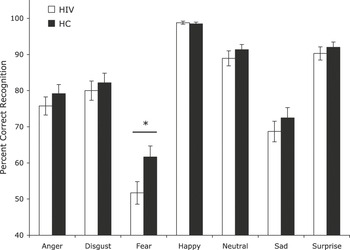
Analyses of the HIV and HC groups’ performances on the emotion recognition tasks revealed a significant group by emotion interaction (F[4.9,464.5] = 2.28, p < .05), a nonsignificant main effect of group (F[1,95] = 2.28, p = .14), and a significant main effect of emotion (F[4.9,464.5] = 40.16, p < .001). CESD was included as a covariate (F[1,95] = 3.07, p = .08), which was significantly related to disgust recognition (b = −.30, p < .05). KMSK scores and ethnicity (Caucasian/non-Caucasian) did not contribute significantly to the model when entered as covariates (KMSK-C, p = .36; KMSK-O, p = .54; ethnicity, p = .27) and were thus removed from the final analysis reported above. To examine the interaction effect, we conducted post hoc tests that showed that HIV participants were significantly less accurate than HC at identifying fearful expressions (t[98] = 2.29, p < .05) (Figure 1); the size of this effect was small (r = .23). The groups did not differ significantly in their ability to recognize any other emotion (all p’s > .05).
Mean (+ standard error of the mean) percentage of facial expression images that were correctly identified by each group.
Note. HIV = HIV Group; HC = Healthy Control Group. Asterisks indicate that the groups’ means are significantly different at the p < .05 level (*).

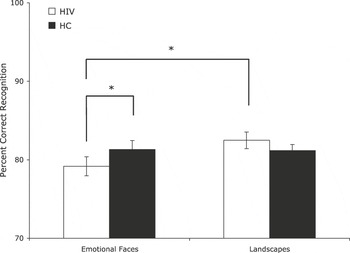
The HC group’s performance on the emotion and landscape recognition tasks did not differ significantly (t[46] = .86, p = .39), verifying that the difficulty levels were comparable for the emotion recognition (HC mean accuracy: 82.5%) and the landscape categorization (HC mean accuracy: 81.2%) image sets in HC. Comparisons of the HIV and HC groups’ abilities to correctly identify emotional expressions relative to nonemotional landscape images revealed a significant group by stimuli-type interaction (F[1,95] = 4.25, p < .05). Post hoc analyses indicated that the HIV group exhibited significantly poorer abilities to identify facial expressions compared with HC (t[98] = 1.99, p = .05, r = .20), whereas their performance on the landscape image set was not significantly different from HC (t[95] = .11, p = .92) (Figure 2). Paired samples t tests comparing the HIV group’s performance on the facial and landscape image sets revealed significantly poorer abilities to classify emotional facial images compared to nonemotional landscape images (t[49] = 2.21, p < .05). Comparisons of the HIV and HC groups’ performances on the seven landscape categories did not reveal significant group differences (main effect of group: F[1,95] = .01, p = .92; group by landscape category interaction: F[3.9,373.6] = 1.76, p = .14; main effect of landscape: F[3.9,373.6] = 28.85, p < .001).
Mean (+ standard error of the mean) percentage of facial expression images and landscape images that were correctly identified by each group.
Note. HIV = HIV Group; HC = Healthy Control Group. Asterisks indicate that the groups’ means are significantly different at the p ≤ .05 level (*).

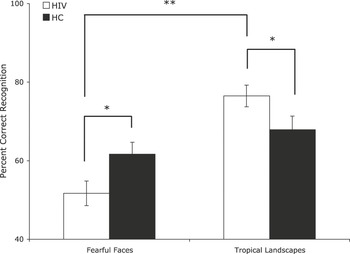
Lastly, we examined the specificity of the HIV group’s difficulty in identifying fearful images by conducting a mixed design ANOVA comparing the HIV and HC groups’ ability to correctly identify fearful images to its matched landscape category (tropical). We observed a significant group by stimuli interaction (F[1,95] = 11.21, p < .001), which was driven by the HIV group’s significantly poorer ability to identify fearful expressions (t[98] = 2.29, p < .05) and greater accuracy at identifying tropical images (t[95 ]= 1.96, p = .05) compared with HC (Figure 3). The HC group’s ability to identify fearful and tropical images did not differ significantly (t[46] = 1.78, p < .05), whereas HIV participants were significantly poorer at identifying fearful than tropical images (t[49] = 6.77, p < .001).
Mean (+ standard error of the mean) percentage of fearful and tropical images that were correctly identified by each group.
Note. HIV = HIV Group; HC = Healthy Control Group. Asterisks indicate that the groups’ means are significantly different at the p ≤ .05 level (*) or p < .01 (**) level.

Emotion Recognition and HIV-Disease Factors
To assess the influence of HIV-disease factors (i.e., CD4 counts) on emotion recognition abilities, we conducted a linear regression analysis for each emotion category as described above. In the model for anger recognition (R 2 = .30, F[5,42] = 3.53, p < .01), WTAR scores contributed significantly to the model (B = 1.03, 95% confidence interval [CI] = .51–1.55, β = .58 [t = 4.03, p < .001]), and a trend effect was observed for current CD4 levels (B = .02, CI = 0–.04, β = .26 [t = 1.79, p = .08]). These results suggest that when controlling for differences in estimated intellectual abilities, age, nadir CD4 levels, and depression, lower anger recognition accuracy is associated with lower current CD4 counts in HIV patients. We estimated the unique contributions of WTAR scores and current CD4 counts by conducting a forward stepwise regression analysis in which these two factors were entered as potential predictors. In the resulting model (R 2 = .29, p < .001), WTAR scores (B = 1.03, CI = .55–1.51, β = .58, p < .001) accounted for 23% of the variance in anger recognition accuracy, and current CD4 levels (B = .02, CI = 0–.04, β = .27, p = .05) accounted for an additional 6%. In the model for sad recognition (R 2 = .27, F[5,42] = 3.15, p < .05), older age contributed significantly to the model (B = 1.00, CI = .28–1.73, β = .38 [t = 2.79, p < .01]), and there was a trend for higher WTAR scores (B = .53, CI = −.06–1.13, β = .26 [t = 1.80, p = .08]) to be associated with greater recognition of sad expressions. None of the models for the remaining emotion categories were statistically significant.
Psychosocial Functioning and Relation to Emotion Recognition
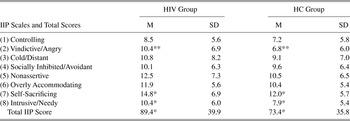
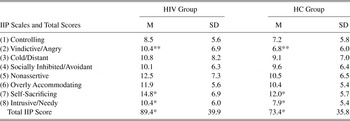
Comparisons of the HIV and HC groups on the IIP scales revealed a significant main effect of group (F[1,94] = 4.23, p < .05) and a nonsignificant group by IIP scale interaction (F[4.29,403.6] = 1.07, p > .05). To further examine the main effect of group, we conducted post hoc comparisons that revealed greater rates of interpersonal distress in the HIV group compared with HC on scales measuring difficulties with managing anger and irritability in interpersonal relationships (scale 2) (t[94] = 2.73, p < .01), self-sacrificing behaviors (scale 7) (t[94] = 2.16, p < .05), and desires to connect with others (scale 8) (t[94] = 2.10, p < .05) (Table 2). The total score on the IIP was also significantly higher in the HIV group (t[94] = 2.08, p < .05). The standard T-score equivalents of the HIV and HC groups’ mean total raw scores are 61 and 56, respectively (Horowitz, Rosenberg, Baer, Ureno, & Villasenor, Reference Horowitz, Alden, Wiggins and Pincus2000). This indicates that the level of interpersonal distress reported by the HIV group overall is 1.1 standard deviations above the general normative population’s mean IIP score (versus 0.6 in the HC group), which can be interpreted as a mild but clinically significant elevation in interpersonal distress in the HIV sample.
Mean (+ standard deviations) group scores on the eight IIP scales (maximum score = 32) and Total IIP (maximum score = 256)
Note
M = mean, SD = standard deviation. Asterisks indicate that the groups’ means are significantly different at the p < .05 (*) or p < .01 level (**).
To investigate the association between interpersonal problems and accuracy rates for each emotion category in the HIV and HC groups, we conducted Pearson correlations with a conservative alpha level of .01. In the HC group, emotion recognition abilities were not significantly correlated with reports of interpersonal problems (p > .05 for all correlations). In the HIV group, poorer anger recognition was associated with greater reports of difficulties with maintaining a sense of social connectedness (scale 3, r = −.41, p < .01). No additional correlations were significant.
DISCUSSION
The purpose of this study was to investigate the relation of HIV-disease status and factors to facial emotion recognition abilities. Such a study is warranted based on the literature indicating that frontostriatal structures, which are known to be abnormal in HIV (Ances et al., Reference Ances, Roc, Wang, Korczykowski, Okawa, Stern, Kim, Wolf, Lawler, Kolson and Detre2006; Aylward et al., Reference Aylward, Henderer, McArthur, Brettschneider, Harris, Barta and Pearlson1993; Jernigan et al., Reference Jernigan, Archibald, Hesselink, Atkinson, Velin, McCutchan, Chandler and Grant1993), contribute significantly to this ability (Adolphs, Reference Adolphs2002a). Our results indicate that individuals with HIV demonstrate a general impairment in emotion recognition abilities, which is driven mostly by specific impairments in the ability to recognize fearful expressions. Furthermore, we observed a relation between emotion recognition abilities and HIV-disease factors, mainly current CD4 counts and anger recognition abilities. Taken together, these data provide strong indication that HIV-associated neuropathological changes could be contributing to emotional processing problems among individuals with HIV.
We administered a carefully designed control task of landscape categorization to address the possibility that facial emotion recognition impairments may arise secondary to task difficulty factors, rather than from the disruption of specific neuroanatomical structures involved in emotion recognition (Rapcsak et al., Reference Rapcsak, Galper, Comer, Reminger, Nielsen, Kaszniak, Verfaellie, Laguna, Labiner and Cohen2000). Inclusion of this task allowed us to assess emotion recognition abilities in our participants relative to their ability to classify nonemotional stimuli of comparable difficulty level. In doing so, we were able to control for two potential sources of bias inherent in forced-choice tasks of facial emotion recognition: differences in difficulty levels across emotions and potential group differences in cognitive abilities (i.e., decision-making/categorization skills). We found that HIV patients performed normally on the landscape task but demonstrated significant impairments on the facial emotion task compared to HC. These results suggest that HIV patients exhibit an overall impairment in the ability to classify facial expressions across several emotional domains (driven most strongly by an impairment in fear recognition). Furthermore, they indicate that the poorer performance displayed by HIV patients on the emotion recognition task was not a result of factors of task difficulty or impaired categorization skills, but instead represents a frank impairment in emotional perception. Hence, the normal performance by HIV patients on the landscape task strengthens our interpretation of the specificity of the observed emotion recognition impairment in HIV.
Our results also indicated that decreases in fear recognition demonstrated by HIV patients were significant even after controlling for increases in depression symptoms, which is a common comorbid symptom of HIV infection (Ciesla & Roberts, Reference Ciesla and Roberts2001). Nevertheless, we did find that depression symptoms contributed modestly to emotion recognition impairments in HIV patients, although this effect appears to have been limited mostly to reducing accuracy for facial expressions of disgust. These results are consistent with those indicating that facial emotion recognition impairments occur in patients with depression (Feinberg, Rifkin, Schaffer, & Walker, Reference Feinberg, Rifkin, Schaffer and Walker1986; Rubinow & Post, Reference Rubinow and Post1992). Moreover, such findings are compelling, as they suggest that some of the emotion recognition difficulties experienced by individuals with HIV might be remediated with improved treatment of their symptoms of depression.
Emotion recognition involves a large set of neural regions that interact within a broad cortico-limbic system (Adolphs, Reference Adolphs2002a). Although some structures are implicated across several emotions, partly dissociable neural subsystems for recognizing individual emotions are evident (Adolphs, Reference Adolphs2002a; Calder, Lawrence, & Young, Reference Calder, Lawrence and Young2001; Posamentier & Abdi, Reference Posamentier and Abdi2003). In particular, the recognition of fear is known to robustly engage the amygdala (Murphy, Nimmo-Smith, & Lawrence, Reference Murphy, Nimmo-Smith and Lawrence2003). Atrophy in limbic temporal lobe regions has been reported in HIV patients (Jernigan et al., Reference Jernigan, Archibald, Hesselink, Atkinson, Velin, McCutchan, Chandler and Grant1993); however, these effects have not been consistently observed (Stout et al., Reference Stout, Ellis, Jernigan, Archibald, Abramson, Wolfson, McCutchan, Wallace, Atkinson and Grant1998), and questions remain about the specificity of these findings to the amygdala. Nevertheless, the amygdala may still be implicated in the development of fear recognition abnormalities in HIV patients secondary to a possible functional disruption between frontostriatal structures and the amygdala.
The basal ganglia receive substantial inputs from the amygdala, and it has been hypothesized that the basal ganglia may function in concert with the amygdala to process basic reward/punishment characteristics of emotional stimuli (Adolphs, Reference Adolphs2002b). Ventral portions of the putamen are strongly connected with the amygdala (Alexander, Crutcher, & DeLong, Reference Alexander, Crutcher and DeLong1990; Kelly & Strick, Reference Kelly and Strick2004), and the dorsolateral striatum receives input from the amygdala via the substantia nigra (Han, McMahan, Holland, & Gallagher, Reference Han, McMahan, Holland and Gallagher1997). The amygdala also receives indirect sensory input from the frontal cortices, particularly the orbitofrontal regions (Rempel-Clower, Reference Rempel-Clower2007), which may serve to modulate amygdala-mediated processing (Adolphs, Reference Adolphs2002b). Thus, it is possible that HIV-related disruptions in frontostriatal regions (e.g., basal ganglia, frontal cortices) may lead to abnormal processing within the amygdala, resulting in reduced fear recognition accuracy.
Yet, fear recognition is a complex process, and as such it draws upon multiple brain regions beyond the amygdala, including the ventrolateral prefrontal cortex (VLPFC), dorsolateral prefrontal cortex (DLPFC), anterior insula, anterior cingulate cortex (ACC), inferior parietal lobule, and fusiform gyrus (Fusar-Poli et al., Reference Fusar-Poli, Placentino, Carletti, Landi, Allen, Surguladze, Benedetti, Abbamonte, Gasparotti, Barale, Perez, McGuire and Politi2009; Morris et al., Reference Morris, Friston, Buchel, Frith, Young, Calder and Dolan1998; Sprengelmeyer, Rausch, Eysel, & Przuntek, Reference Sprengelmeyer, Rausch, Eysel and Przuntek1998). Furthermore, rostral regions of the ACC and the dorsomedial prefrontal cortex (DMPFC) are thought to underlie facial emotion perception across several emotional domains (Murphy, Nimmo-Smith, & Lawrence, Reference Murphy, Nimmo-Smith and Lawrence2003; Phan, Wager, Taylor, & Liberzon, Reference Phan, Wager, Taylor and Liberzon2002). Accordingly, it is plausible that HIV-related disruptions in frontal cortices may contribute to emotion recognition abnormalities in individuals with HIV. Notably, individuals with HIV demonstrate significant frontal lobe atrophy (Cohen et al., Reference Cohen, Harezlak, Schifitto, Hana, Clark, Gongvatana, Paul, Taylor, Thompson, Alger, Brown, Zhong, Campbell, Singer, Daar, McMahon, Tso, Yiannoutsos and Navia2010; Jernigan et al., Reference Jernigan, Archibald, Hesselink, Atkinson, Velin, McCutchan, Chandler and Grant1993), as well as reduced activation in frontal lobe regions (including VLPFC and DLPFC) during cognitive tasks (Melrose, Tinaz, Castelo, Courtney, & Stern, Reference Melrose, Tinaz, Castelo, Courtney and Stern2008). Taken together, the evidence suggests that emotion recognition abnormalities in HIV patients may arise as a result of a disruption of the broader neural network involved in emotion recognition (e.g., amygdala, DLPFC, VLPFC, DMPFC, ACC, posterior cortices), which depends on the integrity of frontostriatal systems.
Our data also indicated that impairments in anger recognition were modestly associated with lower current CD4 levels. Although we did not observe a significant impairment in anger recognition in our HIV group, these data are consistent with evidence indicating that HIV-disease variables (e.g., CD4 levels) are strongly related to neurologic status (Childs et al., Reference Childs, Lyles, Selnes, Chen, Miller, Cohen, Becker, Mellors and McArthur1999; Cohen et al., Reference Cohen, Harezlak, Schifitto, Hana, Clark, Gongvatana, Paul, Taylor, Thompson, Alger, Brown, Zhong, Campbell, Singer, Daar, McMahon, Tso, Yiannoutsos and Navia2010); such findings reveal the importance of HIV-disease variables, beyond HIV-serostatus, in predicting neuropsychological impairment among individuals with HIV. That we observed a specific association between CD4 levels and anger recognition implies that greater neuropathology, secondary to a host of chronic neurotoxic and inflammatory processes (Gonzalez-Scarano & Martin-Garcia, Reference Gonzalez-Scarano and Martin-Garcia2005), may be occurring in neural regions implicated in anger perception among HIV patients with lower CD4 counts. Processing of angry facial expressions involves the lateral orbitofrontal cortex, ACC, parahippocampus, globus pallidus, and claustrum (Fusar-Poli et al., Reference Fusar-Poli, Placentino, Carletti, Landi, Allen, Surguladze, Benedetti, Abbamonte, Gasparotti, Barale, Perez, McGuire and Politi2009; Murphy, Nimmo-Smith, & Lawrence, Reference Murphy, Nimmo-Smith and Lawrence2003). Reductions in current CD4 levels have been associated with frontal-lobe gray matter atrophy (Cohen et al., Reference Cohen, Harezlak, Schifitto, Hana, Clark, Gongvatana, Paul, Taylor, Thompson, Alger, Brown, Zhong, Campbell, Singer, Daar, McMahon, Tso, Yiannoutsos and Navia2010) and increased white matter losses (Cardenas et al., Reference Cardenas, Meyerhoff, Studholme, Kornak, Rothlind, Lampiris, Neuhaus, Grant, Chao, Truran and Weiner2009). Accordingly, CD4-related reductions in the frontal lobes may play a role in the development of anger recognition abnormalities among HIV patients with reduced immune functions; however, given the strength of the observed association between CD4 levels and anger recognition in the current study, our findings should be verified in additional samples.
We also observed that HIV patients reported significantly higher rates of interpersonal difficulties than control participants. Furthermore, interpersonal difficulties in the HIV group, but not in the HC group, were highly correlated with emotion recognition abilities. Specifically, greater difficulties in anger recognition in the HIV group were associated with higher reports of distress regarding the ability to maintain a sense of intimacy and social connectedness in significant relationships, suggesting that impairments in emotion recognition serve to increase psychosocial difficulties in HIV patients. This finding expands on prior research demonstrating that facial emotion recognition difficulties are associated with reductions in psychosocial functioning in neuropsychiatric patient populations (Clark, Neargarder, & Cronin-Golomb, Reference Clark, Neargarder and Cronin-Golomb2008; Kornreich et al., Reference Kornreich, Philippot, Foisy, Blairy, Raynaud, Dan, Hess, Noel, Pelc and Verbanck2002; Shimokawa et al., Reference Shimokawa, Yatomi, Anamizu, Torii, Isono, Sugai and Kohno2001). Although a causal influence between emotion recognition and psychosocial distress cannot be inferred from the current study, future studies may further examine this possibility. Nevertheless, our findings have important implications for the assessment and treatment of HIV patients who are referred to psychotherapy, especially in the current era of HIV treatment in which individuals with HIV are living much longer with their disease as a result of improvements in antiretroviral medications.
There are several issues in the current study that warrant consideration. Although our sample size is somewhat larger than other studies of facial emotion recognition in patient populations (Clark, Neargarder, & Cronin-Golomb, Reference Clark, Neargarder and Cronin-Golomb2008; Dujardin et al., Reference Dujardin, Blairy, Defebvre, Duhem, Noel, Hess and Destee2004; Sprengelmeyer et al., Reference Sprengelmeyer, Young, Calder, Karnat, Lange, Homberg, Perrett and Rowland1996; Suzuki, Hoshino, Shigemasu, & Kawamura, Reference Suzuki, Hoshino, Shigemasu and Kawamura2006), the generalizability of our results needs to be verified in additional patient samples. An important caveat to consider is that a large percentage of our participants reported previous drug or alcohol use. We chose to exclude only those participants reporting recent alcohol abuse or drug use in order to increase the chances that our findings would be generalizable to our typical patient population. Although lifetime drug use history was not found to contribute significantly to emotion recognition in the current study, it is possible that some drug- or alcohol-related effects remain in our sample, as previous research has suggested that substance use is associated with impairments in facial emotion recognition (Clark, Oscar-Berman, Shagrin, & Pencina, Reference Clark, Oscar-Berman, Shagrin and Pencina2007; Kornreich et al., Reference Kornreich, Foisy, Philippot, Dan, Tecco, Noel, Hess, Pelc and Verbanck2003). Substance-related impairments in facial emotion recognition may modify or obscure the effects of HIV, which may have more subtle neuropathological consequences compared with substance use (Pfefferbaum, Rosenbloom, Adalsteinsson, & Sullivan, Reference Pfefferbaum, Rosenbloom, Adalsteinsson and Sullivan2007). Future studies examining facial emotion recognition in HIV-seropositive and seronegative samples with less substance use should be conducted to further assess these abilities in HIV patients. An additional point to consider in interpreting our findings is the difference in racial composition between the HIV and HC groups. In our sample, there was a higher proportion of Caucasian participants in the HC group compared with the HIV group. Although racial differences did not contribute significantly to emotion recognition in our analyses, future studies may benefit from the use of a more ethnically diverse set of facial images (e.g., Tottenham et al., Reference Tottenham, Tanaka, Leon, McCarry, Nurse, Hare, Marcus, Westerlund, Casey and Nelson2009) given prior evidence that differences in ethnicity and cultural familiarity can affect emotion recognition accuracy (Elfenbein & Ambady, Reference Elfenbein and Ambady2003; Wickline, Bailey, & Nowicki, Reference Wickline, Bailey and Nowicki2009), as well as brain responses during facial emotion recognition (Derntl et al., Reference Derntl, Habel, Robinson, Windischberger, Kryspin-Exner, Gur and Moser2009). Lastly, we cannot rule out the possibility that cART use may be contributing to our observed effects, as opposed to HIV infection itself; cART’s effects on the neural structures that subserve emotion recognition in HIV patients should be examined in future studies.
In summary, we report the novel finding that HIV patients demonstrate impairments in emotion recognition abilities, with a specific impairment in fear recognition. Our results also indicate that HIV patients experience higher levels of interpersonal distress, compared with HC participants, and that emotion recognition impairments in HIV correlate with greater rates of interpersonal difficulties. Furthermore, we also observed a modest relation between facial emotion recognition abilities and current CD4 levels. This observation implies that an opportunity exists to improve emotion recognition abilities in some patients through improvements in HIV treatment.
Our results implicate HIV-related disruptions in frontostriatal loops (e.g., fronto-temporal, fronto-subcortical) and their connections with the larger emotion recognition network (e.g., ACC, orbitofrontal cortex) in the development of emotion recognition abnormalities in HIV patients; however, explanations for the relation between emotion recognition impairments and HIV-disease status remain speculative and require further investigation. In particular, studies utilizing neuroimaging techniques (e.g., structural, functional) will likely aid in the elucidation of the neuropathological processes that may underlie HIV-related impairments in emotion recognition. Further investigation of emotion recognition abilities in HIV patients will be important, given that patients with HIV are living longer with the infection in the age of cART. Such studies will likely help to improve the quality of life of HIV patients, as our data indicate that facial emotion recognition abnormalities in HIV patients may have a significant impact on every day psychosocial interactions for affected individuals.
ACKNOWLEDGMENTS
This work was supported by the National Institute of Mental Health (Grants R01 MH074368-02S1 and R01 MH074368-02) and by the Lifespan/Brown/Tufts Center for AIDS Research Grant (P30 AI042853). We thank all of the individuals who participated in this study. Timothy P. Flanigan, MD, and the medical team at The Miriam Hospital Immunology Center provided valuable aid in our recruitment efforts. Preliminary data from this study were presented at the annual meeting of the International Neuropsychological Society, 2009.