Introduction
Laryngotracheal stenosis refers to luminal compromise of the central airway, which can occur at various anatomical levels, occasionally presenting emergently. Despite its multifactorial aetiopathogenesis, the leading cause is injury to the laryngotracheal complex following prolonged intubation.Reference Lorenz1–Reference Gelbard, Francis, Sandulache, Simmons, Donovan and Ongkasuwan3 The anatomical and physiological complexities of the larynx make the management of laryngotracheal stenosis technically demanding. Ideally, management aims to establish and maintain airway patency, preserve or restore glottic competence, and attain acceptable phonation.Reference Mandour, Remacle, Van de Heyning, Elwany, Tantawy and Gaafra4,Reference Gallo, Pagliuca, Greco, Martellucci, Mascelli and Fusconi5
There exists, however, no standard approach to laryngotracheal stenosis. Repeated and oftentimes temporising procedures are commonplace.Reference Gallo, Pagliuca, Greco, Martellucci, Mascelli and Fusconi5 Within the study setting, pressured social circumstances, poor regional transport systems and bed limitations preclude interventions of an iterative nature. Furthermore, a substantial portion of these stenoses are cicatricial, necessitating definitive management. Although numerous reconstructive recourses prevail, many demand a minimum infrastructure that is unavailable to a lot of resource-constrained establishments. As such, an understanding of laryngotracheal stenosis within this setting could assist in the establishment of a treatment algorithm, toward a contextualised ‘gold standard’ of care.
Materials and methods
Objectives
The following specific objectives guided research implementation: firstly, to describe the demographic and clinical profiles of patients with acquired laryngotracheal stenosis at Frere Hospital; secondly, to examine the clinical outcomes of Montgomery Safe-T-Tube (Boston Medical Products, Shrewsbury, Massachusetts, USA)6 stented laryngotracheoplasty at Frere Hospital; thirdly, to establish the correlates of success in this regard; and lastly, to determine the complications of Montgomery Safe-T-Tube stenting.
Design and setting
This retrospective cross-sectional study of acquired laryngotracheal stenosis was conducted by reviewing the medical records of all patients who had undergone Montgomery Safe-T-Tube stented laryngotracheoplasty at Frere Hospital between January 2000 and December 2019. As the major referral institution for the central region of the Eastern Cape Province of South Africa, Frere Hospital serves a combined population of nearly three million people, distributed between four district municipalities.Reference Cotton7
Population and sampling
The study included male and female adolescent (aged 12 years and above) and adult patients. Children aged under 12 years were excluded, as their anatomy and physiology differ significantly from adolescents and adults.Reference Montgomery8 Those patients in whom a Montgomery Safe-T-Tube was not used were also excluded.
The University Hospitals Bristol Clinical Audit Team sample size calculator9 estimated that a cohort of 60 patients would achieve adequate representation of the target population. Nonetheless, all 75 eligible patients were included, commensurate with comparable international studies: 70 in Gallo et al.,Reference Gallo, Pagliuca, Greco, Martellucci, Mascelli and Fusconi5 41 in Lano et al.Reference Lano, Duncavage, Reinisch, Ossoff, Courey and Netterville10 and 71 in Dass et al.Reference Dass, Nagarkar, Singhal and Verma11
Outcome measures
Decannulation rate and adverse-event frequency served as surrogate markers of outcome. Successful decannulation was defined as the restoration of airway lumen, with subsequent decannulation and no further surgical requirement for at least six months.Reference Gallo, Pagliuca, Greco, Martellucci, Mascelli and Fusconi5,Reference Dass, Nagarkar, Singhal and Verma11 In contrast, an obligatory tracheostomy at the last follow up represented treatment failure.
Covariates of outcome
Age, gender, aetiopathogenesis, co-morbidity profile, disease morphology, disease severity, airway structural status and treatment details (including antecedent airway dilatation) were the covariates examined for correlation with clinical outcome. Disease severity was stratified according to the Myer–Cotton classification:Reference Myer, O'Connor and Cotton12 grades I and II were considered low grade, and grades III and IV high grade.
Morphological terminology
Airway stenosis, potentially occurring anywhere within the airway, does not respect arbitrary anatomical boundaries and may transgress any number of these. As such, our operational definition of anatomical subsites requisitely includes categories that contain overlapping spaces (Table 1).
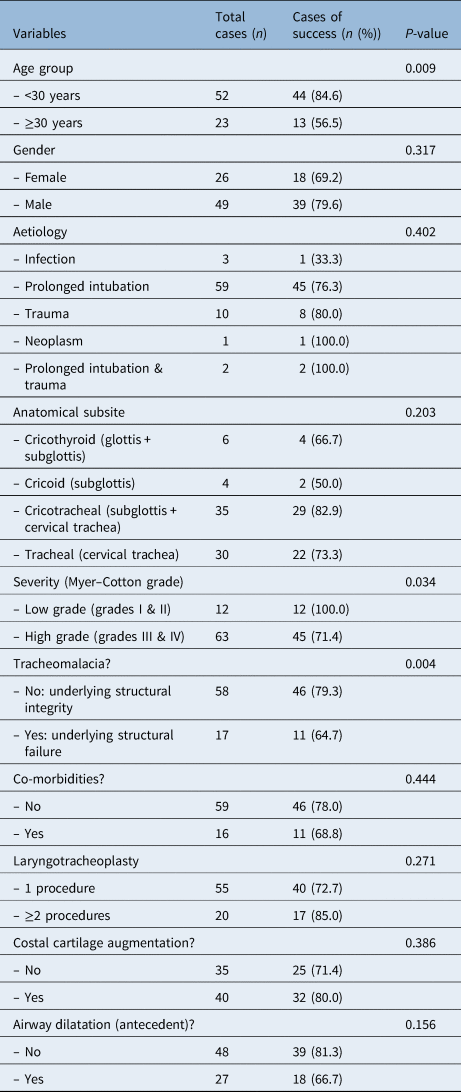
Association of covariates with successful Montgomery Safe-T-Tube stented laryngotracheoplasty*

* n = 57
Montgomery Safe-T-Tube stented laryngotracheoplasty
The following is a brief description of Montgomery Safe-T-Tube stented laryngotracheoplasty as performed at Frere Hospital. A median anterior cricoid split is fashioned, transecting the length of the stenotic tract until normal lumen is visualised both proximally and distally. An additional posterior cricoid split may be performed if the luminal diameter is insufficient to accommodate a Montgomery Safe-T-Tube, with minor excision of cicatricial tissue if possible. The airway is then fitted with a Montgomery Safe-T-Tube, bolstering the stenotic segment longitudinally, and the divided anterior wall is closed over it. If the luminal calibre is inadequate to accommodate a Montgomery Safe-T-Tube, thus preventing primary closure, an augmentation costal cartilage graft is interposed between the free edges of the anterior split. This procedure is readily reproducible in the event of restenosis.
Ethics and legal considerations
Ethical clearance was obtained from the Walter Sisulu University Higher Degrees, Biosafety and Ethics Committee, the Eastern Cape Department of Health, and the Frere Hospital Clinical Governance team. Furthermore, the study is compliant with the South African Protection of Personal Information Act 4 of 2013.
Results
Statistical analysis
The Statistical Package for Social Sciences software, version 25.0 for Windows (IBM, Armonk, New York, USA) was utilised for data analysis. Categorical data were presented using simple descriptive statistics. Categorical and continuous outcome variables were analysed using Pearson's chi-square test and student's t-test, respectively, with a p-value of ≤0.05 representing statistical significance as per convention. Furthermore, event times were determined by Kaplan–Meier regression survival analysis.
Results
Complete records were available for 75 patients (49 males and 26 females), most of whom were below the age of 30 years (69 per cent), with a mean age at first laryngotracheoplasty of 24 ± 14 years (range = 2–56 years).
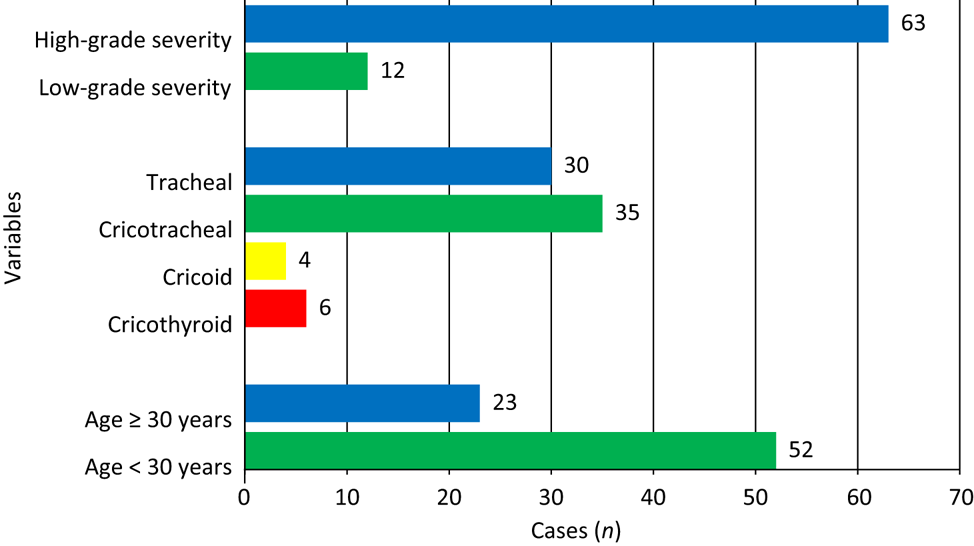
The predominant aetiology was prolonged intubation (78.7 per cent). The most commonly affected airway subsites were the tracheal (40 per cent) and cricotracheal (46.7 per cent) compartments. Most lesions were of a high-grade severity (84 per cent vs 16 per cent): grade I = 2.7 per cent, grade II = 13.3 per cent, grade III = 60 per cent and grade IV = 24 per cent (Figure 1).
Demographic and clinical profiles.

Less than one-quarter of the cohort had co-morbidities (n = 16; 21.3 per cent) (Table 1), of which human immunodeficiency virus was most prevalent (n = 6), followed by hypertension (n = 5), diabetes mellitus (n = 3), Guillain–Barré syndrome (n = 2), chronic obstructive pulmonary disease (n = 2), cerebrovascular accident (n = 1), gastroesophageal reflux disease (n = 1), asthma (n = 1) and Hashimoto's thyroiditis (n = 1).
A total of 101 laryngotracheoplasties were performed over a 20-year period (mean number of procedures per patient = 1.6 ± 0.7, range = 1–4). On average, low-grade stenoses required fewer laryngotracheoplasties (mean number of procedures = 1.2 ± 0.39) than high-grade stenoses (mean number of procedures = 1.7 ± 0.72).
Outcomes
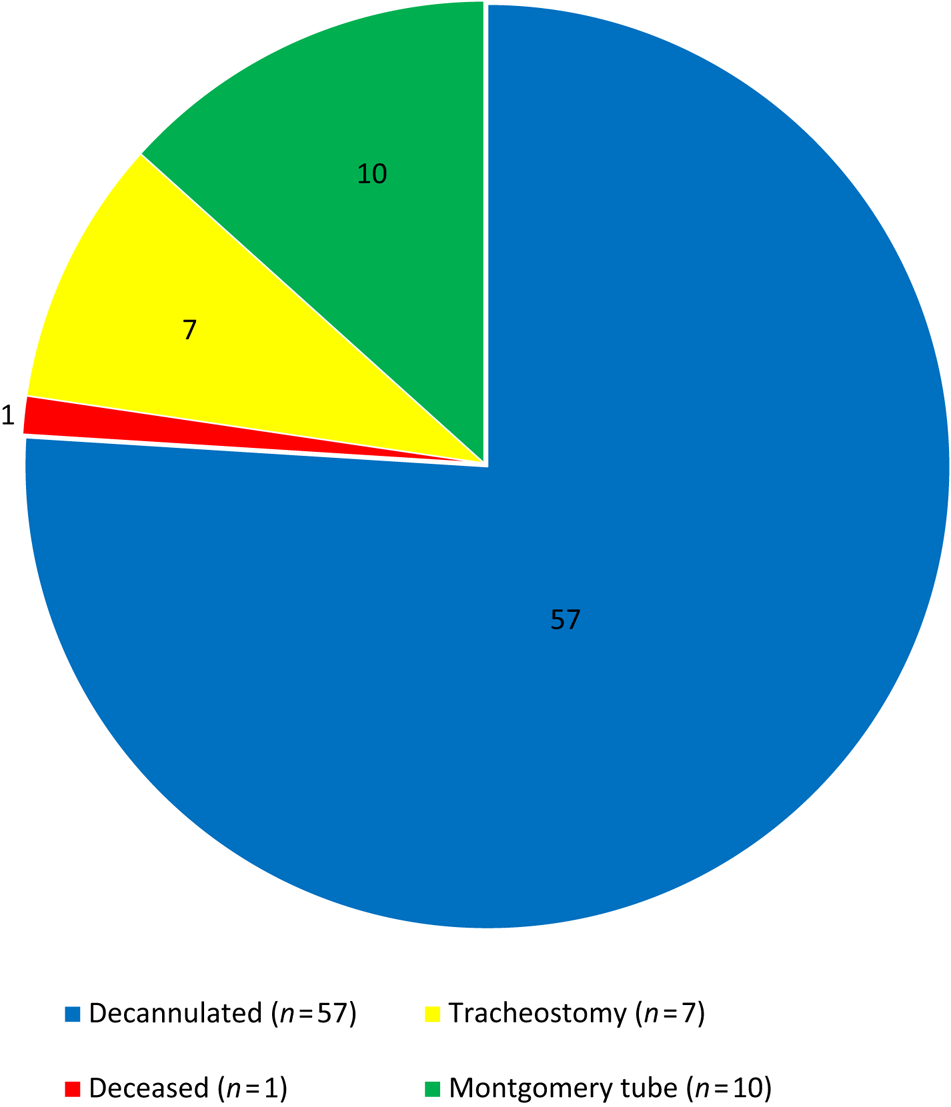
The successful decannulation rate was 76 per cent (n = 57). The remainder of the cohort was managed by permanent tracheostomy (n = 7) or remained permanently cannulated with a Montgomery Safe-T-Tube (n = 10). One patient died from respiratory compromise following decannulation (Figure 2).
Clinical outcomes (numbers of cases).

Correlates of success
Covariates significantly associated with successful Montgomery Safe-T-Tube stented laryngotracheoplasty were: patient age (p = 0.009), disease severity (p = 0.034) and airway structural status (integrity vs failure) (p = 0.004). Successful decannulation was most likely in: patients younger than 30 years (84.6 per cent vs 56.5 per cent), in low-grade stenoses (100 per cent vs 71.4 per cent) and in non-malacic airways (79.3 per cent vs 64.7 per cent). Gender (p = 0.317), aetiology (p = 0.402), anatomical subsite (p = 0.203) and co-morbidity profile (p = 0.444) were not significant covariates of success.
The majority of the cohort (73.3 per cent) underwent only one Montgomery Safe-T-Tube stented laryngotracheoplasty procedure. Although the number of stenting episodes was not significantly associated with outcome, the success rate for patients who underwent only one stenting episode was lower than that for patients who underwent two or more (72.7 per cent vs 85 per cent). Furthermore, mean stenting time (overall mean = 19.5 ± 21.4 months; range = 0.5–117 months) differed between the success (17.1 months; 95 per cent confidence interval (CI) = 11.8–22.3 months) and failure (27.2 months; 95 per cent CI = 14.8–39.7 months) groups by 10.1 months (p = 0.079). Antecedent endoscopic airway dilatation decreased the success rate from 81.3 per cent to 66.7 per cent, and costal cartilage augmentation increased it from 71.4 per cent to 80 per cent. Neither, however, was statistically significant (Table 1).
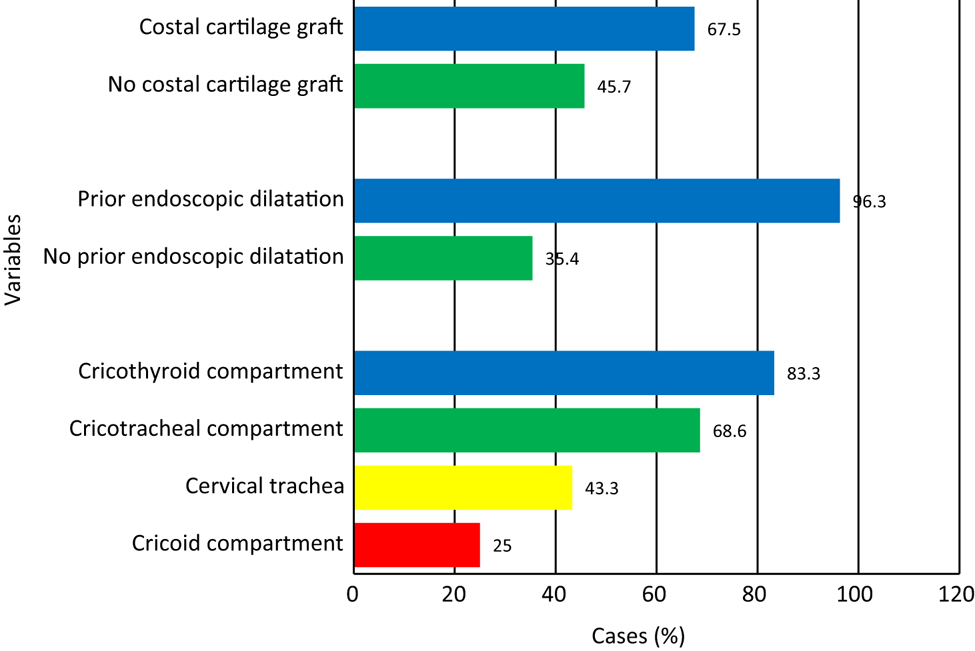
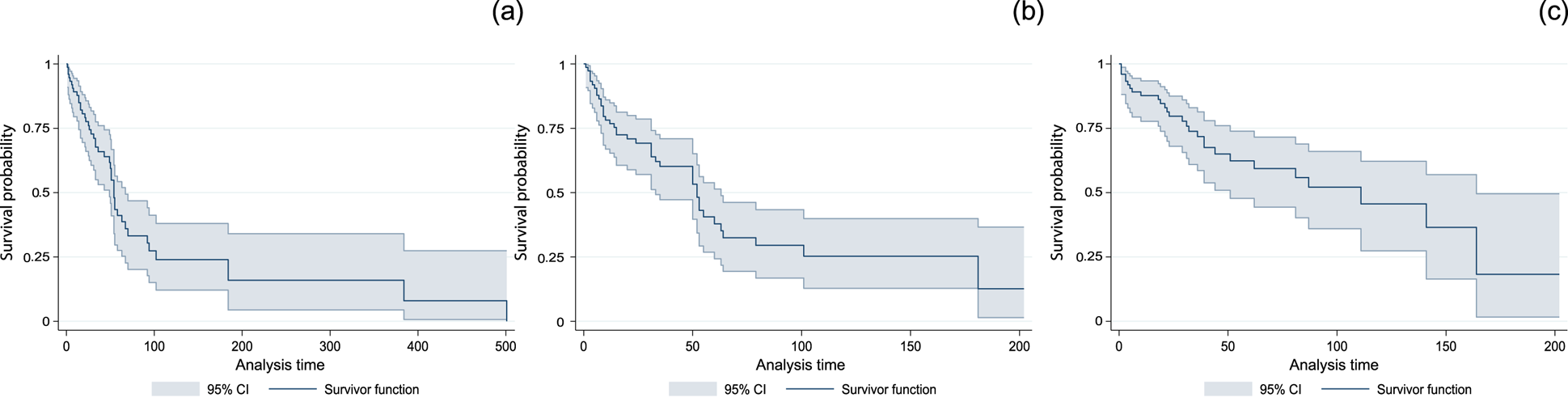
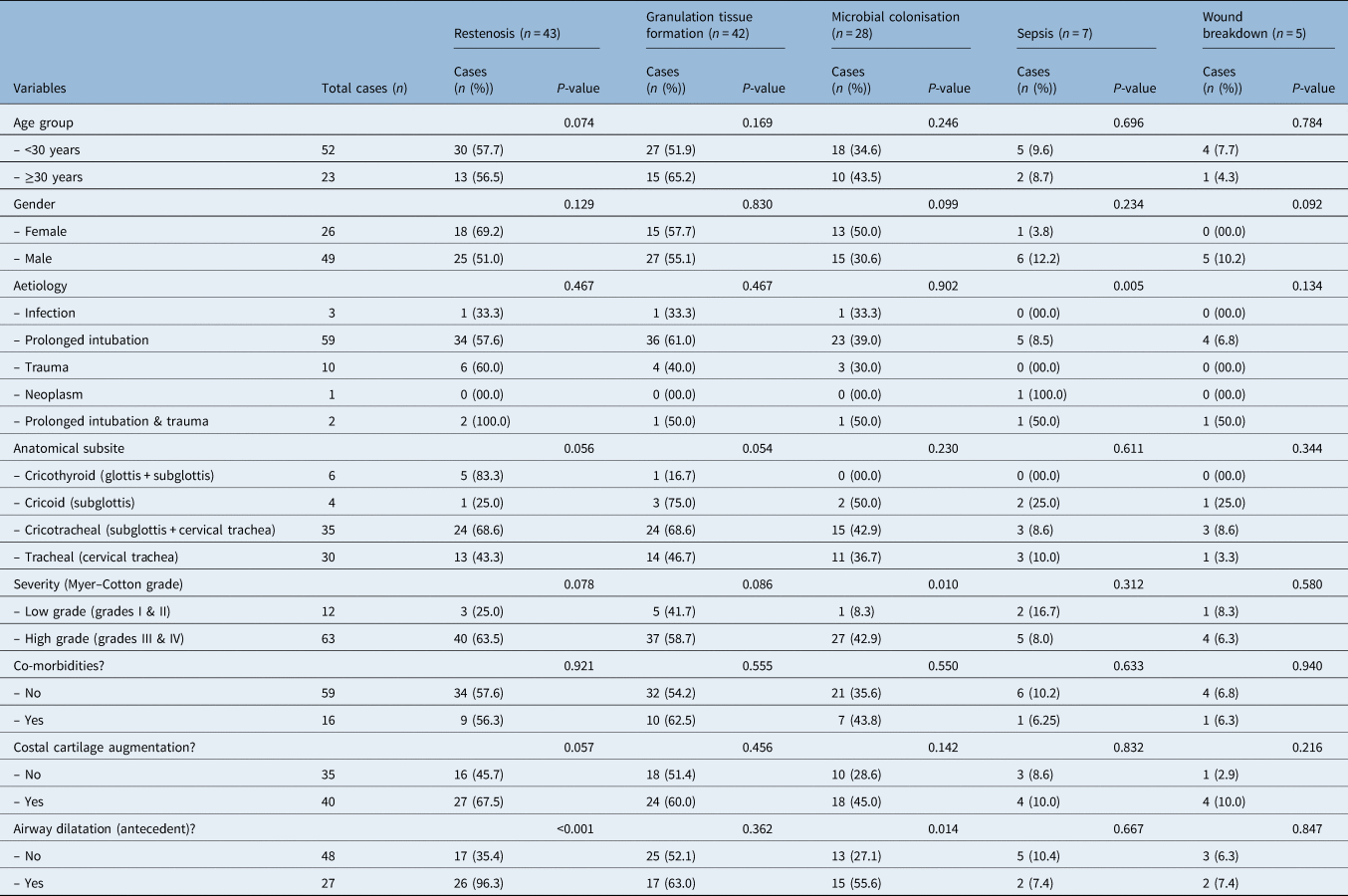
Recurrent stenosis following decannulation occurred in 43 patients (57.3 per cent). The most significant predictor of recidivism was a history of prior endoscopic airway dilatation (96.3 per cent) (p < 0.001) and, to a lesser degree, both the need for augmentation costal cartilage grafting (p = 0.057) and anatomical subsite (p = 0.056). Restenosis occurred most frequently in the cricotracheal (68.6 per cent) and the cricothyroid compartments (83.3 per cent); disease across more than one subsite hence increased lesion severity (Figure 3). Kaplan–Meier survival analysis demonstrated a median time to restenosis of 9.37 weeks (Figure 4).
Statistically significant correlates of restenosis.

Kaplan–Meier survival analyses for (a) time to restenosis, (b) granulation tissue formation and (c) microbial airway colonisation (in days). CI = confidence interval

Stent-related complications
The most common complications were granulation tissue formation (n = 42) and microbial airway colonisation (n = 28). The median time to granulation tissue formation was 7.45 weeks post Montgomery Safe-T-Tube stented laryngotracheoplasty (Figure 4), and was marginally associated with anatomical subsite (p = 0.054). The cricoid (75 per cent) and cricotracheal (68.6 per cent) compartments were most commonly affected. Microbial colonisation, which occurred on average 12.5 weeks following Montgomery Safe-T-Tube stented laryngotracheoplasty (Figure 4), was significantly associated with both antecedent endoscopic airway dilatation (p = 0.014) and disease severity (p = 0.01), demonstrating linear proportionality to Myer–Cotton gradation. Prior dilatation increased colonisation rates from 27.1 per cent to 55.6 per cent. The remaining correlations can be found in Table 2, listed according to complication.
Association of correlates with post-operative complications

Discussion
In keeping with international literature,Reference Monnier, Dikkers, Eckel, Sittel, Piazza and Campos13 the predominant aetiology of laryngotracheal stenosis in this study was prolonged intubation (n = 61; 78.7 per cent). Nonetheless, a remarkable number of stenoses were also trauma-related: either primary airway trauma or secondary airway injury following mechanical ventilation related to polytrauma. Equally remarkable was the predominance of patients younger than 30 years of age (69 per cent), with a relatively low mean age of 24 years, compared with 53 years in Gallo et al.,Reference Gallo, Pagliuca, Greco, Martellucci, Mascelli and Fusconi5 33 years in Dass et al.Reference Dass, Nagarkar, Singhal and Verma11 and 56 years in Herrington et al.Reference Herrington, Weber and Andersen14 This may be related to the male preponderance of the cohort (65.3 per cent); within the South African context, polytrauma is robustly associated with both male gender and age below 40 years.Reference Norman, Matzopoulos, Groenewald and Bradshaw15,Reference Nicol, Knowlton, Schuurman, Matzopoulos, Zargaran and Cinnamon16 Moreover, an extraordinary number of iatrogenic stenoses occurred subsequent to organophosphate ingestion (attempted suicide) (n = 13). This substratum also demonstrated the highest failure rate of all the iatrogenic stenoses (46.2 per cent; n = 13).
The difference in success rate of 28.1 per cent between age below and age above 30 years (p = 0.009) reiterates age as a correlate of success in the management of airway stenosis.Reference Gallo, Pagliuca, Greco, Martellucci, Mascelli and Fusconi5 This might be attributable to the impact of cardiovascular senescence on the endotracheal submucosal capillary plexus, which represents the sole blood supply of the cartilaginous laryngotracheal framework.Reference Grillo17,Reference Salassa, Pearson and Payne18 Airway patency relies upon the structural integrity of said cartilage, with regard to which malacic airway changes bear consideration. Tracheomalacia increases airflow resistance in accordance with both Bernoulli's principle and the Hagen–Poiseuille equation, decreasing the success rate from 79.3 per cent to 64.7 per cent (p = 0.004). Structural failure was most common amongst post-infective airways (66.7 per cent), potentially explaining the poor outcomes of this contingent. Tracheomalacia is known to exponentially worsen clinical outcomes,Reference Gelbard, Francis, Sandulache, Simmons, Donovan and Ongkasuwan3 such that moderate to severe tracheomalacia is suggested to represent a relative contraindication to laryngotracheal reconstruction.Reference Gustafson, Hartley, Liu, Link, Chadwell and Koebbe19 Of future interest may be the spirometric quantification of tracheomalacia toward severity stratification, including the determination of minimum clinically important difference values for changes in the ratio of the area under the flow–volume curve: forced vital capacity, as well as minimum clinically important difference values for total peak flow, further correlated with changes in the Medical Research Council Dyspnoea Scale.Reference Nouraei, Franco, Dowdall, Nouraei, Mills and Virk20
The difference in success rate between low- and high-grade stenoses was nearly 30 per cent (p = 0.034). The strength of correlation between lesion morphology and clinical outcome is known to be great,Reference Herrington, Weber and Andersen14,Reference Grillo, Donahue, Mathisen, Wain and Wright21,Reference Hartley, Rutter and Cotton22 independent of treatment modality.Reference Gelbard, Francis, Sandulache, Simmons, Donovan and Ongkasuwan3 With each additional percentage of luminal compromise, the odds of tracheostomy dependence have been shown to increase by 3 per cent.Reference Gelbard, Francis, Sandulache, Simmons, Donovan and Ongkasuwan3 Co-morbid illness further decreased the rate of successful decannulation from 78 per cent to 68.8 per cent. Although the small size of this contingent precluded statistical significance, chronic co-morbid disease is known to portend poor outcome in laryngotracheal stenosis.Reference Nouraei, Ghufoor, Patel, Ferguson, Howard and Sandhu23,Reference Tawfik, Houlton, Compton, Ying and Khosla24 In reference to individual co-morbidities, the Charlson Comorbidity IndexReference Hall, Ramachandran, Narayan, Jani and Vijayakumar25 has been utilised to demonstrate the strength of this correlation.Reference Gelbard, Francis, Sandulache, Simmons, Donovan and Ongkasuwan3 The Charlson Comorbidity Index may aid in identifying patients who mandate greater scrutiny vis-à-vis decannulation failure. Furthermore, there appears to be a temporal threshold, past which continued stenting not only ceases to be of additional benefit but actually becomes deleterious to outcome. The difference in mean stenting duration between success and failure groups was around 10.1 months (17.1 vs 27.2 months).
Restenosis was associated with antecedent endoscopic airway dilatation (96.3 per cent vs 35.4 per cent) (p < 0.001), which decreased the likelihood of successful decannulation from 81.3 per cent to 66.7 per cent (p = 0.156). Meta-analysis of treatment outcomes in laryngotracheal stenosis supports this observation, suggesting that open surgery is indicated if more than three dilatations are required; airway dilatation is known to upstage both the severity and the length of stenoses.Reference Monnier, Dikkers, Eckel, Sittel, Piazza and Campos13,Reference Yamamoto, Kojima, Tomiyama, Nakamura and Hayashino26 The fibrotic healing of mucosal trauma, inherent in this procedure, may serve to explain these findings.Reference Grillo17,Reference Salassa, Pearson and Payne18 Disease severity, however, could potentially confound this correlation. Both disease severity (p = 0.01) and antecedent dilatation (p = 0.014) were found to be significant covariates of microbial airway colonisation, supporting allegations that every episode of airway instrumentation introduces microbial contaminates.Reference Nouraei, Singh, Patel, Ferguson, Howard and Sandhu2 With linear proportionality, incidence rates of microbial airway colonisation rose alongside increases in Myer–Cotton gradation, such that the majority of grade IV lesions were complicated by bacterial overgrowth (66.7 per cent vs 28.1 per cent). Prior dilatation increased the risk of developing microbial colonisation from 27.1 per cent to 55.6 per cent. Microbial airway colonisation in turn predisposes to granulation tissue formation, which increases the risk of fibrotic restenosis.Reference Ward and April27 Naturally, the ensuing obstruction would be most pronounced within the confines of the unyielding circumferential cricoid cartilage. Moreover, the cricoid (75 per cent) and cricotracheal (68.6 per cent) compartments were more susceptible to granulation tissue formation than the tracheal (46.7 per cent) and cricothyroid (16.7 per cent) compartments (p = 0.054).
• The most common cause of laryngotracheal stenosis is prolonged intubation
• Laryngotracheal stenosis management is complex and technically demanding; treatment should be tailored for each case
• Immature or incipient fibro-inflammatory mucosal injuries respond well to endoscopic intervention; other cases usually require open surgical reconstruction
• Iatrogenic laryngotracheal damage prevention is of primary importance in laryngotracheal stenosis management
• This study highlights the influence of demographic and clinical profiles on laryngotracheal stenosis outcomes and treatment complications, which should inform patients’ risk-stratification
• The study also quantifies critical periods following surgery and decannulation, in which adverse events are most likely
Conclusion
This study describes the experiences of practitioners in a resource-limited setting. It reiterates the notion that clinical outcomes in laryngotracheal stenosis depend on a variety of factors that are patient-, disease- and treatment-specific.Reference Gelbard, Francis, Sandulache, Simmons, Donovan and Ongkasuwan3,Reference Nouraei, Franco, Dowdall, Nouraei, Mills and Virk20 Within this context, the study has shown that laryngotracheal stenosis is largely manageable with Montgomery Safe-T-Tube stented laryngotracheoplasty. The success rate of 76 per cent compares favourably with international studies,Reference Gallo, Pagliuca, Greco, Martellucci, Mascelli and Fusconi5,Reference Lano, Duncavage, Reinisch, Ossoff, Courey and Netterville10,Reference Liu, Lee, Huang, Cheng, Hsu and Huang28 and is acceptable when measured against a variety of therapeutic procedures.Reference Yamamoto, Kojima, Tomiyama, Nakamura and Hayashino26 Certain complications are, however, unavoidable, including: granulation tissue formation, microbial airway colonisation and varying degrees of restenosis. Clinicians should therefore monitor patients closely between the 7th and 13th weeks following both Montgomery Safe-T-Tube stented laryngotracheoplasty and decannulation.
Competing interests
None declared