1. Introduction
Dutch reuze(n)(-) is a nice example of what Denison (Reference Brinton and Traugott2001) and Aarts (Reference Aarts2007) call intersective gradience, namely, synchronic gradience between word classes. Derived from the noun reus ‘giant’, it frequently occurs as the first member of nominal and adjectival compounds such as reuzenpas ‘gigantic step’, lit. ‘giant-step’ and reuzesterk ‘as strong as a giant’, lit. ‘giant-strong’. Moreover, it can be used as an intensifying prefixoid in nominal and adjectival compounds (for example, reuzekerel ‘very nice guy, terrific chap’, lit. ‘giant-guy’; reuzeleuk ‘very nice, very funny, great’, lit. ‘giant-nice’). Even more surprising is the fact that reuze currently occurs as a free morpheme (adjective or adverb) with an intensifying function (for example, Het feestje was reuze ‘The party was great’, lit. ‘The party was giant’; Mijn zwangerschap is reuze meegevallen ‘My pregnancy turned out much better than expected’, lit. ‘My pregnancy is giant well-turned out’).
In this paper, we argue that the prefixoid use of reuze is the result of a regular grammaticalization process. The free uses of Dutch reuze, though, are not the outcome of a single diachronic lineage but the result of an interaction between two different processes: debonding on the one hand and clipping on the other. These observations are completely in line with the recently developed theory according to which lexical and grammatical changes in language often result from (the interaction between) different sources (Van de Velde, De Smet, & Ghesquière, to appear).
In what follows, we first have a closer look at the different synchronic uses of reuze(n)(-) (section 2) and investigate how they are interrelated from a diachronic point of view (section 3). In section 4, we argue that the emergence of the different free uses of reuze(n)(-) results from both debonding and clipping.
2. Synchronic Analysis
Synchronically, reus/reuze(n)- can be used in a wide range of constructions. It can act as a noun (section 2.1), a prefixoid (section 2.2), and an adjective or an adverb (section 2.3).
2.1 Reus as a Noun in N+N and N+Adj Compounds
The noun reus ‘giant’ can be used independently, as in de reus Goliath ‘the giant Goliath’, or as the first member of N+N or N+Adj compounds. In the latter case, it has a form ending in -e(n), which was originally the genitive inflection but is nowadays considered a linking morpheme between the compound members. According to the present-day Dutch spelling rules, a linking morpheme -n-, sometimes cognitively associated with a plural interpretation (see Banga et al., to appear and Hanssen et al., to appear) even if it is not pronounced, should be inserted in N+N compounds, as in 1a, but not in N+Adj compounds, as in 1b.Footnote 1
- (1)
a. reuzenlied ‘song of/about the giants’, lit. ‘giants-song’; reuzenkracht ‘enormous strength’, lit. ‘giants-strength’; reuzenrad ‘big wheel, Ferris wheel’, lit. ‘giants-wheel’; reuzenmossel ‘giant mussel’, lit. ‘giants-mussel’, etc.
b. reuzegroot ‘as big as a giant’, lit. ‘giant-big’; reuzesterk ‘as strong as a giant’, lit. ‘giant-strong’, etc.
The examples indicate that the semantics of reuze(n)- in these compounds manifests some variation. Whereas in reuzenlied ‘song of/about the giants’, reuzegroot ‘as big as a giant’, and reuzesterk ‘as strong as a giant’, the left-hand member keeps its literal lexical meaning—that is, it refers to a giant—it has a qualifying value in reuzenrad ‘big wheel, Ferris wheel’ (and not: ‘wheel of a giant’). This leads to a classifying interpretation of compounds such as reuzenmossel ‘giant mussel’: It is a specific (very big) species of mussel, not a ‘mussel of a giant’.Footnote 2 These latter meanings are most likely derived from the lexical meaning by metonymy since the prototypical property of giants is their gigantic stature: A reuzenrad, for example, is not ‘a wheel of a giant’, but it could be described as ‘a wheel as big as a giant’ because of its enormous size. The semantics of reuzen- in reuzenkracht ‘gigantic strength’ is in-between: It can either literally refer to the strength of a giant or qualify this strength as being enormous (‘strength like that of a giant’).
2.2 Reuze- as an Intensifying Prefixoid
Whereas in the compounds reuzenlied ‘song of/about the giants’, lit. ‘giants-song’ or reuzesterk ‘as strong as a giant’, lit. ‘giant-strong’ in 1 the lexical meaning of reus ‘giant’ is still available, this is not the case for the nominal compounds in 2a, nor for the adjectival compounds in 2b.
- (2)
a. reuzekerel ‘fantastic guy, terrific chap’, lit. ‘giant-guy’; reuzeblunder ‘whopping blunder’, lit. ‘giant-blunder’; reuzehonger ‘great appetite’, lit. ‘giant-appetite’; reuzespektakel ‘enormous spectacle’, lit. ‘giant-spectacle’, etc.
b. reuzeleuk ‘very nice’, lit. ‘giant-nice’; reuzehandig ‘very useful’, lit. ‘giant-useful’; reuzesaai ‘very boring’, lit. ‘giant-boring’; reuzeslim ‘very smart’, lit. ‘giant-smart’; reuzeklein ‘very small’, lit. ‘giant-small’, etc.
In these compounds, reuze- merely expresses a semantic intensification of the compound's right-hand member: It means very, enormous(ly), fantastic and not just very big.
When a morpheme looks like a part of a compound and can still be used as a lexeme (in the present case, reus ‘giant’), but expresses a more general and abstract value (in the present case, an intensifying value) within the compound, it is referred to as an affixoid (Booij Reference Banga, Hanssen, Neijt and Schreuder2009:208). Drawing on Stevens (Reference Norde2005:73) and Leuschner (Reference Lehmann2010:865–866), we can add the following criteria for “affixoid-hood:” Affixoids are usually very productive (see also Meesters Reference Leuschner, Dammel, Kürsner and Nübling2004 on the serial productivity of Dutch affixoids), which is the case of Dutch reuze- as illustrated by 2; they do not express grammatical relations, and are generally in competition or in complementary distribution with true affixes (for example, reuzeleuk/ superleuk/megaleuk ‘very nice’). According to these criteria, reuze- can be considered an intensifying prefixoid in the examples in 2.
Since Dutch compounds generally have fore-stress and Dutch prefixes are not necessarily stressed, it could be hypothesized that affixoids may undergo loss of stress (see Van Goethem Reference Van de Velde, De Smet and Ghesquière2008). However, as Booij (Reference Amiot and Van Goethem2005:117) observes, affixoids are generally not characterized by phonological weakening. This is especially true about intensifying prefixoids, which are always stressed in Dutch.Footnote 3 This implies that the distinction between the compounds in 1, where reuze(n)- should still qualify as a noun, and the word formations in 2, where reuze- acts as an intensifying prefixoid, should essentially be made on semantic grounds. As a matter of fact, in contrast to the compounds in 1, the semantics of the nominal compounds in 2a and the adjectival compounds in 2b can generally not be described by referring to a giant: reuzeleuk does not mean ‘as nice as a giant’ and a reuzeblunder is not ‘a blunder (as one) of a giant’. This clearly indicates the semantic specialization of the prefixoid reuze-. However, the borderline is not always so well defined, as evidenced by reuzehonger, which means ‘great appetite’, but could still be interpreted as ‘an appetite like that of a giant’.
Finally, it should be observed that according to the modern Dutch spelling rules, the linking morpheme -n-, typical of N+N compounds, should be deleted when reuze- (and comparable elements such as klasse- lit. ‘class’ in klassespeler ‘first-class player’, lit. ‘class-player’ and bere- ‘bear’ in berehonger ‘great appetite’, lit. ‘bear-appetite’) is no longer recognized as a noun but has developed an intensifying value.Footnote 4
2.3 Reuze as an Adjective and Adverb
It is noteworthy that reuze can also be used as a free morpheme, namely, an adjective or an adverb, while preserving its linking morpheme -e- and its intensifying meaning, both typical of its bound use as a prefixoid (see section 2.2).Footnote 5 In order to illustrate, classify, and quantify the relative frequencies of these uses, we took a sample of 100 occurrences of the free morpheme reuze from the (Belgian and Dutch) news archives on news.google.com, all published during the period between June 18 and July 18, 2011. In 77% of these examples, reuze is used adverbially, mostly with scope over adjectives (49%), as shown in 3, although it can also have scope over verbs or verbal expressions (28%), as shown in 4.
- (3)
a. Mijn zoontje en ik hebben een reuze leuke middag gehad!
‘My son and I had a great afternoon!’ (lit. ‘a giant nice afternoon’)
b. De inwoners moeten dus behalve voor de vuilnisbak ruimte zoeken voor de gele vuilniszakken, en dat vinden ze reuze onhandig.
‘So the residents not only have to find a place for the garbage can but also for the yellow rubbish bags and they think that is very impractical.’ (lit. ‘giant impractical’)
- (4)
a. Eerst riepen frisse papa-ministers als Wouter Bos en Camiel Eurlings dat het allemaal reuze mee zou vallen en in de VS zou blijven en bovendien tot de huizenmarkt beperkt zou blijven.
‘Newly turned papa-ministers such as Wouter Bos and Camiel Eurlings first shouted that it would all turn out much better than expected (lit. ‘that it all giant would turn out’) and would stay in the U.S. and moreover would be limited to the housing market.’
b. Om uiteenlopende redenen regende het afzeggingen, maar de vijf mensen die wél meededen aan de 18 kilometer lange scootmobieltocht in Terneuzen en omgeving hadden het gistermiddag reuze naar hun zin.
‘Because of various reasons cancellations poured in, but the five people who did participate in the scooter trip of 18 kilometers in Terneuzen and the surrounding area enjoyed it very much yesterday afternoon.’ (lit. ‘had it giant to their liking’)
In the remaining 23% of the examined cases, reuze is used adjectivally, in which case its attributive use (22%) in 5 is much more common than the predicative one (1%) in 6.
- (5)
a. De uitbreiding van de electorale faciliteiten tot heel Vlaanderen, via de unitaire kieskring, is een reuze stap achteruit.
‘The extension of the electoral facilities to the whole of Flanders, via the unitary electoral district, is a giant step backwards.’
b. Vanavond is er als extra attractie een reuze vuurwerkspektakel.
‘Tonight there will be a giant firework show as an additional attraction.’
c. De binnenstad staat immers op een reuze betonnen plaat van 12 ha tussen twee heuvelruggen, waaronder alle gemotoriseerd verkeer moet parkeren zodat het ganse centrum overdag een grote voetgangerszone is.
‘The town center is indeed built on a gigantic slab of concrete (lit. ‘giant concrete sheet’) of 12 ha between two ranges of hills, under which all motorized traffic has to park so that the entire center is a large pedestrian zone by day.’
(6) Ik heb het één keer mogen meemaken en dat was reuze!
‘I had the luck to experience it once and that was great!’
(lit. ‘giant’)
Reuze is not an isolated case of an intensifying prefixoid that has developed free uses; other examples are given in 7 (see Van Goethem & De Smet, to appear).
- (7)
a. Verouderd hotel, maar top sfeertje hier! (NLCOW2012)
‘Old-fashioned hotel, but great atmosphere here!’ (lit. ‘top atmosphere’)
b. Je bent echt kei getalenteerd. (NLCOW2012)
‘You are really very talented.’ (lit. ‘boulder talented’)
c. Ketnet is bere bere bere. (WebCorp 2012)
‘Ketnet is fun, fun, fun.’ (lit. ‘Ketnet is bear, bear, bear.)
d. De wijn eindigt met een lange, elegante afdronk. Te vergelijken met een échte klasse Champagne. (WebCorp 2012)
‘The wine rounds off with a long, elegant aftertaste. Comparable to a true first-class champagne.’ (lit. ‘class’)
Before investigating the diachronic developments of the free uses of Dutch reuze (section 3), we want to discuss some important observations concerning the status and spelling of reuze in Modern Dutch.
2.4. Some Observations on the Synchronic Uses
The status of these free (adverbial and adjectival) uses, as well as their relation to the morphological use of reuze(n)-, deserves some special attention. In particular, in what follows we comment on (i) the existing spelling variations, and (ii) on the possible influence of readability on the spelling of complex expressions with reuze.
First, the spelling of complex expressions with reuze(n)(-) is subject to considerable variation and ambiguity, which signals that the language user does not have clear intuitions about the grammatical status of reuze. For instance, reuze is separated from stap ‘step’ in example 5a, suggesting that it is used as an attributive adjective. It can also be joined to the noun, with or without a linking morpheme -n- (reuzenstap, reuzestap ‘giant(s) step’), in which case the spelling is symptomatic of its status as noun or prefixoid, respectively (see sections 2.1 and 2.2). Semantically, however, all of the three spelling patterns convey similar meanings, as shown by the web examples in 8, where reuze()(n)stap ‘giant(s) step’ is used in the same syntactic construction (een reuze()(n)stap vooruit ‘a giant step forward’) within comparable semantic contexts.
- (8)
a. De komst van de endoscoop betekende al een reuze stap vooruit in de chirurgie.Footnote 6
‘The invention of the endoscope already meant a giantstep forward in surgery.’
b. De overname van Mannesmann (…) door Vodafone Airtouch bracht draadloze communicatie een reuzestap vooruit.Footnote 7
‘The takeover of Mannesmann by Vodafone Airtouch put wireless communication a giant step ahead.’
c. Pilletje tegen jetlag! Een nieuwe sensationele doorbraak, een reuzenstap vooruit in de medische wereld!Footnote 8
‘A pill against jetlag! A new sensational breakthrough, a giant step forward in the medical world!’
A second observation concerning the different synchronic uses of reuze is that it often appears separately when combined with “complex” compounds (namely, compounds with more than two members), such as vuurwerkspektakel ‘firework show’ in 5b or (lexicalized) noun phrases, such as betonnen plaat ‘slab of concrete’ in 5c. As a matter of fact, since 14 out of the 22 examples (63.6%) of attributive reuze in our synchronic data set exemplify this phenomenon, it is very probable that this separation is motivated by a concern for the readability of these complex expressions. A similar motivation could be involved in example 3b: It seems that reuze is often separated from adjectives beginning with a vowel to avoid readability problems caused by a vowel clash (for example, reuzeonhandig ‘very impractical’, lit. ‘giant-impractical’). Thus, it might be argued that the free uses of reuze are, in fact, just instances of the prefixoid (written separately), not only on semantic grounds (similar intensifying value), but also on formal grounds.
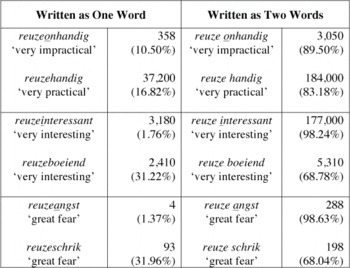
Table 1 (below) presents the number of hits of a Google search from January 25, 2012 for the different spellings of reuze combined with adjectives and nouns with and without an initial vowel. In order to avoid semantic interference, a selection was made of closely related adjectives and nouns, with synonymous (interessant/boeiend ‘interesting’; angst/ schrik ‘fear’) and antonymous (onhandig ‘impractical’/handig ‘practical’) meanings. The results indicate a general strong preference for splitting, which is even stronger in the case of a possible vowel clash.
Although the readability factor should, without any doubt, be taken into consideration when explaining the rise of the free uses, it does not account for the fact that separation also frequently occurs when reuze precedes nouns or adjectives beginning with a consonant (see example 3a and the examples reuze handig ‘very practical’, reuze boeiend ‘very interesting’ and reuze schrik ‘great fear’ in table 1). Similarly, the readability factor does not account for the fact that adverbial reuze can have scope not only over adjectives but also over verbs and verbal expressions, as in 4. In contrast, prefixoid reuze can only have scope over adjectives and (to a lesser extent) over nouns. In addition, as an adjective, reuze can be used not only attributively but also predicatively, as in 6. The adverbial use with scope over a verb or verbal expression and the predicative adjectival use are not (directly) reminiscent of the prefixoid use, which clearly suggests that reuze is used as a true adverb and adjective.
Spelling in case of vowel clash.

Another argument can be found in example 5c, where reuze has scope over the noun phrase betonnen plaat ‘slab of concrete’. Even if Dutch prefixoids can combine with complex compounds (for example, hoofdverblijfplaats ‘main residence’, lit. ‘head-residence-place’), they, unlike Dutch adjectives, cannot have scope over entire (lexicalized) phrases. Compare, for example, belangrijke economische sector ‘important economic sector’ with *hoofd economische sector lit. ‘head economic sector’ or *sleutel economische sector lit. ‘key economic sector’, even though the literal English translation is unproblematic.Footnote 9 Therefore, reuze should be considered a true adjective in cases such as 5c, and not just a prefixoid, written separately for reasons of readability.
3. Diachronic Analysis
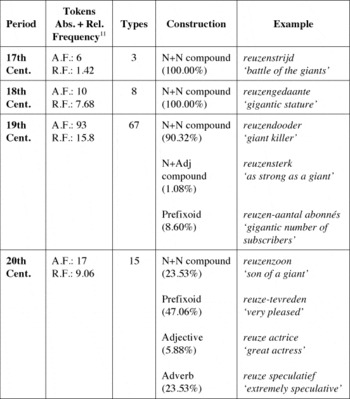
In this section, we present a diachronic analysis that establishes how the different synchronic uses of reuze(n)(-) are historically related and when they emerged. This diachronic study is crucially founded on the data from the Dutch historical dictionary Woordenboek der Nederlandsche Taal (WNT), which provides a detailed description of the different uses of reuze(n)(-), distinguishing between a nominal use (reusI) and a use as a so-called prefix (reuze-I) on the one hand and a use as an adjective, adverb, and interjection (reuzeII) on the other hand. This lexicographic analysis has been completed by a diachronic corpus study based on an extensive database of Dutch historical literature (Digitale Bibliotheek voor de Nederlandse Letteren, Reference Van GoethemDBNL).Footnote 10Table 2 (next page) summarizes the results of the corpus analysis conducted on the basis of the Reference Van GoethemDBNL corpus.
In the following sections, we discuss the emergence of the nominal and adjectival compounds beginning with reuze(n)- (section 3.1), the intensifying prefixoid reuze- (section 3.2), and its free adjectival, adverbial, and interjectional uses (section 3.3).
Results of the diachronic corpus analysis (Reference Van GoethemDBNL corpus).

3.1 Reuze(n)- in N+N and N+Adj Compounds (from the 17th Century On)
From table 2 and the data provided by the WNT, it can be derived that from the 17th until the 18th century, reuze(n)- only occurred as the left-hand member of N+N compounds, as shown in 9. In these first occurrences, reus/ze(n)- always referred to a creature of gigantic stature (literal lexical meaning).
- (9)
a. De blyschap kort den tyt, godinnen scheppen goden. Een reuzenafkomst trotst het hemelsch gezagh.
(J. van den Vondel 11, 31 [1667])
‘Gladness shortens time, goddesses create gods. Descent from the giants (lit. ‘giant-descent’) defies the celestial authority.’
b. De strijd van ‘t Reuzerot tegen den dondergod Jupijn is die van Lucifer tegen God. (J. van den Vondel, Hekeldichten, [1682])Footnote 12
‘The battle of the race of giants (lit. ‘giant-race’) against the god of thunder Jupiter is the one of Lucifer against God.’
c. Reeds sliepen de windjes, en het geboomte (…) was met eene reuzengedaante in den stillen vloed geschilderd.
(E.M. Post, Het land, in brieven, [1787])
‘Already were the winds sleeping, and the trees (…) were painted with a gigantic stature (lit. ‘giant-stature’) in the silent tide.’
From the 19th century on, these N+N compounds become particularly productive and a semantic shift occurs: The left-hand member of the compound acquires a qualifying value (very big, gigantic, great). This gradual metonymic transition manifests itself in the WNT’s semantic description of a compound such as reuzenkind (lit. ‘giant child’): Kind van een reus (Halma [1710]) en vand. groot en zwaar kind (Kuipers [1901]) ‘child of a giant (Halma [1710]) and hence big and heavy child (Kuipers [1901])]’ (WNT, s.v. reusI).Footnote 13Reuzenarm lit. ‘giant arm’ also combines the literal and the qualifying meaning: In addition to the meaning arm (als) van een reus ‘arm (like that) of a giant’ (WNT, s.v. reusI) exemplified in 10a, the WNT dictionary mentions as a second meaning zeer grote arm ‘very big arm’ (WNT, s.v. reusI) given in 10b.
- (10)
a. Een ander menschensoort (…) Sterke schouders, reuzenarmen, schraagden ‘t mateloos geweld. (D.J. Lennep 235 [1823])
‘Another human race (…) Strong shoulders, giant arms, supported the immense violence.’
b. Zij (Maria) wenkt: de krijg valt stil; zij komt heur stad beschermen, Die voor heur altaar bad, en ‘t steunde in reuzenarmen. (V. Ackere, Winterbl. 318 [1868])
‘She (Mary) beckons: the war stops; she comes to protect her city, which prayed for her altar and supported it with gigantic arms.’ (lit. ‘giant-arms’)
According to the diachronic information provided by the WNT, all compounds that combine both meanings developed the literal lexical meaning before the qualifying one. For instance, in the case of reuzen-bed, lit. ‘giant bed’, the meaning grafheuvel (=bed (als) van een reus) ‘sepulchral mound, tumulus’ (=‘bed (like that) of a giant’) (WNT, s.v. reusI) in 11a precedes the qualifying value zeer groot bed ‘very big bed’ (WNT, s.v. reusI) in 11b.
- (11)
a. Hoedaenighe verheevene graven, (…), ende by de inzaeten reusen-bedden genoemd.
(V. Slichtenhorst, Geld. Gesch. 1, 78 a [1654])
‘Such elevated tombs, (…), called giant beds by the inhabitants.’
b. Ik had ‘t over de dilligence, dat is dat reuzebed van boven.
(Naeff, Veulen 140 [1903])
‘I was talking about the stage coach, that is that giant bed from upstairs.’
In a final step of the semantic change, a number of 19th and 20th century's compounds are found, where only the derived qualifying value remains. A reuzenkunstenaar ‘giant artist’ in 12, for example, refers to a very important and very big artist, and conveys a metaphorical qualifying meaning, in which the original meaning referring to a giant is no longer available.
(12) Drie eeuwen zijn er thans in ‘t ruim des tijds vervlogen Sinds Vlaandren aan Europe een reuzenkunstnaar schonk (betr. Rubens). (J. V. Rijswijck Jr. 1, 11 [1877])
‘Three centuries have passed now in the space of time since Flanders donated a giant artist to Europe (about Rubens).’
In addition to this qualifying value, a classifying interpretation emerges from the second half of the 19th century on. When combined with names of animals, plants, and fruits, as in 13, compounds with reuze(n)- refer to species and varieties of very big dimensions.
- (13)
a. De schelp van de reuzenmossel is somtijds vijf voet breed, en wordt van 400 tot 500 pond zwaar.
(Alb. d. Nat. 1859, 1, 32 [1859])
‘The shell of a giant mussel is sometimes 5 feet wide, and can weigh from 400 to 500 pounds.’
b. Reuzenpopulieren, die hun donkere kruinen, hoog in den blauwen sterrennacht, over de stille daakjes uitspreidden.
(Buysse, Rozeke 1,6 [1905])
‘Giant poplars, which spread their dark crowns, high in the blue starry night, over the small silent roofs.’
During the 19th century, reuze(n)- also appears in adjectival compounds, even if they are very rare: The extensive list of compounds included in the WNT article on the nominal use of reus (s.v. reusI) only contains two adjectival compounds beginning with reuze-: reuzesterk ‘as strong as a giant’, lit. ‘giant-strong’ in 14a and reuzegroot ‘as big as a giant’, lit. ‘giant-big’ in 14b; reuzensterk is the only attested N+Adj compound in the Reference Van GoethemDBNL corpus.
- (14)
a. Hij is reuzesterk, il est d'une force de géant, il est prodigieusement fort.’ (Kramers, Ned.-Fr. wdb. 1178a [1862])
‘He is as strong as a giant (lit. ‘giant-strong’), he has the strength of a giant, he is extremely strong.’
b. Twei komkommers feur vaàf sint! … een concurrent … riep met een kermisdrift in zijn aanprijzing: Reùzegraut! … reùzegraut! … ik geif d'r drie feur ‘n stuyfer.
(Querido, Jordaan 1, 320 [1912])
‘Two cucumbers for five cents! … a competitor … shouted with a temper as if he were at the Fair: as big as giants! … as big as giants (lit. ‘giant-big’)! … I give three of them for a penny.’
It can be concluded that the compounds beginning with reuze(n)- have been subject to a gradual semantic shift in the course of time. The 19th century appears to be a transitional period between the original lexical meaning involving reference to giants, and the derived metonymical value very big, great, which since then becomes more productive, in a qualifying or classifying sense. At the end of the 19th and the beginning of the 20th century, the original meaning of reus with a literal reference to giants becomes less available. In this respect, the example in 14a, in which the WNT quotes a bilingual Dutch-French dictionary (Kramerswi 1862), deserves further attention. The example provides two different French translations for the sentence Hij is reuzesterk lit. ‘He is giant-strong’. The first one is literal: Il est d'une force de géant ‘He has the strength of a giant’. The second one suggests a more recently acquired intensifying value: Il est prodigieusement fort ‘He is extremely strong’, with the use of reuze as a prefixoid grounded.
3.2. Reuze- as a Prefixoid (19th Century)
By the middle of the 19th century the compounds with reuze(n)- seem to give rise to a new use as an intensifying prefixoid meaning very, great, enormous(ly). The WNT dictionary nevertheless admits that the formal and semantic boundaries between the nominal, the prefixoid, and even the adjectival use (see section 3.3) are not always obvious. However, when reuze- can no longer be associated with the notion of a giant (a mythological character, a very tall man), it should no longer be analyzed as a noun (WNT, s.v. reuze-I).
According to the WNT (s.v. reuze-I), this prefixoid gains in productivity from the beginning of the 20th century on, which is corroborated by our Reference Van GoethemDBNL corpus analysis: While this prefixoid use remains marginal up to the 19th century (8.60%), it becomes the most frequent one in the 20th century's subcorpus (47.06%).
Already at the beginning of the 20th century, the intensifying prefixoid reuze- (with various spellings) combines with nominal heads, as in 15a,b, and with adjectival heads, as in 15c,d.
- (15)
a. Kol. Bulders (oordeelde) Hindenburg een reuzenflater begaan door de doorbraak te proberen bij St. Quentin.
(Goerée d'Overfl., Dagb. 48 [1918])
‘Colonel Bulders (judged) that Hindenbrug had committed a major blunder (lit. ‘giant-blunder’) by forcing the breakthrough at St. Quentin.’
b. Je trouwt wel … Volgend jaar al misschien. En je krijgt ‘n reuze-cadeau van me, als je nou maar opschiet.
(Cissy V. Marxveldt, J. ter Heul 2, 8 [1921])
‘You will marry once … Maybe already next year. And you will get a huge present (lit. ‘giant-present’), if you just hurry now.’
c. We hadden een reuze-leuke koffietafel.
(Cissy V. Marxveldt, J. ter Heul 2, 73 [1921])
‘We had a very fun (lit. ‘giant-funny’) coffee lunch.’
d. Hij verdient een shilling per dag, maar is dan ook ‘ketier mabsout’, gij zoudt zeggen: reuze-tevreden.
(J.I. de Haan, Jerusalem, [1921])
‘He earns a shilling a day, but then he is “ketier mabsout”, you would say: tremendously happy.’ (lit. ‘giant-satisfied’)
As the next step, this intensifying prefixoid gains autonomy and develops into a free morpheme (adjective, adverb, or interjection).
3.3. Reuze as Adjective, Adverb, and Interjection (20th Century)
The WNT dictionary (s.v. reuzeII) distinguishes three autonomous uses of reuze, which originate from its bound use by a so-called process of isolation. The dictionary supposes that the adjectival and adverbial uses shown in 16a and 16b, respectively, have preceded its use as an interjection shown in 16c.Footnote 14 In all three cases, reuze preserves the intensifying meaning (as well as the linking morpheme -e-) from its corresponding prefixoid. The meaning of the free morpheme reuze is described as follows: “als superlatief gekleurd woord dat iets als zeer groot of zeer goed in zijn soort qualificeert. Te vergelijken met woorden als geweldig, fantastisch, enorm, verschrikkelijk, akelig (netjes), bliksemsch (goed) e.d.” (WNT, s.v. reuze II).Footnote 15
- (16)
a. Reuze boffer, reuze lol, reuze boer, reuze gek, reuze uitvinding, (…) (V. Ginneken, Handb. 1, 509 [1913])
‘Great luck (lit. ‘giant luck’), great fun (lit. ‘giant fun’), great farmer (lit. ‘giant farmer’), great fool (lit. ‘giant fool’), great invention (lit. ‘giant invention’) (…)’
b. Een gelegenheids-eenacter voor de H.B.S.-fuif … of andere hoogtijden, die meestal ‘reuze’ insloeg en ‘t uitmuntend ‘deed’.
(Masker 1, 184 [1921])
‘A one-act play for a special occasion at the H.B.S. party … or other feasts, which usually scored greatly (lit. ‘which usually giant stroke’) and did an excellent job.’
c. N’ smoel, man! reuze! (Ginneken, Handb. 1, 509 [1913])
‘What a face, man! Great!’ (lit. ‘giant’)
The Reference Van GoethemDBNL corpus analysis also corroborates the emergence of the adjectival, as in 17a, and adverbial, as in 17b, uses in the course of the 20th century, even though the small number of occurrences did not allow us to examine their specific diachronic developments in more detail.
- (17)
a. Delphine Seyrig heb ik zelf nooit ontmoet. Ik heb veel sympathie voor die vrouw, en ik vind het een reuze actrice.
(W.M. Roggeman, Beroepsgeheim (6), [1987])
‘I have never met Delphine Seyrig myself. I have a lot of sympathy for this woman, and I think she is a great actress.’
(lit. ‘giant actress’)
b. Het beste kun je natuurlijk in je slaap sterven, zoals Simon. Die heeft het wat dat betreft reuze getroffen.
(P. Piryns, Er is nog zoveel ongezegd.
Vraaggesprekken met schrijvers, [1987])
‘The best thing is of course dying in your sleep, like Simon. In that respect, he was very lucky.’ (lit. ‘he has struck it giant’)
It can, however, be assumed that the attributive use of reuze has preceded its predicative and interjectional uses, the latter probably being derived from the former, as in (het is/was) reuze! ‘(it is/was) great!’, given that attributive uses already sporadically occur by the middle of the 19th century in the historical news archives of the Royal Library (Reference Van Goethem and De SmetKB), as illustrated by example 18.
(18) (…) als men vergelijkender wijze betracht, welke reuze schreden de werktuigkunde, het fabriekwezen en andere kunsten en wetenschappen in deze eeuw hebben gemaakt. (Reference Van Goethem and De SmetKB, 1852)
‘(…) if it is observed, by way of comparison, which gigantic steps (lit. ‘giant steps’) have been taken during this century by mechanics, industry and other arts and sciences.’
From the discussion above it can be concluded that over time, reus/reuze(n)(-) has developed a wide range of uses, and that the semantic and formal differences among all these uses are not always easy to define. Hence, we support the existence of a continuum, along which nominal, semiprefixal, adjectival, and adverbial uses are placed, with the synchronic uses reflecting the different stages of a gradual diachronic evolution of reuze(n)-, in line with Hopper's (Reference Hanssen, Banga, Schreuder and Neijt1991) idea of layering.
In the next section, we argue that the transition from one type of use to another does not happen by way of a linear diachronic change; instead, it involves multiple paths, which supports the idea of multiple source constructions (Van de Velde et al., to appear).
4. A Multiple Paths Account
The transition from noun (as a left-hand member of compounds) to prefixoid has been proved to be mainly a semantic development—that is, a semantic shift from the lexical meaning giant to a metonymically derived qualifying/classifying value very big, and finally to an intensifying function very, great(ly), enormous(ly). In contrast, the evolution from the prefixoid to the adjective and the adverb is essentially a formal, morphosyntactic process as it implies increased autonomy of reuze that activates its intensifying value in new syntactic environments. Given this, we propose that these two paths of development represent different processes. The former can be considered a case of grammaticalization (section 4.1). The latter—the emergence of the free uses, considered as a case of “isolation” by the WNT (see section 3.3)—is shown to involve two distinct processes, namely, debonding and clipping (section 4.2).
4.1. From Noun to Prefixoid: A Case of Grammaticalization
The transition from the noun reus/reuze(n)- to the prefixoid reuze- implies a metonymical shift from a lexeme with a concrete, lexical meaning to a morpheme with an abstract, intensifying value and could be analyzed as a case of desemanticization, typically involved in grammaticalization processes. Although we acknowledge that not all authors treat affixes and/or affixoids as resulting from grammaticalization, we follow Norde (Reference Lightfoot2009:15) in distinguishing between the affix(oid) itself brought about by grammaticalization and the derived word created by word formation or (subsequent) lexicalization in the case of nontransparent word formation.Footnote 16
Previous studies have already suggested that Dutch intensifying prefixoids such as bloed- in bloedserieus ‘very serious’, lit. ‘blood-serious’ and bere- in beregezellig ‘very cozy’, lit. ‘bearcozy’ are the results of grammaticalization (Booij Reference Booij, Dressler, Kastovsky, Pfeiffer and Rainer2010; Van Goethem Reference Van de Velde, De Smet and Ghesquière2008, Reference Van de Velde, Weerman, Sleeman, Van de Velde and Perridon2010, Reference Van Goethem2011). Booij (Reference Booij, Dressler, Kastovsky, Pfeiffer and Rainer2010:58), for instance, explicitly states the following:
[w]e can consider these changes in the meaning of “bound lexemes” as being cases of grammaticalization (Hopper and Traugott Reference Himmelmann, Bisang, Himmelmann and Wiemer2003; Ramat Reference Meesters2001) since these prefixoids have lost their original lexical meaning more or less, and have acquired a more general and abstract meaning of intensification. However, this does not mean that the lexical meaning of these prefixoids has become completely irrelevant (…): there are cases in which the lexical meaning is still relevant, a phenomenon referred to as “persistence” (Hopper Reference Hanssen, Banga, Schreuder and Neijt1991).
Besides desemanticization, other grammaticalization phenomena are involved in this process. Stevens (Reference Norde2005) demonstrates convincingly how changes that typically characterize grammaticalization as defined in Hopper Reference Hanssen, Banga, Schreuder and Neijt1991:22–31 and Hopper & Traugott Reference Himmelmann, Bisang, Himmelmann and Wiemer2003:99–106, 122–124, 172–174 trigger the emergence of affixoids, and, more interestingly, of German Riesen-, a counterpart of Dutch reuze, as in Riesenkrach ‘flaming row, infernal racket’, lit. ‘giant-row’. Just like Riesen-, Dutch reuze- is subject to layering (it competes with other intensifiers); it has undergone divergence with respect to its root reus, while its original meaning still persists (reuzegroot ‘as big as a giant’); it has been decategorialized (it is no longer a noun and therefore cannot have a plural form, as in *reuzenleuk lit. ‘giants-fun’). Stevens (Reference Norde2005:78) also indicates that affixoids meet almost all of the criteria for “strong” grammaticalization advanced by Lehmann (Reference Hopper, Traugott and Heine1985, Reference Hopper and Traugott1995): They undergo attrition (loss of semantic features by developing a more abstract, intensifying meaning), paradigmaticization (in casu, integration into the paradigm of intensifiers), condensation, or scope reduction (as a prefixoid, reuze- has become a modifier of a stem), coalescence (increase in bondedness) and fixation (occurrence in a fixed slot). Stevens (Reference Norde2005:78) concludes that “affixoids are more grammaticalized than roots, and affixes are more grammaticalized than affixoids.”
4.2. From Prefixoid to Adjective and Adverb: Debonding and Clipping
The other type of transition—the one from a prefixoid to an adjective and an adverb—implies an increase in the autonomy of reuze and is diametrically opposed to grammaticalization. It does not involve further desemanticization; instead, reuze preserves its intensifying value. Reuze does not undergo further decategorialization but is instead assigned to new lexical categories (adjective and adverb). Finally, the scope and syntactic autonomy of reuze increase rather than decrease.
All these properties are typical of degrammaticalization, that is, “a composite change whereby a gram in a specific context gains in autonomy or substance on more than one linguistic level (semantics, morphology, syntax, or phonology)” (Norde Reference Lightfoot2009:120). More specifically, the shift from prefixoid to adjective and adverb could be seen as a particular case of debonding, defined by Norde (Reference Lightfoot2009:186) as “a composite change whereby a bound morpheme in a specific linguistic context becomes a free morpheme.” Debonding is typically marked by severance (evolution of a bound morpheme to a free morpheme), re-categorialization, scope expansion, and flexibilization (increase of syntactic freedom), which all apply to the emergence of the adjectival and adverbial uses out of the prefixoid.
Our diachronic study has shown that the intensifying prefixoid gradually develops free uses, first as an attributively used adjective (from the second half of the 19th century on), later as a predicatively used adjective, interjection, and adverb (since the beginning of the 20th century), progressively increasing its syntactic autonomy (that is, flexibilization). Scope expansion manifests itself, for instance, when the attributive adjective can take scope over not only bare nouns (in which case it is still close to the prefixoid, as in reuze uitvinding ‘great invention’, lit. ‘giant invention’), but also entire phrases, as in reuze betonnen plaat ‘gigantic slab of concrete’, lit. ‘giant concrete sheet’. In the case of the adverb, a similar flexibilization can be observed when the adverb extends its scope from adjectives, as in reuze interessant ‘very interesting’, lit. ‘giant interesting’ to (complex) verbs, as in Het valt reuze mee ‘It is much better than expected’, lit. ‘It falls giant with’.
However, the debonding hypothesis cannot account for certain semantic discrepancies among the free uses of reuze. Although the prefixoid, the adverb, and the adjective reuze(-) all share an intensifying value, their specific semantic connotations may differ to a certain extent. When used as a prefixoid, as in 19–20, an adverb, as in 21, or an attributive adjective, as in 22, reuze(-) acts as a neutral intensifier that can appear with adjectives, verbs, or nouns with opposite meanings.
- (19)
a. Gregory Medina uit Kortrijk ging dinsdag lopen met een reuzegroot T-shirt van KV Kortrijk.Footnote 17
‘Gregory Medina from Courtrai went for a run on Tuesday wearing a gigantic (lit. ‘giant-big’) T-shirt of [the Belgian football team] KV Kortrijk.’
b. Hij doodt de grote Filistijn die niemand durfde doden, want Goliath is reuzeklein voor God (…).Footnote 18
‘He kills the big Philistine who didn't dare to kill anybody, because Goliath is very small (lit. ‘giant-small’) for God (…)’
- (20)
a. Soms gebruik je lenzenbakjes als bakjes voor make-up. Reuzehandig maar als je geen lenzen hebt, waar kun je die bakjes dan ergens halen?Footnote 19
‘Sometimes contact lens holders can be used as makeup holders. Very practical (lit. ‘giant-practical’), but if you don't wear contact lenses, where can you find such holders then?’
b. Ik heb gemakkelijk praten, want ik ben reuzeonhandig en die door mij voorgestelde taak komt vast bij iemand anders terecht.Footnote 20
‘It's easy for me to talk, because I am very clumsy (lit. ‘giant-impractical’) and the task I am proposing will probably be done by someone else.’
- (21)
a. Het is de eerste keer dat ik vis en het valt reuze mee.Footnote 21
‘I am fishing for the first time and it turns out very well.’ (lit. ‘turns out giant well’)
b. Het lijkt alsof we hier zo ver zijn, maar dat valt reuze tegen.Footnote 22
‘It seems as if we are here so far away, but that turns out not to be true.’ (lit. ‘turns out giant badly’)
- (22)
a. Mijn eerste bezoek aan de carnavalsgekte van Aalst was een reuze meevaller.Footnote 23
‘My first visit to the madness of the Carnival in Aalst was a very pleasant surprise.’ (lit. ‘giant stroke of luck’)
b. Hoe hard we ook ons best doen om dat in te zien, het blijft altijd een reuze-ontgoocheling te moeten vaststellen dat het mislukt is.Footnote 24
‘No matter how hard we do our best to be aware of that fact, it is still a great disappointment (lit. ‘giant-disappointment’) to find out that it didn't work out.’
However, when used as a predicative adjective or as an interjection (Reuze! ‘Terrific! Great!’), reuze always implies a positive connotation, mostly in the sense of reuzeleuk ‘very nice, very pleasant’ or reuzegoed ‘very good, terrific’. The examples in 23, where reuze combines with semantically neutral subjects, clearly show that the default reading of the predicative reuze is a positive one, which contrasts with its neutral intensifying function in the attributive position.
- (23)
a. Ik heb het één keer mogen meemaken en dat was reuze!Footnote 25
‘I had the luck to experience it once and it was great.’ (lit. ‘giant’)
b. De organisatie laat via Twitter weten tevreden te zijn over het verloop van de eerste dag. ‘Dank voor jullie komst vandaag! Het was reuze en sfeervol.’Footnote 26
‘The organization team twitters being satisfied about the first day. “Thank you for your visit today! It was great (lit. ‘giant’) and delightful.”’
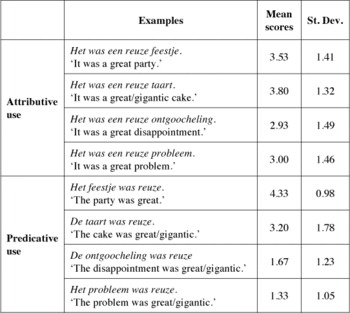
In order to test our intuition regarding the semantics of the adjective reuze, we carried out a small-scale survey with fifteen native (Flemish) speakers of Dutch. The participants had to judge, on a 5-point scale, the acceptability of 8 randomly ordered sentences with reuze used pre-dicatively or attributively to modify nouns with positive and negative connotation (for example, feestje ‘party’, taart ‘cake’ versus ont-goocheling ‘disappointment’, probleem ‘problem’). The results are summarized in table 3.
Semantics of predicative and attributive reuze.

The mean scores in table 3 indicate that, when used predicatively, reuze has a marked preference for subjects with positive connotation. Sentences where the predicative reuze modifies a subject with negative connotation are ranked much lower (mean scores 1.67 and 1.33).Footnote 27 In contrast, when reuze is used attributively, the average scores are less divergent (between 2.93 and 3.80). Moreover, compared to the pre-dicative reuze, the attributive reuze modifying a noun with negative connotation is much more acceptable (2.93 versus 1.67 for the sentences with ontgoocheling ‘disappointment’ and 3.00 versus 1.33 for the sentences with probleem ‘problem’).
The positive compounds (reuzeleuk ‘very nice, great’, lit. ‘giant-nice’; reuzegroot ‘gigantic’, lit. ‘giant-big’) are, in general, much more common than the negative compounds (reuzesaai ‘very boring’, lit. ‘giant-boring’; reuzeklein ‘very small’, lit. ‘giant-small’). Therefore it can be assumed that, when used by itself as a predicate or as an interjection, reuze has developed a positive semantic prosody (Bublitz Reference Booij1996).
A stronger hypothesis would be that predicatively used reuze and its use as an interjection are, in fact, the clipped forms of an adjectival compound with positive connotation, such as reuzeleuk ‘very nice, very pleasant’. This hypothesis can be supported by the fact that back-clipping of N+Adj compounds, used predicatively, is a well-known phenomenon in Dutch: stapel lit. ‘pile’ in 24a is the back-clipped form of stapel-verliefd ‘madly in love’, lit. ‘pile-in-love’ and piep lit. ‘peep’ in 24b is the result of back-clipping of piepjong ‘very young’, lit. ‘peep-young’.
- (24)
a. Zijn eerste liefde was Carine, (…). Laurent was stapel op haar, zoals dat wel vaker gebeurt bij een eerste verliefdheid.Footnote 28
‘His first love was Carine, (…). Laurent was madly in love (lit. ‘pile’) with her, as is often the case with a first crush.’
b. Zo gaat dat nu eenmaal wanneer je er, compleet onverwachts, op wordt gewezen dat je niet zo piep meer bent.Footnote 29
‘That's the way it goes when, suddenly, you get pointed out that you aren't so veryyoung (lit. ‘peep’) anymore.’
The examples in 24 provide additional evidence for the clipping hypothesis: Whereas the predicative use of reuze could be explained by expansion of syntactic context (which would not, however, account for its semantic shift), this is not a plausible hypothesis in the case of stapel or piep. Since the latter elements can neither be used attributively (*een stapele jongen lit. ‘a pile boy; *een piep meisje lit. ‘a peep girl’) nor form intensifying nominal compounds (*stapeljongen lit. ‘pile-boy’; *piep-meisje lit. ‘peep-girl’), they have to be analyzed as clippings, and not as instances of debonding.
In sum, the adjectival uses of Dutch reuze can be accounted for by both debonding and clipping. Whereas debonding accounts for the emergence of its intensifying attributive uses, the clipping hypothesis explains the particular positive semantic prosody of the predicative reuze. It is, however, highly probable that the two processes interfere with one another, in the sense that the rise of attributive adjectival uses by debonding may have triggered back-clipping of reuze + Adj compounds used predicatively, and vice versa.
5. Discussion and Perspectives
In this paper, we have outlined the synchronic gradience of Dutch reuze(n)(-) and explored the diachronic relations among these different synchronic uses (as the nominal left-hand member of nominal and adjectival compounds, as an intensifying prefixoid, as an adjective, interjection, and adverb). In sum, during a first stage (along the 19th century), reuze(n)- grammaticalized from a noun in N+N and N+Adj compounds with a literal lexical (‘giant’), qualifying (‘very big, enormous’), or classifying (‘belonging to a species group characterized by large size’) value to an intensifying prefixoid (‘great; very’). Subsequently (especially during the 20th century), the latter developed adjectival and adverbial uses by (a possible interaction between) degrammaticalization (in casu, debonding) and clipping.
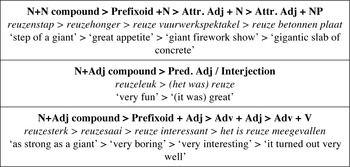
In particular, our data suggest the existence of three clines, the first one leading from the N+N compound to the attributive adjectival uses (debonding), the second one leading from the N+Adj compound to the predicative adjectival uses (clipping), and the third one leading from the N+Adj compound to the adverbial uses (debonding). The three clines are shown in figure 1.
Clines in the development of adjectival and adverbial reuze.

In sum, the evolution of reuze(n)(-) and the emergence of its free uses is a unique development in which the first process of grammaticalization (the development of the intensifying prefixoid) is continued by a reverse process of isolation, involving both debonding (as an instance of degrammaticalization, following Norde Reference Lightfoot2009) and clipping (as an instance of lexicalization, following the broad definition of lexicalization proposed by Norde Reference Lightfoot2009).Footnote 30 These results do not only challenge the unidirectionality hypothesis of language change; they also give evidence of the complexity of language change by showing that it involves bidirectional shifts, multiple lineages, and interacting processes, which supports the recently developed idea of multiple source constructions (Van de Velde, De Smet, & Ghesquière, to appear).
The fact that the grammaticalization process mainly affects the semantics of reuze, whereas the degrammaticalization (namely, debonding) and clipping processes have a particular impact on its autonomy, syntactic behavior and scope, is completely in line with Van der Auwera's (Reference Ramat, Schaner-Wolles, Rennison and Neubarth2002:23) claim that “whereas in grammaticalization it is (predominantly) meaning that takes the lead, in degrammaticalization in the narrow, non-lexicalizing sense, it is (predominantly) form that changes first.” Our synchronic and diachronic analysis indeed demonstrates that whereas the grammaticalization process of reuze follows a natural cline of semantic change with consecutive steps of metonymical and metaphorical reanalysis ((as) of a giant > very big > very important > mere intensification), the debonding of reuze seems to have been caused by (more accidental) formal factors, such as the spelling of complex compounds or compounds involving a vowel clash, as observed in section 2.4.
In this respect, another question to be explored is the possible influence of the linking morpheme -e- on the debonding process, and particularly, on the formal reanalysis of the prefixoid as an attributive adjective. Since attributive adjectives in Dutch mostly end in an inflectional -e, it is very plausible that this linking morpheme has been reanalyzed as the inflectional morpheme -e (see also Van de Velde & Weerman, to appear on the refunctionalization of the Dutch inflectional morpheme -e).Footnote 31 This formal reanalysis would explain, on the one hand, why other Dutch intensifying prefixoids ending in -e develop adjectival uses (for example, een klasse locatie ‘a first-class location’, lit. ‘a class location’; een bere speler ‘a terrific player’, lit. ‘a bear player’) and, on the other hand, why Dutch prefixoids without this linking morpheme are not, in general, used as attributive adjectives, for instance, with scope over noun phrases (for example, *sleutel economische sector ‘key economic sector’; Amiot & Van Goethem Reference Amiot and Van Goethem2012, Van Goethem & De Smet, to appear). The fact that this reanalyzed -e persists in morphosyntactic contexts where regular Dutch adjectives lack inflection, such as the predicative use (for example, Het was reuze! ‘It was great’, lit. ‘It was giant’), can then still be accounted for by the clipping hypothesis.
Furthermore, the complex interplay between the processes of debonding and clipping obviously needs further investigation. As hypothesized before, it is highly probable that the emergence of attributive uses due to debonding has stimulated clipping of predicatively used reuze+Adj compounds, or, conversely, that clipping has triggered the process of debonding in the attributive position. Finally, it should be carefully considered whether clipping could also have played a role in the emergence of the adverbial uses of reuze: For instance, it is possible to interpret adverbial reuze in Het is reuze meegevallen ‘It has turned out very well’ as the clipped form of an adverbial reuze+Adv compound, such as reuzegoed ‘very well’, lit. ‘giant-well’. These issues will be more deeply explored in our future research.