Introduction
In 2006, a prospective UK myringoplasty audit was launched under the direction of ENT-UK's Clinical Audit and Patient Advisory Group. Following in the footsteps of previous national audits of ear surgery outcomes,Reference Kotecha, Fowler and Topham1 the primary aim of this venture was to provide individual surgeons with comparative data to allow benchmarking against their peers.
Subsequent to the completion of this audit, the opportunity arose to review the outcome of myringoplasty as a whole, in order to provide insight into the success rates and other outcomes measures for UK patients undergoing this surgery by UK surgeons. In the current political climate, it is ever more important to appreciate outcomes. The findings benefit patients as they enable the patients to know more about the implications of surgery. The findings also benefit surgeons as they give the surgeons insight into factors that may influence the outcomes of this kind of surgery. Outcome data are also becoming of increasing interest to local and national commissioning groups, who require clinical evidence to justify the provision of services.
Materials and methods
Data were prospectively collected over a three-year period between 1 March 2006 and 1 March 2009 using the web-based Common Otology Database. This audit tool allows individuals to enter data prospectively, before surgery, immediately after surgery and at a number of intervals post-surgery. The Common Otology Database is a well-established tool that is widely used amongst ENT surgeons throughout the UK. Data are recorded in a secure and anonymised format to abide with current good practice; the front end of the database is password protected and data are stored in an encrypted format. Participation in the national myringoplasty audit amongst ENT-UK members was voluntary rather than compulsory, and no funding was required from participants or their employing Trusts.
Data fields regarding patient demographics, risk factors, inter-operative findings, surgical technique, post-operative findings and complications, and pre and post-operative hearing thresholds, were recorded. The data fields in the Common Otology Database were determined by ENT-UK's Clinical Audit and Patient Advisory Group. The use of free text fields is minimised to encourage uniformity in the way data are recorded. In addition, the database utilises multiple dropdown menus and tick boxes to avoid inconsistencies and data entry errors.
Post-operative data were recorded between three and six months after surgery. Patients with cholesteatoma, or those undergoing ossiculoplasty, were excluded. Surgeons with over 20 per cent missing follow-up data were excluded from the final analysis. Data analysis was conducted in a manner so as to ensure continued anonymity with respect to both the surgeon and the patient. Statistical analysis was carried out by a medical statistician using statistical software (SAS® version 9.3).
Results
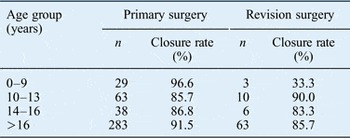
In total, 33 surgeons provided valid and complete data for 495 procedures. The overall closure rate for myringoplasty was 89.5 per cent. For primary myringoplasty the closure rate was 90.6 per cent, and for revision myringoplasty the closure rate was 84.2 per cent. Closure rates according to age group are reported in Table I.
Closure rates according to age

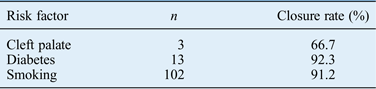
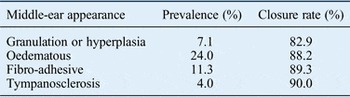
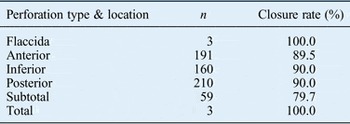
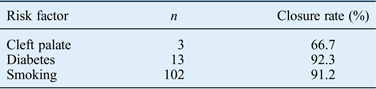
The incidence and outcomes of myringoplasty according to the presence of a cleft palate, diabetes or the patient being a smoker are reported in Table II. Table III reports the prevalence and outcomes of myringoplasty with respect to the condition of the middle-ear mucosa at the time of surgery. The incidence and outcomes of myringoplasty with respect to the location and type of perforation are reported in Table IV.
Incidence and outcomes of myringoplasty according to certain risk factors
Prevalence and outcomes of myringoplasty according to condition of middle-ear mucosa at surgery

Incidence and outcomes of myringoplasty according to perforation type and location

The relationship between perforation size and tympanic membrane closure is illustrated in Figure 1. The Cochran–Armitage test for trend was applied, and this confirmed a close relationship between perforation size and successful tympanic membrane closure (p = 0.0053).
Relationship between tympanic membrane closure and perforation size (percentage of tympanic membrane surface).

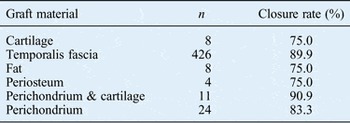
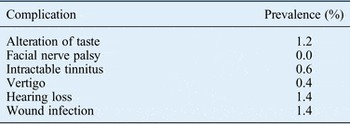
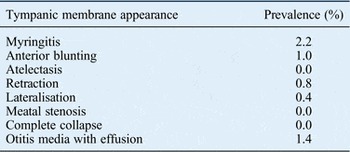
The incidence and outcomes of myringoplasty with respect to the type of graft material used are reported in Table V. The prevalence rates of post-operative complications are listed in Table VI, and the post-operative appearances of the tympanic membrane are reported in Table VII.
Incidence and outcomes of myringoplasty according to graft material

Prevalence of post-operative complications

Tympanic membrane post-operative appearance

The average hearing gain for successful primary myringoplasties was 9.14 dB (standard deviation (SD) = 10.62), and the average hearing gain for successful revision myringoplasties was 7.86 dB (SD = 12.28). The average hearing gain for unsuccessful primary myringoplasties was 9.16 dB (SD = 11.09), and the average hearing gain for unsuccessful revision myringoplasties was 12.29 dB (SD = 7.01).
Discussion
This national myringoplasty audit represents the most recent prospective appraisal of myringoplasty practice and outcome in the UK. The last national prospective myringoplasty audit in the UK was performed in 1995.Reference Kotecha, Fowler and Topham1 The current audit reports the outcomes for 495 procedures; however, this is less than half of the number of procedures that were reported in the 1995 audit.
The overall closure rate in this myringoplasty audit was 89.5 per cent; this compares with 82.2 per cent in the 1995 audit. This discrepancy may represent differences in the specifics of the procedure being performed, the age distribution amongst patients, and/or perforation and middle-ear characteristics, rather than a true improvement in closure rates over time. When reporting the 1995 audit, Kotecha et al. demonstrated an improvement in closure rate when compared with a 1990 national UK retrospective audit.Reference Ryan, Brown, Cameron, Fowler, Grant and Topham2 It was proposed that this was a result of better recording of perforations, as the 1990 audit was retrospective. It was also suggested that modifications in myringoplasty technique had been responsible.
A number of domains were appraised in terms of their relation to the outcomes of the patients undergoing myringoplasty in this series. These are discussed individually below.
Implications of age
Some authors of previously published research reported a lower success rate of grafting for younger children, while others have reported no difference in the graft take rate between younger and older children.Reference Yung, Neumann and Vowler3 In addition, it has been shown that many children have otitis media with effusion, retraction pocket and hearing problems even after a successful myringoplasty procedure.Reference Yung, Neumann and Vowler3 Closure rates in children following myringoplasty have been reported to be between 35 and 94 per cent.Reference Aggarwal, Saeed and Green4 This variation may be the result of a higher incidence of upper respiratory tract infections and the often immature function of the eustachian tube.Reference Gersdorff, Garrin, Decat and Juantegui5, Reference Caylan, Titiz, Fallcioni, De Donato, Russo and Taibah6 For those children aged over 10 years, closure rates within this series improved with increasing age. However, this may not reflect longer-term closure rates, as it is well appreciated that in children a proportion of tympanic membranes re-perforate with time.
Implications of smoking
A number of studies have consistently found that closure rates for myringoplasty are lower in smokers as compared with non-smokers.Reference Lin, Wang, Weng and Lin7–Reference Becvarovski and Kartush9 This is thought to be due to the effects of smoking on the micro-circulation of middle-ear mucosa. The results of this audit propose average closure rates of over 90 per cent in smokers. This is at odds with the literature, but may not be representative of the longer-term outcomes.
Implications of perforation location and size
Larger and more anteriorly placed perforations are known to be associated with lower rates of successful closure.Reference Kotecha, Fowler and Topham1, Reference Gersdorff, Garrin, Decat and Juantegui5, Reference Lee, Kelly and Mills10, Reference Scally, Allen and Kerr11 The results of this audit found that subtotal perforations were associated with slightly poorer rates of closure than anterior, inferior or posterior perforations. There was a 100 per cent closure rate for total perforations; however, this is based on only the results of three patients. Generally, there was a gradual and consistent reduction in closure rates as the reported size of the perforation increased.
Influence of graft material
A recent systematic review of morphological outcome (intact ear drum) associated with cartilage tympanoplasty versus fascia tympanoplasty favoured cartilage tympanoplasty.Reference Mohamad, Khan and Hussain12 This finding was not substantiated in this audit. However, this may be a consequence of low numbers of patients undergoing cartilage myringoplasty in this study, and the fact that those patients undergoing cartilage tympanoplasty may have been selected because of a perceived poorer chance of success if temporalis fascia were to be used. Pooled data from two randomised, controlled trials comparing cartilage and fascial tympanoplasties demonstrated no difference in the graft take rate.Reference Yung, Vivekanandan and Smith13
Post-operative complications
Complications of myringoplasty are commonly low. Post-operative wound infections, post-operative myringitis and a loss of taste occurred more frequently in patients in this audit as compared with the national myringoplasty audit of 1995 (1.4 vs 0.8 per cent, 1.2 vs 0.2 per cent and 2.2 vs 0.4 per cent respectively). Kotecha et al. reported one case of facial nerve palsy in their series of around a thousand patients.Reference Kotecha, Fowler and Topham1 Our series reported outcomes for half as many patients, and no post-operative facial nerve palsies were recorded. This audit did not distinguish a first-side from a second-side myringoplasty; it is possible that the effects of damaging both chorda tympani nerves would have been present in patients undergoing second-side surgery.
Change in hearing
Previous case series investigating hearing improvement after myringoplasty describe a mean hearing improvement of about 8 dB.Reference Lee, Kelly and Mills10, Reference Palva and Ramsay14 This compares well with our results, in which the average hearing gains for successful primary and revision myringoplasties were 9.14 dB (SD = 10.62) and 7.86 dB (SD = 12.28) respectively. Interestingly, patients who had an unsuccessful myringoplasty also experienced hearing improvement.
• This article's data confirm that myringoplasty is a safe and effective procedure in the UK
• The overall closure rate for myringoplasty was 89.5 per cent: 90.6 per cent for primary and 84.2 per cent for revision surgery
• Closure rates improved with increasing age for those aged over 10 years
• There was a gradual, consistent reduction in closure rates as perforation size increased
• The average hearing gains for successful primary and revision myringoplasties were 9.14 dB and 7.86 dB respectively
Shortcomings and outlook
Although the data produced by this audit may provide food for thought, two shortcomings are particularly noteworthy. Firstly, the data may not truly provide an insight into myringoplasty practice and outcome in the UK, as it is likely that only committed otologists participated in this voluntary exercise. Only those surgeons performing a sufficient number of myringoplasties will have participated, with the occasional myringoplasty surgeon not taking part. Secondly, only short-term data have been appraised, and it is appreciated that longer-term outcomes are poorer.Reference Halik and Smyth15 With the introduction of revalidation by the General Medical Council, participation in national audits will be mandatory in the future.16 This study demonstrates that a web-based audit tool would be fit for such a purpose. It is possible that the completeness of cases reported could be validated with complementary data using Hospital Episode Statistics.
Currently, the Common Otology Database provides a web-based tool to support the recording of personal otological surgery outcomes.Reference Yung, Gjuric, Haeusler, Van de Heyning, Martin and Swan17 This tool records pre-operative, intra-operative and post-operative symptoms, findings at operation, details regarding interventions, and audiometric data. In the future, this will be supported further with patient-reported outcome measures data from validated questionnaires such as the ‘COMQ-12’ (a health-related quality of life measure for active chronic otitis media).Reference Phillips, Haggard and Yung18 In a wider context, ambitions to publish patient-reported outcomes for the purposes of benchmarking and improving standards have been set out by the UK Government in its recent White Paper Liberating the NHS: Transparency in Outcomes – A Framework for the NHS.19 It is hoped that future audits will include all surgeons that are involved in this kind of surgery and will assess longer-term outcomes using a greater variety of methods.
Conclusion
This most recent national ear surgery outcome audit provides greater insight into the practice of myringoplasty performed on UK patients by UK surgeons. Myringoplasty is considered a safe and effective procedure in the UK.
The role of audits in assessing results for personal reflection is an important consideration for all surgeons and will form an essential part of the revalidation process in the UK in the future. This study demonstrates that a web-based audit tool would be suitable for performing such audits.