Introduction
The bottle gourd [Lagenaria siceraria (Mol.) Standl.] is a diploid (2n= 2x= 22), self-compatible, annual monoecious, cucurbitaceous vegetable. Two subspecies of bottle gourd, viz. L. siceraria subsp. siceraria (domesticated 4000 years ago in Africa) and L. s. subsp. asiatica (domesticated at least 10,000 years ago in Asia), have been identified (Heiser, Reference Heiser1979). India is the secondary centre of the diversity of bottle gourd, and bottle gourd is grown year-round, extensively throughout the country, except in very cool regions during winter. The development of varieties/hybrids for earliness, yield and resistance to insect pests and diseases is the main breeding objective. Mass selection has been recommended as one of the breeding methods for the improvement of fruit shape for bottle gourd (Bisogin and Storck, Reference Bisognin and Storck2000). In the state of Punjab in India, Punjab Komal (round fruited) and Punjab Long (long fruited) varieties have been developed through selection. Among hybrids, Pusa Meghadoot and Pusa Manjari have also been developed, and these are being grown commercially in India. The breeding of bottle gourd for high yield and downy mildew resistance through marker-assisted selection is being carried out at the Indian Institute of Horticultural Research. A few varieties in South India have been found to be resistant to zucchini yellow mosaic virus and powdery mildew. Telangana region of the state of Andhra Pradesh in India is endowed with a rich variability of bottle gourd, especially with regard to fruit characteristics (Sivaraj and Pandravada, Reference Sivaraj and Pandravada2005). The determination of the level of variation and identification of the variants within the species are gaining importance in view of the documentation, registration and protection of notified/extant cultivars and other plant genetic resources of commercial importance. At present, very few molecular genetic/genomic resources are publicly available for bottle gourd.
Experimental
Methodology
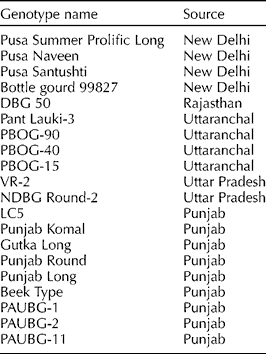
Twenty accessions (Table 1) of bottle gourd were characterized using a set of 20 simple sequence repeat (SSR) primers (Table 1, http://www.biomedcentral.com/content/supplementary) for cultivar identification and diversity analysis. DNA was extracted from the leaves of 2-week seedlings using a modified cetyltrimethylammonium bromide method (Maguire et al., Reference Maguire, Collins and Sedgley1994). SSR sequences were amplified through polymerase chain reaction (PCR) using SSR primers specific for bottle gourd. PCR amplification (25 μl total volume) was carried out in 2.0 μl of 10 × PCR buffer, 2.5 μl of dinucleotide triphosphates (dNTPs) (1 mM), 1.25 μl of each of the forward and reverse primers (5 μM each), 0.2 μl of Taq polymerase (5 units/μl), 5.0 μl of DNA (15 ng) and distilled deionized water using an Eppendorf thermal cycler. The PCR profile consisted of initial denaturation at 94°C for 5 min and subsequent 35 cycles each with denaturation at 94°C for 1 min, primer annealing at 55°C for 1 min and primer extension at 72°C for 1 min. The final extension step was carried out at 72°C for 7 min.
Genotypes used for the SSR analysis

Molecular analysis
Polymorphism information content (PIC) for each SSR marker was determined following the method of Senior et al. (Reference Senior, Murphy, Goodman and Stuber1998). The genetic similarity matrix was analysed using NTSYS-pc version 2.02 to produce an agglomerative hierarchical classification (Rohlf, Reference Rohlf1989) by employing the unweighted pair group method using arithmetic averages. The microsatellite marker amplification profile for all the accessions was also analysed using the computer software program DARwin 5.0 (Perrier and Jacquemoud-Collet, Reference Perrier and Jacquemoud-Collet2006).
Discussion
A limited number of random amplified polymorphic DNA markers (Decker et al., Reference Decker-Walters, Staub, Lopez-Sese and Nakata2001; Morimoto et al., Reference Morimoto, Maundu, Kawase, Fujimaki and Morishima2006) and locus-specific microsatellite (SSR) markers (Xu et al., Reference Xu, Wu, Luo, Wang, Liu, Ehlers, Wang, Lu and Li2011) have been described for bottle gourd, but no single nucleotide polymorphism marker is available so far. Therefore, in the present study, 20 accessions of bottle gourd grown in India were characterized on a molecular basis. Of all the 20 SSR markers used, 19 exhibited a clear and consistent amplification profile. One SSR marker (LSR074) exhibited no amplification, revealing no bands (null alleles). Among these, nine markers (LSR020, LSR040, LSR047, LSR056, LSR108, LSR112, LSR115, LSR116 and LSR117) exhibited a monomorphic pattern. The remaining ten exhibited a polymorphic pattern and amplified a total of 26 alleles. The number of alleles ranged from 2 to 4 with an average of 2.6 alleles per locus. Of the ten polymorphic SSR loci, two (LSR15 and LSR77) exhibited four alleles, two (LSR30 and LSR63) revealed three alleles, and the remaining six (LSR11, LSR88, LSR109, LSR113, LSR114 and LSR118) amplified two alleles. Xu et al. (Reference Xu, Wu, Luo, Wang, Liu, Ehlers, Wang, Lu and Li2011) detected a total of 51 alleles for the 14 polymorphic SSR loci at an average of 3.64 alleles per locus in 44 bottle gourd lines. Unique DNA profiles of all the accessions could be created using a set of five (LSR15, LSR30, LSR63, LSR77 and LSR109) polymorphic primers. These unique SSR profiles provide an opportunity to unambiguously differentiate the respective accessions. If feasible, combinations of two or more primer pairs in a single PCR reaction mix could enable rapid fingerprinting. Therefore, SSR markers used in the present study could precisely distinguish all the 20 accessions from each other and, thus, these SSR markers can be further used to differentiate the future accessions from the existing ones. If accepted, the DNA marker-based distinctness, uniformity and stability testing will effectively augment the process of discrimination of the candidate varieties and hybrids.
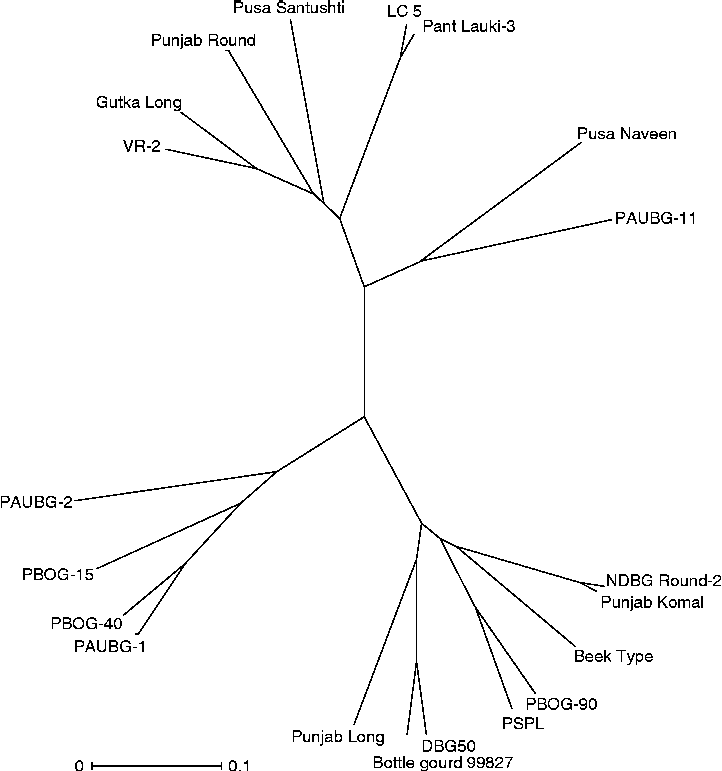
In the present study, PIC values were comparatively higher (0.23–0.73) than those reported (0.11–0.72) by Xu et al. (Reference Xu, Wu, Luo, Wang, Liu, Ehlers, Wang, Lu and Li2011). The dendrogram (Fig. S1, available online) created using NTSYS-pc 2.02 and the tree diagram (Fig. 1) generated using the DARwin 5.0 program classified the accessions into two main clusters. The first cluster is further divided into three subgroups, and the second cluster has two subgroups. Some accessions, for example, NDBG Round-2 and Punjab Komal, exhibited high genetic similarity with a similarity coefficient of 0.96 and were closely related. Xu et al. (Reference Xu, Wu, Luo, Wang, Liu, Ehlers, Wang, Lu and Li2011) also observed high genetic similarity (94%) between bottle gourd lines. The clustering pattern of accessions generated using both programs (NTSYS-pc 2.02 and DARwin 5.0) was similar and was independent of geographical location, which is in agreement with the findings reported by Yetisir et al. (Reference Yetisir, Sakar and Serce2008) and Xu et al. (Reference Xu, Wu, Luo, Wang, Liu, Ehlers, Wang, Lu and Li2011). The present investigations, for the first time, have helped to establish the identity and genetic diversity of the accessions of bottle gourd grown in India, which will be of great utility for the protection of Plant Breeders' Rights as well as for breeding.
Phylogenetic tree diagram depicting genetic relationships among bottle gourd genotypes based on SSR data using the computer program DARwin 5.0.

Supplementary material
To view supplementary material for this article, please visit http://dx.doi.org/10.1017/S1479262113000385