



Secundum atrial septal defect constitutes about 10% of all heart defects. Patients are generally asymptomatic, especially with smaller defects leading to diagnosis even in late adulthood. Reference Engelfriet, Meijboom, Boersma, Tijssen and Mulder1 Up to 90% of adults with untreated atrial septal defect will be symptomatic by the 4th decade, Reference Tesorio, Salemme, Verdoliva, Ferrone, Tesorio and Onorato2 with fatigue, exercise intolerance, dyspnoea, palpitations, and arrhythmia, with 30–49% developing heart failure. Reference Tesorio, Salemme, Verdoliva, Ferrone, Tesorio and Onorato2 About 8–10% of patients with atrial septal defect will develop moderate to severe pulmonary hypertension with female preponderance regardless of age. Reference Vogel, Berger, Kramer, Alexi-Meshkishvili and Lange3 Pulmonary hypertension is a progressive disease that can lead to right ventricular failure and even death. Reference Micheletti4 Most patients with atrial septal defect do not develop pulmonary hypertension even at very old age; thus, the phenomenon of atrial septal defect-associated pulmonary arterial hypertension is unique and carries a worse prognosis regardless of the duration of the shunt Reference Stout5 ; however, these patients still have a better prognosis than those with pulmonary hypertension and intact atrial septum. Patients with atrial septal defect-associated pulmonary arterial hypertension are in a state of chronic volume and pressure overload causing heart failure over time. Thus, complete closure of atrial septal defect in patients with atrial septal defect-associated pulmonary arterial hypertension is contraindicated as it can lead to a progressive increase in pulmonary vascular resistance, pulmonary oedema, and biventricular dysfunction. Reference D’Alto6 As the pulmonary vascular resistance and right ventricular end-diastolic pressure increases, the fenestration within the fenestrated atrial septal defect device allows for the maintenance of systemic cardiac output at the expense of desaturation. Reference Samuel, Al-Khatib, Peacock-McKenzie and Vettukattil7 Herein, we present five patients with atrial septal defect-associated pulmonary arterial hypertension and severe decompensated heart failure prohibitive for surgical repair due to comorbidities and describe management strateg.
Materials and methods
Patients and presentation
Informed consent was waived as the study is retrospective chart review with no patient contact. The study protocol conforms to the ethical guidelines of the 1975 Declaration of Helsinki. Five female patients (mean age 48.8 ± 13.5 years) were referred for evaluation and management of severe progressive atrial septal defect-associated pulmonary arterial hypertension and decompensated heart failure despite maximum guideline-directed medical therapy. Two patients were NYHA class IV, and three patients were class III (Table 1). All were on pulmonary hypertension target therapy; three patients were on dual therapy, and two patients were on single pulmonary hypertension therapy and supplemental oxygen for severe desaturation. One patient was transferred from an outside hospital for urgent lung transplantation and was deemed unsuitable. She was admitted for acute right-sided heart failure with multiorgan dysfunction requiring intravenous inotropes and renal dialysis. Another patient was admitted 4 months before the procedure for acute respiratory failure and heart failure management.
Clinical outcomes

Millimetre, mm; Pulmonary hypertension, PH.
Clinical outcome measures on day 0 (day of procedure) and follow-up time points at 6 weeks (W), 6 months (mo), 3 years (Y), and last follow-up.
Diagnostic workup
Echocardiography showed moderate-severe dilation of the right ventricular with moderate-severe systolic dysfunction, confirmed by magnetic resonance imaging. Congenital cardiac MRI data for right ventricular volumes and function pre-device implantation were available for three out of the five patients (Table 3). All had elevated indexed right ventricular end-diastolic volumes and decreased right ventricular ejection fractions. Post device implantation, MRI data were not available. The left ventricular function was normal. Atrial septal defect ranged from 22 to 36 mm with bidirectional shunting in three and left-to-right shunting in two (Table 1). Exercise capacity was documented with 6-minute walk tests. Pulmonary vasoreactivity testing was performed pre-device implantation in three of the five patients.
Haemodynamic outcome
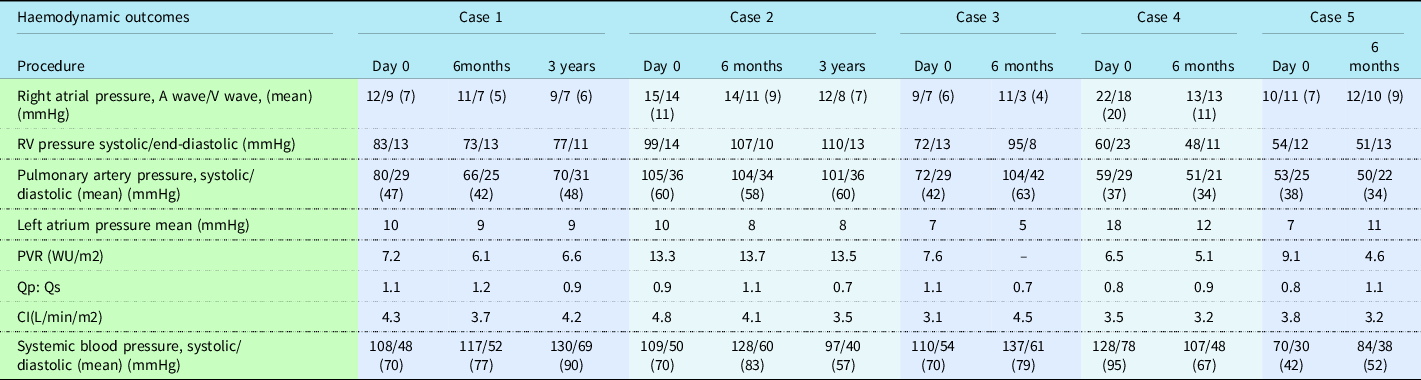
Cardiac index, CI; Pulmonary blood flow to systemic flow ration, Qp: Qs; Pulmonary vascular resistance, PVR.
Haemodynamic outcome measures on day 0 (day of procedure) and follow-up time points 6 months (mo), 3 years (Y) (if present).
Cardiac MRI data pre-device

RVEDVi: Right ventricle end-diastolic volume indexed, RVEF: Right ventricle ejection fraction.
Interventions
All patients underwent cardiac catheterisation. Prior compassionate-use approvals were obtained from the United States Food and Drug Administration and local institutional review board to implant the Occlutech fenestrated atrial septal defect Occluder (Occlutech International AB, Sweden). Mean PAP was 74 ± 18 mmHg (70% of systemic blood pressure); mean indexed pulmonary vascular resistance was 8.7 ± 2.4 Woods Units x m2. All atrial septal defects were closed using Occlutech fenestrated atrial septal defect (27–40 mm, fenestration: 6-8 mm. Fig 1) without complications.
Occlutech fenestrated atrial septal defect occluder: left: a picture of the device showing the fenestration. right: colour 3D echo showing the device with flow through the fenestration.

Outcome measures included 6-minute walk test, systemic oxygen saturation, and NYHA class (Table 1). Echocardiographic data were obtained at day 0, 6 weeks, and 6 months post-closure and at most recent follow-up visits. Haemodynamic data were collected at day 0 and 6 months post-closure. Post device implantation, all patients were on dual therapy for anticoagulation, with exception of one patient on aspirin monotherapy. The dual therapy regimens consisted of a combination of aspirin, apixaban, clopidogrel, and Xarelto.
Results
Patients were followed up at a median of 29 months (range 1064). Fenestration was patent in all patients at their most recent follow-ups with left-to-right shunting in four and bidirectional shunting in one.
Linear mixed effects models of these parameters, standardised within measure and patient, were used to compare pre- and post-closure by specific contrast. All had improved outcome measures (Table 1): significant improvement in effort tolerance as observed in the 6-minute walk test and systemic oxygen saturation comparing day 0 time point to all other follow-up time points data (B = 1.32, SE = 0.28, t (22.7) = −4.77, p = 0.0001) (Fig 2). There was improvement across the haemodynamic data including pulmonary vascular resistance, PAP, both atrial and right ventricular pressures (B = −0.60, SE = 0.22, t (40.2) = 2.74, p = .009) (Table 2).
Outcome plots: Plots showing improvement in effort tolerance and right ventricular (RV) dilation over time. right-sided pressures showed initial improvement months after the procedure with a rebound on later follow-up. The X-axis shows time starting from the procedure and follow-up in weeks, months, and years. Y-axis is the Z-scores of effort tolerance, right-sided pressures, and RV dilation.

Right ventricular size and right ventricular function improved over time after fenestrated atrial septal defect implantation (Fig 2). There was a reduction in right ventricular size from day 0 compared to all available follow-up periods (Fig 2). Right-sided pressures showed some improvement in the initial period after the procedure but showed a tendency to progress after one year (fig 2). There was no observed change in the cardiac index or pulmonary to systemic flow ratio.
Discussion
Untreated atrial septal defects can cause right heart failure over time. As the patient ages with an atrial septal defect, age-related left ventricular non-compliance increases the left-to-right shunt making them symptomatic. A unique group of patients develops progressive pulmonary hypertension relatively early in adulthood Reference Vogel, Berger, Kramer, Alexi-Meshkishvili and Lange3 however, most adults with large atrial septal defects do not develop pulmonary hypertension and benefit from complete closure of their atrial septal defect. Patients who develop pulmonary hypertension after atrial septal defect closure have a poor prognosis and improve after establishing a controlled atrial septal fenestration using an atrial flow regulator device. Reference Patel, Samuel, Girgis, Parlmer and Vettukattil8
Patients with left ventricular diastolic dysfunction and atrial septal defect might not tolerate complete closure of the atrial septal defect as it forces all the pulmonary venous return to the stiff left ventricular causing an acute increase in left atrial pressure causing flash pulmonary oedema and pulmonary hypertension, and arrhythmias. Reference Ewert9
Our patients had unrestrictive atrial septal defects with bidirectional shunting (predominantly left-to-right) unsuitable for complete closure due to pulmonary hypertension and right ventricular dysfunction. They presented with decompensated heart failure and were unsuitable for surgical closure due to comorbidities including multiorgan failure, renal failure requiring dialysis, or consideration for lung/heart transplant. Atrial septal defect closure in this setting is controversial and challenging with a very poor prognosis.
Currently, there are no available Food and Drug Administration-approved devices specific for fenestrated atrial septal defect closure. Our experience suggests that creating a sustained, but restrictive atrial septal communication improves the quality of life in these patients. Reference Samuel, Al-Khatib, Peacock-McKenzie and Vettukattil7 The fenestrated atrial septal defect aids in restricting the atrial septal defect flow while allowing right-to-left shunting to maintain CO at the expense of marginal desaturation when there is a sudden increase in pulmonary vascular resistance to avoid acute right ventricular failure. When initially combined with aggressive diuretic therapy and anti-pulmonary hypertension medications, they show excellent clinical improvement allowing to wean or stop the diuretic therapy completely with time. Post device implantation, half of the patients who were on epoprostenol were successfully weaned off and managed only an oral pulmonary hypertensive regimen. The remaining patients were maintained on their pre-device regimen of pulmonary hypertension medications. As the underlying pulmonary hypertension is associated with the heart defect, it may stabilise or progress depending on its aetiopathology. All patients are alive with no recent hospital admissions. They showed clinical improvement and better exercise tolerance with stable systemic oxygen saturation.
Conclusion
Our series of five patients demonstrated that fenestrated atrial septal defect closure in adults with atrial septal defect-associated pulmonary arterial hypertension and decompensated heart failure is feasible. They showed haemodynamic and functional improvements with excellent outcomes. Based on our experience, fenestrated atrial septal defect closure should be considered in patients with atrial septal defect-associated pulmonary arterial hypertension and heart failure, notwithstanding their comorbidities. The genetic basis of atrial septal defect-associated pulmonary arterial hypertension needs to be characterised to understand the pathogenesis of this unique problem which affects mainly women.
Acknowledgements
None.
Financial support
This research received no specific grant from any funding agency, commercial, or not-for-profit sectors.
Competing interests
Aregullin, Deniwar, Hernandez, Khan, Huang, and Finn have no financial relationship or conflicts of interest relevant to this article to disclose. Vettukattil is a paid consultant for Occlutech International AB, Sweden.
Ethics standard
Informed consent was waived as the study is retrospective chart review with no patient contact. The stud protocol conforms to the ethical guidelines of the 1975 Declaration of Helsinki.



