Introduction
Recurrent depressive syndromes, whether diagnostically linked to unipolar major depressive disorder (MDD) or to bipolar disorder (BD), affect as much as a fifth of the world's population and are associated with substantial morbidity, increased risk for suicide, and premature mortality (Bauer et al., Reference Bauer, Andreassen, Geddes, Vedel Kessing, Lewitzka, Schulze and Vieta2018; Kessler, Reference Kessler2012). Although the initial distinction between BD and MDD (Leonhard, Korff, & Schulz, Reference Leonhard, Korff and Schulz1962) has been validated by the discovery of pharmacologic agents with relative specificity for depressive and manic syndromes (Altshuler et al., Reference Altshuler, Post, Leverich, Mikalauskas, Rosoff and Ackerman1995; Pacchiarotti et al., Reference Pacchiarotti, Bond, Baldessarini, Nolen, Grunze, Licht and Vieta2013), the greater frequency of depressive symptoms in BD often leads to prolonged periods of misdiagnosis and ineffective treatment (Baldessarini et al., Reference Baldessarini, Faedda, Offidani, Vázquez, Marangoni, Serra and Tondo2013; Lish, Dime-Meenan, Whybrow, Price, & Hirschfeld, Reference Lish, Dime-Meenan, Whybrow, Price and Hirschfeld1994). While subjects with a clear history of mania can be easily distinguished from those with MDD, many subjects with BD experience milder or atypical forms of (hypo)mania that may be difficult to recall or characterize, particularly within the context of routine clinical care (Das et al., Reference Das, Olfson, Gameroff, Pilowsky, Blanco, Feder and Weissman2005). Moreover, as the early manifestation of BD is often marked by depressive symptoms (Van Meter, Burke, Youngstrom, Faedda, & Correll, Reference Van Meter, Burke, Youngstrom, Faedda and Correll2016), accurate diagnoses can be challenging to make on clinical grounds alone.
Clinical features such as psychotic symptoms, psychomotor retardation, greater overall severity, and earlier onset have been found to be more prevalent in subjects with bipolar depression (Frankland et al., Reference Frankland, Roberts, Holmes-Preston, Perich, Levy, Lenroot and Mitchell2018; Gan et al., Reference Gan, Diao, Wei, Wu, Cheng, Guan and Zhang2011; Leonpacher et al., Reference Leonpacher, Liebers, Pirooznia, Jancic, MacKinnon, Mondimore and Goes2015; Mitchell et al., Reference Mitchell, Frankland, Hadzi-Pavlovic, Roberts, Corry, Wright and Breakspear2011). Nevertheless, these prevalence differences are generally modest and likely insufficient for diagnostic purposes. Combining symptoms with illness features into more comprehensive models of disease course can provide greater discrimination, with area under the curve (AUC) indexes ranging from 0.7 to 0.8 (Gan et al., Reference Gan, Diao, Wei, Wu, Cheng, Guan and Zhang2011; Leonpacher et al., Reference Leonpacher, Liebers, Pirooznia, Jancic, MacKinnon, Mondimore and Goes2015; Schaffer et al., Reference Schaffer, Isometsä, Tondo, Moreno, Sinyor, Kessing and Yatham2015). However, clinical features can be imprecise, poorly recalled, and can provide prognostic utility after their manifestation, thereby limiting their relevance in prodromal and early onset cases, where the need for better diagnostic indices is arguably greatest (Van Meter et al., Reference Van Meter, Burke, Youngstrom, Faedda and Correll2016).
The strong genetic basis of most psychiatric disorders can, theoretically, provide diagnostic information, particularly in scenarios of clinical uncertainty. Yet, as the genetic basis of complex disorders such as BD and MDD is overwhelmingly polygenic (Stahl et al., Reference Stahl, Breen, Forstner, McQuillin, Ripke and Trubetskoy2019; Wray, Goddard, & Visscher, Reference Wray, Goddard and Visscher2007), clinically relevant stratification is most likely to emerge when considering genetic markers in aggregate in the form of polygenic risk scores (PRSs) (Purcell et al., Reference Purcell, Wray, Stone, Visscher, O'Donovan, Sullivan and Sklar2009; Wray et al., Reference Wray, Goddard and Visscher2007). The extent of the genetic predictive potential is bounded by the overall heritability attributable to additive effects of common variation [‘genome-wide association study (GWAS) heritability’], ranging from about 10% for MDD to 20–30% for more heritable disorders such as BD or schizophrenia (SCZ) (Howard et al., Reference Howard, Adams, Clarke, Hafferty, Gibson, Shirali and McIntosh2018; Pardiñas et al., Reference Pardiñas, Holmans, Pocklington, Escott-Price, Ripke and Carrera2018; Stahl et al., Reference Stahl, Breen, Forstner, McQuillin, Ripke and Trubetskoy2019). However, the proportion of variance explained (R 2) by currently available PRSs is more modest, ranging from ~12% for SCZ, to ~8% for BD and ~2–3% for MDD (Howard et al., Reference Howard, Adams, Clarke, Hafferty, Gibson, Shirali and McIntosh2018; Pardiñas et al., Reference Pardiñas, Holmans, Pocklington, Escott-Price, Ripke and Carrera2018; Stahl et al., Reference Stahl, Breen, Forstner, McQuillin, Ripke and Trubetskoy2019).
Although the predictive ability of GWAS-derived PRS is expected to increase with larger meta-analytic sample sizes, available PRSs are nevertheless beginning to yield association with clinically relevant outcomes. Recent examples include the association of increased SCZ PRSs with a decreased response to antipsychotics in first-episode psychosis (Zhang et al., Reference Zhang, Robinson, Yu, Gallego, Fleischhacker, Kahn and Lencz2019), and a decreased response to lithium in BD (Amare et al., Reference Amare, Schubert, Hou, Clark, Papiol and Baune2017). Arguably the most successful application of PRS thus far has occurred in cardiovascular disorders, where population-based samples have provided strong evidence that PRS can identify a significant proportion of the population at high risk for cardiovascular morbidity who are likely to benefit from more intensive treatment strategies and/or implementation of risk mitigation strategies (Khera et al., Reference Khera, Chaffin, Aragam, Haas, Roselli, Choi and Kathiresan2018, Reference Khera, Chaffin, Wade, Zahid, Brancale, Xia and Kathiresan2019).
In this study, we have explored the degree to which PRSs may aid in distinguishing bipolar from unipolar depression, arguably one of the most important clinical decisions in psychiatry, since the prognosis and optimal treatment of either disorder is likely to be different for most patients. We specifically selected samples that were identically genotyped and phenotyped, thereby allowing us to test the effect of PRSs individually, but also within the broader context of clinical risk factors typically used to help with clinical decision making.
Materials and methods
Subjects
The sample included BD and MDD cases from the National Institute of Mental Health (NIMH) Bipolar Disorders Initiative and Genetics of Recurrent Early-Onset Depression (GenRED) collections, respectively, which were initially ascertained for genetic studies and have undergone previous case–control GWAS analyses (Shi et al., Reference Shi, Potash, Knowles, Weissman, Coryell, Scheftner and Levinson2011; Smith et al., Reference Smith, Koller, Panganiban, Szelinger, Zhang, Badner and Kelsoe2011). These samples were originally collected under Institutional Review Board (IRB) approved protocols (Shi et al., Reference Shi, Potash, Knowles, Weissman, Coryell, Scheftner and Levinson2011; Smith et al., Reference Smith, Koller, Panganiban, Szelinger, Zhang, Badner and Kelsoe2011) that included informed consent for genetic studies and data sharing.
Both studies used the Diagnostic Interview for Genetic Studies (DIGS) and similar best estimate procedures (Nurnberger et al., Reference Nurnberger, Blehar, Kaufmann, York-Cooler, Simpson, Harkavy-Friedman and Reich1994) based on DSM-IV criteria. Subjects were restricted to high-confidence diagnoses of BD or MDD, with diagnostic confidence levels of 3 (‘confident – most but not all diagnostic criteria have been met for a typical case’) or 4 (‘high – typical presentation of a clear case that meets all diagnostic criteria’). We subsequently selected unrelated subjects of European ancestry who were genotyped on the Affymetrix 6.0 Microarray and were independent of the initial training set GWAS meta-analyses samples. Following these criteria, there were 843 subjects broadly diagnosed as BD (808 with BD type I and 35 with schizo-affective disorder, bipolar type) and 930 with recurrent MDD. Further clinical information is provided in Table 1.
Clinical symptoms and features across the BD and MDD samples (n = 1773)

Clinical symptoms/features
In our previous study, we tested a large number of symptoms (directly inquired from the research participant) and clinical features (defined as descriptors of the available illness course) and prioritized seven symptoms/features that showed replicated evidence for association with BD v. MDD and that remained significant in a multivariate model (Leonpacher et al., Table 4). Building on our prior study, we focused our investigation on four previously associated symptoms (psychomotor retardation, incapacitation, delusions, and number of mixed symptoms during worst depressive episode) and three associated clinical features (length of most severe episode, number of depressive episodes, and antidepressant-induced ‘high’ feeling).
We included all available subjects, including 984 (~55% of the current sample) subjects who had been previously used to select the discriminating clinical symptoms/features. Although the overlapping subjects theoretically could lead to concerns of overfitting, we note that the clinical symptoms/features were replicated in our prior studied (Leonpacher et al.) and that further sensitivity analyses in our current sample showed no differences in discriminatory ability between the overlapping and non-overlapping samples. The final sample included a total of 1773 subjects, consisting of 843 with BD and 930 with recurrent MDD.
Genome-wide association study (GWAS)
Cases with BD and MDD were genotyped using the Affymetrix 6.0 micro-array. Raw genotypes were combined using PLINK1.9 (Chang et al., Reference Chang, Chow, Tellier, Vattikuti, Purcell and Lee2015) followed by sequential quality control (QC) steps removing: (1) single-nucleotide polymorphisms (SNPs) with missing rates ⩾5%; (2) individuals with overall missing rates ⩾2%; (3) remaining SNPs with missing rates ⩾2%; (4) SNPs in Hardy–Weinberg disequilibrium (p < 0.000001); and (5) remaining SNPS with differential missing rates >2%. The filtered combined file underwent additional QC/harmonization steps (https://www.well.ox.ac.uk/~wrayner/tools/HRC-1000G-check-bim-v4.2.7.zip) prior to imputation to the multiethnic 1000Genomes version 3 reference panel. Imputation was performed using the Michigan Imputation Server and high-quality genotypes (r 2 > 0.6) with a minor allele frequency of 1% or greater were extracted and converted to the PLINK format for downstream analyses. Principal components analysis (PCA) was performed using PLINK1.9 by combining the filtered genotypes with the 1000G multi-ethnic panel and extracting the top 10 principal components (PCs). We excluded five samples that were outliers in the PCA (online Supplementary Fig. S1).
Calculation of PRSs
PRSs were calculated using recommended parameters in LD-Pred (Vilhjálmsson et al., Reference Vilhjálmsson, Yang, Finucane, Gusev, Lindström, Ripke and Price2015), which uses a Bayesian algorithm to infer the mean effect at each individual marker while accounting for linkage disequilibrium (LD) between markers. We utilized summary statistics from the largest meta-analysis GWAS of BD (Stahl et al., Reference Stahl, Breen, Forstner, McQuillin, Ripke and Trubetskoy2019) and SCZ (Pardiñas et al., Reference Pardiñas, Holmans, Pocklington, Escott-Price, Ripke and Carrera2018) as the training datasets and the European subjects from the 1000Genomes version 3 as the LD reference genotypes. Using an LD-radius of 1775 and 1981, weighted risk scores were constructed for 5 325 407 and 5 943 410 markers in the harmonized BD and SCZ datasets, respectively. PRSs were derived across nine training dataset thresholds, defined as the assumed ‘fraction of causal variants’ (–PS = 1, 0.3, 0.1, 0.03, 0.01, 0.003, 0.001, 0.0003, 0.0001), and standardized by using the standard deviation as the unit of measurement. PRS thresholds were selected to maximize the explained difference between BD and MDD phenotypes. The optimal LD-Pred threshold (‘fraction of causal variants’) was 0.3 for SCZ and 0.003 for BD; however, other thresholds yielded broadly similar discriminatory ability (online Supplementary Table S2).
Statistical analysis
All analyses were performed in R version 3.4.2. Association of PRSs with phenotype status was performed with a generalized linear model using a logit link function. We initially fit baseline models with BD v. MDD status as the outcome variable and the first 10 PCs, age at interview, and sex as covariates. We subsequently added the PRS variable into that base model and compared the difference in Nagelkerke's pseudo-R 2 (ΔR 2) to estimate the proportion of variance attributable to the PRS (Table 2). For better interpretability, the sample was stratified into deciles using the residuals of the top performing BD and SCZ PRSs adjusted for first 10 PCs, age, and sex. Odds ratios (ORs) for BD v. MDD status and 95% confidence intervals (CIs) were calculated for each decile in comparison with the first decile (Figure 2).
ORs of BD v. MDD status for clinical features and polygenic risk scores

OR, odds ratio; CILower, lower bound 95% confidence interval; CIUpper, upper bound 95% confidence interval.
Multivariate logistic regression with symptoms, clinical features, and standardized PRSs as predictors of BD v. MDD status. The model is adjusted for age, sex, and first 10 PCs from the GWAS.
We performed a receiver operating characteristic analysis to estimate the discriminatory potential of PRS by measuring the AUC or C-statistic associated with each model. We first fit a logistic model with the first 10 PCs, age, and sex, and then measured the C-index. To this baseline model, we added PRSs derived from the BD and SCZ PRSs using the optimal LD-Pred threshold described above. We subsequently tested the increase in C-statistic from each of the four individual symptoms (psychomotor retardation, incapacitation, delusions, and number of mixed symptoms) and three clinical features (length of most severe episode, number of depressive episodes, and the presence of high feeling after antidepressant). The C-statistic was initially calculated separately for each individual symptom or clinical feature, and then with the BD and schizophrenia PRSs to measure the respective additive effect of PRS. Subsequently, we performed the above analyses serially for: all clinical symptoms combined, all clinical features combined, and a composite of all symptoms and clinical features.
Lastly, we tested the association of the top performing BD and SZ PRS with each of the symptoms/clinical features listed above, controlling for diagnosis. Logistic regression was used for binary variables (the presence of psychomotor retardation, delusions, incapacitation, and high feeling after antidepressant) and linear regression for continuous variables (length of worst depression in weeks, number of episodes, and number of mixed symptoms).
Results
Clinical and demographic features
Of the 1773 subjects, 843 had BD and 930 had MDD, with more females than males in both groups (66.0% and 70.0%, respectively) (Table 1). Subjects with BD were slightly older at the time of their interview (42.0 years BD v. 40.2 years MDD), had fewer years of education (14.9 BD v. 16.0 MDD), and were less likely to be married (29.8% BD v. 47.8% MDD). Consistent with our previous study (Leonpacher et al., Reference Leonpacher, Liebers, Pirooznia, Jancic, MacKinnon, Mondimore and Goes2015), subjects with BD were more likely to have experienced psychomotor retardation, incapacitation, delusions, and mixed symptoms during the their most severe depressive episode. In terms of clinical features, subjects with BD had a shorter length of depression during their most severe episode, but a greater number of depressive episodes, and a higher prevalence of feeling ‘high after antidepressant treatment’ (Table 1).
Polygenic association with BD v. MDD
Given the strong co-heritability between BD and SCZ (The Consortium et al., Reference Consortium, Anttila, Bulik-Sullivan, Finucane, Walters, Bras and Neale2018), we performed polygenic analyses utilizing the largest meta-analyses of each disorder for polygenic risk scoring, while ensuring that the BD and MDD samples were independent of the training set samples. In our primary analysis, we found that PRS for BD was strongly associated with BD compared with MDD (ΔR 2 = 3.53%, p = 4.94 × 10⁻¹²), with an effect size approximately half of that usually seen in BD case–control studies. Similarly, PRS for SCZ was also similarly associated with BD v. MDD phenotype (ΔR 2 = 3.16%, p = 5.71 × 10⁻¹¹). While the distribution of PRS among BD and MDD samples showed prominent overlap, greater discriminative ability was present at the more extreme values of PRS, as has been observed in other common complex disorders (Fig. 1).
Distribution of PRSs derived from (a) BD and (b) SCZ training datasets. Distribution is shown using dashed lines and solid lines for MDD and BD cases, respectively.

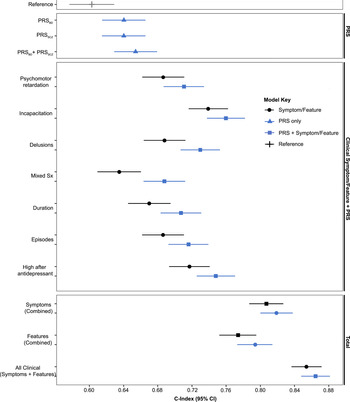
Using PRSs to help classify the overall sample, we found that a baseline model with covariates and PRS produced an AUC C-statistic of 0.64 for the BD and SCZ PRS, respectively and C-statistic of 0.65 for the combined PRS (online Supplementary Table S1). For ease of interpretability, we divided the samples into PRS deciles, finding that individuals with PRS in the top decile had an OR of 3.39 (CI 2.19–5.25) when compared with the lowest decile. Similarly, those in the top decile of SCZ PRS residuals had an OR of 3.07 (CI 1.99–4.73) compared with the lowest decile, in terms of BD–MDD status (Fig. 2).
ORs for association with BD compared with MDD binned by polygenic risk deciles using residuals after adjusting for first 10 PCs, age, and sex. ORs represent comparisons against the lowest decile. Polygenic scores were calculated using (a) BD and (b) schizophrenia GWAS meta-analyses as the respective training data sets.

Genetic risk and clinical features
In a multivariate model adjusted for covariates, we found significant associations of the BD and SCZ PRSs as well as of the seven clinical symptoms/features tested (Table 2). As shown in Fig. 3, the combined PRS contributed significant additive effects to all individual clinical features, providing evidence that prediction based on PRSs is likely to be at least partially independent of that based on clinical features (data shown in online Supplementary Table S2). The classifying ability of PRSs in models with individual clinical predictors varied based on the specific variable. For example, the combined PRSs provided a larger increase in discriminatory ability in a model with delusions alone (ΔC = 0.042) than with incapacitation alone (ΔC = 0.021).
C-indexes (AUC) for classification of BD v. MDD. The figure shows the incremental effects of individual symptoms or clinical features with and without the additional influence of PRSs. The reference models represent the effect of baseline covariates (age, sex, and 10 PCs). Additional clinical predictors are categorized as depressive symptoms [psychomotor retardation (PMR), incapacitation, delusions, and number of mixed symptoms during worst depressive episode] or associated clinical features (length of most severe episode, number of depressive episodes, and antidepressant-induced ‘high’ feeling).

Polygenic risk was also found to increase discrimination when compared with the combined symptoms and combined clinical features categories. As the combined symptoms category represents a set of symptoms that could be plausibly ascertained on initial presentation, these results suggest that PRS can provide additional predictive ability early in the illness course before the longitudinal clinical features have had time to become establish themselves. When both symptoms and clinical features were combined, the AUC increased to 0.855, which was consistent with our prior study (Leonpacher et al., Reference Leonpacher, Liebers, Pirooznia, Jancic, MacKinnon, Mondimore and Goes2015). However, even in the full multi-variate clinical model, the effect of the combined PRS remained significant and led to modest but statistically significant increases in discriminatory ability (ΔC = 0.011, p = 6.48 × 10⁻⁴).
Association of PRS with symptoms and clinical features
Finally, in order to explore the specific effect of polygenic risk, we sought to test whether the polygenic signal was differentially associated with individual clinical symptoms or features, thereby providing a more granular view of the underlying genetic susceptibility. Using a logistic regression model adjusted for covariates that included the main effect of diagnosis, we found a single significant association with BD PRS and incapacitation (p = 0.003, Table 3). In contrast, the SCZ PRS was associated with longer length of depression (p = 0.004), but not with any of the additional risk factors, suggesting that the BD and SCZ PRS have heterogeneous effects despite comparable overall predictive effects.
Polygenic association with individual symptoms and clinical features

Results show the association between individual clinical symptoms or features and PRSs derived for BD and SCZ. Binary variables were tested with logistic regression models, whereas continuous variables were tested using linear models. All models are adjusted for diagnosis, the first 10 PCs, age, and sex.
a Significant after Bonferroni correction (p < 0.007) for multiple tests.
Discussion
While mania remains the cardinal syndrome that defines the diagnosis of BD, subjects often initially present with years of depressive symptoms (Bauer et al., Reference Bauer, Andreassen, Geddes, Vedel Kessing, Lewitzka, Schulze and Vieta2018) which can result in misdiagnosis on initial presentation, potentially leading to the initiation of treatments of limited efficacy (Sachs et al., Reference Sachs, Nierenberg, Calabrese, Marangell, Wisniewski, Gyulai and Thase2007) that may also be associated with iatrogenic harm (Baldessarini et al., Reference Baldessarini, Faedda, Offidani, Vázquez, Marangoni, Serra and Tondo2013). Even when present, relevant clinical symptoms are under-recognized or poorly measured, particularly in primary care settings (Das et al., Reference Das, Olfson, Gameroff, Pilowsky, Blanco, Feder and Weissman2005). Hence, there is a clear need for better prognostic tools that can help identify subjects at high risk for developing BD.
In this study, we have tested whether markers of genetic susceptibility for BD or SCZ (as indexed by PRSs) can augment traditionally used clinically based factors, to identify subjects presenting with depressive symptoms who may be at high risk for ‘converting’ to BD. We found that PRSs derived from the most recent PGC GWAS discriminate modestly between BD and MDD cases, with the BD PRS demonstrating a slightly higher association than the SCZ PRS. Subjects with top decile BD PRS were more than three times as likely to have BD than MDD compared with those in the lowest BD PRS decile, a level of discrimination that is similar to that found in a recent study of PRS in first-episode psychosis (Vassos et al., Reference Vassos, Di Forti, Coleman, Iyegbe, Prata, Euesden and Breen2017). In addition, PRSs had comparable classifying ability to individual clinical features and/or symptoms previously shown to associate with BD, although when included in a model with all clinical features and symptoms, the increase in overall classification was modest. Nevertheless, the effect of PRSs appeared to be largely independent of the clinical features, suggesting that PRSs may represent orthogonal risk factors that may provide incremental information beyond traditional clinical factors.
In other medical disorders, PRSs are increasingly being studied for their potential use in the prediction of common disorders such as heart disease (Khera et al., Reference Khera, Chaffin, Aragam, Haas, Roselli, Choi and Kathiresan2018), type-II diabetes (Udler, McCarthy, Florez, & Mahajan, Reference Udler, McCarthy, Florez and Mahajan2019), obesity (Khera et al., Reference Khera, Chaffin, Wade, Zahid, Brancale, Xia and Kathiresan2019), and cancers such as breast (Mavaddat et al., Reference Mavaddat, Michailidou, Dennis, Lush, Fachal, Lee and Easton2019) and prostate cancer (Seibert et al., Reference Seibert, Fan, Wang, Zuber, Karunamuni and Parsons2018). In these examples, clinical utility is most likely to be found in the extremes of the PRS distribution, where the degree of increased risk approximates those found in our study. PRS for these disorders has also been found to be largely independent of clinically based risk estimation tools, including family history, suggesting that PRS could have an independent and incremental role in comprehensive models that may inform clinical decision making (Lee et al., Reference Lee, Mavaddat, Wilcox, Cunningham, Carver, Hartley and Antoniou2019). Indeed, in some disorders such as coronary artery disease, PRS has not only been associated with increased risk, but also with a greater likelihood of benefit from pharmacological treatment (Mega et al., Reference Mega, Stitziel, Smith, Chasman, Caulfield, Devlin and Sabatine2015). However, for most studied disorders, including BD, the link to specific clinical utility is currently unclear and will require further study based on prospective cohort studies and randomized trials. Ultimately, the most informative risk models are likely to integrate epidemiologic parameters, clinical data, non-genetic biomarkers, and potentially a broader index of genetic risk, summing the effects both common and rare variants.
While genetic data have important limitations, including the constraints placed by heritability estimates, it may also hold advantages over more traditional clinically derived predictors. Unlike most clinical predictors, genetic predictors can be measured before the onset of symptoms and can be informative throughout the life-course of the illness. In contrast, several of the clinical features included in our model, such as number of lifetime episodes, or the duration of depressive episode represents information that would not be available during a first episode or prior to the full manifestation of the disorder. Moreover, clinical symptoms are often experienced in a time-limited manner, leading to poor recall and suboptimal inter-rater reliability (Regier et al., Reference Regier, Narrow, Clarke, Kraemer, Kuramoto, Kuhl and Kupfer2013).
An important strength of our study is that rather than comparing cases and healthy controls, we focus on the more clinically relevant comparison between two disorders with prominent symptom overlap that nevertheless require relatively distinct forms of pharmacotherapy. As such, we therefore restricted our analyses to subjects with either disorder who were diagnosed with identical diagnostic instruments and genotyped with the same microarray chip, in order to minimize the potential for confounding. Additionally, our current analysis focused on the arguably more realistic assumption that PRSs will be used in conjunction with traditional clinical risk factors, rather than studied or applied in isolation. We therefore applied polygenic risk scoring to previously identified clinical factors that had shown replicable associations in a prior comparison of BD and MDD (Leonpacher et al., Reference Leonpacher, Liebers, Pirooznia, Jancic, MacKinnon, Mondimore and Goes2015). Our results therefore may have greater face validity while providing a more contextual view of where PRS may have clinical utility in future studies.
Nevertheless, as an initial proof of concept study, there are also several important limitations. We have analyzed opportunistically samples previously collected for genetic studies that focused on the ascertainment of the more severe types of BD and on recurrent forms of MDD. Further work should test the performance of psychiatric PRS in discriminating MDD and BD cases in more naturalistic clinical cohorts that include the full manifestation of the BD v. MDD mood spectrum, particularly in the early phases of illness (Smith & Craddock, Reference Smith and Craddock2011). Second, our clinical features were derived from a single cross-sectional evaluation that is subject to typical retrospective limitations, including recall bias (Wells & Horwood, Reference Wells and Horwood2004). Although best-estimate procedures include additional diagnostic information to supplement the interview, it is possible that certain symptoms may have been under-reported. Third, we limited our focus to clinical factors available in the diagnostic instrument used in our previous study (Leonpacher et al., Reference Leonpacher, Liebers, Pirooznia, Jancic, MacKinnon, Mondimore and Goes2015), whereas a more comprehensive diagnostic model may ultimately include additional risk and state-related factors more reliably assessed in a prospective manner. Fourth, in the current study we have only tested PRSs derived from BD and SCZ studies, reasoning that other prognostically relevant phenotypes such as major depression or broadly defined anxiety remained underpowered for polygenic prediction. Future studies will no doubt be benefitted by including more powerful training data from diagnostic and cross-disorder phenotypes. Lastly, our study was performed exclusively in samples of European ancestry with PRSs similarly derived in GWAS meta-analyses of subjects of European ancestry. These PRSs are known to be less predictive in non-European samples, reflecting a central limitation of integrating currently available PRS into clinical medicine, which has important consequences for health equity (Martin et al., Reference Martin, Kanai, Kamatani, Okada, Neale and Daly2019).
Supplementary material
The supplementary material for this article can be found at https://doi.org/10.1017/S003329172000015X
Acknowledgements
The Bipolar Samples were genotyped under the direction of Bipolar Genome Study. The Principal Investigators and Co-Investigators were: John R. Kelsoe, Tiffany A. Greenwood, Caroline M. Nievergelt, Rebecca McKinney, Paul D. Shilling, Nicholas Schork, Erin N. Smith, Cinnamon Bloss, John Nurnberger, Howard J. Edenberg, Tatiana Foroud, Daniel L. Koller, Elliot Gershon, Chunyu Liu, Judith A. Badner, William A. Scheftner, William B. Lawson, Evaristus A. Nwulia, Maria Hipolito, William Coryell, John Rice, William Byerley, Francis McMahon, Thomas G. Schulze, David T. Chen, Wade Berrettini, James B. Potash, Peter P. Zandi, Pamela B. Mahon, Melvin G. McInnis, Sebastian Zöllner, Peng Zhang, David W. Craig, Szabolcs Szelinger, and Thomas B. Barrett. We thank Mark Chaffin for assistance in the calculation of polygenic risk scores. We are grateful for the participation of all the subjects contributing to this research.
Financial support
This study was supported in part by Brain & Behavior Research Foundation YI23970 to FSG. FSG has received research support from Janssen Pharmaceuticals.