INTRODUCTION
The neuropathologic changes of Alzheimer's disease (AD) begin well before the disease becomes clinically apparent. The brain may compensate for such changes until cognitive decline becomes obvious and disrupts daily functioning, and the clinical diagnosis of AD can be made. However, cognitive signs and brain changes are subtly present prior to clinical diagnosis, thus denoting a “preclinical” stage of AD in which affected individuals exhibit only very mild changes in cognition despite an ongoing disease process. This stage gradually progresses to mild cognitive impairment (MCI; Petersen et al., 2001), characterized by mild but detectable cognitive impairment, and then to the more severe and clinically apparent stages of AD.
Much research into new AD treatments has focused on slowing or halting the disease process, rather than reversing its neuropathology. Many patients with MCI already exhibit substantial neuropathologic signs of AD (Price & Morris, 1999), illustrating the need to identify the preclinical stages of AD so that treatment can begin promptly. Identifying preclinical disease markers would improve characterization of predisposing factors for AD, promote our understanding of disease course, and improve our ability to assess treatment response without waiting for evidence of significant cognitive or functional declines.
Better recognition of preclinical markers of AD could have profound social and financial effects. Early detection could help reduce the cost of Alzheimer's care ($100 billion per year in the United States; DeKosky & Orgogozo, 2001); an intervention delaying AD onset by two years would result in nearly two million fewer cases 50 years from now (Brookmeyer et al., 1998). Additionally, early and accurate diagnosis will aid patients and families in healthcare decision-making.
We reviewed the current literature on neuropsychological and neuroimaging changes that may reflect preclinical AD. In doing so, we distinguished between “preclinical AD” and “MCI,” typically defined as mild memory impairment without other cognitive or functional deficits (Petersen et al., 2001). In contrast, preclinical AD is conceptualized as a stage featuring subtle cognitive declines (not necessarily impairments, however, and not necessarily in the domain of memory) and no perceptible declines in daily functioning. Another distinction exists on autopsy, at which those with MCI may exhibit substantial AD pathology, whereas preclinical AD patients may exhibit only minor changes (Price & Morris, 1999). Detecting AD in its preclinical stage, before the development of MCI, is crucial, particularly given that the conversion rate from MCI to AD within two years is up to 30% (Petersen et al., 2001). In a recent meta-analysis, Bäckman et al. (2005) found that neuropsychological tests of global cognition, delayed recall, perceptual speed, and executive functioning best discriminated subjects who developed AD from those who remained well. However, of the 47 studies included in their meta-analysis, 27 investigated cognition in MCI, cognitively impaired, or memory clinic samples, thereby making memory measures the most likely to emerge as predictors of future AD. The current review excluded studies of subjects with MCI or memory complaints in favor of a more pure focus on preclinical AD. We present a model of accelerated, nonlinear cognitive decline in the preclinical period and provide evidence that helps reconcile the heterogeneity in AD presentation.
As a backdrop to our focus on preclinical AD, we first review briefly the neuropathology of AD and the diagnostic criteria for the disease. Study designs and the rationale for using at-risk samples in this research are outlined. A comprehensive review of the current neuropsychological and neuroimaging research follows. Finally, the empirical evidence is put into a clinical context, gaps in our understanding are presented, and the potential impact of research on preclinical AD is discussed.
Neuropathologic and Diagnostic Criteria for AD
AD is a progressive degenerative disease characterized by neocortical atrophy, neuron and synapse loss, neuritic plaques, and neurofibrillary tangles (Alzheimer, 1907; Terry et al., 1991). These neuropathologic changes occur primarily in the hippocampus and entorhinal cortex, with later changes occurring in frontal, temporal, and parietal association cortices (Braak & Braak, 1991; Hyman et al., 1984). Eventually, the limbic regions and neocortex are affected (Bobinski et al., 1999; Xu et al., 2000). Additionally, subcortical neuron loss in the nucleus basalis of Meynert and locus coeruleus results in decreased levels of cholinergic and noradrenergic markers, respectively (Bondareff et al., 1982).
Clinically, AD is characterized by profound global dementia, with severe amnesia and additional deficits in other cognitive domains, such as language, executive functions, attention, and visuospatial/constructional abilities (American Psychiatric Association, 1994; Salmon & Bondi, 1999). The current DSM-IV criteria (American Psychiatric Association, 1994) include: (a) Memory impairment and at least one additional cognitive impairment; (b) Impaired functioning and functional decline; (c) Gradual onset and continuing cognitive decline; (d) Cognitive deficits not due to other causes. The criteria for AD suggest that cognitive deficits, structural volume loss, or functional brain changes appear gradually and thus might be identified before the neural degeneration produces clinically diagnosable dementia.
Study Designs
The prototypic longitudinal case-control research design used to identify potential preclinical markers of AD involves a baseline assessment of a large cohort of normal older adults and periodic follow-up evaluations (Collie & Maruff, 2000). Then, individuals who later develop AD are compared with those who remain nondemented on the presence and magnitude of cognitive declines, structural changes, and/or functional imaging changes. Retrospective studies of nondemented individuals who came to autopsy have also been published, comparing neuropsychological profiles of individuals with and without AD pathology.
Studying individuals at high risk for AD has been a common approach to research on preclinical indicators of the disease. Early studies recruited individuals at risk for AD due to family history (e.g., Hom et al., 1994), whereas more recent studies have focused on older adults with genetic susceptibilities such as the presence of an apolipoprotein E (APOE) ε4 allele (Corder et al., 1993). Such studies have used both cross-sectional designs and longitudinal evaluations to examine cognitive decline or neuroimaging changes. To provide a backdrop for our review of longitudinal and cross-sectional studies of preclinical AD, we briefly discuss the established risk factors for AD next.
Risk Factors for AD
Advancing age is the single most important risk factor for AD (Kawas & Katzman, 1999), with exponential increases in AD prevalence in individuals between 65 and 85. Epidemiologic studies of people over age 85, the fastest growing segment of our population (U.S. Census Bureau, 2004), show that the incidence of AD does not plateau, as was previously speculated, but continues to rise in this advanced age group, with 25–50% of this cohort developing the disease (Kawas & Katzman, 1999; Rocca et al., 1998).
In addition to age, certain genetic mutations have been implicated in the pathogenesis of AD. Early-onset AD is associated with defects on chromosome 21, particularly a mutation of the amyloid precursor protein (APP) gene, chromosome 1, and chromosome 14, both due to mutations in the presenilin-2 and presenilin-1 genes (Kawas & Katzman, 1999). Together, these known genetic mutations account for only about 2% of all cases of early-onset AD (Pericak-Vance et al., 2000).
The vast majority of people who develop AD do so after age 65, and the APOE gene on chromosome 19 has been identified as a susceptibility gene for both familial and sporadic late-onset AD (Corder et al., 1993). APOE is a protein influencing cholesterol transport in the blood and appears to be related to the deposition of amyloid and/or the formation of neurofibrillary tangles in the brain. The three different alleles (ε2, ε3, and ε4) yield different disease risks, with the ε4 allele conferring the greatest risk. APOE ε4 is present in up to 50% to 60% of AD patients, compared to only 16% of nondemented individuals. The risk of developing AD is three to four times higher for individuals with one copy of the ε4 allele, and approximately ten-fold in those with two copies of ε4 (Corder et al., 1993). Although APOE genotyping cannot be used alone as a diagnostic test for AD, it significantly improves diagnostic specificity when used in combination with clinical criteria (Mayeux et al., 1998). In a recent meta-analysis, Small et al. (2004) found significant differences between nondemented APOE ε4 carriers and noncarriers in global cognition, episodic memory, and executive functioning.
Numerous environmental, medical, and social factors have also been suggested as putative risk factors for AD, including head injury, hypertension, hypotension, toxin exposure, and low education. Some of these risk factors may interact with each other, and some may contribute to an individual's “cognitive reserve” or brain reserve capacity that buffers one against the cognitive effects of neurodegeneration (Kawas & Katzman, 1999).
METHOD
The literature providing a basis for this review was obtained by searching the Medline and PsycInfo databases for English-language articles containing the key terms “preclinical” and “Alzheimer.” Other terms entered into the search included “neuropsychologic,” “neuropsychological,” and “neuroimaging.” All articles up to April 2005 were included. Relevant papers from the reference lists of identified articles were also reviewed. Only studies that promoted knowledge on how to screen and diagnose AD using noninvasive, in vivo methods were included. Given our focus on ante mortem indicators, we excluded retrospective autopsy studies aimed at identifying biomarkers of AD after death. Family pedigree studies were only included if subjects were compared to normal control groups or genetically unaffected relatives. Given our specific focus on identifying AD before the manifestation of any clinical symptoms, we included only cross-sectional or prospective studies of nondemented, cognitively normal individuals; whereas studies of age-associated memory impairment (AAMI), MCI, questionable AD, or memory clinic populations were excluded. We also excluded investigations that focused solely on evoked potentials, event-related potentials, or olfactory testing, due to the relative paucity of research in these areas. Seventy-three neuropsychological studies, eleven structural neuroimaging studies, and seven functional neuroimaging studies were included in the present review. Comprehensive tables of relevant research were constructed (see the Appendices). When articles presented both neuropsychological and neuroimaging results, they were listed in both tables; cross-sectional and longitudinal results from the same study were listed in those respective sections of the tables. We then summarized the results across studies in Table 1.
Summary of neuropsychological and neuroimaging results across studies

RESULTS
Neuropsychological Changes in Preclinical AD
Compared with older adults who remain nondemented, those who later develop AD perform more poorly across a broad range of neuropsychological measures. Appendix 1, presents summaries of 73 studies of neuropsychological changes in the preclinical period. There were 30 longitudinal case-control studies (Appendix 1, part A); 16 longitudinal studies examining decline in APOE ε4+ and ε4− subjects (Appendix 1, part B); 26 cross-sectional studies comparing neuropsychological performance in subjects with and without the APOE ε4 allele (Appendix 1, part C); 3 retrospective studies using autopsy data (Appendix 1, part D); and 4 studies comparing neuropsychological performance in subjects with and without a family history of AD (Appendix 1, part E).
The domains most consistently associated with preclinical AD were attention (71% of studies in which it was assessed), verbal learning and memory (57% and 50%, respectively), executive functioning (44%), processing speed (43%), and language (33%), with studies showing either early declines in these abilities or significant differences between at-risk subjects and control subjects (see Table 1). Global measures of cognition (e.g., the Mini-Mental State Examination) were less consistently associated with preclinical AD (38% of studies). Although not the focus of the current review, there was one study (Schiffman et al., 2002) that included olfactory processing as part of a comprehensive neuropsychological battery; this and other studies (e.g., Murphy et al., 1998) have shown that olfactory impairment may be an important preclinical indicator.
The current review revealed that attention, although not as commonly assessed as learning and memory in studies of preclinical AD, is even more consistently associated with the later development of AD. Only 10% of the longitudinal case-control studies measured attention, but of those, 100% found that attention performance discriminated cases from controls. Furthermore, verbal learning was a somewhat more consistent indicator of preclinical AD than was verbal delayed recall; these findings suggest that the deficits in verbal delayed recall in preclinical AD may partly reflect poor attention and encoding.
Episodic memory decline is one of the earliest and most prominent features of preclinical AD (Bondi et al., 1995, 1999; Linn et al., 1995). Subtle declines in episodic memory often occur several years before the emergence of the obvious cognitive and behavioral changes required for a clinical diagnosis of AD (Albert et al., 2001; Bäckman et al., 2001; Bondi et al., 1994, 1999; Chen et al., 2000, 2001; Fox et al., 1998; Grober & Kawas, 1997; Howieson et al., 1997; Jacobs et al., 1995; Lange et al., 2002; Masur et al., 1994). It is thought that episodic memory tasks are strong predictors of future AD, because the brain structures subserving episodic memory, such as the medial temporal lobes and the hippocampal formation (Squire, 1992), are among the first affected.
Some studies suggest that, compared to those who remain nondemented, individuals who later develop AD exhibit lower baseline levels of cognitive functioning. Fox and colleagues (1998), for example, tested asymptomatic at-risk members of early-onset familial AD pedigrees over a six-year period. Those who developed AD had demonstrated normal, but significantly lower verbal memory and performance IQ scores at their initial assessment (when they were ostensibly unaffected) compared to the group that remained nondemented. Similarly, Elias and colleagues (2000), in a 22-year prospective study of the Framingham cohort, found that only abstract reasoning (Similarities) and verbal retention performance predicted AD in subjects who were dementia-free for at least ten years after baseline neuropsychological assessment.
Lower baseline functioning among APOE ε4 carriers could represent either a preclinical stage of AD or simply a genetic phenotype for poorer cognition. One study suggested that the ε4 allele is associated with low normal cognitive performance (Berr et al., 1996). However, a later study found that ε4 and non-ε4 subjects' CVLT profiles did not differ once incident AD cases were excluded from the analyses (Bondi et al., 1999). Thus, it seems unlikely that allelic group differences represent evidence for a cognitive phenotype of the APOE gene (Reed et al., 1994). Instead, it appears that more ε4 individuals were demonstrating subtle memory decrements indicative of preclinical AD (see also Small et al., 1998 and Smith et al., 1998).
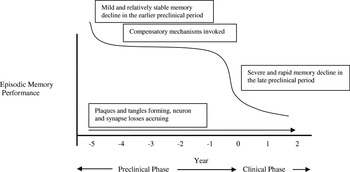
Although few studies have systematically examined the course of episodic memory changes during the preclinical phase (Bäckman et al., 2001; Chen et al., 2001; Lange et al., 2002; Rubin et al., 1998), summarizing and combining their findings may have important implications for detecting AD preclinically and projecting the course of decline. In two studies that have examined memory changes over time, Small et al. (2000a) and Bäckman et al. (2001) measured changes in episodic memory in individuals who eventually developed probable AD. Both studies found that the subjects who had mild episodic memory declines six years prior to diagnosis showed little memory change in the following three years, but exhibited precipitous declines just prior to the development of AD. Similarly, Chen et al. (2001) found a significant decline in episodic memory and executive functioning in individuals with preclinical AD during the 3.5 to 1.5 years before diagnosis, and Lange et al. (2002) found abrupt declines in episodic memory one to two years before AD onset.
The APOE ε4 genotype may hasten the decline in episodic memory that occurs prior to the emergence of diagnosable AD (Bondi et al., 1995, 1999; Reed et al., 1994). In the studies we reviewed, those comparing APOE genotype groups found that the ε4 allele is associated with both verbal and visual learning and memory. Caselli and colleagues (1999) compared performances of ε4 homozygotes, ε4 heterozygotes (all ε3/ε4), and non-ε4 carriers on various neuropsychological measures and found that older subjects in the ε4 homozygote group performed worse on immediate and delayed recall tasks. Baxter et al. (2003) also found that verbal learning ability declined over two years in a group of cognitively normal individuals who had the ε4 allele, but only in those who were 60 years of age or older. Thus, age-related memory decline seems to occur earlier in cognitively normal ε4 homozygotes than in ε4 heterozygotes and noncarriers, and precedes clinically detectable AD.
Neuroimaging Changes in Preclinical AD
Although no routine diagnostic test confirms the presence of AD, imaging techniques are an adjunctive screening measure for undetected pathology (Knopman et al., 2001) and represent an important expanding field in biological neuropsychiatry. Structural imaging techniques can detect early volumetric changes predictive of dementia, and functional imaging can detect preclinical changes in cerebral blood flow, metabolic activity, and neurotransmitter and receptor function. Appendix 2 presents summaries of 18 studies of neuroimaging changes in the preclinical period. There were three longitudinal case-control studies (Appendix 2, part A); one longitudinal magnetic resonance imaging (MRI) study that examined decline in APOE ε4+ and ε4− subjects (Appendix 2, part B); one longitudinal PET study that examined decline in APOE ε4+ and ε4− subjects (Appendix 2, part C); seven cross-sectional studies comparing structural MRI data in subjects with and without the APOE ε4 allele (Appendix 2, part D); and six studies comparing functional imaging data in at-risk versus not-at-risk subjects (Appendix 2, part E).
Of the eleven structural imaging studies and seven functional imaging studies we reviewed (see Appendix 2), most hypothesized that, given the histopathology of AD and the cognitive hallmark of AD (rapid forgetting), changes in temporal and hippocampal functioning would be among the earliest indicators of AD. Indeed, temporal lobe changes were the most common finding in preclinical AD, with 64% of studies measuring temporal lobe changes finding significant differences; changes in the parietal lobe (45% of studies), frontal lobe (40% of studies), hippocampus (39% of studies), and posterior cingulate (36% of studies) were also identified (see Table 1). Global brain changes were not as consistently associated with preclinical AD (27% of studies). We review these studies further in the two following sections on structural and functional brain imaging.
Structural Brain Imaging
Autopsy studies reveal that neurofibrillary changes in incident AD cases occur initially in the transentorhinal and entorhinal cortex, then in the hippocampal formation, and later in the neocortical structures (Braak & Braak, 1995). Amyloid plaque deposition may occur early in other cortical structures (e.g., anterior cortical regions; Morris et al., 1996). MRI can measure volumes of specific brain structures and can thereby distinguish normally aging subjects from potential AD patients even in the earliest stages of the disease. MRI studies reveal that portions of the medial temporal lobe (MTL), particularly the entorhinal cortex and hippocampus, are initially affected in AD.
Studies of the relationship between morphological and cognitive measures of AD have demonstrated that atrophy of the MTL region, especially the hippocampus, correlates with episodic memory impairment in AD (de Leon et al., 1997). Other cognitive abilities are affected as the neuropathologic changes of AD spread from limbic structures to neocortical association areas (Braak et al., 1998). The longitudinal MRI studies reviewed in Appendix 2, part A, uniformly found that MTL volume loss was detectable in preclinical AD cases and that the rate of volume loss also predicted future AD. A similar pattern implicating hippocampal volume loss emerged when APOE status was investigated longitudinally (Cohen et al., 2001).
Controversy exists as to whether greater MTL volume reduction among APOE ε4 carriers reflects preclinical AD or a structural phenotype. Some studies have shown an ε4 effect on MTL volumes (den Heijer et al., 2002; Plassman et al., 1997; Tohgi et al., 1997), but others have not (Jernigan et al., 2001; Schmidt et al., 1996). Cohen et al. (2001), however, showed that ε4 carriers demonstrated greater hippocampal volume loss over time than did noncarriers, suggesting that the cross-sectional differences between groups may reflect a preclinical AD state.
Functional Brain Imaging
Positron emission tomography
Positron emission tomography (PET) studies of AD patients reveal hypometabolism in the neocortical structures, mainly the parietal, frontal, and posterior temporal association cortices, the same areas where neuronal and synaptic degeneration appear most severe in post-mortem AD brains. Later, more advanced stages of AD are denoted by functional brain changes across the neocortex, with relative preservation of the sensorimotor and visual cortices.
Many of the PET studies in this area have compared APOE ε4 carriers with noncarriers. In the first PET study of this kind, Kennedy and colleagues (1995) found that ε4 carriers had lower global and temporoparietal glucose metabolism than did noncarriers. Reiman and colleagues (1996), who compared cognitively normal, middle-aged ε4 homozygotes and matched non-ε4 control participants, found that the ε4 homozygotes had reduced glucose metabolism in the posterior cingulate, parietal, temporal, and prefrontal regions, all of which were regions demonstrating specific metabolic reductions in mild AD. In a later study, Reiman et al. (2004) found that these same abnormalities existed in even younger (20–39 years old) ε4 carriers.
Functional magnetic resonance imaging
Functional MRI (fMRI) studies have generally shown decreased hippocampal activation in elderly subjects with memory decline relative to normal control groups. In one of the first studies to use fMRI to explore preclinical brain changes, Smith and colleagues (1999) examined cortical activation in two groups of cognitively normal middle-aged women who differed only in terms of their AD risk (i.e., family history of AD and APOE status). The groups performed equally well on visual naming and letter fluency tasks during scanning, but their activation patterns during both tasks differed, with the high-risk group demonstrating lower activations in the bilateral mid- and posterior inferotemporal regions.
Other researchers, however, have found increased activation associated with incipient AD. Bookheimer and colleagues (2000) found that during a word recall task, nondemented ε4 carriers had greater activation than did noncarriers in the left prefrontal region and bilateral orbitofrontal, superior temporal, and inferior and superior parietal regions. These abnormal patterns of activation may represent a compensatory functional response, that is, the use of additional brain resources to perform the task. The increased activations in the ε4 carriers were specific to episodic encoding, and were not seen in attentional tasks studied by the same group (Burggren et al., 2002).
Such studies suggest that compensatory mechanisms in brain activity exist in preclinical AD, before the manifestation of frank cognitive and functional impairments (Becker et al., 1996). Several functional neuroimaging studies have shown that the brain activity associated with performance on memory tasks is more diffuse in patients with early AD than in normal older individuals, probably because of the need to recruit additional brain resources to maintain performance. It may be that after an initial decline in memory following damage to MTL structures, patients in the preclinical stage of AD are able to recruit enough compensatory brain resources to slow further memory decline for a period of time. As the disease progresses, however, these additional resources become compromised and rapid episodic memory decline ensues (Lange et al., 2002).
It could be argued that functional neuroimaging methods will be more sensitive to early MTL dysfunction than will structural MRI (Haxby et al., 1986). However, PET studies of at-risk older adults or patients with early AD have not typically demonstrated MTL metabolic changes (Reiman et al., 1996; Small et al., 1995), findings that differ from those derived from structural neuroimaging and neuropathologic studies that demonstrate that the earliest changes in AD occur in MTL regions (Braak & Braak, 1991). Furthermore, studies of brain changes using PET have not unequivocally demonstrated the characteristic temporal-parietal hypoperfusion or hypometabolism in all cases of early AD (Azari et al., 1993).
DISCUSSION
This literature review reveals that a preclinical phase of detectable cognitive decline and structural and functional brain changes precedes the clinical diagnosis of AD by several years or more. Declines in attention, episodic memory, atrophy in medial temporal lobe structures, and/or hypoperfusion in temporoparietal areas appear to be the most common markers of preclinical AD. In contrast to other reviews focusing solely or partially on MCI subjects (Bäckman et al., 2005; Wolf et al., 2003), we found relatively greater evidence for deficits in attention and more evidence for early differences in parietal and posterior cingulate volumes. Bäckman and colleagues' (2005) review found the largest effect for global cognitive measures [e.g., the Mini-Mental State Examination (MMSE) or the Dementia Rating Scale (DRS)], also reported that the effect size confidence intervals overlapped for the domains of episodic memory, executive functioning, and perceptual speed, and found moderate effect sizes for attention tests. Also consistent with our review, Greenwood et al. (2005a, 2005b) demonstrated deleterious effects of the APOE ε4 allele on experimental tests of visuospatial attention, and Jacobson and colleagues (2005a) have shown that performance discrepancies between auditory and spatial attention are associated with presence of the APOE ε4 allele in older adults. Together with this emerging literature, our review suggests that episodic memory is certainly not the only marker of preclinical AD. Using novel measures from cognitive neuroscience or comparing standardized neuropsychological measures in novel ways (e.g., cognitive asymmetry calculations) will be important new directions (Houston et al., 2005; Jacobson et al., 2005b).
Neuroimaging studies have predominantly focused on the temporal lobe, but newer methods examining, for example, the whole brain (e.g., voxel-based morphometry), amyloid imaging (Wu et al., 2005), or diffusion imaging (Medina et al., 2005), are suggesting other areas of interest in preclinical AD. Although neurofibrillary tangle pathology spreads from medial temporal to association cortices (Braak & Braak, 1991), the amyloid plaque burden is more widely dispersed (Arnold et al., 1991), variable in progression, and may also mediate the association of genetic risk to cognition (Bennett et al., 2005). Consistent with this early heterogeneity, AD may initially present with cognitive (Jacobson et al., 2002) or metabolic (Haxby et al., 1985) asymmetries. Recent MR morphometric studies also show that changes sensitive to progression to AD appear asynchronous across brain regions and are more pronounced with global indices, such as whole brain atrophy and ventricular enlargement rates, than with MTL structures (Gunter et al., 2003; Jack et al., 2005; Kaye et al., 2005). Thus, it may be that many possible brain regions are susceptible, and earlier than previously thought, in preclinical AD. The neuropsychological and neuroimaging studies to date argue for comprehensive measurement of cognitive domains and brain regions in future studies.
The cognitive and neuroimaging changes of incipient AD appear to remain relatively stable until a few years before clinical diagnosis, when there is a more notable decline. The mild course of decline in the early preclinical period may reflect the initial invocation of compensatory brain mechanisms, whereas the more rapid decline of the clinical period may reflect the inability of these brain resources to overcome the accrual of plaques, tangles, and neuron and synapse losses. A growing body of fMRI evidence among at-risk persons supports this notion (Bookheimer et al., 2000; Bondi et al., 2005; Dickerson et al., 2005; Han et al., 2006; Johnson et al., 2004), and a similar compensatory response in brain-derived neurotrophic factors (Durany et al., 2000; Egan et al., 2003) or cholinergic activity (DeKosky et al., 2002) may also occur. Given these converging lines of evidence for brain compensation, we propose a nonlinear model of episodic memory decline and neuroimaging changes to characterize this preclinical period of accruing AD pathology (see Figure 1). Consistent with this model, Martins et al. (2005) have demonstrated that APOE ε4 possession is associated with earlier and faster cognitive decline in patients with AD, whereas the ε2 allele is related to slower decline, and that a nonlinear model best predicts these differential rates of decline.

Proposed model of nonlinear pattern of episodic memory decline during the preclinical period of Alzheimer's disease (based on data of Bäckman et al., 2001; Bunce et al., 2004; Chen et al., 2001; Lange et al., 2002).
We believe this review contributes to the field in four major ways. First, it provides the only comprehensive review of both neuropsychological and neuroimaging indicators of preclinical AD. Second, it addresses a significant flaw of previous studies or review articles by excluding studies of subjects with MCI, AAMI, or memory complaints. In doing so, it concludes that if one is looking for preclinical AD, one needs to look beyond memory and the temporal lobe. Third, from the extant literature we present a model of cognitive decline showing that there appears to be an accelerated and nonlinear decline in the period immediately preceding AD diagnosis. Fourth, we provide both evidence for the often conflicting presentation of AD changes in brain and cognition during the preclinical period, as well as possible explanations for these wide-ranging findings across the literature.
Our methodology for the present review has limitations. Although memory deficits are the hallmark of AD, we did not assume that memory declines would be the foremost marker of preclinical AD, and wanted to avoid “stacking the deck” in favor of memory. Thus, we excluded articles on MCI, AAMI, and memory clinic populations to focus specifically on normal older adults or younger people at risk for AD. However, some studies recruited participants via advertisements rather than population sampling, and some of the participants in the studies we reviewed may have met criteria for MCI or AAMI or may have had memory complaints. A second and related limitation is that by excluding research on memory-impaired populations, the present review may over-represent certain groups (e.g., APOE ε4 carriers) whose cognitive profiles may not characterize those of the general population. For this reason, we separated the APOE studies from the others in our review. We focused on neuropsychological and neuroimaging tests, excluding other potentially promising methodologies without substantial published literature (e.g., olfactory testing, Murphy et al., 1998). Finally, although a formal meta-analysis that would have weighted each study based on the number of participants, we chose to use a “box score” approach to examining the findings of the included studies, due to considerable heterogeneity in study methodologies and measures.
Although there have been many exciting developments in this growing area of research, conclusions about the nature and course of preclinical AD remain limited by contradictory findings in at-risk groups and/or studies that rely on retrospective or cross-sectional designs or small datasets. To improve detection of preclinical markers, the neuropsychological functioning, brain structure, and brain functioning of at-risk individuals who develop AD should ultimately be tested against that of persons who remain dementia-free over the same follow-up period. Furthermore, they might be compared to individuals with other conditions (e.g., depression, other dementias) and validated by autopsy-confirmed diagnosis.
In addition to documenting the cognitive deficits in preclinical AD, the longitudinal course of these deficits is also important. There has been a lack of consensus regarding when the preclinical period begins and how early preclinical changes may be detected. Most investigations have used relatively short test-retest intervals (e.g., two to three years after initial assessment), but other studies have used longer intervals (decades or more). With longer test-retest intervals, cognitive changes are more likely to be detected, but it is more difficult to determine when decline began. With some groups finding differences between AD cases and controls five to six decades before the onset of AD (see Snowdon et al., 1996 and Whalley et al., 2000), future research should address the question of the age range in which it is possible to detect a preclinical AD state and whether such states can be distinguished from lower levels of cognitive reserve.
With respect to fMRI studies of at-risk groups, contradictory findings across studies [e.g., decreased vs. increased blood oxygen level dependent (BOLD) responses] may reflect different mechanisms linking the hemodynamic response to its underlying neuroanatomy and neurophysiology. One concern is that differences in the “resting state” will influence the amplitude of the BOLD response (Cohen et al., 2002). If the AD brain is in a lower resting state, as suggested by Reiman et al. (1996), it should show an increased hemodynamic response compared with a non-AD brain in the context of equal stimulation. The BOLD signal must be calibrated to the resting state to prevent over-interpretation of greater BOLD responses as signifying heightened compensatory responses. Recent research using APP23 transgenic mice has demonstrated that amyloid plaques have a direct effect on the hemodynamic response, due partly to compromised cerebrovascular reactivity (Mueggler et al., 2002). Human studies also demonstrate that the hemodynamic response itself changes with age (D'Esposito et al., 1999). Thus, future efforts should incorporate other MR-based techniques such as perfusion imaging and structural morphometry to help delineate the contributions of the neuroanatomic and neurophysiologic underpinnings of the BOLD signal.
It remains that there is still no single marker of AD. Combined cognitive, imaging, and genetic assessments may ultimately be needed to achieve accurate and reliable identification of preclinical AD (Albert, 1996; Small et al., 1996). Detecting preclinical AD will probably be best accomplished by examining decline longitudinally with sensitive cognitive tests and structural or functional markers of brain integrity. Early detection may be enhanced if risk factors such as advancing age or the presence of the APOE ε4 allele (Mayeux et al., 1998) are also considered.
The ability to detect AD in its earliest, preclinical phase will continue to be an important topic of neuropsychological and neuroimaging research. The rapid development of neuroprotective agents designed to impede the progression of the disease is a testament to the recognized importance of early identification and treatment of AD (DeLaGarza, 2003). Moreover, preserving cognitive status and functional independence with more effective interventions will have far-reaching implications for maintaining patients' quality of life and decreasing caregivers' financial and emotional burden (Brookmeyer et al., 1998).
ACKNOWLEDGMENTS
This work was supported by NIMH grants K23 MH066011, T32 MH019934, and NIA grants R01 AG012674 and P50 AG005131.
APPENDIX 1: Neuropsychological Studies


APPENDIX 2: Neuroimaging Studies of Preclinical Alzheimer's Disease